Without a Map

Our ignorance of the route was complete. We knew that California lay west, and that was the extent of our knowledge. Some of the maps consulted, supposed of course to be correct, showed a lake in the vicinity of where Salt Lake now is; it was represented as a long lake, three or four hundred miles in extent, narrow and with two outlets, both running into the Pacific Ocean, either apparently larger than the Mississippi River.

Here is a map from 1826 that is the kind Bidwell would have seen. It shows two large rivers flowing from Lake Timpanogos unimpeded to the Pacific Ocean. One river is labeled R. Timpanogos and the other Los Mongos River. The R. S. Buenaventura flows from the smaller Salt Lake. Note the total absence of the Sierra Nevada mountains. Keep in mind that there was next to nothing known about this region up until the 1840s.

Tanner 1826 map section

1826 Map by Henry Schenck Tanner of North America (detail) Library of Congress https://www.loc.gov/resource/g4410.ct003214/

Another version:

An intelligent man with whom I boarded — Elam Brown — possessed a map that showed these rivers to be large, and he advised me to take tools along to make canoes, so that if we found the country so rough that we could not get along with our wagons we could descend one of those rivers to the Pacific. (John Bidwell, Echoes of the Past, p. 111)

Shooting_the_Rapids_1879

Nope. (Shooting the Rapids, 1871 by Frances Anne Hopkins)

Bidwell doesn’t say whether they took along any boat-building tools. They would have had basic tools along with them anyway, but they weren’t going to be building any boats or floating down to the Pacific Ocean.



Posted in Bidwell-Bartleson Party, Uncategorized | Leave a comment

This Day in History, May 12

The Oregon-California Trails Association has just put out a new “This Day in History” video honoring “John Bidwell, Sapling Grove, and the Bidwell-Bartleson Party.”

It’s a nice little video, about 5 minutes long. Worth your time.

One note on the date: May 12 is about the date Bidwell and a few others arrived at Sapling Grove, which was supposed to be the rendezvous point. They moved on to the Kansas River and did not officially organize themselves, partner with the missionaries, and hit the trail until May 19th. That is the date when Bidwell’s journal begins.

Posted in Bidwell-Bartleson Party, Uncategorized | 1 Comment

The Bidwell-Bartleson Party Gathers

Every day for a week or more, wagons arrived with the same object in view. At last we took steps to see how many had arrived and found our numbers to be sixty-nine. Among those were about fifteen women and children. All were anxious for a start. (1877 Bidwell Dictation)

For the next few days, one or two wagons would come each day, and among the recruits were three families from Arkansas. Every one furnished his own supplies. The party consisted of sixty-nine, including men, women, and children. (The First Emigrant Train (Echoes of the Past))

They were mostly young single men, like John Bidwell and Michael Nye. A few older men, like George Henshaw, and middle-aged John Bartleson, who became captain of the wagon train.

BenjaminKelsey

Ben Kelsey in later years

The families were Samuel and Lucy Kelsey and their five children, Benjamin and Nancy Kelsey and their little girl Martha Ann, and Richard Williams and wife and their teenage daughter, who married Zed Kelsey on the trail.

There were actually four Kelsey brothers on the journey — the other one was Andrew.

Lucy Kelsey’s sister, a widow named Mrs. Gray and her child were also part of the group. Mrs. Gray would find a husband along the way as well.

Nancy-Kelsey

Nancy Kelsey in later years

That doesn’t add up to fifteen women and children, but I don’t think Bidwell was paying close attention to how many children there were. He just remembered a passel of little kids.


Posted in Bidwell-Bartleson Party, Uncategorized | 1 Comment

Rendezvous at Sapling Grove

To reach Sapling Grove in Kansas Territory we had to travel down the Missouri River some fifty miles [from Weston in Platte County] and then cross at the place known as Independence Landing. Then to go west about ten miles to the Missouri line and across into Indian Territory. On reaching Sapling Grove no one was there but we saw fresh wagon tracks and followed them to the Kansas River. They belonged to parties who had come, some from Arkansas, and some from different parts of Missouri to cross the plains.

sign3-1920w

Lots of signs like this in historic Kansas

The plan was to meet at Sapling Grove on May 9th. Sapling Grove was a popular camp site on the the Santa Fe and Oregon Trails, just west of the Missouri border. It had an excellent spring and plenty of wood, grass, and water, all necessities for travelers. It was only three miles or so from the Kansas River.

Back in the winter, John Bidwell had journeyed around Missouri drumming up interest in the venture to California. He had even corresponded with interested parties in other states. But when it came time to leave, he was discouraged to see that most people where he lived were dropping out. Still, he stuck to his plans and found when he got to the rendezvous that there were other pioneers ready to go after all.

Posted in Uncategorized | Leave a comment

Packing a Wagon

What kind of provisions did Bidwell pack for his expedition?

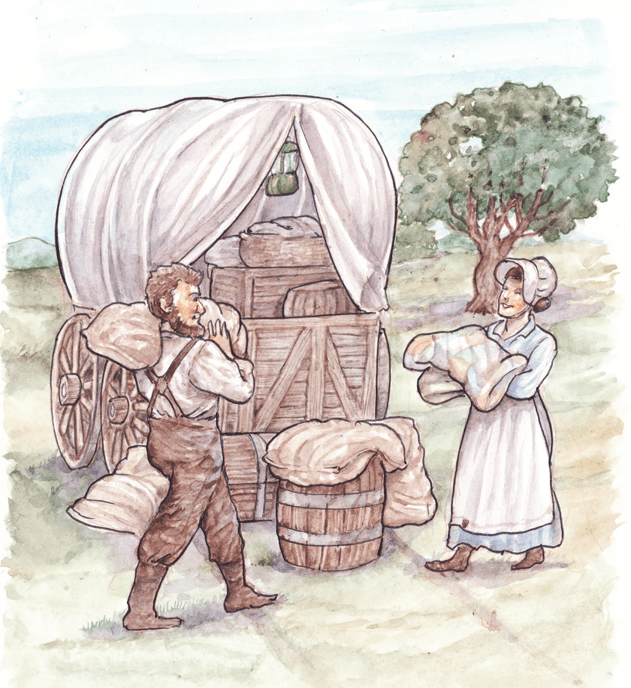
It was understood that every one should have not less than a barrel of flour with sugar and so forth to suit. I laid in one hundred pounds of flour more than the usual quantity, besides other things.

An extra barrel of flour. That’s the kind of practical, foresightful man Bidwell was.

“Other things” would be foodstuffs like cornmeal, salt, coffee, a slab of bacon, and dry beans. Maybe, if he could afford them, a few specialty items like cider vinegar, dried apples, dried ginger, cinnamon, or cayenne pepper. As for the extra flour:

This I did because we were told that when we got into the mountains we probably would get out of bread and have to live on meat alone, which I thought would kill me even if it did not others.

Picture1

Ben and Nancy Kelsey load their wagon

Posted in Uncategorized | Leave a comment

George and Mike

At almost the last moment, everyone abandoned the idea of crossing the plains. I cast about, however, and found in Platte County a man by the name of [George] Henshaw who was willing to go. He was old, quite an invalid, and nearly helpless.  He had a fine black horse that he allowed me to dispose of. I sold him for a yoke of young cattle and a one-eyed mule for Henshaw to ride.

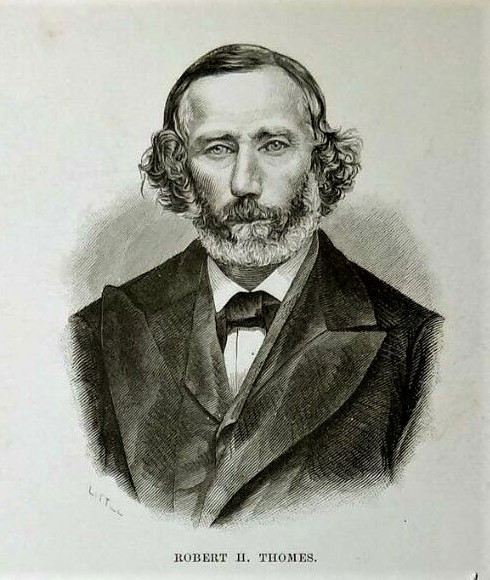
With that much of an outfit we drove into Weston. To complete the outfit, we here purchased what we could and then joined R. H. Thomes, who was about ready to start. A merchant by the name of Nye, seeing our determination to go to California, said if we would wait a week he would let his son Mike go with us.

wagon-oxIt’s hard to know what would induce George Henshaw to undertake such a journey. He probably hoped to improve his health, and had no idea of the dangers and difficulties he would endure. Searching records, I have found a George Henshaw born in 1790 — a man 51 years old would have seemed quite old to young John Bidwell.
I wonder, as he rode his sorry one-eyed mule, if he ever regretted giving up that fine black horse.

Michael Nye was probably 20 years of age at the time. In California he lived for many years in Marysville, and later moved to Crook County, Oregon, where he died in 1906. He was the last surviving member of the Bidwell-Bartleson Party.

Posted in Uncategorized | 2 Comments

Choosing a Rifle

As the time approached, I became very anxious about the expedition but supposed a few would go with me. Finally I could not find a single member of the company who were sure to go. I went forward with my preparations, however, and to the extent I could, I purchased an outfit which consisted of a wagon and some provisions, a rifle, and ammunition.

Attaboy, John!

The rifle was “an old flint-lock rifle, but a good one.” He had been told by experienced hunters that cap or percussion locks were unreliable if they got wet, but if he lost his flint he could always pick up another on the plains.

How Stuff Works has a good description of how a flintlock fires, with this diagram.

It is interesting that presumably, until this time, John Bidwell did not have a gun. Or if he did, he traded it for this old but reliable flint-lock.

Posted in Uncategorized | Leave a comment

Finding a Friend

When May came, I was the only man that was ready to go of all who signed the pledge. In Weston, however, there was a man who had never signed the pledge but who had said from the beginning that he would go to California when May came. This was Robert H. Thomes, a wagon maker at that time.

thomes2Robert Thomes settled in Tehama County. He was a life-long partner with Albert Toomes, who came to California by the southern route, arriving only a short time after the Bidwell-Bartleson Party arrived. They met and worked together as house builders in Monterey, before getting their land grants at Tehama.

Of his overland journey, Robert Thomes said:

We suffered great hardships, and got into very tight pinches for food and water,but we made up for it when we got among the fat beef and venison of California.

Thomes and Bidwell would remain friends the rest of their lives. When Robert Thomes died in 1878, Bidwell was the executor of his estate.

Posted in Uncategorized | Leave a comment

The Western Emigration Society

John Bidwell promoted the California plan throughout the winter of 1840-41covered-wagons-1. Missouri folks interested in going to California formed the Western Emigration Society and signed a pledge “binding each one to dispose of his property, purchase a suitable outfit, and rendezvous at Sapling Grove in Kansas Territory on the ninth day of the following May, ready for crossing the plains.”
Five hundred names were subscribed, five hundred men and women eager to pack their wagons and go. It seemed as if the entire population couldn’t wait to hit the trail. But then . . .

The merchants of Weston, (the principal town in Platte County), fearing a loss of business, united to quash the enthusiasm for migrating. Any news unfavorable to California was published in the newspapers.

Just at this time, and it overthrew our project completely, was published the letters of Farnham in the New York papers and republished in all the papers of the frontier, at the instigation of the Weston merchants and others. Our company soon fell to pieces notwithstanding our pledge was as binding as language could make it.

Thomas J. Farnham, a pioneer on the Oregon Trail in 1839, had been in California in 1840 and had been instrumental in the release from Mexican custody of a number of Americans involved in the Graham Affair. His discouraging account had a disillusioning effect on the members of the Western Emigration Society. Nearly all of them gave up and dropped out.

sc 17336
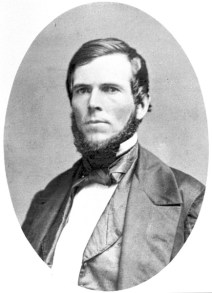
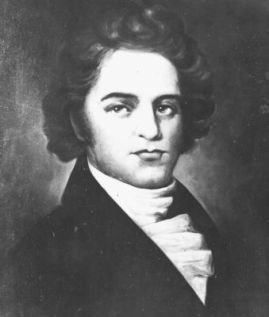
John Bidwell
photograph
ca 1840But not John Bidwell. With his first farm gone, he was determined to go to California and try again. He was twenty-one years old.
Posted in Bidwell-Bartleson Party, Uncategorized | Leave a comment

Going West

Join the Party!

60023246_10158632701167588_7819501601801895936_n

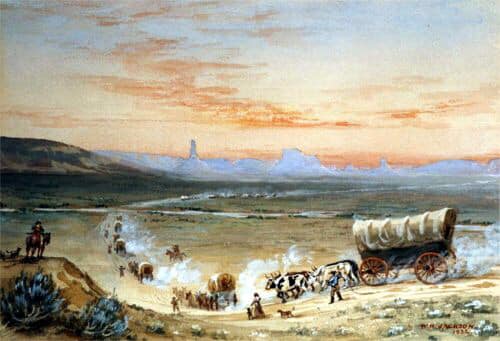
Painting by William Henry Jackson

The Bidwell-Bartleson Party, that is. It is May 1841 and John Bidwell is getting ready to set out for California.

The Party organized on May 18th and set out on the trail on May 19th. But before that there was much to prepare. John Bidwell had been planning this trip for nearly a year, ever since he lost his land claim in the Platte Purchase section of Missouri. But let’s let him tell the tale:

In the summer of 1840, the weather being excessively hot, and needing some books and other things that could only be obtained in St. Louis, I set out for the latter place expecting to be gone a week. I went on the steamer Shawnee down to St. Louis, but as the navigation was bad owing to low water and snags, I was gone four weeks instead of one. On my return I found a man had jumped my ranch.

The law at that time was such that I had to be twenty-one years of age or a man of family in order to hold the land. I was neither. The man who had my ranch was a sort of desperado, having killed at least one man, and I had no means of making him give up the land.

Robidoux-208

Antoine Robidoux, dressed up for his portrait

About his same time a fur trapper and Indian trader named Antoine Robidoux came along, telling stories of California. Robidoux had traveled to California on the Santa Fe Trail.

He said it was a perfect paradise, a perpetual spring. He was a calm, considerate man and his stories had all the appearance of truth. He said the hospitality of the people was unbounded. Cattle and horses ranged there in the greatest abundance.

Not only all that, but he said California had none of the chills and fever of Missouri. A paradise, indeed! A public meeting was held, committees were organized, a pledge was signed. The Platte Purchase residents were eager to head out for California.

il_794xN.864819755_nebz

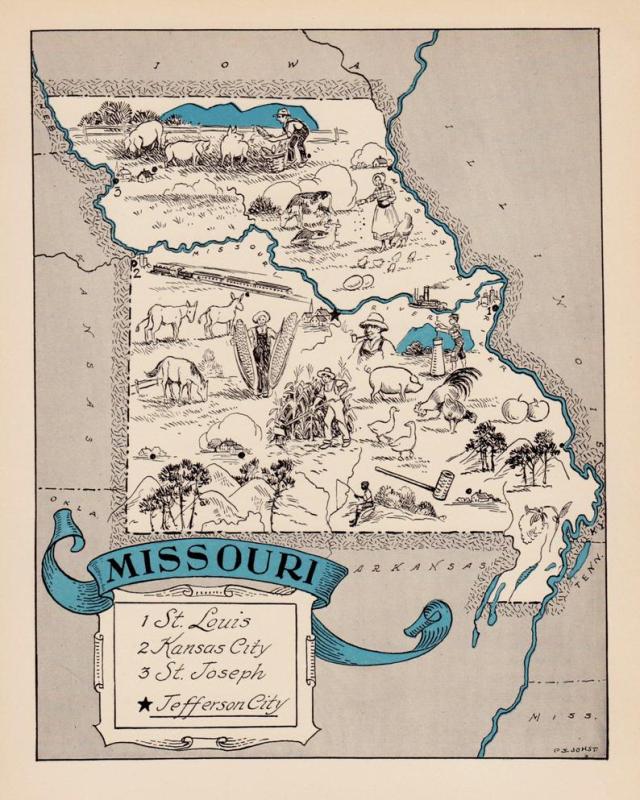
The Platte Purchase is the northwest corner that sticks out from the straight north-south state line. #3 marks St. Joseph, where John Bidwell would have boarded the steamer for St. Louis, which is on the eastern edge of the state at #1. The Bidwell-Bartleson Party set out from Sapling Grove, just west of #2 Kansas City.

(Quotations are from Bancroft’s 1877 Bidwell Dictation, as published in The Bidwell-Bartleson Party, by Doyce B. Nunis.)

Posted in Bidwell-Bartleson Party, Uncategorized | Leave a comment