California Admission Day

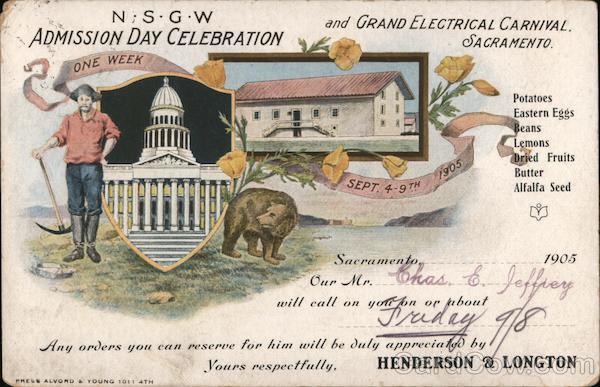
Happy California Admission Day! Not much celebrated anymore, but an important date in California history. It’s strange to think that on September 9, 1850, as President Fillmore put his signature on the document that admitted California to the Union, the people of California had no way of knowing that they had just become a state. No telephone, no telegraph, not even the Pony Express to spread the news. It would take five weeks for the news to reach San Francisco.

In September 1889 — 39 years after the event — John Bidwell wrote to his friend E. Nelson Blake:

Your memory is good — true, 39 years ago we brought the news of California’s admission into the Union. Where are those who were our fellow passengers? Except for yourself, I cannot recall the name of one living! We ought to be thankful that our lives have been spared to behold the wonderful march of events of this prolific age!

Bidwell and Blake were both passengers on the steamship Oregon, arriving on October 18, 1850 with the news that California had become the 31st state. Bidwell was traveling in a first class cabin, while Blake, a farm boy on his way to the goldfields, was in steerage.

Bidwell carried with him the statehood documents, but fearing their loss to unknown men who opposed the admission of California as a free state, he gave the document into the keeping of Mrs. Elisha Crosby and her daughter Helen. Miss Helen slept with the packet of papers under her pillow and hid them in her blue silk umbrella as the crossed the Isthmus of Panama. For more on this story, see “Miss Crosby’s Blue Umbrella.”

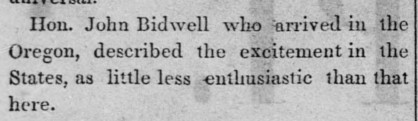
Bidwell himself never said much about his role in bringing California into the Union. But he reported that the other states (at least the Northern ones) celebrated the event almost as much as Californians themselves.

Sacramento Transcript 21 October 1850

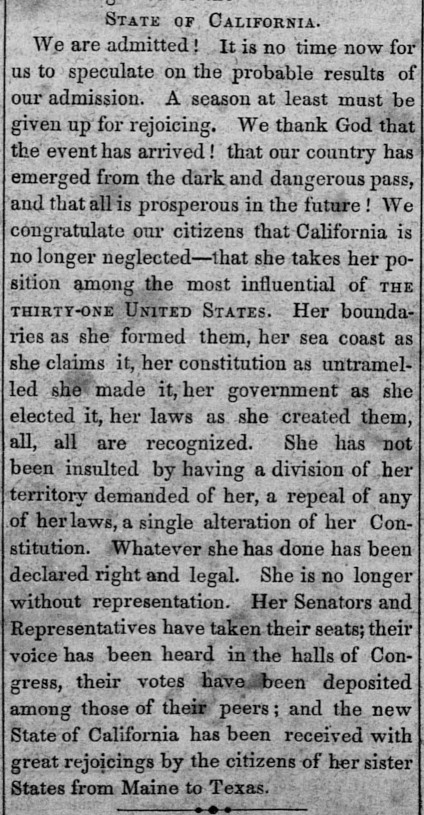
The citizens of California were well prepared to become a state. Never a territory, they had organized themselves in 1849 with a Constitutional Convention. They had passed a code of laws and elected two U.S. senators (William Gwin and John C. Fremont) who were ready to take their seats as soon as statehood became official. The newspapers trumpeted the glad tidings.

Sacramento Transcript 21 October 1850

So get out your bear flag and celebrate California statehood.

Posted in Admission Day | Leave a comment

Upcoming Talks

I have a couple of talks scheduled for September, so if you are in the neighborhood, I hope you will come and say, “Hi!”

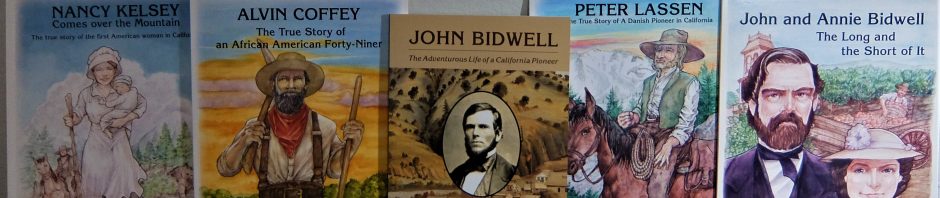
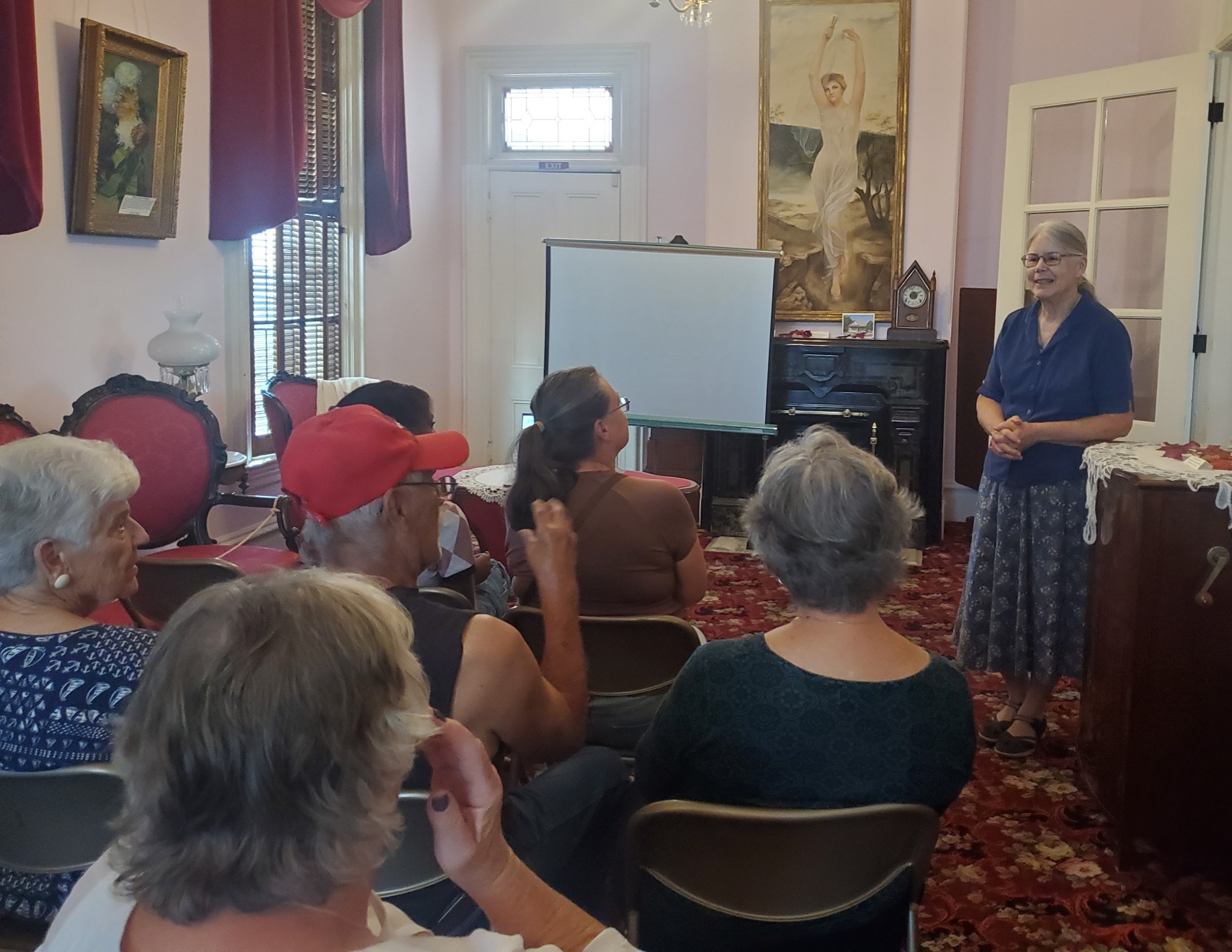
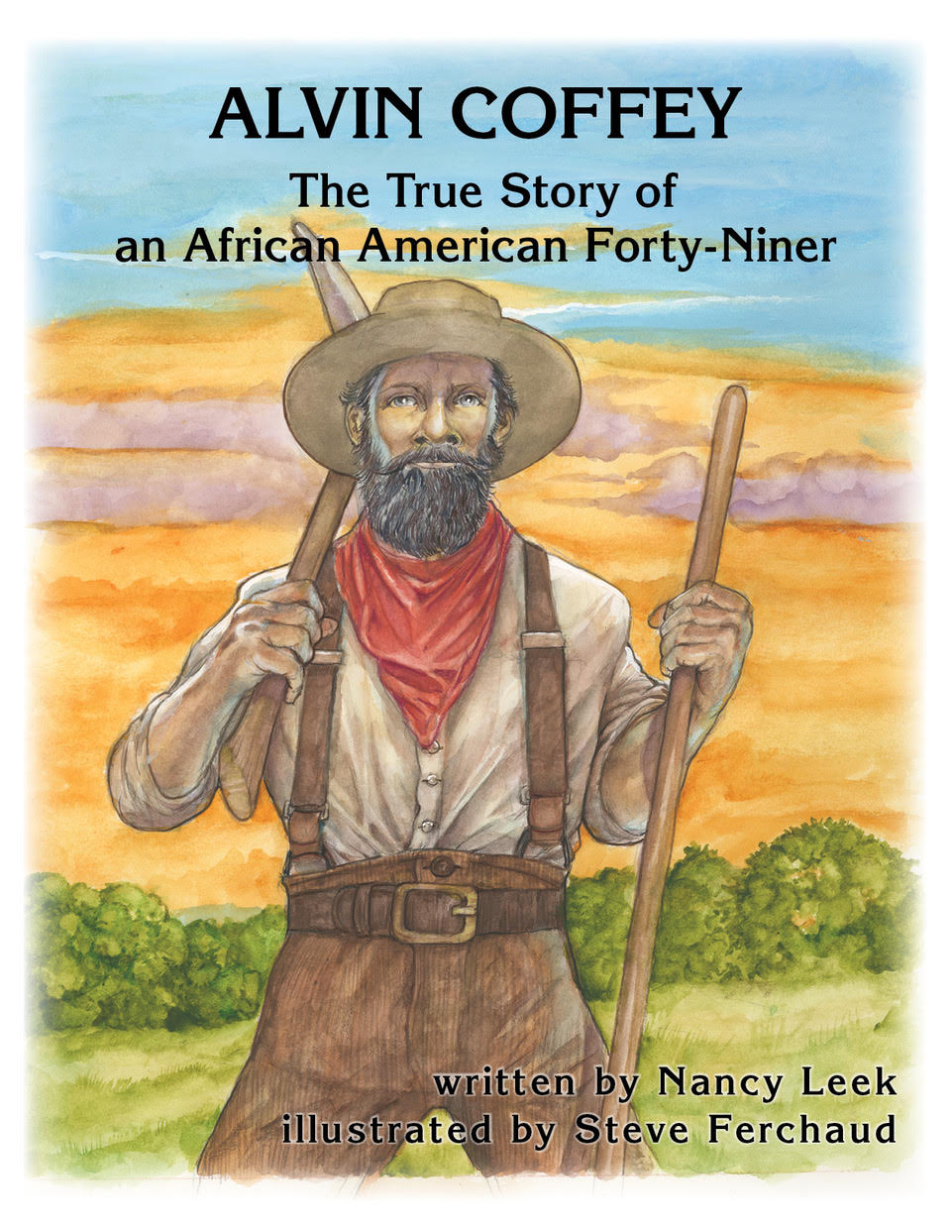
On Saturday, September 21st I will be speaking at the Butte County Historical Society about my latest book, Alvin Coffey: The True Story of an African-American Forty-Niner. The talk is at 1:00 p.m. and refreshments will be served. The BCHS Museum is at the corner of Baldwin and Spencer Avenues in Oroville. Their phone number is 530-533-9418. Books will be available for purchase.

Then the next day, Sunday September 22nd, at 2:00 p.m., I will be at the lovely Kelly-Griggs House Museum in Red Bluff. Again the topic will be Alvin Coffey, who was a resident of Tehama County. I am looking forward to visiting the Kelly-Griggs House again — it’s been a few years. It is a beautiful classic Victorian-era home with a nice variety of displays.

In both cases, my talk will not be just about Alvin, but also the history of black slavery in California. Maybe you didn’t know that black slavery existed in California, but it did, and was the subject of great contention in California from the Gold Rush to the Civil War.

Alvin’s story is an inspiring one of determination and the love of freedom. When I first heard about it, I knew I had to tell his story. Steve Ferchaud did a great job with the illustrations.

I really enjoy talking to groups, whether it be adult history enthusiasts or school classes. It’s a chance to get away from the desk and out in the world of people of all ages who are curious about our local history. If you need a speaker, contact me at goldfieldsbooksca@gmail.com. I’d love to talk to you.

Posted in Uncategorized | Leave a comment

Summer Updates

What’s new?

I took a trip to England in June and did absolutely nothing related to California history. I hiked the ancient Ridgeway trail and spent a few days in London. Here is a picture of my crew in Avebury, before the weather turned warm and sunny.

Left to right: Jean (the organizer of the trip), Kim, Teresa, and me.

I came back from the UK and promptly came down with a mild case of COVID, my first. I got over that pretty quickly.

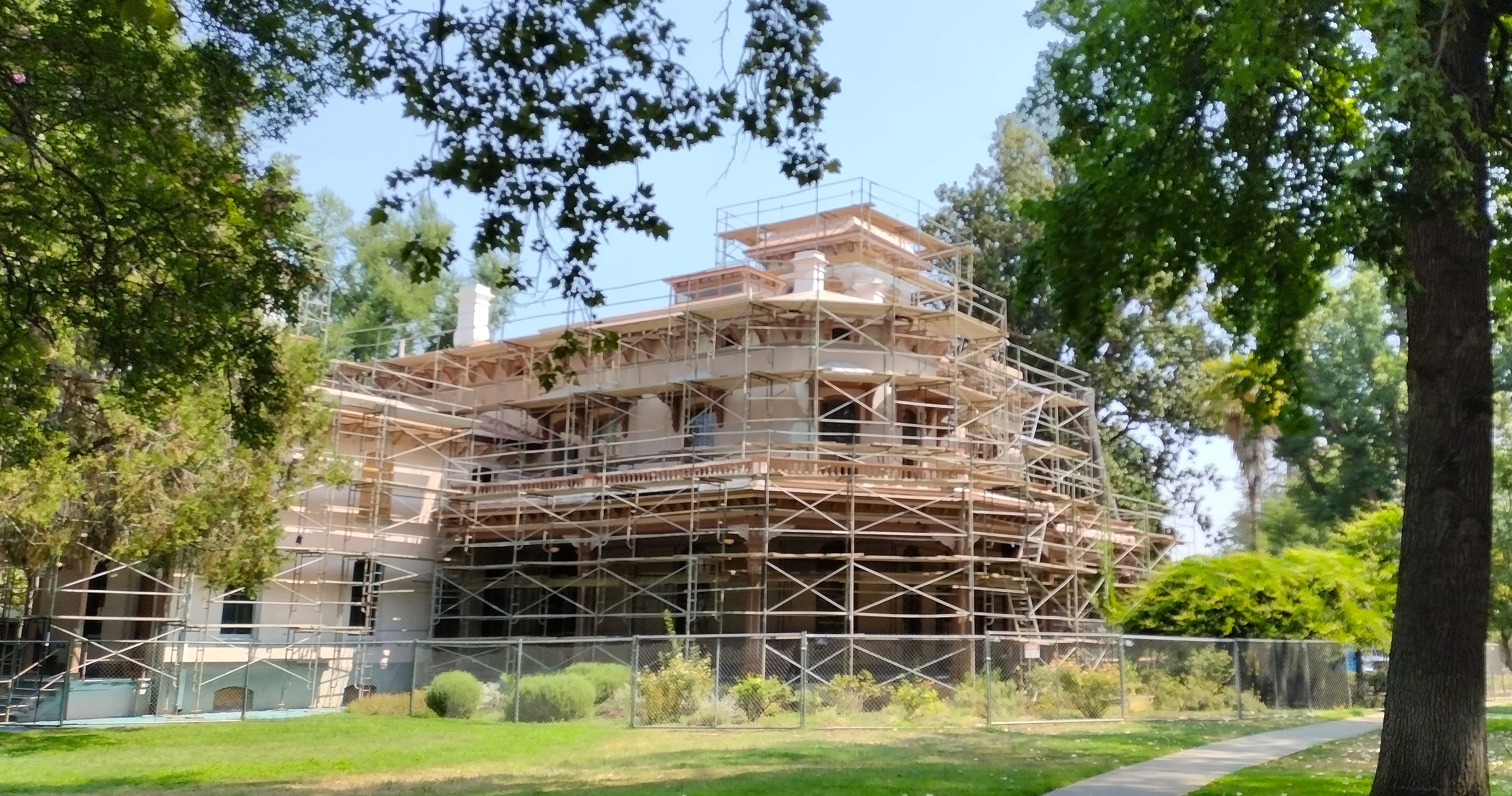
I walked by Bidwell Mansion today. As you can see from these photos, it is completely engulfed in scaffolding. For information about the renovation project, look at this State Parks page. The roof will be replaced, the balusters and urns and other woodwork will be evaluated and repaired if necessary, and the mansion will be repainted inside and out.

A year ago I published a post on this blog about a painting of Bidwell Mansion by John Frederick Holtzman. If you are interested to know more about the artist, there is an article about him (and also Augustus Koch), by John Rudderow and Deana Glatz, in the Summer 2024 issue of the Butte County Historical Society Diggin’s.

Holtzman lived in a number of northern California communities, from Mokelumne Hill to Grass Valley to Santa Cruz. He only spent a couple of years in Chico. It must not have been easy to make a living as an artist, even if he also painted houses and carriages.

I hope your summer is going well. Stay cool and read history!

Posted in Uncategorized | Leave a comment

Taking a Break

Dear Friends,

I have enjoyed writing this blog for the past 13 years, every since my first book came out. Four more books and 1231 blog posts later, it’s time for me to take a break. I have a big project that I am working on, and I want to devote my time and thinking to it. I also have some summer travel plans coming up.

I will have the occasional post here, when something strikes my fancy, so I won’t disappear entirely. For instance, I want to invite you all to the Paradise Chocolate Fest. I will be in the All About Books section, together with friends from ANCHR and all our many books. Admission to the entire fun (and chocolate) – filled festival is only $5. Music, games, artisans, food, and so much chocolate. I hope I’ll see you there. Stop by our table and say “Hi!”

When my project gets closer to finalization, I’ll let you in on it. But for now I am saying “Adios.”

Keep on riding down the History Trail!

Best regards and wishes — Nancy

Posted in Uncategorized | 2 Comments

More News about Johnson’s Ranch

For many pioneers coming to California, Johnson’s Ranch was the end of the trail. I have written about it here and here. It is on private land and threatened by development.

I am hopeful that Johnson’s Ranch will get the recognition and preservation that it deserves. You can read about it in this article from the San Francisco Chronicle.

https://www.sfgate.com/bayarea/article/johnsons-ranch-historic-stop-california-trail-19267765.php

The cemetery at Johnson’s Ranch
Posted in Uncategorized | Leave a comment

Wine Sauce for General Bidwell

I came across this story when looking through clippings of a column called “Off the Record” which appeared in the Chico Record during the 1940s. It was written by Mayor Paul Roberts, who was never an official mayor of anything, but was known as the “Mayor of Sandy Gulch,” for his prominence in the Sandy Gulch neighborhood, where he ran a grocery store. Sandy Gulch is the waterway now known in Chico as Lindo Channel.

Paul Roberts was a great collector of stories. He not only relayed old tales of Chico in his column “Off the Record,” but also collected the reminiscences of George Moses Gray, John Bidwell’s orchard foreman, and published them in his own weekly Sandy Gulch News.

This story appeared on June 6, 1947. Paul Roberts credits it to Joe Kennedy, Annie Bidwell’s nephew, who was well-acquainted with the Bidwells and their home. Joe Kennedy worked as a pharmacist at Lee’s Pharmacy.

As most of us know, ever since he married Annie Kennedy, John Bidwell was a staunch prohibitionist. Before he met Annie, he grew wine grapes and employed a wine maker. But he tore out all the wine grapevines and after his marriage only grew table and raisin grapes. According to Roberts:

The General was fond of eating and had the finest of food prepared by the best of cooks. He favored all kinds of fruits, vegetables and melons, but he liked desserts too, one of them being plum pudding with wine sauce. But when he turned prohib he banished the wine from the table and from the kitchen, and when it came time for plum pudding he told the cook to make the wine sauce from grape juice, it was just as good!

The cook tried her best with grape juice. She made several batches of wine sauce with juice but they were all failures. They just didn’t have the zing that real wine gives the sauce. What to do?

Time was getting short, the General would be home soon, and no wine sauce! Joe Kennedy came home to the Mansion about that time and the cook enticed him out to the kitchen, where she whispered to him about the grape juice failures.

Well, Joe was always practical, so he hurried back to the drug store and returned soon to smuggle in a gallon of fine claret wine, part of which helped produce that very important wine sauce and the rest was hidden away for future wine sauces.

Well, as they say, the proof of the pudding is in the eating.

The meal was served and at last came the plum pudding – with wine sauce. The General tasted it, tasted it again, smacked his lips and called across the table to his wife:“See there, Annie? Wine sauce from grape juice – just as good as any sauce ever made from wine!”

Joe Kennedy, seated at the dinner table, had to keep a straight face. So did the cook and the maid waiting table. And the General? “The General never knew that he enjoyed wine sauce that time and many another time made from grape juice which was grape juice once – before something happened to it!”

Paul Roberts’ calling card, courtesy of Meriam Library Special Collections
Posted in Uncategorized | Leave a comment

An Historic California Eclipse

I had hopes of going to Texas to see the total solar eclipse on April 8th, but plans fell through and clouds are predicted for Texas next Monday. So no eclipse for me. But if you had been here in California in 1889, you could stay home and enjoy viewing an eclipse in your own backyard.

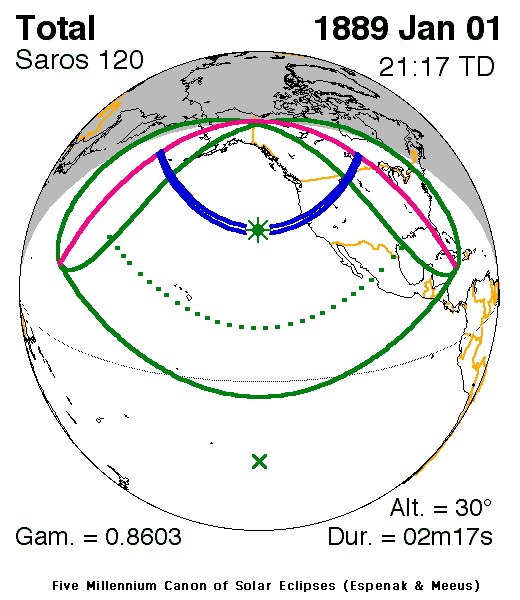
In 1889 there was no better place to observe the solar eclipse than Chico. Note the blue line.

By Attribution: Eclipse Predictions by Fred Espenak, NASA’s GSFC – http://eclipse.gsfc.nasa.gov/, Public Domain, https://commons.wikimedia.org/w/index.php?curid=17085968

John Bidwell recorded the eclipse in his diary:

Tues., January l.  Professors Pearson, Payne & Wilson, astronomers here to observe the total eclipse of the sun > Mansion. Events: Great total solar eclipse. The Astronomers had a very fair view of same. Weather: Fair some haze or thin clouds – air cold and raw.

Astronomers from around the nation flocked to northern California and Nevada to observe the eclipse. The Chico Daily Enterprise reported:

The party of observers from Carleton College, Northfield, Minnesota, were stationed in this town on a fine, open piece of ground on the ranch of General Bidwell. Professor Payne was in charge of the 2-inch zenith telescope, used for accurate determination of the times of contact of the moon with the sun, and for the study of the corona of the sun during totality. Professors Pearson and Wilson were in charge of the 6-inch reflecting telescope and the various cameras used for photographic purposes. . . .

The close of totality was as startling and pleasing as the beginning was depressing. The sense of awe and of being in the presence of an uncanny event cannot be described.

As the eclipse approached totality flocks of quail were observed flying to roost, and later came the crowing of cocks, while the sounds which came from the Indian camp should have been heard to be appreciated.

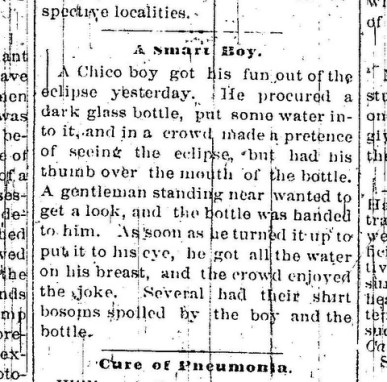
The Enterprise also included this little item. I wonder if this would work on modern observers.

Issue Date JANUARY 02 1889 page 3

If you miss this year’s solar eclipse, stick around. Northern California will see another one on August 12, 2045.

Posted in Uncategorized | Leave a comment

California Corner

If you enjoy California history of all kinds (and who doesn’t?), sign up for the California Corner newsletter from the History Room at the California State Library. You’ll get a quarterly newsletter sent to your email box, packed full of photos, stories, and various tidbits of California lore.

To sign up, go to the California State Library mailing list page at https://www.library.ca.gov/mailing-lists/ There’s a slew of newsletters there, and maybe you are also interested in some of them. California Corner is the last one on the list.

The first edition of the newsletter includes announcements of upcoming events, a welcome to new librarians (there’s a job I would have liked!), a feature on California authors, a fun item in “Discoveries in the Stacks” on the Gingerbread Man cookbook, and this featured photo of a sassy chicken. She looks like a fashion model on the catwalk. Or should that be henwalk?

The California State Library has a Facebook page and it is worth checking out too. There can never be too many ways to get your California history fix!

Posted in Uncategorized | Leave a comment

Aftermath of a Murder

John Richards and Steve Thompson were incarcerated in the California State Prison at San Quentin when the census was taken in June 1900. John was 19 years old; Steve was 21. Their occupations (before they went to prison) are listed as teamster for John and laborer for Steve.

After 1900, I find no more record of Steve Thompson. He disappears. Given a life sentence, he probably spent the rest of his life, whether long or short, at San Quentin. But John Richards’ story continues.

Johnny Richards had garnered some sympathy from the public as a young man led astray by an older and more criminally-minded companion. Annie Bidwell wrote to him while he was in prison. She sent him packages; in 1901 she sent him Aesop’s Fables for Christmas and 25 handkerchiefs in 1905. She sought to get him paroled from prison, and in 1909 she was successful. Her diary tells the story:

1907 Mon Sept 2  [List of letters written] #3 John Richards – San Quentin

1909 Tues., February 2. Letters: 1 From Sister : 2 John Richards about his release on parole from San Quentin. His “papers” had been rec’d. at Prison. Very grateful to me.

Mon., February l5. Events: “John Richards Paroled from San Quentin, to take effect March l st l909” – thus the clerk of the prison wrote me in letter recd. today. Also sends list of clothing he must have and his fare to Chico. Ordered the clothing & fare sent to him, today.

Mon., February 22 Letter from San Quentin Clerk & Receipt for $35.00 which I sent for John Richards’ parole expenses

Tues., March 2. Events: John Richards returned on parole from San Quentin and called on me this A.M. and P.M. Wrote letter to officials notifying same of his arrival & that I would give him continuous work. We held a little service of prayer & thanksgiving.

The Diaries of Annie Kennedy Bidwell, 1888-1896, 1899-1911

John Richards went back to working as a teamster, and might have faded quietly from sight, if it weren’t for his strange and unfortunate death in 1918.

Chico Record 17 January 1918

In a wild frenzy, John Richards rushed from his sickbed at the home of Mrs. Ed Martin on Humboldt avenue last night, dashed madly for the Northern Electric Mulberry shops, climbed to the top of a sixty-foot water tank and jumped from the tank to the ground, breaking both is legs in two places, the upper and lower jaw bone and the hip bone. He was unconscious at the Enloe Hospital early this morning. He may die.

Richards, who is thirty-seven years old, is employed by the Chico Ice & Cold Storage Company. About a week ago he was stricken with pneumonia, and the crisis approaching last night, he lost his reason temporarily.

He was discovered at the top of the water tank by Bert Holmes, nigh operator at the Northern Electrics shops.

“What are you doing up there?” queried Holmes as he looked up at Richards on top of the tank, his nightshirt flying in the breeze.

“I’m just taking in the scenery,” retorted Richards, who had climbed to the railing.

Bert Holmes telephoned the police for help, but by the time they got there, John Richards had jumped. He was taken to Enloe Hospital and died the next day. His body was buried at the Chico Rancheria cemetery.

No mention was made in newspaper articles about the crime from eighteen years ago. He had cleared his record. He had a job and a fiancee and the support of friends and family. His illness and death are a sad end to a promising life.

Posted in Billy Simpson, Uncategorized | Leave a comment

Murder at the Mansion — The Trial

Justice was swift in the year 1900. The murder of Billy Simpson had taken place on the night of February 27th, and his body was found on the 28th. On March 2nd Steve Thompson and John Richards were arrested, and it was not long before they confessed to the crime. They were held in the Chico jail until their arraignment on March 9th in Oroville.

The two men were held in the same cell, and Thompson came up with a plot to escape. When Richards’ mother visited in the jail, he told her of the plan to “sandbag” the jailer, steal his keys, and let themselves out. Richards was nervous and did not want any part in a plot that would only get them in deeper trouble.

Chico Record 9 March 1900

Richards and Thompson were separated. Mrs. Harriet Young, the mother of Johnny Richards, visited him every day in jail. Steve Thompson seems not to have had any friends or family to care about him.

Chico Record 20 March 1900

Less than three weeks after the murder, Thompson and Richards were in court before Judge Gray. Once again the newspapers contrasted the two: Richards tearful and remorseful, and Thompson with his “defying grin.” Both men pleaded guilty and the judge decided to take testimony before pronouncing sentence.

Sheriff Sylvester H. Wilson recounted the arrest and confessions of the two suspects. Mrs. Bidwell took the stand to attest to their characters.

Mrs. Bidwell was called and testified regarding the character of John Richards. She said that she had known him since he was a child about five years of age; that he had been a hard-working boy, and she had petted him considerably. [i.e., she had favored him and given him attention when a child.] Thompson she had known only a short time. She considered him hopelessly ignorant.

Chico Record 20 March 1900

In her diary Annie wrote:

Mon., March 19

Up at 4.30 A.M. At 6.5 this A.M., Mr. & Mrs. Garrison, Mrs. Thornton & self over to Oroville to see Johnny Richards who, with Steve Thompson were to be arraigned for murder this A.M. Arrived a few moments before time. Mrs. G. saw the boys & prayed with them, while Mrs. Thornton & I went to see Dist. Atty. Sentence was pronounced on them about 10.20 O’C and Judge Gray, seeing our interest, took our testimony as to the boy’s character, which testimony he would give the privilege for a petition to the Gov. in 15 years, for Johnny’s pardon, in view of Johnny’s previous character as given by us.

Steve Thompson admitted that he was the one who killed Billy Simpson: “I kill him” was how Annie recorded it in her diary. He said John Richards did not beat Simpson with the iron pipe. Both admitted to taking several drinks of liquor before the crime. Statements were also taken from Richards’ sobbing mother and both attorneys.

Attorney McGee, representing the Indians, made a brief address in the course of which he asked that clemency be shown both defendants, because of the extreme ignorance of the one and the youth of the other. He also called attention to the fact that liquor had aroused the savage instincts and prompted the deed. He asked that justice be tempered with mercy.

Since a sentence of hanging would have been entirely possible, justice was indeed tempered with mercy, and Judge Gray sentenced both men to prison for life. The next day they were delivered by the sheriff to San Quentin.

Next time: The Aftermath of Murder

Posted in Billy Simpson | Leave a comment