“If this is true . . . it is outrageous.”

Here is the second half of Bidwell’s September 30, 1848 letter to George McKinstry. He is outraged by a rumor that he has killed two Indians, a charge that he stoutly denies. It would certainly have been out of character for Bidwell. The story may have been motivated by Bidwell’s success in mining and in recruiting Indians to work for him.

He is particularly incensed that this report is being spread by Michael Nye, one of his companions on the overland journey in 1841.

I have been told by a great many persons that there is a report all through the country, that I have killed most barbarously two Indians who were at work for me – and that it come from Nye, and was told and repeated by him without any reserve all down this river the day he left our camp when I was absent – You recollect the time, he was here.

One Indian was said to be cruelly beaten by my vaquero and that he fell and dashed his brains out against a rock. – the other, it was said, I have stabbed with my knife in the act of stealing meat, and thrown him in the river. You will hear if this is believed below, from whom it came; if from Nye or anyone else. If any one has heard Nye say so, I wish you would be particular and receive it from him who heard it told direct by Nye. For if this is true that Nye has said so it is outrageous.

It must be on account of the sway which we hold over the Indians in these regions, which prevents his success on this river. However the Indians came constantly to work here from the plains but almost invariably complain of Nye’s Alcalde interfering with them. The Toto Indians came this morning with complains that Pumul (Nye’s Alcalde) was at their rancheria and had taken all their things from them. I sent one of the men to find out certain before I do farther.

DSCF0593   Tuesday after you left the other current machine was in operation, and all three have been going ever since except one day. I am extremely anxious to see you in camp, but do not expect you until next Saturday. I hope you will make all haste your presence is much wanted in camp – people are going above us in all directions etc. etc.

Yours truly,  J. Bidwell
rancho willy

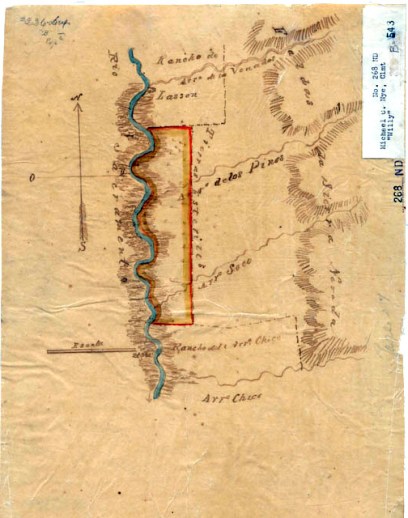
Diseno of Rancho Willy, drawn by John Bidwell. Courtesy of the Bancroft Library.

Michael C. Nye was probably born in 1811, making him just a few years older than John Bidwell. He came to California with the Bidwell-Bartleson Party and was granted a rancho for his service in the Micheltorena War in 1844. His Rancho de Willy was on the Sacramento River, between Rancho del Arroyo Chico on the south and Lassen’s Rancho on the north.

He may not have done much to develop the ranch, since he spent most of his time in Marysville. Nye later moved to Oregon, where he died in 1906, the last surviving member of the Bidwell-Bartleson Party.

Posted in Michael Nye, Uncategorized | Leave a comment

“A great many people have crowded upon this stream”

gold-miner-washing-with-panAnother letter from Bidwell to George McKinstry in 1848. I hope you find these letters as interesting as I do. I think the insights into the early days of gold-mining in California are fascinating.
Camp 30th Sept. 1848

Dear Mac,

Two weeks and a little more have elapsed since you left, and our work has gone on with usual regularity. I was back in camp early Sunday morning after I left you on Friday at Charles’s, — the 5 new Indians had run away on Friday night – and I have not been able since to prevail upon them to return. The Paegnes, however have submitted since I paid them a visit and made them some presents, and I have 11 of them at work also some of the Yunos. Last week we had 20; this 33 hands. A great many people have crowded upon this stream since you left. About 300 people have arrived from Oregon inpressly [sic] for Gold digging.

Charles’s was the ranch of Charles Roether, a German immigrant who came overland to California in 1845. According to Bancroft’s Pioneer Register, “his name often appears in the New Helvetia Diary ’45-’47; [he] settled at ‘Charley’s rancho’ in Butte Co, moving in ’58 to Feather River in Yuba, where he died in ’68, leaving a widow and 3 children.” Mansfield’s History of Butte County locates the ranch on the Huber Grant, on Honcut Creek.

I don’t recognize the names “Paegnes” and “Yunos” for California Indian tribes. If anyone can enlighten me, please do. It’s interesting to see how Bidwell deals with the Indians, paying them visits and giving them presents, in an effort to get them to “submit” to working for him.

            I have heard of the arrival of several companies from the States – and have seen some of the people among whom was Mr. Farwell, formerly in this country. He returned, perfectly “broke down” as regards funds, and desired to join us, but I did not employ him in any way, although I would like to assist him if any one. In case nothing has transpired since you left to prevent starting a trading post at some point on your return, and you have not made other engagements, I think Mr. Farwell would answer the purpose. You will probably see him at Mr. Cordua’s.

We have been apprehensive that people might call on us to work on our bar, but up to date have not been interfered with. Burch has said since he left us that we had bluffed him off abruptly when he asked permission to work here and that he was not going to give it up, but find a partner and come any how; but he is all talk – this was told me by one to whom B. was telling it, but did not want B. to know he told me.

“Our bar” is probably Bidwell Bar, as it became known. It was a productive site for gold.

Edward A. Farwell, a sailor from Boston, came to California in 1842, and after becoming a Mexican citizen in 1843, got the “Rancho de Farwell” grant on the south side of Chico Creek. In 1845 he returned to the States to seek medical help for his “weak eyes.” He returned, as Bidwell reports here, in 1848. He still owned the Farwell grant, but he was land rich and cash poor. Nothing had been done to develop the ranch.

Rather than take a job at the Bidwell & McKinstry trading post, he ran Sutter’s launch on the Sacramento River for a few months. He died in San Francisco in January 1849, leaving his estate to be administered by John Bidwell.

“Mr. Cordua’s” was the ranch of Theodor Cordua, another German immigrant.

Burch is probably Charles H. Burch, who shows up in Bancroft’s Pioneer Register. He came in 1846 and was at Sutter’s Fort (everyone was at Sutter’s Fort) 1846-47. Nothing more known about him.

This is just the beginning of this letter. Next time we’ll get to the juicy part, in which Bidwell defends himself against accusations of brutality towards the Indians.

Posted in Edward Farwell, George McKinstry, Theodore Cordua | 2 Comments

“The most laborious business I know of”

Charlie_S_Miner_Photo_-_Library_of_Congress

This letter is in the McKinstry collection, but I don’t know who wrote it. Possibly it is by the Mr. McCall mentioned in Bidwell’s letter of 24 June 1848. It gives another view of Bidwell and Dickey mining on the Feather River. It’s a long letter, and I won’t quote all of it. This is just the opening sentences. It looks like the letter-writer is writing from Sutter’s Fort.

New Helvetia  July 1st ‘48

Dear Sir,

Your two favors of 22d & 27th June I found on my desk last night on my arrival from the mountains after an absence of eight days. I was in hopes that I should have found you here on my return, I have brought down a letter from Mr. Bidwell which I send annexed which will explain to you the situation of the business on the mountains. It was my second visit to the camp I find it entirely different from what I expected it to be. The country is so rough that it is impossible to employ hands, in fact it is actually necessary to work in person which is the most laborious business I know of.

Mr. Dickey and Bidwell have been very industrious but not very successful as you will see from his statement. Mr. Dickey positively refuses to be engaged in the business with partners while on the mountains. I explored the Yuba river and the South fork of Feather river but can find no suitable place for working machines and the Indians do nothing working among the rock. Could a suitable place be found Mr Bidwell and myself could probably bring two hundred Indians in the field but now we find that 6 or 8 hands are more than we can employ profitably.

I have no doubt could I be kept supplied with a stock of goods say to the amount of 8 or 10,000 dollars I could make much more than I could by gold digging but as at present it appears that it is not convenient for you to furnish the goods and I therefore have concluded to go to digging say for some two months. I am more strongly convinced that a large and profitable business could be done at this point and I flatter myself that I could compete with anyone now engaged. The work of mining is too severe for my constitution and I do not think I can stand it long. The weather on the mountains is much warmer than in the valley there are already a number of severe cases of bilious fever on the Feather river, one I brought down, others to low to remove.

Hard labor, hot weather — it’s no wonder that this writer and many others aspired to be merchants rather than miners.

And what was bilious fever, you ask? It was a common diagnosis in the 19th century for any fever that was accompanied by symptoms of nausea, vomiting, and diarrhea. “Bilious” meant the condition was thought to arise from disorders of bile in the liver. It could have been any number of diseases; very commonly it was malaria.


Posted in Uncategorized | Leave a comment

“We did tolerably well washing the sands”

Another 1848 letter from John Bidwell to George McKinstry.

Feather River below first camp

Saturday 24th June 1848

Dear Mc,

Mr. McCall arrived yesterday morning and brought two letters from you dated the 20th inst. We spent the remainder of the day in search of a place to construct a washing machine, but did not succeed in finding one. McCall and Dickey go again today to look at another place.


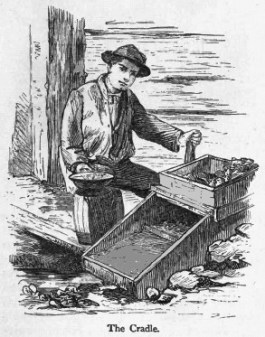
Washing machine? Bidwell means this: cradle

A machine for washing gold out of sand, by rocking it in a “cradle.” His first one must have been a rather crude version.


Not this: washingmachine

            Last week we did tolerably well washing the sands along the river – we made something not far from $1000 – This week we have done but little – The first camp above where we were when you came to us, was good – the first day of our arrival there we took out not less than 300 dolls. – but the place soon became exhausted it being small, and we have not been able to find as good a one since – In fact if Mr. McCall had not arrived I should have sent an express to you yesterday. We are not making over $50 per day with all our Indians – and if we do not find a good place in one or two days at most, I want to go down either to Yuba or the American Fork. So I think that the boat had better not be sent up until we determine, or if it is already on the way when you receive this, have it detained at Hock.

According to the website Measuring Worth, $1000 dollars in 1848 would have a purchasing power of $31,000 today. Not bad for a week’s work. Even that $50 a day was equivalent to $1550. The forty-niners, however, would soon find out that prices were high in California and a thousand dollars in gold wasn’t as much as it sounded like it was.

I am expecting this letter will find you of the road up, but thought you might dispatch the boat ahead with direction to pass on up from Hock. I have written a few lines to Mr. Cameron, requesting him to detain the boat until you receive my letter. I shall expect you to either come or send an answer to this, stating your opinion of going below etc. I am entirely out of coffee; I would like a few more shirts having sold nearly all of these which I brought up. I see plainly that we cannot keep goods in camp to supply miners unless we can find a place where we can establish ourselves permanently for some time or are better provided with means of transportation. I cannot leave camp or I would meet you at Hock. If I were certain that you would be there I should come down any how. If you come you can find camp by asking any of the Indians along the river mentioning my name.

Yours etc.  J. Bidwell

Maybe Bidwell hadn’t settled at Bidwell Bar yet; he seems to be moving around quite a bit. A permanent place of business and reliable transportation are concerns.

Duncan E. Cameron was employed at Sutter’s Hock Farm, but other than that I know nothing about him.

All the men who were already established on ranches in the valley used Indian labor when they went seeking gold. They usually brought along natives that they had already established a working relationship with. They saw their role as one of supervising and organizing, rather than the harder labor of digging and panning.

Bidwell had a reputation for treating his Indian workers fairly, but many others did not. There is no doubt, of course, that from our perspective, the Indians were being exploited as labor by all the white settlers. But Bidwell used persuasion and payment instead of coercion. Indians were paid in food, blankets, shirts, and desirable items like sugar, knives, and beads.

Posted in George McKinstry, Uncategorized | 1 Comment

Tomorrow I shall land in the “diggings”

Here is John Bidwell, about to go searching for gold on the Feather River, in this letter to George McKinstry. Lots of interesting tidbits here — see notes further down.

Hock June 19th 1848

Dear Sir,

I have been up to my Ranch, moved camp down to the bend of Feather river with a quantity of meat and coarse flour, and have come down to take up the things that were sent up in the canoe. Tomorrow I shall land in the “diggings”. I wish you would get me a summer coat like yours. – What do you call it “blows” or “blouse” made by Mrs. Zins if she can do it from that piece of calico if you have not sold it.

I have been able to get a shovel for one of the Picks, and a Packsaddle for a blanket which I was very glad to do under present circumstances.

I see the necessity of procuring horses for our service – we cannot do without them, and I would suggest the propriety of getting Iron made while old Hookenburger is in a working mood.

Thomes, Toomes, Dye and some others are on their way down to Feather River to work at the mines – they have about 50 Indians with them.

I hope you will be able to come up soon; as there is no one with me but Mr. Dickey. The men who were on my farm go down to see their people before they get off for the salt lake – but have promised to return.

Yours truly,  J. Bidwell

Bidwell is writing from Sutter’s Hock Farm on the Feather River just south of Yuba City. This and Cordua’s Ranch at Marysville are the only places he could have received shipments or sent letters.

“Up to my Ranch” means to his ranch or farm at Butte Creek, where he first settled on a portion of the Farwell Grant (as he thought; actually he was on the Hensley Grant.)

In 1877, describing his gold discovery he said, “On reaching Chico an expedition was organized but it took some time to get everything ready. We had to send twice up to Peter Lassen’s mill to obtain flour, meat had to be dried, and we had to send to Sacramento for tools.”

sackcoat

A calico sack coat, c. 1850.

Mrs. Zins was Dorothea, wife of George Zins, and a survivor of the Donner Party. He was a brickmaker at Sutterville. Seamstresses were scarce in early California and I expect her skills were in demand.

I think Bidwell is asking for a light cotton coat. It was called a “blouse” because it was loose, not fitted. Calico was a medium-weight cotton cloth, heavier than muslin and lighter than denim. Today we think of calico as cotton printed with a design of flowers or other figures, but at this time it would have been just a light-colored cloth, not printed.

Hookenburger may have been the blacksmith at Sutter’s Fort, but I can’t find anything about him. Probably he didn’t spell his name like that, whatever it was.

Thomes, Toomes, and Dye were Tehama County settlers: Robert Hasty Thomes (Rancho Saucos), Albert G. Toomes (Rancho Rio de los Molinos) and Job F. Dye (Rancho Primer Cañon o Rio de Los Berrendos). Robert Thomes was well known to John Bidwell as one of his companions in the Bidwell-Bartleson Party of 1841.

William Dickey, who at the time was the owner of Rancho Chico, was Bidwell’s partner in mining at Bidwell’s Bar.

“The men who were on my farm” were his two employees, Thomas Frazier and Edward Wade. They were members of the Mormon Battalion who had ended up at Sutter’s Fort. They worked for John Bidwell at his farm on Butte Creek for a while, but in the summer of 1848 they left to go east and join the Mormons who were settling near the Great Salt Lake. Although they may have intended to return to Bidwell’s employ, they never did.

Posted in George McKinstry | Leave a comment

“I foresee great struggles in the mining regions”

In 1848 things were happening in California. John Bidwell had been quietly and steadily developing a ranch on Butte Creek. He was also still doing occasional jobs for John Sutter — drawing up contracts, surveying, laying out lots in Sutterville.

Then gold was discovered and the world rushed in.

The big rush would come in 1849, but already in 1848 the Californians, plus men from Mexico and Oregon, were flocking to the hills to get rich. The quiet life was over.

John Bidwell made an expedition to the Feather River with some friends in the summer of 1848 and he found “the color,” as they used to say. He would spend the summer of ’48 and ’49 prospecting for gold, hiring Indian workers to sift the sands of the Feather River, and setting up a trading post to supply other miners. One of his partners in these ventures was George McKinstry, who had come to California in 1846 with a printed copy of John Bidwell’s 1841 journal as his guidebook.

Several letters from Bidwell to McKinstry are in the California State Library, and they shed light on life in the goldfields. This first one predates Bidwell’s own gold discovery. Instead he is at New Helvetia, as Sutter’s land holdings were called, and he has been busy surveying Sutter’s new project of Sutterville.

DSCF0581

New Helvetia, 21st May, 1848

Dear Sir

Having been confused by the continual arrival of Gold Diggers from all quarters, which made my room, in spite of my determination, a little too public, I made a hasty finish of the map.

I made an index to the map in which you will see lots 2 & 3 of Block 48, and 6&7 of B.59 marked with your name.

This is followed by more instructions about lots. Then he continues:

Mr. Leese is on his way here to enter into the mining business, and wishes me to join him, and form a company – but I have declined on acct. of reasons which I did not state to him.

I foresee the great struggles which are going to be in the mining regions which impresses me with the importance of finding if possible, a more retired place above.

To this end in your absence I shall make every endeavor: We ought to make early arrangements for cattle for beef, because every thing in the provision line is about to command an exorbitant price, and unless we guard in time against it we shall lose a great deal.

I have the key to your room behind the picture in the S.W. corner if the hall.

The form book is in the lower drawer of the bureau.

Yours etc.   J. Bidwell

Bidwell is thinking about the money to be made from miners — they are going to want beef and other provisions.

Mr. Leese is Jacob P. Leese, early (1834) settler in California, San Francisco merchant, and husband of the sister of General Vallejo. Evidently Bidwell had plans of his own.

I like that little note about where to find the key.

Posted in George McKinstry | Leave a comment

The Great Solar Eclipse of 1889

Are you heading up to Oregon to see the total eclipse of the sun? Are you already there, waiting for the event tomorrow? Here in Chico we will see a partial eclipse, about 83% coverage, I am told.

Solar_eclipse_1889jan01-mapTo see a total solar eclipse in Chico, you would have had to be here in 1889. That’s the last time that Chico was in the path of totality. We had an annular eclipse here in 2012, but not a total eclipse within living memory. (In an annular eclipse the moon is further away from the earth and does not completely cover the sun — a solar ring shows around the moon. Which is cool too.)
John Bidwell recorded the eclipse in his diary:

Tues., January l.  Professors Pearson, Payne & Wilson, astronomers here to observe the total eclipse of the sun > Mansion. Events: Great total solar eclipse. The Astronomers had a very fair view of same. Weather: Fair some haze or thin clouds – air cold and raw.

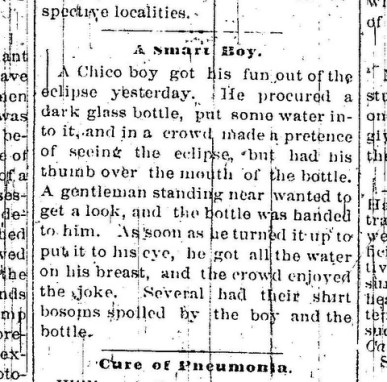
Astronomers from around the nation flocked to northern California and Nevada to observe the eclipse. The Chico Daily Enterprise reported:

The party of observers from Carleton College, Northfield, Minnesota, were stationed in this town on a fine, open piece of ground on the ranch of General Bidwell. Professor Payne was in charge of the 2-inch zenith telescope, used for accurate determination of the times of contact of the moon with the sun, and for the study of the corona of the sun during totality. Professors Pearson and Wilson were in charge of the 6-inch reflecting telescope and the various cameras used for photographic purposes. . . .

The close of totality was as startling and pleasing as the beginning was depressing. The sense of awe and of being in the presence of an uncanny event cannot be described.

As the eclipse approached totality flocks of quail were observed flying to roost, and later came the crowing of cocks, while the sounds which came from the Indian camp should have been heard to be appreciated.

The Enterprise also included this little item:Issue Date JANUARY 02 1889 page 3

I wonder if that would still work on modern observers.

Posted in Uncategorized | Leave a comment

Two More Letters from Nancy

Kelsey, that is. Two more letters to her friend, Helen Weber, are in the Weber Family Papers. They are written from Gilroy, where the Kelseys moved after they left Lone Pine, Inyo County.

The earthquake occurred in March 1872. By October they were in Gilroy, and by the next February they had rented a place. Nancy’s letter gives us an idea of what people were looking for in a piece of property, and what it cost in 1872. I have fixed up her spelling and added some punctuation.

We have rented a place in old Gilroy. We have to pay ten dollars a month. There is three acres of ground and a barn and a few fruit trees. I have a few chickens and ducks. I am again going to try to make me a home here if I can.

And that what Nancy, and many a pioneer woman did over and over — start again to

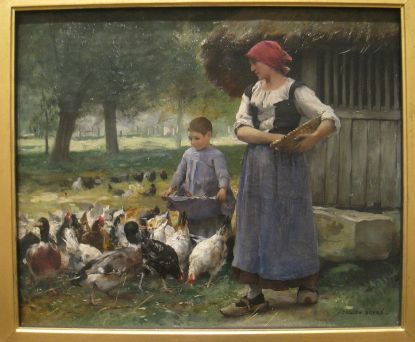
Farm_Girl_Feeding_Chickens

Farm Girl Feeding Chickens, by Julien Dupre

make a home in a new place.


Posted in Nancy Kelsey, Uncategorized | Leave a comment

The Lone Pine Earthquake

The 1872 Lone Pine Earthquake experienced by Nancy Kelsey was felt throughout California. John Bidwell, almost 400 miles north in Chico, recorded in his diary for March 26:

Very heavy earthquake at about 2.24 a.m

So the earthquake was noticeable enough in Chico to wake folks up in the wee hours of the morning. In the Owens Valley, it was devastating. 52 of Lone Pine’s 59 homes were destroyed, and 30 people died.

The earthquake had an estimated magnitude of 7.8, making it comparable to the 1906 San Francisco earthquake. It was only the sparse settlement of this remote area of California that kept this quake from being equally destructive.

One of most famous accounts of this earthquake came from John Muir, who was working as a caretaker at a Yosemite hotel at the time. Here is his report:

The shocks were so violent and varied, and succeeded one another so closely, one had to balance in walking as if on the deck of a ship among the waves, and it seemed impossible the high cliffs should escape being shattered. In particular, I feared that the sheer-fronted Sentinel Rock, which rises to a height of three thousand feet, would be shaken down, and I took shelter back of a big Pine, hoping I might be protected from outbounding boulders, should any come so far. Then, suddenly, out of the strange silence and strange motion there came a tremendous roar. The Eagle Rock, a short distance up the valley, had given way, and I saw it falling in thousands of the great boulders I had been studying so long, pouring to the valley floor in a free curve luminous from friction, making a terribly sublime and beautiful spectacle—an arc of fire fifteen hundred feet span, as true in form and as steady as a rainbow, in the midst of the stupendous roaring rock-storm.

The aftershocks were powerful and numerous. It’s no wonder that Nancy wrote that “the earth shakes so that I cant rite” and that her husband, whose boots were made for wandering anyway, was determined to sell their place at whatever loss and leave.


Posted in Nancy Kelsey, Uncategorized | Leave a comment

Letters from Nancy Kelsey

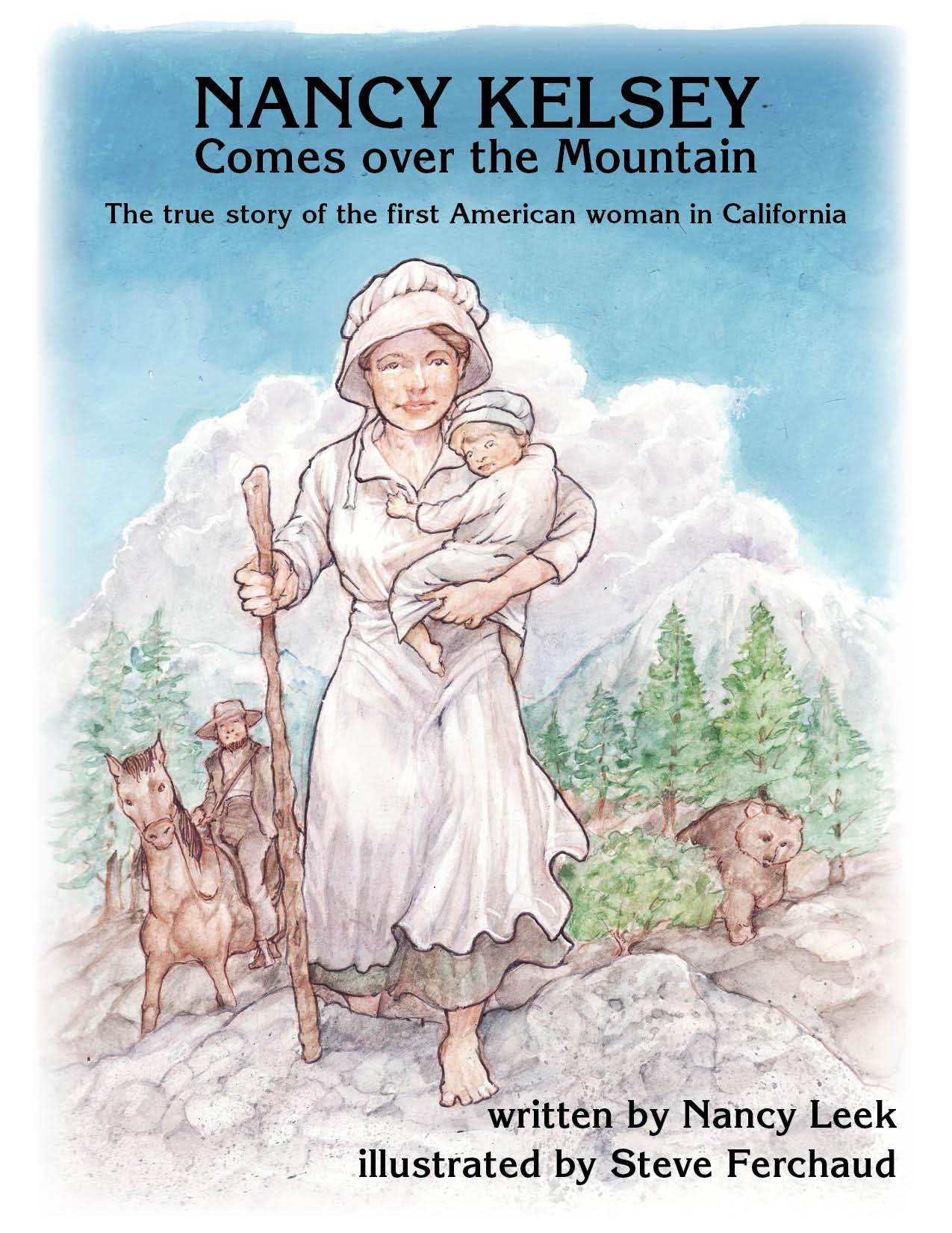
I am working on a picture book biography of Nancy Kelsey, who came to California in 1841 as the only female member of the Bidwell-Bartleson Party. I’ve done lots of research, but I am always looking for that last elusive bit of information.

helenweber

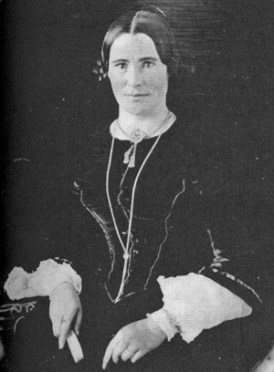
Helen Murphy Weber

Friday I was at the Bancroft Library to look at three letters written by Nancy Kelsey to her friend, Helen Murphy Weber, wife of Charles M. Weber, the founder of Stockton. The Webers have their own story— he was another member of the 1841 Bidwell-Bartleson Party, and she was part of the Stephens-Murphy Party of 1844 that were the first to get wagons over the Sierra Nevada. But that is a tale for another time.

I found a reference to Nancy’s letters in the bibliography to Cecelia Holland’s “dramatized biography” of Nancy Kelsey, An Ordinary Woman. Up till now I had surmised that Nancy Kelsey was illiterate, a not unlikely conjecture for a backwoods Kentucky girl who married at 15, and who dictated her memoir. But I was wrong.

Nancy could write a good letter — her spelling was somewhat uncertain but she had decent penmanship — and there is no indication that someone else was doing the writing for her.

Here is her letter written from the Owens Valley in 1872, two weeks after the massive Lone Pine Earthquake (estimated magnitude 7.4 to 7.9). I have retained her spelling.

April the 11 1872

Mrs. Helen A. Weber

Dear friend,

As I promised to wright to you I will proceed. I would of written to you sooner but the country has bin in such An up roar that I couldnt. Ther was none of my folks hurt but they were all most scard to death. The earthquake shook down our chimney but the house did not fall. We have earthquakes every day and night yet, and my husband is sow dissatisfied that he is A-going to sell his place and leave. I am sory that he is A-going to sell for we cant get much for it at presant.

Rit to me and tell me if there is any land A round Stockton that we can get if we come out thair. The earth shakes so that I cant rite. Answer this or soon as you get it and tell me if you think that we can make A living thair.

Give my best regards to mr. webber and tell him that I would of A sent that money to him in this letter but I couldnt At present. Remember me to your children. . . . . . . . . .

Good ByDSCF3840

I remain your Friend.

Mrs. Nancy Kelsey

Posted in Nancy Kelsey, Uncategorized | 4 Comments