Murder at the Mansion — The Maid’s Testimony

Shortly before 9:00 p.m., on the evening of February 27, 1900, John A. McFeely left his hardware store on Second Street and headed for home. As he neared the footbridge over Chico Creek he heard Charles Cunningham’s dogs barking at the rear of Bidwell Mansion.

Inside Bidwell Mansion, a maid, Florence Blake, heard them too.

This incident is important in fixing the time of the crime for the reason that Miss Florence Blake, a domestic at the Bidwell home, tells that she never knew of one of the dogs acting as he did at that time. She called the dogs to quiet them, and one of them growled at her viciously and then darted out in the direction of the place where Simpson was killed.

Chico Record 1 March 1900

Charles Cunningham, who worked for the Bidwells as a gardener, lived on Lincoln Avenue near the Esplanade, but evidently kept his dogs near the mansion.

Imagine Florence sitting in the kitchen, having a cup of tea before retiring for the evening. She is feeling a bit nervous. It has been an unsettling day. General Bidwell is in his office, making notes in his diary. Mrs. Bidwell is up in their bedroom, writing letters. Florence hears the dogs making a commotion outside. She opens the back door in the laundry room and tells the dogs “Quiet!” Rather than obeying, they growl and run off toward the creek. What is going on?

Florence shut the door and locked it. She had already had one disturbing caller that evening and didn’t want any more trouble. Only an hour before she had answered a knock on the door to find a stranger asking to speak to General Bidwell. The man was clearly intoxicated. She told him that the General was busy, but to call again later and he could speak to the General.

Strangers knocking on the door of the mansion, looking for work or a handout, were common enough, but Florence didn’t care for such an interruption by a drunk on a dark night.

The man went away, but did not return. About a half or three-quarters of an hour later, one of the young ladies employed there [this was Florence] heard the dog growl fiercely and jump from the porch. The young lady was quite nervous after the visit of the drunken man, and she called the dog back to the porch.

This morning the tracks of the dog show that he had started straight for the spot where Simpson’s body was found, and it is confidently believed that he was aroused by the scuffling made during the time the deed was committed.

Chico Weekly Enterprise 2 March 1900

The police hunted for the drunken stranger the next day and found him. They decided he was not the murderer, but only a common troublemaker.

The mysterious drunken man who called at the Bidwell mansion on the evening of the murder, turned out to be James Wilson, the drunk who broke jail that day.

Chico Weekly Enterprise 2 March 1900

Tuesday morning one of Constable Potter’s prisoners broke out of the city prison by prying out one of the staples which held the gate to the prison yard. The prisoner was Jim Nelson [sic — the headline has the name Wilson] who was arrested for indecent exposure on the Shasta road [the Esplanade]. . . .

Yesterday he was identified as the man who had escaped from the jail. Further investigation proved that he was the fellow who, while intoxicated, had visited the Bidwell mansion Tuesday evening two or three hours before the murder of Simpson, and had frightened Miss Blake.

Chico Record 1 March 1900

After questioning Jim Wilson, the police decided he was not their man. Their attention turned to the men on the Mechoopda rancheria. Could this have been a case of revenge?

Posted in Uncategorized | Leave a comment

Murder at the Mansion

Fred Petersen, the head gardener at Bidwell Mansion, got an early start on the morning of February 28, 1900. And it was not long after his arrival that he made a grisly discovery.

At 6:30 a.m., just as it was getting light, he came upon the body of a man lying by the driveway, his head battered and bloody. As reported by the Chico Record, “A glance was sufficient to tell Peterson that an awful crime had been committed, for the upturned face of the body was covered with blood, the features disfigured and the head resting in a pool of blood.”

Chico Record 1 March 1900

The victim was Billy Simpson, an Indian* and a long-time employee of John and Annie Bidwell. Fred Petersen would have known and recognized him. He alerted Reuben Messinger, Bidwell’s stableman and coach driver. As they stood over the slain man, John A. McFeely hurried over to join them. He was on his usual morning walk from his home on Arcadian Avenue to his hardware store on Second Street. The horrified men notified John Bidwell and summoned the police. By the time the constables arrived, a large crowd of men and boys had gathered around the body and trampled the ground in every direction.

That evening John Bidwell noted the event in his diary: MURDER: Billy Simpson found dead this morning – murdered – nearby.

“Nearby” was directly behind the mansion. The newspaper reported that the body “was discovered in the driveway about twenty yards northwest of the woodshed near the mansion.” Although I don’t know where the woodshed was located, this site would be on the unpaved driveway near the carriage house, where today a path runs toward the Chico State campus. Other reports said that the body was discovered beneath a large fig tree.

A rear view of Bidwell Mansion with a carriage on the driveway and the architect’s cottage and the carriage house on the left.

Both the Chico Record and the Chico Daily Enterprise reported the crime in gruesome detail. From the Enterprise on March 2nd:

That Simpson had been murdered in cold blood, and by some man or men who were determined on robbery, there seems no possibility of a doubt. Those who were early on the scene could plainly see the marks in the driveway where Simpson had fallen, when the first terrible blow was delivered.

The murderer evidently slipped up behind his victim and dealt him a terrific blow on top of the head with some blunt instrument. Stunned and bleeding with his skull fractured in a dozen places the inoffensive Indian had fallen to the ground, and while the victim was lying prostrate on the ground, the murderer, evidently intent on making sure that his victim was dead, delivered two more blows upon the head and face of the fallen man.

The report goes on to detail the dreadful injuries inflicted upon Billy Simpson. Then:

After making sure that his victim was beyond giving an alarm, the murderer carried the body of the Indian under the dense foliage of a giant fig tree, where he proceeded to rifle the pockets of the dead man. A trail of blood marks the path of the murderer as he bore his human burden off of the driveway into the darkness to conclude his hellish work.

All this happened while John and Annie Bidwell and their servants went on with their evening inside the walls of Bidwell Mansion.

Who murdered Billy Simpson? Why? When did it happen? Did anyone hear the crime?

Stay tuned for more about Billy Simpson, about the arrest and fate of his murderers, and their motives for the killing.

*I will be using the term “Indian” or “American Indian” rather than “Native” or “indigenous person,” simply because “Indian” was the term in use at the time and it is still preferred by some indigenous groups.

Posted in Uncategorized | Leave a comment

Ladies! Here’s Your Chance!

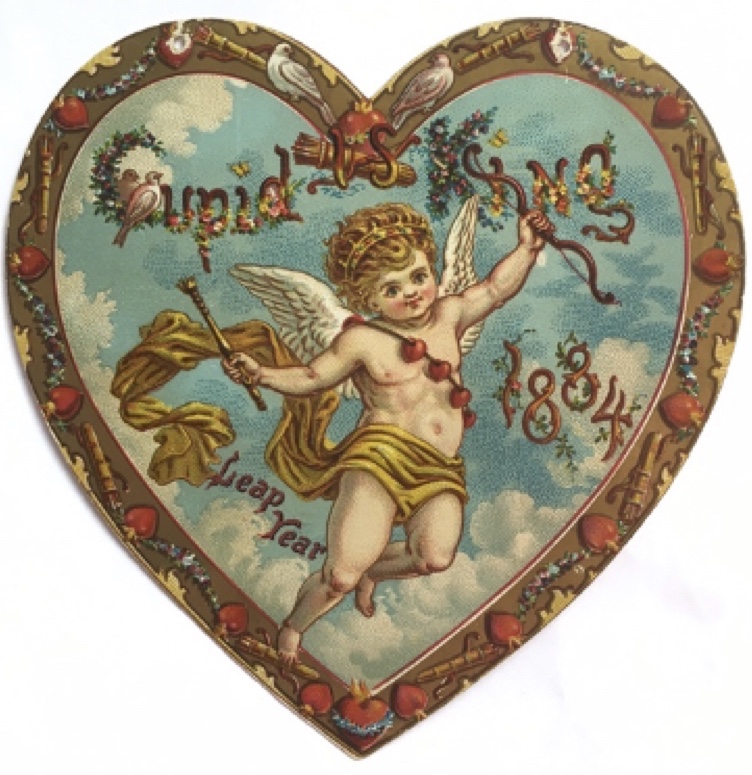
A Leap Year Valentine

Ladies! Make your plans now for February 29th!

2024 is a Leap Year, and that means, according to an old custom, it is a year when women can propose marriage to men. Traditionally, it was the man’s role to propose marriage, but anytime during a leap year, but especially on February 29th, the roles were reversed. A woman could finally take matters into her own hands and pop the question. It was said that if the man refused the offer, he was required to give the woman a gift of a pair of gloves or a silk gown as compensation.

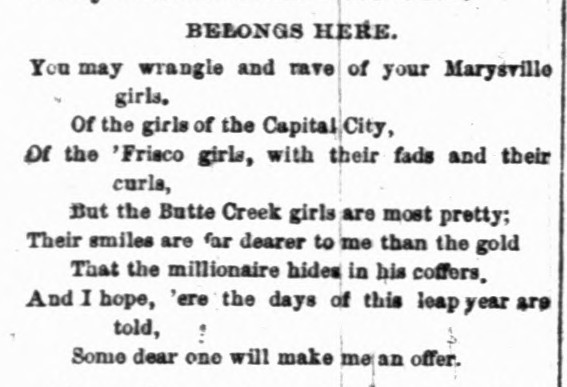
Pres Longley, our own Bard of Butte, shared these lines of verse on the subject in 1892.

You may wrangle and rave of your Marysville girls,
Of the girls of the Capital City,
Of the ‘Frisco girls, with their fads and their curls,
But the Butte Creek girls are most pretty.
Their smiles are far dearer to me than the gold
That the millionaire hides in his coffers,
And I hope, ‘ere the days of this leap year are told,
Some dear one will make me an offer.


Chico Weekly Enterprise 29 April 1892
Posted in Pres Longley | Leave a comment

February Celebrations

The Weekly Butte Record found a number of reasons to celebrate in February. All the following come from the issue for February 13, 1864.

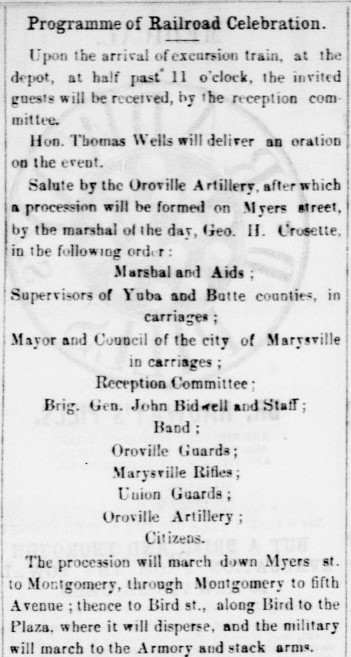
The event that got the most coverage was the completion of the California Northern Railroad, linking Marysville and Oroville. This was a boon to merchants and shipping, and called for a parade and speeches, followed by a collation, a ball, and general jubilation. All the local militia units would be on display.

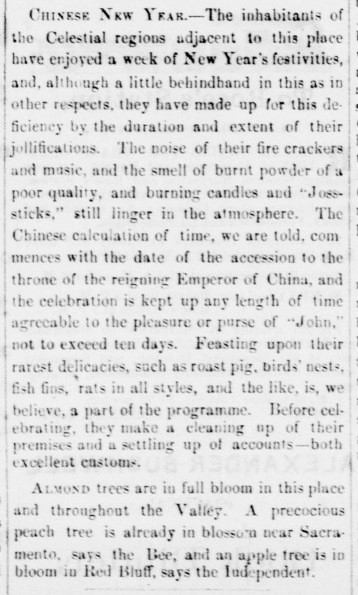
The newspaper also took note of the Chinese celebration of the Lunar New Year, referring as they often did, to the Chinese as “celestials.”

Notice that the almond trees were in bloom in mid-February, then as now.

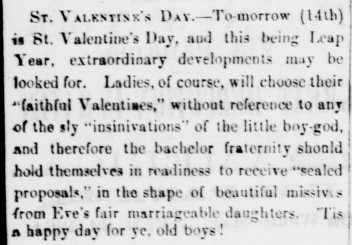
And of course, Valentine’s Day. 1864 was a year to be reckoned with — it was a leap year, when custom said that women could propose to men. “The bachelor fraternity should hold themselves in readiness”!

Posted in Uncategorized | Leave a comment

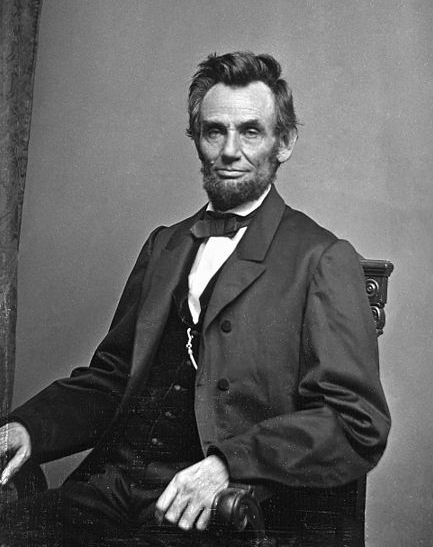
Abraham Lincoln and Freedom

February 12th 2024 marks the 215th birthday of Abraham Lincoln, 16th president of the United States, who led the country through four years of a bloody and bitter war, a war fought to end slavery and to maintain a government “of the people, by the people, and for the people.”

This last week I had the opportunity to speak to two 5th grade classes. Since they had already covered California history in the 4th grade, and were currently studying U.S. history, I figured a good topic would be the issue of slavery in California, as demonstrated in the life of Alvin Coffey.

We tend to think of slavery and the American Civil War as events that took place “back East”, but these issues touched California too. People in California came from every state in the nation and from all over the world, and they brought their customs and prejudices with them. Slavery was a hot issue in California.

Fifth grade students, kids who are 10 years old or so, find it hard to wrap their brains around the idea that some people thought it right to enslave other human beings. They know it is wrong, and they live in a world of such diversity that it doesn’t make sense to them. President Lincoln would approve.

Lincoln thought long and hard about the issue of slavery. He had such clarity of thought and expression that he was able to explain the problem in terms that any adult or 5th grader can understand. In the 1850s he wrote out his thoughts on a fragment of paper, using the reasoning he heard around him from proponents of the slave system.

If A. can prove, however conclusively, that he may, of right, enslave B.—why may not B. snatch the same argument, and prove equally, that he may enslave A?” Lincoln wrote. “You say A. is white, and B. is black. It is color, then; the lighter, having the right to enslave the darker? Take care. By this rule, you are to be slave to the first man you meet, with a fairer skin than your own.

You do not mean color exactly?—You mean the whites are intellectually the superiors of the blacks, and, therefore have the right to enslave them? Take care again. By this rule, you are to be slave to the first man you meet, with an intellect superior to your own. But, say you, it is a question of interest; and, if you can make it your interest, you have the right to enslave another. Very well. And if he can make it his interest, he has the right to enslave you.

As quoted by Heather Cox Richardson, “Letter from an American” https://heathercoxrichardson.substack.com/p/february-11-2024

Lincoln saw clearly that if we give up the principle of equality before the law, we have given away our own freedom. We have put ourselves at the mercy of any person who decides that they are smarter, stronger, richer, or more worthy in any way than we are, and are willing to enforce that notion.

So– Happy Birthday to President Abraham Lincoln, and may we never forget the principles he lived and died to defend.

Posted in Abraham Lincoln, Uncategorized | Leave a comment

A Visit to Ide Adobe State Historic Park

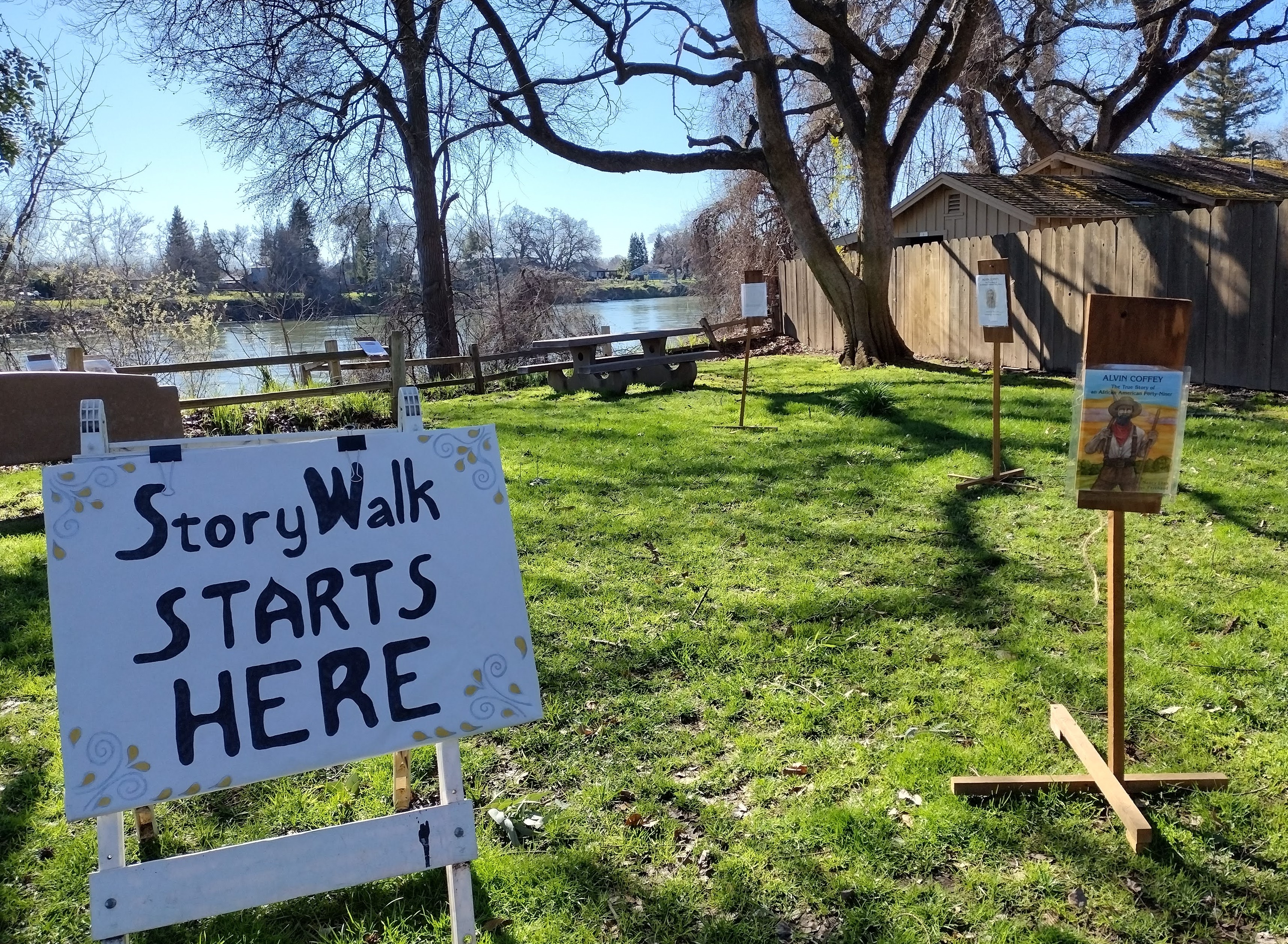
Today is a beautiful day to be out and about, so I went to William B. Ide Adobe State Historic Park in Red Bluff to walk their StoryWalk.

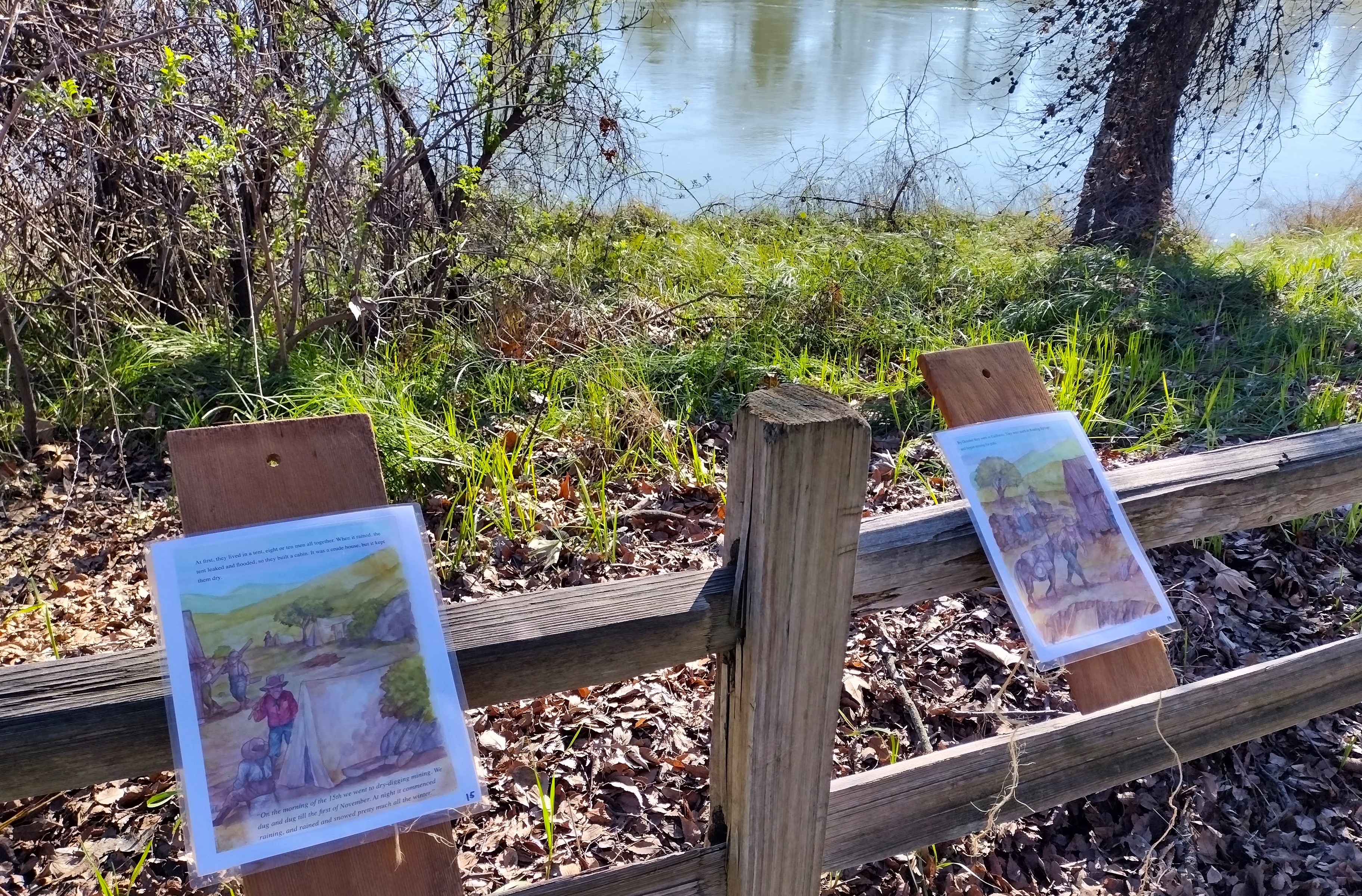
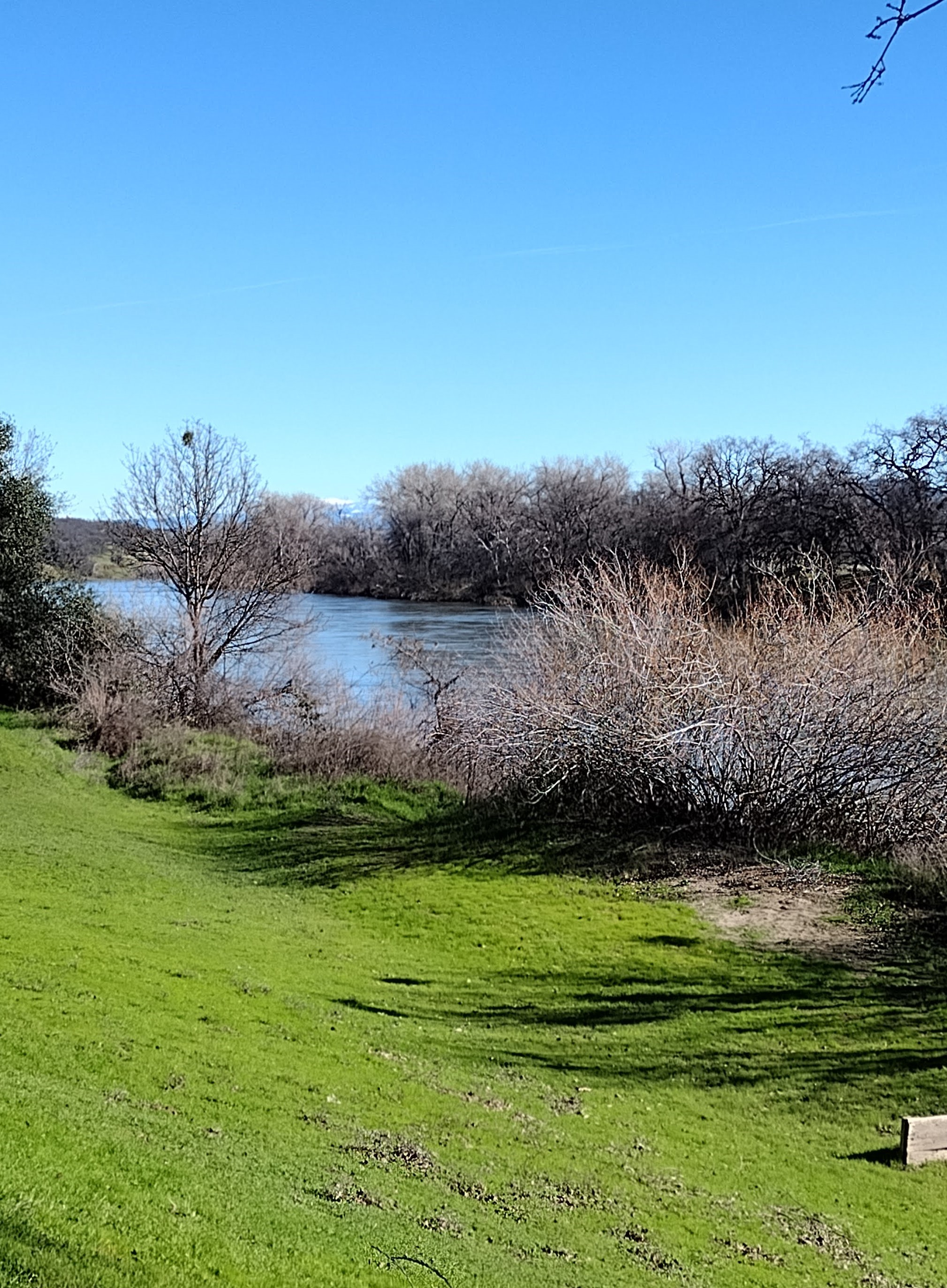
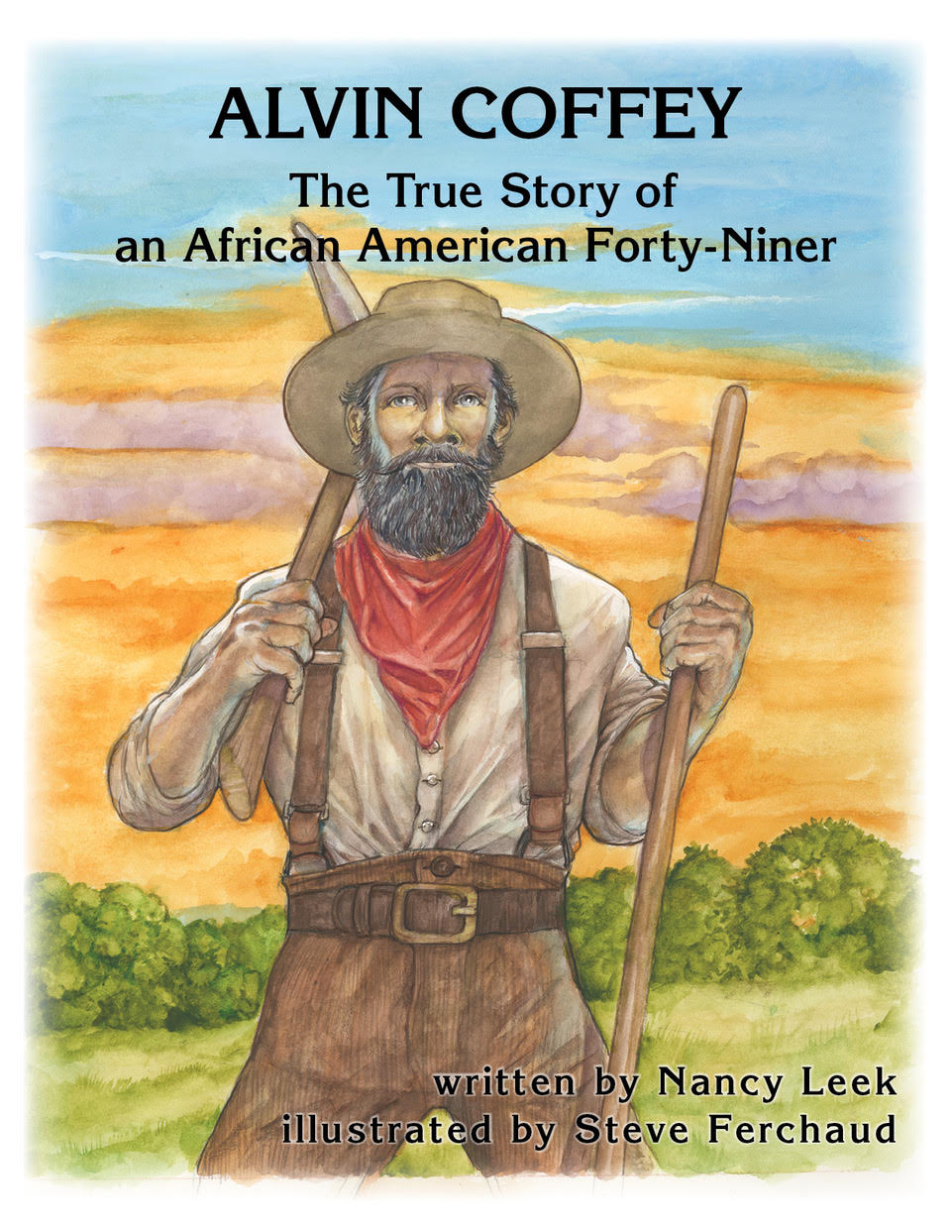
The guides at Ide Adobe do a StoryWalk every month, featuring a seasonal or fun picture book. Today’s book, in honor of Black History Month, was my book on Alvin Coffey, African-American Forty-Niner. The pages were cut apart, laminated, and posted on the fence along the river. Read at your own pace.

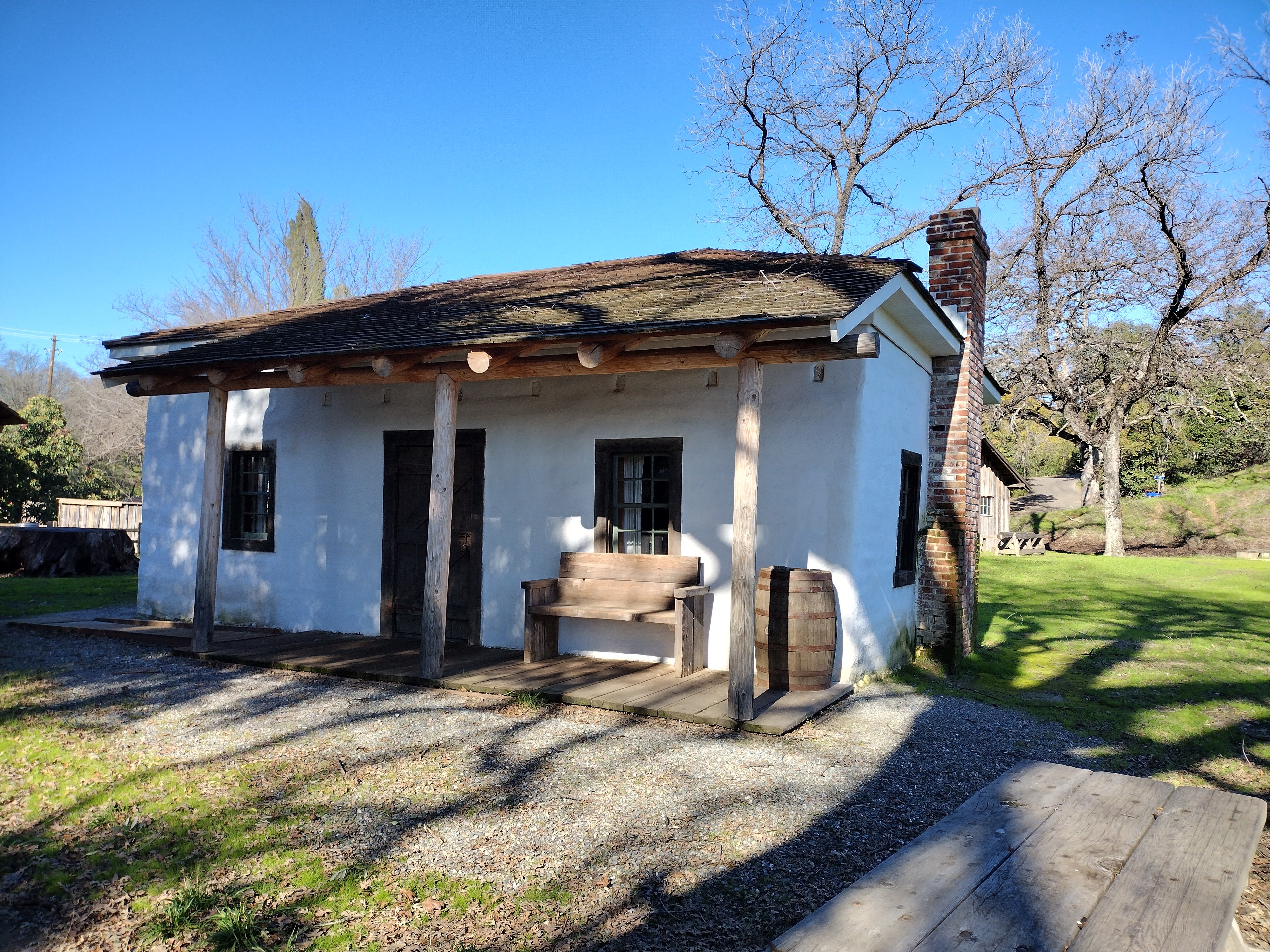
If you want to see what pioneer life was like on the California frontier in the 1850s, Ide Adobe SHP is the place to go. It sits on the banks of the Sacramento River, and shows how a family might have lived, with its adobe cabin, water well, smokehouse, garden, blacksmith shop, and garden.

It was once thought that William B. Ide, a leader of the Bear Flag Revolt and the first (and only) president of the short-lived California Republic, lived here in this adobe house. That is now considered incorrect, but the State Park still bears his name and honors his legacy. The site is just north of Rancho Barranca Colorada, the Mexican land grant that Ide owned jointly with Josiah Belden.

The adobe was actually built in 1852 by A. M. Dibble, an early settler in Red Bluff. It changed owners numerous times over the years, until acquired by California State Parks. The site was the location of a ferry across the Sacramento River.

Spring is the perfect time to visit Ide Adobe State Historic Park. Take a walk down by the river. Look for birds and wild critters. The grounds are open sunrise to sunset and the Visitor’s Center is open Friday to Sunday, 10 a.m. to 4 p.m. Check their Facebook page for the next StoryWalk activity.

Posted in Uncategorized | Leave a comment

StoryWalk at Ide Adobe

Alvin Coffey is getting some attention during Black History Month! The Red Bluff Daily News announced that my book, Alvin Coffey: The True Story of an African American Forty-Niner, will be the featured book at a StoryWalk activity at Ide Adobe State Historic Park.

The event takes place on Saturday, February 10th, from 10 a.m. to 1 p.m. You can check it out on the Ide Adobe Facebook page. There will be crafts and games and lots of fun related to Black History in the California Gold Rush.

I am honored to have my book featured at a history activity in Tehama County, where Alvin and his family settled and prospered. Come out and learn how black Americans made history right here in the North State.

Posted in Uncategorized | Leave a comment

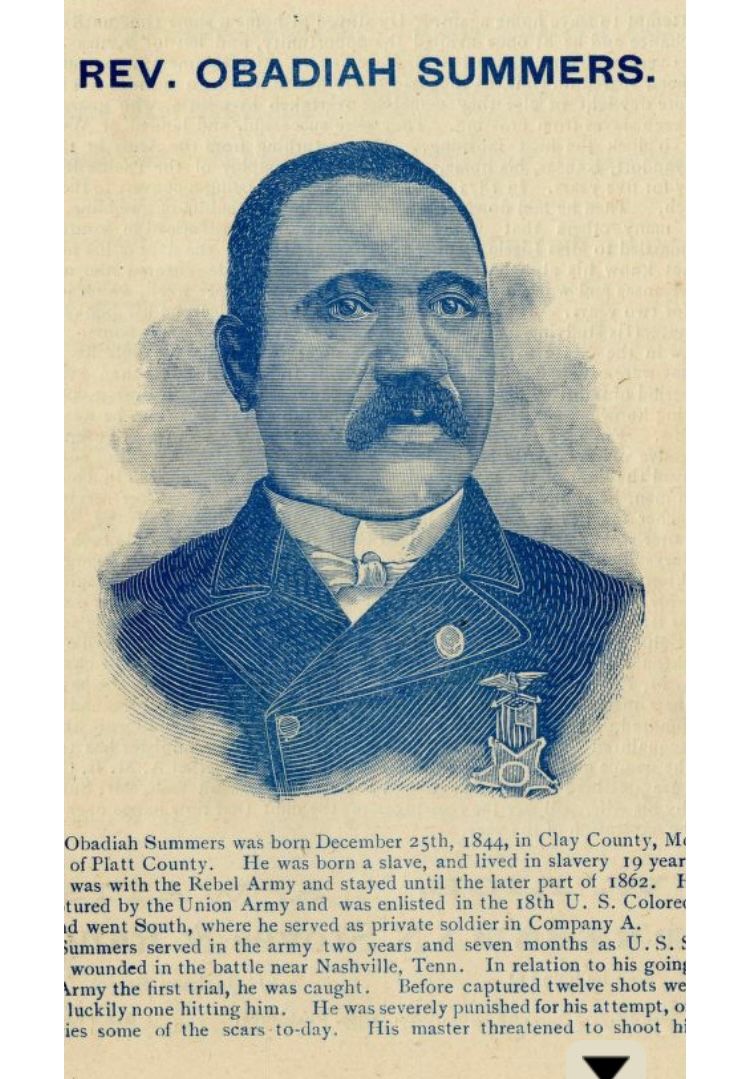
Reverend Mr. Obadiah Summers

Obadiah Summers served as pastor in the African Methodist Episcopal Church in Chico in 1885, before moving on to serve congregations and build up churches in Sacramento, San Francisco, and Oakland.

Summers was born a slave in Missouri in 1844. During the Civil War he was compelled to serve in the Confederate Army as a servant to a Confederate officer. He was captured by Union forces in 1862, and had no intention of returning to Missouri as a slave. He enlisted in the Union army on January 18th, 1864, in Wyandotte, Kansas and served as a private in Company A of the 18th Regiment of the United States Colored Troops.

After the war he went to work for the railroad and in 1871 was licensed to preach by the A.M.E. Church. He probably worked at both jobs for some time. During his time in Chico he also seems to have been ministering to an A.M.E. church in Marysville.

Chico Weekly Enterprise 9 September 1885

In September 1885 the Chico Weekly Enterprise appealed to its readers to “Help Them Out.” Rev. Summers was raising money to clear the church of debt and was seeking help from Chico citizens.

In addition to appealing for donations, the church raised money with a variety of social activities. In May a social was held which the newspaper labeled a “grand and pleasant affair.” After recitations and songs, ice cream and cake were served. It wasn’t reported how much admission was charged or how much money was raised, but it was typical to charge 25 cents.

But to pay off a debt of over $100, the church was still seeking contributions. In his diary John Bidwell recorded several visits in May 1885 by “Rev. Mr. Summers (colored)”. These visits were surely part of the Rev. Summers campaign for contributions.

John Bidwell doesn’t record how much he gave, but he could be counted on to be generous to churches. On July 7, 1886, he notes “Rev.O.Summers (colored) lectured in our church.” That would have been the Presbyterian Church.

Widely popular and admired, Obadiah Summers was appointed the first black chaplain to the California State Assembly in 1895. The Chico Weekly Enterprise remembered and congratulated him.

Rev. Summers was married and the father of seven children. He died in Oakland on March 15, 1896 at the age of 51 and is buried in the Mountain View Cemetery in Oakland.

Posted in Black History Month, Uncategorized | Leave a comment

February Is Black History Month

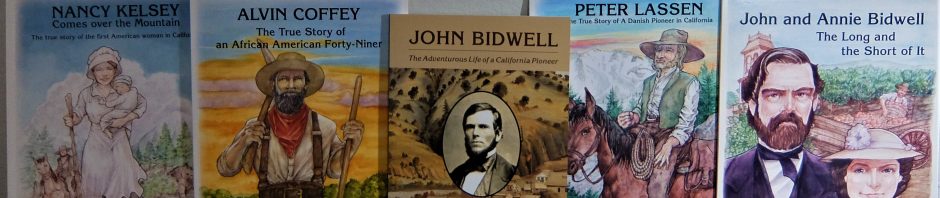
Get ready for Black History Month! Alvin Coffey is the ideal book to highlight black history in California.

As 4th grade students study the Gold Rush, they learn about the prospectors who came seeking gold in the rivers and hills of our Golden State. Too often the image presented is a white prospector. But men (and some women and children) came from every country and every race and ethnicity on the face of the earth.

African Americans came, both enslaved and free. Free blacks from the Northern States came looking for gold, but also for freedom from prejudice and greater opportunities.

Enslaved men from the South, like Alvin Coffey, had the choice made for them by those who claimed to own them as property. But Alvin knew it was an opportunity to earn his freedom and freedom for his wife and children. It must have been galling for Alvin to labor to make another man rich. But he persisted, hoping that the money he earned on his own time would buy him a better life.

I read and researched everything I could find on Alvin Coffey, including primary sources. The book is historically accurate and visually appealing, with full color illustrations on every page by Steve Ferchaud.

You may not think a picture book is for you, but you can buy one for a school library, a 4th or 5th grade teacher, or a grandchild or young friend. It’s an exciting story with an inspiring message.

Books are available from the Association for Northern California Historical Research (ANCHR), from Amazon, or directly from me. Just send me an email at goldfieldsbooksca@gmail.com.

I’d love to hear from you!

I am also available to do presentations to schools and groups. I love talking to kids, and I am pretty good with adults too. Contact me to visit your class or organization.

Posted in Uncategorized | Leave a comment

It’s Gold Discovery Day!

A cold, clear morning in January 1848. Jim Marshall goes out early to check the tailrace of the sawmill that he is building for John Sutter on the American River. The night before he had turned the water from the river into the tailrace to deepen and widen it. Each morning he inspected it to see if it had become deep enough to adequately carry off the water from the waterwheel.

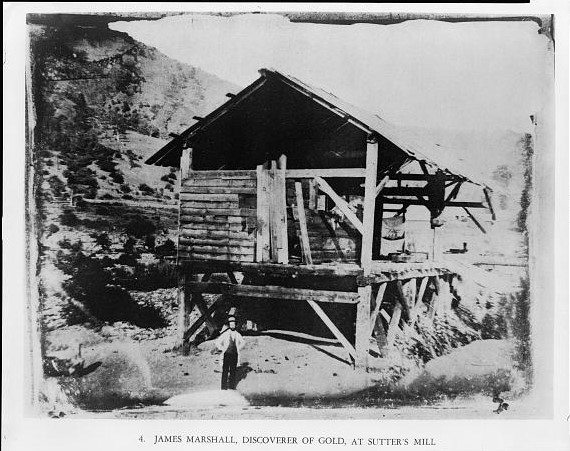
The Library of Congress labels this “Photomechanical reproduction of the 1850 (?) daguerreotype by R. H. Vance shows James Marshall standing in front of Sutter’s sawmill, Coloma, California, where he discovered gold.” Probably not actually Marshall in the picture.

On January 24 Marshall noticed some bright and shiny flecks of metal in the water. Could it be gold? He was sure that it was, and tests proved him right. And so the stampede for riches that we call the California Gold Rush was on.

Was Jim Marshall the first to find gold in California? His name would go down in history as the discoverer of gold in California. But he wasn’t the first to find gold.

There was Jennie Wimmer, wife of Marshall’s assistant and cook for the men building Sutter’s Mill. She had seen gold mined in Georgia and had told the men that she was sure that the sparkles she saw on the river bottom were gold. But they ignored her.

Before Jennie there was Margaret Hecox, who came to California with her family in 1846. Coming down the Yuba River, she and another woman went to wash clothes.

We were busy at our washing down near the stream, when something brightly gleaming in the water attracted our attention. It looked like sands of gold. I gathered my apron full of the shining specks and carried it to Mr. Hecox, saying I thought it was gold. He laughed at me and seemed to consider it a good joke. This made me angry and I threw it away. I have always been sorry that I did not keep it and wait until I could have it tested. I am sure now that it was gold.

In 1844 Pablo Gutierrez and John Bidwell went searching for gold in the mountains. Pablo recognized the landscape, the soil, and the rivers as being like that of the gold-mining regions of Mexico. But before they could get the equipment they needed, the short-lived rebellion called the Micheltorena War intervened. The Californios rebelled against the new governor — Manuel Micheltorena — and his henchman sent up from Mexico City. Sutter sided with the Mexican government and took Bidwell, Pablo Gutierrez, and a troop of Indian soldiers along with him. Pablo was captured while carrying messages and hanged as a spy.

Before Pablo Gutierrez, there was Jean Baptiste Ruelle, a French-Canadian fur trapper who discovered gold in the San Fernando Hills in 1841. Bidwell later wrote:

The first gold discovery in California so far as I know, was made in 1841 by “Juan Baptiste Ruelle,” at a place in the mountains about 30 miles N.E. from the Mission of San Fernando. He was a Canadian trapper but had lived in New Mexico, and worked in Placer Mines. His discovery in California created no excitement whatever, owing to the fact no doubt of the very small yield.

No doubt there were others who found a bit of gold, but never cashed in on their find. Everybody knew about Ruelle’s mine, and everybody knew the earnings were hardly worth the work. The great rush for gold would have to wait until Jim Marshall picked those few shining flecks out of the tailrace on January 24, 1848.

It was a discovery that would utterly change the landscape, the people, and the culture of California.

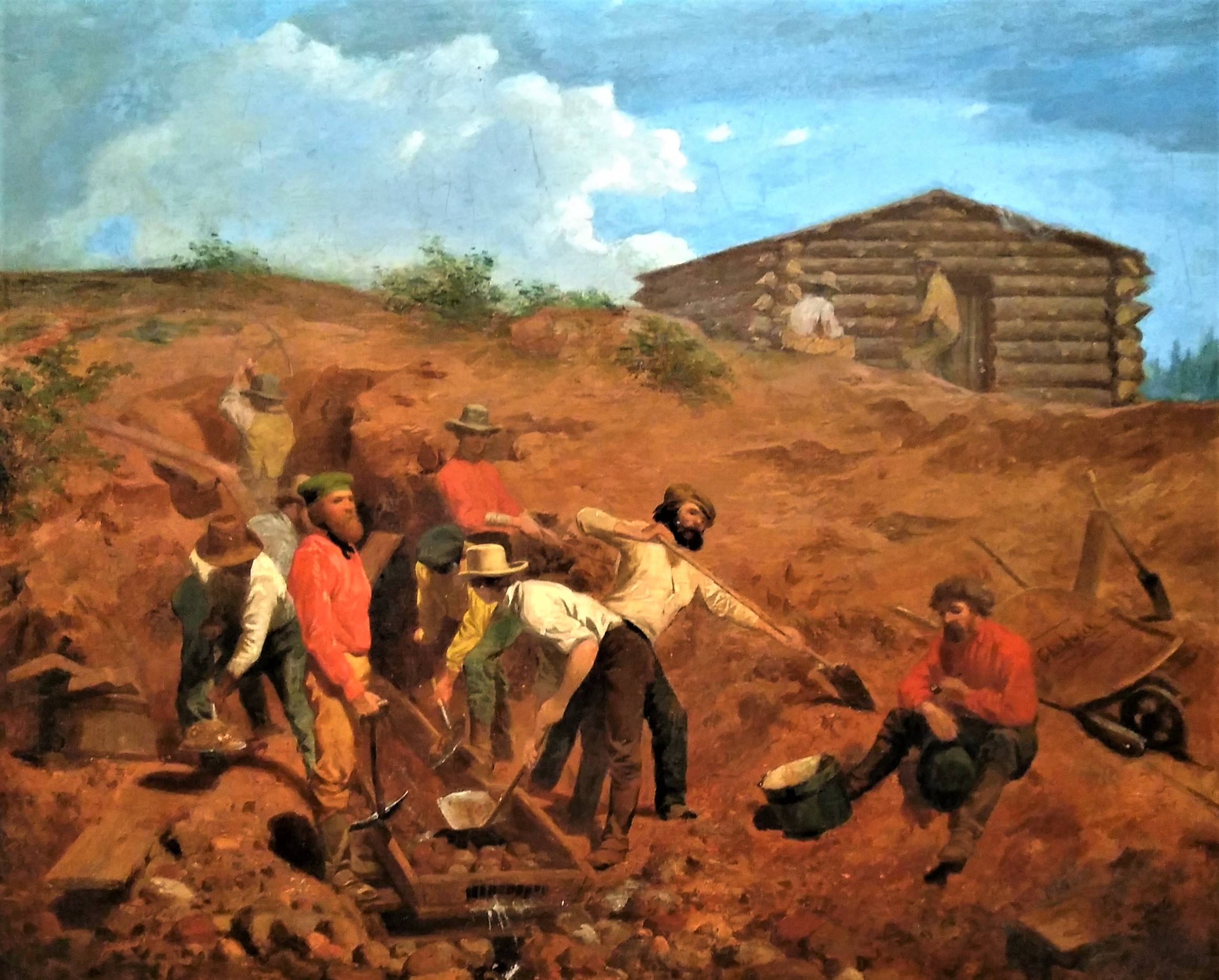
Miners at work. Crocker Art Museum, Sacramento.
Posted in Uncategorized | Leave a comment