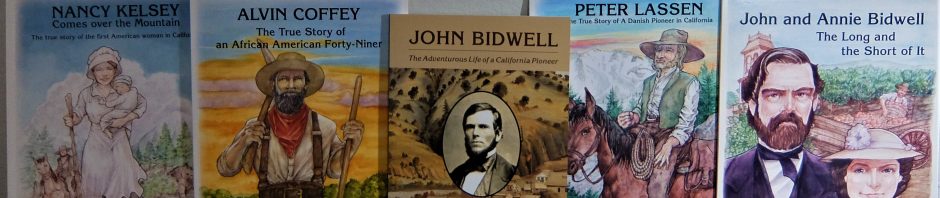

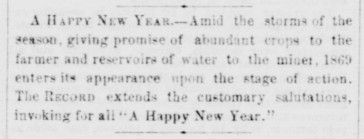
. . . as John Bidwell traveled toward Oroville on Friday, January 1, 1869. He drove a buggy and intended to take “the cars” (the railroad) to Marysville and then go by steamboat to San Francisco on business. But the weather was horrible. From Oroville he wrote to Annie:
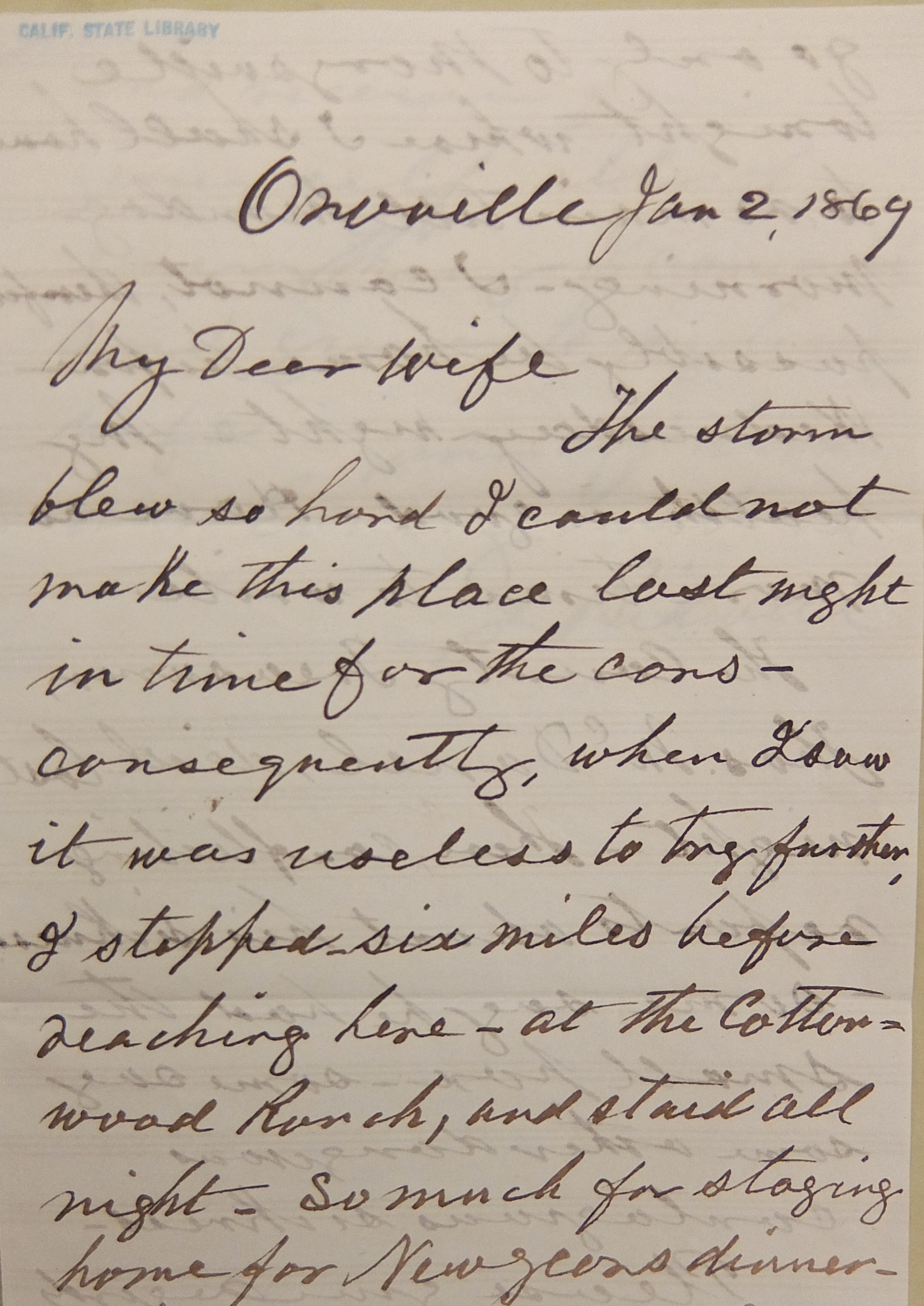
Oroville Jan. 2 1869
My dear wife The storm blew so hard I could not make this place last tonight in time for the cars – consequently, when I saw it was useless to try further, I stopped six miles before reaching here – at the Cottonwood Ranch, and staid all night.
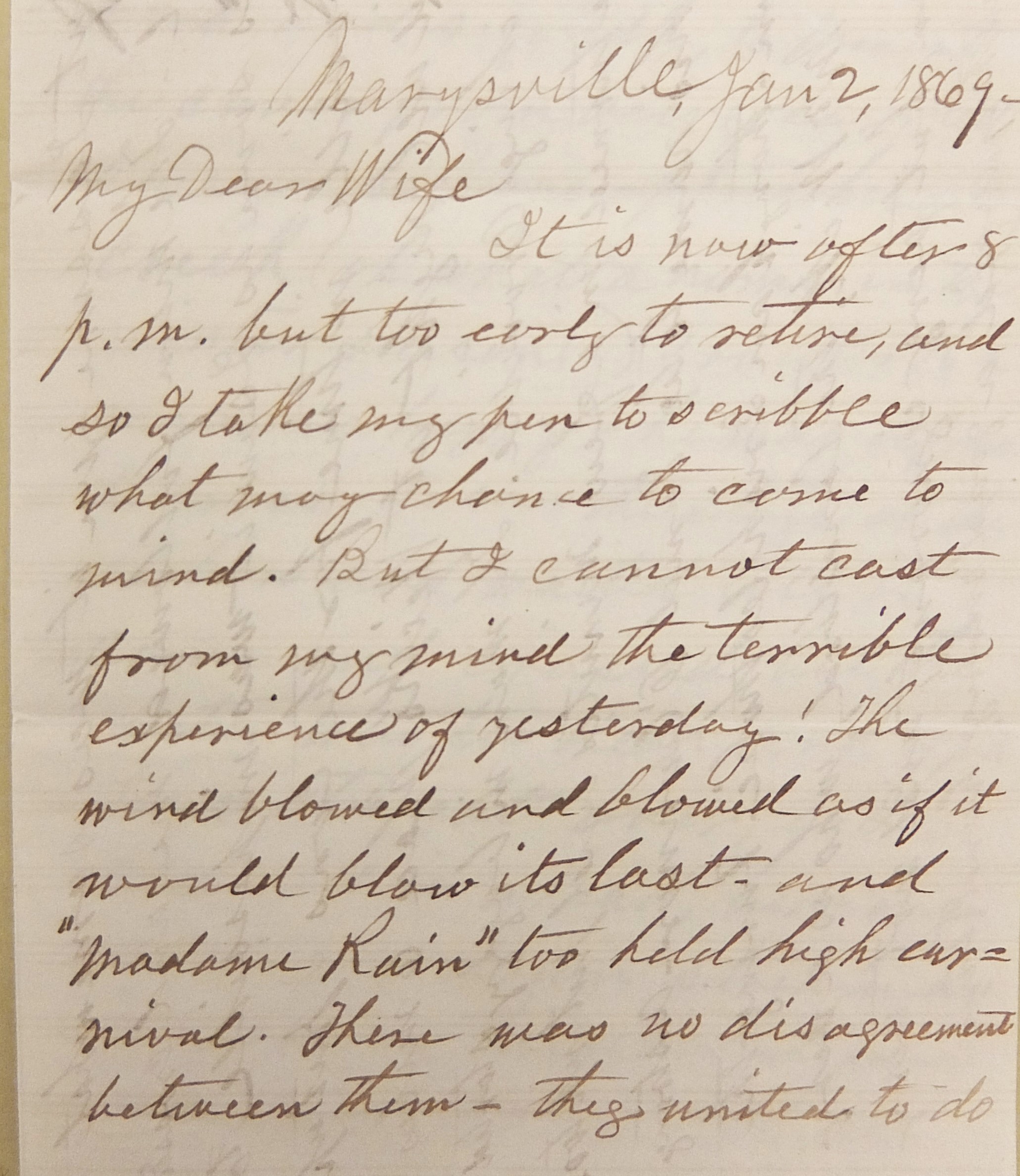
From Marysville he wrote again to describe his ordeal.
My dear wife It is now after 8 p.m. but too early to retire, and so I take my pen to scribble what may chance to come to mind. But I cannot cast from my mind the terrible experience of yesterday! The wind blowed and blowed as if it would blow its last and “Madame Rain” too held high carnival. There was no disagreement between them – they united to do their worst.
I was obliged to put down the buggy top for two reasons – first because the horses could not pull the buggy against the wind, and secondly, to prevent the cover from being carried away. As I was approaching Dry Creek (oh what a name in the winter season!) I overtook a man in a buggy – he was afraid to cross. We saw the stage at the station and waited till it came and crossed; but the water was too deep and rapid to go straight over, so I plunged in ahead, bearing slantingly downstream so as to have the current favor me, and came out all right. But I assure you it was somewhat frightful. The man followed me and crossed over. As soon as I saw it was impossible to reach Oroville in time for the cars I put up and staid all night at Wick’s place 6 miles before reaching Oroville.
Bidwell was followed a road that today is Highway 149 (more or less). Dry Creek intersects the road a mile or so south of where 149 branches off from Hwy. 99 and some three or four miles north of Wicks Corner, the junction of Hwy. 149 and Hwy. 70. Since “it was useless to try further” he stopped overnight at the ranch of Moses Wick.
Wick’s ranch was on the heavily traveled Marysville-Shasta Road and in addition to raising cattle he kept a hotel for travelers.
I don’t like driving a car on a paved road in heavy wind and driving rain. Imagine what it would be like in a buggy drawn by one or two horses, with no bridge over a raging stream.
The man in the other buggy was an Irishman named Daniel O’Connor, “a strong Union man, though an Irish Catholic.”
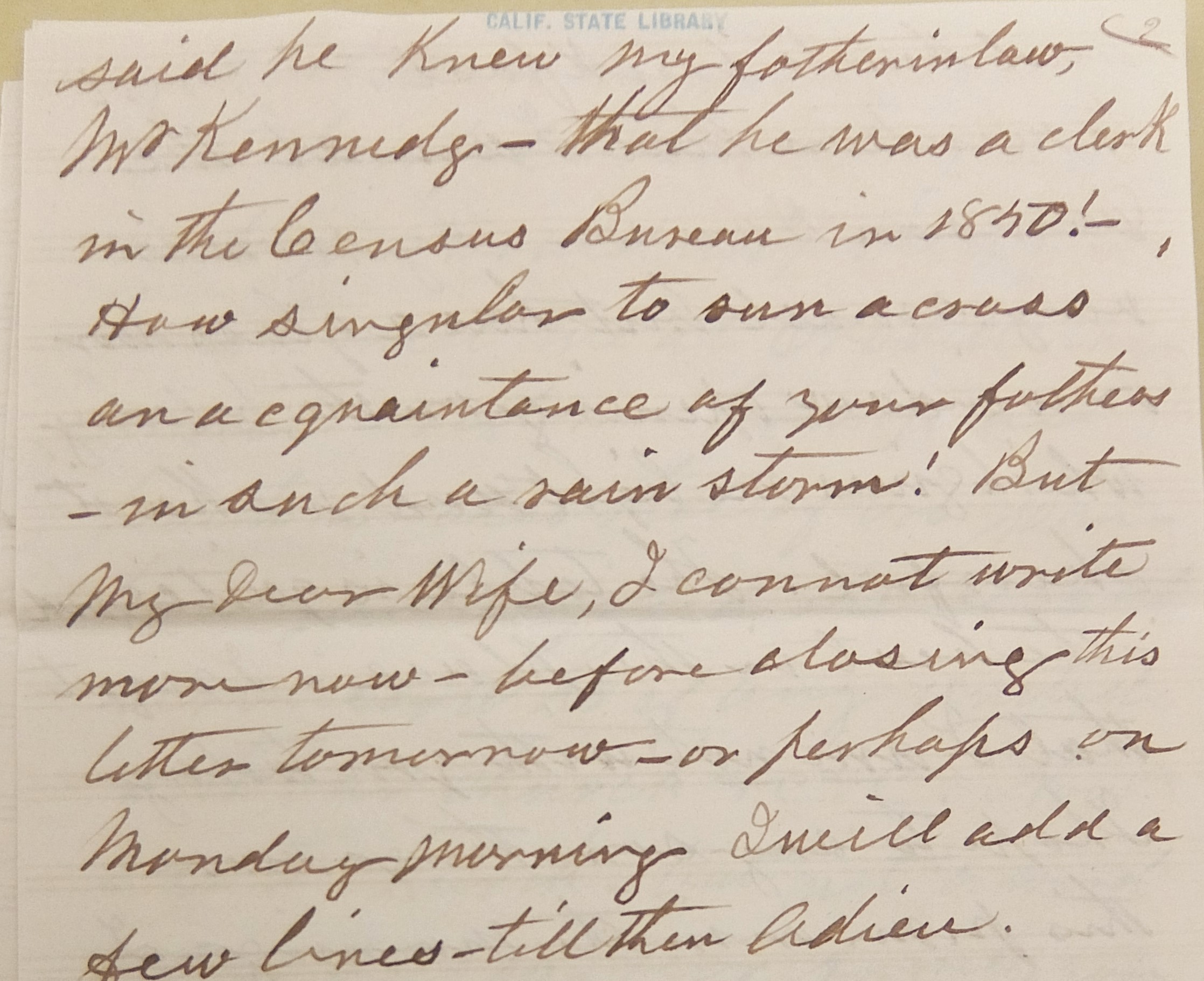
Mr. O’Connor “said he knew my father-in-law, Mr. Kennedy – that he was a clerk in the Census Bureau in 1850! How singular to run across an acquaintance of your father’s in such a rain storm!”
In his diary John Bidwell noted:
Fri. January l. Set out for San Francisco – Stormy day, heavy southeaster – Roads horrible – Reached Wick’s ranch and staid all night – Met a Mr. Daniel O’Connor once in the Census Bureau.
And that is how the year 1869 began for newly-married John Bidwell, trying to get to San Francisco through the wind and the rain of a very wet year.







 goldfields