On the Trail — July 22-23, 1841

Thursday, 22nd. Descended Big Sandy about 12 miles and stopped where we found plenty of grass — this was very acceptable as our teams were already much jaded for the want of grass.

Gray returned this evening having found Trapp’s company, which consisted of about 20 men. They had returned to meet our company, though on their way to hunt buffalo, and were now encamped on Green river about 8 miles distant. Gray had suffered much in overtaking the trappers; his mule gave out, there being no water for a great distance, and he himself was reduced so much by hunger and thirst that he was unable to walk. He was therefore compelled to crawl upon his hands and feet, and at last came up with the company in the most forlorn situation imaginable–if they had been another half mile farther, he never could have reached them.

Poor John Gray! He nearly lost his life in pursuit of the fur trappers. If anyone could have found them, it was John Gray, the half-Mohawk, half-Scottish trapper and trail guide, but he was traversing some of the most  unforgiving territory in America. It was only his skill and knowledge of the wilderness that kept him alive.

The man that Bidwell here calls “Trapp,” was generally called “Frapp” by his men. A German-American from St. Louis, his name was actually Henry Fraeb. He was a veteran fur trapper and one of the founders, with Jim Bridger and William Sublette, of the Rocky Mountain Fur Company.  The Rev. Joseph Williams called his outfit “a wicked, swearing company of men,” which is probably a pretty accurate description of the kind of men who lived far from civilization.
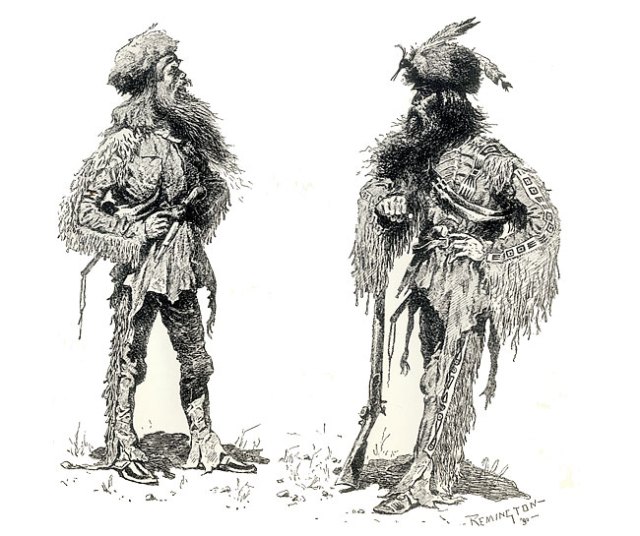
remington

A drawing of two mountain men by Frederic Remington, captioned “I took ye for an Indian!”

Friday, 23rd. Went to Green river — distance 8 miles — spent the remainder of the day trading with the hunters.
Posted in Uncategorized | Leave a comment

On the Trail — July 16-18, 1841

Friday 16th. Traveled about 10 miles and encamped opposite the Wind River mountains where we were in full view of many lofty peaks glittering with eternal snow and frost under the blaze of a July sun.

Sunday, 18th. Left Sweet Water this morning, course SW. Crossed the divide which separates the water of the Atlantic and Pacific oceans, and after a travel of 20 miles reached Little Sandy, a branch of Green river – 1 buffalo was killed.

Leaving the Sweetwater River, the emigrants took the gradual climb up through South Pass, as a few wagons had done before them, and many, many more would do in the following years. As George R. Stewart wrote,”Here, at the summit of the Rocky Mountains, the very backbone of the continent, the grade was easy and the pass itself was more like a broad plain, so level that you were never sure when you passed from the Atlantic to the Pacific watershed.” (The California Trail)

South Pass–hardly the inspiring vista you expect for the Continental Divide.

Meanwhile the company awaited the return of John Gray, who had set off in search of the trappers who would surely be interested in the items (alcohol) that some members of the group had brought along to sell.

Stay tuned for more about the trappers and John Gray.

Posted in Uncategorized | Leave a comment

On the Trail — July 15, 1841

John Gray and W.G. Romaine had set out on July 6th to see if there were any fur-trappers camped at Green River, where the trappers usually had their rendezvous at this time of year. They didn’t find anyone, so the two men came back on the 13th. But other members of the party were anxious to find the trappers, since they had items that they wished to trade, so Gray set out once again on the 15th.

Thursday, 15th. As many of the company had articles of traffic which they wished to dispose of at Green river, a subscription was raised to recompense any who would go and find the trappers. John Gray started in pursuit of them, while the company marched on slowly, waiting for his return. Travelled about 6 miles today.

Gray was gone for a week and suffered a great deal in his search for the trappers. It would have killed a weaker man. I’ll write more about his ordeal when we get to the 22nd.

At this point in their journey they were traveling along the Sweetwater River and approaching South Pass and the Continental Divide.

Bidwell doesn’t mention it in his journal, but elsewhere he reveals that the “articles of traffic” were bottles or kegs of liquor. In The First Emigrant Train to California (Echoes of the Past, p. 119) Bidwell says:

Approaching Green River in the Rocky Mountains, it was found that some of the wagons, including Captain Bartleson’s, had alcohol on board, and that the owners wanted to find trappers in the Rocky Mountains to whom they might sell it. This was a surprise to many of us, as there had been no drinking on the way.

No drinking—because Bartleson was saving it up to sell to thirsty trappers. This was a bit of entrepreneurship that hadn’t occurred to young John Bidwell. Bidwell was not a teetotaler at this time in his life, but he never was a drinking man.

Posted in Uncategorized | Leave a comment

On the Trail: July 10, 1841

From John Bidwell’s journal for July 10, 1841:

“Saturday, 10th. Travelled about 14 miles and stopped to kill and dry meat. Buffalo began to grow scarce.”

By this time on their journey the company had almost exhausted its supplies of flour and other foodstuffs. Bidwell had laid in extra supplies, because he hated the idea of living on nothing but meat, but by now even he must have been running low. He doesn’t say how much he had left. The company knew they still had a long way to go, although they really didn’t have a good idea of how far. They began to kill buffalo and dry the meat, with the hope that the jerky would last them until California.

However they had left their plans to “make meat” until too late. Crossing the plains they had seen vast herds of buffalo, but now as they traveled up the Sweetwater River toward the Continental Divide, they saw fewer and fewer. They killed twenty buffalo on the 8th and ten on the 9th. On the 10th they decided to stay in place and spend a day or two hunting and drying meat.

greenriver

Green River, Wyoming

They killed 6 or 7 the 10th, and 4 or 5 on the 11th. John Gray and William Romaine came back from a scouting expedition to the Green River on the 13th and reported that they found no game ahead. Meat on the hoof was running out just at the time they realized how much they would need it.

Posted in Uncategorized | Leave a comment

John Grey and Ignace Hatchiorauquasha

John Grey (Bidwell spelled it Gray) was hired by the Englishman W. G. Romaine as a guide for his summer tour of the American West. Grey was half Iroquois and half Scottish, a St. Regis Mohawk, born around 1795 in upstate New York.  His father, William L. Grey, had served as a soldier during the American Revolution and then married into the Mohawks of Akwesasne. John Grey also went by the Iroquois name of Ignace Hatchiorauquasha, St. Ignatius being his patron saint.

John Gray, as depicted by Nicholas Point, S.J.

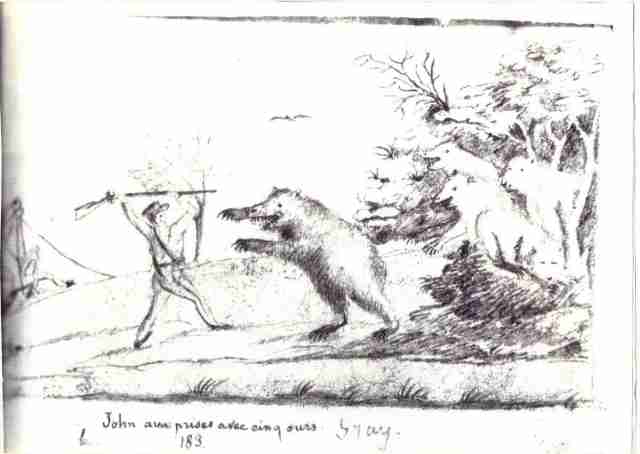
Father Nicholas Point, one of the priests with Father DeSmet, drew this portrait of John Gray while on the trail. The smaller picture is of Gray’s wife. Father Point also drew a sketch of John Grey battling five grizzly bears.

Grayandgrizzlies

The Catholic priests had a high opinion of Grey and his abilities. Father Gregory Mengarini records the following:

“So the sun rose and the sun set, and the end of our journey was still over a thousand miles away. Sometimes John Grey would say to me in the morning, “Father, so you see that speck in the distance? Today we must reach there.” “Then our day’s travel will be short,” I would answer. “We shall see,” he would say laughingly. And the hours of the morning would pass and we would be already journeying long under a scorching afternoon’s sun before that speck would achieve appreciable magnitude and distinctness of form.”

Grey entered the fur trade sometime around 1818, about the same time that he married his wife Marienne Netketichon, also a Mohawk. He was active in the fur trade for the next 25 years or so. He was considered a gifted leader who helped bridge the gap between Indians and white people.

Grey and Romaine, along with four other men, left the wagon train on July 25th to return to the United States. The trip with Romaine was probably the last of Grey’s excursions to the West, after which he retired to his home in Kansas City, Missouri. He was killed in 1848 in a dispute with a neighbor.

For more about John Grey, consult The Mountain Men and the Fur Trade of the Far West, by Leroy R. Hafen, or see the website of his great-great-great grandson Hunter Gray. (I removed the link because that website is no longer operative.)

Posted in Uncategorized | 1 Comment

On the Trail with Bidwell and Lord Romaine

Tuesday 6th. This morning John Gray and Romaine were sent on to Green river to see if there were any trappers at the rendezvous, and then return to the company with the intelligence. All hands were anxious to have their names inscribed on this memorable landmark [Independence Rock], so that we did not start until near noon; went up stream about 8 miles and encamped on Sweet Water.

John Gray (or Grey) and W. G. Romaine were two of the most intriguing members of the party. They were part of Father De Smet’s missionary party: Gray was listed as a trapper, and Romaine as a “pleasure seeker,” or tourist. Romaine was an Englishman, and was referred to by the other men as “Lord” Romaine. Both men returned to the States without going all the way to California or Oregon.

The men in the Bidwell-Bartleson Party had a variety of reasons for setting out on the trail; not all of them were seeking a new home in the West. “Cheyenne” Dawson, in his 1894 recollection of his 1841 overland trip, says that their group was a “very mixed crowd.” “There were heads of families . . . and many adventurous youths like myself and John Bidwell, who wanted nothing but to see and experience. There were gentlemen seeking health, and an English lord, Lord Romain, going out with a half-breed hunter, John Grey, to shoot buffalo.”

I imagine that a well-to-do young Englishman with a cultured accent would have been called “Lord” by an American frontiersman whether he was one or not. In fact, William Govett Romaine was not an aristocrat. Born in 1815, he was the second son of a clergyman, Robert Govett Romaine, vicar of Staines, Middlesex. He graduated from Trinity College, Cambridge, went on to study law, and was called to the bar in 1839.

William Romaine sounds like a proper Victorian gentleman, solidly middle-class, well-educated, and destined for a distinguished career in the civil service. All of which is true, but he also had an adventurous spirit and a yen to see the world. Before he settled down to an office in the Inns of Court and genteel family life, he decided to take a trip to see the great American West.

He hired an experience mountain man, John Gray, as his guide, and joined Father De Smet’s company. He was eager to experience every bit of the wild West that he could, and Father De Smet records that at the very beginning of their journey, while the others set out on their long trek to the West, he, Father Point, and the “young Englishman” took a side trip to visit a nearby Indian village.

On July 25th, after reaching the Green River, “Lord” Romaine and his guide turned back. Romaine had accomplished his goal: he had roughed it on the trail, met Indians and mountain men, shot buffalo, and seen the beauties and wonders of the great American West. He was one of the earliest English travelers to do so, well before the famous explorer Sir Richard Burton.

Maitland, R. E. Fuller, active 1904-1924; William Govett Romaine (1815-1893)

Maitland, R. E. Fuller; Portrait of William Govett Romaine (1815-1893) by R.E. Fuller Maitland,  Ministry of Defense Art Collection

“Lord” Romaine did not give up travel after his return to Great Britain. His distinguished legal career took him to the Crimea, India, and Egypt. The British Dictionary of National Biography describes Romaine as “adventurous, fond of travel, a keen observer, high-spirited, and zealous in all he undertook,” a description that certainly fits the young Englishman who traveled with the first emigrant party to set out for California.

Next time: John Gray, who is maybe even more interesting than William Romaine

Posted in "Lord" Romaine, Uncategorized | Leave a comment

On the Trail — July 5, 1941

Monday, 5th. The hills continued to increase in height. After travelling 16 miles we encamped at a noted place called Independence Rock. This is a huge isolated rock covering an area, perhaps half a square mile, and rising in shape of an irregular obtuse mound to the height of 100 feet. It took its name from the celebration of the 4th of July at this place by Capt. Wm. Sublette, and it now bears many names of the early travelers to these regions.

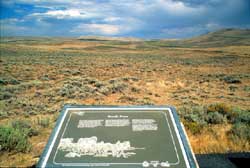
Independence Rock is located in southwestern Wyoming, near the Sweetwater River.  It’s impossible to miss.

june2014 450Captain William Sublette, a famous early fur trader, camped here on July 4th, 1830, and gave Independence Rock its name in honor of the nation’s birthday.
Father De Smet at first thought “it had received this pompous name from its isolated situation and the solidity of its basis,” but he was soon set right. It was also known as the “Great Record of the Desert,” because travelers made a practice of carving their names into the rock. Bidwell and company were no exception. On the 6th he records that “All hands were anxious to have their names inscribed on this memorable landmark, so that we did not start until nearly noon.”

Many names can still be read on Independence Rock. The ones that have lasted are the ones carved into the rock. The ones written with tar or grease have faded away.

Independence Rock

Posted in Bidwell-Bartleson Party, Uncategorized | Leave a comment

A Chico Fourth of July

Issue Date JUNE 30 1876 page 3

From the Chico Enterprise Weekly, here is what you could expect on July 4, 1877:

The patriotic citizens of Chico, always ready to do homage to the birthday of a great and glorious Republic, made this the one hundred and first anniversary no exception. The weather was most favorable, with the sweet south wind coming in refreshing zephers to temper the sultry Summer sun. The joyous occasion was ushered in at midnight by the ringing of a merry peal from the city bells. At sunrise a salute was fired from the old cannon which has hone good service in this city for sixteen years, on many similar occasions, and the bells again took up the chorus, waking the unconscious sleeper to the fact that the day’s rejoicing had opened, and that loyal hearts were even now astir to welcome in the day and throw “old glory” to the breeze.

The 4th of July celebration was an all-day affair. A large crowd, including many from surrounding communities, assembled at the Armory and the Engine house to watch the mustering of the militia and the firemen. At 9:30 a.m. the festivities began with a parade through the streets, ending at “the grove near the Sierra flume.” The program that followed consisted of music by the Chico Brass Band, an invocation by the Rev. J.W. Ellis, a song from the Chico Glee Club, and the reading of the Declaration of Independence.

This was followed by a poem written for the occasion and read by George F. Nourse. The poem, The People’s Pioneer Line, was quite a lengthy one and was printed in the newspaper. It likened the nation to a railway line:

‘Tis just one hundred years and one ago,
With thirteen cars we pulled from Station One,
And under orders steamed along quite slow,
Making by day and night our wondrous run.
From time to time we lengthened out our train,
By adding on new freshly peopled cars,
Til now our line does thirty-eight maintain,
And on our flag there’s just as many stars.

The poem was followed by an oration, given by J.F. Hutton, “full of eloquence and original thought”and also printed in full. According to the newspaper report:

There was a breathless silence prevailed during the delivery of the oration, and at its close the audience broke forth in rapturous applause.  The benediction was then given and a rush was made for the tables.

The tables were laden with barbecued meat, several oxen having been cut into quarters and roasted for 12 hours. 1800 pounds of beef were served, along with a dozen hams, plenty of bread, and a variety of pickles.

Next came the “Comicalities” or the “Parade of Horribles,” described by the reporter as the “most ludicrous, comical and laughable exhibition we have seen in many a day.” After a solemn morning assembly and a good meal, it was time for some entertainment.

The Parade of Antiques and Horribles was an old New England custom in which folks dressed up in grotesque costumes and rode old nags to make fun of local dignitaries and current events. The morning parade was a stirring procession of soldiers, bands, and notable citizens in carriages. The afternoon parade was a parody to lighten the day’s mood.

The Chico parade featured a “burlesque on the City Police force and the City Fathers,” and a depiction of “Brother Jonathan and his family going West in an old cart.” “About half a dozen lengths of stovepipes on wheels burlesqued the artillery representation in the forenoon’s procession.”

I haven’t seen any photos of Chico’s Parade of Horribles, and I don’t know how long the custom lasted. Here’s a photo from a New England parade in the same period.

wethersfield-parade-of-ho-004

Photo of a Parade of Horribles from Wethersfield, Connecticut.

The Chico Independence Day celebration went on into the evening with more music, fireworks, and a grand ball. Our ancestors knew how to celebrate the 4th in style!


Posted in Uncategorized | Leave a comment

On the Trail with John Bidwell — July 1841

Friday, 2nd. Continued to coast up the N. fork [of the Platte River]; the bottoms of the river were in many places completely covered with Glauber Salts, so much so that even handfuls could be taken up perfectly white.

Glauber’s salt is a hydrous sodium sulfate mineral, also known as sal mirabilis (wonderful or miraculous salt). It was formerly used as a laxative, much as Epsom salt (magnesium sulfate) was, until gentler methods came along. Now the mineral is mainly used in the manufacture of detergents, and in paper pulping. Bidwell saw it everywhere is the West.

Saturday, 3rd. Left the N. fork; a distance of 12 miles took us to a spring of cool, though unpleasantly tasted water. The day was intensely warm, and road mountainous; killed four buffalo and two deer.

Sunday, 4th. Pursued our way over hills and dales, scorched with heat; came to a small copse of red willows, from which issued excellent springs of water. Three buffalo killed, distance travelled 22 miles.

They were getting close to Independence Rock, and their guide Thomas Fitzpatrick could tell them so.

No one in the group, not Bidwell, nor Jimmy John, nor Father De Smet, make mention of any celebration of Independence Day on the 4th of July in their journals. Yet you’d think it could hardly have gone unremarked. But their focus was always on the day-to-day difficulties of the journey: the rough terrain, the need to find food and water, and the imperative to press on.

Posted in Uncategorized | Leave a comment

Food on the Trail: June 24-30

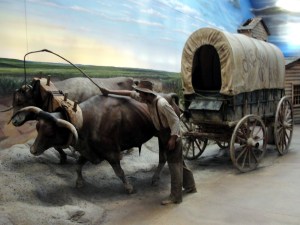
When I talk to 3rd and 4th grade classes about John Bidwell, I usually start with his westward journey. I show them a picture of a small ox-drawn wagon, the kind he would have taken, and ask them what they would pack for a 6-month journey, making sure that they understand that there will be no place to buy food along the way and that all food will have to be made “from scratch.” (Which can be difficult, but fun, for youngsters to imagine.)

3wagon&oxen

They will come up with water, bread (“you’ll have to make your own bread, so take some flour”), and apples, among other things. If someone mentions meat, we talk about no refrigeration — how will you get meat? And then one child (usually a boy) will happily announce that you will need a gun.

Yes indeed, a gun was an essential tool. After the Bidwell-Bartleson Party left Fort Laramie they saw buffalo in abundance as they traveled along the Platte River. They were eating buffalo meat on a daily basis at this time.

But what else was on the menu? Besides the supplies they had in their wagons, what else could they find to eat along the trail?

Bidwell mentions:

many wild pears, likewise an abundance of peas, wild — though the bush was dissimilar to to ours, yet the the pods bore an exact similarity, taste, the same.

I have no idea what this pea-plant was.

James John, in his diary covering the same period, writes of “a kind of mountain turnip.”

They are about as large as hen’s eggs and are tender and good eating; also there is currants and mountain cherries.

(These were maybe chokecherries.)

In Wyoming they also found excellent grass for their animals, and grizzly bears. James John was referring to grizzlies when he wrote:

There are some gray bears there which are monsters. Large, but we have killed none of them yet.

If there are any Euell Gibbons types out there who are familiar with edible wild plants, and can identify these pioneer foods, please let us know.

Posted in Uncategorized | Leave a comment