Ghost Town

Columbia_Flippen_Webdam-1280x642

I love reading old books about California history, tales of “The days of old, the days of old, the days of ’49.” And here is just such a book.20160510_095015-1
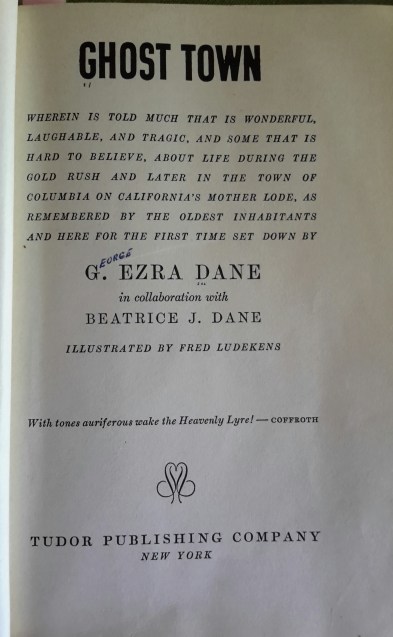
Ghost Town, by G. Ezra Dane, is a collection of incidents, mostly true, from  the history of Columbia. Today Columbia, “the Gem of the Southern Mines,” is a State Historic Park, with many visitors. But when Dane published these stories in 1941, it really was a “Ghost Town.”

Dane begins his tale with this caveat:

Warning to unwary readers: Here is where we tell you what not to expect from this book. Do not expect historical accuracy — this is not a history. There is some history in it; there are even whole pages of what we know to be plain, honest truth. A great deal more of it may be true; we shouldn’t be surprised if it was. Some of it we know to be absolutely false, and that is the best part of all. In another sense it is all true. It’s “genuwine.” What there is of invention in it is the natural product of three generations of story-telling in a country where that art has flourished.

Although the entire book is related as if by a single “Old-Timer” it is actually made up of stories from a number of storytellers, all of whom are given credit at the end of the book. The chapters have headings such as this one:

Wherein we learn why Life in the Diggins produced such remarkable characters; are introduced to several of them, including Nervi the Hieroglyphographer; the comparatively learned Mr.Matt Brady; George Foster, the Jovial Host & Joker; and J.B. Harmon, the Water-Walker; and are told of the Cook that was Too Good for Columbia,, or, the Black Cat in Rabbit’s Clothing.

How can you resist wanting to read more about them? and many more, including Pitch-Pine Billy and his Golden Frog, the Valiant Washer-Lady, the Battle of Hardscrabble Gulch, the Loves of Diamond Bill, and Women, Plain & Fancy. This is pure entertainment, and “mostly true.”

20160510_095101

I have another reason, besides its sheer entertainment value, for recommending this long out-of-print book. I checked it out of the Butte County Library. It is labeled copy 3, and is the only copy left in the system. Since it was rebound at some time, it doesn’t look like much. It’s the sort of book that could be carelessly discarded, but not if it has a history of frequent checkouts.

So read it and enjoy!
Posted in Columbia, Uncategorized | 2 Comments

Join Me at the Chico Museum

bidwelldayz

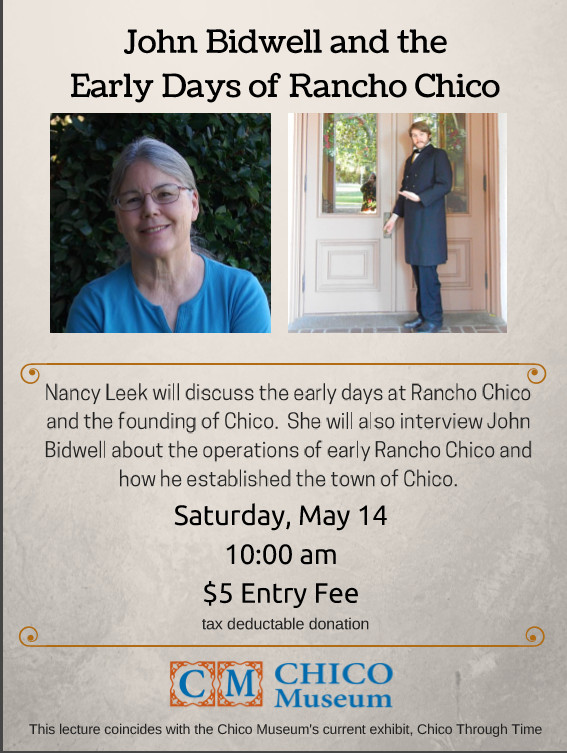
What was happening at Rancho Chico in the early 1850s? Who was here and what were they doing?

Find out when I interview Major John Bidwell at the Chico Museum on Saturday, May 14th. Enjoy the program at 10 a.m. and then stay to enjoy “Chico through Time,” an outstanding display all about Chico history. Your $5 admission gets you the program and museum entry.

John Bidwell is portrayed by Nick Anderson. I always enjoy working with Nick. Last month we went to Orland and talked to some 4th grade classes. This month we face a tougher audience — people who actually know something about Chico history!


Posted in Uncategorized | 1 Comment

May Garden Journal continued

DSCN3982

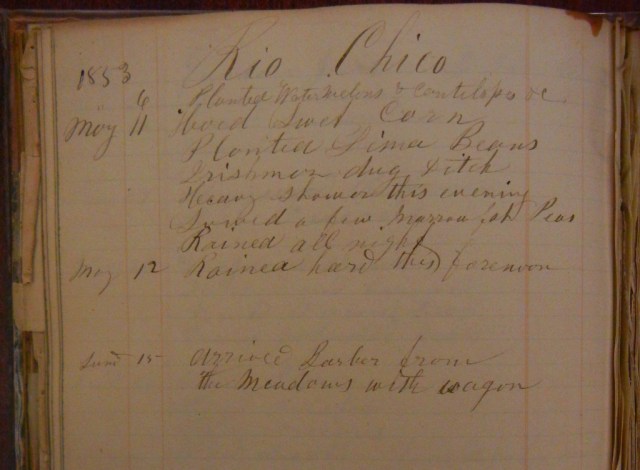
1853          Rio Chico

May 6:   Planted Watermelons and Cantaloupes
May 11:  Hoed Sweet Corn
Planted Lima Beans
Irishmen dug Ditch
Heavy Shower this evening
Sowed a few Marrowfat Peas
Rained all night

May 12: Rained hard this forenoon

Sund[ay] 15: Arrived Barber from the Meadows with wagon

Barber is Alexander H. Barber, Bidwell’s ranch manager at the time. He supervised various activities around the ranch, and often went on business trips to Marysville and Sacramento. Marrowfat peas are the traditional starchy green peas.

I don’t know who the Irishmen were who were digging the ditch. Bidwell had a great number of men working for him, and the roster changed all the time as the men came and went.


Posted in Gardening, Uncategorized | Leave a comment

More on The Esplanade

In 1979 Helen Sommer Gage was interviewed in an oral history project about her memories of early Chico. The interview is called Chico Changes: The Bidwells, the Park, First Street, the Esplanade, 1888 to 1979, and the interviewer was Insu Justesen. The typescript of the interview is available at Special Collections, Meriam Library, CSU Chico.

Helen Sommer Gage was born in 1888, and had grown up knowing the General and Mrs. Bidwell. As a young woman she was a friend and companion to Mrs. Bidwell, and often stayed overnight at the Mansion. Here is what she had to say about the development of The Esplanade:

IJ: How do you feel about the remaking of the Esplanade? I know that they took out a lot of trees and remade it.

HG: They didn’t remake it exactly. After General made his first visit to Washington as a member of the House, that was his first view of a real beautiful city. He was just enchanted with the tree-lined streets and the beautiful homes set back in lovely gardens. He made up his mind: if he ever had a town it would have broad streets lined with trees. And that was one reason why Chico’s streets are broader than the towns that were laid out at that time.

locust-tree3

He planted locust trees from one end of town to the other. They were very beautiful, and they were very fragrant, but of course they did scatter blossoms and all that sort of thing. It had been his project to make the Esplanade a beautiful, tree-lined street. I remember after they cut them all down, it was horrible, just a blazing mass in the summertime. And I remember Mrs. Bidwell having one of those little carriage parasols that turned sideways. Whenever her carriage was driven out when they came out of the Mansion gate she would never look towards the Esplanade. And she’d say a little prayer to herself, like that. . . . But she felt so terribly to see that beautiful tree-lined street that in the springtime was just filled with these beautiful, white blossoms. She just couldn’t look at it. And a lot of people felt that way too.

IJ: I know that this century, when those trees did finally grow, I heard that when you drove along Esplanade you were completely enclosed by the tree branches meeting overhead.

HG: You mean the old trees that were there. Yes, they were big trees. I think it’s beautiful now. I think they probably have a better type of street tree. That was all they had in those days.

esplanade postcard

Meriam Library, Special Collections

Posted in Esplanade, Uncategorized | Leave a comment

May Garden Journal

DSCN3981-001

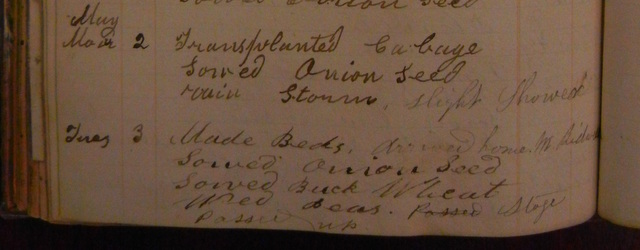
May
Mon 2:  Transplanted Cabage
Sowed Onion Seed
rain storm     slight Shower

Tues 3:  Made Beds    drived home Mr. Bidwell
Sowed Onion Seed
Sowed Buck Wheat
Weed peas.  passed  Stage passed up

The note “drived home Mr. Bidwell” is an indication that not only is this journal not written in Bidwell’s hand, but that he wasn’t even present when some of it was written. Bidwell was frequently gone from Rancho Chico — at Marysville, Sacramento, or San Francisco — engaged in business or politics.

Posted in Gardening, Uncategorized | Leave a comment

Esplanades and Boulevards

Paris! Barcelona! New York City! Chico!  Chico?

What puts Chico in the same class as these world-renowned cities? It is Chico’s own Esplanade, a boulevard noted for its beauty and charm.

bouleward bookIn The Boulevard Book, authors Allan B. Jacobs, Elizabeth Macdonald, and Yodan Rofé study the “History, Evolution, Design of Multiway Boulevards.” A beautiful large volume with numerous drawings and diagrams, this book was published by The MIT Press in 2002. Allan B. Jacobs is a notable urban designer and professor emeritus at the UC Berkeley Center for Environmental Design.

The authors have this to say about The Esplanade:

The Esplanade in Chico, California is a relatively new multiway boulevard and it is unexpected, but it plays second fiddle to none of the others. . . .

One would not expect to find a multiway boulevard in a small, agriculturally-based community in the northern Central Valley of California. Boulevards of this type are so often associated with formal structure and strong, centrally directed design — characteristics not usually associated with agricultural communities. Often, too, boulevards start out as such; they are designed and built that way from the outset. Not so The Esplanade. It began as a private road on Rancho Chico, the 25,000 acre Bidwell family estate, and was first used principally by farm wagons. [Although it crossed Rancho Chico, which was Bidwell’s private property, the Esplanade (the former Shasta Road) was always a public thoroughfare.]

But by as early as 1898 it had been planted with four rows of trees and become a public roadway for buggies, wagons, bicycles, and pedestrians. By 1905 there were streetcars on The Esplanade, part of what was to become a remarkably comprehensive public transit system in a small city, one that permitted travel as far south as San Francisco.

The authors continue with a detailed analysis of The Esplanade and its functionality. At the time this study was written, the only criticisms they had were that the needs of pedestrians at crosswalks could be better addressed, and that the Esplanade really needed an ice cream shop about halfway along. (I’ll vote for that! although I do like a softie cone from Big Al’s.)

By the way, if you are wondering about the world “esplanade,” it comes from Middle French, via Spanish, from the Latin word explanare, meaning “to make level.” Originally an esplanade was a clear level space around a fortification, but it came to mean “a level, open area; especially : an area for walking or driving along a shore.” (Merriam-Webster Dictionary.)


Posted in Esplanade, Uncategorized | 2 Comments

Book News

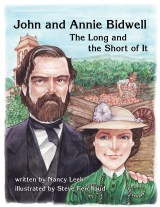
John and Annie Bidwell: The Long and the Short of It is now available at Costco! If you are a Costco customer, it’s a good place to pick up my book.

Otherwise, I still recommend that you buy it from The General’s Store at Bidwell Mansion, because purchases there support the Bidwell Mansion Association and its educational support of the Mansion.

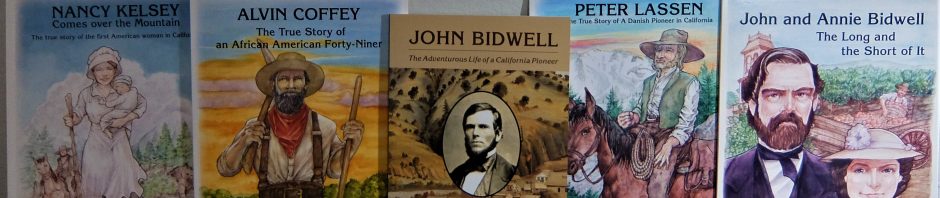
If you want a classroom set for your school, please contact me at goldfieldsbooksca@gmail.com and I will get you a set at a discount. I am also available for class presentations, and sometimes I even bring John Bidwell with me!

My books are also available at Made in Chico, The Bookstore (Chico), My Girlfriend’s Closet in Paradise and The Rusty Wagon in Orland.

Posted in Uncategorized | 2 Comments

Chico’s Esplanade

I was glad to see this article in today’s Chico Enterprise-Record about the historic significance of the Esplanade. Amy Huberland, an archeologist and the assistant coordinator for the Northeast Information Center at Chico State, is calling attention to the need to proceed carefully when dealing with a road that has historical significance, not only for Chico, but for all of northern California.

Esplanade1890.jpg

Bicycle path along the Esplanade, with rows of trees marking other lanes. Photo courtesy Special Collections, Meriam Library, CSUChico.

Today’s Esplanade is based on the Marysville-Shasta Road that dates from the Gold Rush, if not earlier. When John Bidwell and Peter Lassen first came this way, the road was no more than a faint track, based on native trails and the trails of the fur-trappers. There is a good map accompanying the Chico E-R article.

By the time Rancho Chico was established it was a busy road. It ran along side the Feather River as far as Hamilton, and then struck out across the valley in a northwest direction, headed for Red Bluff on the Sacramento River. Travelers could stop at Neal’s Ranch or Bidwell’s Ranch along the way for refreshment and information.

D.F. Crowder, who came to Chico in 1856 at the age of twelve, described it this way:

There was no bridge across Chico creek but there was a ford near where the present bridge now stands. The Shasta trail, now the Shasta road, lead off almost due north as it does now and it was black with immigrants — just like ants, coming and going. Some had ox teams, some were afoot and others drove mules. I don’t remember ever seeing a burro at that time.

This was the road that became the Esplanade, and later Highway 99. It ran right through the middle of Rancho Chico. In the 1890s John Bidwell began to develop the road with an eye toward selling off lots along the road. He planted rows of trees along the broad track of the Shasta Road to mark off lanes for carriages, wagons, riders, and pedestrians. He doesn’t say much about this project in his diary, but he referred to it in this entry for March 31, 1891:

Wife drove with me this A.M.- Laid out lines on W. side Esplanade for road

Although some changes are necessary to keep the Esplanade safe and effective in the 21st century, I hope we can keep its historic character in mind as changes are planned.


Posted in Esplanade, Uncategorized | 1 Comment

Garden Journal continued

1853     Garden Journal   Rio Chico

DSCN3981.JPG
[April]
Mon 25:  Sowed Onion Seed
Tues 26:  Sowed Onion Seed
Planted Corn
Wen 27:  Manured the Garden
Weed Onions
Thurs 28:  Frequent showers
Plowed and harrowed
Sowed Onion seed
Transplanted Beets

Frid 29:  Rain Storm
Hoed Potatoes
Weed Onions
Weed Beets     Snowed on low mountains

Sat 30:  Made Beds
Sowed Onion Seed

And that’s April 1853 in the garden at Rancho Chico.  Not the most exciting journal ever written, but still, it’s a glimpse into life on Rancho Chico in the 1850s.

They were planting a lot of onions, it looks like to me! But onions would have been a reliable crop and a good seller. People want more onions than beets.

This is not in John Bidwell’s handwriting. He didn’t make the letter “d” as you see it here. The Garden Journal may have started out in his hand, but someone else took it over — I don’t know who.


Posted in Gardening, Uncategorized | Leave a comment

McIlhany, Mules, Major Bidwell, and Murder

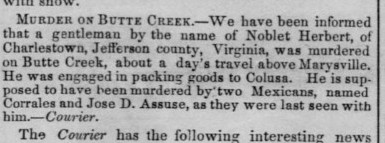
Business was good for Edward McIlhany in 1851, with a store in Onion Valley and a ranch near Marysville where he could rest and feed his mules, and assemble pack-trains to carry goods to the miners in Onion Valley. But business got tougher in 1852; expenses were high and defaults by creditors were numerous. Ed McIlhany decided to quit the packing business. He sold his string of mules to four men who had come to California in the same Virginia company with him: Noblet Herbert, Robert Blakemore, and brothers Charles and George Cuningham.

Noblet Herbert was a great-grand-nephew of President George Washington. He was one of the men of McIlhany’s group that  went to the Shasta Mines, then to Bidwell’s Bar and American Bar, where their efforts to dig a race failed.

In the spring of 1852 he bought the string of mules from McIlhany. The two Cuninghams were otherwise engaged, and Blakemore decided to return to Virginia, so Herbert was on his own, packing with two Mexican muleteers who came along with the mule train deal.

And then in the fall of 1852 Herbert disappeared, and so did the two Mexicans. $3000 in gold was missing, the mules were  straying around, and the remains of the pack saddles were found burnt at a campsite near Butte Creek.

herbert murder news

Daily Alta California, December 2, 1852

McIlhany got the word that Herbert was missing, and that “a train of mules, some twenty-five or thirty, had been running loose at Bidwell’s Ranch for some time and the mules were very fat and no one claimed them.”

I took the stage and landed at Bidwell’s Ranch. The Major was glad to see me. I asked him about the mules and he told me that such a lot of mules were there and had been for some weeks. I asked if he would have them driven up so I could see them, which he did. As soon as the mules came up I recognized them immediately, as I had owned them and the boys had put a plain brand upon them, every brand alike.

Bidwell explained to me that there had been a train camped about a mile from his place on a little stream [Butte Creek] where there was a cabin and some men living in it. I went down to see them and found that there had been a train of mules camped there . . . with a white man and only two Mexicans. One day they said that the men had disappeared, the mules were gone, and the camp with everything in it had burnt up.  (Recollection of a ’49er, pp. 149-150)

They searched for Noblet Herbert, and even dragged the creek, but nothing was ever found. It was a sad end for a young man who had come to California to make his fortune.

Ed McIlhany stayed for a few more years in California, but a string of bad business deals and lawsuits left him with little to show for his investment of time in the Golden State. In December 1856 he returned to the States and his family, who had moved from Virginia to Missouri in his absence.

Posted in Edward McIlhany, Uncategorized | Leave a comment