Esplanades and Boulevards

Paris! Barcelona! New York City! Chico!  Chico?

What puts Chico in the same class as these world-renowned cities? It is Chico’s own Esplanade, a boulevard noted for its beauty and charm.

bouleward bookIn The Boulevard Book, authors Allan B. Jacobs, Elizabeth Macdonald, and Yodan Rofé study the “History, Evolution, Design of Multiway Boulevards.” A beautiful large volume with numerous drawings and diagrams, this book was published by The MIT Press in 2002. Allan B. Jacobs is a notable urban designer and professor emeritus at the UC Berkeley Center for Environmental Design.

The authors have this to say about The Esplanade:

The Esplanade in Chico, California is a relatively new multiway boulevard and it is unexpected, but it plays second fiddle to none of the others. . . .

One would not expect to find a multiway boulevard in a small, agriculturally-based community in the northern Central Valley of California. Boulevards of this type are so often associated with formal structure and strong, centrally directed design — characteristics not usually associated with agricultural communities. Often, too, boulevards start out as such; they are designed and built that way from the outset. Not so The Esplanade. It began as a private road on Rancho Chico, the 25,000 acre Bidwell family estate, and was first used principally by farm wagons. [Although it crossed Rancho Chico, which was Bidwell’s private property, the Esplanade (the former Shasta Road) was always a public thoroughfare.]

But by as early as 1898 it had been planted with four rows of trees and become a public roadway for buggies, wagons, bicycles, and pedestrians. By 1905 there were streetcars on The Esplanade, part of what was to become a remarkably comprehensive public transit system in a small city, one that permitted travel as far south as San Francisco.

The authors continue with a detailed analysis of The Esplanade and its functionality. At the time this study was written, the only criticisms they had were that the needs of pedestrians at crosswalks could be better addressed, and that the Esplanade really needed an ice cream shop about halfway along. (I’ll vote for that! although I do like a softie cone from Big Al’s.)

By the way, if you are wondering about the world “esplanade,” it comes from Middle French, via Spanish, from the Latin word explanare, meaning “to make level.” Originally an esplanade was a clear level space around a fortification, but it came to mean “a level, open area; especially : an area for walking or driving along a shore.” (Merriam-Webster Dictionary.)


Posted in Esplanade, Uncategorized | 2 Comments

Book News

John and Annie Bidwell: The Long and the Short of It is now available at Costco! If you are a Costco customer, it’s a good place to pick up my book.

Otherwise, I still recommend that you buy it from The General’s Store at Bidwell Mansion, because purchases there support the Bidwell Mansion Association and its educational support of the Mansion.

If you want a classroom set for your school, please contact me at goldfieldsbooksca@gmail.com and I will get you a set at a discount. I am also available for class presentations, and sometimes I even bring John Bidwell with me!

My books are also available at Made in Chico, The Bookstore (Chico), My Girlfriend’s Closet in Paradise and The Rusty Wagon in Orland.

Posted in Uncategorized | 2 Comments

Chico’s Esplanade

I was glad to see this article in today’s Chico Enterprise-Record about the historic significance of the Esplanade. Amy Huberland, an archeologist and the assistant coordinator for the Northeast Information Center at Chico State, is calling attention to the need to proceed carefully when dealing with a road that has historical significance, not only for Chico, but for all of northern California.

Esplanade1890.jpg

Bicycle path along the Esplanade, with rows of trees marking other lanes. Photo courtesy Special Collections, Meriam Library, CSUChico.

Today’s Esplanade is based on the Marysville-Shasta Road that dates from the Gold Rush, if not earlier. When John Bidwell and Peter Lassen first came this way, the road was no more than a faint track, based on native trails and the trails of the fur-trappers. There is a good map accompanying the Chico E-R article.

By the time Rancho Chico was established it was a busy road. It ran along side the Feather River as far as Hamilton, and then struck out across the valley in a northwest direction, headed for Red Bluff on the Sacramento River. Travelers could stop at Neal’s Ranch or Bidwell’s Ranch along the way for refreshment and information.

D.F. Crowder, who came to Chico in 1856 at the age of twelve, described it this way:

There was no bridge across Chico creek but there was a ford near where the present bridge now stands. The Shasta trail, now the Shasta road, lead off almost due north as it does now and it was black with immigrants — just like ants, coming and going. Some had ox teams, some were afoot and others drove mules. I don’t remember ever seeing a burro at that time.

This was the road that became the Esplanade, and later Highway 99. It ran right through the middle of Rancho Chico. In the 1890s John Bidwell began to develop the road with an eye toward selling off lots along the road. He planted rows of trees along the broad track of the Shasta Road to mark off lanes for carriages, wagons, riders, and pedestrians. He doesn’t say much about this project in his diary, but he referred to it in this entry for March 31, 1891:

Wife drove with me this A.M.- Laid out lines on W. side Esplanade for road

Although some changes are necessary to keep the Esplanade safe and effective in the 21st century, I hope we can keep its historic character in mind as changes are planned.


Posted in Esplanade, Uncategorized | 1 Comment

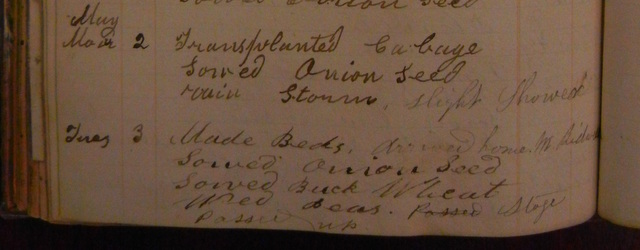
Garden Journal continued

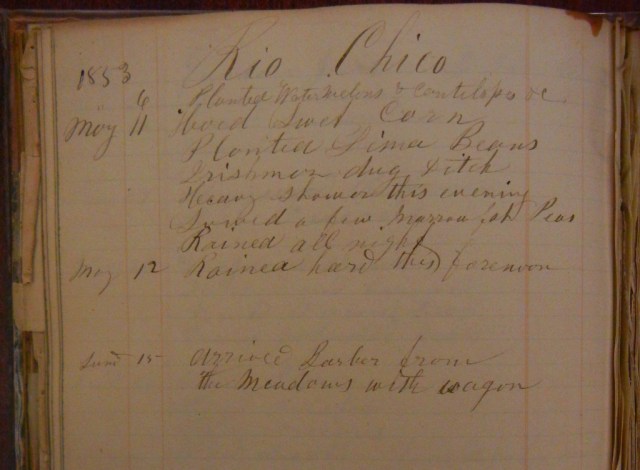
1853     Garden Journal   Rio Chico

DSCN3981.JPG
[April]
Mon 25:  Sowed Onion Seed
Tues 26:  Sowed Onion Seed
Planted Corn
Wen 27:  Manured the Garden
Weed Onions
Thurs 28:  Frequent showers
Plowed and harrowed
Sowed Onion seed
Transplanted Beets

Frid 29:  Rain Storm
Hoed Potatoes
Weed Onions
Weed Beets     Snowed on low mountains

Sat 30:  Made Beds
Sowed Onion Seed

And that’s April 1853 in the garden at Rancho Chico.  Not the most exciting journal ever written, but still, it’s a glimpse into life on Rancho Chico in the 1850s.

They were planting a lot of onions, it looks like to me! But onions would have been a reliable crop and a good seller. People want more onions than beets.

This is not in John Bidwell’s handwriting. He didn’t make the letter “d” as you see it here. The Garden Journal may have started out in his hand, but someone else took it over — I don’t know who.


Posted in Gardening, Uncategorized | Leave a comment

McIlhany, Mules, Major Bidwell, and Murder

Business was good for Edward McIlhany in 1851, with a store in Onion Valley and a ranch near Marysville where he could rest and feed his mules, and assemble pack-trains to carry goods to the miners in Onion Valley. But business got tougher in 1852; expenses were high and defaults by creditors were numerous. Ed McIlhany decided to quit the packing business. He sold his string of mules to four men who had come to California in the same Virginia company with him: Noblet Herbert, Robert Blakemore, and brothers Charles and George Cuningham.

Noblet Herbert was a great-grand-nephew of President George Washington. He was one of the men of McIlhany’s group that  went to the Shasta Mines, then to Bidwell’s Bar and American Bar, where their efforts to dig a race failed.

In the spring of 1852 he bought the string of mules from McIlhany. The two Cuninghams were otherwise engaged, and Blakemore decided to return to Virginia, so Herbert was on his own, packing with two Mexican muleteers who came along with the mule train deal.

And then in the fall of 1852 Herbert disappeared, and so did the two Mexicans. $3000 in gold was missing, the mules were  straying around, and the remains of the pack saddles were found burnt at a campsite near Butte Creek.

herbert murder news

Daily Alta California, December 2, 1852

McIlhany got the word that Herbert was missing, and that “a train of mules, some twenty-five or thirty, had been running loose at Bidwell’s Ranch for some time and the mules were very fat and no one claimed them.”

I took the stage and landed at Bidwell’s Ranch. The Major was glad to see me. I asked him about the mules and he told me that such a lot of mules were there and had been for some weeks. I asked if he would have them driven up so I could see them, which he did. As soon as the mules came up I recognized them immediately, as I had owned them and the boys had put a plain brand upon them, every brand alike.

Bidwell explained to me that there had been a train camped about a mile from his place on a little stream [Butte Creek] where there was a cabin and some men living in it. I went down to see them and found that there had been a train of mules camped there . . . with a white man and only two Mexicans. One day they said that the men had disappeared, the mules were gone, and the camp with everything in it had burnt up.  (Recollection of a ’49er, pp. 149-150)

They searched for Noblet Herbert, and even dragged the creek, but nothing was ever found. It was a sad end for a young man who had come to California to make his fortune.

Ed McIlhany stayed for a few more years in California, but a string of bad business deals and lawsuits left him with little to show for his investment of time in the Golden State. In December 1856 he returned to the States and his family, who had moved from Virginia to Missouri in his absence.

Posted in Edward McIlhany, Uncategorized | Leave a comment

More Mule-Packing Marvels

In another story in Recollections of a ’49er ( 2006, edited by Scott Lawson), Ed McIlhany (who was not the modest or retiring type) tells another tale of derring-do on the trail:

The winter was nearly over and I got word from the boys [in Onion Valley] as soon as I possibly could to come in with a train of goods.

Ed put together his train of pack mules loaded with goods and started for the valley. Unbeknownst to him, his partners and the men at a rival store had made a bet about whose goods would get there first. He got to Little Grass Valley to find hundreds of mules lined up on the trail ahead of him.

The mules in advance of me had stopped because the drivers were afraid to undertake the crossing of the river and the valley. I remarked, “You better be careful how you bet, as drinks are high and it may cost you a good deal of money.”

McIlhany scouted out the trail, which was still mostly covered with snow:

There was a large tree that had been cut down and the log crossed the stream. It had been leveled off on top and then chopped across with an ax so the foot would not slip and some limbs left on the tree for banisters to hold on to. I examined the crossing carefully and found that on the opposite side 100 yards from the river I could see a little ground where the old path was.

He went back to his mule train, had his men tighten up the loads, and moved out.

. . . as the mules came up we let them take the log very carefully not to make a rush. They commenced crossing nicely. Most of the mules were over. I had one loaded with sheet iron [!!!]. She lost her footing and plunged into the river. I jumped in immediately, the boss following me, and supported the pack on either side and landed her safely at the ford, where she could get out easily.

The balance of the mules all landed safely across the log. Just then there was a tremendous cheer and the waving of hat at the ranch. (pp. 89-92)

Needless to say, McIlhany was first to reach the goal. He sold all his goods in a day and started back for more. And he won the bet. But that poor mule, loaded down with sheet iron!

Posted in Edward McIlhany, Uncategorized | 2 Comments

Getting a Billiard Table to Rich Bar

Ed McIlhany packed plenty of flour, bacon, beans, and whisky in his day, but he also occasionally carried some very unusual items, as in the following story:

rich-bar

A man came to me in Marysville and wanted a large billiard table packed into Rich Bar on the North Fork of the Feather River. There was no wagon road, but I knew the route well. I made a bargain with him to pack the table there for him.

I loaded up forty-nine mules with flour and a large bay mare mule, one of my strongest and gentlest mules, to pack the billiard table. It was a large old-fashioned table. I unscrewed the legs from the table and I put two fifty-pound sacks of flour on either side of the top of the packsaddle, putting the table on top of the flour to balance it and lashed it tightly.

I finally reached the top of the mountain; the way then descended six miles down to the bar, with a winding trail. My men watched the mule carefully to see that she did not bruise the table, which was wrapped. I finally reached the store with the table. The mule was wet with perspiration and was trembling like a leaf . . .

He paid me $450.00 in gold dust for landing the table there safely. The table was put up immediately in his store, where he had both goods and a bar besides this table, and the boys commenced playing on the table at a dollar a game.

I packed with me my own bed and I slept on the ground at my camp, which was close to the store, feeding my mules on barley that night. I was up early in the morning and the men were still playing billiards and the proprietor told me that they had been playing all night. He said, “I will soon have that costly billiard table paid for.”

(Recollections of a 49er, 96-97.)

billiard-history-2

I am amazed at the strength and agility of mules. They can pack anything! And I’ll bet the man who ordered the table made his money back in no time.

Posted in Edward McIlhany, Uncategorized | Leave a comment

Ed McIlhany Gets a Bear

When Edward Washington McIlhany went home to his family in the East in December 1856, he took with him a pack of stories to tell. From his Recollections it’s not hard to tell that he enjoyed recounting his adventures. Here is one of them:

grizzly-bear-pvSitting around the campfire one night there were six of us concluded to try to kill a bear. We were all anxious to kill one. There was a very large pine tree that had been cut down about fifty yards from where the beeves were butchered. [They had butchered some beef cattle with plans to pack the meat to mining camps, and they knew the entrails would attract bears.]

The limbs had been cut off of this tree for fires. We made our plan; five of us, each with a rifle, were to get behind that log. It was arranged that I should give the word when to fire. It was a pretty night and very quiet. We got all arranged with our rifles pointing over the log, waiting for the bears to come.

Finally we heard them coming down the mountain. They were making a kind of growling noise. The hillside was not very steep. They came to the place where they had been in the habit of eating. They followed the scent of the entrails to where it was and they commenced eating.

There were three of them. Two would eat and one would sit up and watch; then that one would get down and eat and another one would sit up. I whispered to the boys that just so soon as another one stood up, I would give the word to fire. This was all done in a whisper. One of the men had a double-barreled rifle. Finally one bear sat up and I gave the word to fire.

The report was loud, but so closely together that it seemed that there was only one rifle discharged. Almost instantly all of us ran to this log cabin and climbed up on top of it. One man said, “What did you run for?” Others said, “We ran because you did.” The dog heard the shot and smelled the bear. He broke loose from his man and ran. The man, instead of running to the log cabin, climbed a tree that was close by and went up about thirty feet and was perched there, looking on. I remarked, “Boys, I hear that dog after the bear; we have crippled one. Let us run quickly and try to rescue the dog, as I would not have him killed for all the bear in California.”

We jumped off the cabin, grabbed a revolver or two, and one of the men an axe, having one rifle still loaded. We ran up the mountain 300 or 400 yards and found the bear and the dog rolling over and fighting together. The bear had the dog hugged up in his forepaws and we were afraid to shoot for fear of killing the dog. Thomas slipped up with his axe and gave the bear a blow on the head which stunned him. Another powerful blow on the skull killed him. I immediately examined the dog, and to my delight found that he was uninjured.

In our delight at having killed the first bear, we all took off our hats and yelled.

(Recollections of a ’49er, 70-71)


Posted in Edward McIlhany, Uncategorized | Leave a comment

Mule-Packing with Ed McIlhany

mcilhany bookIn the spring of 1850, after he had recovered from scurvy, Ed McIlhany relocated with his friends further up the Feather River at American Bar. They found a promising claim and decided to build a “race” to channel the water a quarter of a mile to their diggings. The weather was hot and the work was wearying, so McIlhany hired a substitute at $8.00 a day and went into mule-packing. He preferred being on the move.

We had to have goods packed into the camp from Bidwell’s Bar, and I told the boys that I intended to go to packing instead of working there. They agreed to get me to buy the goods and pack them into the camp, using several mules that belonged to the company. (p. 60)

McIlhany transported goods not only for his company, but for other miners along the river. He added mules and built up a successful packing business. Meanwhile his friends finished their race, and were ready to turn the water into it.

That night the dam broke, gave way, and everything went rushing down the river. The boys had worked so hard and faithfully, that they abandoned the idea of building the dam again and they broke up and scattered to hunt for different mines. (p. 64)

Some of them ended up at Rich Bar. They made a deal with McIlhany to pack supplies in for them, in exchange for a fourth interest in their claim. McIlhany bought supplies, loaded up his mules, and started out up the steep and rocky road to Rich Bar. By the time he got there, his friends were gone; they had sold their claim and moved on.

But McIlhany found that he could always make money packing in supplies to miners. Eventually he built a store at Onion Valley (about 20 miles south of Quincy) and went into the mercantile business, bringing up goods from Marysville.

By that time the mountains were getting full of prospecting miners, coming in by the hundreds, going in every direction, with packs on their backs and some with one mule pack.  (p. 67)

He knew that the prices of goods were high at Rich Bar so he decided to load up his six mules and make trip to Rich Bar.

My load consisted of twenty gallons of whisky in two ten-gallon kegs each. The other five mules were loaded with 250 pounds each of sugar, coffee, bacon, rice, and potatoes and a few other things. Very soon there were buyers to buy my goods. I sold the whisky for $16.00 a gallon, which brought $320.00. The balance of the goods I sold for $2.00 a pound which gave me about $3000.00 in gold dust. (p. 69-70)

McIlhany made $2000-$3000 in gold dust every trip he made with his mules, and he soon had a thriving business. Stay tuned for more adventures of Ed McIlhany!


Posted in Edward McIlhany, Uncategorized | 1 Comment

For California History Lovers

What do the following have in common?

The tsar orders the closure of Fort Ross. (Thus lining up John Bidwell’s first job.)
San Francisco incorporates.
Modoc War ignites.
Jolly Trixie is arrested.
The Poodle Dog Restaurant closes.
Alioto’s Restaurant opens.

And much, much more.

Intriguing, right? All these event happened on April 15th in California history (but in different years.) How do I know? I read the webpage This Week in California History. Find it on Facebook and join the party.

This is a great place to fill up on all kinds of California history through the years. It is the project of librarian Jim Silverman, who is especially interested in creatively involving children in history.

bear-teacherAnd I love his logo!

Posted in Uncategorized | Leave a comment