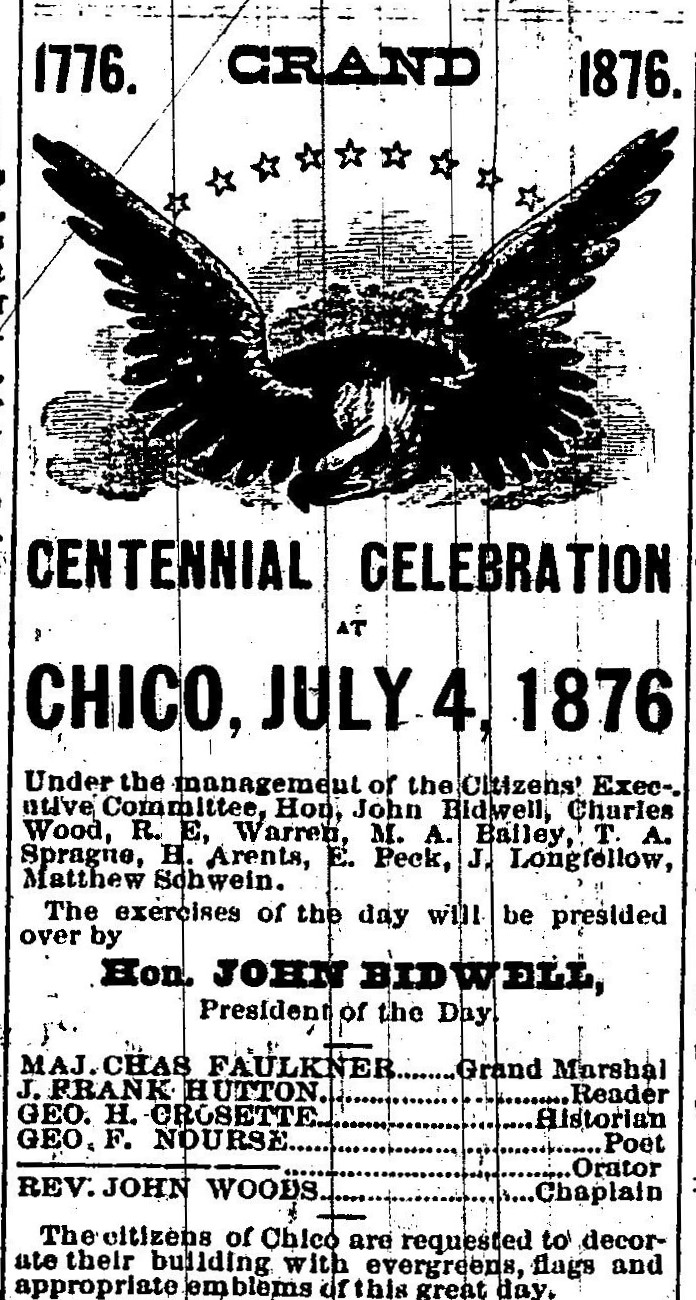
The citizens of Chico celebrated the 100th birthday of American independence, and every Independence Day, in grand style. Our celebrations of Independence Day are skimpy compared to the way they enjoyed the Fourth in Chico in the 19th century. On July 4th, 1876, John Bidwell recorded the following in his diary:
Tues. July 4
Warm, very – no wind. = Bells rang & cannon & anvils roared all last night – Celebration went off well – good oration by Rev. Mr Dickerman – Fireworks & ball in evening. = Lost our greyhound, Roamer = Haynes had watermelons ripe in town. =
The celebration was announced in the newspaper a few days before the event. Citizens were urged to decorate their buildings with “evergreens, flags, and appropriate emblems.” Folks who lived out of town came to Chico for the day-long festivities.
The Butte Record published a report of the proceedings the following Saturday. Everybody turned out for the parade and the “patriotic exercises”. The parade encompassed most of the town, proceeding up 2nd Street to Main, down Main to the Junction (where Broadway, Main, Park, and 8th and 9th meet), then up Broadway to 6th Street to Chestnut, then to Front Street (now 1st), back to Main, and “counter march to Broadway” to the Pavilion, which stood between 4th and 5th.
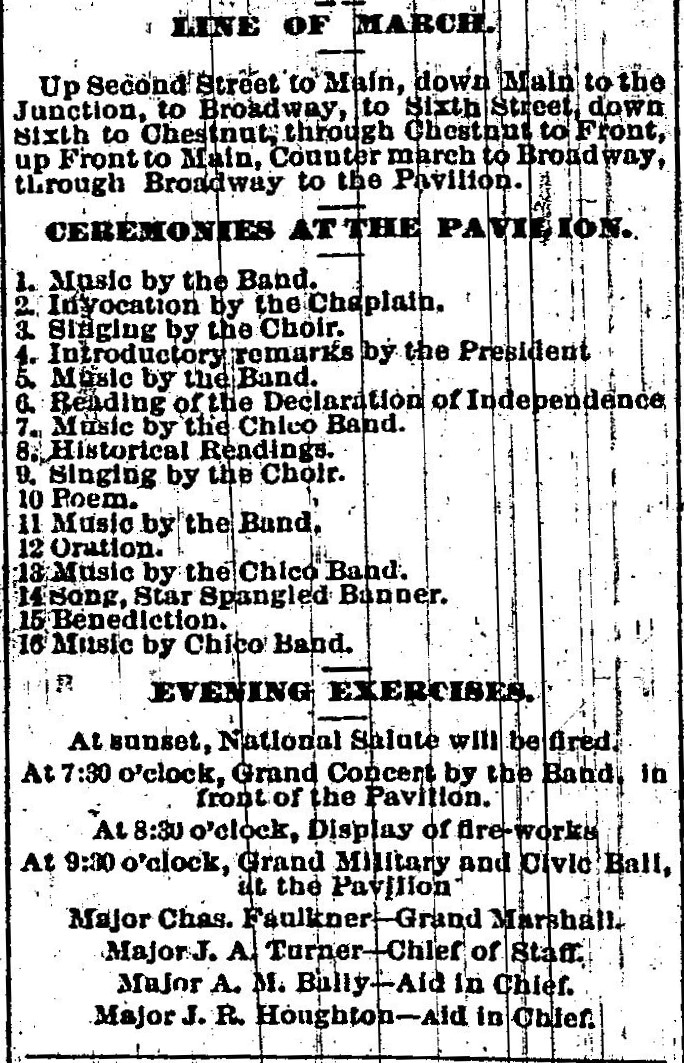
Viewers of the parade would have enjoyed music by a brass band, and seen the Chico Guard marching, the fire hose companies, dignitaries in carriages, various clubs and fraternal orders, patriotic floats, and children waving flags. One special young lady on a float represented Lady Liberty.
The exercises at the Pavilion included band music, an invocation by a clergyman, songs by a choir (“Star Spangled Banner” and “Hail, Columbia”), the reading of the Declaration of Independence, a patriotic poem written for the occasion, and more music. The remarks by the president of the event, General John Bidwell, were considered “appropriate to the occasion.” He “hoped that the people of Chico would never again contemplate the idea of allowing the National Anniversary to pass without due observance.” Perhaps they had neglected it in a previous year.
The concluding song was “America”, better known today as “My Country, ‘Tis of Thee.” “America the Beautiful” hadn’t been written yet.
An oration by a public figure was a must, and it was lengthy. That was followed by the reading of the Declaration of Independence and a seventeen-stanza “Centennial Ode”, which the Record printed in full. A sample stanza:
The British Lion curled,
And round the world,
The Stars and Stripes were wide unfurled;
And now our second “seventy-six” we hail,
The grand old century goes out. The tale
Of all its deeds lives on and shall not fail.
Its heroes live enthroned,
Their fame intoned
By priests and bards of Freedom owned.
It was a day-long event, and as Bidwell notes, it started the night before, and went on well into the evening of the 4th. At sunset a “national salute” was fired, at 7:30 there was a concert by the Chico Brass Band on the plaza, followed by fireworks and at 9:30 a “Grand Military and Civic Ball at the Pavilion,” where “a happy and joyous crowd tripped the light fantastic, to the inspiring music of Cressy’s Band.”
Watermelons were a feature, then as now. Roamer the greyhound was frightened by all the noise and went missing. Bidwell advertised for him in the newspaper.
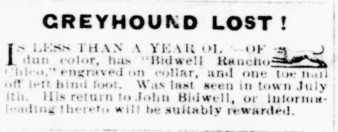
IS LESS THAN A YEAR OLD — OF dun color, has “Bidwell Rancho Chico,” engraved on collar, and one toenail off left hind foot. Was last seen in town July 4th. His return to John Bidwell, or information leading thereto will be suitably rewarded.
Roamer was found a few days later seven miles away at Hog Springs, on the Humboldt Road.