Where did John Bidwell live before he built his spacious mansion?
Rancho del Arroyo Chico was John Bidwell’s “loveliest of places,” the land he had his eye on ever since he rode up the Sacramento Valley in 1843. But the Mexican land grant of some 22,000 acres belonged to William Dickey.
Bidwell bided his time and kept busy amassing a fortune from gold-mining and trading at Bidwell’s Bar. Then on May 7th, 1849, William Dickey sold Rancho Chico to George McKinstry, Bidwell’s former partner in business. It might have been the end of Bidwell’s hopes, except he knew there was a deal in the works.
On July 6, 1849, two months after he’d purchased it, McKinstry sold to John Bidwell, for $1,785 cash, one undivided half of Rancho del Arroyo Chico. A dream was suddenly within his grasp.
As he took the first steps to transform the rancho into a productive farm, Bidwell built a rudimentary dwelling on the land. The oral history passed down by the Mechoopda Indians located “the General’s private home” site as “just in front of the present Mansion” and described it as “built of plain lumber.” Annie concurred, placing her husband’s first Rancho Chico home “on the lawn area just in front of the present mansion,” close to the busy Marysville-Shasta Road.
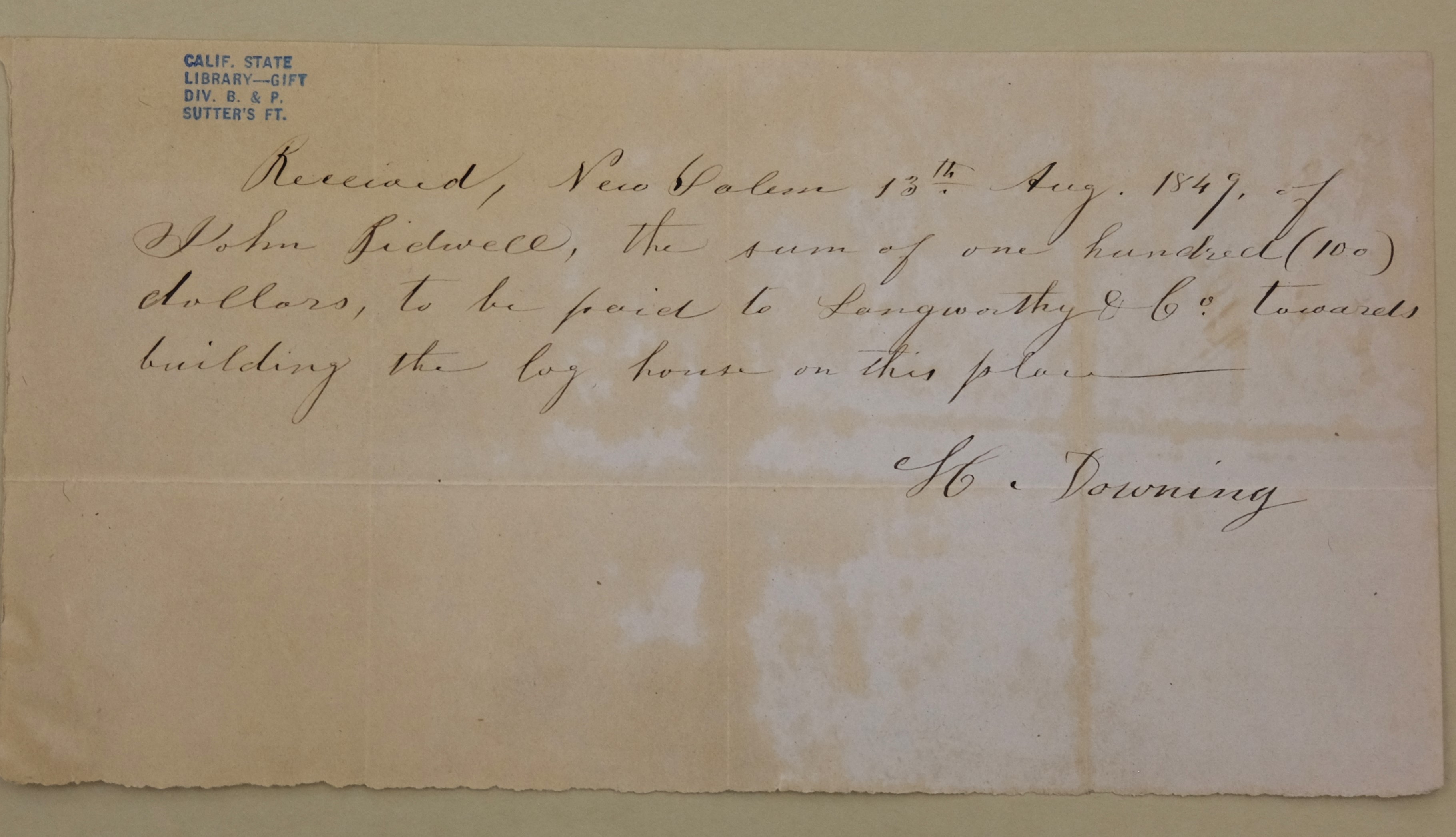
In August 1849 Bidwell contracted “for the sum of one hundred dollars, to be paid to Longworthy & Co. towards building the log house in this place.” I don’t know who Longworthy & Co. were, or H. Downing, who signed the contract, but the fact that he had a builder erect the house, rather that erect a shelter built by his Mechoopda employees, suggest a cabin somewhat more substantial than the simple log cabin he had on Little Butte Creek.
So Bidwell’s first house on Rancho Chico was a log house, probably more than one room, with a real door rather than a deerskin curtain. It was big enough to accommodate guests — Edward McIlhaney recalled staying there for several days in 1849 as he and his companions traveled toward the northern mines.
Over the next three years Bidwell added more buildings: a stable, a granary, a carpenter shop, a kitchen. And then they were all swept away, burned to the ground, in a raid by mountain Indians on the night of August 24, 1852. He would replace his house with the two-story Old Adobe.
You can read much much more in our book, Tower in the Tress: The Story of Bidwell Mansion, coming from ANCHR books in December.