The Book is Here!

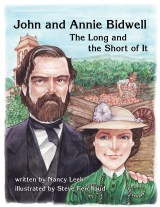
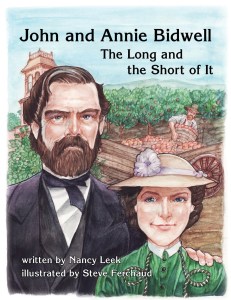
John and Annie Bidwell CoverJohn and Annie Bidwell: The Long and the Short of It is now available! It will be in the General’s Store (the gift shop) at Bidwell Mansion starting next weekend. Bidwell Mansion State Historic Park is open Saturday, Sunday, and Monday, 11 a.m. – 5 p.m. Other places that will be carrying it are Made in Chico and The Bookstore on Main Street.

If you want to get a copy into your eager little hands, and you live in Chico, you can contact me at goldfieldsbooksca@gmail.com. I will arrange for me to deliver, or you to pick up, your very own copy.

The cover price of the book is $16.95. Direct sales are $17 a copy, sales tax included.

DSCF0100This has been a fun project. It was a pleasure to work with Steve Ferchaud, who is not only a fine illustrator, but also a delightful human being. He had plenty of imaginative ideas for extending the text and enhancing the appeal of the book. Wait till you see his two-page spread on Bidwell Park!

Posted in Uncategorized | Leave a comment

November 1, 1841

From John Bidwell’s trail journal:

November. Monday, 1st. The Company tarried to kill game; an abundance of wild fowl and 13 deer and antelopes were brought in. My breakfast, this morning, formed a striking contrast with that of yesterday which was the lights of a wolf.

The “lights of a wolf” is described in other recollections as the windpipe of a coyote. Another member of the party had shot the coyote on the morning of October 31st. By the time Bidwell caught up with the rest of the men, the only thing left to eat was the lungs (lights) and the windpipe.

Got to be about the worst breakfast ever!

But their situation changed literally overnight. On the afternoon of the 31st they sighted the valley, “joyful sight to us poor famished wretches!!!” Antelope! Elk! Wild ducks and geese! On November 1st they spent the day hunting and feasting on wild game.

Bidwell tells it this way in his 1877 Dictation:

The eve of the next day found us surrounded by abundance. . . . It was about the first of November, and there was no time to delay if we were going to reach California that fall. Most of the party were ready and anxious to press forward. Captain Bartleson and his men though otherwise. They said we hadn’t yet reached California, we probably still had a long distance to travel, that such a place as we were in could not be found everywhere and they were going to stop and lay in meat for the balance of the journey.

Leaving them in camp and crossing the Stanislaus River, we proceeded down the north side of the same and camped. Early the next day the news came that the Indians in the night had attacked them and stolen all their horses. We remained till they came up, carrying on their backs such things as they were able.

John Bidwell never did get on with John Bartleson. There is a note of satisfaction here that once again, Bartleson was wrong and got what he deserved.

Posted in Uncategorized | Leave a comment

Goldfieldsbooks.com

This blog has a new name — it is now goldfieldsbooks.com. Don’t leave out the “s” in the middle or you won’t find it. It’s still the same northern California history blog, but I’ll also be promoting my new book here. You can also still get here with the old URL.

My new book is John and Annie Bidwell: The Long and the Short of It. It’s a paperback picture book selling for $16.95. It has full-color illustrations by the talented Steve Ferchaud, and is aimed at the young readers who visit Bidwell Mansion and want to know more. I hope it will be equally valuable to teachers and families.

I am self-publishing the book under the imprint Goldfields Books. I don’t know what future projects are in store, but there may be more books from Goldfields in days to come.

John and Annie Bidwell is at the printer right now. It will be out well in time for Christmas. It will be for sale at Bidwell Mansion, at Made in Chico, and at other outlets around the area. I’ll keep you posted on where and when you can buy the book.

Posted in Uncategorized | Leave a comment

Coming Soon!

The book is almost here! John and Annie Bidwell Cover

This is what the cover will look like. It’s at the printer now, and in a week or two a pallet of books will show up on my doorstep, and then the fun begins.

I will be having a book-signing at the Bidwell Mansion Association Holiday Event on December 4th. Other book-signing programs are in the works. If anyone wants me to do a presentation, I am always happy to talk about the Bidwells’ incredible lives and sign books.

The book is a 32-page 8.5 x 11 inch soft-cover picture book, with full-color illustrations throughout by Steve Ferchaud. The design and layout was done by Carla Resnick, who is not only an excellent graphic designer, but a good neighbor. The cover price is $16.95. I am self-publishing the book under the imprint Goldfields Books.

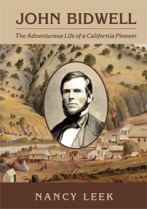
I have done my best to make it historically accurate, and it includes a timeline and a bibliography. I think it will make an excellent companion to my first book: John Bidwell: The Adventurous Life of a California Pioneer.

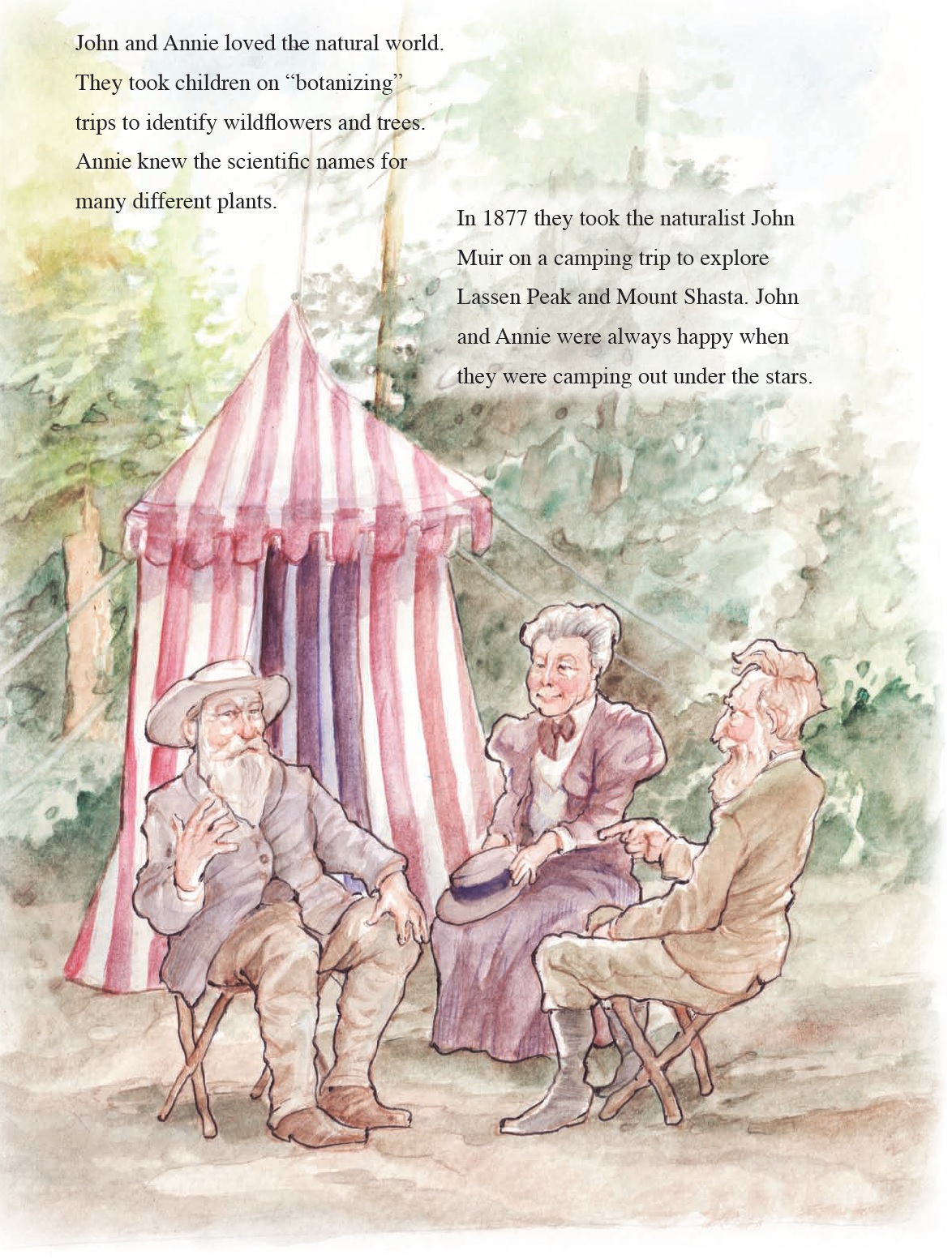
Bidwell3Here’s another one of my favorite illustrations from the book: John and Annie camping with John Muir. The Bidwells were good friends with Muir. They really did take him camping with them, and they really did have a tent that looked like that. There is a well-known photograph that shows John and Annie posing outside their striped tent.

I certainly hope everyone who sees the book likes it, and I hope it will be a valuable resource for teachers who bring their classes to Bidwell Mansion. And I’ll let you know as soon as the book is available for purchase.

Posted in Uncategorized | Tagged | Leave a comment

Manjiro’s Return Home

Manjiro arrived in Honolulu in October of 1850 with his earnings from the goldfields in his pocket. He went immediately to find his friends, Denzo, Toraemon, and Goemon. Denzo and Goemon were willing to risk the return, but Toraemon, knowing that there was a very real danger of being imprisoned or executed, decided to stay in Hawaii.

A newspaper appeal on behalf of the men brought in $160 and clothing for the men. Putting together all their money, Manjiro bought an old whaleboat, maps, a compass and other needed equipment, as well as gifts for his family. He found a merchant ship bound for Shanghai whose captain was willing to drop them off near Japanese waters.

Two months later the ship came within four miles of Okinawa. In spite of heavy seas and rough weather, the whaleboat was lowered and Manjiro and his companions rowed for shore. The fishermen and villagers they encountered fled from them and refused to speak with the strangers, even though Manjiro entreated them in Japanese. Laws were strict and any contact with outsiders meant punishment. They were immediately arrested by the local officials.

Okinawa was under the rule of Japan, so the men were sent to a powerful lord on Kyushu, the southernmost major island of Japan. From there they were sent to the shogun. The gifts that Manjiro had bought for his family and the gold he had sewn in his clothing for his mother were confiscated. The men feared for their lives, but Manjiro was able to convince the authorities that he was much more valuable alive than dead. He possessed knowledge of the West that no one else in Japan had.

The men underwent endless questioning. Altogether they were imprisoned and interrogated for a year and a half.  It was not until June 1852 that they were released and allowed to visit their families. It had been nearly twelve years since Manjiro left home. His mother and siblings greeted him as one returned from the dead and took his to see his memorial tablet in the village graveyard.

Manjiro did not get much time to spend with his family. Within three days the local lord sent for him. His knowledge and experiences were of the utmost value. In a move nearly unprecedented in Japanese society, Manjiro was elevated from the station of a lowly fisherman to the rank of samurai. As a samurai he was allowed to wear two swords and to take a surname. He chose the name of Nakahama, his home village. He began teaching world history, geography, and English to other samurai.

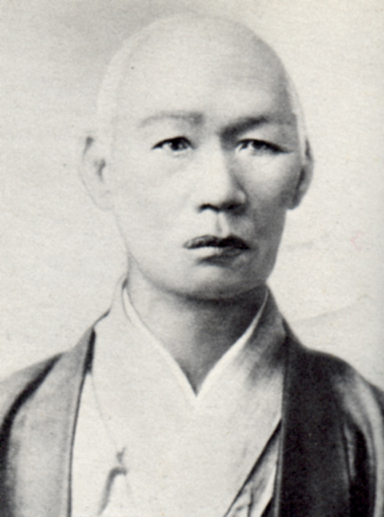
Nakahama Manjiro

Nakahama Manjiro

His career as a teacher was interrupted by the advent of Commodore Perry and his fleet. As the only man in Japan fluent in English and familiar with the United States, he was summoned to the capital to advise the shogun. Although never allowed to meet with the Americans, he counseled behind the scenes for an end to Japan’s isolationist policy. As Japan’s outlook on the world changed, Manjiro took on the task of teaching ship-building and navigation at the Naval Academy, and served as interpreter with the first Japanese embassy to the United States. While there he went to visit his old friends in New Bedford. By then it had been twenty-one years since he had seen Captain Whitfield.

To the end of his life at the age of 71, Manjiro taught English and advised the government. His incredible life story made him a famous man in Japan. It’s good to know that his sojourn in the California Gold Rush helped him on his way.

Posted in Manjiro | Leave a comment

Manjiro in California

Captain William Whitfield and his wife took Manjiro in, treated him like a son, and sent him to school, where he excelled. Then when he was nineteen years old, Manjiro went to sea once again aboard an American whaling ship. For three years, from 1846 to 1849, he sailed the Atlantic, Indian, and Pacific Oceans as the Franklin, commanded by Captain Ira Davis, searched for whales.

At one point in their voyage, as the ship sailed close to Japan, Manjiro spotted a group of Japanese fishing boats. Captain Davis gave his permission for a boat to be lowered, and  eagerly Manjiro approached the fishermen, hoping to be taken home. But fearing the authorities, the fishermen would not even speak to him, let alone take him on board. He returned to his ship.

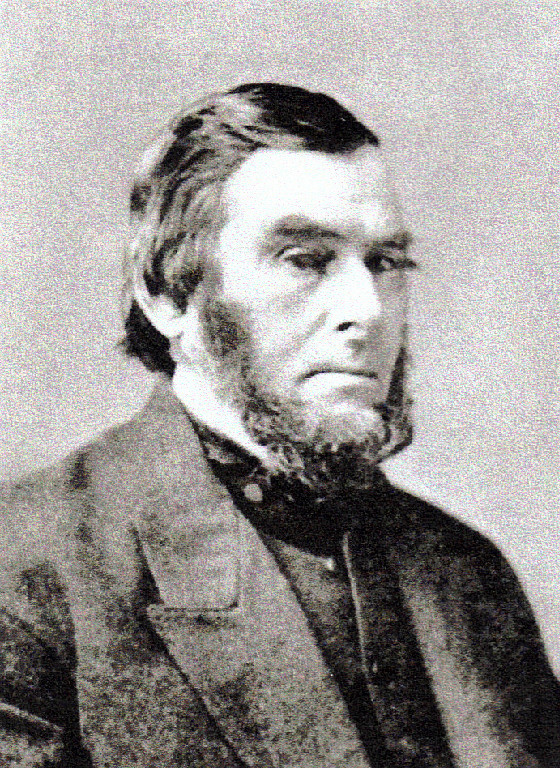
Captain William Whitfield of New Bedford, Massachusetts, looking every inch the whaling ship captain.

Captain William Whitfield of New Bedford, Massachusetts, looking every inch the whaling ship captain.

Later the whaler docked in Honolulu, where Manjiro’s companions had been left when he went on to New Bedford with Captain Whitfield. One of the men had died, but three were left, working as servants and hoping for the day that they could return to Japan. Manjiro consulted with them about how they might someday make the return voyage.

By the time the Franklin reached New Bedford in September 1849, the entire nation was talking about the discovery of gold in California. Manjiro saw his chance. If he could get to California and strike it rich, he would have the money he needed to return to Japan and his mother.

He signed on board a lumber ship bound for California. Such was the competition for passage to California that Manjiro worked for no wages as part of the crew, and paid $25 besides for the privilege.

Arriving in San Francisco, Manjiro wasted no time in making his way by steamship to Sacramento, and then by foot to the goldfields. He found a job working for $6 a day digging for gold. After a month he bought his own tools and went off to try his luck.

Two months of panning gold in a mountain stream, and Manjiro had what he figured would be enough. Living frugally, he avoided the gambling dens and dance halls and kept a close watch on his pile. He took his gold to San Francisco and traded it for $600 in coin. Then he bought passage on a steamship bound for Honolulu. He was homeward bound.

Next time: What Kind of Welcome Awaits?

P.S. I first discovered the story of Manjiro when I read Rhoda Blumberg’s book for young readers: Shipwrecked: The True Adventures of a Japanese Boy (2001). Two adult books on his experiences are The Life and Times of John Manjiro, by Donald R. Bernard (1992) and The Man Who Discovered America, by Hiskazu Kaneko (1956).

Manjiro’s adventures have also been fictionalized in Heart of a Samurai, a novel for young readers by Margi Preus (2011), and Manjiro: The Boy Who Risked His Life for Two Countries, a picture book biography by Emily Arnold McCully (2013).
Posted in Uncategorized | Leave a comment

A Japanese Man in the Gold Rush

In May 1850 a young man stepped off a ship in San Francisco. Nothing remarkable there. Thousands of young men were arriving in San Francisco on their way to the goldfields. Like the others, this young man had come to California to seek for gold. But he hadn’t joined the Gold Rush to get rich. He just wanted to get home.

The young man was an Asian, but with a difference. He was not Chinese, like the other Asian immigrants beginning to come to Gold Mountain — he was Japanese, and he must have been the only native of Japan in California.

His name was Manjiro. He was born in a fishing village in 1827, and by the time he was nine years old his father had died and he was left to support his mother and siblings. So from that young age he worked the fishing boats. Then at the age of 14, he and his five companions were shipwrecked. For five months they nearly starved on a small rocky island until they were picked up by a New England whaling ship.

It was impossible for them to be taken back to Japan. Foreign ships were not allowed to land on the coast of Japan, even to return rescued fishermen, and if they left, even accidentally, Japanese citizens could not return to their homeland on pain of death.

A photo, possibly showing Manjiro as a young man, recently found in the New Bedford Public Library.

A photo, possibly showing Manjiro as a young man, recently found in the New Bedford Public Library.

So Manjiro went with Captain William Whitfield to New Bedford, Massachusetts. On board ship, he began learning English, and the captain, impressed by the boy’s intelligence and attentiveness, taught him piloting and seamanship. In New Bedford he was enrolled in school and continued his education in language, mathematics, and navigation. Captain Whitfield and his wife treated Manjiro, whom they called John Mung, as their adopted son.

Throughout his sojourn in the United States, Manjiro suffered from homesickness. He longed to see his native land once more. He yearned for his mother and worried that she was living in poverty and distress without her eldest son to care for her. But how could he return to Japan? How would he find the means to make the voyage? What ship could take him there? And if he did find a way to get to Japan, how would he be treated? What good would it do his mother if he were arrested and executed on his return?

More about Manjiro and his return to his homeland next time. For information about the photo, see this article in the Japan Times.

Posted in Uncategorized | Tagged | 4 Comments

A Picture Book for John and Annie

Coming soon! A picture book biography of John and Annie Bidwell for young readers. I want to show you some samples pages.

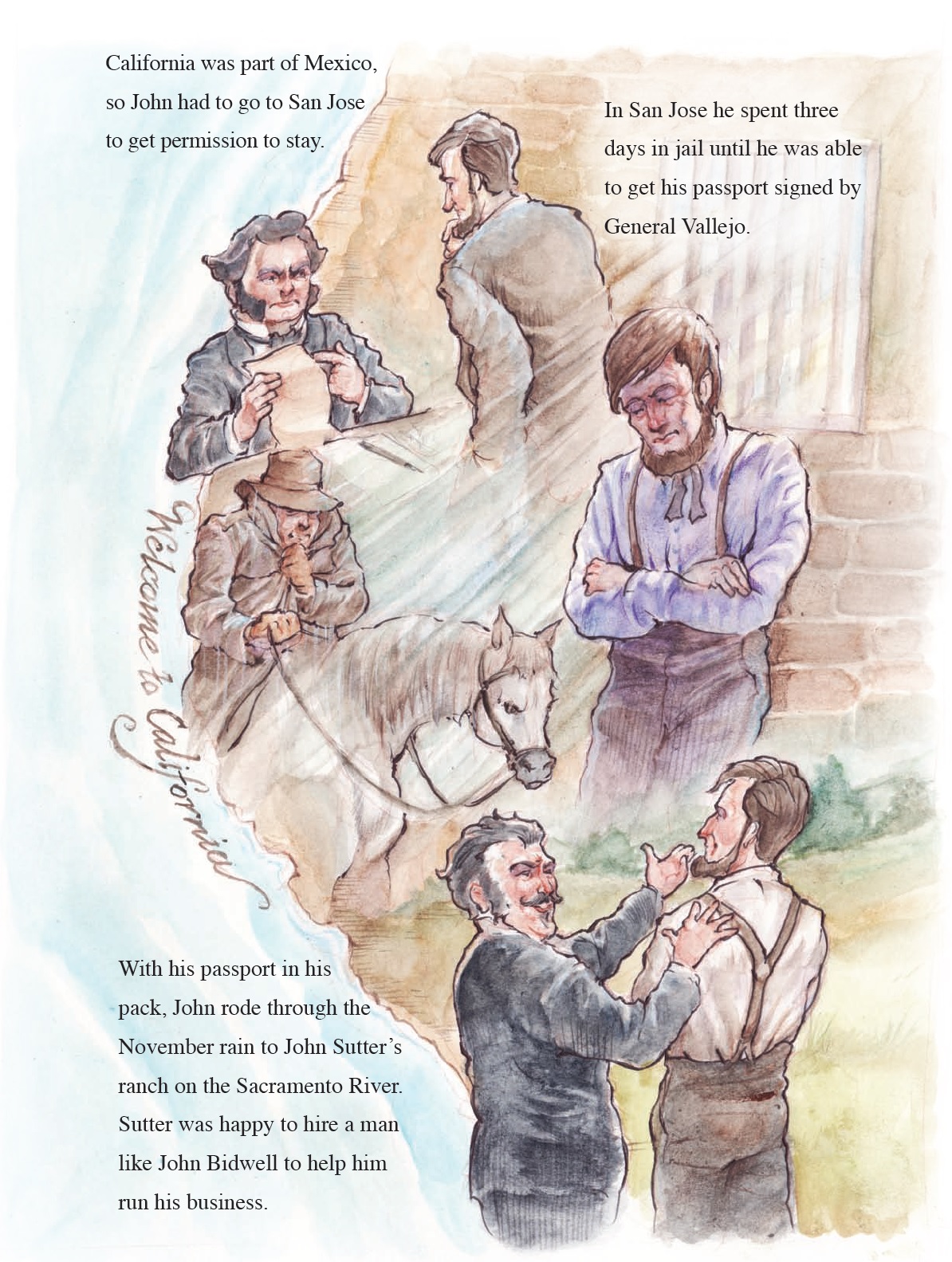
John Bidwell's first days in California.

John Bidwell’s first days in California.

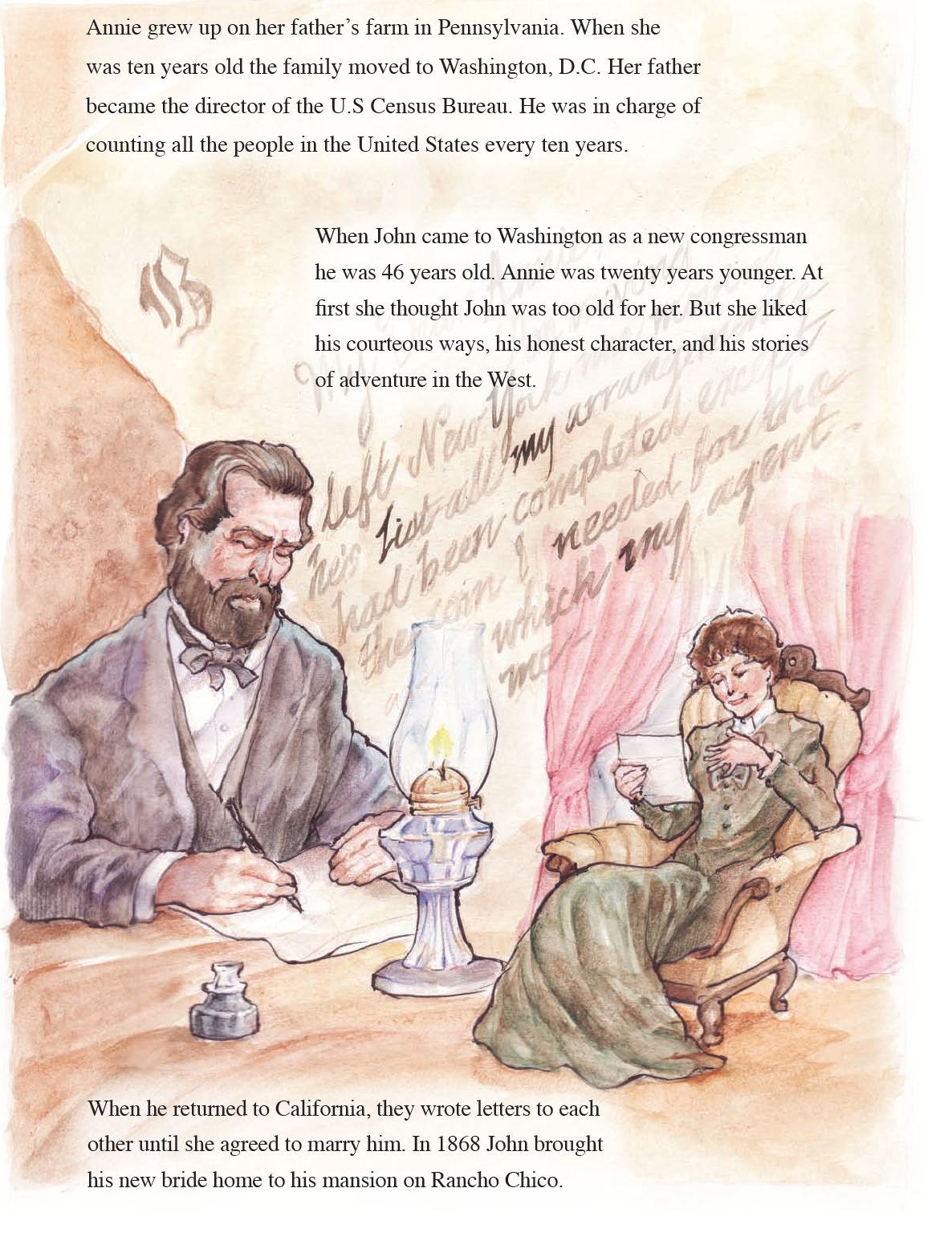
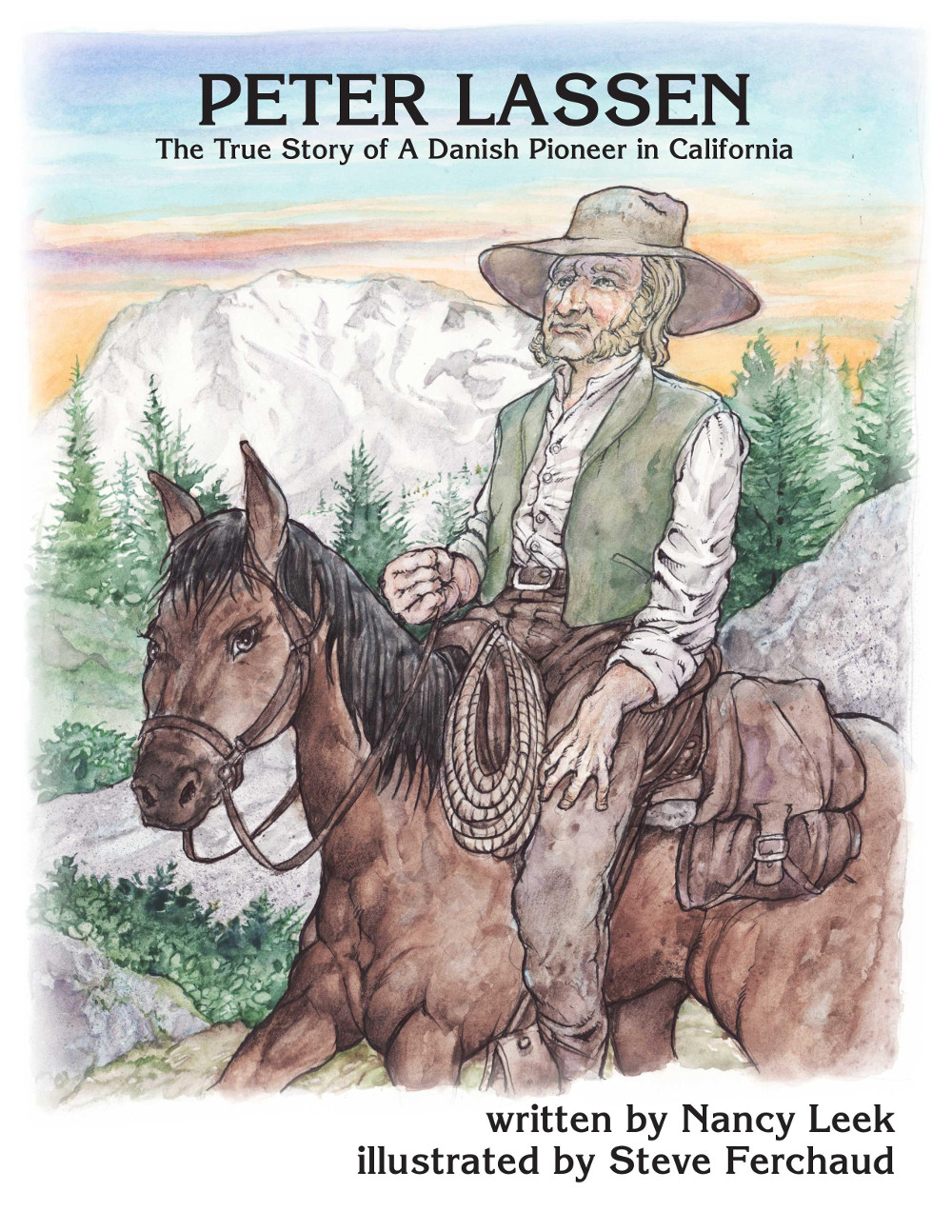
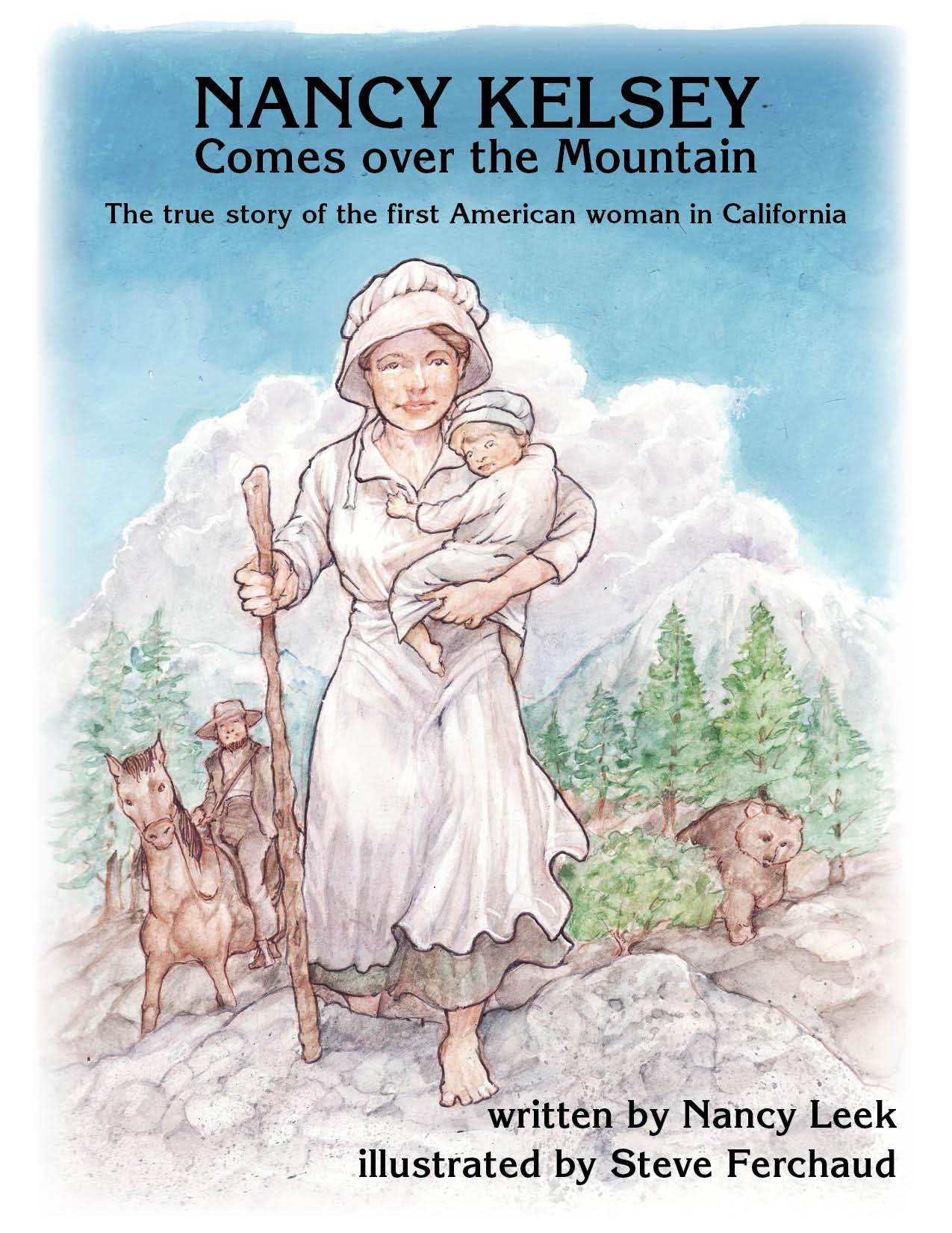
Ever since I did my book on John Bidwell in 2010, teachers have asked me for an easier book that they can use with 3rd grade classes. It’s in the works and should be available shortly. It covers the Bidwells’ lives from the time John left Missouri to journey to California, to the day Annie gave Bidwell Park to the city of Chico.

The illustrations are by Steve Ferchaud, a talented local illustrator who has illustrated many books, as well as doing pictures for magazines and newspapers. It’s been a delight to see how he can translate my text into lively, informative pictures.

Bidwell2

John and Annie’s romance.

The book will be 8.5 by 11 inches and 32 pages, with color illustrations throughout. It includes an afterword and timeline that add more information about John and Annie’s lives. Steve and I have worked hard to make sure that the text and illustrations are as historically accurate as we can make them.

Bidwell3

Camping with the Bidwells and John Muir.

The book will be for sale at Bidwell Mansion State Historic Park and in other local outlets. I hope you enjoy it!

Posted in Uncategorized | Leave a comment

Chico in the 1850s

Continuing the recollections of D. F. Crowder. The following appeared in the Chico Enterprise for December 27, 1917. Crowder came to Chico in 1856, at the age of twelve, so he saw it before it was even a town.

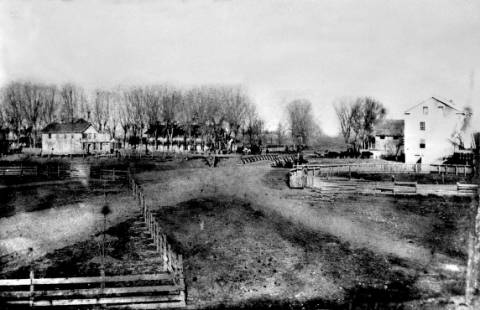
Bidwell had a flour mill which was run by water power. It was located on the creek about a hundred yards from where the present Sperry flour mill stands.

Rancho  Chico in the 1850s, with Bidwell's Store, adobe house and hotel, and flour mill.

Rancho Chico in the 1850s, with Bidwell’s Store, adobe house and hotel, and flour mill.

Both flour mills are gone today, but they stood next to the creek next door to where Northern Star Mills is today.

Flour was $1.75 a sack of fifty pounds, but no one kicked in those days. I used to see a good deal of John Bidwell. He was always busy with the ranch affairs and was seen very little about the hotel. He never was behind the bar himself, that I know of. Drinks we’re told were 25 cents each.

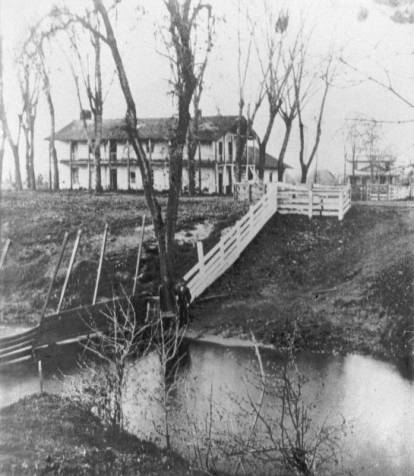
The hotel was Bidwell’s two-story adobe that he built after his log cabin burned down in 1852.

There was no bridge across Chico creek but there was a ford near where the present bridge now stands. The Shasta trail, now the Shasta road, lead off almost due north as it does now and it was black with immigrants — just like ants, coming and going. Some had ox teams, some were afoot and others drove mules. I don’t remember ever seeing a burro at that time.

John Bidwell's adobe with Chico Creek in foreground.

John Bidwell’s adobe with Chico Creek in foreground.

It must have been a busy place in those days with plenty of traffic and people stopping all the time at Bidwell’s house for a meal or a drink or a rest.

Posted in Uncategorized | Leave a comment

Stagecoach Robberies in Butte County

D.F. Crowder’s memories of early days in Chico continued:

Soon after I came here [in 1856] I remember hearing the men folks tell about a robbery just across Butte creek, about six miles south of here — at the first little creek that you cross beyond the present Butte creek bridge.

The name of that creek is Robbers’ creek today because of this robbery. The highwaymen got away with a big quantity of gold, $5000 I think.

Another robbery took place right in front of where now stands Canfield’s wagon shop in Main street. Here the robbers made a good haul and for many years it was supposed that they buried their loot beneath a huge oak tree which stood there. Diligent search, however, failed to disclose it. Everybody was a peace officer in those days when it came to anyone breaking the law of man. They very seldom caught these stage robbers and the only way to catch them at all was to shoot them on the spot. They killed two north of Keefer’s ranch.

According to Cheryl Anne Stapp, in her book The Stagecoach in Northern California, the first holdup of a moving stagecoach in California happened in 1856 near Marysville. Robberies increased steadily through the 1860s, reaching a peak in the ’70s and ’80s.

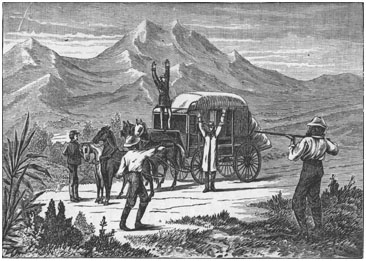
stagecoachrobberyI searched the California Digital Newspaper Collection for information about the stagecoach robberies that D. F. Crowder describes. It’s hard to know, but here is one that might be a match. It appeared in the Sacramento Daily Union on June 11, 1860.

ROBBERY OF WELLS. FARGO, AND CO. — On Saturday night, June 9th, about nine o’clock, as the Shasta stage from Marysville arrived at a gulch about seven miles below Chico, five men rose up from the gulch, where they had beep secreted, and leveling their guns at the driver, and Bowen, the Express Messenger, ordered them to stop. Bowen instantly grasped his pistol, but finding it was useless to resist, surrendered. One of the gang unhitched the horses, while another took the treasure box, and demanding the key of Bowen, opened it and extracted $15,000, with the remark that the company was rich, and his party had particular use for the money. This done, they hitched on the horses, and permitted the stage to proceed. As the stage started, some passenger gave the robbers four charges from a revolver, but does not know if they took effect. Bowen has returned with his party to Chico, without finding any clue to his treasure or the robbers. Bowen, James Y. McDuffie, and a lady, were the only passengers. A reward of $7,000 has been offered by Wells, Fargo & Co. for the recovery of the treasure, and $5,000 for the conviction of the robbers.

Posted in Stagecoaches | 1 Comment