How NOT to Treat Historical Materials, or, The Librarian’s Despair

1849-1850 Farm Account for Rancho Chico courtesy Special Collections Meriam Library CSUChico

1849-1850 Farm Account for Rancho Chico courtesy Special Collections Meriam Library CSUChico

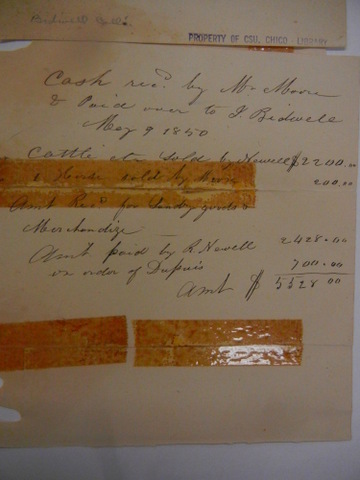
DSCN4544 DSCN4545 DSCN4546Here are four pages labeled Farm Account from Rancho Chico for 1849 and 1850. The paper is very brittle and fragile, and I am grateful to George Thompson for allowing me to handle the originals.

The second image here is the reverse side of the first page. Since the pages had been folded in thirds, they were cracking along the fold lines, so someone mended them with Scotch tape. They were probably mended with the tape before they ever came to Special Collections at Meriam Library.

This is so sad! Look how the tape has discolored the page. It probably can’t be taken off now.

The account book starts with Nov. 16, 1849. Paid to Mr. Grry [Grey] $1.53. I am not sure whether that is one dollar and fifty-three cents, or one hundred and fifty-three dollars. Whoever was writing this always seems to put in a dot if the amount is three digits.

Next:

Paid to Mr. Potter for Beef 7. Paid for geting wood 2.

Further down the page:

one mule 40.   two horses sold $3.85. Bilding of shed 1.25.

This handwriting is a bit tricky to read. The other side is easier. I don’t think either one is John Bidwell’s hand. He had other men working for him and helping keep the books.

The third page lists Number of Cattle and Horses Sold by R. Newell for the Ranch, and is dated Feb. 12th, 1850. A lot of Bidwell’s business at this time was the buying and selling of cows, oxen, horses, and mules. With a total of $2350 on the sales, it was evidently a good business.

If you ever have any old papers — letters, books, or other documents — and they are cracked and splitting, please please please do not mend them with ordinary scotch tape. Take them to the library and ask about the best way to conserve them. Or just put the pieces in a folder and store them in a safe place. Doing nothing to old papers is better than trying to mend them with the wrong materials.

Posted in Uncategorized | Leave a comment

The Rubbish of Spiders No Mortal Supposes

I was vacuuming up cobwebs around the windows this morning, and it recalled to mind this phrase:

The rubbish of spiders no mortal supposes

which is a line from The Housewife’s Lament, also known as the The Housekeeper’s Tragedy. or The Poor Old Woman. The entire poem goes like this:oldllady-sweep_mth

One day I was walking, I heard a complaining
And saw an old woman the picture of gloom
She gazed at the mud on her doorstep (’twas raining)
And this was her song as she wielded her broom

Oh! Life is a trial and love is a trouble
And beauty will fade and riches will flee
Pleasures they dwindle and prices they double
And nothing is as I would wish it to be.

There’s too much of worriment goes to a bonnet
There’s too much of ironing goes to a shirt
There’s nothing that pays for the time you waste on it
There’s nothing that last us but trouble and dirt.

In March it is mud, it is slush in December
The midsummer breezes are loaded with dust
In fall the leaves litter, in muddy September
The wall paper rots and the candlesticks rust.

There are worms on the cherries and slugs on the roses
And ants in the sugar and mice in the pies
The rubbish of spiders no mortal supposes
And ravaging roaches and damaging flies.

It’s sweeping at six and it’s dusting at seven
It’s victuals at eight and it’s dishes at nine.
It’s potting and panning form ten to eleven
We scarce break our fast ere we plan how to dine.

With grease and with grime from corner to center
Forever at war and forever alert.
No rest for a day lest the enemy enter
I spend my whole life in struggle with dirt.

Last night in my dreams I was stationed forever
On a far distant isle in the midst of the sea.
My one chance of life was a ceaseless endeavor
To sweep off the waves as they swept over me.

Alas! ‘Twas no dream; again I behold it
I see I am helpless my fate to avert
She lay down her broom, her apron she folded
She lay down and died and was buried in dirt.

Although none of us are making bonnets anymore, and few of us iron shirts (I can remember having to iron my father’s dress shirts though), still some of these troubles remain with us.

The midsummer breezes are loaded with dust — they are if you live across the road from an orchard, like I do. In fall the leaves litter — they still do. There are worms on the cherries if the jays don’t get them first. I don’t have mice in the pies, but we had to set traps for the mice in that were eating our tomatoes.

And if you have a large family or many guests, then the sweeping, victuals, dishes, potting and panning go on and on, so that We scarce break our fast ere we plan how to dine.

So if you ever feel burdened with housework, if you feel that:

Pleasures they dwindle and prices they double
And nothing is as I would wish it to be.

remember that you have something in common with our 19th century sisters.

The poem first appeared in print (unattributed) in a magazine in 1871, and in 1872 was published in Out-of-Door Rhymes by Eliza Sproat Turner. It has been set to music, with the second verse as the chorus. One version by Anne Hills and Cindy Mangsen can be heard here.

Posted in Uncategorized | Leave a comment

The Wimmer Nugget

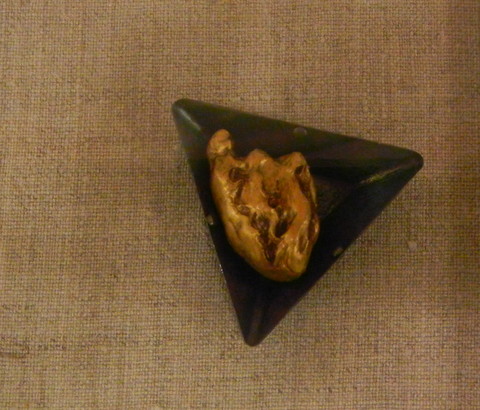
In this post, I wrote that the first gold nugget found by James Marshall is now in the Smithsonian Institution. Certainly they have one of the first pieces of gold found at Coloma. But another piece of gold has an equally good claim, and that is the Wimmer Nugget, now at the Bancroft Library.

The Wimmer Nugget, on display at the Bancroft Library, University of California, Berkeley.

The Wimmer Nugget, on display at the Bancroft Library, University of California, Berkeley.

I saw the Wimmer Nugget in its display case recently when I went to the Bancroft to do some research. It is about the size of the end of my thumb.

Everyone knows the name of James Marshall, discoverer of gold at Coloma. But how many know the names of Peter and Jennie Wimmer? Yet they have just as good a good claim to be gold discoverers, and Jennie was the only person in the camp who actually had experience in gold mining.

Elizabeth Jane “Jennie” Cloud Wimmer was born In Virginia in 1822. In 1838, when she was 16 yeas old, her family moved to north Georgia where Jennie helped her mother run a boarding house for miners. In her free time Jennie went out with her gold pan to do a little prospecting for herself. She developed a good eye for the signs of gold-bearing ore.

She moved to Missouri with her first husband, and after his death, she and Peter Wimmer married and in 1845 joined a wagon train headed for California. Peter was hired by John Sutter and became James Marshall’s assistant in the building of the sawmill at Coloma. Jennie was hired to cook for the men.

There is some debate whether it was Marshall by himself, or Marshall and Wimmer together, or some other combination that first spotted gold in the tailrace of the mill. But there seems to be no doubt that Jennie Wimmer was the first to test it. Although others were doubtful, thinking that it was only iron pyrites that had been found, she recognized the first nugget as true gold. In an interview published in the San Francisco Bulletin in 1874 she stated: “I said, ‘this is gold, and I will throw it into my lye kettle, and if it is gold, it will be gold when it comes out.'”

Jennie was making soap that day, with lye she had made from wood ashes. She threw the nugget in the kettle with the mixture of lye and grease, and after she took off the soap, the nugget of gold was found in the bottom of the kettle the next morning, just as bright and yellow as when it had gone in.

The fortunes of the Wimmer family fluctuated through the years as those of so many pioneer families. They lived in various locations in California and Jennie Wimmer died in San Diego County around 1885. If you want to read more about her, there is information at a variety of Gold Rush internet sites, such as the Oakland Museum and the Gold Rush Gallery.

Posted in Gold, Jennie Wimmer | Leave a comment

Jennie Megquier — Sewing in San Francisco

Jennie Megquier’s letters from Gold Rush San Francisco record a few interesting notes about clothing. In November 1849 she wrote:

I have starched twenty shirts this evening. I tell you this to give you an idea of the amount of work I have to do. Uncle has given me a whole piece of calico, one of de laine, one balererine. I shall make it all into broad aprons as I cannot get time to make a dress and when they get dirty throw them away that is the order of the day in this rich country.

Calico is a plain weave cotton fabric, and delaine was a lightweight wool fabric with a print. What balererine is I have no idea. It isn’t in any online fabric dictionary, like this one or this. Delaine is the sort of fabric that Jennie would have ordinarily used to make a nice dress, not aprons.

Uncle had some washing done for which they charged six dollars a dozen, they looked so bad, he gave them two dollars to keep them.

Which sounds like a joke, but that’s what Jennie wrote.

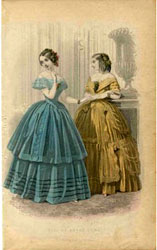
A fashion plate from Godey's Lady's Book 1853.

A fashion plate from Godey’s Lady’s Book 1853.

Later she had more time to sew, and in 1853 wrote:

I was in at Mrs. Calkins today, all well, she and Mrs. Davis are making dresses all the while, I presume they have twenty five in a year, a silk dress lasts but two months at the best. I know not why but everything goes to destruction in a very short time here. . . . I have been making me a brown silk, and next week I am going to make a black one, today I have been making a pink thibet sack trimmed with velvet ribbon but I am sure I do not know when I will wear it.

Thibet was another fine woolen cloth used for making dresses. By a “sack” she probably meant a free-hanging dress with a loose waist.

Posted in Uncategorized | Leave a comment

Chickens at Rancho Chico

In going through the John Bidwell Papers at the California State Library I came across this note from Edward Shackelford Darlington, a young man who briefly worked for John Bidwell in 1851. He is writing from Sam Neal’s Ranch, just south of Rancho Chico, to remind Bidwell to give the chickens water — just the sort of instruction that nowadays would be communicated by cell phone or email.

Letter courtesy California State Library, John Bidwell Papers.

Letter courtesy California State Library, John Bidwell Papers.

Darlington, who was only 19 or 20, can’t resist spoofing the etiquette of 19th century letters. It looks like something Mark Twain would write.

Here is the text, but the bare text cannot do justice to Darlington’s courtesy and flourishes.

Neal’s Oct. 24th [1851]

Major,

I neglected to tell you to have water placed in the chicken coop – also in the small pans around the house. This is absolutely necessary for the preservation of the health of the feathered tribe. – By complying with the requests herein named you will much oblige

Yours very respectfully

with great regard

Your obt servant

in great haste etc.

E. Shackelford Darlington

Posted in Edward Darlington | 2 Comments

How Ya Gonna Keep ‘Em Down on the Farm

. . . after they’ve seen San Francisco?

It didn’t take long for San Francisco to work her magic on Jennie Megquier. She wrote about the folks at home in Maine, “I have seen so much of things a little more exciting that I fear I shall never feel perfectly satisfied with their quiet ways again.” Then she drew this word-picture for her daughter:

Here you can step out of your house and see the whole world spread out before you in every shape and form. Your ears are filled with the most delightful music, your eyes are dazzled with everything that is beautiful, the streets are crowded the whole city are in the street. We have near us a splendid ice cream saloon which surpasses anything I have seen in the states, very large windows with magnificent buff silk damask curtains with lace like those that Newhall Sturtevant boasts so much of, two large rooms are connected by an arch hung with the same material, marble tables, floors and counters and as light as day at all hours of the night. The homeliest man in the city treated me to an ice cream there a few nights since at one dollar a glass.

icecreamparlorWinthrop Maine had nothing to compare with the ice cream parlors of San Francisco!

Posted in Uncategorized | Leave a comment

A Woman’s Work Is Never Done

SIL7-89-01, 4/22/03, 4:14 PM,  8C, 3724x5398 (1956+864), 100%, A.I. Basic,  1/60 s, R46.5, G33.3, B47.8

SIL7-89-01, 4/22/03, 4:14 PM, 8C, 3724×5398 (1956+864), 100%, A.I. Basic, 1/60 s, R46.5, G33.3, B47.8

Jennie Megquier ran a boarding house in San Francisco, and the work was never-ending. She writes:

I should like to give you an account of my work if I could do it justice. . . In the morning the boy gets up and makes a fire by seven o’clock when I get up and make the coffee, then I make the biscuit, then I fry the potatoes then broil three pounds of steak, and as much liver, while the woman is sweeping, and setting the table, at eight the bell rings and they are eating until nine.

I do not sit until they are nearly all done. I try to keep the food warm and in shape as we put it on in small quantities. After breakfast I bake six loaves of bread (not very big) then four pies, or a pudding, then we have lamb, for which we have paid nine dollars a quarter, beef, and pork, baked, turnips, beets, potatoes, radishes, salad, and that everlasting soup, every day dine at two.

For tea we have hash, cold meat, bread and butter, sauce and some kind of cake and I have cooked every mouthful that has been eaten excepting one day and a half that we were on a steamboat excursion.

I make six beds every day and do the washing and ironing you must think that I am very busy and when I dance all night [she loved to go to dances] I am obliged to trot all day and if I have not the constitution of six horses I should have been dead long ago, but I am going to give up in the fall whether or no, as I am sick and tired of work.

She also sewed all her own clothes, but more of that later.

Posted in Uncategorized | Leave a comment

More from Jennie Megquier

The Megquiers shipped a “portable iron house” to San Francisco, figuring it would be a good investment in a city where people were living in shacks and tents, and indeed it was. They used the ground floor for a store, and rented out the upper floor for offices.

We have a fine store which is now nearly completed, the upper part will rent for one thousand per month a pretty little fortune of itself if rents continue as they are now, but it is doubtful. Our motto is to make hay while the sun shines, we intend to sell the first good offer and return forthwith, although there are many things here that are better than the states yet I cannot think of staying from my chickens [her children] a long time, and it is not just the place for them at present, no schools, churches in abundance but you can do as you please about attending, it is all the same whether you go to church or play monte, that is why I like, you very well know that I am a worshipper at the shrine of liberty.

Jennie had chafed under the day-long church services back home in Maine, where her father was a deacon in the Baptist church. She didn’t miss that at all.

The land is very rich would yield an abundance if it was cultivated, but no one can wait for vegetables to grow to realize a fortune, potatoes are twenty cents a pound, beets one dollar and seventy-five cents a piece, tomatoes, dollar a pound but we have them for dinner notwithstanding, we have made more money since we have been here than we should make in Winthrop in twenty years, the Dr often makes his fifty dollars, a day in his practice, then we have boarders to pay our house rent, they make great profits on their drugs [Dr. Megquier and his partner].

To show you some of the profits on retail, the Dr bought a half barrel of pickle in salt, after soaking them I put up fourteen quart bottles, sold them for six dollars more than we gave for the whole, which still left me the same bulk I had at first.

Prices were fascinatingly high — everyone talked about the prices. The money came in fast, but it went out fast as well. Jennie was sure that she would go home with “an apron full of gold,” but that would take longer than she expected.

Posted in Uncategorized | Leave a comment

Mary Jane Megquier in San Francisco

Mary Jane, known as Jennie, arrived in San Francisco on June 13, 1849. Her husband, Thomas Megquier, was a medical doctor and planned to practice medicine and open a drug store. Jennie knew she could make money running a boarding house, if she could just get a house. (Their name, by the way, was pronounced “Me-gweer.”)

. . . you may bless your stars [she wrote to her daughter] that you are not here at present, report says there are six thousand people here that have no shelter, but some are going and coming from the mines, so we got a small room the size of my bedroom in Winthrop for five of us with our luggage, your Father and me lie on a single mattress on the floor with one small pillow. Col. Hagen, wife, and little girl lie on a hard mattress on the bedstead  . . .

. . . some kind of provision are cheap as in the states such as beef pork flour, but vegetables are enormously high . . .We have been here three days and have had nothing to eat but beef, pickled fish, and poor flour bread.

. . . money is plenty as dirt if you have any means of getting hold of it, but we have not been here long enough to tell whether we can make anything or not, but if your Father can get practice there will be no doubt but we can get money enough in a year or two to come home, there is seven million dollars in gold dust in this little place besides thousands of coined money . . .

Jennie would soon find how to make her own way in San Francisco, where, as she wrote:

everyone must do something, it matters but very little what it is, if they stick to it, they are bound to make money.

Posted in Uncategorized | Leave a comment

Chico’s 4th of July

cropped-imgp8959.jpgHow did 19th century Chicoans celebrate Independence Day? Here’s an entry from John Bidwell’s diary for 1876 that will give you a glimpse:

Tues. July 4
Warm, very – no wind. = Bells rang & cannon & anvils roared all last night – Celebration went off well – good oration by Rev. Mr Dickerman – Fireworks & ball in evening.

An oration by a public figure or clergyman was a must. That would be followed by the reading of the Declaration of Independence and at least one patriotic poem. There would have been a parade too, and the town was decked out in red, white, and blue bunting. It was a day long event, and as Bidwell notes, it started the night before, and went on well into the evening of the 4th with fireworks and dancing.

Bells ringing and cannon firing makes sense, but what’s this about “anvils roared?” How do they do that?

“Firing the anvil” was a popular way to generate noise and excitement in the 19th century. All you need are two anvils and some black powder, which you could get from your friendly neighborhood blacksmith. Here’s what you do:anvil

(I don’t recommend trying this at home, even if you do happen to have an anvil. Could be dangerous.)

Take one anvil and turn it upside down. On the underside is a hollow about the size of a brick. Pour in some gunpowder and place a fuse or a trail of gunpowder. Then place the other anvil right side up on top. When you light off the gunpowder, you will get a terrific explosion and the top anvil will fly at least a hundred feet in the air. It will come down too, so clear the deck.

You can find some examples of anvil firing on YouTube, like this one.

Posted in 4th of July | Leave a comment