Fun with Demographics

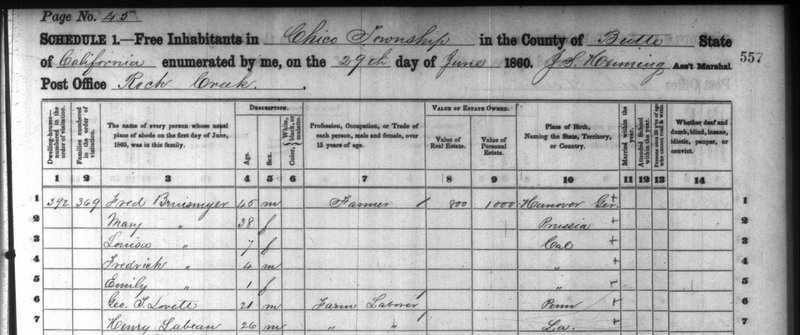
The top of a page from the 1860 Federal Census for Chico Twp, Butte Co., California.

The top of a page from the 1860 Federal Census for Chico Twp, Butte Co., California.

I have been looking at the 1860 Federal Census for Butte County. I accessed it at a website called fold3.com, a division of ancestry.com. Fold3 focuses on military records, but for some reason it is the only place I found for the 1860 census. This is a subscription website, but you can get a 7-day free trial. You can look at, print out, or download a lot in seven days.

In 1860 the census was taken in eleven townships in Butte County: Bidwell, Cascade, Chico, Eureka, Hamilton, Kimshew, Mountain Springs, Ophir, Oregon, Oro, and Wyandotte. The Chico township was not just the newly-founded city of Chico; it stretched from Pine Creek and Rock Creek on the north, to Durham on the south. Anyone familiar with Butte County history will recognize names on the list. The last name listed is W. Northgrave [sic], 60 years old, who was living with P. C. Munn and Jas. M. Maxey, hotel keepers, and Sing, a cook.

The census was taken by J.S. Henning and Joseph Pierce, and neither of them totaled their counts when they reached the end of a township. But according to Mansfield, in 1860, Chico Township. had 1482 residents, out of a county population of 12,106. The largest township was Ophir (Oroville) with 3064 people.

Many pages are just long lists of miners, but mining was giving way to agriculture. In Chico, farmer and farm laborer are the most common occupations. Women are still out-numbered by men; pages list anywhere from 1 to 10 females. Probably two-thirds of those females are children, because families are beginning to appear.

The census includes Chinese men (I haven’t spotted any women) and “tame” Indians (those who were working for settlers). One column on the census sheet is for “Color: White, black, or mulatto.” Once in a long while a black miner or cook is listed, and then a “B” is noted in the column. The census sheet doesn’t take into account Asians or Native Americans, so the census taker wrote in either “Ind” for Indian, or “mon” for Mongolian. At the bottom of the page, where he was supposed to total “no. white males” “no. white females” “no. colored males”, and “no. colored females,” all the Asians and Indians go into the white column, since they don’t have a column of their own. Anyone wanting to total these groups would have to go through the census one name at a time.

Here is a representative family, one who still has their name on the map. I won’t list all the names, but summarize some of the list:

J.A. Keefer, 26, farmer and P.M. (postmaster) Rock Creek (should be J.L.)

Rebecca Keefer, 28

5 children, ages 6 years to 4 months

Latham Odell, 37, farm laborer

Jno. Odell, 29, farm laborer (these two were Mrs. Keefer’s brothers)

Tho. Allen, 26, farm laborer

9 male Indians named Sam, Bill, Slick, Pete, Tom, Dick, John, Aleck, and Tim, and two female Indians, Polly and Judah, all designated as farm laborers

2 female Indians, Jenny and Clemmie, house servants. All the Indians are between the ages of 16 and 27.

In addition there is a note written sideways in the margin: “16 Indians in Rancheria uninployed [sic].” These may be older Indians, or children. The census didn’t bother to count Indian children.

I’ll have more from the census next time.

Posted in Uncategorized | Leave a comment

The Lemm Ranch Murders

An attack on six Chinese workers on the Lemm Ranch shocked the citizens of Chico and brought infamy to the town. The Lemm Ranch was located near today’s intersection of Highway 32 and Forest Avenue. On the night of March 14, 1877, as six Chinese laborers lay asleep in their cabin, a gang of five men and a boy broke into the cabin and searched for money to steal. They then shot the men in cold blood as they lay in their bunks. They piled bedding in the middle of the room, doused the pile with kerosene and set fire to it, then fled out the door.

Three of the Chinese men were killed outright and one died the next morning. Wo Ah Lin, who had feigned death, threw himself on the fire and extinguished it, then staggered to the ranch house to report the attack. There his wounded arm was bound up, but nobody at the ranch house went to attend to Wo’s dead and wounded companions. Nor did they send to town for help.

Wo walked the two miles to town where he sought out Constable Ben True, a man trusted by the Chinese. True alerted Butte County Deputy Sheriff James Hegan, who rode out the next morning to the scene of the crime. As the bodies were brought in to Chico,  horrified onlookers clustered on the streets to watch. Prejudice against the Chinese ran high, but no one expected outright murder. A citizen’s committee was quickly organized to investigate and to raise reward money.

John Bidwell reported on the committee in his diary:

Fri. March l6.
Warm bright beautiful day. = Laying out dump vineyard. = Meeting of Citizen’s Committee in Masonic Hall against the murders of the Chinese on Lemm Ranch, = Received notice last night from a “committee” to discharge Chinese. . .

Threatening letters were sent to a number of employers in Chico. Bidwell’s note read as follows:

To General Bidwell– Sir; you are given notice to hereby discharge your Mongolian help within ten days from date, or suffer the consequences. Let this be enough.  signed Committee

Bidwell ignored the demand, but since the post office was in his business building, he had the mailbox watched for suspicious letters. Within days, a suspect named Fred Conway was caught dropping threatening letters in the mail, and he was soon arrested. He confessed and gave the names of others involved in the murders.

Conway was convicted, and the other four men pled guilty to the murders. They were given sentences of twenty-five years each in San Quentin, and one, Thomas Stainbrook, received a sentence of twenty-seven and a half years. It would seem that justice had been served.

But in the town of Chico there was more fellow feeling for the white murderers than there was for their dead Chinese victims. Four years later, in 1881, men from Chico sent a petition to the governor for the murderers’ release.  Governor George Perkins, formerly of Oroville, pardoned four of the men and they returned to Chico. Only Thomas Stainbrook remained in prison.

Most of the information for this entry was taken from a monograph by Michele Shover: Chico’s Lemm Ranch Murders and Anti-Chinese Campaign of 1877, published by the Association for Northern California Records and Research in 1998. This essay also appears in her collection entitled Exploring Chico’s Past (2005). Both books are highly recommended for anyone interested in Chico history.

Posted in Chinese | 2 Comments

Chinese Workers Strike

Chinese Workers on John Bidwell's Ranch. Special Collection, Meriam Library, CSUChico.

Chinese Workers on John Bidwell’s Ranch. Special Collection, Meriam Library, CSUChico.

John Bidwell always had a need for workers — lots of workers, both skilled and unskilled. He had a diverse workforce — whites predominated, but he also had Indians, Mexicans and the occasional African-American.  Bidwell was willing to employ anyone who would do the job, but he was always trying to control expenses. He employed Chinese workers because they were generally hard-working, reliable, and cheaper to pay.

But they weren’t always happy with the lower pay. George Moses Gray, who was employed as the Rancho Chico orchard manager from 1880 to 1890, tells the following story about Chinese and Indian workers on the ranch:

All the time I was on the ranch we only had one strike. We let a contract for gathering and hulling the almond crop, at 3 cents per pound, dry weight. They (the Chinese workforce) had only worked half a day and had hardly got started [when they went on strike].

I went over and asked the General what I should do about it. After considering a while, he said, “Go down and talk with Noppaney and see if the Indians will do the job; the men can knock them and the boys and girls pick them up and the squaws hull them.”

They were glad to take the job and they did good work and we got the work done at just a little more than we were going to pay the Chinamen.

Posted in Chinese | Leave a comment

The Chinese in Chico

The attitude toward the Chinese in California was one of ambivalence. Employers liked getting labor at low cost. Middle-class families that employed Chinese domestic servants could hardly do without them. And everyone in town turned out to watch the colorful Chinese New Year festivities.

From John Bidwell’s diary for 1871:

Sun. February 19.
J.R.Kennedy & wife also self & wife, went to Ah Sun’s & to Chinatown in evening, found Chinese joyous over their New Year.

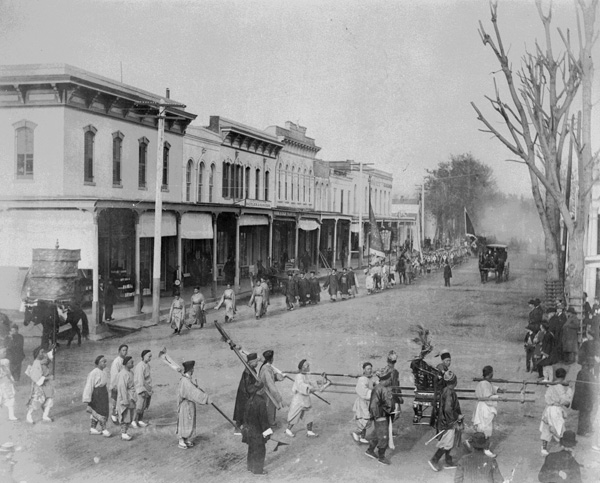
sc4766 Chinese New Year Parade / Procession Chico Main near 2nd

Photograph shows a Chinese New Year Parade through downtown Chico, 1894. Special Collections, Meriam Library CSUChico.

But the benefits from the Chinese community were overshadowed by fear, resentment, and prejudice. To the white population, the Chinese were a foreign element that would never assimilate into the American body politic. They were too different. Everything from their food and clothing to their religion was alien.

White workingmen resented the Chinese for taking jobs they thought should be theirs. When times got tough and jobs were scarce, whites turned on the Chinese and blamed them for the loss of jobs. The economic depression of the 1870’s created widespread unemployment and deep resentment of Chinese immigrants.

Men banded together to drive out the Chinese. In Chico they formed a branch of a statewide society called The Order of Caucasians. Members included not only laborers, but store owners, farmers, teachers and lawyers. They rallied to the cry “The Chinese must go!” and repeatedly told John Bidwell and other employers to discharge their Chinese workers or else.

1874    Tues. May 19.
Weather cool and pleasant – Man at dairy abused Chinaman –

1886: Sun., August 29.
Events: Hoodlums threw stones at Chinamen – wounded one badly.-

The chief weapon used against the Chinese was arson. Men set fire to buildings in both of Chico’s Chinatowns. They sent death threats to General Bidwell and told him to get rid of his Chinese workers. Arsonists burned down buildings on the ranch. Chinese men were threatened, beaten, and shot at. For the most part the police ignored these crimes.

1877: Fri. March 9.
Cloudy, but warm, – began to drizzle, – rained all P.M. . . .  Both Chinatowns were set on fire last night.

The tension and agitation would culminate in murder.

Posted in Uncategorized | 1 Comment

The Chinese in Butte County — and a Correction

Correction:  In reading the census tables, I thought Butte County had the highest percentage of Chinese residents in the state, but that honor goes to Trinity County. Although small in population, Trinity County had the largest proportion of Chinese miners and railroad workers.  In 1880, out of a population of 4939, 1951 (almost 40%) were Chinese.

Butte County reached its peak in 1852, when a state census showed 25% of Butte County residents were Chinese. The percentage was 20% in 1880 This fell off steeply after the Chinese Exclusion Act was passed in 1882.  Chinese immigration was rigidly limited, and older Chinese men (it was almost all men) died or returned to China.

Chinese Railroad Workers

Chinese Railroad Workers

When gold was discovered in 1848, it did not take long for the news to reach China.  Chinese gold-seekers, mostly from the province of Kwangtung started arriving in 1849 and continued coming throughout the next three decades. Immigrants on sailing ships from China could actually reach San Francisco in less time than it took to travel around Cape Horn, 4 months vs. 6 months.

At first the Chinese population in Butte County was concentrated in and around Oroville, where the men engaged in mining. Chinese miners took over abandoned gold claims and through diligence and teamwork extract the traces of gold left behind by less patient white miners who had moved on. They managed to make a living out of “played-out” mines, in spite of the burden of the Foreign Miners’ Tax.

The Foreign Miners’ Tax was levied against non-native born miners, but in reality it targeted only the Chinese. Foreign miners from Europe or South America were not hassled for the tax. The law passed in 1850 called for a tax of $20 per month. When this proved to be too high to collect, the tax was reduced to $4 per month in 1852. This was a major source of revenue for the state of California and it can be argued that state government was built on the backs of Chinese miners.

Mining remained a major occupation for Chinese workers throughout the 19th century, but as the gold dwindled, they moved into other occupations and became everything from ditch diggers and wood choppers to laundrymen and merchants. Many Chinese workers had also come to work on the transcontinental railroad, and when that was completed they migrated to the valley and swelled the ranks of available labor.

Next: Chinese Workers on Rancho Chico

Some of the above information was taken from The Chinese in Butte County, California, 1860-1920, by Susan W. Book.

Posted in Uncategorized | 2 Comments

Chinese-American History in Chico

Date: ca 1895 Photographer: H.H. Frye     Chico, CA Donor: John Nopel Collection Collection # jn1001023 John Nopel identified this image as a Chinese house boy who worked for the Bidwells.

Date: ca 1895
Photographer: H.H. Frye Chico, CA
Donor: John Nopel Collection
Collection # jn1001023
John Nopel identified this image as a Chinese house boy who worked for the Bidwells.

Bidwell Mansion State Historic Park is giving thematic tours on the Chinese in California during the month of May. If you are interested, check out the dates and times here.  I took the tour last Saturday and came away with a greater appreciation of the Chinese contribution in Chico and a better understanding of the relationship between the Bidwells and the Chinese.

The picture to the left shows a Chinese man who worked for John and Annie Bidwell as a houseboy. His name may have been Ah Sang. Bidwell mentions him in his diary in 1882.

Chinese immigrants came to California beginning in 1850 as part of the Gold Rush, and they stayed to work on the transcontinental railroad and in various other pursuits. John Bidwell first hired Chinese workers in 1869. On Wednesday, May 19 of that year he records: “Ah Wing,
Chinaman, began work at $25 per month.” This was less than he paid white workmen.

Bidwell was soon employing a good number of Chinese workmen. They pruned trees, picked fruit, and tended vegetable gardens. They were skilled and reliable workers with extensive agricultural experience. They were also cheaper to hire, and Bidwell, like other businessmen, saw no reason to pay the Chinese at the same rate as whites if he could get them for less.

Many of the Chinese in Butte County were mining along the creeks where they managed to extract gold from claims abandoned by white miners. Others grew vegetables on rented land and sold their produce in town. Chinese vegetable peddlers were a common sight. Others worked as cooks, domestics servants, and laundrymen. Most middle-class families employed at least one Chinese servant. At Stansbury House you can see the small room occupied by Dr. Stansbury’s Chinese cook.

The Chinese community made up a significant portion of the Chico population. By 1880, according to the U.S. census, 20% of Butte County residents were Chinese. This is the highest percentage in the state. (The totals for Butte County are: White: 14.270, Colored: 136, Chinese: 3,793, Indian: 522). Overall in California, the Chinese were about 10% of the population. This holds true for San Francisco, where 21,790 Chinese lived alongside 210,496 whites.

Friction and resentment developed along the interface between Asians and Americans in Butte County. There would be trouble between the white population and the Chinese, and John Bidwell would be right in the middle of it. More next time  . . . .

Posted in Uncategorized | Leave a comment

Miss Crosby’s Blue Umbrella

On September 9, 1850, John Bidwell was present when President Millard Fillmore signed the bill, passed by the Senate and the House, that made California the 31st state of the Union. Bidwell had been in Washington since May, advancing the cause of California. Now with that goal accomplished, he lost no time in starting back to California. Bearing the precious admission papers, he traveled to New York where he boarded the steamship Oregon on September 13th, 1850.

Before John Bidwell left California, Elisha O. Crosby had asked him to escort his wife and daughter on their trip to join him. Crosby had come overland to California with the Chiles Party in 1848, leaving his wife and teenage daughter in New York. He had done well in the Gold Rush and served in the California Senate with John Bidwell. He trusted Bidwell to bring his family safely to join him in California.

Those admission papers seem to have worried Bidwell. What if he lost them, or what if they were stolen? How could he keep them safe? Not trusting them to his own luggage, he gave them for safe-keeping to Mrs. Crosby, and she in turn entrusted them to her daughter, Mary Helen.

Or maybe it wasn’t so much that he was worried about the documents. Maybe he just wanted to impress Miss Crosby, and give himself a reason to ingratiate himself with her. At any rate, she guarded the papers closely. She kept them under her pillow at night, and stowed them inside her blue silk umbrella as the party crossed the Isthmus of Panama. In spite of the tropical rains, it is said she never opened her umbrella, but kept it tightly rolled the entire time.

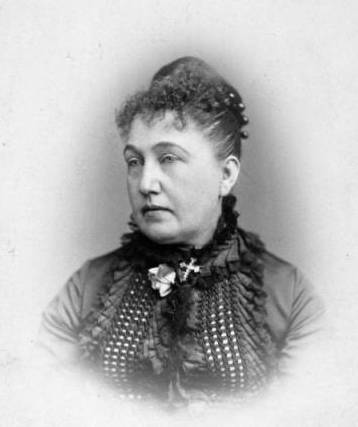
Throughout the voyage, John Bidwell paid courtly attention to 19-year-old Helen Crosby. She was probably a pretty young lady, although no portrait exists from 1850.

Mary Helen Crosby Hensley in 1871.

Mary Helen Crosby Hensley in 1871.

But he was not the only suitor on the ship. Samuel J. Hensley, another California pioneer, also had his eye on the young lady, and she favored Hensley. They were married on April 7, 1851.

No doubt John Bidwell was disappointed at the time. Young ladies of quality were in short supply in early California. But in the end he was probably happy he waited for Annie.

More on Miss Crosby and her umbrella to come . . .

Posted in Mary Helen Crosby | Tagged | Leave a comment

A Little Map of Chico

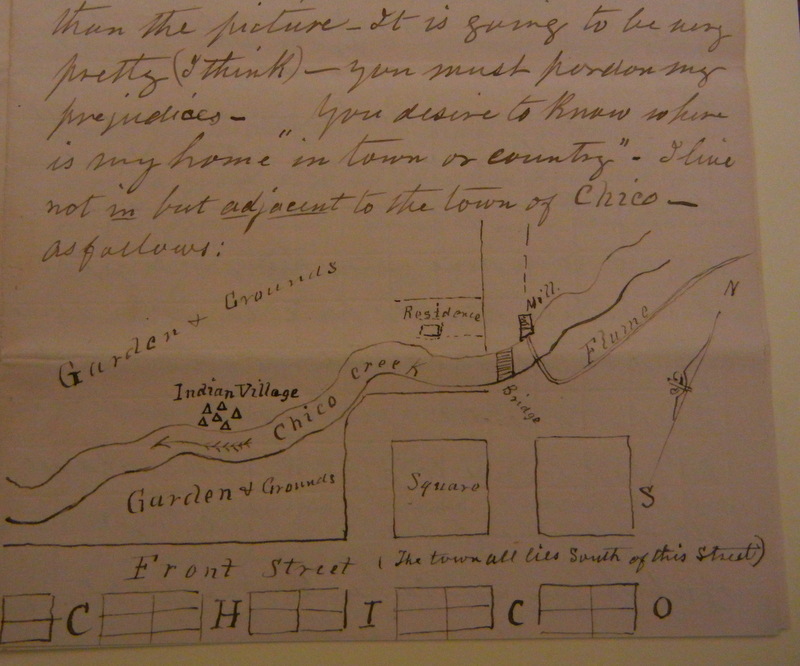
July 5th, 1867: You desire to know where is my home “in town or country?” I live not in but adjacent to the town of Chico — as follows:

DSCN3501So wrote John to Annie after he returned from Washington to Chico, and he drew her a little map so she could visualize his home. At that time he was still living in his adobe house. Construction on the mansion was going forward, but he doesn’t say whether the “Residence” is his new or his old house. What he labels as “Square” is now a triangle, sliced through where the Esplanade joins Broadway.

Posted in Uncategorized | Leave a comment

California Diversity Goes a Long Way Back

HN000800a copy

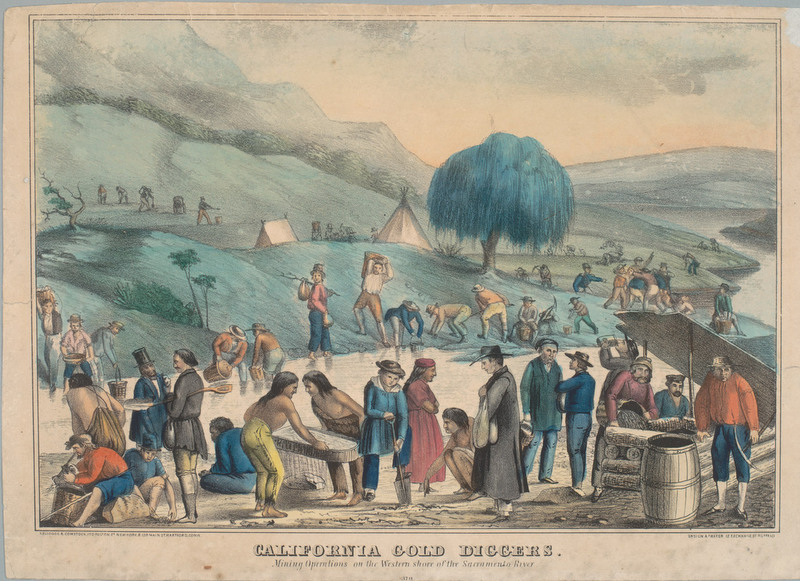
Magazine illustration of mining on the Sacramento River. Image courtesy of the Bancroft Library.

One more excerpt from John Bidwell’s letter to Miss E. Boyd:

Here the sun’s rays come blistering down the deep and narrow gorge where seats together all the nations of the earth. . . . There’s nothing here to please the eye or gladden the heart but Gold. The Yankee, the Mexican, the Spaniard, Portuguese, Chinese, Malays, N. Zealanders, Sandwich Islands, Chillanians, Peruvians, besides various Tribes of Indians tame and wild, civilized and barbarous. I have seen that I know of at this moment. These with some other nations are all toiling after this wondrous stuff.

Men (and a few women) had flocked to the goldfields from around the world, and any ship that docked in San Francisco after word of the gold discovery got out was soon deserted of all its sailors, no matter where they were from.

Almost the only group John Bidwell doesn’t mention are African-Americans, but they were there too, and he would have met them. Some were brought as slaves by their Southern masters, and many came as free blacks to try their luck in the goldfields.

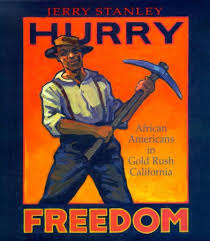
For a look at the African-American experience in California, an excellent book is Hurry Freedom, by Jerry Stanley. Although written for younger readers (like my own book), it is a good overview for any reader. It focuses on the experience of Mifflin Gibbs (1823-1915)  born in Pennsylvania, who had a successful boot store in San Francisco and founded the city’s first black newspaper. Gibbs led the black community in an unsuccessful struggle to get the California legislature to recognize equal rights for African-Americans. hurryfreedom

Gibbs finally gave up and migrated to Canada during the Fraser River gold rush. After the Civil War he returned to the United States, studied law, and served as a judge and as U.S. consul to Madagascar.

Posted in Uncategorized | Leave a comment

Summer in California

After telling Miss Boyd about the beauties of a California spring, John Bidwell went on to describe the changes of summer.

. . . hold now — let time speed but one month. The fragrant and beautiful flowers are dead, the waving grass and oats are dried, a hot suffocating breath attends you to the shaded stream where you propose to cool and refresh yourself, but here too has the scene changed in your absence — perchance you see the spot — while the grapes are still hanging from the boughs and are full of richness, but the stream where you thought to quaff a good measure of clear cold water is dried up, a few stagnant pools is all that remains. The foliage even from the trees has been crisped by the burning sun, and thus it will continue for six long months, not a cloud to dim the intensity of the midday sun — not a shower to reanimate thirsty drying nature.

That certainly describes a California Central Valley summer — six long months of hot weather and no rain. And he didn’t like it. He suffered from the heat and dreamed of returning to the States. He made his plans, but never carried them out.

Who was Miss Boyd? Evidently she was someone he wanted to impress, because his language in letters and diaries is rarely this poetical and flowery. Maybe he hoped to win her heart and hand if he returned to the States. She was someone whose family he had known in Missouri, but other than that I don’t know who she was. She probably married someone else, wrote him a “Dear John,” and that was the end of his efforts.

Posted in Uncategorized | Leave a comment