Scott’s Bluff, part 2

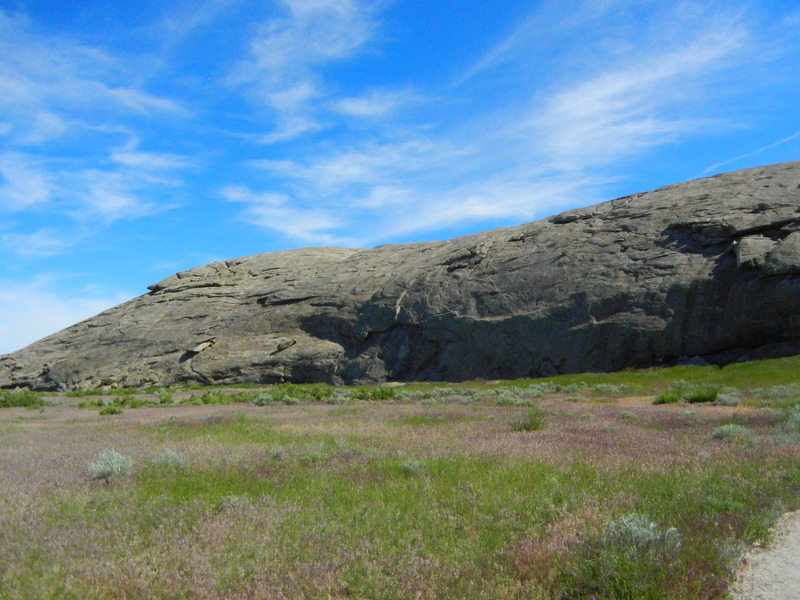
scottsbluff-1As the Bidwell-Bartleson Party approached Scott’s Bluff, they faced a problem that they hadn’t encountered yet on their journey–a barrier. Pioneer companies followed rivers, but they didn’t cross them any more than they had to, because crossing a river was a difficult and dangerous undertaking. They had been following the Platte River, but now the river ran right under the bluffs.

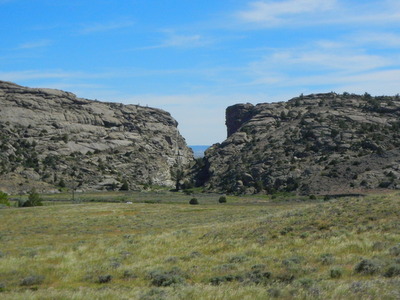
So with Scott’s Bluff before them, they had three choices: cross the river and see if traveling was better on the other side, go around the short range of hills on the south (now known as the Wildcat Hills), or head straight for the gap. The Gap seems to be the obvious choice, but when I spoke to a ranger at Scotts Bluff National Monument, he told me that getting through the Gap was too difficult and wagon trains before 1851 were forced to go the long way around the hills.

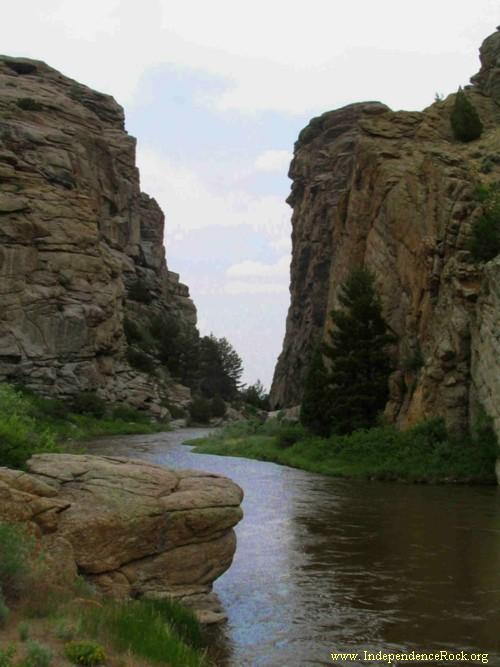
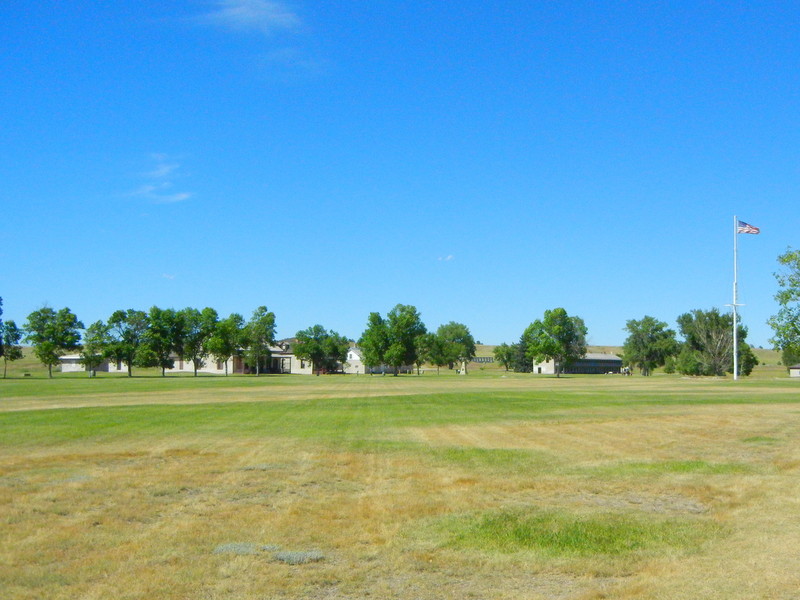
In 1851 the U. S. Army built the road through Mitchell Gap, making it passable for wagon trains. If you look at the photo above you will see the highway that follows that road today, but you will also see the ravines that made traveling through the Gap so arduous.

But Bidwell says nothing about going around. They camped among these “grand and picturesque” hills on June 19th, and on the 20th they made their passage. He writes:

Sunday, 20th. Passed through the Gap–came into an extensive plain, the beautiful scenery gradually receded from view–came to a creek called Horse–passed it, reached the river again–cool and windy–having come about 23 miles.

They took those hills in stride and carried on, making good time.

Posted in Oregon Trail | Leave a comment

Scott’s Bluff

Scott's Bluff

Scott’s Bluff

One day’s journey west of Chimney Rock the emigrants came to Scott’s Bluff, a rock formation named for Hiram Scott, a wounded fur trapper left behind to die by his companions in 1828. The fantastical shapes of the rocks were a welcome sight to travelers who had just spent weeks traversing the flatlands of the prairie. John Bidwell wrote:

We gradually receded from the river in order to pass through a gap in a range of high hills called Scott’s Bluffs. As we advanced towards these hills, the scenery of the surrounding country became beautifully grand and picturesque–they were worn in such a manner by the storms of unnumbered seasons that they really counterfeited the lofty spires, towering edifices, spacious domes, and in fine all the beautiful mansions of cities. We encamped among these envious objects having come about 20 miles.

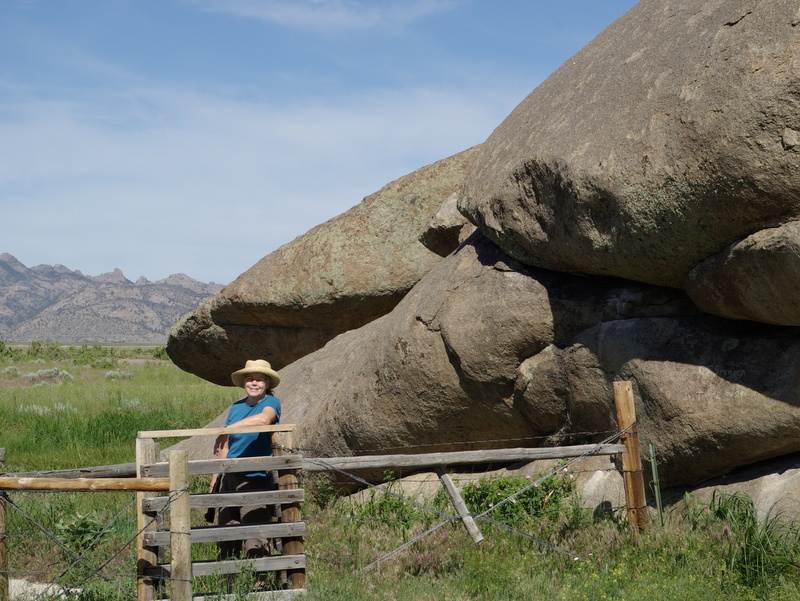
The Platte River runs along the northern base of the bluff. On my visit to Scott’s Bluff National Monument I wondered why the pioneers had to find a way through the rock formations of Scott’s Bluff. They were following the river–why didn’t they cross it (it looks narrow and mild-mannered at this point) and travel along the flatter land on the other side?

I talked to the ranger about it, and he told me that the Platte is now controlled and doled out for irrigation, but back in the day it was wide and treacherous. Pioneers didn’t want to cross it if they could avoid doing so. Moreover, the land on the other side, which today is developed, was actually criss-crossed with ravines that made it difficult to navigate. So travelers stayed on the southern side and negotiated the bluffs and hills instead.

Tomorrow’s question: Where did the Bidwell-Bartleson Party cross Scott’s Bluff?

DSCN2880


Posted in Uncategorized | Leave a comment

Bidwell at Chimney Rock

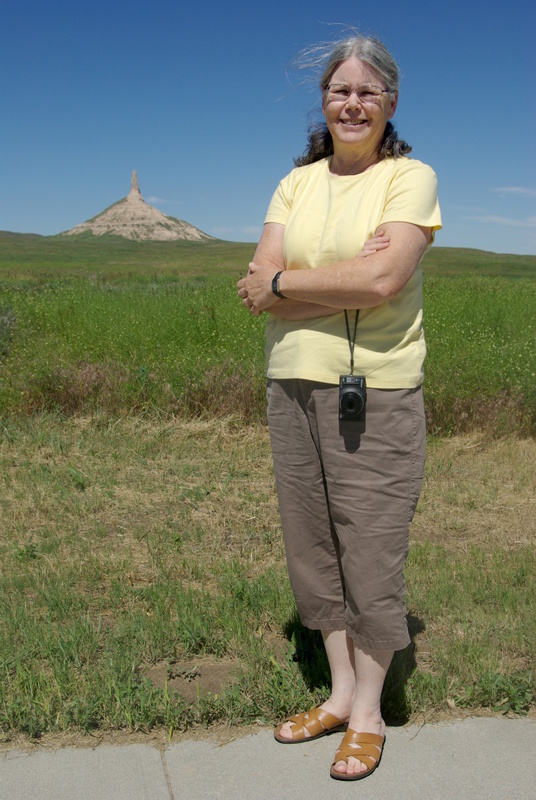
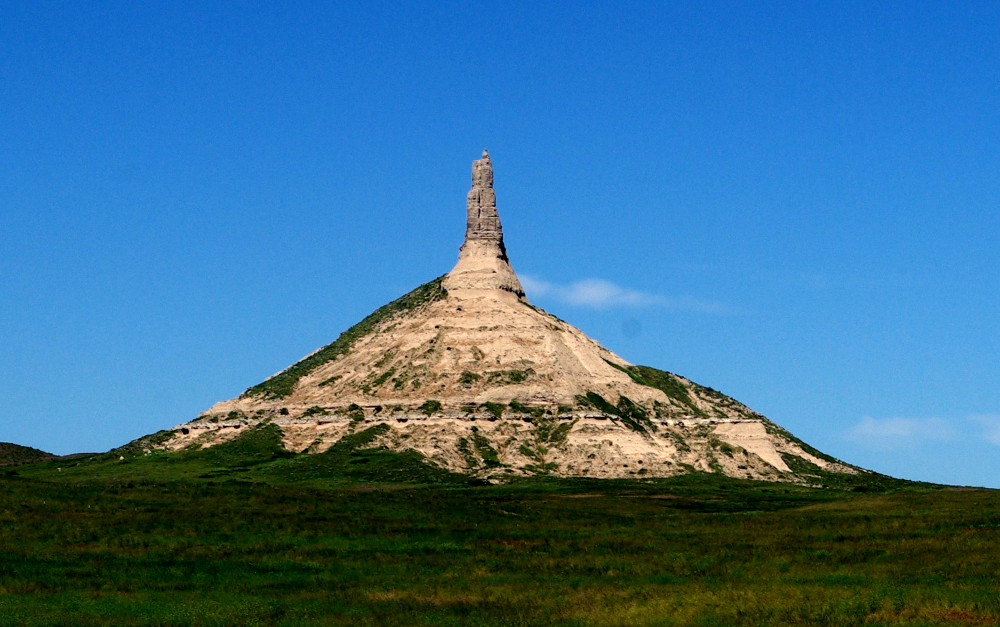
needle1In 1841 John Bidwell was traveling across the “dull and monotonous” Great Plains when finally the landscape began to change. On June 17th the party spotted castle-like Courthouse Rock, and on the 18th they came to Chimney Rock, a landmark mentioned by nearly every emigrant who left a record:

Friday 18th: At about 12 o’clock today we passed another object, still more singular and interesting. It is called by the mountaineers the Chimney, from its resemblance to that object, and is composed of clay and sand so compact as to possess the hardness of rock. It has been formed from a high isolated mound which, being washed on every side by the rains and snows of ages, has been worn down till nothing is left but the centre which stands upon an obtuse cone, and is seen towering like a huge column at the distance of 30 miles.

Most of the company members traveled from their campsite to Chimney Rock to get a closer view and to inscribe their names with tar and grease. No doubt the names have long since worn away. Bidwell later noted that the chimney had become shorter than when he first saw it and less square. Today it looks more like a spire, but in 1841 it really did look like a chimney. Or maybe, as Father DeSmet said, a funnel.

Father Jean Pierre De Smet, the missionary whose group traveled along with the Bidwell-Bartleson Party, wrote of seeing “the chimney”:

It is called so on account of its extraordinary form; but instead of applying to it an appellation which is rather unworthy this wonder of nature, just because it bears some resemblance to the object after which it is named, it would have been more proper to call it “the inverted funnel” as there is no object which it resembles more. What excites our astonishment, is the manner in which this remnant of a mountain,composed of sand and clay, has been so shaped, and how it has for such a length of time preserved this form, in spite of the winds which are so violent in these parts.

And if you have ever traveled through Nebraska, you too can attest to the “violence” of the winds.

Posted in Oregon Trail | Leave a comment

On the Trail with John Bidwell

buffalo-1-2I am on vacation in the Great American West and starting tomorrow I’ll be following in the footsteps of John Bidwell and countless other pioneers who trekked across the Plains. I saw these bison near the road today; here is what Bidwell had to say about the buffalo he saw in 1841:

Tuesday, June 8th: There were 8 or 10 buffalo killed today,but not one-tenth of the meat was used; the rest was left to waste upon the prairie. In the afternoon we passed the confluence of the N. & S. forks of Platte river and encamped, having come about 18 miles; many hundreds of buffalo were seen at this place.

The scenery of the country on the Platte is rather dull and monotonous [sorry Nebraska], but there are some objects which must ever attract the attention of the observant traveler; I mean the immense quantity of buffalo bones, which are everywhere strewed with great profusion, so that the valley, throughout its whole length and breadth is nothing but one complete slaughter yard where the noble animals used to graze, ruminate, and multiply in uncounted thousands–but they are fast diminishing. If they continue to decrease in the same ratio that they have for the past 15 or 20 years, they will ere long become totally extinct.

The Indians are anxious to preserve them, and it is said of them that they never kill as long as they have any meat remaining, but behold with indignation the shameful and outrageous prodigality of the whites, who slaughter thousands merely for their robes and leave the meat, which is far more delicious than that of tame cattle, to waste, or be eaten by wolves and vultures.

Tomorrow we will join up with the Oregon-California-Mormon Trail and I’ll give you more reports from along the way.

Posted in buffalo, Oregon Trail | Leave a comment

Happening this Weekend

There’s a lot going on the weekend of May 10-11, with events for every interest and taste, all in beautiful Butte County. Here are two of them:

Feather Fiesta Days is the big event in Oroville. The Butte County Historical Society is taking part by hosting Conversations With Local Authors at the Ehmann Home from noon to 3 p.m. Looking for a book on local history and travel? Find it in the gift shop and get it signed by the author, or just enjoy chatting with local researchers about their areas of interest. The books include titles covering several Butte County towns, Oroville Dam, Oroville-Quincy Highway, the poet Pres Longley, John Bidwell, flumes and hiking trails, a logging mill, and other topics of local interest.

I’ll be signing my books on John Bidwell and Pres Longley. I’d love to meet you! Drop in anytime during the open house to chat. Refreshments will be served.

Museums all around Butte County have joined together to host the first ever Chico Area Museum Alliance Museum Hop. Start at the museum of your choice, get a passport, and visit as many as you can on Saturday and Sunday, May 10-11. Your name will be placed in the prize drawing. Participating museums are: Bidwell Mansion State Historic Park, Chico Creek Nature Center, Chico Museum, Colman Museum, Gateway Science Museum, Janet Turner Print Museum, Museum of Northern California Art, Patrick Ranch Museum, Stansbury House, and Valene L. Smith Museum of Anthropology.


Posted in Uncategorized | Leave a comment

Why Did President Hayes Visit a “Backwater” Like Chico?

Larry commented on my previous post about bridges that “Someone asked me why these dignitaries came to a “backwater” place.” What was the president of the United States, the First Lady, Secretary of War Ramsey, General William Tecumseh Sherman, and the rest of their traveling party doing in a small out-of-the-way place like Chico? What could have attracted them to Chico?

President Rutherford B. Hayes made his tour of the western United States in September 1880. He was nearing the end of his term; he had vowed that he would not run for a second term, and the Republican Party had nominated James Garfield as its candidate the previous June. He was the first sitting president to visit the West Coast.

General Sherman made the travel arrangements for the presidential party. Bidwell notes in his diary for August 26 that he wrote to Sherman about the trip. The plan was for the president to travel by train from Chicago across the western states to San Francisco and Sacramento, and then northward until the end of the railroad line in Northern California. After that the party traveled by stage coach through Oregon to Portland and all the way to Seattle before turning back east in October.

General Bidwell had the finest home in all of California north of Sacramento. Bidwell Mansion was an ideal overnight stopping place for the presidential party. General Sherman knew he could count on John Bidwell to entertain the president in style and comfort.

President and Mrs. Hayes visit Yosemite, California. Image courtesy of Ohio Memory Collection.

President and Mrs. Hayes visit Yosemite, California. Image courtesy of Ohio Memory Collection.

Bidwell joined the presidential party on its train at Roseville on Sept. 8th. He accompanied the president in Sacramento and on to Oakland and San Francisco. Then while the president and Mrs. Hayes visited Yosemite, San Jose, and other sites, Bidwell returned to Chico on the 13th to finalize preparation for their visit. On the  19th he traveled back to Sacramento to visit the State Fair. The entries in his diary for the actual visit to Chico are annoyingly brief:

Tues., September 21. Sacramento -Davisville – Sacramento Events: Went to Davisville to meet Presidential party – Dined with them at Gov. Stanford’s – Introduced Mr. Rideout to Pres. Hayes. Weather: fine – warm – fine –

Wed., September 22. Sacramento. Pavilion.

Thurs., September 23. Sacramento> Chico with President Hayes & party: Gen. Sherman, Sec. Ramsey.

Fri., September 24. Chico, Cherokee, Chico  President & party went to Cherokee and returned – and left for Oregon.

It was just an overnight stay, with an excursion to see the mines at Cherokee. But no one could entertain the president in finer style or with greater cordiality than General John Bidwell.

Posted in Rutherford B. Hayes, Uncategorized, William Tecumseh Sherman | 3 Comments

Dmitry Zavalishin’s Bold Plan

Flag of the Russian-American Company

Flag of the Russian-American Company

If Dmitry Zavalishin’s colonial visions had come to pass, Northern California would be New Russia, not the State of Jefferson or any other part of the United States. It’s pretty hard to imagine, but he certainly used all his charm and powers of persuasion to try to make it a reality, and how different California’s history would be if he had succeeded!

Writing some 40 years after his visit to California, he still regrets that Imperial Russia did not seize the opportunity. Even without its well-known mineral wealth, it was a prize to be sought after.

The superior climate, rich soil, and capital location on the Great Ocean, with one of the best ports in the world [San Francisco], constitute the unalterable and inalienable advantages of California, and from this naturally sprang the desire to expand our colony of Ross at least as far as the northern shore of San Francisco Bay and the Sacramento River, and to that extent it was still possible.

He believed that “California’s subjection to Russia would have brought mutual and considerable advantages.” He was sure, from his conversations with the Mexicans in California, that Mexico’s neglect of its northernmost province would make it easy for Russia to expand its foothold. Mexico was weak, it had no navy to defend California, and the Californios were dissatisfied with Mexican rule. They seemed amenable to a pact with the Russians to protect them from the Americans, who it was feared would seize their lands without compensation.

In their eyes the Americas were heretics, and the specimens of United States citizens that they had come to know–adventurers and petty traders–had done little to recommend their nation. . . . As they themselves realized, almost the only means of deliverance from the terrible danger and at the same time from their disastrous situation was union with Russia.

And so Zavalishin envisioned a colony (led by himself he hoped), that would stretch from the northern shores of the San Francisco Bay to the 42 ° parallel (the Oregon border).  It would have Russian farmers, a school, a doctor, and friendly relations with the Indians. It would give Russia a magnificent warm-water port and a firm foothold in North America.

Alas for Dmitry, it was not to be. Many years later, after the Mexican War, the Gold Rush, and the annihilation of the Indians, he remembers the Californios who welcomed him so cordially, and writes,

I am sure in the light of everything that has happened, they often remember how much better it would have been if, instead of the events that occurred, our mutual proposals and desires had been realized at that time.

(Quotations are taken from California through Russian Eyes, 1806-1848)


Posted in Dmitry Zavalishin, Russian American Company | Leave a comment

California through Russian Eyes

California Through Russian EyesAnyone interested in the Russian presence in early California can do no better than to read California through Russian Eyes, 1806-1848, compiled translated, and edited by James R. Gibson (Arthur H. Clark Company, 2013), the second volume in a series entitled Early California Commentaries. It consists of 32 documents–letters, reports, and journal entries–by Russians who visited and lived in Alta California, from the earliest explorers to the last manager of Fort Ross. (I checked the book out from the Butte County Library.)

The Russians were careful and curious observers of life in California. Dmitry Irinarkhovich Zavalishin was a 20-year-old midshipman in 1824 when he spent several months in California purchasing provisions, learning Spanish, and conversing with various Californios.  Many years later, after the Gold Rush had made California famous, he recounted his experiences for Russian readers. Here he is reporting on the native population:

Compared with other Indians of North America glorified in the novels of Cooper and other writers, California’s Indians were a meek lot. Of course they were sometimes driven to ferocity by brutal treatment,and then they committed atrocities on Californios who fell into their hands . . . Undoubtedly with good treatment and proper upbringing they were capable if development; this was proven by numerous examples in the missions. Even in the wild state they displayed remarkable abilities in many respects. They made many artistic and very durable articles. Their root baskets and hats were waterproof and combined unusual lightness and durability with resilience; head ornaments, belts, the outsides of baskets, and other articles, which were minutely decorated with the different and multicolored feathers of local birds, were splendid examples of art and patience.

Regarding weapons, their bow, strung with sinew, was usually so taut that the strongest among us could not pull it without practice and skill. Their arrows were made from rushes with stone heads daubed with poison; wounds from them, regardless of the poison, were very dangerous, for they had a rough finish and a jagged edge.

A typical European, perhaps, but one who was open to appreciating the people he observed. He was positive that the Russians could get along better with the California Indians than the Spaniards and Mexicans did.

In conclusion, with regards to the Indians I will say a few words about their relations with the Russians. Whoever has studied the Russian national character knows very well that Russians, if they have not been aroused by some special external circumstance, are very good-natured and well-disposed toward everyone, despite differences in religion, nationality, and social status. A Russian disdains neither a savage nor a heterodox . . .  No wonder that the Indians liked the good-natured Russian sailors, especially the generous and affectionate officers.


Posted in Uncategorized | 2 Comments

What Ever Happened to Josiah Belden?

Josiah Belden

Josiah Belden

From time to time I’ve written about other members of the Bidwell-Bartleson Party and followed up on their subsequent adventures. Many of them returned to the States after a short time, and very few of them were successful in California. One man who made a name for himself, much like John Bidwell, was Josiah Belden.

Josiah Belden was born in Connecticut in 1815. As a young man he had a typical case of “itchy feet” and traveled to New York, throughout New England, over to Liverpool and back, down the Mississippi River to New Orleans and up the river to St. Louis. There he heard about California and joined the first emigrant group to attempt the overland journey to California.

Josiah dictated a statement of his experiences on the trail and in California in 1878. After arriving at Marsh’s ranch in November 1841 he headed first to San Jose to obtain a passport, and then to Monterey to seek employment.

About a dozen of us, after resting a day or so at Marsh’s Ranch, started out to go down to the Pueblo San Jose, with directions from Marsh how to find our way there. We came on to that place, crossing what is now Livermore’s Ranch, but there was no settlement there then. We proceeded, and stopped one night at Geary’s [Joaquin Higuera] ranch, two or three miles south of the mission of San Jose. We excited a good deal of interest as we passed by the mission of San Jose.

He went to work for Thomas O. Larkin, a merchant and later the American consul in Monterey.

[I] made arrangements with him to go over to Santa Cruz and take charge of a store there, which he wished to establish as a branch, and I went over to manage the business there for him–a store of general merchandise. We carried on the usual business there, selling goods and taking pay in hides and tallow, and buying lumber . . . mostly the redwood lumber.

In 1844, during the ruckus known as the Micheltorena War, Belden recruited some Americans to guard the governor’s home and family. In reward Governor Micheltorena granted Belden a 21,000 acre land grant on the upper Sacramento River.  Together with Robert Thomes he traveled to Rancho Barranca Colorado, at the present site of Red Bluff, but before long he hired William B. Ide to manage the ranch for him, while he went back to the mercantile business in Yerba Buena.

He tried his hand at mining in 1849, but soon realized he could make more money selling supplies to miners. His astute merchandizing deals and real estate investments made him a wealthy man. (It’s an advantage to be already on site when great events transpire.) He sold his interest in the Rancho Barranca Colorado to Ide, and settled in San Jose. He was elected the first mayor of San Jose in 1850, which must have given him a great deal of satisfaction, since he had spent six days in jail there when he first arrived.

He occasionally met his old traveling companion, John Bidwell. For instance, on June 19, 1871, Bidwell records in his diary: “Josiah Belden & son (George) arrd. fm Tehama.” They stayed overnight at the Mansion and left the following day.

Belden married and in 1855 built a fine home in San Jose. The family traveled extensively and lived the good life. In 1881 he moved to New York City and in 1892, nearly 77 years of age, he died there. He was a man to whom California had been very good indeed.

Home of Josiah Belden in San Jose (no longer in existence.)

Home of Josiah Belden in San Jose (no longer in existence.)

Posted in Josiah Belden | 4 Comments

Bidwell and Bridges

I have been puzzling over these two photos. Both come from CSUChico Meriam Library Special Collections, and both show John Bidwell standing with a group of people on a bridge. Where was the bridge? Who are the other people in the photos?

sc17321 "First toll bridge across Sacramento River, Chico, 1879."The title on this one is “Gianella Bridge”, and the date is 1879. Since the Gianella Bridge, which crossed the Sacramento River at Hamilton City, wasn’t built until 1910, it can’t be that bridge. The description goes on to call it the Sacramento Bridge, the first toll bridge across the Sacramento River, and states that it washed out in the 1883-84 flood.

It’s easy to spot John Bidwell in this photograph. He is the tallest man in the picture. At six feet, or maybe 6′ 2″, (descriptions differ), he was much taller than most men of his era. He was also rather portly by this time in his life.

The woman beside him is his wife Annie. This is the only photo I can think of that shows them standing side by side, which makes it the best photo to demonstrate the difference between their heights. Annie was 4′ 8″, which is quite small today, but not very much shorter than many other women in her day.

Here’s another bridge photo:

John_Bidwell_Entertaining_President_HayesThis comes from the John Nopel collection, and is titled “John Bidwell Entertaining President Hayes.” The note says that this is the “bridge over Big Chico Creek near Sacramento River.”

It looks like the same bridge to me in both photos. Is it a bridge over Chico Creek or over the Sacramento River? If anyone knows, let me know.

President Hayes visited Chico while on a tour of the western states in September 1880. Hayes is on the left, and the woman next to him is presumably his wife, Lucy Hayes.

That is definitely John Bidwell on the right. Who could mistake him? And it looks like it might be Annie next to him, except that Annie was not at home when the president came to call. Annie was on an extended visit to her family in Washington D.C. when the president took his western tour. She left it up to John to entertain the president, and he called on other leading ladies in the town for assistance. So that’s not Annie.

The note with the photo also says that General Sherman is in the picture.  I’dWilliam Tecumseh Sherman Library of Congress like to know which one he is. William “War is hell” Tecumseh Sherman accompanied the president and should be in the picture, but none of these men look like him. Here is a picture of him taken during this period. I don’t think any of these men is a good match.

Lots of questions for two old photographs. What do you think?


Posted in bridges, Rutherford B. Hayes, William Tecumseh Sherman | 6 Comments