The Adventures of the Sutter Gun, Part 1

A couple of years ago I wrote about the French Army muskets that ended up at Sutter’s Fort, after Johann August Sutter bought Fort Ross from the Russian-American Fur Company. Dismantling Fort Ross and sending every bit of useful equipment to Sutter’s New Helvetia was John Bidwell’s first job after arriving in California.

But Napoleonic firearms weren’t the only weapons that Bidwell transported to Sutter, and the story of the cannon that became known as the Sutter Gun is a true tale of global arms trading and California adventure.

From The Overland Monthly, 1893.

From The Overland Monthly, 1893.

The bronze four-pounder was cast in St. Petersburg in 1804, just in time to be used against Napoleon’s army.  But even though it could fire a cannonball up to a mile, it was considered too small to be useful against the larger French field artillery. So the Czar gave the cannon to the Russian-American Fur Company, which transported it across Siberia to Sitka, and eventually down to Fort Ross in California. When Sutter bought Fort Ross, Bidwell shipped the cannon down the coast, through the bay and delta, and up the Sacramento River to Sutter’s Fort.

Sutter acquired a few other ships’ cannon with which to arm the fort, but the Sutter Gun was the only piece of field artillery in all of California, according to Stephen Beck, author of A Brief History of John Sutter and his Bronze Field Cannon. It was mounted on a caisson with large iron-reinforced wheels, and was accompanied by a limber, a two-wheeled wagon to carry ammunition and firing equipment. It was a true piece of field artillery, not a make-do ship’s cannon on an ox cart, which was all anyone else had.

In 1845 Sutter, Bidwell, and a small militia organized by Sutter took part in the little known Micheltorena War.  General Manuel Micheltorena had been sent to California by the Mexican government to replace Juan Alvarado as governor and collect taxes to support the war against Texas independence. He was as unpopular as a governor could possibly be.

Micheltorena came with an army of cholos recruited from the prisons of northern Mexico, who proceeded to pillage the ranchos and harass the residents. The residents of California, the Californios, turned against him, but Sutter, as a citizen of Mexico with the rank of captain in the Mexican army, sided with Micheltorena. His decision was undoubtedly aided by the new governor’s grant of thousands of additional acres of land to Sutter.

Stay tuned for part 2, for the further adventures of the Sutter Gun.

Posted in John Sutter, Sutter Gun | Leave a comment

Christmas Day, 1869

From John Bidwell’s diary for 1869:

Sat. December 25.  Christmas – Rained last night with a furious wind – Boys & girls of the town invited and had a high old time –

May you have just as good a time this Christmas with your family and friends.

Posted in Christmas | Leave a comment

Christmas with the Bidwells, Dec. 23-25

1870

Fri. December 23.  Little cloudy this morning but pleasant – heavy frost and freeze last night- H.W. Cleaveland left this morning for San Francisco – Annie shopping for Christmas presents – Mr. D. Ramage dined with us – Mr. McNair called to see about colt – Mr. Davis, carpenter of R.R. Co. called to see about place to connect pipes with flume.-

Sat. December 24. Sent turkies to Fairbairn, A.B.s, Wilson, etc.-

Sun. December 25. Rev. Mr. F. preached in morning -Rev. Mr. Reese preached in evening -Weather loveliest – walked down to R.R. bridge & up along creek with Annie – Last night Dick O’Farrell mare stolen –

Posted in Christmas | Leave a comment

Christmas with the Bidwells

How did John and Annie Bidwell celebrate Christmas? Well, for one thing, it didn’t go on all month like it does for us. Bidwell doesn’t usually mention Christmas in his diary entries until a few days before December 25th.

For instance, here is Bidwell’s diary entry for December 22, 1873:

Mon. December 22.  Began laying foundation to green house – Bought presents for S.S. Scholars- Dana C. Pearson called – and I subscribed to “Crofutts Western World” and got picture (Am Prayers) – Wife fixing Christmas tree – Sore from cold –

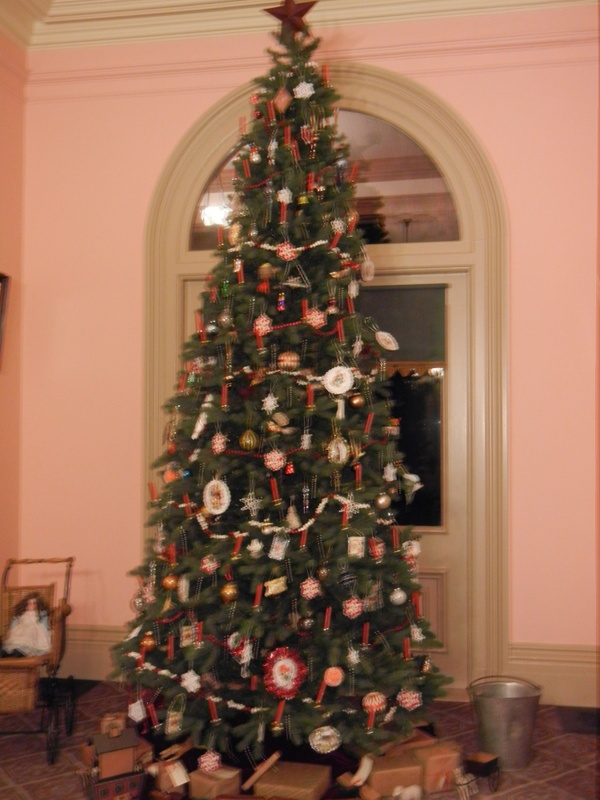
So three days before Christmas Bidwell is working on his usual ranch business (even though he is “sore from cold”), they go shopping for gifts for the children at the Presbyterian Church (the Sunday School scholars), and a salesman calls and he subscribes to a magazine and purchases a picture. Annie is busy trimming the Christmas tree. Rather than have the tree up for several weeks like we do, it is only up and decorated for a few days before and after Christmas Day.

Crofutt’s Western World, by the way, was a periodical (as it said on the masthead), “devoted to the railroad and kindred interests of the Great West; and to information for tourists, miners, and settlers beyond the Mississippi.crofutts

Posted in Christmas | Leave a comment

Melons in December

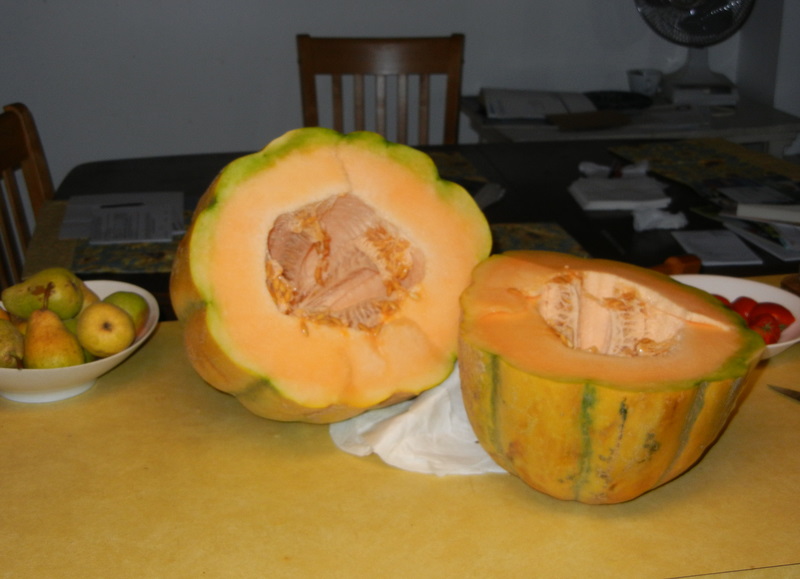
Most people know that John Bidwell loved to eat melons, especially the casaba melons that he grew from Turkish seed sent to him by the U.S. Department of Agriculture in 1881. He ate them every day from summer until they ran out in December. Here is what his ranch foreman, George M. Gray, tells about the melons:

The next year we planted ten acres on casabas on newly cleared ground between the flume and the Humboldt Road where the vegetable garden and the Bidwell nursery was for several years. The ground was very rich and we had plenty of water from the flume and of all the melons I ever saw growing those were the best.

DSCN0538

Bidwell sold the melons in town and to peddlers, and persuaded a hotel in San Francisco into taking them, until the hotel  decided that the melons were too large to make a handy serving. Overripe melons were fed to the hogs, and as Gray reports, “those hogs were said to be the sweetest pork that was ever sold in San Francisco.”

Bidwell made sure that he would have plenty of melons for himself.

Just before the first frost the General had a small slat building built back of the mansion under the trees with wide shelves on each side of the passageway, had straw put in the shelves, then filled with firm casabas and a light covering of straw on top.

When those on the ground out of doors were all gone these were getting ready to eat. On the last Sunday before Christmas the table girl brought in a casaba and said, “General, this is the last casaba.” The General threw up his hands and said, “Annie! Annie! do you hear that? This is the last casaba! What shall we do? What shall we do? Five months of melons and all gone.”

Poor John! It would be six months before melons would be in season again.

Posted in Casaba melon | Leave a comment

Christmas at Bidwell Mansion

Bidwell Christmas 001It’s beginning to look a lot like Christmas at Bidwell Mansion. BMA elves were busy decorating last week with new old-fashioned holiday decor.

December is a wonderful time to visit the Mansion, and a great place to take your out-of-town guests. The Bidwell Mansion Association will hold its annual Holiday Event for members and their guests on Friday, December 6th. For a donation of $25 you will be treated to catered appetizers, wine-tasting from New Clairvaux Vineyards, an exhibition of fine art photography, a tour of Bidwell Mansion in all its holiday splendor, costumed guides, AND . . .

the opportunity to be greeted by General and Mrs. Bidwell themselves. Yes! John and Annie will welcome you to their home in person!

If you are interested in the BMA Holiday Event on December 6th, please let me know and I will see that you get tickets. You can email me at naleek@gmail.com.

Bidwell Mansion State Historic Park will also be open for Holiday Night Tours on Tuesday through Friday, December 12th-15th. Another chance to enjoy Bidwell Mansion at Christmas!

Posted in Uncategorized | Leave a comment

Nugget, Nugget, Who’s Got the Nugget?

I just found out where James Marshall’s gold nugget is today. Along with many other great American artifacts, like Lincoln’s top hat and the Star-Spangled Banner, it is in the National Museum of American History, part of the Smithsonian Institution.goldnugget

When James Marshall picked up that first flake of gold from the tailrace of the sawmill he was building for John Sutter, he touched off a mass movement that would transform California, and indeed, the entire United States. He took the little nugget to Sutter, and they tested it: bit it, weighed it, hammered it, and boiled it in lye. Later that same day Sutter called his business manager, John Bidwell, into his office and asked his opinion. Bidwell agreed: it looked like gold. Sutter sent him to San Francisco with the sample to have it assayed, and Marshall high-tailed it back to Coloma to protect his find.

Soon the word was out: Gold in the California hills! But what became of that first flake of gold from the American River?  According to the National Museum of American History:

In June of 1848, Colonel Sutter presented Marshall’s first-find scale of gold to Capt. Joseph L. Folsom, U.S. Army Assistant Quartermaster at Monterey. Folsom had journeyed to Northern California to verify the gold claim for the U.S. Government.
The gold samples then traveled with U.S. Army Lt. Lucien Loesser by ship to Panama, across the isthmus by horseback, by ship to New Orleans, and overland to Washington. A letter of transmittal from Folsom that accompanied the packet lists Specimen #1 as “the first piece of gold ever discovered in this Northern part of Upper California found by J. W. Marshall at the Saw Mill of John A. Sutter.”
By August of 1848, as evidence of the find, this piece and other samples of California gold had arrived in Washington, D.C., for delivery to President James K. Polk and for preservation at the National Institute. Within weeks, President Polk formally declared to Congress that gold had been discovered in California.

In 1861 the gold nugget entered the Smithsonian Institution, where it remains to this day.

Posted in Gold | 1 Comment

Whatever Happened to Joseph Chiles?

John Bartleson took a look around California, decided it wasn’t for him, and left the next year to return to Missouri. Joseph Chiles took a look around California, and decided it was for him, and also returned the next year to Missouri to recruit more settlers.chiles2

After all the hardships of six months on the California trail, to turn right around and do it again shows a full measure of fortitude and toughness. Joseph Chiles was a Kentuckian, born in 1810, who moved to Missouri in 1831 with his wife, Polly Ann Stevinson. She bore four children and passed away in 1837. When the Western Emigration Society formed in 1841 Chiles signed up to take the trail to California, leaving his four young children with relatives.

Chiles traveled all over California on his first visit and got General Mariano G. Vallejo to promise him a grant of land for a mill site in Napa Valley. Then he took the southern route back to Missouri to see his children. There he signed up his friend Billy Baldridge for the next California trip and gathered the machinery for a gristmill. With a party of thirty men, six women and a few children he set out, eventually passing through the Sierras by way of Walker Pass. Unfortunately, they had to abandon the mill machinery on the way.

Nevertheless, Chiles proceeded to Sonoma and showed his friend the nice little valley he had found on the eastern side of the Napa Valley. He got a grant of two leagues and named it Rancho Catacula. He fought in the Mexican War in 1846 and then returned once again to Missouri to collect his children in 1847. Not yet done with trekking back and forth across North America, he would make one more round trip in 1853-54. This time he met Margaret Garnhart and married her. Their first child was born on the trail in Nevada.

By this time he had built his gristmill, and when the Gold Rush came he resisted the temptation to go prospecting for gold, and instead prospered from the great demand for beef and flour. Although his fortunes had their ups and downs through the years, he lived to the good old age of 75, leaving behind a numerous posterity.

Posted in Uncategorized | 1 Comment

Vallombrosa

Have you ever wondered why we have a Vallombrosa Avenue in Chico?

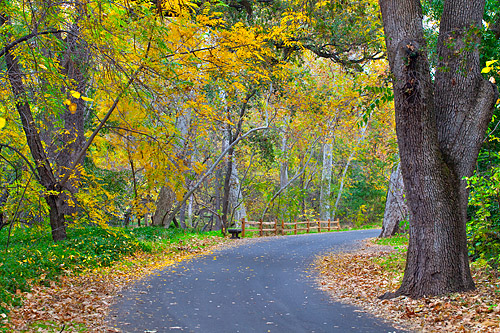
“Vallombrosa” is the name that John and Annie Bidwell gave to the strip of land running along either side of Big Chico Creek. It was a landscape that they loved and wanted to preserve in its natural state. Later, when Annie Bidwell donated the land to the City of Chico, it became Bidwell Park. But the Bidwells never called it that; they always called it Vallombrosa.

I imagine it was Annie who came up with this poetical name, based on a line from Milton’s Paradise Lost. In the poem’s first book Milton compares the fallen angels to autumn leaves:

Angel Forms, who lay entranced
Thick as autumnal leaves that strow the brooks
In Vallombrosa, where th’ Etrurian shades
High over-arched embower . . .

Photo of Bidwell Park in autumn by Anthony Dunn

Photo of Bidwell Park in autumn by Anthony Dunn

And where is that original Vallombrosa? It was a Benedictine monastery about 20 miles south of Florence in the Apennine Mountains. Milton traveled to Italy in 1638 and visited Florence in September. When he saw Vallombrosa he was struck by the beauty of the thickly falling leaves and later immortalized the locale in Paradise Lost. The name Vallombrosa derives from the Latin for “shady valley,” vallis umbrosa.

Posted in Vallombrosa | Tagged | 6 Comments

What Ever Became of John Bartleson?

The first emigrant train to California has been called the Bartleson Party, the Bartleson-Bidwell Party, and the Bidwell-Bartleson Party, after its captain, John Bartleson, and its most prominent member, John Bidwell. Bidwell rose to fame and influence in California, but what became of the captain of the company?

John Bartleson wasn’t the oldest man in the company, but he was older than most. The majority of men were, like John Bidwell, in their twenties. Bartleson was born in October 1786, making him 54 years old when they set out from Missouri. He was part of the “Chiles Mess,” made up of Joseph B. Chiles, Michael Nye, and some German immigrants. When they joined the company he insisted on being made captain, probably feeling that as an older and more experienced man, he was more qualified to lead the group. Bidwell wrote of him:

He was not the best man for the position, but we were given to understand that if he was not elected captain, he would not go; and he had seven or eight men with him, and we did not want the party diminished.

Exactly what he did when he arrived in California, other than get a passport in San Jose, I am not sure, but he didn’t stay long. He was one of those who decided than California was not for them, and promptly turned around and went back to Missouri. In 1842 he joined Chiles in traveling back via the southern route. After all, he had said to one and all when they were starving in the Sierras,

 Boys! If I ever get back to Missouri, I will never leave that country. I would gladly eat out of the troughs with my dogs.

John Bartleson died in Jackson County, Missouri on October 7, 1848, at the age of 61. What if he had stayed in California? Maybe he would have lived longer and made a fortune when gold was discovered. But he gave up on California too soon.

Posted in John Bartleson | 1 Comment