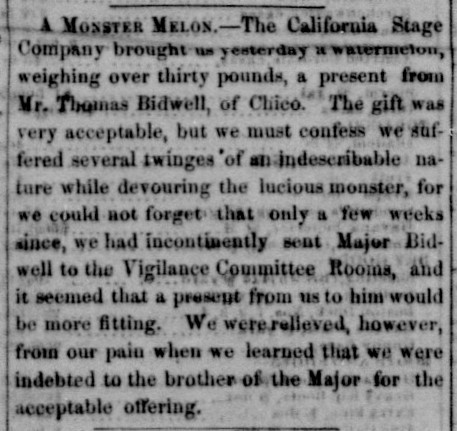
On August 1st, 1856, The Marysville Daily Herald published their thanks for the gift of a 30-pound watermelon, sent by Thomas Bidwell, younger brother of Major John Bidwell.
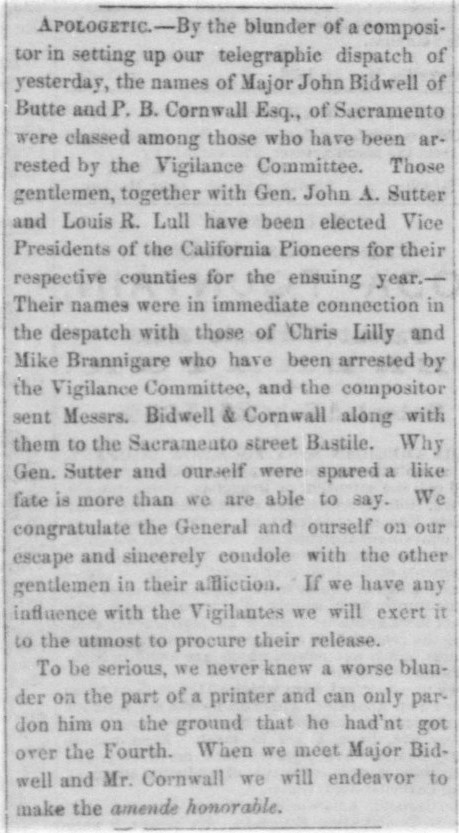
Why were they honored with such a hefty and delicious gift? It seems to have been a case of “no hard feelings.” When the Herald published the news from San Francisco, the compositor had mixed up two stories and put the names of John Bidwell and P.B. Cornwall down as men arrested by the Vigilance Committee, when instead they had been elected to the governing board of the Society of California Pioneers.
Marysville Daily Herald 9 July 1856
It looks like Major Bidwell has been consorting with bad company.
The editor of the Herald, Louis R. Lull (also an SCP board member) promptly apologized. Why he and General Sutter hadn’t likewise been “arrested” he couldn’t say, but he condoled “the other gentlemen in their affliction” and promised that “If we have any influence with the Vigilantes we will exert it to the utmost to secure their release.”
Marysville Daily Herald 10 July 1856
I imagine John Bidwell got a laugh out of the mix-up and told his brother to ship one of their best melons to editor Lull.
What is a man who has just married a temperance wife to do with five hundred gallons of “superior wine”? That was John Bidwell’s dilemma and here is his solution.
Sacramento Daily Union 29 August 1868
Bidwell had never been a drinking man, and once he meet Annie E. Kennedy he swore off alcoholic beverages forever. But on Rancho Chico he had been growing wine grapes for several years and he had a good supply of wine on hand. According to George Moses Gray:
When the General first set out his grapes he planted 300 acres of wine grapes. They were in full bearing, and he had hired a wine expert and had a wine cellar nearly full of wine, some of it three years old. He found out that his wine man had a good many friends, especially when he was working in the wine cellar, and he found out that these friends could not walk straight when they started for home.
George Moses Gray: his reminiscences of the life of General John Bidwell. Chico: ANCRR, 1999, p. 29.
Bidwell had all the vines pulled out and replaced them with table and raisin grapevines. As noted above, he shipped the wine to San Francisco to be used for “medicinal uses” at a hospital run by the Missionary Society. This society was formed by several Protestant churches to serve the poor of the City.
What did Bidwell prefer to wine or any other beverage? He wrote to Annie on New Year’s Day, 1868, “I shall drink to your health today with my favorite beverage, cold water.” As far as he was concerned, cold clear water from Chico Creek was the best drink in the world.
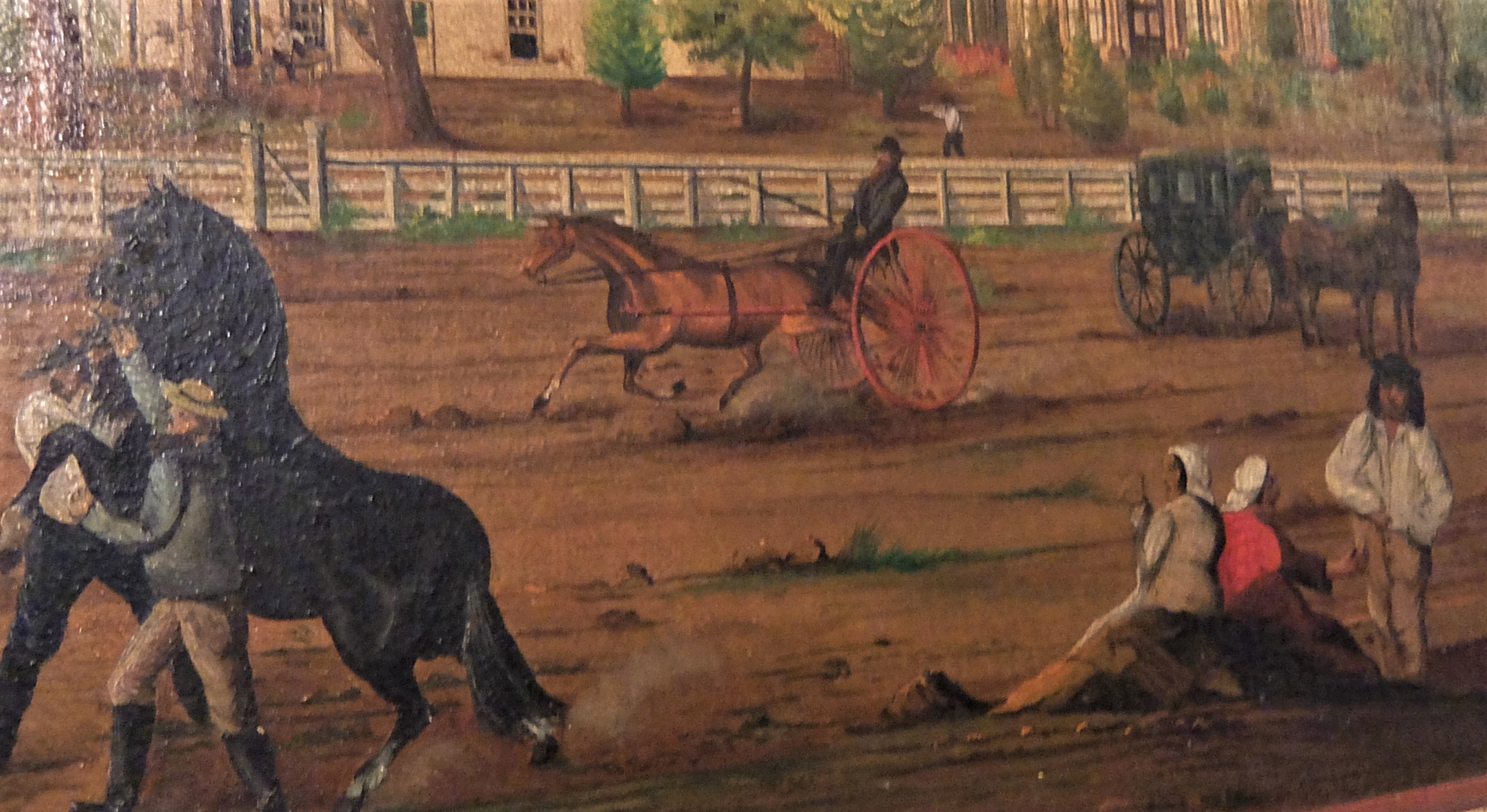
Writing about Bidwell’s old adobe house a few months ago, I posted this picture of Bidwell Mansion, which shows the adobe on the left-hand side and Bidwell Mansion in the center. At the time I said it was an “undated painting by an unknown artist,” but I was wrong about that, and now I am here to tell you about John Frederick Holtzman and his painting.
(I apologize for not giving you a better view of the painting. The glare from the bright light shining on it makes photography difficult.)
It is thanks to John Rudderow and Deana Glatz that I learned so much more about the painting.
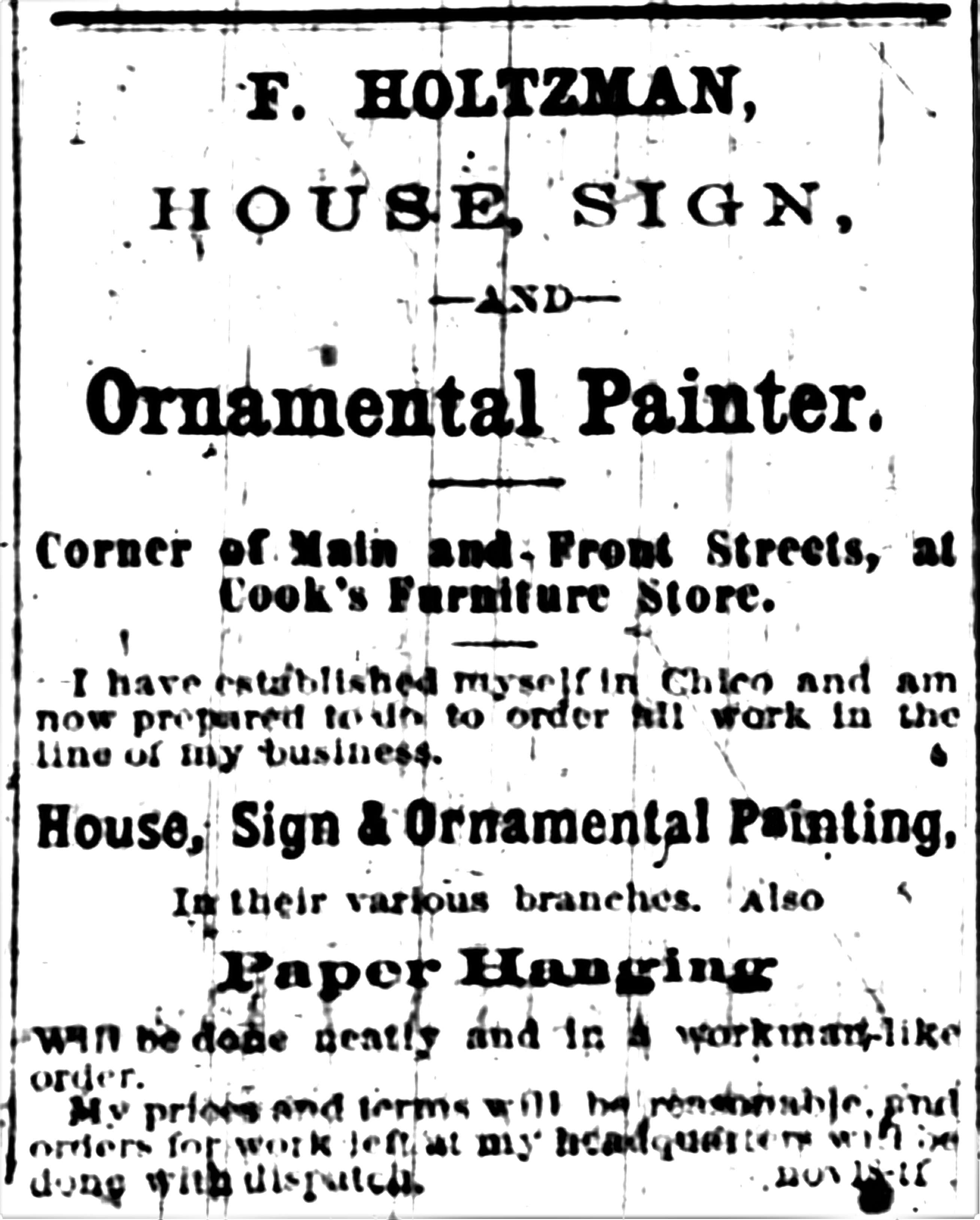
John Frederick Holtzmann (he dropped the second ‘n’ in America) was born in Bremen, Germany in 1833 (give or take a year). He immigrated to the United States in 1853 and by 1856 he was in the gold-mining town of Columbia. He was a painter by trade — he could paint a house inside and out, or he could paint a painting of a house. He moved from county to county: various records find him in Amador, Nevada, San Francisco, Sacramento, Yolo, and in 1871, Butte County. He married in 1861 and he and his wife Anna had a family of four children.
Chico Northern Enterprise 25 November 1871
During his time in Chico he produced this oil painting of Bidwell Mansion. It features a busy scene of activities on the Esplanade. Our best guess is that that is General Bidwell riding in a buggy driving a spirited horse, along with other figures including several Indians, a carriage and farm wagons.
John Rudderow speculates that Holtzman offered to sell the painting to Bidwell, but for some reason Bidwell declined the offer. Bidwell makes no mention of Holtzman or the painting in his diary.
Eventually the painting came into the hands of Glenda Carpenter of Oroville who donated it to the Butte County Pioneer Museum in 1932, where it hangs today. If anyone out there knows how she came to possess it, please let us know. John and Deana would very much like to trace the history of the painting.
In late 1873 the Holtzman family moved to Santa Cruz County, where they remained for the next five years, until the death of Mrs. Holtzman. After his wife’s death, Holtzman began moving around the state again, finally ending up in Portland Oregon, where he died in 1906.
Holtzman created a number of other sketches and paintings but few of them are available online. John Rudderow and Deana Glatz are seeking other images and more information for a future article about John Frederick Holtzman.
If you know more about Holtzman or about his painting of Bidwell Mansion and how it came to the Carpenter family, please let me know and I will pass the information on.
I have been reading with enjoyment the Gold Rush diary of Dr. Israel Shipman Pelton Lord (his parents didn’t stint on the names for their son). For sharp observations and colorful descriptions he can’t be beat.
Born in Connecticut in 1805, Dr. Lord lived to the ripe old age of 91. He was a homeopathic doctor with decided views on health and diet, and a strongly judgemental attitude toward the behavior of his fellow men. He came overland to California in 1849 and mined for gold along the Feather River.
He kept a journal, sometimes just a brief note about the weather, but more often an extended description of day-to-day life in the “diggins.” Here he is, writing in the summer of 1850 about the heat. Keep in mind that he is not in the valley, but in the foothills, somewhere further up than Bidwell Bar on the South Fork of the Feather River.
Monday, June 24: Not a cloud. Still it is not as hot as in Illinois in June.
Tuesday, June 25: The days are getting hotter, and the nights decidedly warmer, though I have never yet, since I left Illinois, endured a regular sultry night . . . No, we can sleep here, for all the heat, or the musquitoes; too cold for them. But the ants are everywhere, regular engineers.
“Musquitoes” is Lord’s spelling. Not only are the ants a nuisance, but “the flies — the flies!!”
Alas! there is no escape. Even while I write, any number of ants (I can’t stop to count) have been ranging undisturbed over my paper and not less than a score of flies, oftener fifty, are on each of my hands.
My flesh creeps to think of it — I don’t like flies. The weather, although usually cool at night, gets hotter during the day.
Tuesday, July 9. I have been informed by several persons, that, at Long’s the thermometer stood in the shade at 116 degrees for several days. It was 107 at Stringtown. It is a fact that the fish do not come up Feather River, at least this year. [Does he mean the salmon run?] So much for another California humbug. I shall be disappointed if we can keep the count of all [the humbugs] we discover betwixt now and fall. I propose to call the State Humbugnia and that Fremont be appointed Governor “in perpetuo.”
“Humbug,” meaning a fraud, a hoax, or a deception of some kind, was a popular word in the 19th century. It was readily applied by Dr. Lord to everything from fake cures to rumors about Gold Lake.
Wednesday, July 17th. The air seems like a furnace and is entirely destitute of moisture. There is no dew.
Thursday, July 18. Hundreds are, as usual, passing up and down, the up-ites for the most part clean, and tolerably decent; the down-ites as dirty as earth and grease can make them. Some will remain in the mountains for four to six weeks, and no change of clothing. Worst of all, they get very little gold.
I would have like to have seen the Gold Rush, but I wouldn’t want to smell it! What a life!
In 1852, from her log cabin at Indian Bar on the Feather River, Dame Shirley (Louise Clappe) wrote about a 4th of July celebration across the river at Rich Bar. She had the honor of making a flag, of white cotton cloth and red calico stripes, a union (or canton) of faded blue drill, and “a large star in the center, covered with gold-leaf, represented California.” Real gold leaf! It must have been spectacular, as it waved from a pine tree in front of the Empire Hotel.
The patriotic “exercises” should have included a reading of the Declaration of Independence, but they hadn’t been able to get one. But there were speeches, orations, songs, and this anonymous poem, newly composed for this occasion.
Ye are welcome, merry miners, in your blue and red shirts all;
Ye are welcome, 'mid these golden hills, to your nation's festival;
Though ye've not shaved your savage lips nor cut your barb'rous hair,
Ye are welcome, merry miners, all bearded as ye are.

What though your brows are blushing at the kisses of the sun,
And your once white and well-kept hands are stained a sober dun;
What though your backs are bent with toil, and ye have lost the air
With which ye bowed your stately heads amid the young and fair,

I fain would in my slender palm your horny fingers clasp,
For I love the hand of honest toil, its firm and heartfelt grasp;
And I know, O miners brave and true, that not alone for self
Have ye heaped, through many wearying months, your glittering pile of pelf.

Ye of the dark and thoughtful eyes beneath the bronzèd brow,
Ye on whose smooth and rounded cheeks still gleams youth's purple glow,
Ye of the reckless, daring life, ye of the timid glance;
Ho! young and old; ho! grave and gay, to our nation's fête advance.

Ho! sun-kissed brother from the South, where radiant skies are glowing; Ho! toiler from the stormy North, where snowy winds are blowing;
Ho! Buckeye, Hoosier, from the West, sons of the river great,
Come, shout Columbia's birthday song in the new Golden State.

Ho! children of imperial France; ho! Erin's brave and true;
Ho! England's golden-bearded race, we fain would welcome you,
And dark-eyed friends from those glad climes where Spain's proud blood is seen;
To join in Freedom's holy psalm ye'll not refuse, I ween.

For now the banner of the free's in very deed our own,
And, 'mid the brotherhood of states, not ours the feeblest one.
Then proudly shout, ye bushy men with throats all brown and bare,
For, lo! from 'midst our flag's brave blue, leaps out a golden star.
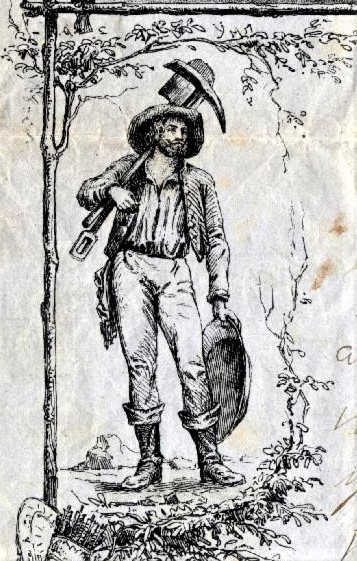
Image of a miner from a letter sheet, Society of California Pioneers
This was followed by a dinner, presided over by a veteran of the Mexican War, with many toasts and songs — “everything passed off at Rich Bar quite respectably.” Things got rowdier as the day went on. “To be sure, there was a small fight in the barroom, which is situated just below the dining-room, during which much speech and a little blood were spouted.”
All in all, it was a typical Gold Rush Fourth of July.
In late May and early June of 1848 John Bidwell was prospecting for gold on the Feather River. He had already found some gold, but he hadn’t yet found rich diggings. The search continued until he struck pay dirt on July 4th at what became known as Bidwell’s Bar.
On June 24th he wrote from “Feather River below first camp” to his friend and partner, George McKinstry. The letter tells us a number of things about the first days of the Gold Rush and life in the “diggins.”
Mr. McCall arrived yesterday morning and brought two letters from you dated the 20th inst. We spent the remainder of the day in search of a place to construct a washing machine, but did not succeed in finding one. McCall and Dickey go again today to look at another place.
I don’t know who Mr. McCall is — he doesn’t show up in Bancroft’s Pioneer Register and Index. Dickey is William Dickey, owner of Rancho Chico at the time. A “washing machine” was a cradle, so named because it was rocked to agitate the water and sand. It made washing the gold out of the dirt easier and quicker than panning.
Last week we did tolerably well washing the sands along the river – we made something not far from $1000 – This week we have done but little – The first camp above where we were when you came to us, was good – the first day of our arrival there we took out not less than 300 dolls. – but the place soon became exhausted it being small, and we have not been able to find as good a one since.
We are not making over $50 per day with all our Indians – and if we do not find a good place in one or two days at most, I want to go down either to Yuba or the American Fork. So I think that the boat had better not be sent up until we determine or if it is already on the way when you receive this, have it detained at Hock. I am expecting this letter will find you of the road up, but thought you might dispatch the boat ahead with direction to pass on up from Hock I have written a few lines to Mr. Cameron, requesting him to detain the boat until you receive my letter. I shall expect you to either come or send an answer to this, stating your opinion of going below etc.
$1000 in a week sounds great, but $50 a day probably barely covered the expenses of transportation, labor, and provisions.
Everything that Bidwell writes about “Hock” (Sutter’s farm on the Feather) and the boat just goes to show how difficult communication could be. Bidwell can’t be sure where McKinstry is or when his letter will reach him. Mr. Cameron was Duncan Cameron, an employee of Sutter’s at the Hock Farm.
“With all our Indians” tells us that Bidwell and others were using Indian labor to extract the gold. Bidwell had already developed a relationship of trust with the Indians who lived where he first settled on Little Butte Creek. He had employed Indians to help him dig ditches and plant crops.
Bidwell (and others) have been criticized for paying the Indians with beads, blankets, clothing, and foodstuffs. But the reasons for this are easy to discern. Very little coin was in circulation and the Indians were not familiar with money as a means of trade. Beads and blankets were things they could use. Whether they were paid sufficiently is a separate question. The evidence from other letters shows that Bidwell used persuasion and payment to get Indians to work for him. He never coerced them and was critical of men who did.
As more white miners flocked to the goldfields, using crews of Indians fell out of favor. Forty-niners saw it as a type of cheating; they liked to see every miner working on an equal footing, not aided by any type of paid or unpaid help.
I am entirely out of coffee; I would like a few more shirts having sold nearly all of these which I brought up. I see plainly that we cannot keep goods in camp to supply miners unless we can find a place where we can establish ourselves permanently for some time or are better provided with means of transportation. I cannot leave camp or I would meet you at Hock. If I were certain that you would be there I should come down any how. If you come you can find camp by asking any of the Indians along the river mentioning my name.
John bidwell to George McKinstry, June 24, 1848. John Bidwell Papers, California State Library
Bidwell and McKinstry are not just mining gold; they have gone into business to supply goods to other miners. They need a permanent location, which they will find at Bidwell’s Bar, and a reliable form of transportation to the diggings. Boats could bring goods as far as the Hock Farm or Marysville, but what then? Pack mules were the usual method, but here we can see that they are still developing their system.
On this date — June 21 — in 1879 the notorious stage robber Black Bart held up a stage coach near Forbestown in Butte County. It was his first robbery in the year 1879 and his ninth robbery since he began his career in 1875. This incident would be followed by two more robberies in October in Shasta County. He generally committed his crimes in the summer and fall, and then retired to San Francisco to live off his ill-gotten gains over the winter.
Sacramento Daily Union 23 June 1879
The description of the robber in this newspaper notice fits Black Bart’s modus operandi. A lone bandit, no accomplices, only wanting the Wells, Fargo box, never molesting a lady — those were the signs of the “gentleman bandit.”
Of all the stagecoach robbers in California history — and there were many — Black Bart is the name that still holds a place in the minds of the public. Why does he remain the most famous hold-up artist in California history?
One reason is the length of his career. He committed 28 robberies and eluded capture for eight years. That’s a long time in a chancy business.
Another reason is his choice of pseudonym and his penchant for advertising himself by leaving notes in verse at the scene of the crime.
His real name was Charles Boles, but “Black Bart”, a name he seems to have picked out of thin air, sticks in the memory. His verse was crude, but it caught the public’s attention, especially when he signed himself as “Black Bart, the Po-8.”
It also helped that he was a “gentleman bandit.” He was never cruel or vicious. He didn’t molest women. He didn’t murder stagecoach drivers or passengers. He politely asked the driver to “Please throw down the box” while holding a shotgun that he would later claim wasn’t even loaded.
For eight years, from July 1875 to to November 1883, “Bart” got away with it. Wells Fargo detectives and county sheriffs couldn’t catch him. A left-behind handkerchief with a laundry mark was his undoing. Black Bart was finally captured and sent to San Quentin prison in November 1883. He spent five years in prison and disappeared from public notice after his release in 1888.
Black slavery in the United States did not disappear as soon as Abraham Lincoln issued the Emancipation Proclamation on January 1, 1863, nor did it end with the defeat of the Confederacy and the end of the American Civil War in April 1865.
June 19th, 1865, marks the date when 250,000 enslaved people in Texas found out that they had been emancipated by executive decree two and a half years earlier. Texas was the last area in the South to receive the news that slavery had been abolished. Not until Union troops under Major General Gordon Granger arrived at Galveston did the news reach African Americans in Texas.
Even then, pockets of slavery continued to exist, and one of those was in California.
Delilah L. Beasley tells the story in her ground-breaking book The Negro Trail Blazers of California (1919).
A “colored girl” named Ida (or Addie) Taylor was held as a slave at Hansonville (later named Rackerby) in the hills of Butte County. She worked as a sheepherder. Word of her plight came to the attention of a black man, Robert Anthony, who ran a quartz mill at Honcut. Anthony had come to California as a slave in 1852 and had earned his freedom after two years in the goldfields.
Beasley, who interviewed Robert Anthony, writes:
He drove out to the place and asked her if she did not wish her freedom. She replied: “Yes.” He requested her to get into his wagon and he drove with her to Colusa. Some time afterward this slave girl became his wife.
The Negro Trail Blazers of California, p. 90
Robert Anthony and Ida Taylor were married in Colusa on September 9th, 1870. It was either 1869 or 1870 when the young lady was at last freed from slavery, some seven years after the Emancipation Proclamation.
Other than a wedding announcement in the Colusa Sun and the story in Beasley’s book, there is no record of Ida Taylor. She has no age, no birth record, no death notice. No photograph. We don’t know when or how she came to California. She appears all too briefly, and then fades from our view, like so many other black California pioneers.
Lake Oroville is full to the brim. If you are one of my readers living in Butte County, you already know this. If you are elsewhere I hope you will enjoy seeing the change.
Yesterday I went with my husband Jim and daughter Jean to have a look. It is a glorious sight. No deep dirt rim around the lake anymore — just acres and acres of water. In 2021 the water was so low that it looked like this:
That photo from CNN shows the intake gates at the hydroelectric power plant in the dam. The water was so low that the plant couldn’t function. Today the same gates are under water and can’t be seen.
The spillway has been repaired and is working at full capacity. Water is roaring down into the Feather River. To get an idea of how big that spillway is, notice the two tiny trucks on the right side of the spillway about two-thirds of the way up. dwarfed by the spillway.
In 2017, after a wet winter, the spillway broke, resulting in an emergency evacuation order for the city of Oroville. If you are interested in learning more about the breakup of the spillway, what caused it and how it was repaired, watch this “Practical Engineering” YouTube video. It’s informative and easy to follow.
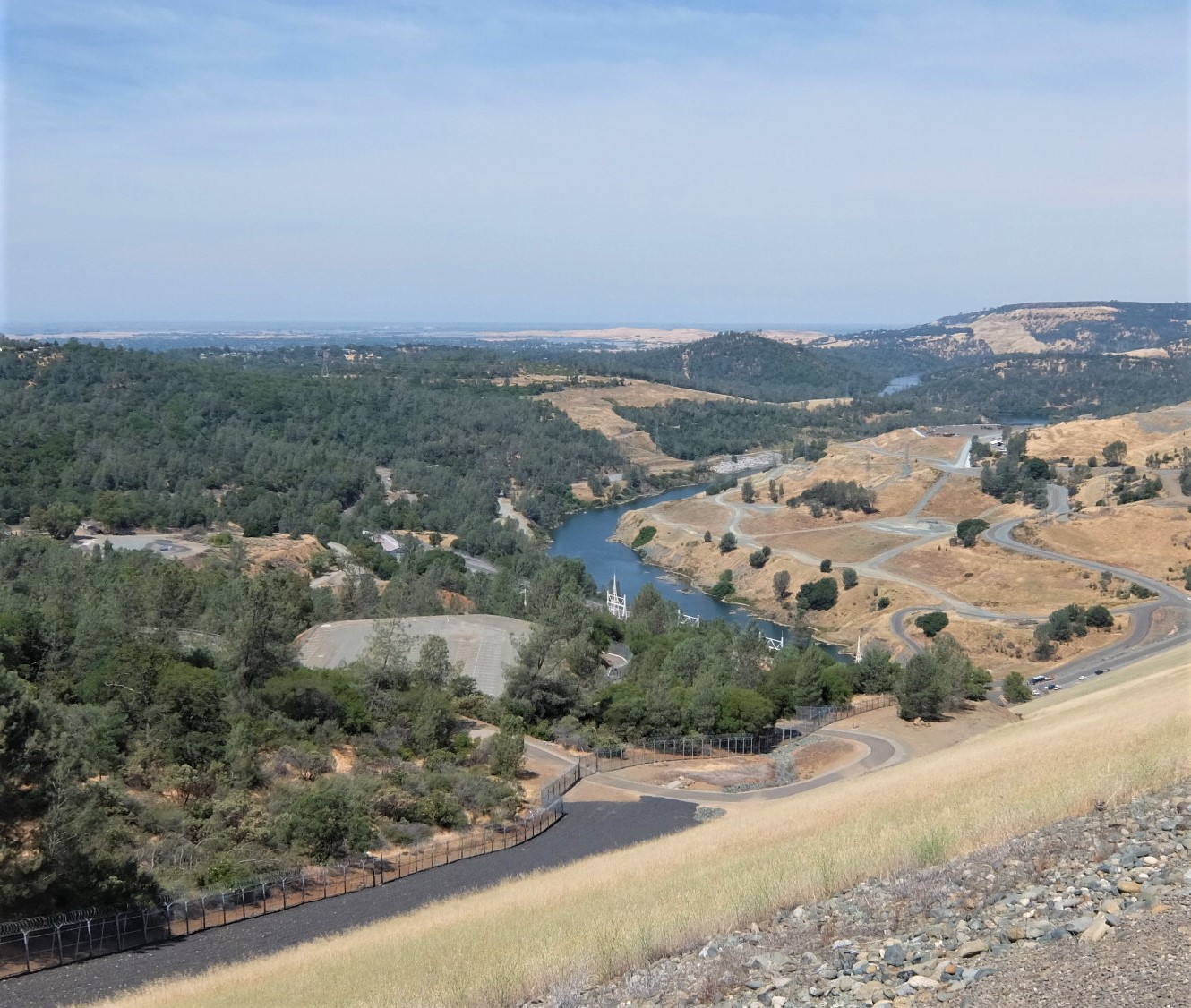
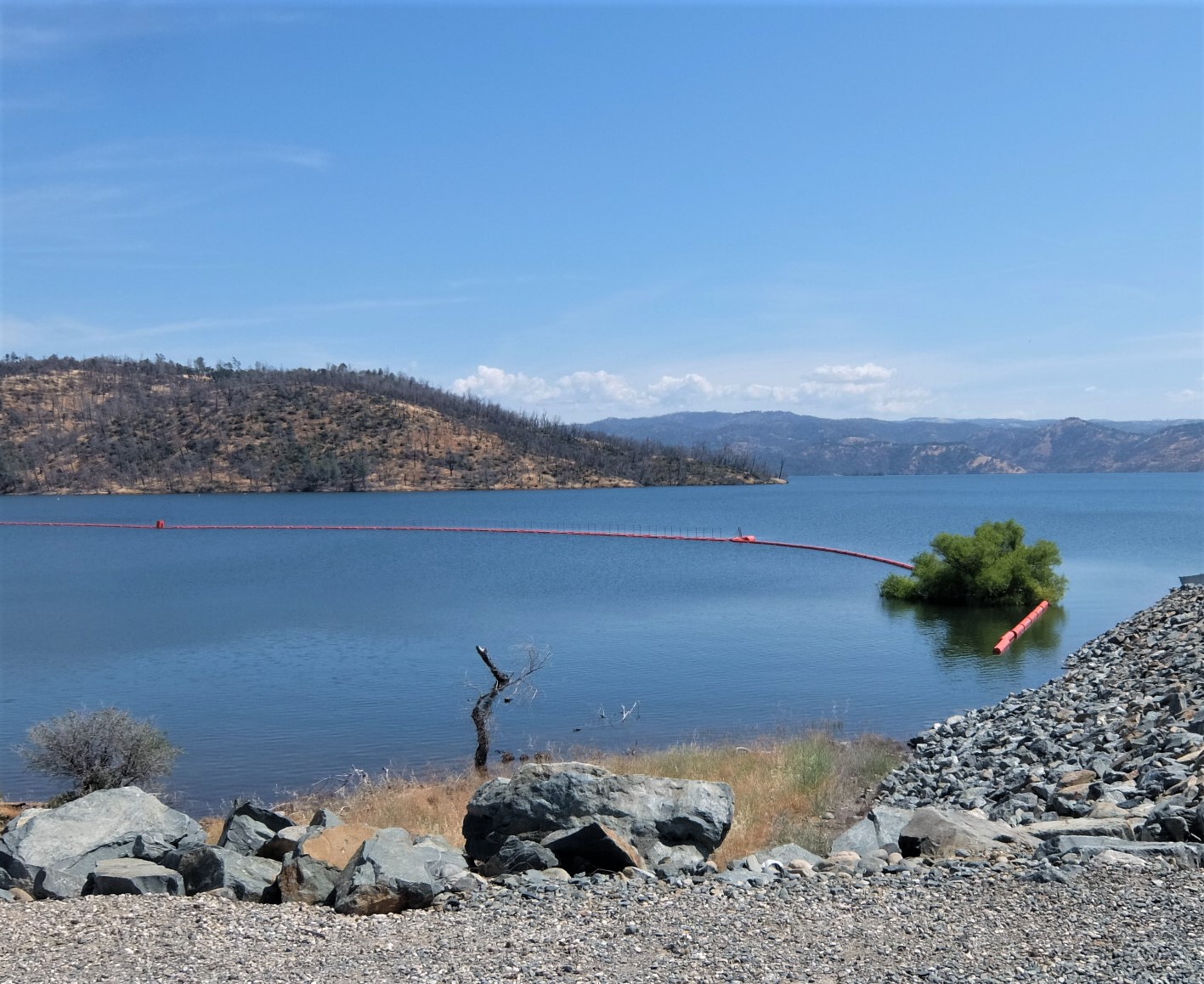
At 770 feet, Oroville Dam is the tallest dam in the United States. (Hoover Dam is 726 feet high.) Standing by the road that crosses the top of the dam and looking west, you get a beautiful view of the Feather River with the city of Oroville and the Sutter Buttes in the distance. Looking to the east, it’s all blue water and green trees. (The orange barrier in the last photo prevents boats from getting close to the spillway intake.)
Lake Oroville is a State Recreation Area and a great place for boating, swimming, fishing, picnicking, and other outdoor activities. Enjoy it while it’s full!









 goldfields