November 10, 1841

“I went to R. Livermore’s, which is about 20 miles from Marsh’s, nearly W[est]; he has a Spanish wife and is surrounded by 5 or 6 Spanish families.”

John Bidwell was eager to explore the California landscape and find out what the opportunities were for a farmer. Dr. Marsh must have told him that Robert Livermore had a ranch about 25 miles to the southwest of Marsh’s ranch, so Bidwell set out to learn more.
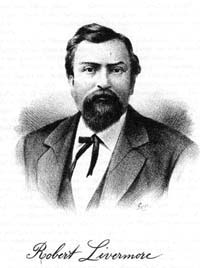
Robert Livermore was an Englishman, one of those sailors who jumped ship and stayed in California. Born in 1790, he landed in California in 1822 in San Pedro and worked as a ranch foreman until he could acquire his own land grant. In 1834 he and his partner Jose Noriega started running cattle on a ranch in what became Alameda County, and in 1839 they acquired title to Rancho Las Positas. In 1838 he married Maria Josefa de Jesus Higuera Molina. They had eight children.

He had a reputation as a hospitable and honest man. He stayed out of politics. He didn’t even go prospecting for gold during the Gold Rush, knowing that his land, livestock, and crops would be more valuable in the long run than gold could ever be. John Bidwell would have agreed with him on that.

Robert Livermore died in 1858, and the town of Livermore is named after him.
Posted in Livermore | Leave a comment

November 8, 1841

John Bidwell stayed at Marsh’s rancho, while fifteen of the company went to “the pueblo of St. Joseph” (San Jose) to look for work. Bidwell wanted to pump Marsh for more information about California and its resources, as well as travel around and see some of the country on his own.

“The next morning I rose early, among the first, in order to learn from our host something about California, –what we could do, and where we could go,–and strange as it may seem, he would scarcely answer a question.”

Marsh had at first welcomed the newcomers, but he was evidently having second thoughts.  Bidwell soon came to see him as “one of the most selfish of mortals.” Although he had fed them on pork and beef the first night, and even used some of his seed wheat to make tortillas for the thirty-two men, Marsh was obviously worried about being saddled with a host of hungry mouths that he couldn’t afford to feed.

The men, who had no money, paid him with various items—a can of gunpowder or a butcher-knife–but Marsh only grumbled that they had already cost him $100, and “God knows whether I will ever get a real or it or not.” (A real being a Mexican coin.) All the men left as soon as they could, and Bidwell never had a good word to say about John Marsh.

Posted in Uncategorized | Leave a comment

November 4, 1841

“Thursday, 4th. Left the river in good season and departing gradually from its timber came into large marshes of bulrushes. We saw large herds of elk and wild horses grazing upon the plain. . . . Finally we arrived at Marsh’s house, which is built of unburnt bricks, small and has no fireplace — wanting a floor and covered with bulrushes. In fact it was not what I expected to find; a hog was killed for the company. We had nothing else but beef; the latter was used as bread, the former as meat.”

After the skimpy rations of the past few months, the men hungered for fat meat, and the pork was welcome, even if it came in a beef and pork “sandwich.” Bidwell might have been hoping for bread too. He liked bread and missed it. But he had no complaints about the food Marsh gave them that first night.

Considering the glowing reports of California that Marsh had sent back east, Bidwell was surprised at the primitive conditions he was living in. A small adobe house with a dirt floor and no fireplace–hardly what Bidwell had envisioned. He was accustomed to cooking over a fireplace indoors, but in California the cooking was generally done outside in the courtyard.

But Dr. Marsh welcomed the company. “He seemed delighted to see us and was very communicative and even enthusiastic.” He had known a few of the men in the company back in Missouri. Now, their journey ended, they sat around telling their stories and exchanging news.

The journey was over, but the adventure would continue. John Bidwell was now embarking on a new life, the life of a Californian.

Posted in John Marsh | Leave a comment

November 3, 1841

“Wednesday, 3d. We waited till Capt. B. came up, and all started for Marsh’s about noon; arrived at the St. Joaquin and crossed it — distance 13 miles — found an abundance of grass here. The timber was white oak, several kinds of evergreen oaks, and willow — the river about 100 yds. in width.”

With the news from Jones and Kelsey on the 2nd that they had found Dr. Marsh, the Company at last knew that they were definitely in California. All that was left to do now was to cross the San Joaquin River and the Central Valley. “It was an occasion of great joy and gladness. We were not only near our journey’s end, but the men knew just where to go, instead of uncertainty.”  (1877 Dictation)

It is stunning to consider how long they had traveled in uncertainty and doubt. For three months, since they had split off from the party that went to Oregon, they had been blazing a trail through unknown territory. Who today would undertake such a journey?

Posted in Uncategorized | Leave a comment

November 2, 1841

“Tuesday, 2nd.  Capt. B. with his 7 remained to take care of the meat he had killed — while the rest of the Company went on. We passed some beautiful grapes, sweet and pleasant.  . .  Behold! This morning Jones, who left the camp to hunt on the 23rd ult. came to the camp. They (he and Kelsey) had arrived in the plains several days before us, and found an Indian, who conducted them to Marsh’s house, but he brought bad news; he said there had been no rain in California for 18 months, and the the consequence was, there was little breadstuff in the country. Beef, however, was abundant and of the best quality.”

Thomas Jones and Andrew Kelsey (younger brother of Benjamin Kelsey) had gone on ahead to search for settlements, and came back with the exciting news that they had been lead by an Indian to the ranch of Dr. John Marsh. This was good news indeed, for Marsh was the man who had set the movement in motion. His letters to Missouri, read by Bidwell and many others, had painted a glowing picture of the healthful climate and fertile soil of California. It was Marsh who had enticed them across half a continent to  this new land. Now they were about to meet the man himself.

Bidwell might have been worried though, by that mention of drought. As a farmer, he was looking for a place to raise wheat, livestock, and produce. Without reliable rainfall, how could that happen?

Posted in Uncategorized | Leave a comment

November 1, 1841

“November. Monday, 1st. The Company tarried to kill game; an abundance of wild fowl and 13 deer and antelopes were brought in. My breakfast, this morning, formed a striking contrast with that of yesterday which was the lights of a wolf [coyote].”

Bidwell tells it this way in his 1877 Dictation:

The eve of the next day found us surrounded by abundance. . . . It was about the first of November, and there was no time to delay if we were going to reach California that fall. Most of the party were ready and anxious to press forward. Captain Bartleson and his men though otherwise. They said we hadn’t yet reached California, we probably still had a long distance to travel, that such a place as we were in could not be found everywhere and they were going to stop and lay in meat for the balance of the journey.

Leaving them in camp and crossing the Stanislaus River, we proceeded down the north side of the same and camped. Early the next day the news came that the Indians in the night had attacked them and stolen all their horse. We remained till they came up, carrying on their backs such things as they were able.”

John Bidwell never did get on with Captain Bartleson, and I think there is a note of satisfaction here that once again, Bartleson was wrong and got what he deserved.

Posted in John Bartleson, Uncategorized | Leave a comment

October 31, 1841

“When morning came the foremost of the party waited for the others to come up. They had found water in a stagnant pond, but what was better, they had killed a fat coyote, and with us it was anything but mule meat.  . . . Being in the rear, I did not reach it in time to get any of the coyote except the lights [lungs] and the windpipe. Longing for fat meat and willing to eat anything but poor mule meat and seeing a little fat on the windpipe, I threw it on the coals to warm it and greedily devoured it.” (1877 Dictation)

That was his breakfast, but dinner would be another thing altogether. From the journal:

“Sunday, 31st. Bore off in a N.W. direction to the nearest timber . . . reached timber, which was white oak and finally the river which we had left in the mts., joyful sight to us poor famished wretches!!! Hundreds of antelope in view! Elk tracks thousands! Killed two antelopes and some wild fowls; the valley of the river was very fertile and the young tender grass covered it like a field of wheat in May.”

Somewhere near the present day town of Oakdale they came out of the foothills and down into the valley along the Stanislaus River, which they had followed off and on all down the western slope. They feasted on deer and antelope, and “ripe and luscious wild grapes.” Their horses feasted on the new grass just springing up from the fire-burnt ground. What a difference from morning to evening!

Posted in Uncategorized | Leave a comment

October 30, 1841–California at last!

“Saturday, 30th. We had gone about 3 miles this morning, when lo! to our great delight, we beheld a wide valley! This we had entirely overlooked between us and the high mountains which terminated our view yesterday. Rivers evidently meandered through it, for timber was seen in long extended lines as far as the eye could reach. But we were unable to reach it today, and encamped in the plains. Here grew a few white oaks. Traveled today about 20 miles. Saw many tracks of elks. The valley was wonderfully parched with heat, and had been stripped of its vegetation by fire. Wild geese, fowls, etc. , were flying in multitudes.”

So when did Bidwell and Co. enter the promised land of California? By present day borders they had already been in California for about two weeks, since they had started making their way into the Sierra Nevada in mid-October. Of course they had been in Mexican territory much longer than that, but the land they were traversing was more like the Great Empty Quarter of North America than part of a foreign nation. Although claimed by Mexico, the territory that later became the states of Utah and Nevada was uninhabited by anyone except Native Americans.

For the Mexicans, Alta California was a narrow strip of land along the Pacific coast. There had been little exploration and no settlement in the Central Valley. All the missions and ranchos lay between the Pacific Ocean and the Coastal Range. Bidwell & Co. had not reached the settled part of California yet, but at least they could see ahead of them a land where they would not starve to death.

They were in California at last, but they didn’t know it.  Most of the men were sure that they would not reach California until they crossed another mountain range. How far they still had to go to get to California was hotly debated in the group, with some insisting that they could not get there before winter set in.

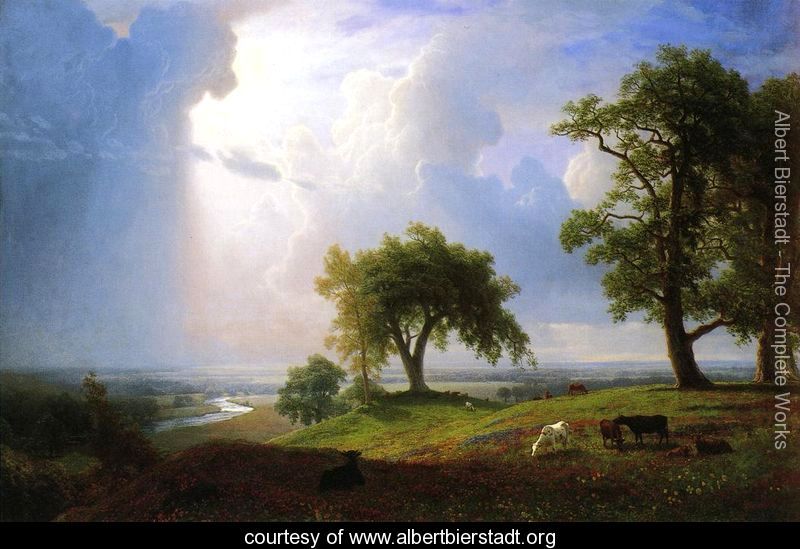
But still, if we have to pick a date for their entry into California, October 30 is as good as any. They could see California spread out before them, and it was everything they had been promised: a fertile land teeming with wild game, with a healthy climate and plenty of room for all. California at last!It didn’t really look like this, but Albert Bierstadt’s painting California Spring conveys the delight with which John Bidwell must have looked out upon the California landscape.

Posted in Uncategorized | Leave a comment

October 29, 1841 (almost there!)

Friday, 29th. Last night, the Indians stole a couple of our horses. About noon we passed along by several huts, but they were deserted as soon as we come in sight, the Indians running in great consternation into the woods. At one place the bones of a horse were roasting in a fire; they were undoubtedly the bones of the horses we had lost. Travelled no less than 9 miles today; the night was very cool and had a heavy frost. Although our road was tolerably level today, yet we could see no termination to the mountains–and one much higher than the others terminated our view. Mr. Hopper, our best and most experienced hunter, observed that, “If California lies beyond those mountains we shall never be able to reach it.”

Most of the Company were on foot, in consequence of the horses giving out, and being stolen by Indians, but many were much fatigued and weak for the want of sufficient provision; others, however stood it very well. Some had appetites so craving that they eat the meat of most of the mule raw, as soon as it was killed; some eat it half roasted, dripping with blood.”

Weary and worn to the bone, barely living on the meat of their own pack animals, struggling down rocky canyons, the Company was in a desperate situation. With no map and no guide, they had not a clue where they were, and they could see no end to their journey.

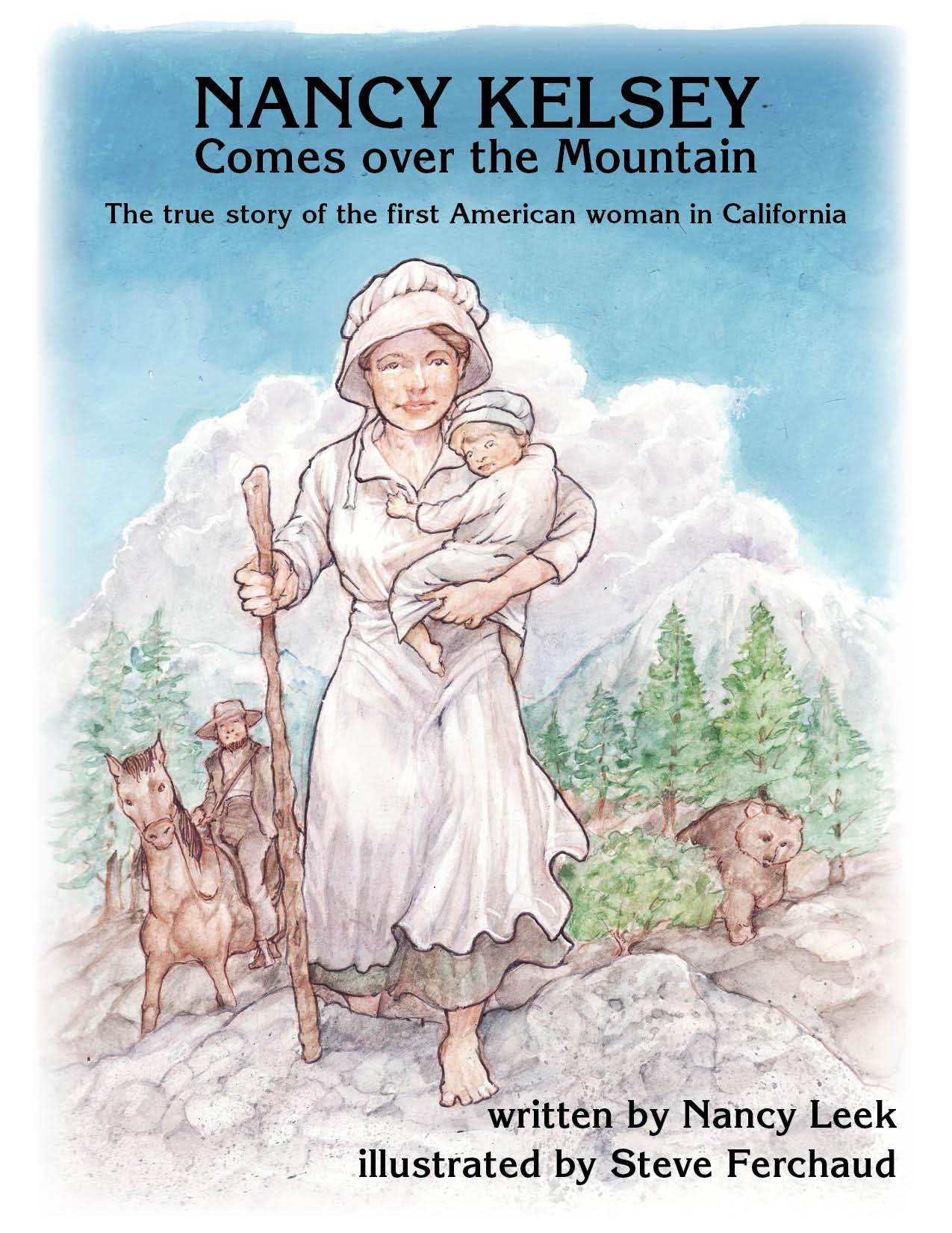
Nancy Kelsey, who had started up into the Sierras riding a horse, with Baby Ann on her lap, was now walking. In her own recollection, taken down by a friend in 1893, she says, “I walked barefoot until my feet were blistered.”

As Bidwell explained in Echoes of the Past, “we were now on the edge of the San Joaquin Valley, but we did not even know that we were in California. We could see a range of mountains lying to the west–the Coast Range, but we could see no valley.” They discussed and debated their situation. Many in the party were convinced that they were not yet within five hundred miles of the Pacific Ocean. The mountains stretched as far as the eye could see, and greatly discouraged, they feared that they would never reach California alive.

Posted in Uncategorized | Leave a comment

October 28, 1841

“Thursday, 28th. Surely no horses nor mules with less experience than ours could have descended the difficult steeps and defiles which we encountered in this day’s journey. Even as it was, several horses and mules fell from the mountain’s side and rolling like huge stones, landed at the foot of the precipices. The mountains began to grow obtuse, but we could see no prospect of their termination. We eat the last of our beef this evening and killed a mule to finish our supper. Distance 6 miles.”

Yum! old mule meat. How John Bidwell must have longed for a loaf of bread. And those poor animals, done to death at the bottom of a cliff. It’s a wonder there was anyone with a horse left by the time they got out of the mountains.

Posted in Uncategorized | Leave a comment