October 19, 1841

“Tuesday, 19th. Descending along the stream,we found several oak scrubs which confirmed us in the hope that we were on the waters of the Pacific. But the route became exceedingly difficult–the stream had swelled to a river–could not approach it–could only hear it roaring among the rocks. Having come about 12 miles a horrid precipice bid us stop — we obeyed and encamped.

Those who went to explore the route had not time to come to any conclusion where we could pass. We had descended reapidly all day; the mts. were still mantled with forests of towering pines. The roaring winds and the hollow murmuring of the dashing waters conveyed int he darkness of the night the most solemn and impressive ideas of solitude.

To a person fond of the retiring life, this, thought I, would be a perfect terrestrial Paradise, but it was not so to us, when we knew that winter was at hand, and the Capt. Walker (the mountaineer) had been lost in these very mountains 22 days before he could extricate himself.”

According to Michael Gillis, Bidwell & Co. were following Clark’s Fork to where it converged with the Middle Fork of the Stanislaus River. As they continued down the Middle Fork, they found the terrain extremely rough, rocky, and thickly covered with pine and brush. It was tough going.

Joseph Walker was a famous mountain man and explorer who had guided Bonneville’s party through the Sierras in 1833 and was with Fremont on his exploring trips during the 1840’s. Fremont named the Walker River and Walker Lake after him. Bidwell had probably read about him in Washington Irving’s popular account of the Bonneville expedition. Spending 22 days wandering around the Sierra Nevada as winter came on was certainly not anything that he wanted to do. The sooner they got out the better.

Posted in Uncategorized | Leave a comment

October 18, 1841

“Monday, 18th. Having ascended a about half a mile, a frightful prospect opened before us–naked mountains whose summits still retained the snows perhaps of a thousand years, for it had withstood the heat of a long dry summer, and ceased to melt for the season. The winds roared–but in the deep dark gulfs which yawned on every side, profound solitude seemed to reign. We would along among the peaks in such a manner as to avoid most of the mountains which we had expected to climb–struck a small stream descending toward the W., on which we encamped, having come 15 miles.”

The “small stream” that they camped by was Clark’s Fork, which flows into the Middle Fork of the Stanislaus River. They didn’t know how far they had to go yet, but at lest they were headed downstream.

Michael J. Gillis traced this journey in his article for the Overland Journal entitled “The 1841 Trans-Sierra Route of the Bidwell-Bartleson Party.” On the 18th he says that the group was climbing up Golden Canyon, and crested the Sierra Nevada at an elevation of 9,425 feet.

“In only four days, thanks to good weather, good luck and some savvy scouting, the Bidwell-Bartleson Party had made its way to the west side of the Sierra Nevada. One of the most daunting portions of the travelers’ trip now lay behind them. Unfortunately, their joy at successfully locating a pass over the summit was quickly tempered by the sobering panorama that now lay before them. Snowcapped mountains were visible in every direction. Many days of difficult traveling were still ahead.”

Posted in Uncategorized | Leave a comment

October 17, 1841

“Sunday, 17th. This morning we set forth into the rolling mountains; in many places it was so steep that all were obliged to take it on foot. Part of the day we traveled through valleys between peaks, where the way was quite level . . . Encamped on the side of the mountains, so elevated that the ice remained all day in the streams–but we had not yet arrived at the summit. Killed another ox on this evening–made 12 miles.”

Following the Walker River, the Bidwell-Bartleson Party entered the Sierras at Antelope Valley. They faced the challenge of crossing a daunting range of snow-capped mountains and steep canyons. Could they do it?

On the day before Bidwell had written: “This evening the Company was convened for the purpose of deciding by vote whether we should go back to the lake and take a path which we saw leading to the N.W., or undertake to climb the mountains. We had no more provision than would last us to the lake–nearly all were unanimous against turning back.”

No one wanted to go back to the desert. They were already on short rations, down to their last one or two oxen, but the mountains at least promised water and the possibility of game. The desert had nothing to offer but sand, heat, and starvation. So the decision was made; they would tackle the mountains. On the 17th they started up into the mountains, hoping to break through to California.

Posted in Uncategorized | Leave a comment

October 16, 1841

“Saturday, 16th.  This morning 4 or 5 men started to ascend several of the high peaks to ascertain if it was possible to pass the mountains. Just as they were going to start Capt. B. came up. He was in rather a hungry condition, and had been traveling several days without provision, excepting a few nuts which they had purchased from the Indians . . .”

Bidwell later recalled that Bartleson and his men had also obtained fresh fish from the Indians—fish which gave them all dysentery, and made them so weak they could hardly stand. No wonder they were eager to reunite with the rest of the party.

“We were glad to see them although they had deserted us. We ran out to meet them and shook hands, and put our frying-pans on and gave them the best supper we could. Captain Bartleson, who when we started from Missouri was a portly man, was reduced to half his former girth. He said, “Boys! If I ever get back to Missouri, I will never leave that country. I would gladly eat out of the troughs with my dogs.” He seemed to be heartily sick of his late experience, but that did not prevent him from leaving us twice after that.” (Echoes of the Past)

Bartleson did indeed return the next year to Missouri, having found California not to his liking, and there he died in 1848, missing out on the Gold Rush that might have made him a rich man, had he stayed.

Posted in John Bartleson | Leave a comment

What did John Bidwell carry in his pack?

John Bidwell started out with a wagon full of provisions and equipment. We don’t know exactly what he was hauling other than food and a flintlock rifle, but presumably he had some things in the way of personal effects and cooking utensils.

Crossing Utah Bidwell & Co. abandoned their wagons. They had eaten all their provisions and were living off whatever berries and game they could find, plus the meat of their oxen that they butchered one by one as needed. There wasn’t much left for the wagons to carry, so they put everything left in packs and loaded them on their animals.

By the time they reached the Sierra Nevada mountains Bidwell was on foot and they were down to their last two oxen. He was probably carrying anything he had left in a knapsack.

So what did he have left to carry? He had his journal and something to write with–a pen or more likely, a pencil. He must have had some ammunition, a knife and a canteen. A change of clothes, maybe. Not much else.

But John Bidwell also kept two items which he could not bear to part with: a small textbook on astronomy called The Geography of the Heavens, and the large illustrated Celestial Atlas that went with it. These were too precious to leave behind in the desert. He had purchased them in St. Louis, Missouri so he could teach himself astronomy, and he would carry them all the way to California.  It’s doubtful that anyone else in the company was carrying books. It just goes to show how much John Bidwell valued knowledge and education. He kept these two books all his life. Today they can be seen in the California State Library.

Posted in astronomy book | Leave a comment

October 14, 1841

But first—-this announcement:

I’ll be signing books at the Chico Library Fall Festival tomorrow from 11 a.m. to 12:30 p.m. If anyone would like a copy of my book, or would like to meet and talk to the author, please stop by and say, “Hi!”

And now, back to our regularly scheduled program.

“Thursday, 14th. This morning we saw at a distance Capt. B. with his 7 men, coming in a direction towards us, but we made no halt, ascended the stream about 20 miles. The mountains continued to increase in height.”

Captain Bartleson was back. He had taken off with seven of his eight companions, their saddlebags packed with most of the meat from a slaughtered ox. One of Bartleson’s friends stayed behind, saying, “The captain is wrong and I will stay with you, boys.” At first the rest of the company followed in Bartleson’s tracks, knowing that the company’s best scout, Charles Hopper, was with them.

On the 11th they deviated from Bartleson’s trail and started along the Walker River into the mountains. It would be another day and a half before Bartleson’s group, in a very hungry condition, caught up with them.


Posted in Uncategorized | 2 Comments

October 11, 1841

“Monday, 11th. Left the lake this morning going into the mountains on a S.W. course. Today we left the trail of Capt. B. and having traveled 19 miles, arrived on a stream which flowed rapidly, and afforded more water than Mary’s river. We thought now, without doubt, that we were safe on the waters of the St. Joaquin (pronounced St. Wawkeen) according to Marsh’s letter. Here grew willows, balm Gilead, and a few cottonwoods.”

They had been traveling through the area of the Carson Sink, where the Humboldt River ends, and the landscape was one of alternating sand and swamp. The river that they mistook for the San Joaquin was the Walker River, which flows eastward out of the Sierras. It made for a good route up into the mountains. Future travelers on the California Trail would not travel this far south, but in following water Bidwell & Co. had missed the few miles of dry country that would have taken them to the Truckee River.

Posted in Uncategorized | Leave a comment

October 7, 1841

“Now we have been found fault with long enough, and we are going to California. If you can keep up with us, all right; if you cannot, you may go to hell!”

Captain John Bartleson’s words still rang in John Bidwell’s mind when he wrote about the incident 48 years later.   (Although Bidwell, mindful of the audience for Echoes of the Past, put in a dash— for the word “hell.” I am assuming that’s what the man said.)

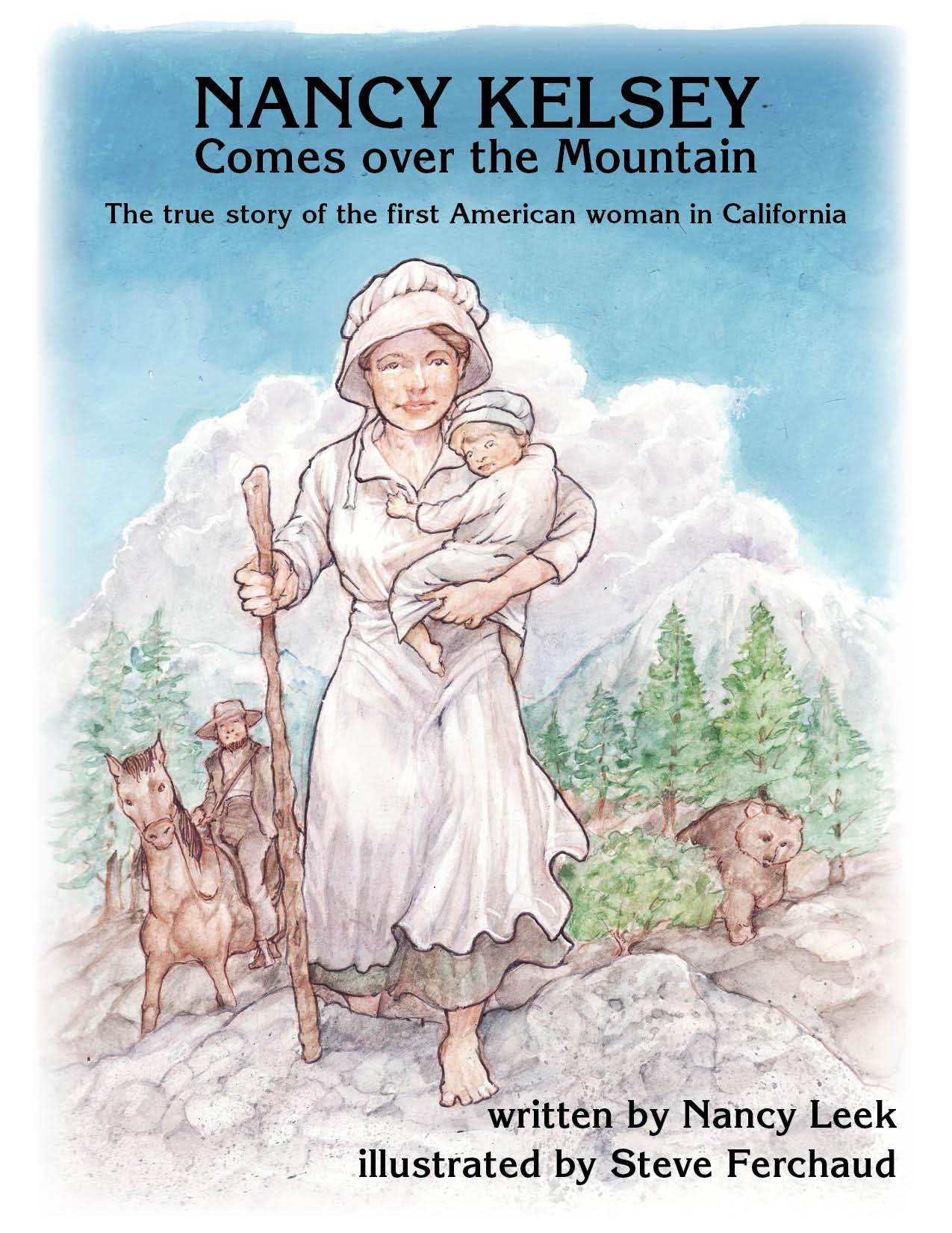
Bartleson and his eight companions took off on their mules, with most of the meat from a freshly-slaughtered ox.  They had not said a word about abandoning their companions before this. Figuring that he and his men had enough meat to get them to the mountains, they left the others—the other men mostly on foot, Nancy Kelsey and her little daughter, the slow-traveling oxen–in the dust.

Who was John Bartleson? Nothing much is known about him before he joined up with the Western Emigration Society in 1841. After making the trip to California, he returned to Missouri in 1842. He died there on October 7, 1848, aged 61 years.

At 55 years of age when the wagon train set out for California, he was considerably older than the rest of the men in the company. Most of the men were, like John Bidwell, in their early 20’s or 30’s. Bartleson insisted on being chosen as the captain of the company, saying that if he was not, he and the men with him would not go. Since the party wanted all the men and guns they could muster, they allowed Bartleson to take charge.

At the outset, this probably didn’t make a lot of difference. Thomas Fitzpatrick, the trail guide hired by Father DeSmet, was the real leader of the combined companies. It was only after the two groups split up that Bartleson’s defects became apparent. Headstrong and over-bearing, Bartleson made a poor leader. If it were not for the fact that they still needed all hands, the rest of the company would probably be glad to see the back of John Bartleson.

Posted in John Bartleson, Uncategorized | Leave a comment

October 5-6, 1841

“Tuesday, 5th.  Today was very warm, and the oxen were not able to keep up with the horses. Traveled about 30 miles and stopped on the river about dark–grass plenty, willows–this going so fast was the fault of Capt. B., nothing kept him from going as fast as his mules could possibly travel. But his dependence was on the oxen for beef–for it was now all we had to live upon.”

“Wednesday, 6th. Company was out of meat and remained till the oxen came up; several Indians came to camp, one of whom we hired to pilot us on.”

On horses and mules, and half of them on foot, the Bidwell-Bartleson Party was making its way across Nevada along Mary’s River (the Humboldt River).  On the 5th it was Bidwell’s turn to drive the oxen, as he recounts many years later in Echoes of the Past. As Bartleson and his companions drove forward on their animals, Bidwell lagged behind with the slow cattle.

That night, far behind the others, he found a patch of grass, unpacked the oxen, and laid down to sleep without supper and without blankets. The next morning he packed the oxen again and started out to find the others.

“Not having had supper or breakfast, and having to travel nine miles before I overtook the party, perhaps I was not in the best humor. [Who would be?] They were waiting, and for the very good reason that they could have nothing to eat until I came up with the oxen and one could be killed. I felt badly treated, and let the captain know it plainly; but much to my surprise he made no reply, and none of his men said a word.” (p. 127)

Imagine having to walk 2 or 3 hours through the rocky wilderness on no breakfast, looking for your flyaway companions. Imagine sitting in camp, no breakfast, waiting for food to show up in the form of an emaciated ox that you would have to slaughter and roast before you could eat. It amazes me that this group did not have more arguments and divisions than it did, and furthermore, that they would all make it to California alive.

Just why Bartleson did not argue with Bidwell we shall see tomorrow. He had a plan.

Posted in Humboldt River, John Bartleson | Leave a comment

October 2, 1841

“Saturday, 2nd.  Having traveled about 5 miles, we all beheld with delight the course of the river change to S. W.  Here was excellent grass–it was 3 or 4 feet high, and stood thick like a meadow, it was a kind of bluegrass. The whole valley seemed to be swarming with Indians, but they were very timid.  Their sable heads were seen in groups of 15 or 20, just above the tops of the grass to catch a view of us passing by.”

The Humboldt River takes a turn southward where it meets present day Highway 789, about 25 miles east of Winnemucca, Nevada. Then it meanders westward until just north of Winnemucca, where it takes a definite turn to the southwest. Seeing the river turn in the expected direction was a great relief to Bidwell & Co. They were pretty sure that they were on the right track, their animals had sufficient feed, and they had access to water.

They were tired though. In Echoes of the Past Bidwell writes:

“From the time we left our wagons many had to walk, and more and more as we advanced. Going down the Humboldt at least half were on foot. [Bidwell doesn’t say whether he was walking or riding a horse.] Provisions had given out, . . . we saw no game except antelope, and they were scarce and hard to kill; and walking was very fatiguing.”

So they pressed on, weary but hopeful of success.

Posted in Uncategorized | Leave a comment