130 years of Casaba Melons

This afternoon I planted casaba melons in a big empty patch in the middle of our orchard. This is the second year that I have planted casabas—they were such a favorite with General Bidwell that I had to try them. I would have planted them sooner, but the weather has been too cool up until now for the seeds to sprout.

I got my seed from Seed Savers Exchange I don’t know of any other catalog that carries it. They are wonderful melons, juicy and delicious, with a heady aroma, but they take a long time to grow.

Seed Savers Exchange lists the seed as Bidwell Casaba Melon. The packet description says, in part: “Grown by John Bidwell (1819-1900), a Civil War General and U.S. Senator who procured his stock seed from the USDA in 1869.” The statement is partly erroneous and partly misleading. John Bidwell did serve as a brigadier general in the California State Militia during the Civil War, but most readers would assume that calling him a “Civil War General” indicates that he served in the U.S. Army. He was not a senator, but a congressman.
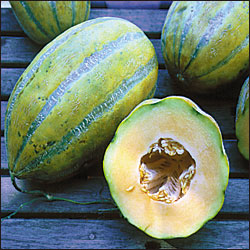
And he did not acquire the seed in 1869. It was sent to him in 1881 by the Department of Agriculture, who knew how he liked to experiment with new crops. The melons grown in 1881 were such an outstanding success that Bidwell decided to devote 10 acres to them the following year.

Casabas take a lot of water, and my husband asked me how Bidwell managed to grow them during our dry Chico summers. The answer comes from his ranch foreman George Moses Gray. He recounts:

“The next year, 1882, we planted ten acres of casabas on newly cleared ground on land between the flume and Humboldt Road. . . The ground was very rich and we had plenty of water from the flume and of all the melons I ever saw growing those were the best.”

Hope mine turn out as good this year!

Posted in Casaba melon, Uncategorized | 1 Comment

May 21, 1841

“Friday, 21st. Our oxen left us last night, and it was 9 o’clock before we were all ready to start, passed a considerable stream called Vermillion, a branch of the Kanzas. On its banks were finer timber than we had heretofore seen, hickory, walnut, &c. &c. The country was prairie, hilly and strong; we passed in the forenoon a Kanzas village, entirely deserted on account of the Pawnees, [we] encamped by a scattering grove, having come about 15 miles.”

On the 19th they had met some well-armed Kansas (Kaw or Kanza) Indians. who were expecting an attack by the Pawnees, in retaliation for an attack by the Kansas on a Pawnee village a short time before. The Kaw and Pawnee were traditional enemies whose enmity had been intensified by pressure from the westward movement of American settlers. Under the guidance of Thomas Fitzpatrick, the members of the Bidwell party were able to avoid coming between rival native bands.

Posted in Bidwell-Bartleson Party | Leave a comment

May 19, 1841

“Wednesday, 19th. This morning the wagons started off in single file; first the 4 carts and 1 small wagon of the missionaries, next 8 wagons drawn by mules and horses, and lastly, 5 wagons drawn by 17 yoke of oxen. . . . Our course was west, leaving the Kanzas no great distance to our left, we traveled in the valley of the river which was prairie excepting near the margin of the stream. The day was very warm and we stopped about noon, having traveled about 12 miles.” (Bidwell-Bartleson Party, p. 28-29)

The missionaries were led by Father Jean Pierre De Smet, a Belgian Jesuit who spent many years working among the American Indians. In 1841 he was on his way, with two other priests and three lay brothers, to minister to the Flathead Indians. He established St. Mary’s Mission on the Bitterroot River near Missoula, Montana. Bidwell described him as follows:

“He was genial, of fine presence, and one of the saintliest men I have ever known, and I cannot wonder that the Indians were made to believe him divinely protected. He was a man of great kindness and great affability under all circumstances; nothing seemed to disturb his temper.” (Echoes of the Past, p. 114)

More information on Father De Smet can be found in this article from the Catholic Encyclopedia: http://oce.catholic.com/index.php?title=Pierre-Jean_de_Smet

Posted in Uncategorized | Leave a comment

May 18, 1841

I had a good time speaking to the Chico Friends of the Library last night. I have been a member for many years, and always have enjoyed hearing the speaker at the annual meeting—I remember Steve Brown, Roger Aylworth, and Michelle Stover, among others. And now it was my turn!

On this date in 1841, what later became known as the Bidwell-Bartleson Party was ready to roll. Bidwell wrote in his journal:

“Having waited at this place (2 miles W. of Kanzas river) 2 days, and all the Company being arrived . . . the Company was convened for the purpose of electing a Captain and adopting rules of government of the Company; when T. H. Green was chosen President–and J. Bidwell, Secretary.” (Bidwell-Bartleson Party, p. 28)

Bidwell did indeed spell Kansas that way, but then that’s the way it sounds. Talbot H. Green was an interesting character. To begin with, his name was not Green, but Paul Geddes. As a bank clerk in Pennsylvania he had embezzled $8,000 from the bank and then headed west, abandoning his wife and four children. After tending a dying Englishman on a steamboat on the Mississippi River, he adopted the dead man’s name and began passing himself off as Talbot H. Green. (Shades of “What was your name in the States?”!)

Green had a successful career as a businessman in California during the 1840’s. By 1851 he was living in San Francisco, where he was considered a trustworthy and generous pillar of the community. He married again (bigamously) and had a son. He had served on the city council and decided to run for mayor. But this prominence was his undoing. He was recognized on the street by a man who had known him in Pennsylvania as Paul Geddes. Although he denied it, it was the end of his career in San Francisco. He returned East, spent a number of years in Tennessee and Texas, and finally lived out the last years of his life back in his hometown with his first wife. (If you ask me, this story would make a pretty good movie.)

Posted in Uncategorized | 2 Comments

The Missionaries and the Mountaineer

“In five days after my arrival we were ready to start, but no one knew where to go, not even the captain. Finally a man came up, one of the last to arrive, and announced that a company of Catholic missionaries were on their way from St. Louis to the Flathead nation of Indians with an old Rocky Mountaineer for a guide, and that if we would wait another day they would be up with us. At first we were independent, and thought we could not afford to wait for a slow missionary party. But when we found that no one knew which way to go, we sobered down and waited for them to come up.” (Echoes of the Past, p. 133)

It was very fortunate, even life-saving, for the Bidwell-Bartleson Party to have joined up with the missionary party, since they had hired as their guide Thomas Fitzpatrick, an experienced mountain man and trail guide.

Thomas "Broken-Hand" Fitzpatrick in his later years.

Fitzpatrick was born in County Cavan, Ireland, in 1799. By the time he was 17 years old he had come to the United States, where he joined a fur trading expedition up the Missouri River.  He had spent many years trapping, trading, and traveling in the Rocky Mountains, and was familiar with the Oregon Trail route across the plains and through the South Pass.

He had met and dealt frequently with Native Americans, who called him “Broken-Hand.” He had injured his left hand in an accident with a gun at some time during his long career.  Meeting up with this experienced guide was a stroke of luck for the California-bound emigrants, since he was able to teach them how to survive in the wilderness, how to get along with the Indians, and was able to point them in the right direction when the time came for them to part ways.

Posted in Thomas Fitzpatrick, Uncategorized | 2 Comments

Gathering: May 1841

Camped by the Kansas River, John Bidwell and his companions waited to see who else would show up.

“Every day for a week or more wagons arrived with the same object in view (going to California.) At last we took steps to see how many had arrived and found our numbers to be sixty-nine. Among these were about fifteen women and children. All were anxious for a start.” (California 1841-8, p. 5)

There were five women in the group, and at least seven children, maybe more. No one seems to have recorded the names of all the children.

“No one of the party knew anything abut mountaineering and scarcely any one had ever been into the Indian Territory, yet a large majority felt that we were fully competent to go anywhere no matter what the difficulties might be or how numerous and warlike the Indians.” (California 1841-8, p. 6)

Such was the confidence of the American pioneers! especially young men eager to be on their way. Luckily they fell in with a missionary party who had hired an experienced guide. If they had taken off on their own, Bidwell surmised,  “probably not one of us would ever have reached California, because of our inexperience.” (Echoes of the Past, p. 113)

Posted in Uncategorized | Leave a comment

May 9, 1841

“When May came I was the only man that was ready to go out of all who signed the pledge. In Weston however there was a man who had never signed the pledge, but who had said from the beginning that he would go to California when May came. This was Robert H. Thomes, a wagon maker at that time. As the time approached I became very anxious about the expedition but supposed a few would go with me. Finally I could not find a single member of the company who was sure to go. . . . At almost the last moment every one abandoned the idea of crossing the plains.” (California 1841-48, p. 4-5)

(Thomes Creek in Tehama County is named after Robert Thomes, who settled there in 1844.)

May 9th was the day decided on for gathering at the jumping off point: Sapling Grove, in Kansas Territory. Early in May, in the Platte Purchase area of Missouri, Bidwell was the only member of the Western Emigration Society ready to go. He recruited George Henshaw and persuaded him to trade his “fine black horse” for a pair of oxen and a “sorry one-eyed mule” for Henshaw to ride.  They were joined by Thomes and a young man by the name of Mike Nye.

When California fever had swept the region in the winder of 1840-41, quite a few people in the Platte Purchase had signed the pledge. Now they had all backed out. But they saw the four men off on their way with the best of wishes. Bidwell and his companions soon arrived at the rendevous point of Sapling Grove.

“On reaching Sapling Grove no one was there but we saw fresh wagon tracks and followed them to the Kansas River. They belonged to parties who had come, some from Arkansas, and some from different parts of Missouri to cross the plains. We camped here and waited to see if others would come.” (California 1841-48, p. 5)

Posted in Uncategorized | Leave a comment

Essentials for Immigrants, part 3

“It was understood that every one should have not less than a barrel of flour with sugar and so forth to suit; but I laid in one hundred pounds more flour than the usual quantity, besides other things. This I did because we were told that when we got into the mountains we probably would get out of bread and have to live on meat alone, which I thought would kill me even if it did not others.” (Echoes of the Past, p. 113)

The time would come, in the Sierra Nevada, when Bidwell would indeed be living on meat alone, and little of that. By the time they got across the Great Basin they had used up all their supplies, and were eating their draft animals. Even game was hard to come by. (Coyote windpipe for breakfast, anyone? Come on, try it–it’s great!)

The “other things” in the way of foodstuffs that Bidwell packed in his wagon were things like dried beans, cornmeal, salt, and coffee. Those, plus buffalo meat and other game that they shot, made up the travelers’ diet as they crossed the plains. But before they reached the end of the trail it was all gone. As much as he disliked the notion of “no bread,” John Bidwell lived for a time on an all-meat diet, and it didn’t kill him.

Posted in Uncategorized | Leave a comment

Essentials for Immigrants, part 2

John Bidwell talked to anyone who had knowledge of travel in Indian Territory. One of the things he needed to know was what kind of gun to take. There was no more important piece of equipment than a gun.

“My gun was an old flint-lock rifle, but a good one. Old hunters told me to have nothing to do with cap or percussion locks, that they were unreliable, and that if I got my caps or percussion wet I could not shoot, while if I lost my flint I could pick up another on the plains.” (Echoes of the Past, p. 113)

Rifles with percussion caps were the modern gun of the day, but there were still plenty of flintlocks in use. A flintlock rifle fires by by scraping a bit of flint rock down a steel plate  which makes sparks that fall into a shallow depression filled with gunpowder. When the powder in the pan is ignited, it ignites the powder in the barrel, which propels the bullet. A flintlock may have been more primitive than a percussion cap rifle, but it was going to be more reliable where John Bidwell was going.

How Stuff Works has a good description of how a flintlock fires, with this diagram.

Posted in Uncategorized | Leave a comment

Essentials for Immigrants

What were the essentials for a journey to a new country, a journey that might take up to six months far away from towns, stores, or farms?

First of all, a man needed information, and there was no public library to provide it. So John Bidwell did the next best thing. He asked questions and took advice from anyone who had experience on the trail. In the months before departure he made several trips around Kansas and Missouri “to see men who were talking of going to California, and to get information.” (Echoes of the Past, p. 112)

Getting ready to go was going to take all the means Bidwell could muster. He needed a wagon and animals to pull it. The usual draft animals were mules, horses, or oxen. He had money to buy a wagon, a gun, and provisions, but not enough for the animals. His partner, who was going to supply horses, had backed out. Luckily another man came along who was interested in going to California to improve his health.

“At the last moment before the time to start for the rendezvous at Sapling Grove—it seemed almost providential—along came a man named George Henshaw, an invalid, from Illinois, I think. He was pretty well dressed, was riding a fine black horse, and had ten or fifteen dollars. [A man of means, indeed!] I persuaded him to let me take his horse and trade him for a yoke of steers to pull the wagon and a sorry one-eyed mule for him to ride.” (Echoes, p. 113)

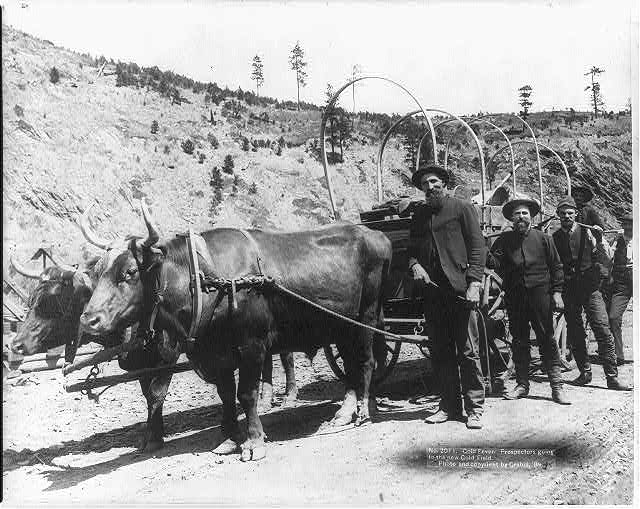
An ox-drawn wagon similar to the one which John Bidwell would have had.

There was no horse or mule for John. He would walk all the way. A wagon drawn by oxen was different than one drawn by horses or mules. With the latter the driver would ride on the wagon seat, holding the reins that guided the animals. Oxen couldn’t be driven with reins, instead the driver would walk along beside them with a stick to tap or poke them this way or that.

Next time: What kind of gun was best?

Posted in Uncategorized | Leave a comment