On Sunday I visited Shasta State Historic Park along with a group of trail enthusiasts from the Oregon-California Trail Association. We were in Anderson for a “Spring Symposium” and our field trip was to drive 40 or so miles on the Nobles Emigrant Trail, starting at its terminus, Shasta City.
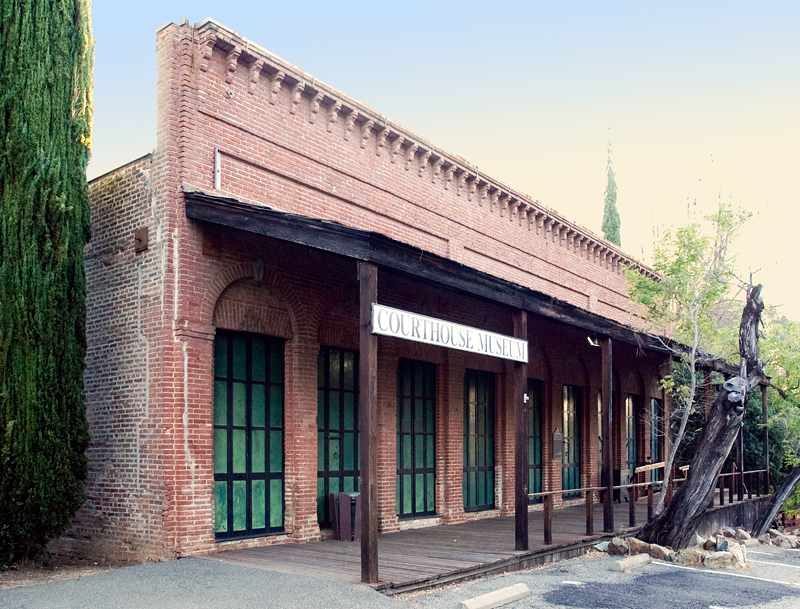
Shasta City, once a thriving mining community and the first county seat, is now a handful of old brick buildings on either side of Highway 299. Most of the park is an open-air display that can be visited any time. The museum, inside the courthouse, is still closed to the public while State Parks readies things like new displays and ADA compliance.
We were fortunate to be given a special tour by parks guide June Morris. She couldn’t take us inside the museum, but she let us take a look at the gallows and guided us around the old cemetery.
The gallows behind the courthouse
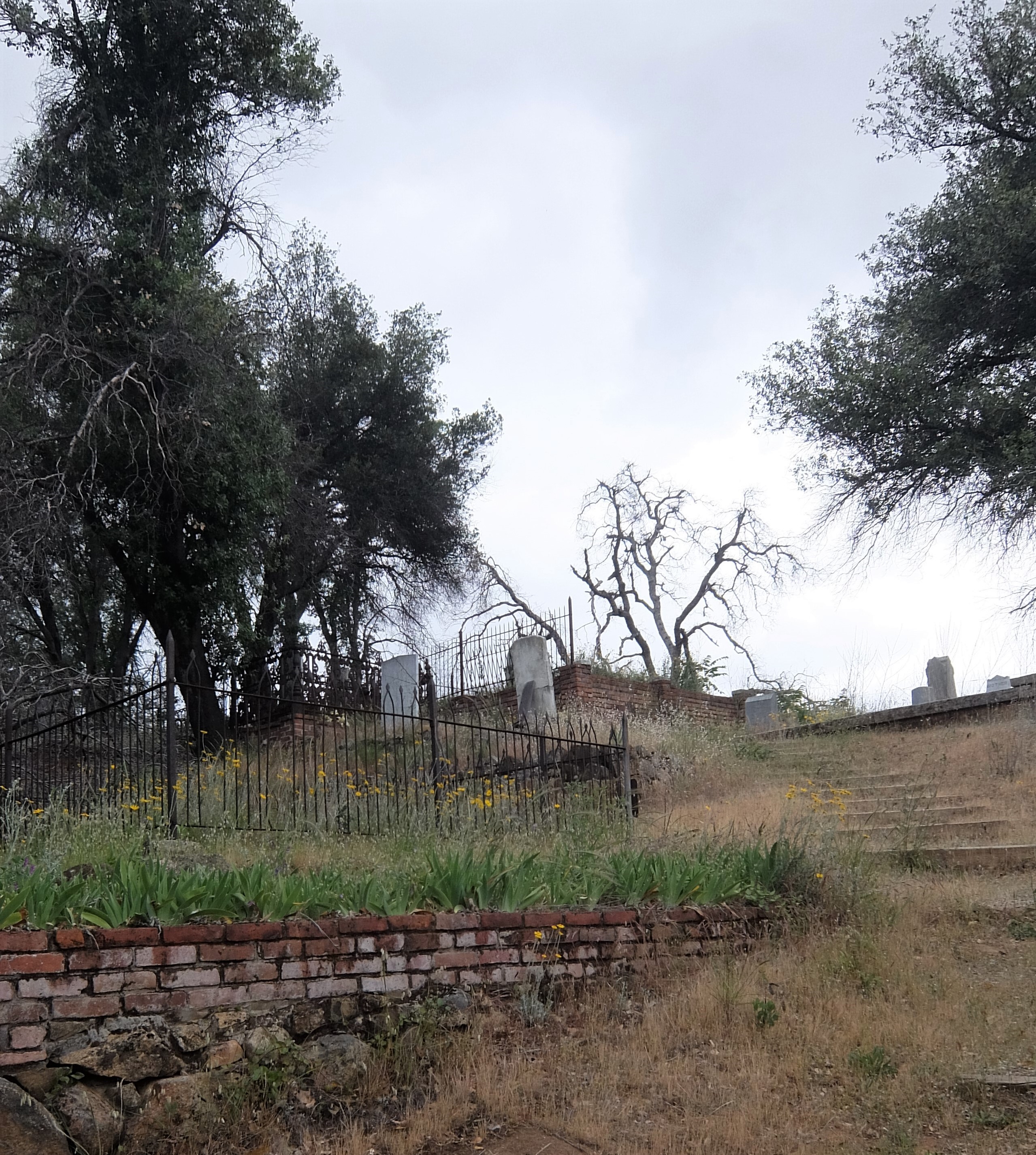
Shasta Union Cemetery
An infant’s grave
The cemetery was hilly, overgrown with weeds and wildflowers, and home to many a sleeping pioneer — not only miners, but wives and children as well.
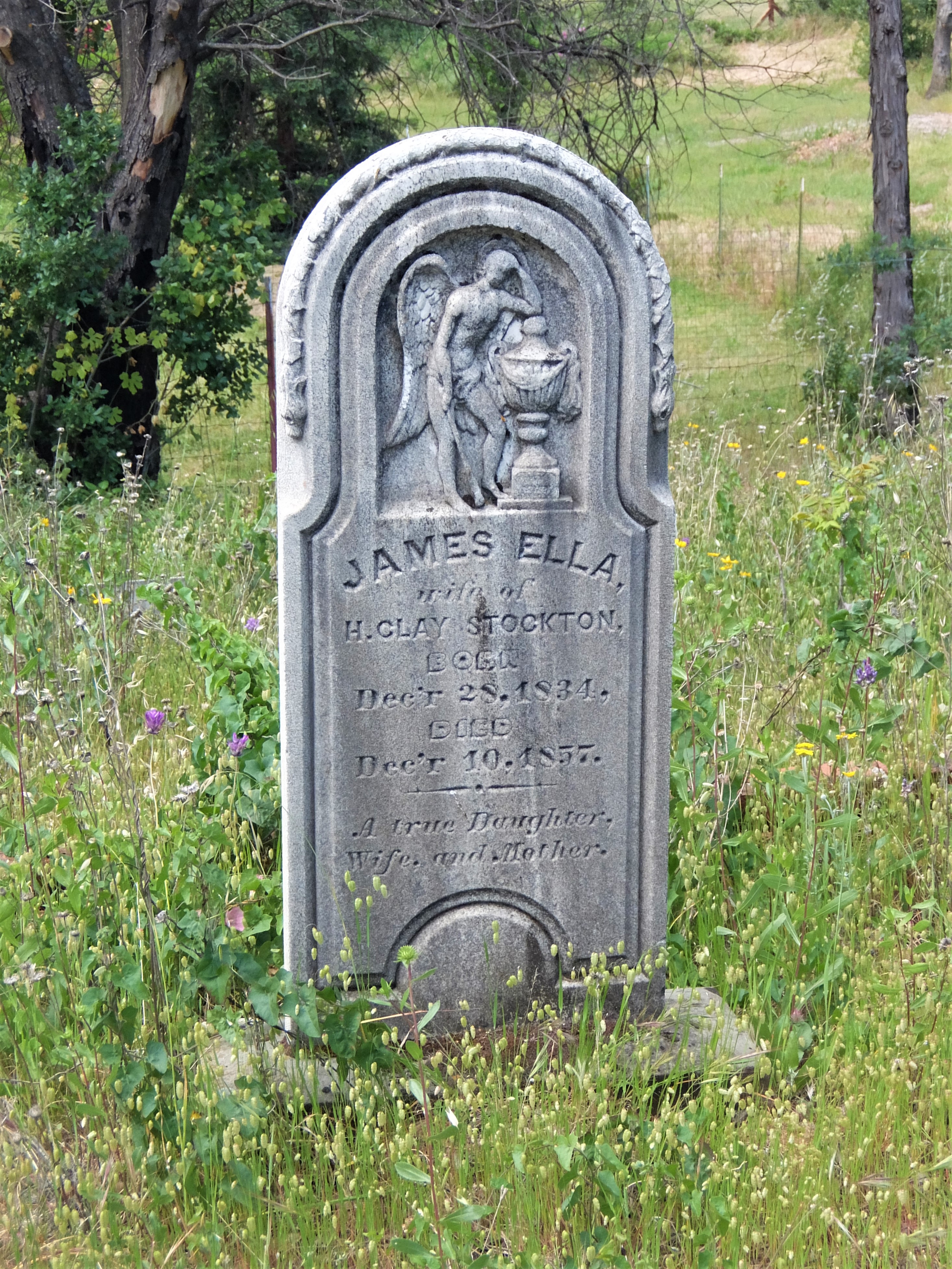
Here is the tombstone for James Ella Stockton, who died at the age of not-quite 24, after giving birth.
When she was born, her father was so certain that the baby would be a boy, that he registered the name as James, only to find out that the baby was a girl. Ella was added to make the name sound feminine.
The image on the tomb is a classic example of tombstone iconography. It shows a mourning angel with a drooping trumpet in one hand, weeping over a funeral urn.
Keep an eye out for the reopening of the Courthouse Museum at Shasta State Historic Park so that you can plan a visit. I am hoping that this summer I can visit again, tour the buildings and museum, reacquaint myself with the inhabitants of the cemetery, and have a picnic in the park.
I am always on the lookout for illustrations of life in Gold Rush California, and what I like best are authentic photographs or drawings from the period. Whenever I do a picture book set in California history, I have to find pictures for the illustrator (the wonderful Steve Ferchaud) — pictures that show life at that time. This daguerreotype is a great example.
The picture was posted on Facebook by The Society of California Pioneers. Probably taken in 1849, it shows a miner outside his makeshift cabin playing a flute. A closer look reveals some tools of his trade.
He has one foot up on a keg, but what the keg held is anyone’s guess. Everything was packed in barrels and kegs. It could have been brandy, it could have been pickles. Next to the keg is a log with an ax, and nearby are his mining tools — what looks like a pan and a shovel.
Look closer. To the right of the door, just in front of the little lean-to, is a dog, On top of the log chimney is a barrel for a smokestack.
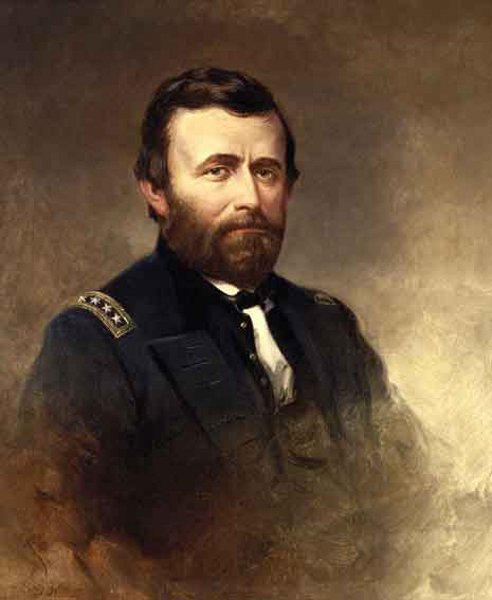
Ulysses S. Grant was born on April 27, 1822, making this year his bicentennial. So Happy Birthday! to “the man who saved the Union” and to two-term President Grant.
He was born Hiram Ulysses Grant in Port Pleasant, Ohio. Always known as Ulysses, Grant’s name change was an error by the congressman who nominated him to West Point. He graduated 21st in the class of 1843 and served with distinction in the Mexican-American War. In 1848, he married Julia Dent; together they would have four children.
After posts in Detroit and upstate New York, Grant was sent to California during the gold rush. He arrived in San Francisco in August 1852. He was posted with the 4th Infantry to Vancouver Barracks in Oregon Territory, and then to Fort Humboldt on the California coast. Here is how he described San Francisco in his memoir:
SAN FRANCISCO at that day was a lively place. Gold, or placer digging as it was called, was at its height. Steamers plied daily between San Francisco and both Stockton and Sacramento. Passengers and gold from the southern mines came by the Stockton boat; from the northern mines by Sacramento. In the evening when these boats arrived, Long Wharf — there was but one wharf in San Francisco in 1852 — was alive with people crowding to meet the miners as they came down to sell their “dust” and to “have a time.” Of these some were runners for hotels, boarding houses or restaurants; others belonged to a class of impecunious adventurers, of good manners and good presence, who were ever on the alert to make the acquaintance of people with some ready means, in the hope of being asked to take a meal at a restaurant. Many were young men of good family, good education and gentlemanly instincts. Their parents had been able to support them during their minority, and to give them good educations, but not to maintain them afterwards. From 1849 to 1853 there was a rush of people to the Pacific coast, of the class described, All thought that fortunes were to be picked up, without effort, in the gold fields on the Pacific.
Grant was promoted to captain in August 1853 when he took up his duties at Fort Humboldt. Finding himself in dreary surroundings, with little to occupy him and missing his family, he took to drink. Colonel Buchanan reprimanded Grant for one drinking episode and told Grant to “resign or reform.” Soon he was found to be under the influence again. Given the choice to stand trial or to resign, Grant chose to resign, despite the urging of his friends, who thought he would be acquitted. He said “he would not for all the world have his wife know he was tried on such a charge.” (according to his friend Rufus Ingalls, quoted in Ulysses S. Grant: His Life and Character by Hamlin Garland, 1898.)
And so Grant left California and the army to return to civilian life. For the next several years he struggled to keep his family out of poverty, until he rejoined the army in 1861 at the onset of the Civil War.
There is no need for me to review the rest of Grant’s life, his leadership in the Civil War and his presidency. I will leave you with some notes on Grant’s connection to John Bidwell.
Bidwell was a great admirer of General Grant. He met his hero in the summer of 1864, which you can read about in this earlier post. Grant attended the wedding of John Bidwell to Annie Kennedy in 1868. Bidwell met him again in Washington when Grant was president in 1876. After his presidency, Grant and his wife set out on a two-year trip around the world. Here is Bidwell’s diary entry for the day that the Grants returned to San Francisco from Japan.
Grant returns to the United States, at San Francisco, 1879, aboard the City of Tokyo
Sat., September 20. [1879] San Francisco at Col. Bee’s. Weather: fine. Events: Called at the Chinese Consulate, 9l7 Clay Street. Saw the Consul General, Chen Shu Tang, and the Consul Col. F.A. Bee – Lunched at the Occidental with Mr. Cleaveland – At 3.l5 P.M. The Tokio was sighted – went to Broadway wharf & took steamer St. Paul to meet Tokio -GEN. GRANT escorted and welcomed! the grandest ovation ever given to any man in America! The multitude was simply boundless – and the rush unparalleled!
On the following Monday he “saw Gen. Grant in a hat store.” A month later General Grant was still in California and a grand reception was held for him in Sacramento. Bidwell recorded:
Weds., October 22. Chico > Sacramento Events: Large delegation went to Sac. to Grant Reception -We (self & wife, her father & mother) went to Carroll’s – Immense throng – large procession – vast multitude at Capital in P.M. & evening -Fireworks and calcium lights – Henry Edgerton [prominent California Democrat] delivered welcome address. – Grant Ovation and grand success. –
Thurs., October 23. Sacramento Events: Took casaba melons to Golden Eagle for Grant – Went to Fair grounds – saw sham battle – Drove with the Grant party to the R.R. shops, etc.
He took casaba melons to the hotel for Grant. Of course he did!
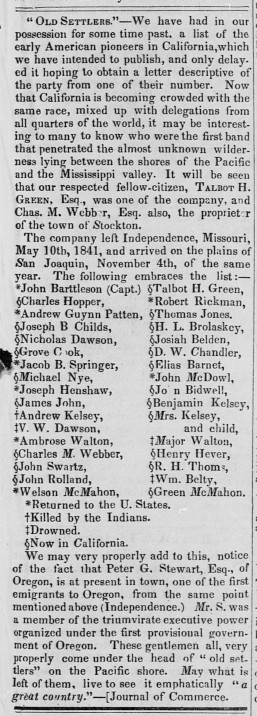
In 1850 the Sacramento Transcript published this list of the members of the “first band that penetrated the almost unknown wilderness lying between the shores of the Pacific and the Mississippi valley.” This is what became known as the Bidwell-Bartleson Party. The article called them “Old Settlers” since they had been in California eight or nine years longer than most men.
Sacramento Transcript 5 May 1850
Several of these men became prominent in California. One such was “our respected fellow-citizen” Talbot H. Green. Green was a leading San Francisco businessman and a founding member of the Society of California Pioneers. This article was written before Green’s true name and history was discovered. Click on the link to find out who he really was.
Charles M. Weber was the founder of Stockton. More about him someday.
Josiah Belden became a wealthy businessman in San Jose.
Michael Nye, was a well-known resident of the Marysville area and shows up in Bidwell’s correspondence.
Robert H. Thomes acquired Rancho Saucos, where the town of Tehama is now located, in Tehama County. He remained a close friend of John Bidwell.
Another prominent settler was Joseph B. Chiles, who was probably the person who took Bidwell’s journal back to the States for publication. A hardy pioneer, he made three trips back to Missouri — to gather more immigrants, to pick up the children he had left behind, and to remarry. He settled on a ranch in the Napa Valley.
The Kelsey brothers, Ben and Andrew, set out from Missouri with two other brothers, Samuel and Zedediah (also known as Isaac). The two latter brothers took the safer route to Oregon and came later to California.
Note that Andrew Kelsey’s name has a mark by it indicating that he was killed by Indians. This was a fate he and his partner Charley Stone brought on themselves by their brutal treatment of the Pomo Indians that they held in slavery. It’s a dark chapter in California history.
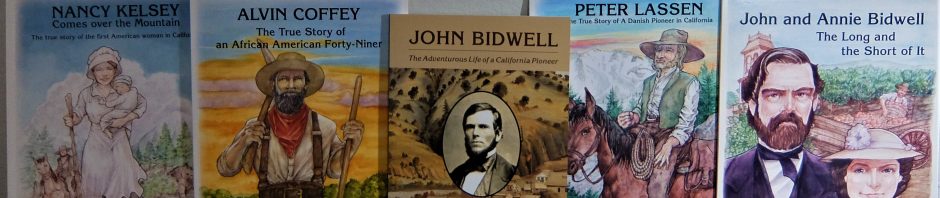
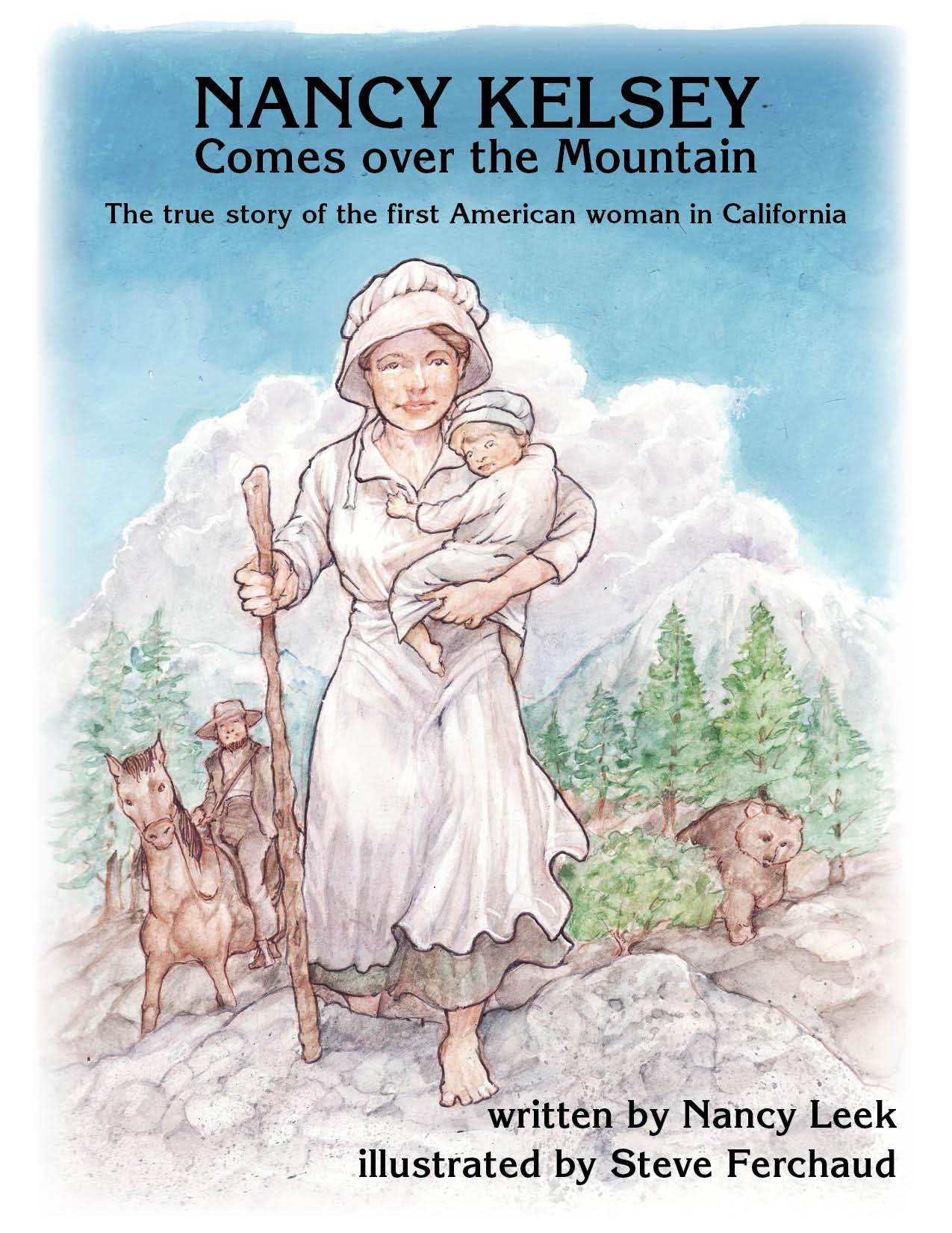
I have written a picture book biography of Nancy Kelsey, famous for being the first American woman to come into California on the overland route. She led an adventurous life with her peripatetic husband, Ben. They lived all over California. Like his brother though, he was an Indian killer, not a man to admire.
I have written quite a few posts about Nicholas Dawson. After three years in California, he went back to Arkansas to find a wife. By 1850, when this article was written, he was back in California, having returned in 1849 for the Gold Rush. He eventually settled in Texas.
According to this list, three of the men drowned, which was a fairly common fate in pioneer days. Eight of the men, a quarter of the list, returned to the United States, including John Bartleson. Bartleson managed to get himself elected Captain of the emigrant party, but he turned out to be a poor leader, and his subsequent career was negligible. Getting his name on the first emigrant party to come to California was the only notable thing he ever did.
A couple of the names on this list should be corrected. Joseph Henshaw was George Henshaw. He returned east in 1842.
Henry Hever was actually Henry Huber. He acquired a Mexican land grant of eight leagues situated somewhere between the Yuba and Feather Rivers and Honcut Creek and the foothills. The boundaries were vague and he made no improvements, hence the grant was not confirmed by the U.S. Land Commission. So Huber bought some lots in San Francisco and there (according to Bancroft’s Register) he kept a liquor store.
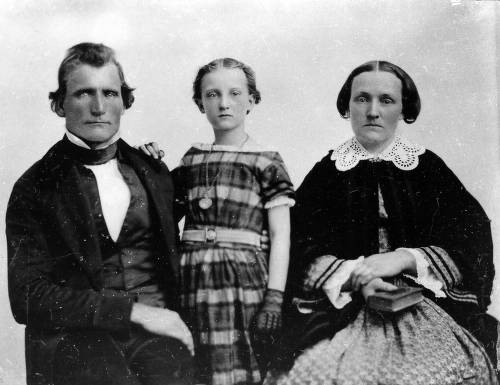
Springer was James P. (not Jacob B.) Springer. I’ll write more about him someday. He returned to the States in 1842 with Joseph Chiles. In Missouri he promoted immigration to California and made several overland trips. He married and settled in Saratoga, Santa Clara County. I have corresponded with one of his descendants.
James Springer in 1857, with daughter Alice and wife Mary
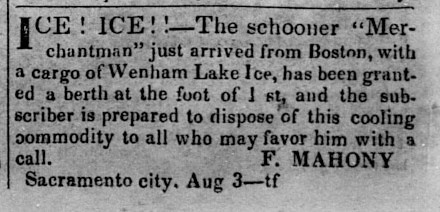
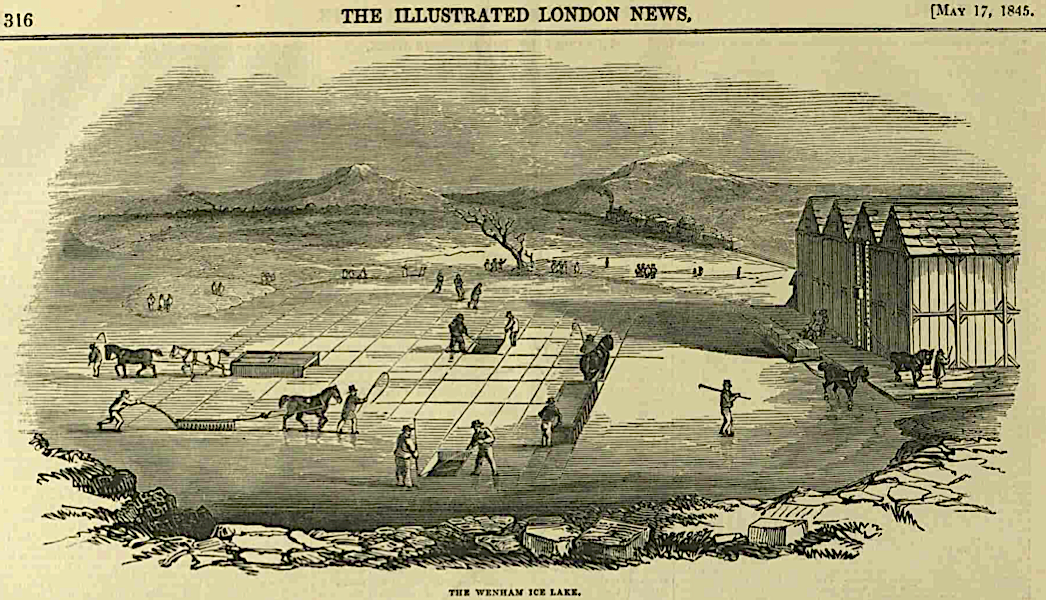
Wenham Lake ice was famous. The lake in northeast Massachusetts supplied crystal-clear ice to the eastern states, Great Britain, and all the way to California. The ad above began publication in the Sacramento Transcript at the end of July and continued through the fall.
Sacramento Transcript 30 July 1850
The Transcript publicized the news and poked fun at their rival newspaper, the Alta California and its editor, J.E. Durivage (“Dury”). I guess they didn’t have any of this precious stuff in San Francisco.
According to a Wikipedia article:
“A crew of 100 men and 30 to 40 horses was required to harvest the ice. The crew waited for a foot of black ice to form in the lake. Snow was swept off and snow-ice was scraped off by horse-drawn vehicles if necessary. Then, a horse-drawn cutting tool, the marker, scored a grid 2-3 inches deep forming 21-inch squares over two to three acres of ice. Men with saws cut along a line in one direction while men with ice spades knocked the blocks free from the strip. Another crew with ice hooks drew the ice along ramps onto platforms. Full platforms were slid onto sledges for transport to ice houses on the shore. An ice house was built of pine walls filled with sawdust to a thickness of 2 feet (61 cm). The blocks were packed in sawdust for transport, moved to a train in a special wagon and brought directly to a wharf in Boston The blocks arrived in Boston within an hour of the cutting with no loss.”
From Boston the ice went by ship around Cape Horn, a five to six month voyage. Its arrival in Sacramento in the midst of the summer heat would have been welcome indeed. There was probably “pressed snow” available from the Sierras, but nothing could beat Wenham ice for purity and clarity, just the thing to cool your drink, whether it be champagne or sarsaparilla.
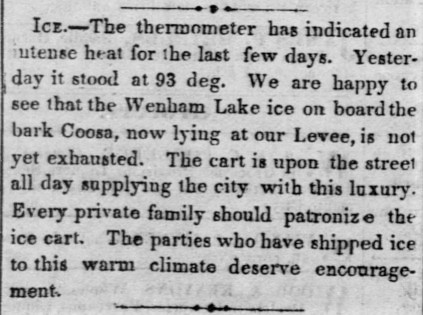
Another shipment of ice on the bark Coosa arrived in Sacramento in January 1851. Ice was still available in May, as the weather began to heat up.
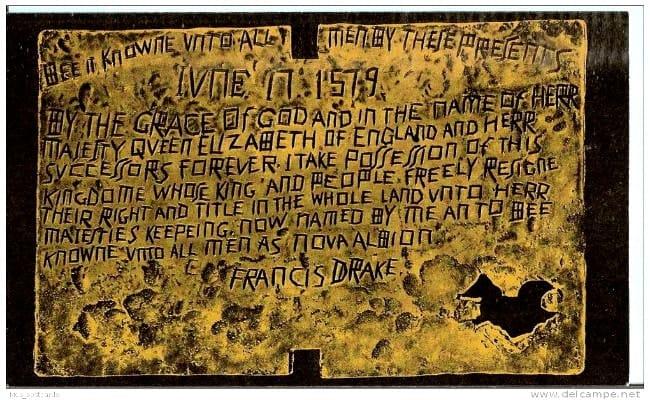
On this date, April 6, in 1937, Herbert E. Bolton, professor of history at UC Berkeley and director of the Bancroft Library, announced a spectacular find. Nothing less than the inscribed brass plate set up by Sir Francis Drake to claim the west coast of North America for Queen Elizabeth of England.
Sir Francis Drake, miniature by Nicholas Hillyard
On his round the world voyage Drake explored the west coast and was thought to have landed in California at Drake’s Bay in 1579. His actual landing place is now thought to have been further north, not in California.
According to a contemporary account by Francis Fletcher, a member of Drake’s crew, Drake left behind “a plate” as “a monument of our being there” that claimed “her maiesties, and successors right and title to that kingdome”. The memoir also say that the plate included the date of the landing, Drake’s name, and the queen’s portrait on a sixpence coin.
This was just the recipe needed for a bunch of pranksters to cook up a hoax to fool one of California’s most notable historians. Bolton had talked about Drake’s plate and urged his students to keep a lookout for it. The perpetrators of the hoax (who by the way were all members of E Clampus Vitus) got the plate cut and inscribed, and even included a hole for a missing sixpence. They hoped to lure Bolton to find it where they planted it, but instead it was found by a hunter who threw it in the trunk of his car, and then tossed it out by the side of the road. When it was next discovered, three years later, the finder took it to Bolton to be authenticated.
Delighted with the find, Bolton announced at a California Historical Society meeting on April 6, 1937, that “One of the world’s long-lost historical treasures apparently has been found!… The authenticity of the tablet seems to me beyond all reasonable doubt.” Doubters questioned the plate’s authenticity, but Bolton had it verified by a pair of metallurgists, who declared it genuine. The plate of brass was proudly put on display in the Bancroft Library. For the next 40 years the hoax went undetected.
I first saw it in the Bancroft when I was a student employee there. “What a fabulous piece of history,” I thought. “What could be more romantic than a shiny brass plate that connected California history with the daring sea rover, Sir Francis Drake, and Queen Elizabeth I?”
I have a cardboard souvenir replica, with a gold-tone top layer, which my children took to school to share when they studied California history. I was careful to make sure they knew it was a fake, because in the 1970s a team of scientists, after a thorough examination, found the plate to be a modern forgery. Among the findings, tests revealed the plate to be too smooth, made by modern rolling equipment, not hammered flat by a sixteenth-century hammer. Neutron activation analysis showed that it contained far too much zinc and too few impurities to be Elizabethan English brass.
(For more information, the Wikipedia article is a good place to start.)
I still can’t help but wish it were real.
Drake’s ship, the Golden Hind, by Cornelis de Vries.
Today my daughter and I made our annual pilgrimage to Table Mountain in Butte County to enjoy a hike and admire the wildflowers.
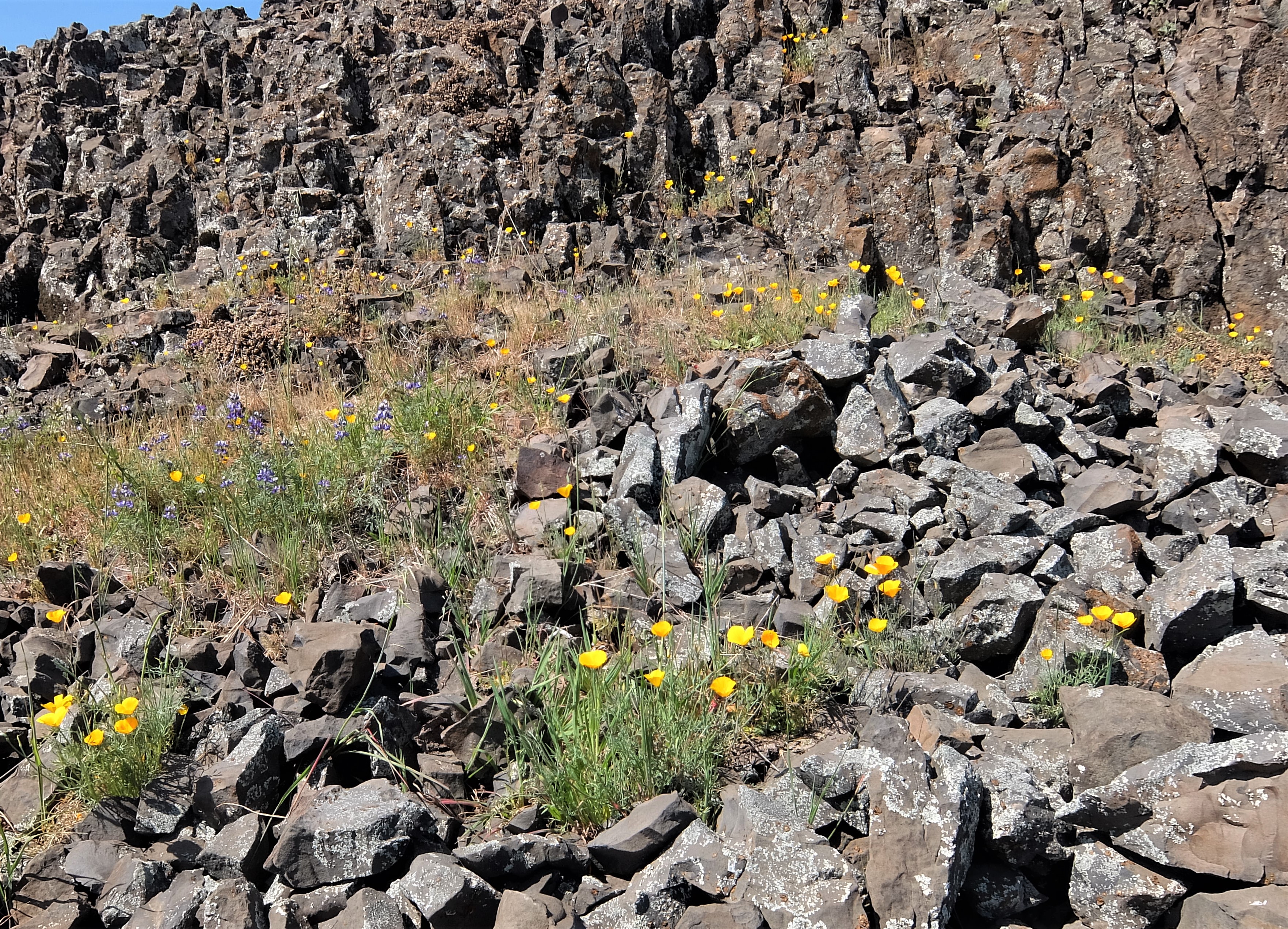
With almost no rain in January, February, or March, it is a meager year for flowers. The grass is drying up and the flowers are short and skimpy. They are all in a hurry to set seed before the season is over, and are not wasting time on lush growth or lavish bloom. We saw mostly sky lupine, popcorn flowers, and the little poppies called frying-pans.
The section of Table Mountain set aside for hiking is officially known as North Table Mountain Ecological Reserve. A Lands Pass from the California Department of Fish and Wildlife is required to visit. I have never seen anyone checking for passes, but it only costs $4.89 for a day pass and the fee goes towards upkeep and improvements.
And we did see a number of improvements. The parking lot has been enlarged, restrooms and porta-potties have been installed, and a viewing platform with informational signs has been set up.
The viewing platform includes a three-dimensional map of the terrain, which is nice for locating where you are and where you are going. The boundaries of the reserve are outlined and the various falls are labeled.
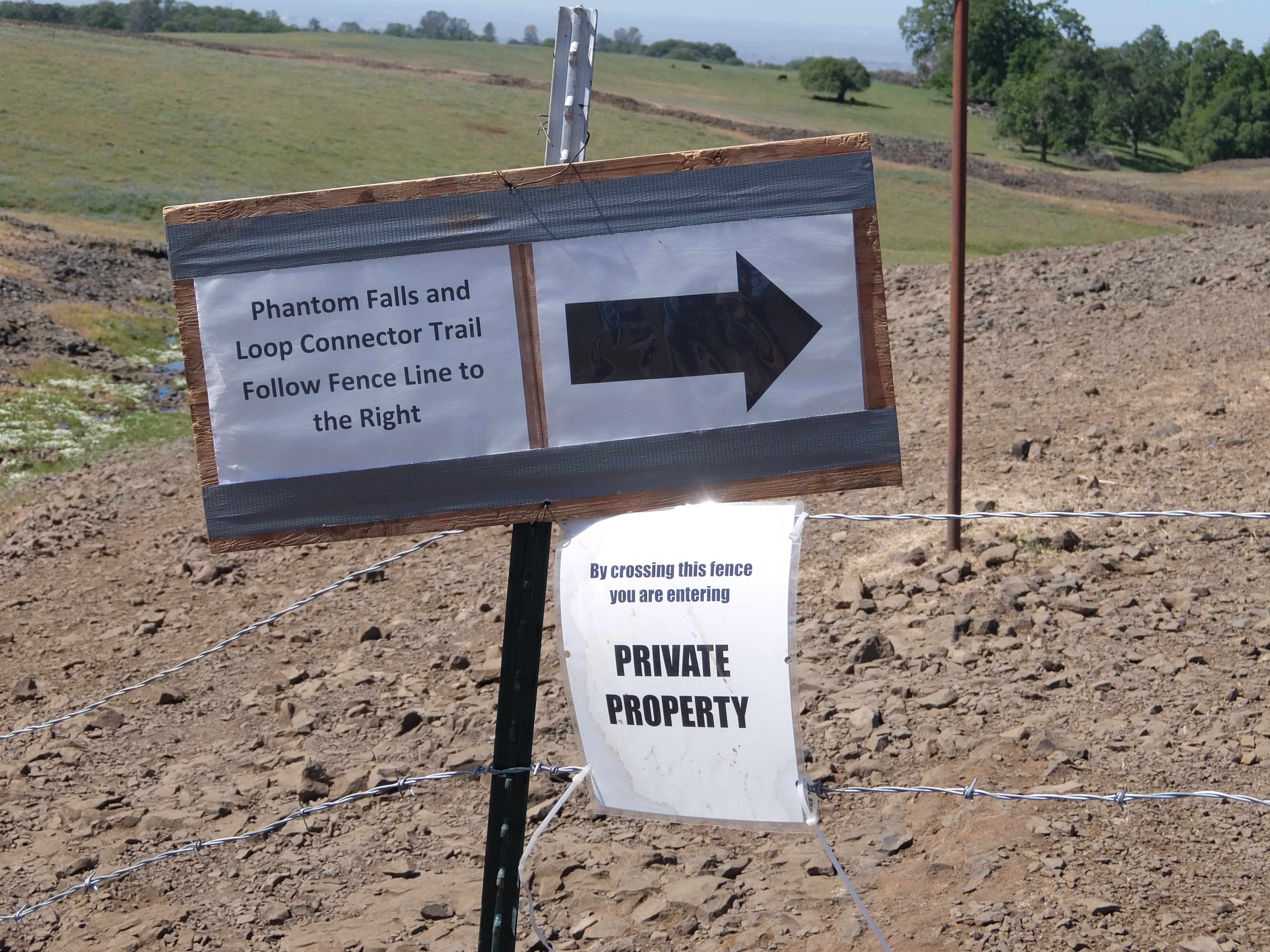
In the past we have usually hiked to Beatson Falls, the way that most visitors take. But that, as it turns out, is actually on private land. It is not part of the reserve and signs will tell you so.
The signs direct the visitor to take a turn to the right and hike to Ravine Falls and Phantom Falls. Which we did.
Not everybody heeds the signs and stays within bounds. The fence at this point has been pushed down. I saw a couple of folks step over the fence and head for Beatson Falls. The cows didn’t seem to care.
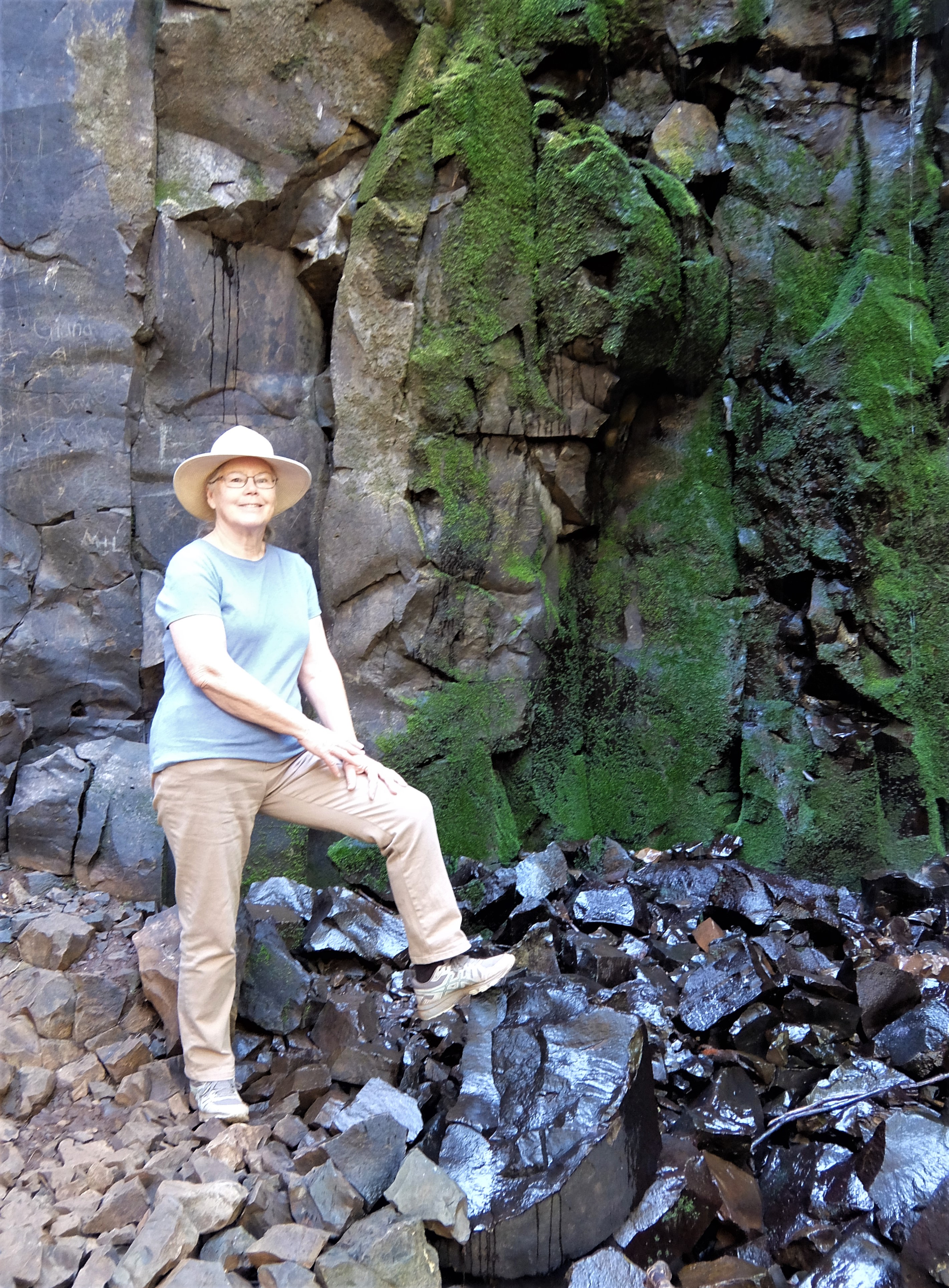
We made it to Ravine Falls, which was still dripping water, although the creek itself was dry. I would have liked to continue another 0.6 mile to Phantom Falls, but I had another place to be this afternoon, so we turned around and headed back.
It was a nice morning out, but I am hoping for more rain next winter and better wildflowers next spring. Here’s a little bit of owl clover we saw.
Can you oblige me by letting me have a few seeds of the Casawba (?) Melon, provided you can conveniently spare them. You will be pleased to hear that my father & all the family are very well indeed. Will you kindly remember me to Madam Bidwell, & trusting that you are both enjoying the best of health
I remain, dear General, very truly yours,
Tiburcio Parrott
Who was Tiburcio Parrott, who wrote with such an elegant hand and courteous manner?
Tiburcio Parrott
He was the son of John Parrott, San Francisco banker and possibly the richest man in California. John Parrott had served as American consul in Mazatlan, Mexico, from 1837 to 1850. The position as consul paid nothing, but Parrott amassed a fortune in Mexico as a merchant and importer. Tiburcio, born in 1840, was his son by his Mexican mistress.
In 1850 John Parrott came to San Francisco and increased his fortune through banking and real estate. He built a large and beautiful mansion in San Francisco and a handsome summer home on his estate, Baywood, in San Mateo County. In 1853 he married Abbie Meagher and together they had eight children.
John Parrott did not neglect his Mexican-born son. He saw to it that young Tiburcio was given a good education in Massachusetts and England, before returning to the States to enter on a career in banking. Tiburcio came to California in 1862 and started working with his father. After his father’s death in 1884 he took over the Parrott Bank. About this time his step-mother bought property for him in the Napa Valley, where he built a mansion he called Miravalle and developed an interest in wine-making. This estate is surely where he planned to grow the casaba melons that John Bidwell had made famous.
The Parrott family has a Butte County connection. In 1860 John Parrott began buying land in Butte County and by 1875 he had acquired all of Rancho Llano Seco. This Mexican land grant, originally deeded to Sebastian Keyser, is situated on the east bank of the Sacramento River south of Chico. The ranch is still owned by the Parrott family.
Jennie Megquier’s letters from Gold Rush San Francisco record a few interesting notes about clothing. In November 1849 she wrote:
I have starched twenty shirts this evening. I tell you this to give you an idea of the amount of work I have to do. Uncle has given me a whole piece of calico, one of de laine, one balererine. I shall make it all into broad aprons as I cannot get time to make a dress and when they get dirty throw them away that is the order of the day in this rich country.
Calico is a plain weave cotton fabric, and delaine was a lightweight wool fabric, often with a print. What balererine is I have no idea. Delaine is the sort of fabric that Jennie would have ordinarily used to make a nice dress, not aprons. Some of you may recall that Caroline Ingalls, in Little House in the Big Woods, wears her delaine dress to a barn dance. It’s her best dress.
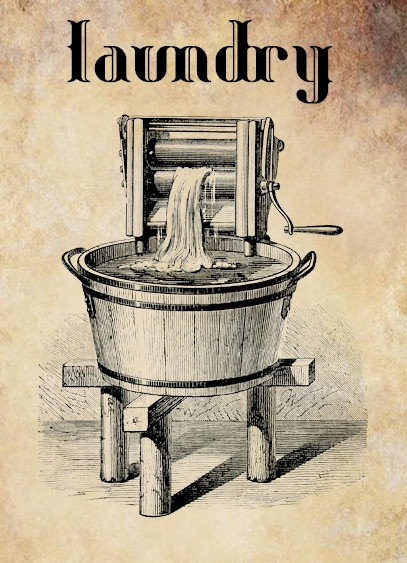
Uncle had some washing done for which they charged six dollars a dozen, they looked so bad, he gave them two dollars to keep them.
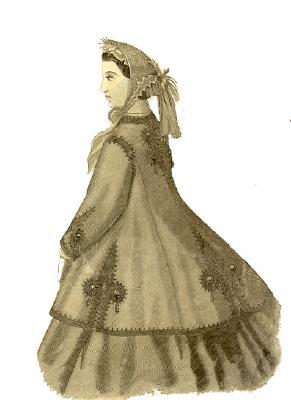
A sack trimmed with black braid.
Which sounds like a joke, but that’s what Jennie wrote.
Later she had more time to sew, and in 1853 wrote:
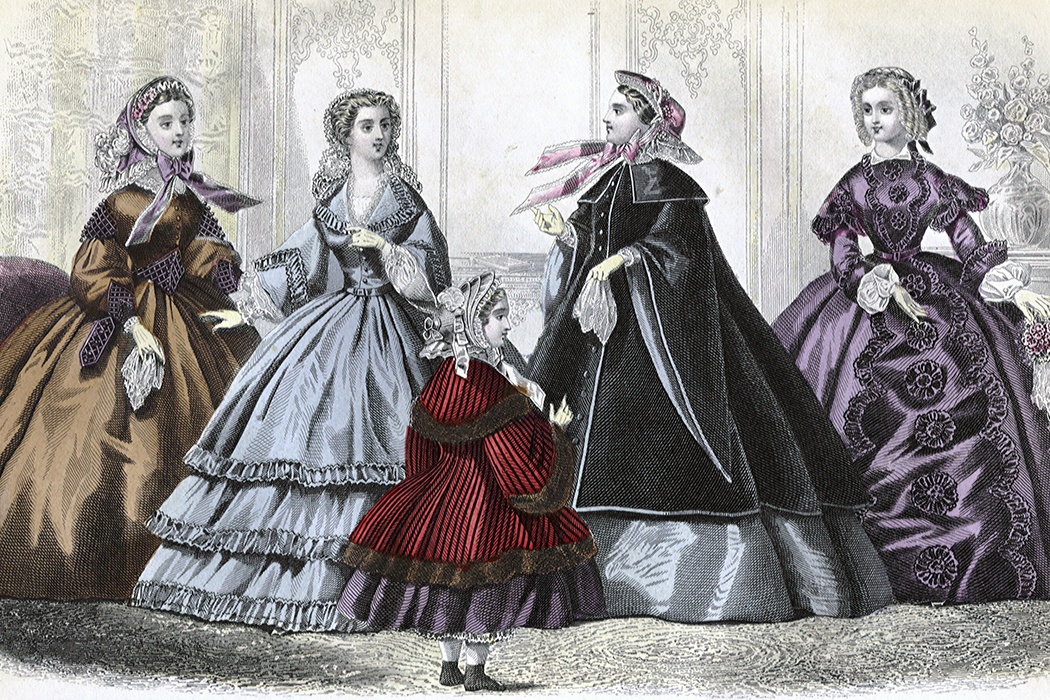
I was in at Mrs. Calkins today, all well, she and Mrs. Davis are making dresses all the while, I presume they have twenty five in a year, a silk dress lasts but two months at the best. I know not why but everything goes to destruction in a very short time here. . . . I have been making me a brown silk, and next week I am going to make a black one, today I have been making a pink thibet sack trimmed with velvet ribbon but I am sure I do not know when I will wear it.
Thibet was another fine woolen cloth used for making dresses. Originally “thibet” referred to a coarse Tibetan cloth woven from goat’s hair, but later it came to mean a kind of woolen fabric suitable for suits or dresses.
By a “sack” she either meant a free-hanging dress with a loose waist or more likely, a jacket, overcoat, or wrap that fitted loosely over a dress. It could also be spelled “sacque.”
Jennie Megquier ran a boarding house in San Francisco. It was profitable, but the work was never-ending, even though she mentions having the help of a boy and another woman. She writes:
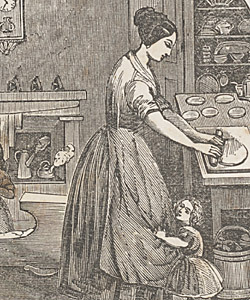
I should like to give you an account of my work if I could do it justice. . . In the morning the boy gets up and makes a fire by seven o’clock when I get up and make the coffee, then I make the biscuit, then I fry the potatoes then broil three pounds of steak, and as much liver, while the woman is sweeping, and setting the table, at eight the bell rings and they are eating until nine.
I do not sit until they are nearly all done. I try to keep the food warm and in shape as we put it on in small quantities. After breakfast I bake six loaves of bread (not very big) then four pies, or a pudding, then we have lamb, for which we have paid nine dollars a quarter, beef, and pork, baked, turnips, beets, potatoes, radishes, salad, and that everlasting soup, every day dine at two.
For tea we have hash, cold meat, bread and butter, sauce and some kind of cake and I have cooked every mouthful that has been eaten excepting one day and a half that we were on a steamboat excursion.
I make six beds every day and do the washing and ironing you must think that I am very busy and when I dance all night [she loved to go to dances] I am obliged to trot all day and if I have not the constitution of six horses I should have been dead long ago, but I am going to give up in the fall whether or no, as I am sick and tired of work.
She also sewed all her own clothes, but more of that later.
















 goldfields