Escape from Slavery

Delilah L. Beasley tells this story in her ground-breaking book The Negro Trail Blazers of California:

Robert Anthony came with his master to Sacramento, California, in 1852, from St. Louis, Missouri, by ox team across the plains. Two years to pay for his freedom he worked in the mines by day for his master. At night he worked for himself and with the money thus earned he purchased and built two quartz mills at Horncutt [Honcut], California, which is located between Yuba and Dry Cut.

While working his mills he heard of a colored girl at Hansonville [now Rackerby], in the mountains, who was being held as a slave. She was working as a sheepherder. He drove out to the place and asked her if she did not wish her freedom. She replied: “Yes.” He requested her to get into his wagon and he drove with her to Colusa. Some time afterward this slave girl became his wife. The writer interviewed the subject a few years ago at the poor farm in Marysville, and he made the following remark in regard to his marriage: “The marriage of Miss Addie Taylor to Robert Anthony was witness by Allen Pinkard and Thomas Scott.” He further stated he had an only son, who worked on one of the Hearst papers, but who had forgotten his old father. (p. 90)

The first part of this story is clear enough. Robert Anthony was an enslaved man, like Alvin Coffey, brought by his owner to California to work in the mines. Like Coffey, he was able to earn enough money to purchase his freedom. Unlike Coffey, he had no family in slavery back in Missouri to worry about. At the age of about 40 he married Ida (or Addie) Taylor.

Weekly Colusa Sun 9 September 1870

(“No cards” in this announcement meant that the couple did not wish to receive visits or calling cards from their acquaintances. Perhaps because they were not planning to stay in Colusa.)

They were married on September 9th, 1870, sometime after Robert Anthony rescued her from slavery. How did Miss Taylor come to be held in slavery in California as late as 1869 or ’70?

It’s possible. If she was brought to California before slavery was abolished, and if she was kept isolated, tending sheep in the hills, it could have taken several years before she found out that things had changed. Her owner would have had no incentive to tell her that she was free, and she wouldn’t have had any way to find out, until someone took an interest in her. Even if she did find out, it might be difficult for a poor, vulnerable, uneducated young woman to walk away from the only people and job she knew.

Other than that one marriage announcement, I can’t find Addie in any other record — no birth announcement, no census record, no death record. Robert Anthony shows up occasionally. He was a blacksmith. He moved around — records show him in Colusa, Tehama, Butte, and Yuba Counties. Some time before 1889 Addie must have died, because in that year Robert married again, to Nancy Cooper in Oroville.

Robert Anthony died at the age of 87, a widower, in 1917. He is buried in the Marysville Pioneer Cemetery.

What a shame we don’t know anything more about Addie Taylor’s story. She shows up all too briefly, and then disappears. But what we do know demonstrates the lingering effects of slavery, in the free state of California, well after the war to free the slaves.
Posted in Uncategorized | Leave a comment

A California Valentine

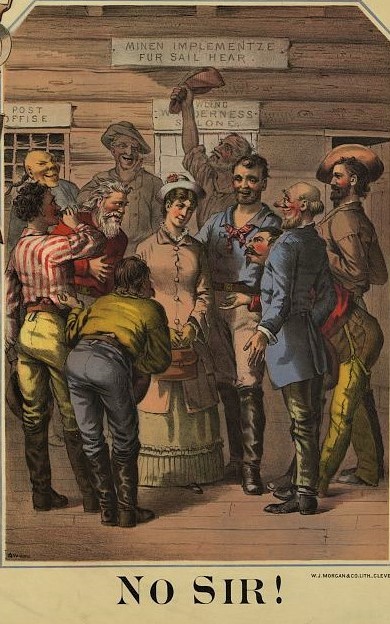
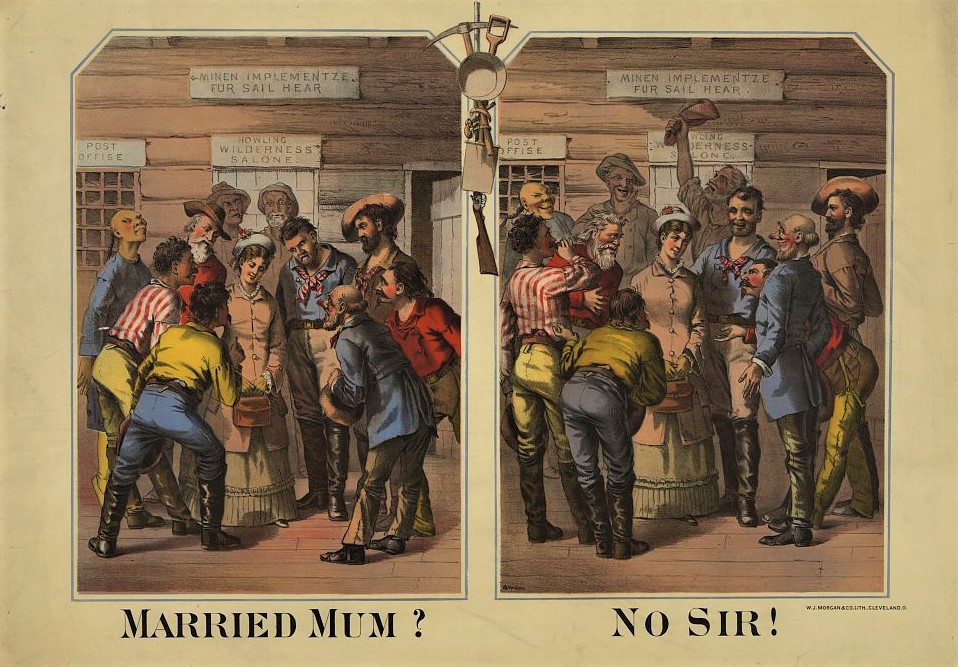
In the great bachelor party that was Gold Rush California, women were scarce. Here’s a cartoon of the era that gives an idea of how rare and sought-after a pretty young lady could be.

Do any of those men look to be a likely choice for a Valentine? Here is a closer look—

(Artist unknown, published by W.J. Morgan & Co., Cleveland, Ohio)

Posted in Uncategorized | Leave a comment

Abraham Lincoln — Plain Common Sense and Apt Illustrations

Happy Birthday to President Abraham Lincoln, born on February 12, 1809. I remember when this day was a school holiday, but now it has been absorbed into Presidents’ Day. It’s still a good day to remember this great leader.

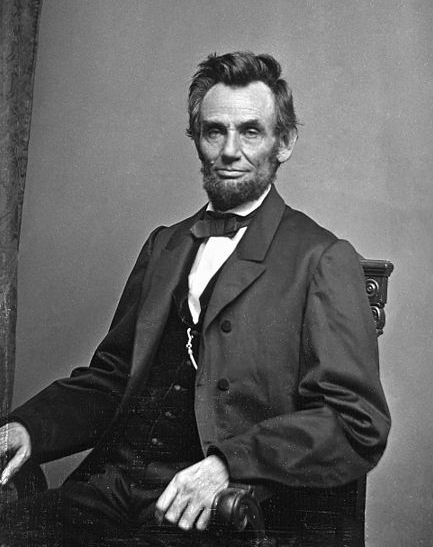
John Bidwell met President Lincoln in 1864 and was greatly impressed.

Bidwell believed whole-heartedly in the Union cause. In 1864 he was a California delegate to the Republican National Convention in Baltimore on June 7-8, where Lincoln was renominated for president. Bidwell was in the delegation sent to the White House to inform Lincoln of his renomination.

Upon his return home, he spoke to the Butte County “Lincoln and Johnson Club” on August 10th, 1864, about his experiences. He was pleased to have met with President Lincoln and gave this description, as reported in the Weekly Butte Record:

While at the Capitol, I had the pleasure of several interviews with the President. I found him to be a man possessed of that great and most precious of all natural gifts, plain common sense. Still he was not exactly the man I had expected to see. I had been told that he was continually inclined to jest, and that he did not appear to appreciate the magnitude of our national troubles. Suffice it to say that much injustice has been done Mr. Lincoln in reference to his personal traits. What are called jokes should in most instances be styled apt illustrations. He is calm, reflective, quite fluent in speech, and evidently feels the weight of the responsibility resting upon him. The more I saw of him the better I was pleased, and the more he looked like a President.

(Weekly Butte Record, 20 August 1864)

Posted in Uncategorized | Leave a comment

The Sweet Vengeance Mine

The Gold Rush brought men from all over the world to California. About 2000 of those men were black Americans — both enslaved and free.

One group of African American miners banded together and called their mine the “Sweet Vengeance Mine.” There’s some attitude for you — the attitude that they could succeed as well as any men in the diggings. The mine was located in Brown’s Valley, Yuba County, not far from Marysville.

According to Delilah L. Beasley, in The Negro Trail Blazers of California (1919) the men were Gabriel Simms, Fritz James Vosburg, Abraham Holland, Edward Duplex, James Cousins, and M. McGowan. I found out a little about some of these men.

Beasley notes that “”Fritz James Vosburg and James Eiker organized a company and manufactured ‘Cocoanut oil soap’ in San Francisco.” These men were entrepreneurs.

Abraham Holland was a free man from New York State. With the money he made from the Sweet Vengeance Mine, he moved with his son to Oakland, where he worked as a Pullman porter. It was a good-paying job that allowed him to travel the country.

Edward Duplex was a native of Connecticut, born in 1831. He was active in civic affairs and the first representative from Yuba County in 1855 to the California Colored Citizens State Convention. In 1875, he moved his family to Wheatland, where he opened a successful barber shop and hair salon. In 1888, the board of trustees of Wheatland elected him mayor of the community. It’s likely that he was the first African American mayor west of the Mississippi.

For some photos of Edward Duplex’s barber shop on Main Street in Wheatland, including the plaque placed by the Native Daughters of the Golden West, see this article from SacramentoValley.org. I haven’t found any photos of any of the owners of the Sweet Vengeance Mine.

Unidentified miner at Auburn Ravine, 1852. California History Room, California State Library

Posted in Uncategorized | 2 Comments

I Love Bookstores!

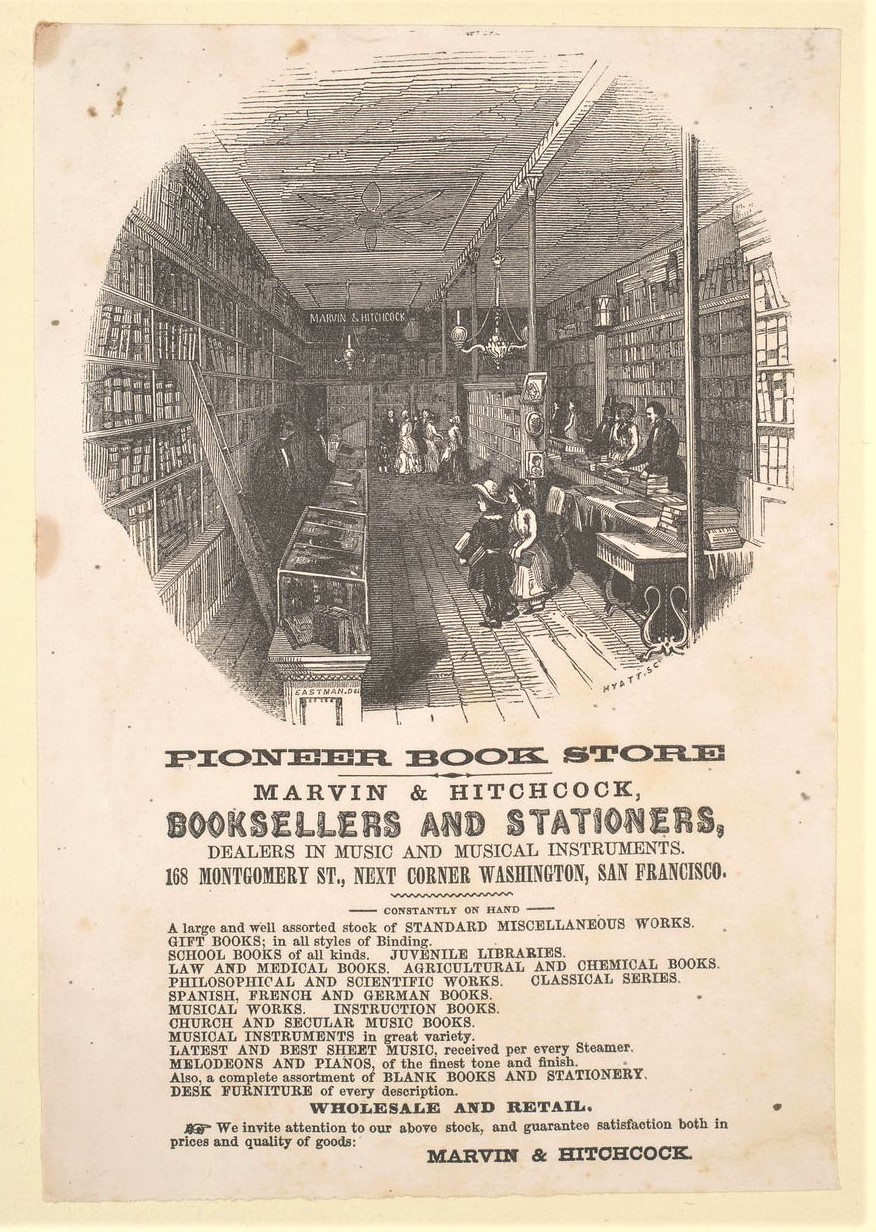
Robert Honeyman Collection, Bancroft Library
Daily Alta California 12 January 1854

And wouldn’t I love to browse in that one. Something for everyone, including musical instruments, at the Pioneer Book Store on Montgomery Street in San Francisco.

The image is from the “Robert B. Honeyman, Jr. Collection of Early Californian and Western American Pictorial Material” at the Bancroft Library, on the UC Berkeley campus. That’s an all-absorbing place to browse too.

The Pioneer Book Store must have been one of the earliest book stores in San Francisco. It was advertising in newspapers as early as 1851.

Stationery, law books, sheet music (20,000 pages!), dictionaries, school books, law books, and literature of every kind. Another ad listed some of the popular poets available–Byron, Shakespeare, Milton, Burns, Keats, Longfellow. Just what a miner needed to while away the evenings in camp.

As the Daily Alta California noted on 11 January 1853:

We have in San Francisco three or four establishments whose fitting up and furnishing indicates permanence and a prosperous state of refined and refining business. Their stocks are heavy, varied and well selected, from the best publishing houses in England and America. By every steamer that arrives with freight from the Atlantic shores, the latest English and American publications are received. Such is the book trade of San Francisco, whose bookselling houses supply all the interior and the mines with every species of reading, and carry on a home traffic that, were figures shown, would surprise some of our Eastern friends, who sigh over the moral and mental darkness which still lingers around ” benighted California.”

With bookstores like Marvin and Hitchcock’s Pioneer Book Store, California was far from “benighted.”

Posted in Uncategorized | 3 Comments

My Forthcoming Book

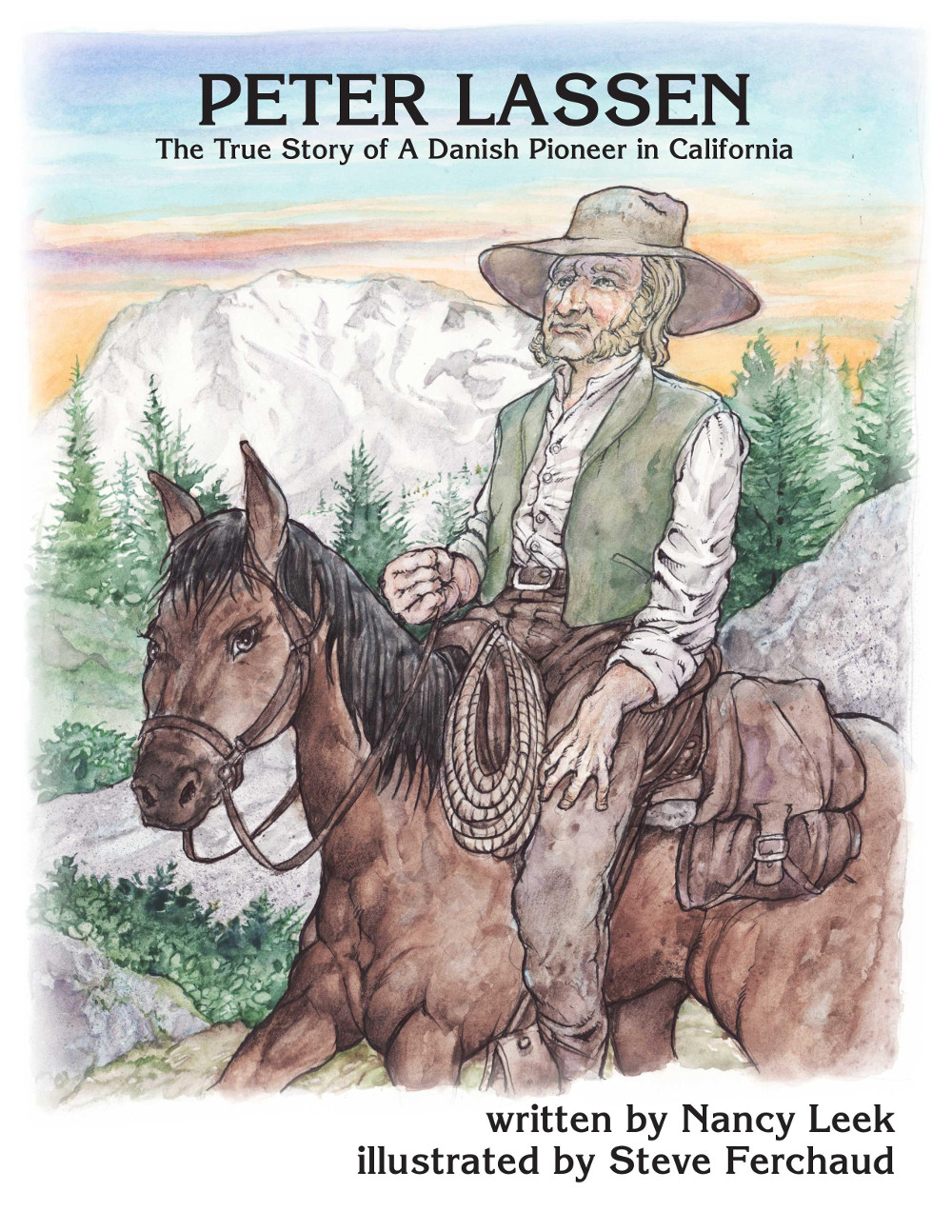
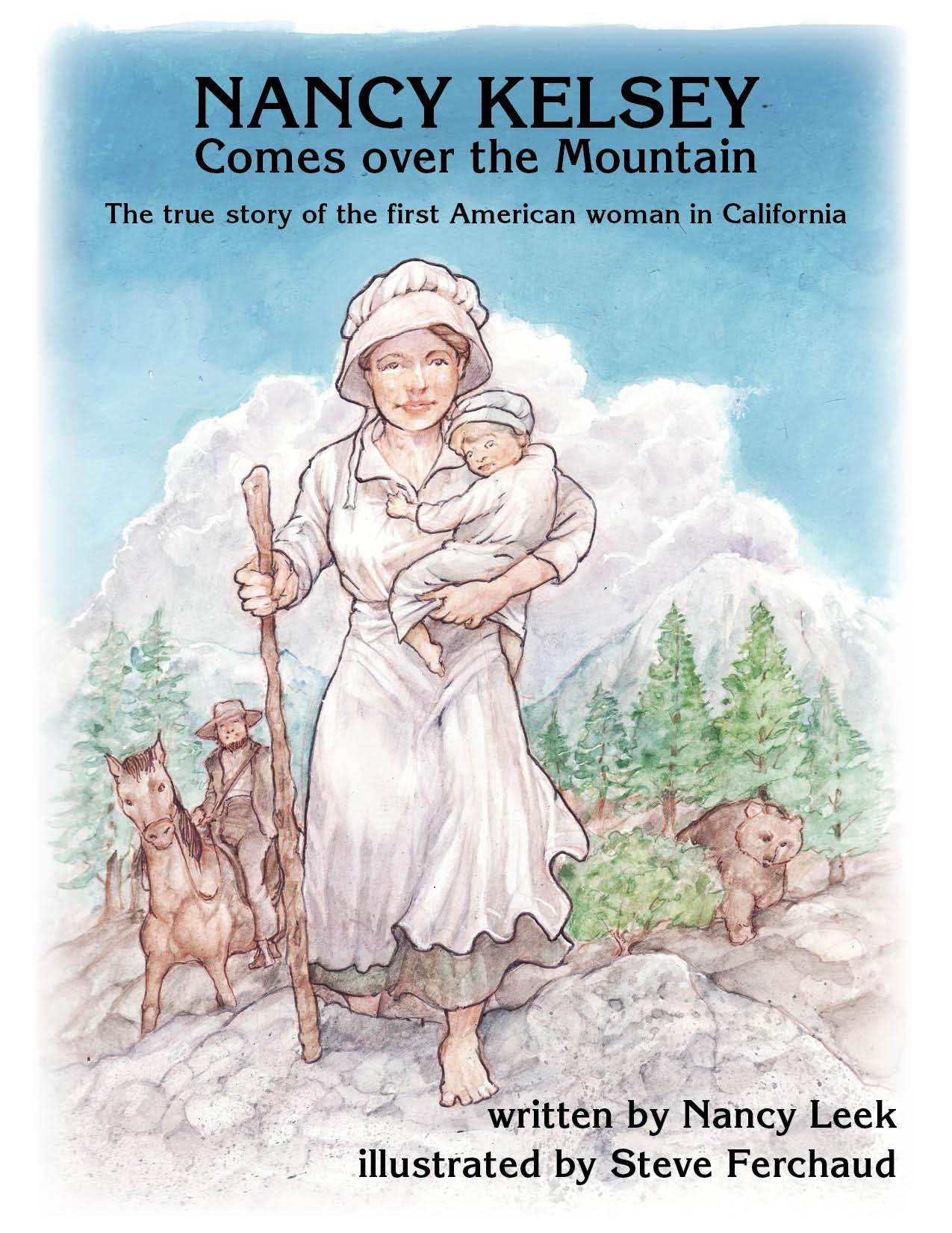
For the past year I have been working on a book about Alvin A. Coffey. This will be the fourth book in my Gold State Biographies series of picture book biographies for young readers. I am particularly excited about this one because it brings attention to African Americans in the California Gold Rush.

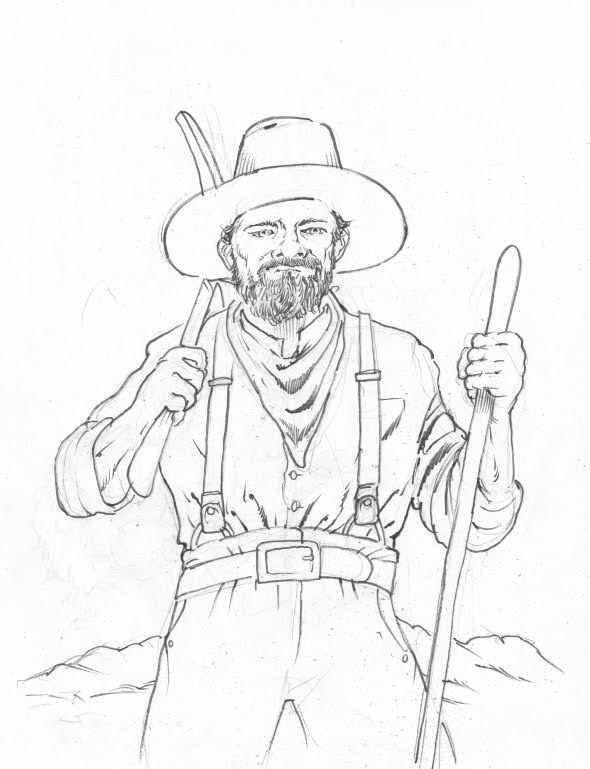
Steve’s cover sketch

I was fortunate to be able to connect with Jeannette Molson, the great-great-granddaughter of Alvin and Mahala Coffey and the author of The Torturous Road to Freedom: The Life of Alvin Aaron Coffey. She has been helpful in giving me suggestions about the text and illustrations.

My inspiration came last February when I read a post by The Society of California Pioneers about Alvin Coffey, who was a proud and loyal member of that organization. I could tell that Alvin’s story was one worth telling. Black pioneers who came to California, both enslaved and free, are not well enough known. Children and adults alike need to know that people of all colors, races, and nationalities made contributions to the Golden State.

Like my other books, the illustrations are done by Steve Ferchaud, a talented local artist. It’s always a pleasure to work with Steve.

The book has taken longer to finish than I was hoping for. It won’t be out in February, but maybe March. I’m eager to share it with you and I’ll keep posting about its progress.

Alvin bids farewell to his family
Posted in Alvin A. Coffey, Uncategorized | 3 Comments

A Visit to Chico in 1864

We get a glimpse of Chico in the 1860s from a profile of John Bidwell published in the San Jose Mercury on April 7th, 1864. It was written by John C. McPherson, whom Bancroft described as “a Scotchman of good education and considerable ability as a writer, although eccentric to the point of insanity” (!). McPherson came to California in 1848 and in later years wrote his “Reminiscences of Early Days.” He did not interview Bidwell for the profile, but he did visit Chico more than once and describes it in very complimentary, even flowery, terms.

The ranch is in the highest state of cultivation. The quantity of wheat alone produced on the undisposed portion of it belonging to the General is very great. It is all made into flour of the very best quality at his own mill, to which he can point with pride. The mill is propelled by water, which Chico amply affords throughout the year.

Two years ago or better, he laid out a town and which he named Chico. His fine private residence, with all the numerous office houses together with the mill is on the north, the town being on the southern side of the stream, which flows beautifully transparent and musically between.

The reference to “his fine private residence” is a good indication that Bidwell built a house after the adobe, but before the mansion, which was begun in 1865.

I was at Chico some 18 months ago, and not having heard that a town had been established there until 24 hours before arrival, I was certainly astounded at the appearance of the place, although fully aware of the enterprise of the man. It is well laid out, the streets running at right angles, and all was bustle and animation.

It contained some fine buildings of substantial character, and the capacious store of Bidwell & Co., even in point of architecture, would grace any city in the state. He did not forget a fine square, not the planting of trees, which perchance the coming sultry weather, may afford grateful shade to the denizens of the place, and I can well imagine in the calm evening hours, the quiet smoking of pipes, the discussions on the war, politics of the State and country and other topics receiving attention beneath those trees.

“the capacious store of Bidwell & Co.”

I should like to take a trip this Summer to the beautiful spot just to note the improvements, and probably shall.

J.C. McP., San Jose Mercury, 7 April 1864

Next time: McPherson on the Humboldt Wagon Road

Posted in Uncategorized | Leave a comment

Happy Gold Discovery Day!

A cold, clear morning in January 1848. Jim Marshall goes out early to check the tailrace of the sawmill that he is building for John Sutter on the American River. The night before he had turned the water from the river into the tailrace to deepen and widen it. Each morning he inspected it to see if it had become deep enough to adequately carry off the water from the waterwheel.

Sutter’s Mill, Coloma

On January 24 he noticed some bright and shiny flecks of metal in the water. Could it be gold? He was sure that it was, and tests proved him right. And so the stampede for riches that we call the California Gold Rush began.

Was Jim Marshall the first to find gold in California? His find touched off the Gold Rush, brought men from all over the world to the goldfields, and utterly changed everything about California. His name would go down in history. But he wasn’t the first to find gold.

There was Jennie Wimmer, wife of Marshall’s assistant and cook for the men building Sutter’s Mill. She had seen gold mined in Georgia and had told the men that she was sure that the sparkles she saw on the river bottom were gold. But they ignored her.

Before Jennie there was Margaret Hecox, who came to California with her family in 1846. Coming down the Yuba River, she and another woman went to wash clothes.

We were busy at our washing down near the stream, when something brightly gleaming in the water attracted our attention. It looked like sands of gold. I gathered my apron full of the shining specks and carried it to Mr. Hecox, saying I thought it was gold. He laughed at me and seemed to consider it a good joke. This made me angry and I threw it away. I have always been sorry that I did not keep it and wait until I could have it tested. I am sure now that it was gold. It was just like the dust they brought from the mines two years later.

In 1844 Pablo Gutierrez and John Bidwell went searching for gold in the mountains. Pablo recognized the landscape, the soil, and the rivers as being like that of the gold-mining regions of Mexico. But before they could get the equipment they needed, war intervened. Not the Mexican War, not yet, but the short-lived rebellion called the Micheltorena War. The Californios rebelled against the new governor — Manuel Micheltorena — and his henchman sent up from Mexico City. Sutter sided with the Mexican government and took Bidwell, Pablo Gutierrez, and a troop of Indian soldiers along with him. Pablo was captured while carrying messages and hanged as a spy.

Before Pablo Gutierrez, there was Jean Baptiste Ruelle, a French-Canadian fur trapper who discovered gold in the San Fernando Hills in 1841. Bidwell met him a few years later:

The first gold discovery in California so far as I know, was made in 1841 by “Jaun Baptiste Ruelle,” at a place in the mountains about 30 miles N.E. from the Mission of San Fernando. He was a Canadian trapper but had lived in New Mexico, and worked in Placer Mines. His discovery in California created no excitement whatever, owing to the fact no doubt of the very small yield. When I visited the mines at that place in 1845 there
were probably about 30 people, most if not all from New Mexico. The average earnings as I heard were very small not exceeding 25 cents per day though at times nuggets had been found from all sizes up to an ounce.

James Marshall

No doubt there were others who found a bit of gold, but never cashed in on their find. Everybody knew about Ruelle’s mine, and everybody knew the earnings were hardly worth the work. The great rush for gold would have to wait until Jim Marshall picked those few shining flecks out of the tailrace on January 24, 1848.

Posted in Uncategorized | 4 Comments

The Great Comet of 1881

Looking for something completely different in John Bidwell’s diaries, I came across this notation for June 26, 1881:

Events: Slept in tower to watch the comet

The tower of Bidwell Mansion would be a great viewing platform for watching a comet, and it was a comet well worth watching. It was considered a “Great Comet” — a majestic comet, visible to the naked eye, with a long, prominent tail. I have never been lucky enough to see such a spectacle during my lifetime.

The room at the top of the tower is small, but big enough to hold a cot or a mattress, where the General could get a little shut-eye before waking up to admire the heavenly visitor. And without the light pollution that we suffer from today, the comet would have stood out brilliantly from the dark night sky.

San Jose Mercury-News 29 June 1881

Discovered just a month previously by astronomer John Tebbutt in New South Wales, Australia, this unpredicted comet is designated C1881 K1.

It was much remarked on by the newspapers of the day. The San Jose Mercury-News, for instance, showed its readers how the comet would look at various times. It was visible both in the evening and the morning, leading some viewers to surmise that it was two comets.

Astronomical photography was in its infancy, so few photos exist of the Great Comet of 1881. But a French artist and amateur astronomer, E.L. Trouvelot, created this beautiful chromolithograph, based on his observations.

How I wish I could see that from the tower of Bidwell Mansion!

Posted in Uncategorized | 2 Comments

The First California Legislature, by Themselves

Noodling around the Internet Archive and I found this, a collection of brief autobiographies of the members of the California legislature.

The first legislature consisted of 36 Assemblymen and 16 Senators. They began their deliberations on Monday, December 17, 1849. At some point during the first session, Assemblyman John S. Bradford asked his fellow legislators to write down some particulars about themselves and 30 members complied. Here are three selections:

Born Chautauqua Co. N.Y. 5 Aug. A.D. 1819 — emigrated to Penn. – thence to Ohio — thence to Missouri — thence in 1841 to California — Single — term in Senate one year — Democrat — etc. etc. J. Bidwell

Here is Elisha O. Crosby, whom I have written about before. Not all the men indicated their party affiliation, but he did, with emphasis:

Elisha O. Crosby. Senator from Sacramento District. Native of New York State. Emigrated from New York Decr. 25, 1848. Age 34. Married. Democrat all the time.

Since all but two of the legislators were born in other states, it was important for them to indicate their home state. Michigan, Ohio, South Carolina, Virginia, Tennessee — nearly every state in the Union was represented.

Two Senators, Mariano Guadalupe Vallejo and Pablo de la Guerra, were native-born Californios. Here is Vallejo’s statement:

M. G. Vallejo born in Monterey of Alta California on the 7 of July, 1807. . . .

If anyone would like to translate the rest of his statement, I would be happy to post it. I am pretty good at reading old handwriting, but unfortunately I do not read Spanish.

Posted in Uncategorized | Leave a comment