Thursday, 9th. The part of the Company that remained yesterday went on and overtook the 2 wagons. Capt. Bartleson & Hopper returned, bringing intelligence that they had found the head of Mary’s river — distant about 5 days’ travel. Distance traveled today about 12 miles S.W. direction. The Indians stole a horse — day cool.
Emigrant Road mile post 37
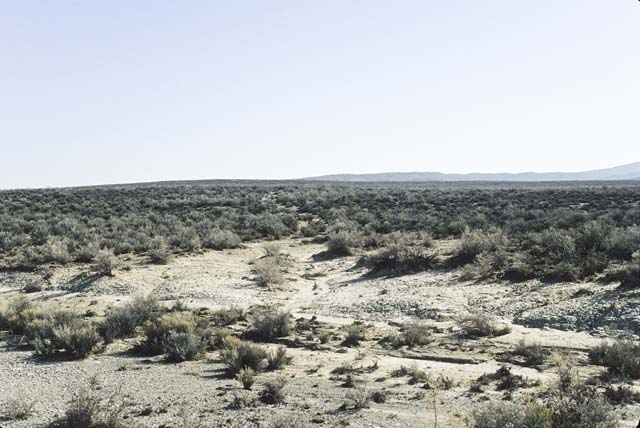
Imagine traveling across that at two miles per hour.
Wednesday, 8th. Exceedingly cold; ice in our water buckets. Part of the Company remained on account of the cold — 2 wagons with owners being contrary, went on.
James John says that six wagons remained at the camp and two went on. Before this there hasn’t been any indication of how many wagons were in the California company, but it looks like there were eight for 32 men, plus Mrs. Kelsey and her baby. The Kelseys had their own wagon, which they probably shared with brother Andrew Kelsey. John Bidwell was sharing his wagon with George Henshaw and maybe someone else.
Other members of the company had organized themselves into “messes,” each mess being four or five men. For instance, the Chiles mess consisted of Joseph Chiles, John Bartleson, Charles Hopper, Michael Nye, and Robert Rickman. They probably each had a horse or mule to ride, and they carried their food supplies, cooking gear, and blankets and other personal effects in the shared wagon.
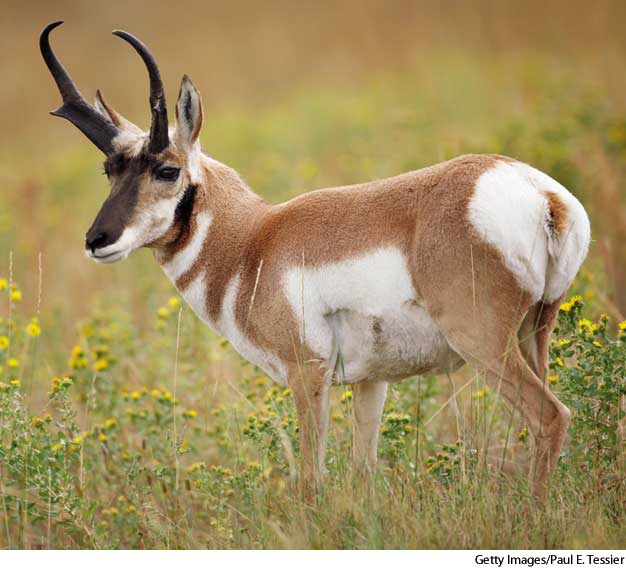
Tuesday, 7th. Traveled about 7 miles; antelope appeared to be plenty.
James John has a little more to say about this day:
On the 7th we traveled 6 miles and encamped at the foot of a mountain near a small brook. Killed one antelope today. This night was cold and windy. There were some Shoshanen [sic] Indians encamped near us. One of them agreed to pilot us to Mary’s river for 6 lbs of powder and 100 balls.
John Bidwell doesn’t mention an Indian guide, but they need one. They haven’t found Mary’s River (the Humboldt) yet and they don’t know what happened to the two scouts that went looking for it.
Well, that’s not much. But yesterday we were discussing horses, mules, and oxen. So to fill in, I will give you a story that Nicholas “Cheyenne” Dawson told about how he got his ride while still on the prairie.
Before we passed beyond the range of friendly Indians, I made a trade, which, as it brought in what proved to be a very important member of our company, I will tell of. The old mule I had traded my horse for proved very unsatisfactory. When I wanted him to go to water he wanted to go to grass; when I wanted him to go to grass, he wanted water — perhaps enough is told when I say that it was he that taught me to swear.
One day we met a gang of Indians. The leader was riding a spirited white pony, which I at once coveted. Riding up alongside the Indian, I drew my forefingers across each other and holloed “swap!” “Swap!” grunted the Indian. He jumped from his horse, I from my mule. He took off his saddle, I took off mine. He fastened his saddle upon my old mule, and I girthed mine around the white pony. Then we each sprang into our saddles and rode off. Thus came into my possession, “Monte.” This was the only trade I remember ever to have made in which I did not get the worst of the bargain.
Sunday, 5th. Grass having become scarce, we concluded to move on a little every day to meet Capt. B[artleson] & H[opper]. Traveled about 6 miles and encamped by a beautiful cedar grove.
After a week at Tenmile Spring, the company decides to move on. Their animals have pretty much used up the grass at the spring and they need to find a new location.
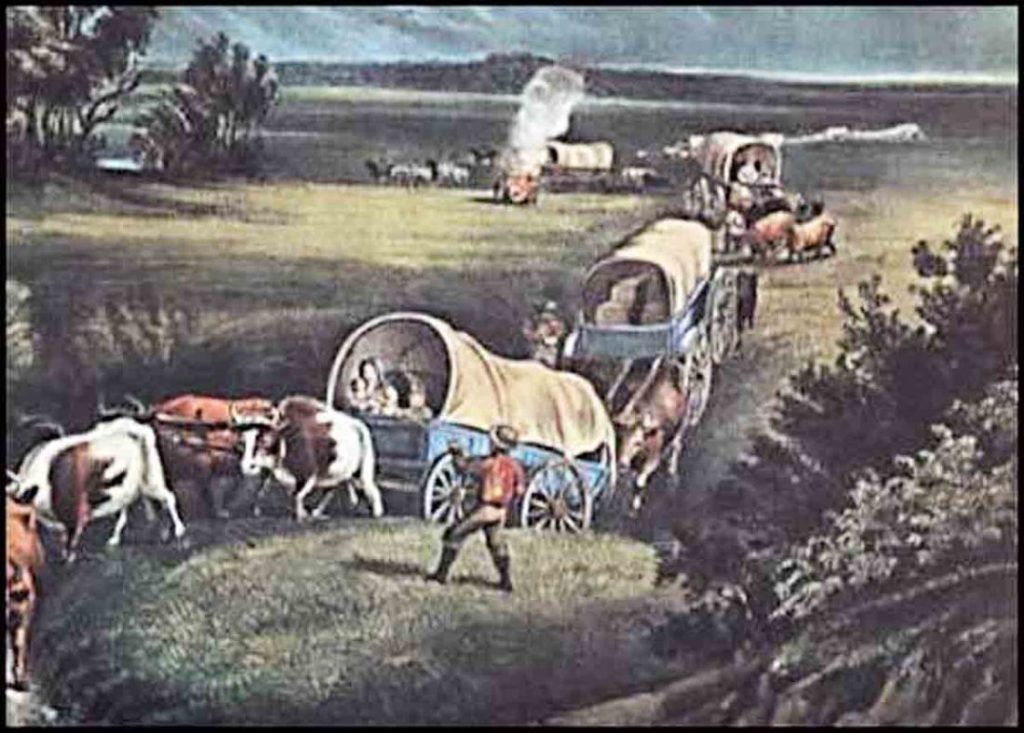
Their animals were a mixture of horses, mules, and oxen. This raises the question: Why pick one over the other? Did it make a difference which you picked to pull your wagon?
Horses were faster but they required additional grain to keep them fit for the journey, and hauling grain for the horses would take up valuable space in the wagon. They lacked the stamina of mules or oxen and were more likely to be stolen by Indians. Generally, horses were for riding, not for hauling wagons over the prairies. (Stagecoaches, with frequent stations to change horses, were a different story.)
Nancy and Ben Kelsey each had a horse to ride, in addition to their ox-drawn wagon. Nancy rode with her baby girl in her lap.
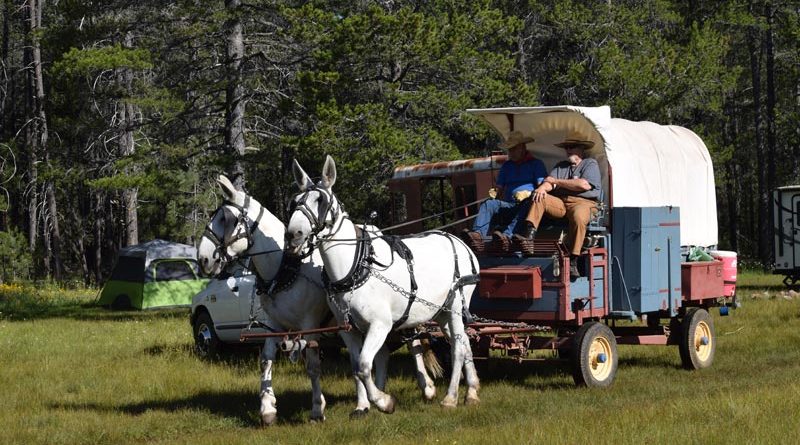
Mules had more stamina than horses. In spite of their reputation for being stubborn, they were valued because they were sure-footed and reliable. Like horses, they did best with some grain feed, but did better than horses without it. They were generally more expensive than oxen, costing $100 each. Several of the men had either mule teams or a single mule to ride.
A modern-day team of mules pulling a wagon. Photo from the Plumas News.
Oxen became the choice of a majority of emigrants. They were a slower than mules, but were dependable, less likely to run off, and less likely to be stolen. They could survive on the available vegetation without needing extra grain. One yoke of oxen was enough for a small wagon. A larger, heavier load would need two or three yoke (with each “yoke” being two animals yoked together.)
In 1841 two oxen probably cost John Bidwell $25. Or as he put it, he was able to trade George Henshaw’s “fine black horse” for “a yoke of young cattle and a one-eyed mule for Henshaw to ride.”
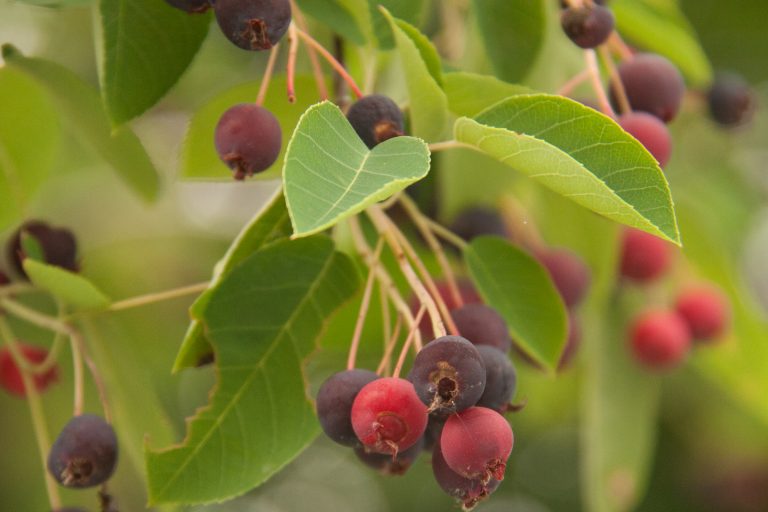
Saturday, 4th. Bought a few serviceberries of the Indians.
I have written about serviceberries before. They would have been a welcome addition, but probably didn’t satisfy the appetites of thirty men, plus a woman and child.
Bidwell would later write that “Provisions were becoming scarce, and we saw that we must avoid unnecessary delay.” Yet they stopped at Tenmile Spring for a week. “The condition of our animals compelled us to rest here,” he wrote. The oxen, mules, and horses were worn down, so it was a good idea to let them recuperate where there was water and grass. But the company could look to the west and see “this desolate region” stretching endlessly ahead of them.
On the other hand, they had to press on and find Mary’s River, so they send two men to scout ahead. Now they were starting to worry that the men had met an untimely end.
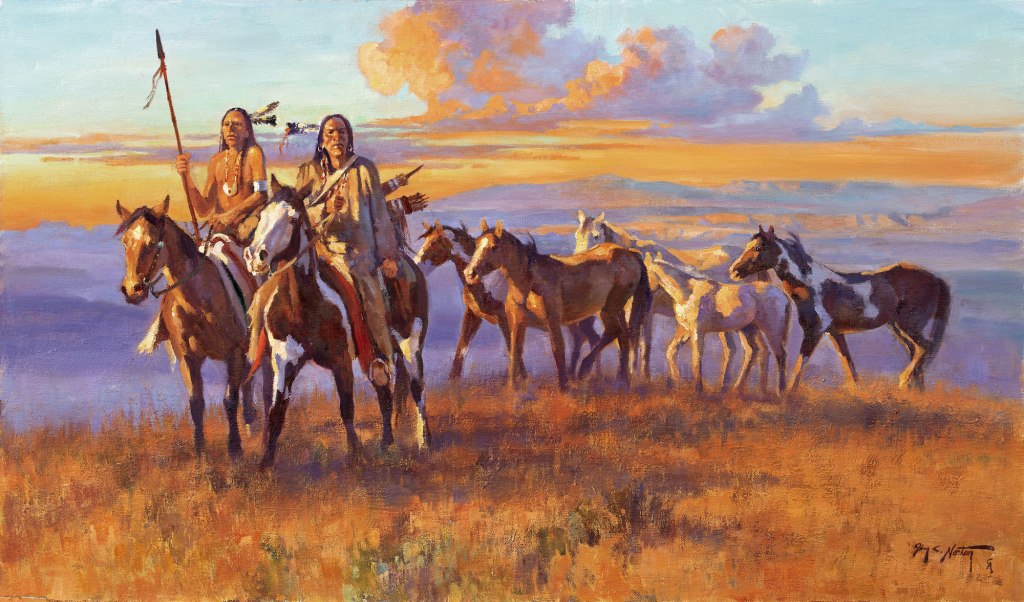
Friday, 3rd. Four or 5 Indians came to camp — bought three horses of them.
The previous Saturday they had gone looking for Indians who would sell them horses, but with no success. Now the Indians have the horses and are ready to trade. The usual payment was in powder and ball.
The local Indians—Shoshones—were happy to trade horses, game, or berries for any useful items, especially ammunition. The travelers were still wary of the Indians, because they never knew whether the natives they encountered would be friendly or not. But once they had established a friendly trading relationship, things went well.
Bidwell doesn’t say that he bought a horse, just that some members of the company bought horses. He may have bought a horse from the Indians at this time. Up until this point he did not have his own horse; he had put all his money into a yoke of oxen and he was on foot. But on September 18th his oxen stray and he goes looking for them on horseback, so either he had bought one, or someone loaned him one.
What does “idle in camp” mean? Maybe a few of the thirty men are out hunting, but they haven’t been having any success with that. The rest are perhaps discussing their situation, repairing harness or wagons, trying not to think about food, and taking naps.
And waiting. Waiting and hoping that their two scouts have found Mary’s River and are on their way back with news. The trouble is, none of them know where the river is. The trappers at Fort Hall told them to go south, and then west, but they don’t know how far in either direction. From where they are now, at Tenmile Spring, the headwaters of Mary’s River (the Humboldt River) are over 100 miles away. They must have been hoping that it was a lot closer than that, but they have no idea.
“Idle in camp”, a drawing by Father Nicholas Point
This is the first time that John Bidwell records killing one of the oxen for meat. It’s another ominous sign — it means that hunting is poor and their other food has run out.
The orange arrow on the map below shows the location of their camp. They are in Utah, and still have to get themselves all the way across Nevada. They should get moving, but they are waiting for Captain Bartleson and Charles Hopper to come back with directions on how to get to Mary’s River.
The green line on this map is the Bidwell-Bartleson Trail. It is not the trail used by any other pioneer companies. The red line to the north and to the south of the Great Salt Lake shows two different California Trail routes.
“No success hunting” is not good. They have probably used up most of the supplies that they brought with them — flour, beans, bacon. They have to live off the land, dependent on the food that they can shoot or catch. And there is not much to find.
Jimmy John didn’t bother to write in his journal during the week that they spend at Tenmile Spring, other than to note that “There is neither rain nor dew here this season of the year. We have had no rain since we left the Platte river.” That’s typical for the American West, but not what they are accustomed to.