Wednesday, 21st. Descended Big Sandy about 15 miles and again encamped upon it — no grass, had a little rain this evening but not enough to lay the dust.
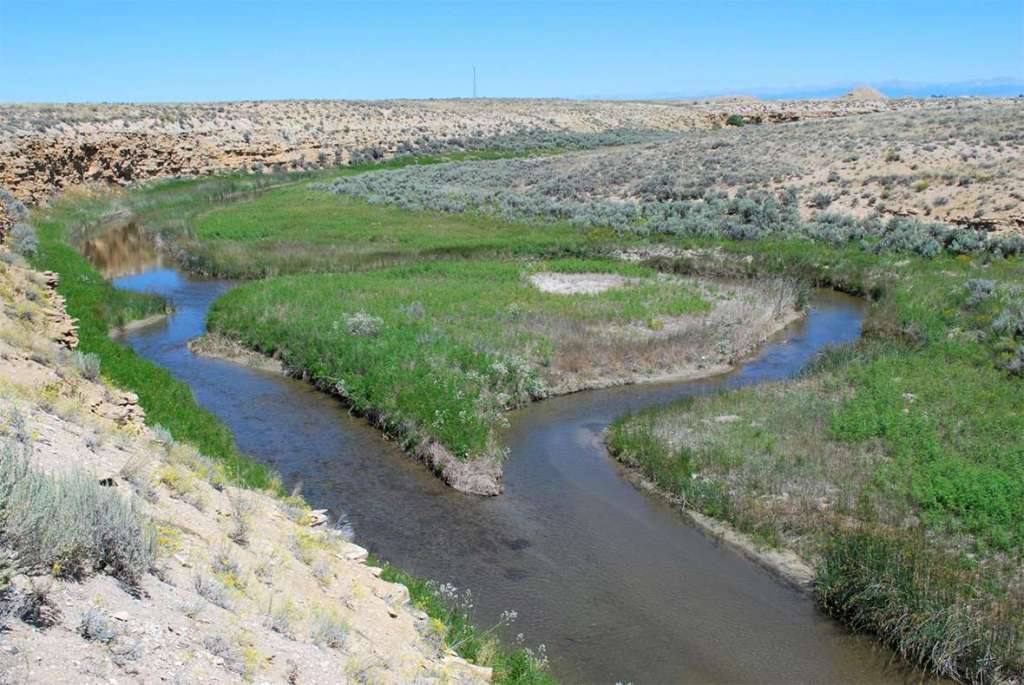
There’s a little grass in this picture, but you can see that beyond the margins of the river there is no grass at all. Grass was the fuel that powered the wagon train — the travelers would not get far without grass for the animals.
Caption from WyoHistory.org:The Big Sandy ‘is a flat-running stream over a sand bottom,’ former mountain man James Clyman wrote in 1846. Here, the river winds about a mile downstream from the Oregon Trail crossing at present Farson, Wyo. Randy Brown photo.
Tuesday, 20th. Traveled about 18 miles in a circuitous direction, first west and then south. Country was extremely dry and dusty — no game seen but a few antelope — encamped on Big Sandy, having come about 18 miles.
Or, as Jimmy John wrote: “Traveled hard all day and did not get more than eight miles in a straight line.”
I don’t know why they were wandering around like that. Maybe looking for grass, maybe for game. Grass was scarce and the oxen, mules, and horses couldn’t get far without it.
Monday, 19th. 15 miles took us on to Big Sandy, which is likewise a branch of Green river — 2 buffalo were killed.
They are roughly at the halfway point of their journey. They have been traveling three months, and it will be another three months before they enter California (although they won’t know that they are in California for another two weeks after that.) They have traveled almost 1000 miles, and they have another almost 1000 miles to go.
But that was the easy half of the journey. Rolling over the prairie had its ups and downs (so to speak) but nothing compared to what they were about to encounter. Deserts and mountains and totally unknown territory lie before them. Here on the Big Sandy they know the name given the river because they have a trail guide with them. Captain Fitzpatrick had traveled this trail many times. There will soon come a time when the rivers are nameless.
Sunday, 18th. Left Sweet Water this morning, course SW. Crossed the divide which separates the water of the Atlantic and Pacific oceans, and after a travel of 20 miles reached Little Sandy, a branch of Green river — 1 buffalo was killed.
At an elevation of 7400 feet, South Pass is a broad open saddle between the Wind River Range to the north and the Oregon Buttes to the south. It affords a relatively easy route through the Rocky Mountains, and became the chosen route for emigrants on the Oregon, California, and Mormon Trails.
Leaving the Sweetwater River, the emigrants took the gradual climb up through South Pass, as a few wagons had done before them, and many, many more would do in the following years. As George R. Stewart wrote,”Here, at the summit of the Rocky Mountains, the very backbone of the continent, the grade was easy and the pass itself was more like a broad plain, so level that you were never sure when you passed from the Atlantic to the Pacific watershed.” (The California Trail)
South Pass
The Wyoming Historical Society has an excellent article on South Pass with maps, well worth checking out if you want more information.
Little Sandy Creek flows into Big Sandy River, which leads to Green River, which is a tributary of the Colorado River, which flows into the Pacific Ocean at the Gulf of Mexico. The Bidwell-Bartleson Party has crossed the Continental Divide.
Saturday, 17th. Traveled about 5 miles — still on Sweet Water.
Not all days are exciting. Plenty of days on the trail were humdrum — travel a few miles, hunt for game, try to preserve some meat, take care of the animals, keep going. It was a hot, dirty, sweaty, hungry business, but with magnificent scenery.
Friday, 16th. Traveled about 10 miles and encamped opposite the Wind River mountains where we were in full view of many lofty peaks glittering with eternal snow and frost under the blaze of a July sun.
The trail may have been tough but the scenery was grand!
Sweetwater River and Wind River Mountains, by Albert Bierstadt?
Sorry I couldn’t find a better copy of this painting. It gives you a good idea of what the Bidwell-Bartleson Party was viewing in western Wyoming.
Thursday, 15th. As many of the company had articles of traffic which they wished to dispose of at Green river, a subscription was raised to recompense any who would go and find the trappers. John Gray started in pursuit of them, while the company marched on slowly, waiting for his return. Travelled about 6 miles today.
Gray was gone for a week and suffered a great deal in his search for the trappers. It would have killed a weaker man. Stay tuned for more about his ordeal when he returns on July 22nd.
Bidwell doesn’t mention it in his journal, but elsewhere he reveals that the “articles of traffic” were bottles or kegs of liquor. In The First Emigrant Train to California (Echoes of the Past, p. 119) Bidwell says:
Approaching Green River in the Rocky Mountains, it was found that some of the wagons, including Captain Bartleson’s, had alcohol on board, and that the owners wanted to find trappers in the Rocky Mountains to whom they might sell it. This was a surprise to many of us, as there had been no drinking on the way.
No drinking—because Bartleson was saving it up to sell to thirsty trappers. Enterprising fellow. This was a bit of entrepreneurship that hadn’t occurred to young John Bidwell. Bidwell was not a teetotaler at this time in his life, but he was not a drinking man and he hadn’t thought about bringing items to sell of any kind.
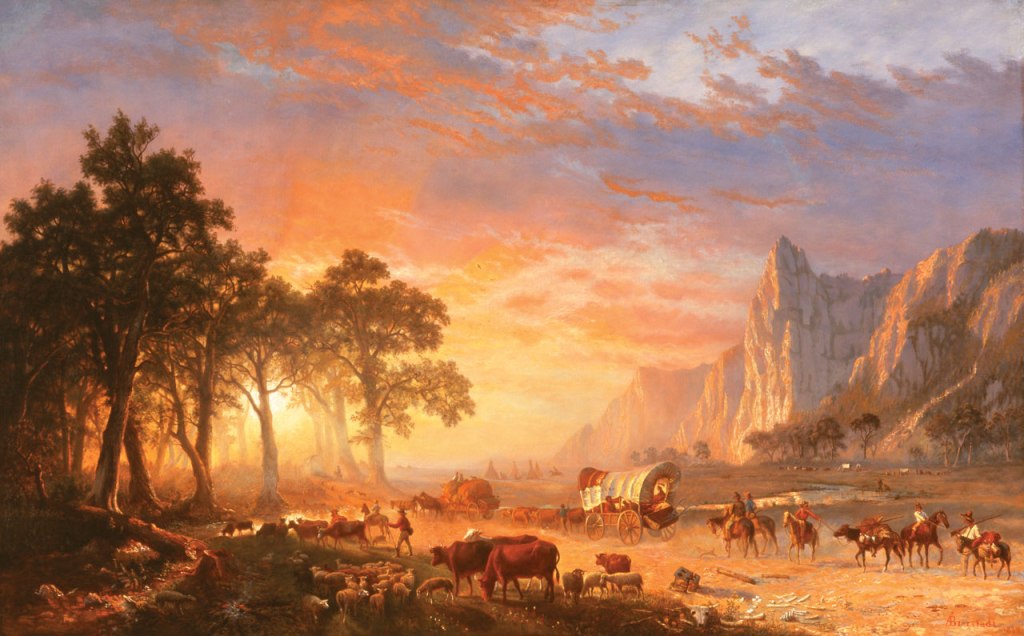
Bartleson’s wagon might have been like this, only with a cover on it.
Wednesday, 14th. Company engaged in hunting and curing meat.
Another brief entry. Jimmy John reported in his journal that they killed ten buffalo. It sounds like they are accumulating plenty of jerky, but it won’t last them very long.
They are getting close to South Pass and the Continental Divide.
Tuesday, 13th. Left our hunting encampment and met John Gray and Romaine returning from Green river. They found no person at the rendezvous on Green river, not any game ahead; it was therefore thought best to lay in more meat, while we were in the vicinity of the buffalo. We therefore came to a halt, having travelled about 15 miles.
John Grey and “Lord” Romaine had left on July 6th and gone ahead to see if there were any trappers or traders at the usual rendezvous spot on the Green River. The trip there and back had taken them a week. Nobody at the rendezvous and scarce game ahead was not good news. Jimmy John recorded that “they did not see any person, not even an Indian.”
By the way, William G. Romaine was called “Lord” Romaine by the company because of his British accent. He was a well-to-do and well-educated young Englishman who had hired Grey to guide him on a tour of the “Wild West.” His cultured upper-crust accent (think Masterpiece Theatre) naturally made these American frontiersmen think of him as an aristocrat, whether or not he was one. I expect he was a good sport about it all.
After his adventures in America, Romaine went on to a distinguished legal career at various outposts of the British Empire.
Since John Bidwell did not make a separate journal entry for this day, I will substitute an incident he related in his 1891 dictation. This happened somewhere along the journey — we don’t know just when or where.
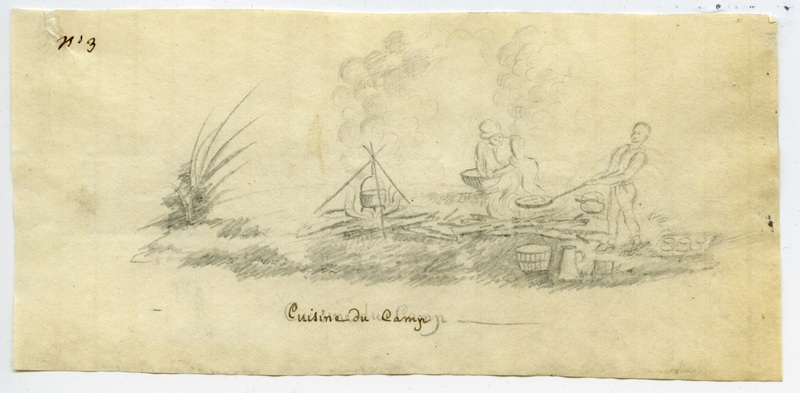
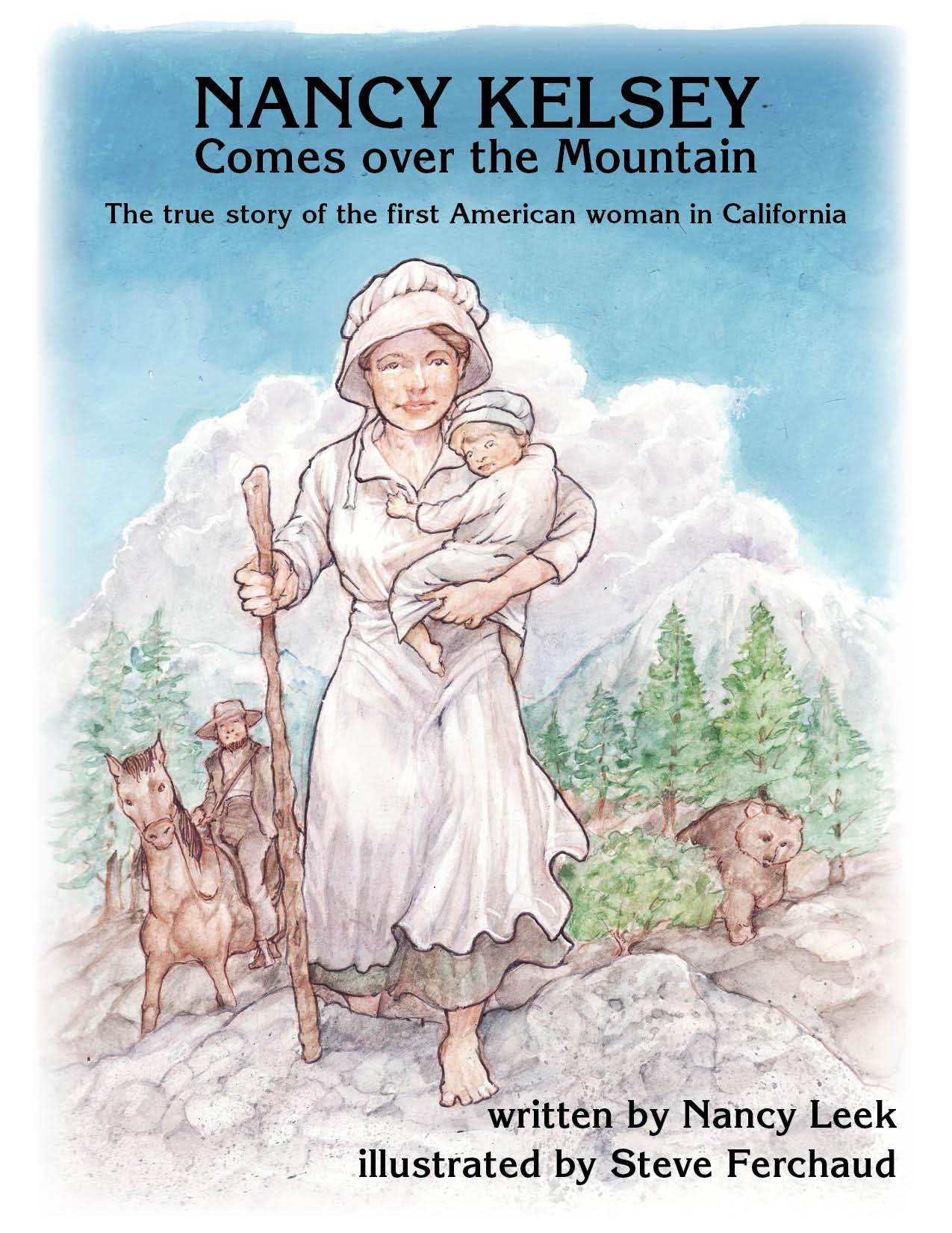
I remember Mrs. Samuel Kelsey; I pitied her. We had traveled all day and everybody was tired. It was hard work to get a fire built, but she managed to and was frying some bacon and tried to make some coffee. She had, I think, five children, the smallest of which could barely stand alone. They were all standing around, crying at the top of their voices for something to eat. Just at that time the coffee upset and it went into the bacon and put out the fire. She threw up her hands and hollered out loud enough for the whole camp to hear: “I wish to the Lord I had never got married!”