Thursday, 10th. This morning the most of the oxen were again at large, owing to the neglect of the owners to the great danger of losing them by the Indians and by them mingling with buffalo, or by their straying so far that it would be impossible to track them on account of the innumerable tracks of the buffalo. Making therefore rather a late start, we continued to ascend the river on the N. side. We traveled about 14 miles and encamped on the river.
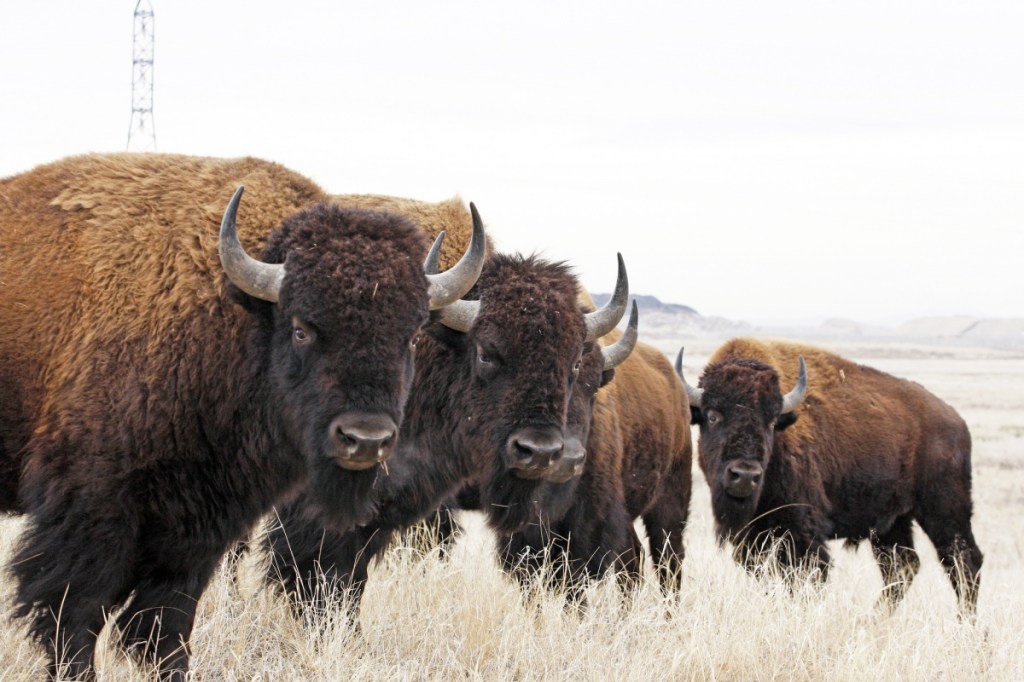
Buffalo were seen in countless thousands on the opposite side of the river; from the time we began to journey this morning till we ceased to travel at night, the whole south side of the stream was completely clouded by these huge animals, grazing in the valley and on the hills, ruminating upon the margin of the river, or crowding down to its banks for water.
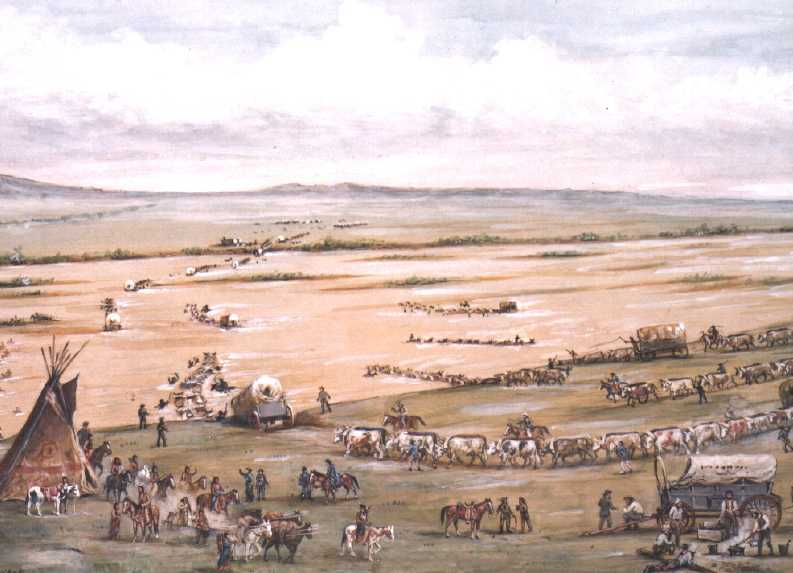
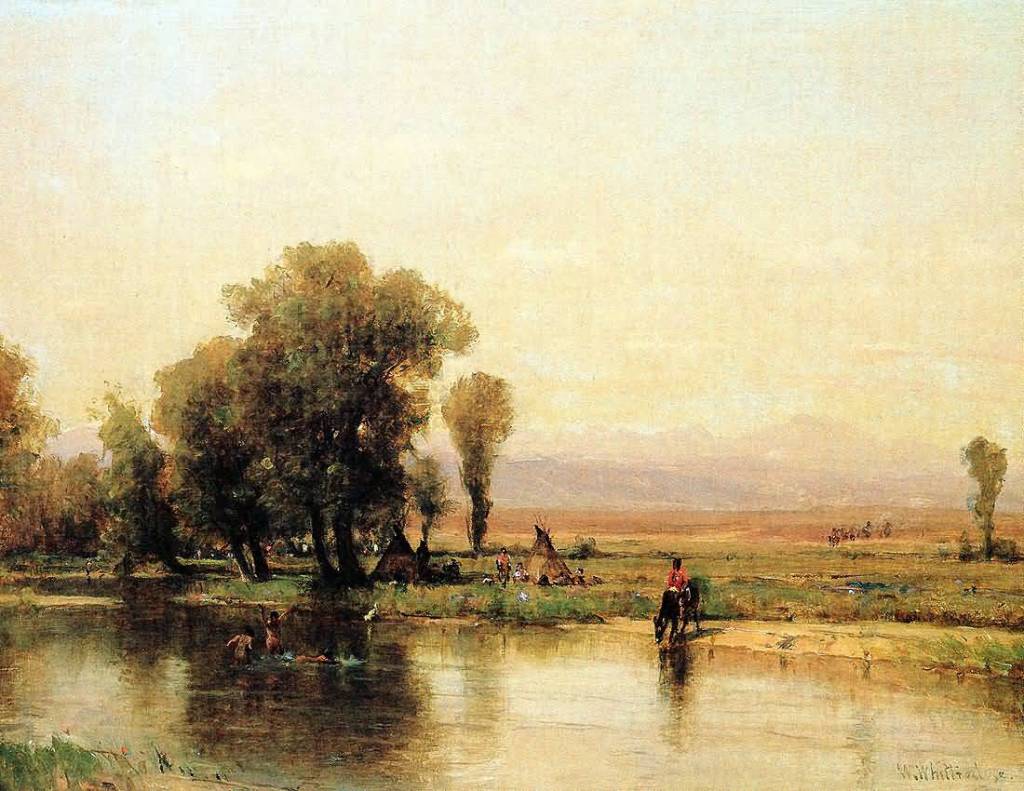
Wednesday, 9th. Spent the day in crossing the S. fork of Platte — a buffalo was killed from a herd that came within 300 yards of the camp. We crossed the river by fording, the water being sufficiently shallow — width of river here about 2/3 of a mile — its waters are muddy like those of the Missouri.
The painting below, by William Henry Jackson, gives a good idea of what fording the river was like for a much larger group of emigrants.
Tuesday, 8th. There were 8 or 10 buffalo killed today; but not one-tenth of the meat was used; the rest was left to waste upon the prairie. In the afternoon we passed the confluence of the N. & S. forks of the Platte river & encamped, having come about 18 miles; many hundreds of buffaloes were seen at this place.
The scenery of the country on the Platte is rather dull and monotonous, but there are some objects which must ever attract the attention of the observant traveler; I mean the immense quantity of buffalo bones, which are everywhere strewed with great profusion, so that the valley, throughout its whole length and breadth, is nothing but one complete slaughter yard, where the noble animals used to graze, ruminate and multiply in uncounted thousands–but they are fast diminishing. If they continue to decrease in the same ratio that they have for the past 15 or 20 years, they will ere long become totally extinct. It has been but a few years since they left the frontiers of Missouri, and are now fast retreating towards the Rocky Mountains.
The Indians are anxious to preserve them, and it is said of them that they never kill as long as they have any meat remaining, but behold with indignation the shameful and outrageous prodigality of the whites, who slaughter thousands merely for their robes and leave the meat, which is far more delicious than that of tame cattle, to waste or be eaten by wolves and vultures.
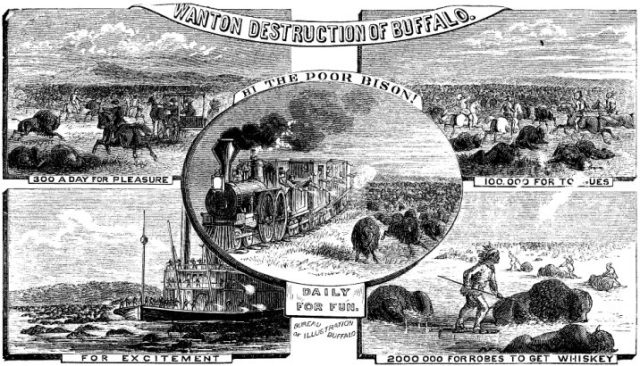
“Wanton Destruction of Buffalo”. By Artist John Reuben Chapin, c 1870
When you think that the massive slaughter of the American bison had only just begun, and that the great Gold Rush migration, and the building of the railroad, was yet to come, you realize how prescient John Bidwell was when he foretold the extermination of the buffalo. Those mighty herds would be brought to the edge of extinction before the slaughter ended and the rescue began.
Monday, 7th. Three Indians continued with us. The wind blew very hard towards evening. 3 buffaloes were killed and part of their meat brought to the camp.
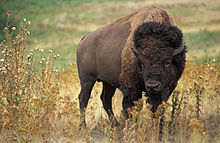
The company is starting to see the buffalo (American bison) that roamed the prairie in vast numbers. These will be an important source of meat for the company.
Sunday, 6th. This morning was extremely cool for the season; 25 more of the same Indians came up with us.
Only a few days before Bidwell wrote about the oppressive heat. Prairie weather was changeable.
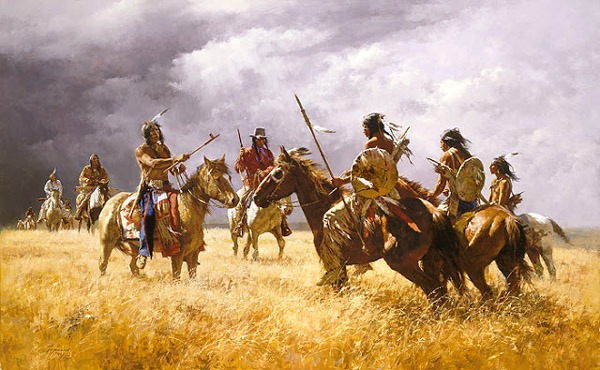
The same Cheyenne Indians who had accosted Nicholas Dawson were still following them — to assess and keep an eye on these strangers, or to see what could be picked up along the way.
Saturday, 5th. Started early to get clear of our red visitors. Descried a large herd of buffalo on the opposite side of the river–saw several boats descending the river, laden with fur, robes, etc. They belonged to the American Fur Company–one of our Company, E. Stone, returned with them.
The latter part of the day was very inclement, high winds, dark clouds rushed in wild confusion around and above us. Soon with amazement we saw a lofty waterspout, towering like a huge column to support the arch of the sky; and while we were moving with all haste, lest it should pass over us and dash our wagons to pieces, it moved off with the swiftness of the wind and was soon lost among the clouds. Rain & hail succeeded, the largest hailstones I ever saw. Several were found, an hour after the sun came out bright & warm, larger than a turkey egg.
Another one of the emigrants, James John, described this same storm:
There came up a storm in the afternoon. The wind blew very hard and on the opposite side of the river a tremendous hurricane. We saw trees flying on the air and water blown our of the river a high apparently as the clouds. After the storm abated we traveled about one mile and found hail stones as big as goose eggs.
Tornadoes, hailstorms, and wild weather are nothing new to the Great Plains, but this was the first time these Americans had seen weather quite so spectacular.
Friday, 4th. Half past six this morning saw us on the march. The valley of the [Platte] river was here about 4 miles wide. Antelope were seen in abundance. A young man (Dawson) was out hunting, when suddenly a band of Cheyenne Indians about 40 in number came upon him; they were pleased to strip him of his mule, gun, and pistol, and let him go. He had no sooner reached the camp and related the news than the whole band came in sight. We hastened to form a corral with our wagons, but it was done in haste. To show you how it affected the green ones, I will give the answer I received from a stout, young man (and he perhaps was but one of 30 in the same situation), when I asked him how many Indians there were. He answered with a trembling voice, half scared out of his wits, there are lots, gaubs, fields and swarms of them!!! I do really believe he thought there were some thousands. Lo! there were but 40, perfectly friendly, delivered up every article taken, but the pistol.
After this incident, Nicholas Dawson was known in the company as “Cheyenne,” to distinguish him from the other Dawson in the company, V. W. Dawson, called “Bear.” He left his own account of the incident. The guide, Thomas Fitzpatrick, had warned them not to stray beyond sight of the wagon train, but in following an antelope herd Dawson had wandered out of sight. Suddenly he was accosted by the band of Cheyenne, who forced him to dismount and, in his words, “seized my gun and knife, stripped me of my outer clothing, and taking my mule, left me.”
Dawson ran back to the wagon train, told his story, and Fitzpatrick and a few men on horseback set out to find the Indians. Dawson continues:
I was very angry now, and intent on vengeance, so hastily borrowing a horse and gun, I hurried after the party. I came on at full speed and was aiming at the first Indian within range, when I was stopped by some forcible language from Fitzpatrick, and perceived that Fitzpatrick and the Indians were engaged in a friendly powwow. It had proved to be a band of Cheyennes, friendly but thievish. They camped near us that night, and Fitzpatrick attempted to get back my property. He and I and the Indians sat around in a circle, and for every article to be returned, gifts of blankets, clothes, etc. had to be thrown down, a peace pipe smoked by all, and much haranguing done. Fitzpatrick’s patience gave out before all was got back, and declaring that I ought to be satisfied to have got off with my life, he refused to intercede further.
It was a good thing all around that the Bidwell-Bartleson Party had joined up with the missionaries and their guide, Fitzpatrick. Otherwise they would have all been dead on the prairie within a month from their misadventures.
“Cheyenne” Dawson in later years
I have written a lot more about “Cheyenne” Dawson and his further adventures in California. Start here, or scroll down and click on the link to his name in the sidebar.
“Cheyenne” Dawson passed away in 1903, the last but one of the Bidwell-Bartleson Party.
This morning the company was convened for the purpose of taking a vote upon the question whether the companies should continue to travel together; that some were complaining that the missionaries went too fast; but the thought of leaving Mr. Fitzpatrick who was so well acquainted with the Indians, &c. &c. met, as it ought to have done, the disapprobation of all. We now proceeded directly up the river, making this day about twelve miles.
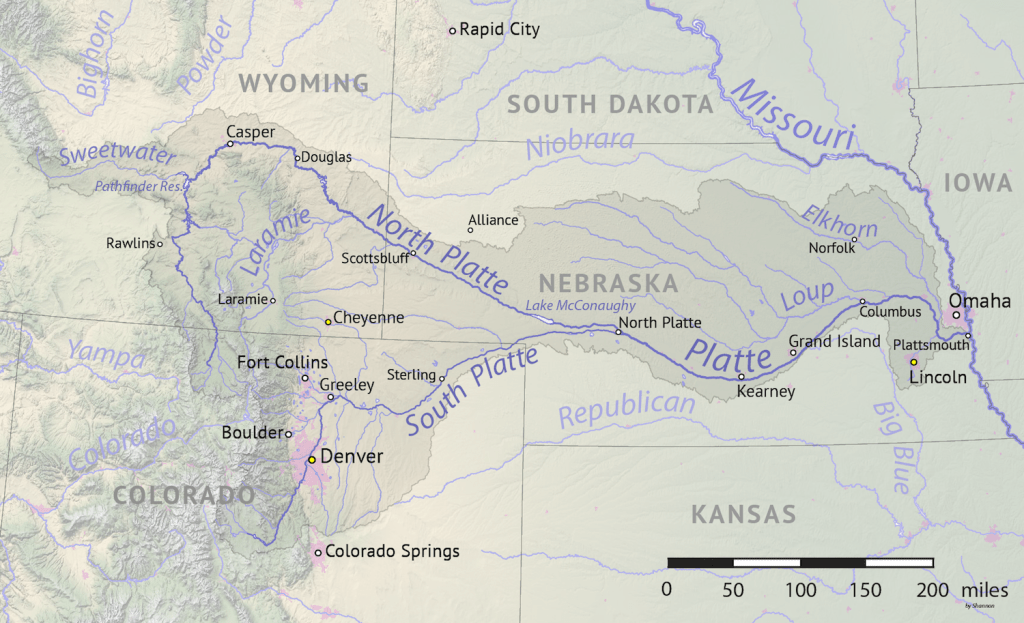
They have now reached the Platte River. They are making good time, and some think they are being pushed too hard, but it was necessary to make haste if they were going to make it to California within their window of time.
The Platte is a wide, shallow, slow-moving, silt-laden river. For the pioneers, it was the highway across the plains.
June. Tuesday, 1st. This morning we hastened to leave our miserable encampment and proceeded directly north, we reached Big Platte river about 12 o’clock. The heat was uncommonly oppressive. I here discovered the ground was in many places hoary with Glauber Salts, or at least I was unable to distinguish them by taste. This afternoon we had a soaking shower, which was succeeded by a heavy hailstorm.
Glauber Salts are sodium sulfate, an inorganic chemical which today is used in the manufacture of detergents and in paper pulping. In Bidwell’s day it was used as a laxative.
About the hailstorm, the Rev. Williams wrote:
At 2 o’clock commenced a most tremendous bad storm, with wind, which blew down most of the tents, accompanied with rain and lightning and thunder almost all night. I slept but little, the ground being all covered with water. That night dreadful oaths were heard all over the camp ground. O the wickedness of the wicked!
Poor Rev. Williams found it very trying to travel “in the midst of an ignorant and hard-hearted people.” (“Narrative of a Tour from the State of Indiana to the Oregon Territory” in The Bidwell-Bartleson Party, edited by Doyce B Nunis.)
The Impending Storm, by Albert Bierstadt
Bidwell continues his journal entry:
Wonderful! This evening a new family was created! Isaac Kelsey was married to Miss Williams, daughter of R. Williams. The marriage ceremony was performed by the Rev. Pr. Williams, so we now have five families, if we include a widow and child.
Miss Winifred Williams was the daughter of Richard Williams and his wife, whose name is not recorded. Isaac Kelsey, who was also known as Zedidiah, was one of the four Kelsey brothers on the trip. He and Samuel and their families went to Oregon, and Benjamin and Andrew went to California. Isaac was born in 1818, making him one year older than John Bidwell, and 22 or 23 years old when he married on the trail. Very little else is known about the young couple and their further adventures.