John and Annie Bidwell Video!

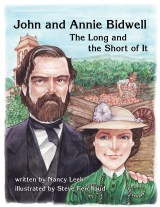
I am very pleased to announce that I now have a read-aloud version of my picture book about John and Annie Bidwell. With the fantastic help of Jean Ping, I was able to turn this book into a video experience.

My heartfelt thanks go to Jean and to Kelly Noble, who suggested we do this. I also thank the staff at Bidwell Mansion State Historic Park, who allowed us to film inside Bidwell Mansion.

I hope this project will be especially useful for 3rd and 4th grade teachers and students. Even if you can’t visit Bidwell Mansion at this time, and you can’t get the book from the library, you can still enjoy the story of Chico’s pioneer couple.

Posted in Uncategorized | Leave a comment

Missionaries and Mountaineers

DSCN2880

At first we were independent, and thought we could not afford to wait for a slow missionary party. But when we found that no one knew which way to go, we sobered down and waited for them to come up; and it was well that we did, for otherwise probably not one of us would ever have reached California, because of our inexperience.

Afterwards when we came into contact with Indians our people were so easily excited that if we had not had with us an old mountaineer the result would certainly have been disastrous. The name of the guide was Captain Fitzpatrick; he had been at the head of trapping parties in the Rocky Mountains for many years. He and the missionary party went with us as far as Soda Springs, now in Idaho Territory, whence they turned north to the Flathead nation.

jgray

John Gray, as depicted by Father Nicholas Point. S.J.

The party consisted of three Roman Catholic priests — Father De Smet, Father Pont, Father Mengarini — and ten or eleven French Canadians, and accompanying them were an old mountaineer named John Gray and a young Englishman named Romaine, and also a man named Baker. They seemed glad to have us with them, and we were certainly glad to have their company. (Echoes of the Past)

Click on those links to read the fascinating stories of John Grey and “Lord” Romaine.


Posted in Uncategorized | Leave a comment

Partnering Up

In five days after my arrival we were ready to start, but no one knew where to go, not even the captain. Finally a man came up, one of the last to arrive, and announced that a company of Catholic missionaries were on their way from St. Louis to the Flathead nation of Indians with an old Rocky Mountaineer for a guide, and that if we would wait another day they would be up with us. At first we were independent, and thought we could not afford to wait for a slow missionary party. But when we found that no one knew which way to go, we sobered down and waited for them to come up. (Echoes of the Past, p. 133)

And a good thing they did.

The wagon train was very lucky to be able to join up with the missionary party. Without the guidance of the trail guide — Thomas Fitzpatrick — hired by the missionaries, they probably would have gotten hopelessly and fatally lost.

Thomas Fitzpatrick, born in County Cavan, Ireland, had been a mountain man, fur trapper, and trail guide in the Rocky Mountains for twenty years. He spoke several Indian languages and knew the geography (like the location of South Pass).

The missionaries were led by Father Pierre Jean De Smet, a Belgian Jesuit who spent many years working among the American Indians. In 1841 he was on his way, with two other priests and three lay brothers, to minister to the Flathead Indians. He established St. Mary’s Mission on the Bitterroot River near Missoula, Montana. Bidwell described him as follows:

He was genial, of fine presence, and one of the saintliest men I have ever known, and I cannot wonder that the Indians were made to believe him divinely protected. He was a man of great kindness and great affability under all circumstances; nothing seemed to disturb his temper. (Echoes of the Past, p. 114)

More information on Father De Smet can be found in this article from Historic St. Mary’s Mission and Museum.

Posted in Bidwell-Bartleson Party, Uncategorized | Leave a comment

Where Do I Get All This?

The adventures of the Bidwell-Bartleson Party didn’t officially start until John Bidwell was elected secretary on May 18th and began keeping his journal. Up until that point we can’t put a date on the various events that led up to the journey. But Bidwell filled us in on his experiences in two other accounts.

In 1877 the historian and indefatigable collector Hubert Howe Bancroft sent  S. S. Boynton to take down Bidwell’s dictation of his journey. Boynton at the time was  principal of the Oroville schools, and later became editor of the Oroville Register. The dictation is titled “California 1841: An Immigrant’s Recollections of a Trip Across the Plains.” Anyone who wants to read it can find it in The Bidwell-Bartleson Party, edited by Doyce B. Nunis, or on microfilm at Meriam Library Special Collections (if you live here in Butte County).

510CB5PGCNL._SX325_BO1,204,203,200_Nunis’s book also contains Bidwell’s account, written in 1890 for the Century Magazine, titled “The First Emigrant Train to California.” Another place to find this is in Echoes of the Past, which collects all three articles on California life dictated by Bidwell for the Century. Bidwell’s journal account is also in Nunis’s book, as well as every other account, even if it is only a page or two, by a member of the group.

Can you see the original journal? No, unfortunately.

During his spare time in February and March of 1842 Bidwell copied out the journal and added his observations of California. Then he sent it back to Missouri to an unknown friend, and that friend had it printed up as a guidebook. How did he get the copy back to Missouri? He couldn’t just pop it in the mail. He probably sent it east with Joseph Chiles, another member of the Bidwell-Bartleson Party who returned to Missouri in 1842.

Sometime in 1843, ’44, or ’45 the journal was published as a pamphlet, by an unknown printer. This became the first overland guidebook to California. Only one copy is still in existence–-the copy carried by George McKinstry when he emigrated to California in 1846. It now resides in the Bancroft Library at UC Berkeley. It has been printed by the Bancroft in their keepsake series and that can be found (again) at Meriam Library Special Collections, or other rare book collections.

Bidwell’s own original journal — that’s long lost. Sigh.

Posted in Bidwell-Bartleson Party, Uncategorized | Leave a comment

“Fully Competent to Go Anywhere”

No one of the party knew anything about mountaineering and scarcely anyone had ever been into the Indian Territory, yet a large majority felt that we were fully competent to go anywhere no matter what they difficulties might be or how numerous and warlike the Indians.

We heard before starting, however, that a party of Catholic missionaries from St. Louis going to the Flathead Indians under the auspices of Father De Smet were soon expected and that they had for their guide the experienced Captain Fitzpatrick.

The more prudent advised waiting for the missionary party and finally with much persuasion they prevailed on the others to wait. (The 1877 Bidwell Dictation)

“More prudent” — that would describe John Bidwell.

But what confidence these men had in their abilities to take on anything. No map, no guide, no trail experience — but so what? Let’s get going! How hard can it be?

Little did they know . . . .

fitzpatrick

Thomas “Broken-Hand” Fitzpatrick in his later years.

Posted in Bidwell-Bartleson Party, Uncategorized | Leave a comment

Without a Map

Our ignorance of the route was complete. We knew that California lay west, and that was the extent of our knowledge. Some of the maps consulted, supposed of course to be correct, showed a lake in the vicinity of where Salt Lake now is; it was represented as a long lake, three or four hundred miles in extent, narrow and with two outlets, both running into the Pacific Ocean, either apparently larger than the Mississippi River.

Here is a map from 1826 that is the kind Bidwell would have seen. It shows two large rivers flowing from Lake Timpanogos unimpeded to the Pacific Ocean. One river is labeled R. Timpanogos and the other Los Mongos River. The R. S. Buenaventura flows from the smaller Salt Lake. Note the total absence of the Sierra Nevada mountains. Keep in mind that there was next to nothing known about this region up until the 1840s.

Tanner 1826 map section

1826 Map by Henry Schenck Tanner of North America (detail) Library of Congress https://www.loc.gov/resource/g4410.ct003214/

Another version:

An intelligent man with whom I boarded — Elam Brown — possessed a map that showed these rivers to be large, and he advised me to take tools along to make canoes, so that if we found the country so rough that we could not get along with our wagons we could descend one of those rivers to the Pacific. (John Bidwell, Echoes of the Past, p. 111)

Shooting_the_Rapids_1879

Nope. (Shooting the Rapids, 1871 by Frances Anne Hopkins)

Bidwell doesn’t say whether they took along any boat-building tools. They would have had basic tools along with them anyway, but they weren’t going to be building any boats or floating down to the Pacific Ocean.


Posted in Bidwell-Bartleson Party, Uncategorized | Leave a comment

This Day in History, May 12

The Oregon-California Trails Association has just put out a new “This Day in History” video honoring “John Bidwell, Sapling Grove, and the Bidwell-Bartleson Party.”

It’s a nice little video, about 5 minutes long. Worth your time.

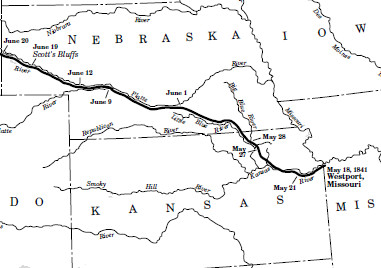
One note on the date: May 12 is about the date Bidwell and a few others arrived at Sapling Grove, which was supposed to be the rendezvous point. They moved on to the Kansas River and did not officially organize themselves, partner with the missionaries, and hit the trail until May 19th. That is the date when Bidwell’s journal begins.

Posted in Bidwell-Bartleson Party, Uncategorized | 1 Comment

The Bidwell-Bartleson Party Gathers

Every day for a week or more, wagons arrived with the same object in view. At last we took steps to see how many had arrived and found our numbers to be sixty-nine. Among those were about fifteen women and children. All were anxious for a start. (1877 Bidwell Dictation)

For the next few days, one or two wagons would come each day, and among the recruits were three families from Arkansas. Every one furnished his own supplies. The party consisted of sixty-nine, including men, women, and children. (The First Emigrant Train (Echoes of the Past))

They were mostly young single men, like John Bidwell and Michael Nye. A few older men, like George Henshaw, and middle-aged John Bartleson, who became captain of the wagon train.

BenjaminKelsey

Ben Kelsey in later years

The families were Samuel and Lucy Kelsey and their five children, Benjamin and Nancy Kelsey and their little girl Martha Ann, and Richard Williams and wife and their teenage daughter, who married Zed Kelsey on the trail.

There were actually four Kelsey brothers on the journey — the other one was Andrew.

Lucy Kelsey’s sister, a widow named Mrs. Gray and her child were also part of the group. Mrs. Gray would find a husband along the way as well.

Nancy-Kelsey

Nancy Kelsey in later years

That doesn’t add up to fifteen women and children, but I don’t think Bidwell was paying close attention to how many children there were. He just remembered a passel of little kids.


Posted in Bidwell-Bartleson Party, Uncategorized | 1 Comment

Rendezvous at Sapling Grove

To reach Sapling Grove in Kansas Territory we had to travel down the Missouri River some fifty miles [from Weston in Platte County] and then cross at the place known as Independence Landing. Then to go west about ten miles to the Missouri line and across into Indian Territory. On reaching Sapling Grove no one was there but we saw fresh wagon tracks and followed them to the Kansas River. They belonged to parties who had come, some from Arkansas, and some from different parts of Missouri to cross the plains.

sign3-1920w

Lots of signs like this in historic Kansas

The plan was to meet at Sapling Grove on May 9th. Sapling Grove was a popular camp site on the the Santa Fe and Oregon Trails, just west of the Missouri border. It had an excellent spring and plenty of wood, grass, and water, all necessities for travelers. It was only three miles or so from the Kansas River.

Back in the winter, John Bidwell had journeyed around Missouri drumming up interest in the venture to California. He had even corresponded with interested parties in other states. But when it came time to leave, he was discouraged to see that most people where he lived were dropping out. Still, he stuck to his plans and found when he got to the rendezvous that there were other pioneers ready to go after all.

Posted in Uncategorized | Leave a comment

Packing a Wagon

What kind of provisions did Bidwell pack for his expedition?

It was understood that every one should have not less than a barrel of flour with sugar and so forth to suit. I laid in one hundred pounds of flour more than the usual quantity, besides other things.

An extra barrel of flour. That’s the kind of practical, foresightful man Bidwell was.

“Other things” would be foodstuffs like cornmeal, salt, coffee, a slab of bacon, and dry beans. Maybe, if he could afford them, a few specialty items like cider vinegar, dried apples, dried ginger, cinnamon, or cayenne pepper. As for the extra flour:

This I did because we were told that when we got into the mountains we probably would get out of bread and have to live on meat alone, which I thought would kill me even if it did not others.

Picture1

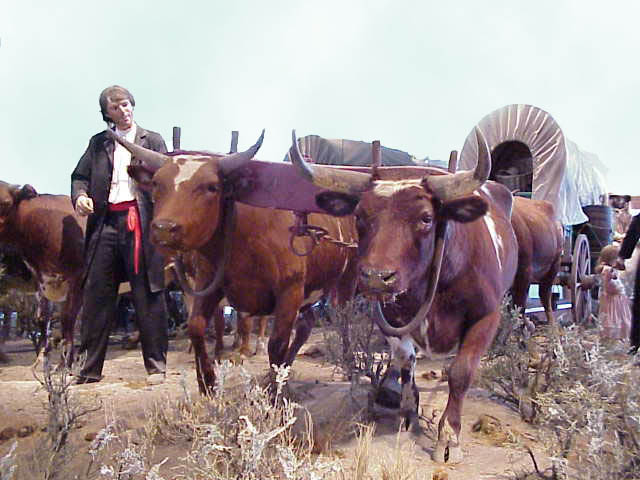
Ben and Nancy Kelsey load their wagon

Posted in Uncategorized | Leave a comment