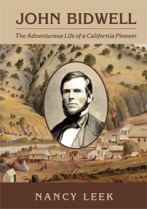
Rendezvous at Sapling Grove

To reach Sapling Grove in Kansas Territory we had to travel down the Missouri River some fifty miles [from Weston in Platte County] and then cross at the place known as Independence Landing. Then to go west about ten miles to the Missouri line and across into Indian Territory. On reaching Sapling Grove no one was there but we saw fresh wagon tracks and followed them to the Kansas River. They belonged to parties who had come, some from Arkansas, and some from different parts of Missouri to cross the plains.

sign3-1920w

Lots of signs like this in historic Kansas

The plan was to meet at Sapling Grove on May 9th. Sapling Grove was a popular camp site on the the Santa Fe and Oregon Trails, just west of the Missouri border. It had an excellent spring and plenty of wood, grass, and water, all necessities for travelers. It was only three miles or so from the Kansas River.

Back in the winter, John Bidwell had journeyed around Missouri drumming up interest in the venture to California. He had even corresponded with interested parties in other states. But when it came time to leave, he was discouraged to see that most people where he lived were dropping out. Still, he stuck to his plans and found when he got to the rendezvous that there were other pioneers ready to go after all.

Posted in Uncategorized | Leave a comment

Packing a Wagon

What kind of provisions did Bidwell pack for his expedition?

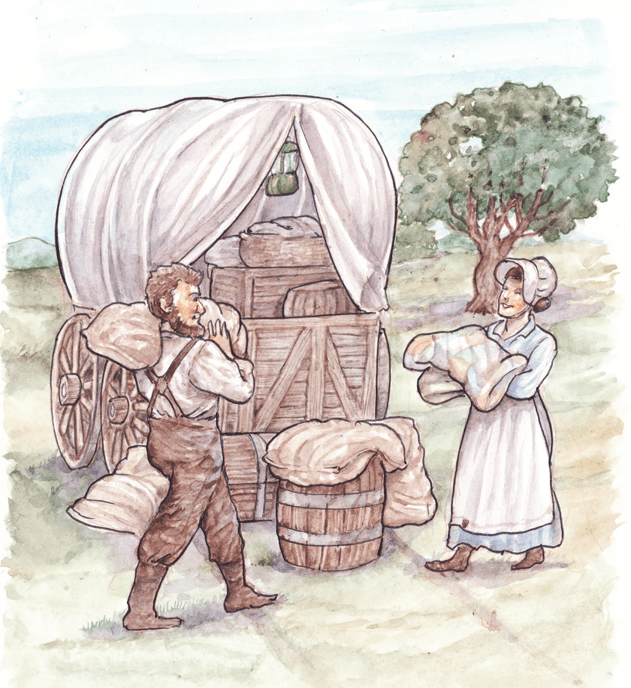
It was understood that every one should have not less than a barrel of flour with sugar and so forth to suit. I laid in one hundred pounds of flour more than the usual quantity, besides other things.

An extra barrel of flour. That’s the kind of practical, foresightful man Bidwell was.

“Other things” would be foodstuffs like cornmeal, salt, coffee, a slab of bacon, and dry beans. Maybe, if he could afford them, a few specialty items like cider vinegar, dried apples, dried ginger, cinnamon, or cayenne pepper. As for the extra flour:

This I did because we were told that when we got into the mountains we probably would get out of bread and have to live on meat alone, which I thought would kill me even if it did not others.

Picture1

Ben and Nancy Kelsey load their wagon

Posted in Uncategorized | Leave a comment

George and Mike

At almost the last moment, everyone abandoned the idea of crossing the plains. I cast about, however, and found in Platte County a man by the name of [George] Henshaw who was willing to go. He was old, quite an invalid, and nearly helpless.  He had a fine black horse that he allowed me to dispose of. I sold him for a yoke of young cattle and a one-eyed mule for Henshaw to ride.

With that much of an outfit we drove into Weston. To complete the outfit, we here purchased what we could and then joined R. H. Thomes, who was about ready to start. A merchant by the name of Nye, seeing our determination to go to California, said if we would wait a week he would let his son Mike go with us.

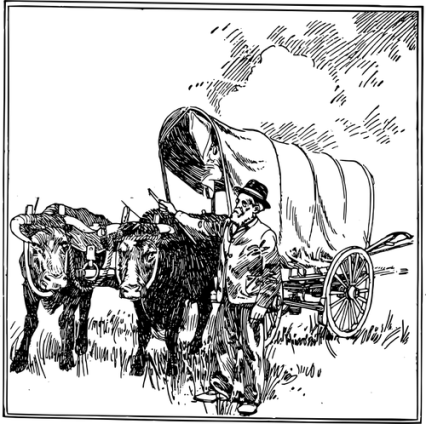
wagon-oxIt’s hard to know what would induce George Henshaw to undertake such a journey. He probably hoped to improve his health, and had no idea of the dangers and difficulties he would endure. Searching records, I have found a George Henshaw born in 1790 — a man 51 years old would have seemed quite old to young John Bidwell.

I wonder, as he rode his sorry one-eyed mule, if he ever regretted giving up that fine black horse.

Michael Nye was probably 20 years of age at the time. In California he lived for many years in Marysville, and later moved to Crook County, Oregon, where he died in 1906. He was the last surviving member of the Bidwell-Bartleson Party.

Posted in Uncategorized | 2 Comments

Choosing a Rifle

As the time approached, I became very anxious about the expedition but supposed a few would go with me. Finally I could not find a single member of the company who were sure to go. I went forward with my preparations, however, and to the extent I could, I purchased an outfit which consisted of a wagon and some provisions, a rifle, and ammunition.

Attaboy, John!

The rifle was “an old flint-lock rifle, but a good one.” He had been told by experienced hunters that cap or percussion locks were unreliable if they got wet, but if he lost his flint he could always pick up another on the plains.

How Stuff Works has a good description of how a flintlock fires, with this diagram.

It is interesting that presumably, until this time, John Bidwell did not have a gun. Or if he did, he traded it for this old but reliable flint-lock.

Posted in Uncategorized | Leave a comment

Finding a Friend

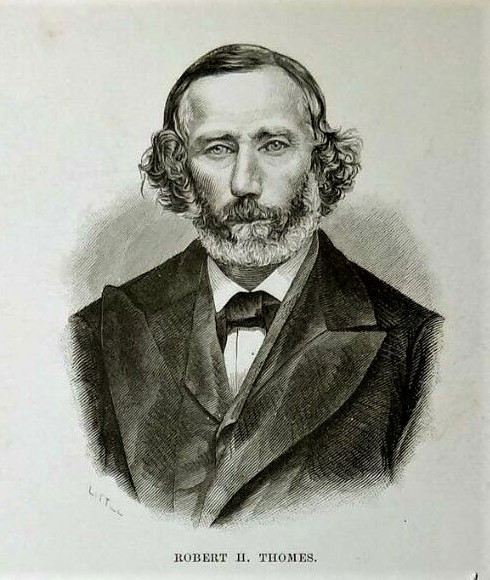
When May came, I was the only man that was ready to go of all who signed the pledge. In Weston, however, there was a man who had never signed the pledge but who had said from the beginning that he would go to California when May came. This was Robert H. Thomes, a wagon maker at that time.

thomes2Robert Thomes settled in Tehama County. He was a life-long partner with Albert Toomes, who came to California by the southern route, arriving only a short time after the Bidwell-Bartleson Party arrived. They met and worked together as house builders in Monterey, before getting their land grants at Tehama.

Of his overland journey, Robert Thomes said:

We suffered great hardships, and got into very tight pinches for food and water,but we made up for it when we got among the fat beef and venison of California.

Thomes and Bidwell would remain friends the rest of their lives. When Robert Thomes died in 1878, Bidwell was the executor of his estate.

Posted in Uncategorized | Leave a comment

The Western Emigration Society

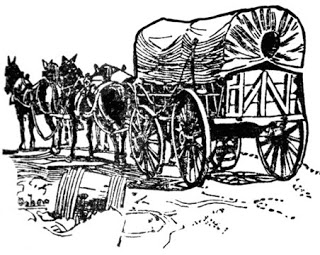
John Bidwell promoted the California plan throughout the winter of 1840-41covered-wagons-1. Missouri folks interested in going to California formed the Western Emigration Society and signed a pledge “binding each one to dispose of his property, purchase a suitable outfit, and rendezvous at Sapling Grove in Kansas Territory on the ninth day of the following May, ready for crossing the plains.”

Five hundred names were subscribed, five hundred men and women eager to pack their wagons and go. It seemed as if the entire population couldn’t wait to hit the trail. But then . . .

The merchants of Weston, (the principal town in Platte County), fearing a loss of business, united to quash the enthusiasm for migrating. Any news unfavorable to California was published in the newspapers.

Just at this time, and it overthrew our project completely, was published the letters of Farnham in the New York papers and republished in all the papers of the frontier, at the instigation of the Weston merchants and others. Our company soon fell to pieces notwithstanding our pledge was as binding as language could make it.

Thomas J. Farnham, a pioneer on the Oregon Trail in 1839, had been in California in 1840 and had been instrumental in the release from Mexican custody of a number of Americans involved in the Graham Affair. His discouraging account had a disillusioning effect on the members of the Western Emigration Society. Nearly all of them gave up and dropped out.

sc 17336
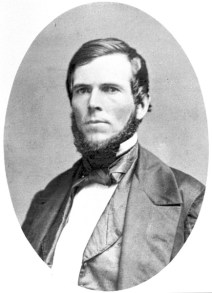
John Bidwell
photograph
ca 1840But not John Bidwell. With his first farm gone, he was determined to go to California and try again. He was twenty-one years old.

Posted in Bidwell-Bartleson Party, Uncategorized | Leave a comment

Going West

Join the Party!

60023246_10158632701167588_7819501601801895936_n

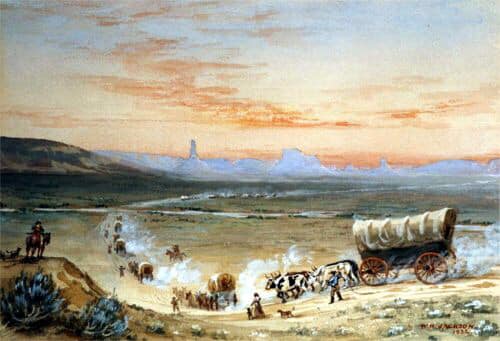
Painting by William Henry Jackson

The Bidwell-Bartleson Party, that is. It is May 1841 and John Bidwell is getting ready to set out for California.

The Party organized on May 18th and set out on the trail on May 19th. But before that there was much to prepare. John Bidwell had been planning this trip for nearly a year, ever since he lost his land claim in the Platte Purchase section of Missouri. But let’s let him tell the tale:

In the summer of 1840, the weather being excessively hot, and needing some books and other things that could only be obtained in St. Louis, I set out for the latter place expecting to be gone a week. I went on the steamer Shawnee down to St. Louis, but as the navigation was bad owing to low water and snags, I was gone four weeks instead of one. On my return I found a man had jumped my ranch.

The law at that time was such that I had to be twenty-one years of age or a man of family in order to hold the land. I was neither. The man who had my ranch was a sort of desperado, having killed at least one man, and I had no means of making him give up the land.

Robidoux-208

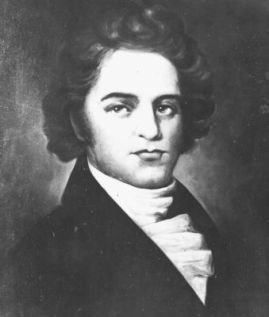
Antoine Robidoux, dressed up for his portrait

About his same time a fur trapper and Indian trader named Antoine Robidoux came along, telling stories of California. Robidoux had traveled to California on the Santa Fe Trail.

He said it was a perfect paradise, a perpetual spring. He was a calm, considerate man and his stories had all the appearance of truth. He said the hospitality of the people was unbounded. Cattle and horses ranged there in the greatest abundance.

Not only all that, but he said California had none of the chills and fever of Missouri. A paradise, indeed! A public meeting was held, committees were organized, a pledge was signed. The Platte Purchase residents were eager to head out for California.

il_794xN.864819755_nebz

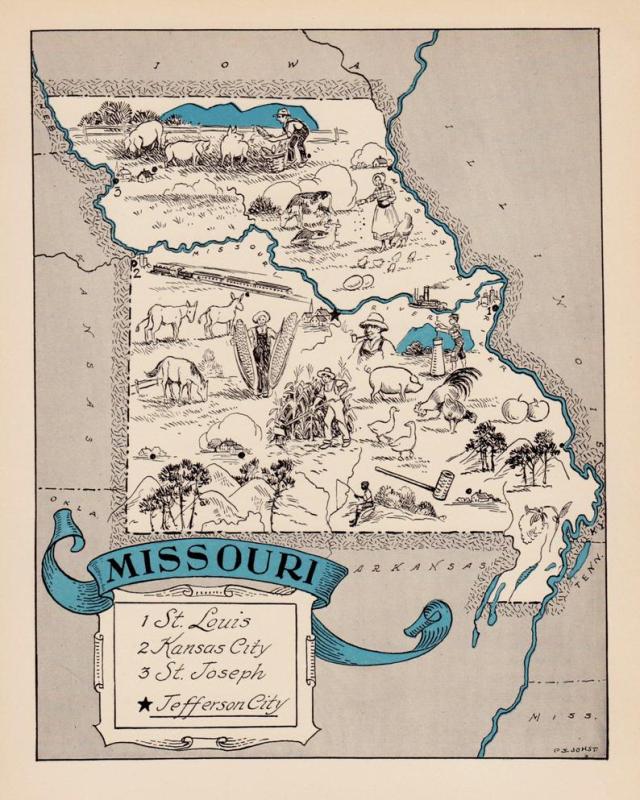
The Platte Purchase is the northwest corner that sticks out from the straight north-south state line. #3 marks St. Joseph, where John Bidwell would have boarded the steamer for St. Louis, which is on the eastern edge of the state at #1. The Bidwell-Bartleson Party set out from Sapling Grove, just west of #2 Kansas City.

(Quotations are from Bancroft’s 1877 Bidwell Dictation, as published in The Bidwell-Bartleson Party, by Doyce B. Nunis.)

Posted in Bidwell-Bartleson Party, Uncategorized | Leave a comment

Bidwell as Land Monopolist

wasp-combined

The San Francisco Wasp published this two-page cartoon on June 18, 1892. (Look below for larger versions of the pages.) On the left are farmers in Kansas, desperately fleeing tornadoes and floods. On the right, entrance to sunny, fertile California is blocked by the large landowners, building a wall to keep the small farmer out. Prominent among these land hogs is John Bidwell.

waspjanjune1892unse_0516

One name you might recognize on a building block is “Glenn Estate 42,000 [acres].” Dr. Hugh Glenn, for whom Glenn County is named, had the largest wheat farm in the state, but had died in 1883.

waspjanjune1892unse_0517

And here is California, the most desirable farmland in the world. Lined up to build the wall are Cox, Bidwell, B. Murphy, and J.S. Cone. It’s a very good likeness of John Bidwell. I don’t know Murphy or Cox. Cone had extensive holdings in Tehama County and he and Bidwell served on the Board of Trustees for the Chico Normal School.

Bidwell was often accused of being a land monopolist, especially since he was anti-monopoly when it came to rail and steam transportation, a position shared by other farmers. He ran for governor of California in 1875 on a third-party, anti-monopolist ticket, and the two major parties maligned him as a fraud and a land-grabber.

SDU18750712.1.2-1300-462-971-889-485wB

Sacramento Daily Union, 12 July 1875

It was almost the only thing that Bidwell could be accused of, since he was well-known for his honesty and upright principles. But in political fights you have to have mud of some sort that you can fling at your opponent, and his extensive land holdings were almost the only dirt around (as it were).

The Wasp deplored the greed of the large landowners, saying that they drained the wealth from the rich valley lands and lived in luxury in San Francisco, while depriving poor-but-honest workingmen from acquiring a living on the land. This doesn’t really apply to Bidwell, who ran his ranch himself, gave employment to hundreds, and had already begun selling parts of the ranch. In 1888 lots in Chico Vecino had gone on sale, and even more land would go up for sale as time went on.

Posted in Wasp | Leave a comment

Hydraulic Mining

farmerminer

The Wasp 16 January 1892

Here you have a cartoon showing a fat “Sacramento Farmer” beating down the poor “Hydraulic Miner” with his club of “Unreasonable Prejudice.” Uncle Sam is about to step in, saying, “See here, Rusticus, drop that [word lost in the gutter] and fight fair or I’ll take a hand in this little scrimmage myself.”

As much as I like the work of the cartoonist, Charles Saalburg, this is hardly an accurate depiction of the situation.

Placer mining (i.e., surface and stream mining) soon gave way to more aggressive ways of getting at the gold and the red-shirted independent miner became a figure of former times. Hydraulic mining was not something done by the lone miner or a small group of pals. It took a serious investment of capital and organization of technology to get at the gold, and the payout could be enormous.

Cherokee

Hydraulic mining at Cherokee

We have a fine example of the remains of hydraulic mining here in Butte County at Cherokee. Another even larger land scar can be seen at Malakoff Diggins State Historic Park. Vast quantities of earth and rock were blasted from the mountain face by powerful water cannons, known as monitors.

malakoff-the-diggins

The Diggins at Malakoff

The Wasp supported hydraulic mining, writing, “Shall an industry be suppressed which promises to put at least $200,000,000 of virgin gold into circulation?” I don’t know how accurate that figure is, but there was certainly a lot of gold still in those hills. and the gold would pass through the U.S. Mint at San Francisco, making it an important part of San Francisco’s economy. No wonder that the San Francisco Wasp supported hydraulic mining.

At the same time, farming was a vital and growing part of California’s economy, and “slickens” from the mines were devastating fields and orchards. The first lawsuit brought by a farmer against a mining company, Crum v. Spring Valley Mining Company, pitted Butte County farmer A.J. Crum against the mine at Cherokee. Crum sued in 1872 after he found four feet of mud smothering his peach orchard.

A.J. Crum lost his suit. The jury found, among other points, that

  • Mining was there before farming
  • The slickens came from numerous mines and Crum could not prove its source
  • The mines produced more revenue than the farms and were hence more valuable

To its credit, the Spring Valley Mining Company at Cherokee mitigated the damage it caused by building a canal to carry water from the mine away from the farms. It also offered to buy damaged farmland, and built a dam to capture debris and silt from the mining operations. It was the only company in California to do so.

In 1882 farmer Edward Woodruff filed suit against the North Bloomfield Gravel Mining Company for damage to his fields. Judge Lorenzo investigated and deliberated for two years. The Sawyer decision of 1884 brought an end to the heyday of hydraulic mining and is considered California’s first environmental law. And yet the argument was still going on in 1892, when the Wasp published this cartoon.

I took the information about hydraulic mining here from Ron Womack’s introduction to The Road to Cherokee, a book published by ANCHR in 2016.
Posted in ANCHR, hydrulic mining, Wasp | Leave a comment

The First Pioneer Child Born in California

Ann Gregson Reid wrote or dictated her memories for the Golden Jubilee edition of the San Francisco Call, January 23, 1898. She had seen fifty years of California history.  Here is her memoir:

Being the first white child born in California*, perhaps I take a deeper interest in her welfare than others. I was born at Sutter’s Fort on September 3, 1846. My father, John Gregson,** and mother [Eliza] had come to California the year before from Illinois. They arrived at Johnston’s ranch, on Bear Creek, on October 20, 1846, and a couple of weeks later they moved to Sutter’s Fort, where father obtained employment at his trade of blacksmithing. Here my birth occurred the following fall. The fort at that time consisted of about one hundred men and a few women. But the discovery of gold soon made the place a bustling headquarters for mining men. Shortly after my birth father joined a company that was organized to go to General Fremont at Monterey. They took down a drove of horses. When General Vallejo was a prisoner of the Bear Flag party at the fort father was one of the guards in charge of the distinguished personage. My birth, according to my parents’ version, created great excitement at the little fort.

jameseli

James and Eliza Gregson

When the Indians heard of me, they, too, must see the little paleface. They were amused, but skeptical; and insisted on pinching me to make me cry before they were satisfied I was alive. The squaws hung around the place and watched me for hours at a time. Captain John Sutter was so pleased over the event that he wanted my parents to call me John Sutter Gregson,*** and said he would give me a league of land if they would do so. But they hardly thought John Sutter a proper name for a girl, and I was called Ann Gregson, and his wish went unfulfilled.

In February, 1848. father went to Coloma to assist Marshall in building the millrace in which gold was discovered. He was with Marshall at the time he found the gold. The pick which was used on the ditch and which was really instrumental in the gold being discovered, was made by my father at Sutter’s Fort. It was the first pick made in California. The news of the existence of gold California soon spread, [and men left] their homes in the East and flocked to the Pacific Slope by the thousands.

My folks removed to Green Valley. Sonoma County, in 1850. There my girlhood was spent. The mining excitement was then at its height, and but little attention was paid to children. Everything was primitive, and the boys and girls of my time enjoyed none of the toys and playthings that the children of to-day get.

cradle

A gold-washing cradle

There were no cradles in California when I was a baby, and when one day the miners put me in an old miner’s cradle and rocked me. I thought mining was the greatest pleasure on earth.

We lived in a three-room log cabin, and with other children I attended a school presided over by a middle-aged Irishman. The school was of logs. Rough boards formed the benches and there were no desks. A shelf along the side of the room was where the children did their writing. The teacher was an incessant smoker and had his pipe in his mouth all day long. The gold fever even had possession of the children. I remember on one occasion three or four little companions and myself found some rich specimens of mica. We thought the glittering stuff gold and the whole afternoon we labored in carrying pieces of it home How tired we were at night and how crushed our spirits were when father returned at night and pronounced it “false” gold. The visions of cakes and candy that filled our heads during the afternoon soon filled and gave way to disappointment.

I have witnessed the transformation of California into one of the brightest States in the sisterhood.

Ann Elizabeth Gregson Reid

Posted on findagrave.com by Harry Noel

I am the mother of five native sons and seven native daughters. Two others are dead. I also have two grandchildren. So I have done my share toward populating the State. My husband, Robert M. Reid, died six years ago. John Gregson. my father, still lives at Green Valley, Sonoma County, and is upward of 70 years of age.

The present Golden Jubilee celebration is a fitting one, for the half-century that has passed since Marshall made the discovery that brought the world to California’s feet. It should be a grand reunion and serve to reunite the acquaintances and friendships formed by the sturdy pioneers in the early days. MRS. R. M. REID. (Nee Gregson)

* “The first white child born in” someplace, formerly a favorite trope, is not much heard anymore. Nancy Kelsey had actually given birth at Sutter’s Fort to a male infant in December 1841, but since he did not survive, we can let Mrs. Reid’s claim stand.

** Her father’s name was James, not John, which leads me to think this was dictated to a reporter.

*** Why not Johanna or Joanna Gregson? After all, Sutter’s first name was really Johann.

The Library of Congress has published the “Gregson Memoirs” by James and Eliza Gregson, online and they are well worth reading for a look at the emigrant experience and life in early California.

Posted in Gregson Family, Uncategorized | Leave a comment