A California Welcome — November 4, 1841

On this date 178 years ago, John Bidwell and most of the rest of the Bidwell-Bartleson Party reached the home of John Marsh near Mount Diablo.  At last they knew for sure that they were in California. The long journey was finished and a new chapter of adventure would begin.

Thursday, 4th. Left the river in good season and departing gradually from its timber came into large marshes of bulrushes. We saw large herds of elk and wild horses grazing upon the plain. . . . Finally we arrived at Marsh’s house, which is built of unburnt bricks, small and has no fireplace — wanting a floor and covered with bulrushes. In fact it was not what I expected to find; a hog was killed for the company. We had nothing else but beef; the latter was used as bread, the former as meat.

After the skimpy rations of the past few months, the men hungered for fat meat, and the pork was welcome, even if it came in a beef and pork “sandwich.” Bidwell might have been hoping for bread too. He liked bread and missed it. But he had no complaints about the food Marsh gave them that first night.

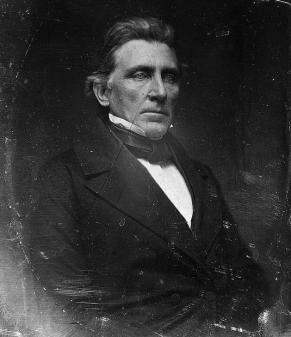
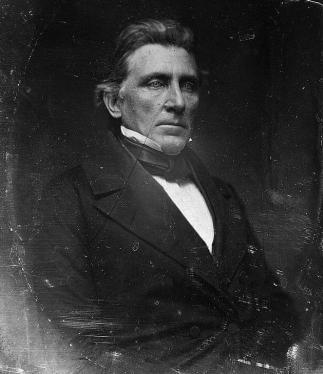
John_Marsh,_Pioneer,_1852

John Marsh in 1852

Considering the glowing reports of California that Marsh had sent back east, Bidwell was surprised at the primitive conditions he was living in. A small adobe house with a dirt floor and no fireplace -– hardly what Bidwell had envisioned. He was accustomed to cooking over a fireplace indoors, but in California the cooking was generally done outside in the courtyard.

Dr. Marsh welcomed the company. “He seemed delighted to see us and was very communicative and even enthusiastic.” He had known a few of the men in the company back in Missouri. Now, their journey ended, they sat around telling their stories and exchanging news.

The long, tough journey was over, but the adventure would continue. John Bidwell was now embarking on a new life, the life of a Californian. He would spend the next 59 years in his new home state.

Posted in Uncategorized | Leave a comment

William Gwin in California

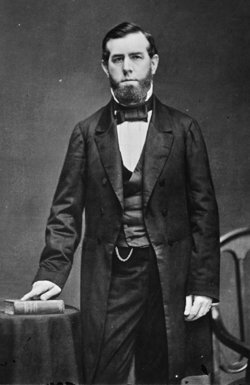
WMGwinWilliam M. Gwin got everything he wanted out of California, and he got it quickly.

Gwin arrived in San Francisco in June of 1849 and immediately jumped into the whirlwind of California politics. California at the time was under a military governor, but in effect there was no government and no legal system. Forty-niners were clamoring for representative government and American laws. Gwin had come to give them what they wanted.

Governor Bennett Riley had just called for a constitutional convention the day before Gwin arrived on the steamship.  The election of delegates would be held on the first of August. Gwin stumped around the mining camps in support of the election and then put his name on the ballot in San Francisco.

He was elected to the constitutional convention and took a ship to Monterey.  Other shipboard delegates were irritated by his “haughty and dictatorial attitude.” He was a boastful know-it-all, and that did not sit well with men who had been in California more than three months. But he did know his stuff when it came to politics and men deferred to his judgement.

mexicanwarresultsBetween the first of September and the thirteenth of October, the 48 delegates met in Colton Hall and hammered out a constitution for California. One of their jobs was to set the boundaries of California. We are so used to California as it looks today that we don’t think it might have been otherwise, but Gwin wanted California to consist of all the vast lands taken from Mexican in the Mexican War, except for Texas. Finally the men decided that the Sierra Nevada range would make a natural eastern boundary for the state.

As soon as the convention was over, Gwin went back to San Francisco to campaign for a seat in the state senate. He got that too, and when he went to the meeting of the legislature in mid-December in San Jose, the first order of business was to elect two U.S. senators. A seat in the U.S. Senate — that had been Gwin sole aim in coming to California and now it was within his grasp.

As he candidly wrote to his brother in 1864, he was “determined not to make money, but to devote all my energies to obtaining and maintaining political power.” (Not to worry — he made money too with a productive gold mine and through political jobbing.)

Dashing John C. Fremont, “The Pathfinder,” was easily the first choice for senator. Gwin had two other rivals for the other seat, but he managed to get elected on the third ballot. Then he and Fremont drew straws to see who would get the long term (six years) and who would get the short (two years). Gwin won that too. The lucky man was “in like Gwin.”

In January Fremont and Gwin left San Francisco for Washington D.C. to present their credentials to the U.S. Senate. Of course, California was not yet a state, so they couldn’t take their seats just yet. But how long could it take?


Posted in William M. Gwin | Leave a comment

William M. Gwin

WMGwin If you covet a seat in the U.S. Senate, one way to get it is to find a place that is just about to become a state, and make yourself a leader in state politics. Come with the air of a man who already knows the ins and outs of Washington, D.C., and lesser men may give way before you.

That was William Gwin’s plan.

Gwin was born in Tennessee in 1805. By the time he came to California in 1849 he was 44 years old, and mining for gold was a young man’s game. But Gwin did not plan on striking it rich in the goldfields. He knew that there are other ways to make a fortune.

Gwin studied medicine at Transylvania University, Kentucky’s oldest place of higher learning. His father had served under Andrew Jackson during the Battle of New Orleans. That gave young William a ticket into the world of politics, and he served as President Jackson’s personal secretary during his second term and paid close attention to the maneuvers of a master political manipulator.

He then went to Mississippi with a political patronage job as U.S. Marshal for southern Mississippi. He engaged in land speculation, had a plantation with slaves, and incurred debts. In 1839 he got himself elected to Congress, which not only sent him back to Washington, but offered the bonus perk of making him immune to debt collection.

Ten years later, he was in Washington, but without political office. He had lost his last bid for congress to a up-and-coming Democrat named Jefferson Davis. In March 1849 he stood watching the inaugural parade of President Zachary Taylor. Taylor was a Whig, so there would be no political patronage from this administration. Standing next to Stephen Douglas, he told the Illinois senator that he planned to go to California, make it into a state, and be back in a year to present his credentials as a senator from California.

To become a state, California would need a constitution and a code of laws. Gwin was prepared. He astutely supplied himself with constitutions from Ohio and Iowa and then booked passage on a steamship bound on the Panama route.

Destiny awaited in California.


Posted in Uncategorized, William M. Gwin | Leave a comment

The Democracy

In the early years of California statehood, the Democratic Party dominated state politics. Often referred to as “The Democracy,” it arose out of Jefferson’s Democratic-Republican Party. For a while, after the demise of the Federalists, this was the only party around, but it split in 1828 over the choice of a successor to President James Monroe.

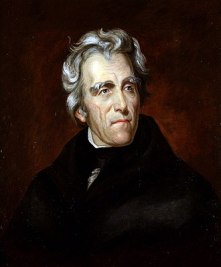
330px-Andrew_Jackson

Andrew Jackson in 1824

Andrew Jackson was the first Democratic president. Under Jackson’s leadership, the party favored a decentralized government, individual liberty, and agrarian values. It was the choice of the small farmer and the artisan, the “common man,” and so was naturally the political party for a farmer’s son like John Bidwell.

The opposition party was the Whigs, the party of Henry Clay and Daniel Webster. Named after the Whig Party in Britain, which opposed absolute monarchy, the American Whigs opposed the man they called “King Andrew.” They favored a stronger national government, a national bank, and protective tariffs. It appealed to landowners, merchants, and the urban middle class.

The men who came to California were overwhelmingly Democrats. From the beginning of state government, the Democratic Party held the reins. But the national struggle over slavery would soon lead to rifts in the party.

Enter William M. Gwin, a pro-slavery Southerner with a copy of the Iowa constitution in his pocket and a eye on the U.S. Senate.

Posted in Uncategorized | Leave a comment

A Pioneer in California Agriculture

bicentennielJohn Bidwell was not only an American pioneer on the California Trail, he was California’s foremost pioneer in agriculture. Agriculture was Bidwell’s consuming passion and lifelong pursuit. After discovering gold at Bidwell Bar, he was able to purchase Rancho del Arroyo Chico, a 22,000-acre Mexican land grant. The development of his ranch as an agricultural showcase was his enduring mission.

In the early days he concentrated on raising and improving livestock, and on growing grain. He erected the first grist-mill in what is now Butte County. He was so successful in wheat production that in 1878 at the International Exposition in Paris, he was awarded a gold medal for the finest wheat in the world.
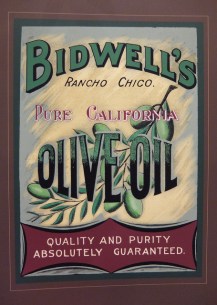
DSCF0088But Bidwell saw the Sacramento Valley’s potential for a much greater variety of crops. He planted the first peach trees, raised the first raisin grapes, and produced the first olive oil in Butte County.

He was a tireless promoter of California agriculture. He joined the California State Agricultural Society in 1858 and in 1867 was elected the first president of the Butte County Agricultural Association. In 1872 he was elected the president of the State Farmers’ Union, a precursor of the Grange.

In his annual addresses to the State Agricultural Society, he promoted diversity in California agriculture.

In a speech in 1860 he stated:

There is no reason why we cannot supply ourselves with the thousands of barrels, boxes, hogsheads, and casks, of dried apples, peaches, nuts, raisins, and other fruits which are constantly imported hither. It will not do to say that we cannot raise apples in California, for it is too well known that our mountains, the country along our extended sea coast, and numerous intermediate valleys, produce in abundance the finest apples in the world. Of peaches and pears it would be vain to attempt description that would be credited abroad—to be appreciated they must be seen. No country can equal much less surpass them. Almonds grow to perfection here, and can be raised almost as easily as peaches and in quantities to supply all the markets on the Pacific Ocean. We can also grow the Persian Walnut, and without doubt the Filbert also.

In 1891 he was still promoting fruit production in California:

I think this state is to be largely a fruit garden. I don’t think it is to be used continuously for the production of grain. Of course we will always produce cereals, but the capabilities of California are in the direction of fruit raising. It is capable of being made one grand fruit orchard. In order to do that, two things have to be done, some portions of the country must be drained and other portions irrigated, but this will have to be done systematically to be successful.

label_slipeac

Bidwell’s vision for California was far-reaching.

  • He promoted irrigation and envisioned a statewide network of canals, reservoirs, and dams to bring water to valley farms.
  • He led the farmers’ fight against hydraulic mining, an industry that filled rivers and covered fields with mud, gravel, and debris.
  • He tested new machinery and shared his findings.
  • He imported specialty plants and experimented with new crops. The U.S. Department of Agriculture sent seeds from all over the world to him, which he planted, keeping careful records of the results.
  • He donated land for an experimental forestry station.

The list of his accomplishments in agriculture go on and on.

Throughout the second half of the 19th century, Rancho Chico was known as the finest and best-managed farm in California. In 1857, less than ten years after John Bidwell acquired Rancho Chico, a reporter from the California Farmer visited it and stated:

. . . this splendid Ranch, which embraces an area of five leagues of the best land in California; is . . . owned, cultivated and enjoyed by one of the best of men—a man who labors to encourage the working classes, and build up our glorious State.
 

Posted in Uncategorized | 1 Comment

Rancho Olompali

On this date—

Rancho Olompali is the only Mexican land grant awarded to a California Native American. The story is an interesting one, and I have to thank the Sacramento History Museum for bringing this date in history to my attention.

On October 22, 1843, the Governor of Alta California, Manuel Micheltorena, deeded Rancho Olompali to Camilo Ynitia, the Hoipu (headman) of the Coast Miwok people living at Olompali. The name Olompali comes from the Coast Miwok language and means “Southern Village,” or “Southern People.”

olompali diseno

Diseño for Rancho Olompali

General Mariano Vallejo aided Camilo with his land grant application. He was given (if that is the right word) two Spanish leagues (8,877 acres) of his ancestral lands. The land grant was later confirmed by the U.S. Land Commission, which is somewhat surprising, since the commission denied as many claims as they confirmed. Given the widespread animosity to California Indians, it wouldn’t have been surprising if they had denied Camilo Ynitia’s claim. But they didn’t.

During the Bear Flag Revolt, in June 1846, this rancho was the site of the Battle of Olompali, a small conflict that is the only battle to take place as part of the Bear Flag Revolt (as distinct from the Mexican War.) 

A group of less than twenty Bear Flaggers, led by Lt. Henry Ford, were looking for William Todd and an unnamed companion who had been captured by Mexican forces and were being held at the Olompali adobe.

(Todd, by the way, was not only the nephew of Mary Todd Lincoln, but also the man who painted the Bear Flag.)

Ford’s men positioned themselves in a grove of trees and opened fire as the Mexican force charged on horseback. One Mexican soldier was killed. During the ensuing long-range battle, William Todd and his companion escaped from the house and ran to the Bears. The longer range rifles of the Americans gave them an advantage over the muskets of the Mexicans. Eventually they were able to disengage and return with Todd to San Rafael.

 Camilo Ynitia sold most of Rancho Olompali in 1852 and it later changed hands several times. In 1977, Olompali was purchased by the State of California and it is now a state park. I have never visited it, but now I want to! Olompali State Historic Park is in Marin County, 2.5 miles north of Novato on Highway 101. The remains of Camilo Ynitia’s adobe home still exist, encased within the later two homes built by the Burdell family.

olompali

Posted in Olompali, Uncategorized | Leave a comment

Politics in Nineteenth Century California

header-fall-30th-2036px_0

I am working on a presentation for an OLLI class on Local History. (OLLI is the Osher Lifelong Learning Institute — basically retirees teaching other retirees whatever they feel like teaching. It’s a fun and easy way to keep your brain ticking.) I have done other presentations in this class over the last couple of years. So far, they have let me come back.

I decided to talk about John Bidwell in California politics this time. It’s a topic that has always interested me, although I do not have a background in political science. But I thought it might be entertaining to get away from the turmoils of the present day and see what they were up to way back when.

My opening question will be “With what political party did John Bidwell affiliate?” He was active in politics, so what party did he belong to?

It all depends on which decade you are asking about. That is what makes it interesting, and what makes Bidwell a portrait of the changing trends in California politics.

1840–1860: “I was in those years an incorrigible Democrat.”

1860–mid-1870s: Republican or Union Party

1875–mid-1880s: People’s Independent Party (Anti-Monopolist)

1885-1900: Prohibition Partyprohibition button

That looks simple, if changeable, but it gets more complicated the deeper you dig. Come with me on a ride through the quickly changing landscape of 19th-century politics.


Posted in Uncategorized | Leave a comment

For California’s Gold

I enjoy reading historical fiction, but only if I know it is as authentic as possible. Nothing makes me more testy than to have an anachronism intrude into a good story.  I remember one where two young men arrived by ship in California in 1849 — and got on a train to go to the mines! They were enjoying the view from the railroad car and I was shouting, “But there was no railroad in California until at least 1855!”

levyYou will never experience that emotion reading JoAnn Levy’s For California’s Gold (University Press of Colorado, 2000). As the author of They Saw the Elephant: Women in the California Gold Rush, JoAnn knows the pioneer experience better than anyone.

For California’s Gold is the story of Sarah Daniels of Illinois, whose husband is seized by gold fever. Reluctant to leave her home and concerned for the welfare of her four children, she only goes along because of her husband’s insistence. The overland journey confirms all her worst fears: bad weather, disease, poor food, a desperate struggle to cross the 40-mile desert, and worst of all, fatal accidents.

Once in California, Sarah’s only goal is to earn enough money to get back to the safety of Illinois. But her efforts are plagued by flood and fire. Only gradually does she learn to love her new home and her new friends.

Sarah is a composite of many women who came to California and who shared their experiences in letters and diaries. JoAnn Levy seamlessly weaves together incidents and reflections from the lives of many women to make one unforgettable heroine. I recognized several incidents from the life of Luzena Stanley Wilson, but JoAnn never simply copies. Instead she transforms .

Gracefully written, with beautiful descriptions and exciting incidents, this is a novel that puts all other attempts at pioneer historical romances in the shade. I only wish it was easier to come by. I found my copy in a used bookstore. Your best bet may be inter-library loan. If you have any interest at all in the women of the westward movement, it will be worth it.


Posted in Book Reviews, Uncategorized | Leave a comment

Ghosts of Gold Mountain

godl mountainGhosts of Gold Mountain, by Gordon H. Chang, is “the epic story of the Chinese who built the transcontinental railroad,” a book that combines faultless scholarship with compelling storytelling. (published by Houghton, Mifflin, Harcourt, 2019; available at your public library.)

Chinese men came to “Gold Mountain” in the 1850s to escape war and poverty in China and seek their fortunes in the goldfields. Thousands more arrived in the 1860s to labor on the monumental task of building the Central Pacific Rail Road from its western terminus in Sacramento to its meeting point with the Union Pacific in Utah. The challenges and hardships were beyond description — no words can adequately convey the blistering summers, the bone-chilling winters, and the back-breaking labor needed to conquer the Sierra Nevada range.

No diaries or letters survive from these men, although many of them were literate. Reconstructing their story takes deep digging in newspapers, payroll sheets, archeological digs, historical photography, and the business letters and speeches of men like Crocker and Stanford. The picture that emerges is one of men who were strong, intelligent, resilient, disciplined, and well-organized.

In a tunneling contest with Cornish miners, thought to be the best miners in the world, the Chinese team outstripped the men of Cornwall, and Charles Crocker reported that compared to white men, the Chinese showed “greater reliability and steadiness” with a tremendous “aptitude and capacity for hard work.” (p. 142) Nevertheless, Chinese laborers were always paid less than their white equivalents, and their lives were considered of little account. The number who died is unknown and all but a handful of their names are lost.

For anyone interested in California history, railroad history, or the Chinese presence in the United States, this is a must-read, the compelling story of the men who built the railroad. Too long forgotten, or hidden behind stereotypes, the “Railroad Chinese” finally get their due in Chang’s ground-breaking book.

Posted in Book Reviews, Uncategorized | Leave a comment

I’m Back!

And you probably didn’t even know I was gone.

scotland-2019 (962)

Edinburgh Castle and me with a blue backpack

I’ve been silent here for the last couple of weeks because I was on vacation. My husband and I went on a trip to Scotland, to see the land of my mother’s ancestors. We spent time in Edinburgh and went on a tour of the Isle of Skye. All in all, we had a wonderful time.

DSCF8149 (2)

Here’s looking at you, kid.

And now I’ll get back to blogging. I have a couple of books to review, and a presentation to write about John Bidwell and politics, some of which I will share here.


Posted in Uncategorized | Leave a comment