The Scandalous Saga of Senator Sharon and Sarah Althea Hill — part 2

DAC18831113.1.1-1401-93-3658-3978-457w

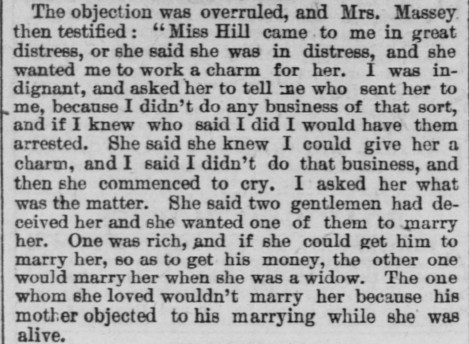
The famous marriage contract, as reproduced in the Daily Alta California, 13 November 1883

The court dismissed the suit against William Sharon for adultery on a technicality, so Sarah Althea Hill promptly sued for divorce. Of course, in order to obtain a divorce, she first had to prove that they had been married.

Her claim was that in August 1880 the senator (whom she called her “dear Sen”) had persistently wooed her. When she resisted his advances, he proposed marriage, but he wanted to keep it secret. He was campaigning for re-election to his seat in the U.S. Senate, and did not want it known that he was married, since a former mistress had just given birth to a baby, and the announcement of his marriage would cause a scandal and hurt his chances for re-election. (Allie could not explain why he wanted the marriage kept secret for two years, when the outcome of the election would be known in a few months. At any rate, his reputation as a do-nothing senator killed his chances for re-election.)

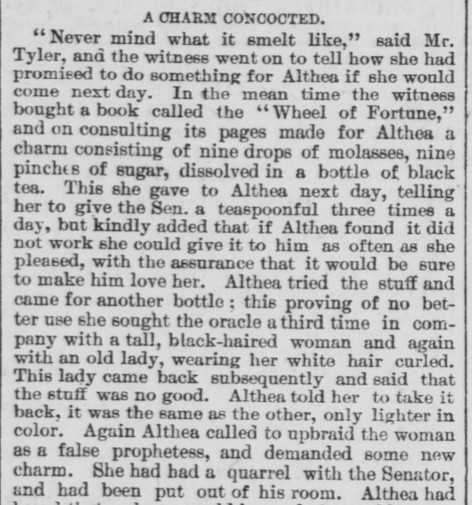
DAC18840313.1.1-2926-5349-941-1207-470w

Daily Alta California, 13 March 1884 (Flora was the senator’s daughter)

She claimed that she wrote out the marriage contract at his dictation and he signed it. The ex-senator maintained that the paper was a forgery, although the signature might possibly be genuine, signed on a piece of blank paper.

The entire case for Miss Hill, or Mrs. Sharon (depending on which side you took), depended on that scrap of paper. She was reluctant to produce it, and even more loath to allow the opposition to examine it. She must have feared that Mr. Sharon would rip it up in front of the court and that would be the end of the case. But she did at last produce it.

The newspapers enjoyed reporting every movement of the lady plaintiff, every objection of the lawyers, and every outburst from the defendant. The Daily Alta California took delight in referring to “Artless Althea,” “Althea’s Agony,” and “Althea’s Agitation.” It was better than a melodrama on the stage.

DAC18831109.1.1-818-5797-727-1139-363w

Daily Alta California, 9 November 1883

The court spent days examining the contract and taking the testimony of hand-writing experts. An elderly man who had served as Sharon’s clerk for many years testified that it certainly looked like his signature. Allie also had a handful of letters from Sharon, addressing her as “Dear Wife,” and these too were put through the wringer of examination.

No one seems to have asked about witnesses to the contract. There were none. It was simply her word against his. How it could be a valid marriage when there were no witnesses, no ceremony, and no filing of a marriage certificate, was never addressed. This conundrum would have its effect on subsequent California marriage law.

Next: Life in the Palace, and the Bosom Buddy Behind the Bureau

Posted in Sharon v. Hill, Uncategorized | 2 Comments

“Sarah and the Senator”

SarahHill (1)I learned of the story of William Sharon and Sarah Althea Hill from the book you see here.

I sort and price books for the Chico Friends of the Library’s weekly book sale, and that’s how I came across the book. Just another donation, coming in the back door. Judging by the cover (which is what you are never supposed to do), I thought the book was a novel.

It’s a typical ’60’s book cover: beautiful scheming woman in the foreground and a prosperous-looking gentleman eyeing her in the background. He looks more like Gov. Leland Stanford than ex-Senator William Sharon, who sported a mustache, but not a beard, but what the hey, you get the idea.

I set it on the shelf, thinking I might get around to it someday.

When I looked inside the book, I found that it is a detailed account of an actual historical event. The court cases generated by the scandal titillated the newspaper reading public of the day as it dragged on for years. Parts of it went all the way to the United States Supreme Court.

The author of the book, Robert H. Kroninger (1923-2015), was himself an attorney and a judge of the California Superior Court. His account is meticulous and comprehensive, but at the same time it is lively and full of interest. As the author says in his introduction, the case involved:

Civil suits ranging from divorce to libel to slander; criminal prosecutions ranging from adultery, perjury, and larceny, to murder; and all this accompanied by myriad contempt of court citations and habeas corpus writs. These actions plagued both state and federal courts for nearly ten years. They were responsible for at least 14 appeals to California’s highest court and nine proceedings in the federal circuit court. Three times they found their way to the Supreme Court of the United States.

I do not plan to recount the entire tangled tale, but I will give you an outline of the story and pick out some of the more sensational aspects (of which there were many).

Posted in Sharon v. Hill, Uncategorized | Leave a comment

The Scandalous Saga of Senator Sharon and Sarah Althea Hill

william sharonIn San Francisco, on Saturday, September 8, 1883, William Sharon, a former U.S. Senator from Nevada and a wealthy man about town, was arrested on a charge of adultery. This was a surprise to all who knew the senator since his wife had died in 1875. As far as anyone knew, the senator was a widower.
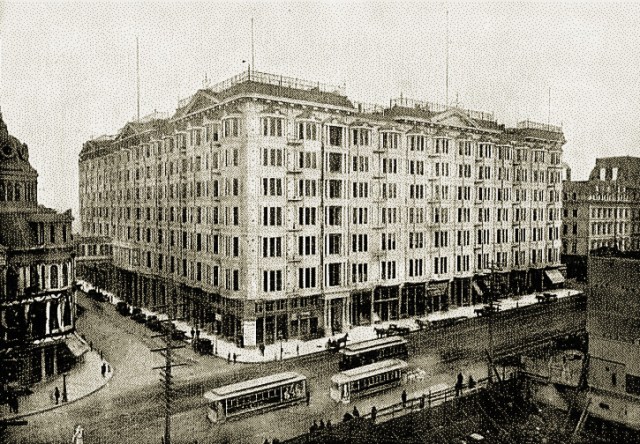
Not that he deprived himself of female companionship. He was known to have had a series of young ladies whom he paid to be available. He could afford the luxury, since he was a multi-millionaire, having made his pile in the Comstock Lode. Mining operations and real estate deals had made him the “King of the Comstock” and he used some of his profits to build two luxury hotels, the Palace and the Grand Hotel on Market Street.

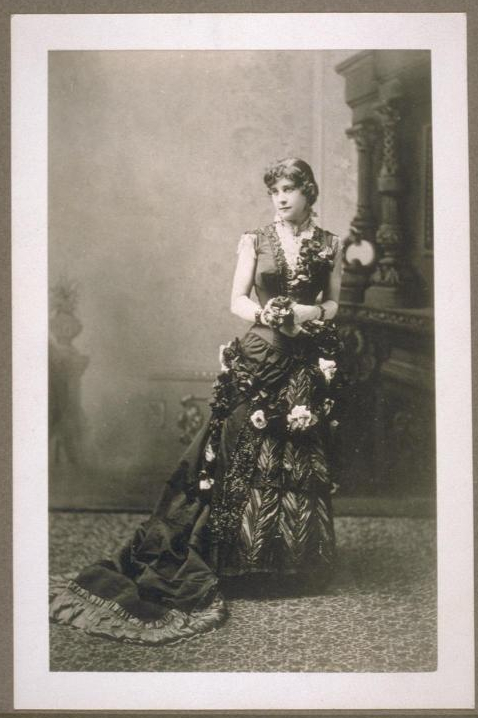
The charge of adultery was brought by William Neilson, a shady character recently arrived from Australia, who was acting on behalf of Sarah Althea Hill, a young woman who claimed to be Mrs. William Sharon. Although books on the case usually refer to her as Sarah, she actually used her middle name and was called “Allie.”

tf2779n8vr-fid3.jpg

Miss Allie Hill was well known in San Francisco society, but not as Mrs. William Sharon. She had come to California from Missouri in 1871 with her brother, Morgan Hill (for whom the town of Morgan Hill is named.) She had inherited enough money from her deceased parents to support herself and claimed that she initially met Senator Sharon when she went to him for investment advice.

Allie claimed that she had a marriage contract signed by Sharon and herself, which he insisted on keeping secret when he was running for reelection to his senate seat. He claimed that the contract was a forgery. Interviewed about the scandal, he told a newspaper reporter, “I am a pretty old fish and that kind of bait won’t catch me.”

mu18830913.2.5-a2-343w.jpg

The Grass Valley Daily Union, 13 September 1883 (note the error of “Miss Aggie Hill” rather than Allie)

He was indeed an old fish at sixty-five, and Miss Gertie Dietz, his current paramour, was only the latest in a long sequence. Allie Hill was thirty years old when she started her relationship with Sharon. He said he had paid her $500 a month to be his mistress, and as a young lady who liked to dress in the height of fashion, she easily managed to spend that amount. If he had stopped paying her monthly stipend, then she had good reason to seek another way to get money out of him.

The charge of adultery was dismissed by the court. Allie then sued for divorce, alimony and division of community property. This meant she would have to prove that they were married.

Next: The Source of the Story

The story of Senator Sharon and Sarah Althea Hill is told in full in Sarah and the Senator, by Robert H. Kroninger, published by Howell-North Books in 1964. This is the source of my information. Another more recent book about Sarah (or Allie) is Enchantress, Sorceress, Madwoman by Robin C. Johnson (California Venture Books, 2014), but I have not seen that book.

Posted in Uncategorized | Leave a comment

Spring, Glorious Spring!

California-Spring-large

California Spring, by Albert Bierstadt

Albert Bierstadt’s painting is a romanticized view of spring in California, and yet I think we know that sometimes, if you go to the right spot at the right time, and close one eye, so that the electrical wires and the paved roads and the vehicles disappear, California in spring looks just like this. Blue sky, heaps of white clouds, cattle grazing on green hills spread with wildflowers, and a river winding through the landscape — that’s the beauty of California in the spring.

Bret Harte saw the other side of spring in California — the spring that brings rain, overflowing rivers, and mud, until it all turns to dry grass, dust, and searing heat — and then he wrote this ode to Spring.

California Madrigal

(On the Approach of Spring)

Oh, come, my beloved, from thy winter abode,
From thy home on the Yuba, thy ranch overflowed;
For the waters have fallen, the winter has fled,
And the river once more has returned to its bed.

Oh, mark how the spring in its beauty is near!
How the fences and tules once more reappear!
How soft lies the mud on the banks of yon slough
By the hole in the levee the waters broke through!

All nature, dear Chloris, is blooming to greet
The glance of your eye and the tread of your feet;
For the trails are all open, the roads are all free,
And the highwayman’s whistle is heard on the lea.

Again swings the lash on the high mountain trail,
And the pipe of the packer is scenting the gale;
The oath and the jest ringing high o’er the plain,
Where the smut is not always confined to the grain.

Once more glares the sunlight on awning and roof,
Once more the red clay’s pulverized by the hoof,
Once more the dust powders the ‘outsides’ with red,
Once more at the station the whiskey is spread.

Then fly with me, love, ere the summer’s begun,
And the mercury mounts to one hundred and one;
Ere the grass now so green shall be withered and sear,
In the spring that obtains but one month in the year.


The month of March brings the beginning of spring in California. Trees are in bloom and soon the rains will cease. Enjoy it while it lasts, “ere the summer’s begun,” because as Harte says, in California, spring “obtains but one month in the year,” and before you know it, it will be 101º in the shade.

Posted in Uncategorized | 1 Comment

The Great Flood of 1862

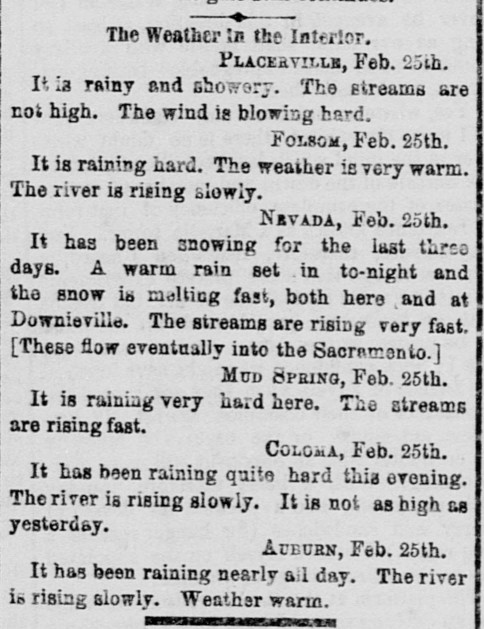
I had planned to drive to Sacramento today, but this wet and windy weather is keeping me home. My journey can wait until next week. As it happens, the weather on February 25th, 1862, was nearly identical.

flood SDU18620226.1.2-2034-4269-969-1259-484w

Sacramento Daily Union, 25 Feb. 1862

But at least we don’t have boats in the streets.

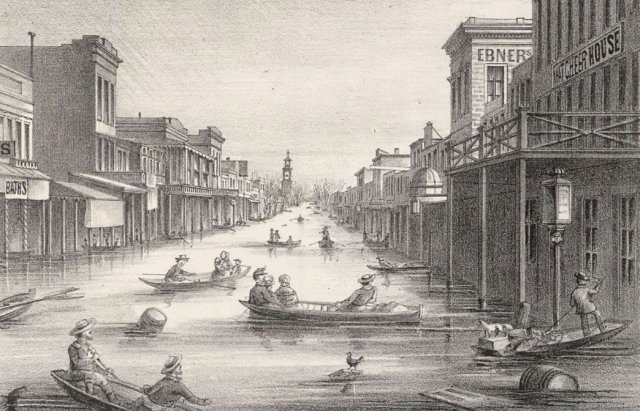
sacfllod

Sacramento in 1862

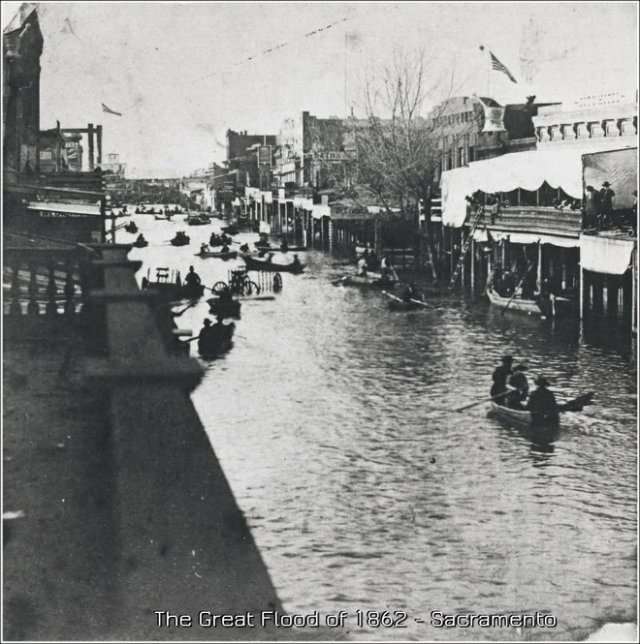
The Great Flood of 1862 filled the Central Valley of California like an enormous lake. The rain started in November, and heavy rain and snow continued to fall throughout the winter, causing flooding that lasted well into spring. The city of Sacramento, built where the American and Sacramento Rivers meet, had constructed a levee to keep the river water out of the city. Instead, it acted as a dam, containing water in the city, as water flowed in from higher land to the east.

Great Flood 1832 - Sacramento

The Great Flood of 1862

For more on the Great Flood, here is a good article. from activenorcal.net.

Could it happen again? These intense weather events are predicted to happen every 100 to 200 years. But we now have levees, dams, and bypasses in place to shift the water away from urban locations.

On Sunday I went to San Francisco — we traveled via Hwy. 113 and Knight’s Landing, crossing over the brimful Sutter Bypass, one of the channels that takes excess water out of the Sacramento River. Here is a lovely video, shot recently by John Hannon, showing the Sutter Bypass. Near the end you will see Hwy. 113 crossing the bypass, which is wider, though shallower, than the river.


Posted in Uncategorized | Leave a comment

Dining at Bidwell Mansion

LLJohnandAnnie

Nick Anderson and Jenise Coon as John and Annie Bidwell

Dec. 31, 1866

Miss Annie E. Kennedy

Annie, with your assent I will ask permission of your parents to address you. I must go further or turn away and not see you at all, for you are constantly in my mind, and thoughts of you haunt me everywhere. I shall hope, for it seems as if all my future hopes were involved in the result. . . Promise me to let no one see this, burn it if necessary. I know I shall never find another to whom I can so tenderly confide.

In your own way let me know your mind. I am, Dear Annie, your very grateful and affectionate friend,

J. Bidwell

It took a year of writing heart-felt love letters to Annie Kennedy, but at last John Bidwell’s persistence was rewarded when in November 1867 she accepted his proposal.

BMA Valentine Dinner 2019 Annie reading letter to John 042

Jenise Coon as Annie Kennedy reads a letter

“General, I find myself conquered — by your constancy, and the many noble traits of character developed by time and circumstances, as also by the mysterious providence which constrains me to make this confession. With many thanks for past kindness I throw myself on your avowed affection for the realization of future earthy happiness.”

During this bicentennial year commemorating the birth of John Bidwell in 1819, the Bidwell Mansion Association held a very special event for sixteen guests inside Bidwell Mansion, with a four-course dinner and the reading of selections from the courtship letters of John Bidwell and Annie Ellicott Kennedy. Annie was portrayed by Jenise Coon and John by Nick Anderson.

BMA Valentine Dinner 2019 Serving the guests 015

General John Bidwell sits at the head of the table

bma-valentine-dinner-2019-menu-0215191825a.jpg

The delicious dinner was catered by Roots Catering. Chef David Gomez, consulting with Elizabeth Quivey, developed a menu that recalled fine dining in the 19th century.

BMA Valentine Dinner 2019 the staff 026

Servers Elizabeth, Adrienne, Quinn, and Christian gather for instructions in the historic kitchen.

Posted in Bidwell Mansion, Uncategorized | 1 Comment

New Book!

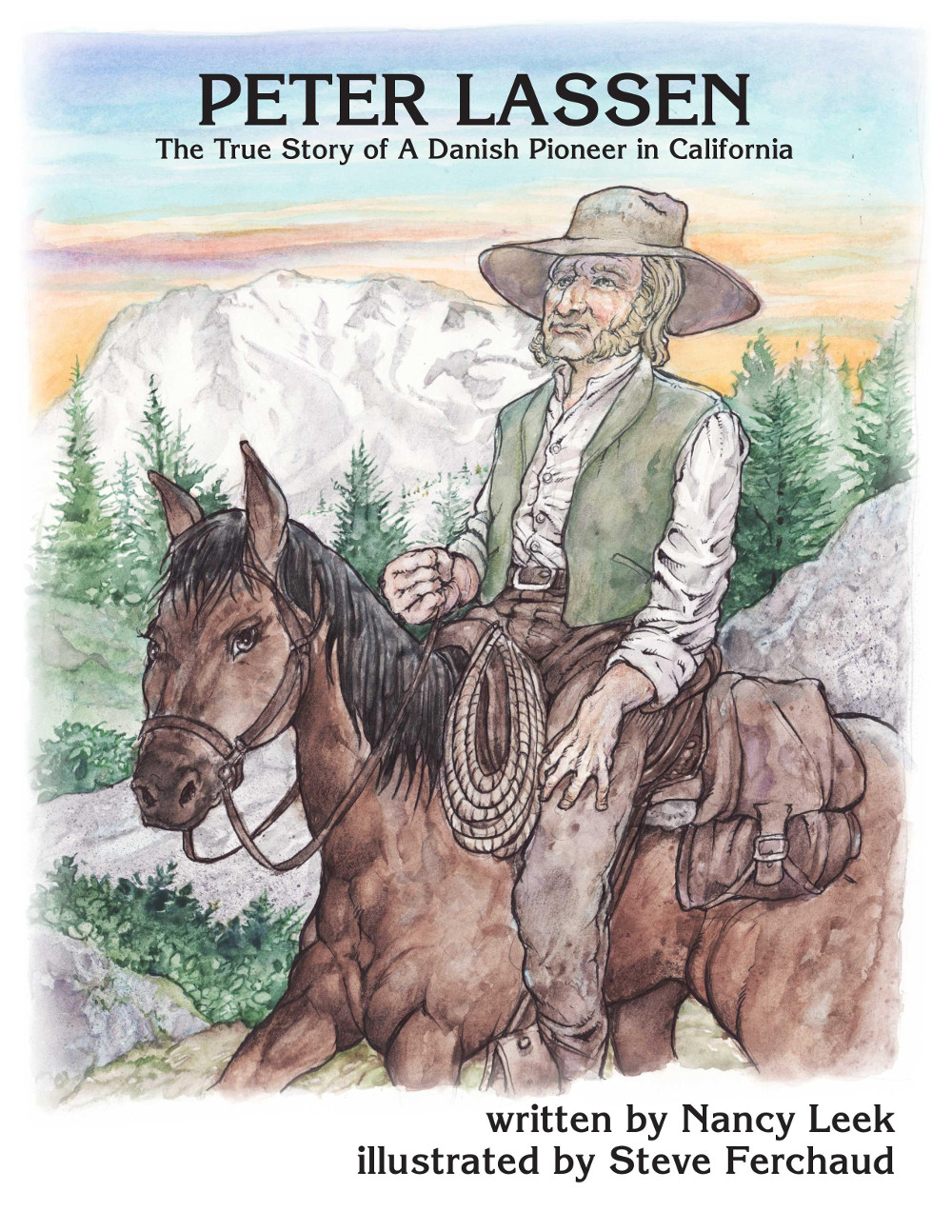
Got delivery today on 500 copies of my new book. Here they are:

DSCF6671

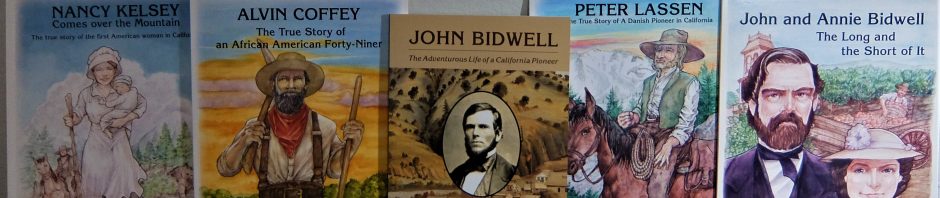
Peter Lassen: The True Story of a Danish Pioneer in California tells the story of Lassen’s adventures coming to America and settling in California. Steve Ferchaud did the illustrations and Carla Resnick did the graphic design and layout. I thank them for their wonderful work, as well as Josie Reichschneider-Smith and Ken Johnston for checking the historical facts, Gary Kurutz for giving me a great blurb for the back cover, and Christian and Jens Bak for helping Steve and I get the look of old Copenhagen right.

Here’s what Gary Kurutz said about the book:

“Through comprehensive research and gifted writing, historian Nancy Leek brings out the magnetic life of this intrepid Danish pioneer who crossed the country to settle and tame the rugged and remote land of northeastern California. Like Captain Sutter, he was generous and welcoming to immigrants and respected Native Americans, only to be murdered in 1859 on his way to the newly discovered Nevada silver mines.”

(Gary is the former curator of the California State Library and the executive director of the California State Library Foundation.)

Here are a couple of inside pages. That’s Peter Lassen and John Bidwell exploring the Sacramento Valley and hunting grizzly bear.

DSCF6674(2)

Information about purchasing the book can be found on the My Books tab above.

Here are some other blog pages about Lassen: searching out his life and his mysterious death.

Posted in Peter Lassen, Uncategorized | Leave a comment

Seeing the Grizzly

Just posting these pictures here because grizzly bears are cool and not very scary at all if you have a nice thick piece of glass between you and the bear. This grizzly lives at the Oakland Zoo.

grizzly2

The Oakland Zoo has two orphaned grizzly bear cubs. If this is a cub I’m not sure that I want to deal with a full grown grizzly. They can get up to 9 feet long and 1200 pounds. You can read about how the bear brothers came to the zoo in this article from the San Francisco Chronicle.

griz3

They have a nice big grassy enclosure to live in, with hills and dells and trees and a pool. It can be hard to spot them if they are not in the pool and not close to the viewing platform. My husband Jim was lucky and got these excellent photos.

When pioneers and gold seekers got to California there were grizzly bears everywhere. There was plenty of game and life was good for a bear at the top of the food chain. But they were hunted to extinction — the last grizzly was seen in California in 1924. I am glad they are back in California, in a safe environment.

DSCF3607

And there he goes, over the hill and out of sight.

Posted in grizzly bears, Uncategorized | 2 Comments

The M & T Ranch Water Tower

Here is a little more on the water tower on the M & T Ranch. Liz Stewart and John Gallardo alerted me to the existence of a drawing of the ranch in Butte County Illustrated, a book that was published in 1877. The pictures from this book are available online at Meriam Library Special Collections Historical Photograph Collection.

Reavis Butte_County_Illustrated

Ranch of D. M. Reavis

As you can see, the Reavis Ranch was quite the spread. And you have to admire the fine horses, bulls, and cows that ornament the corners. But it’s hard to see the water tower in this picture, so here is a closeup.

Reavis Butte_County_Illustrated (2)

You can see that in 1877 or a little earlier, when the drawing was made, the tower was no more than a box on stilts. It had yet to be enclosed.

Here is another photo of the tower — other pictures in the album have the date March 21, 1922. By this time the ranch was owned by James D. Phelan, the mayor of San Francisco. The photo comes from the Phelan Photograph Album collection at the Bancroft Library, accessible at Calisphere.

tf4s2009bg-FID3(2)

There are several other photos of the Reavis Ranch in this collection — pictures of a few outbuildings and fields, such as this one.

tf2j49p1j4-FID4(2)

Back to Butte County Illustrated — In the upper left corner of the drawing is a picture of Reavis’s famous race horse, Blackbird.

Reavis Butte_County_Illustrated (3)

John Bidwell wrote in his diary in 1874:

Fri. December l8.
Somewhat hazy – & clear – Drove to Reavis’ ranch with Van Vliet — Saw Blackbird


Posted in Uncategorized | 1 Comment

The Ohmura Letter

This is the letter that was in the same box with the Ohmura bowl. It was written from Cleveland, where the Ohmuras had been relocated in 1944. They both found work there, but never at the same level of prosperity that they had had in Chico with the Home Grown Vegetable Market. Mr. Ohmura found a job selling vacuum cleaners and  Mrs. Ohmura took on work as a domestic. Archie McDonald quotes their daughter May as saying, ” They didn’t have the energy to start a business again.”  (The Japanese Experience in Butte County, p. 135)

Mr. Ohmura did his best to put a good face on things for his letter to Robert and Mary Grace DeBeque. (I have retained the original spelling and grammar.)

DSCF6610

1911 E. 89th Cleveland 6 Ohio    Jan 21 1945

Dear Mr. and Mrs. DeBeque:

I beg you will excuse my neglect.

Thank you ever so much Mr. and Mrs. DeBeque for the greeting card, thoughtful letters, mental equivalent scrap paper and couple of lovely books which you sent through the unity school of Christianity, Kansas City Mo.

We don’t know how to express our appliciation [appreciation] and delight for your kindness and thoughtfulness. How wonderful you are! We feel very proud to have such a friend. We have a lot of friends in Chico but real friend are not many, even among Japanese people. It seems to be good in personally but when they get together to do something come to different. It was in Feb. of 1943 at Tule Lake Center, W.R.A. [War Relocation Authority] required us registration to find out loyal or disloyal to united states. That time I was put in a hot water. People in the camp were very excited to discuss this registration problem and held mass meeting all over the camp. When they ask me opinion, I express my attitude as an American citizen and maintained what we should do then. Majority express my opinion. One day I received a treating [threatening] poster from these people. Finally one night our apartment was attacked by armed group of people and our windows and door were broken by them. I did not meet these people and did not open the door. Fortunately, policemen came around as soon as hear the noise, and my family was safe. W.R.A. put a few watchmen after this happened and protected us. It was an awful thing. I din’t have any fear of them but felt so sorry for them instead. I know most of them for good many years and I have been good to them and they are good to me in personally and yet when they get together turned out disposition by the few of agitators. Well, that time I found only one real friend and he was willing to fight to death for us. I really felt wonderful of him.

For good many years, most Japanese people who lived in West Coast, especially farmers, make a Japanese colony and din’t get associated with Caucasian much. In other words they lived in Japanese way and get by without speak English. For this reason they did not study English much. In fact they din’t have any chance to get acquaintance each other with white people. I believe this was whole trouble. However, all Japanese love to live in U.S.A., love freedom, liberty, and justice as well as American. Their sons (second generation) are fighting in France, Italy, and south Pacific for their country U.S.A. now. Sacrifices will prove it and will grow.

I am very glad to read such a publication which you send to us. As you know, I live in Chico more than twenty years. During that time I never had a bad feeling yet and I love Chico people. They were very good to us. Now I come Cleveland and living almost one year. I din’t have any friend, every one were stranger to us. Certainly felt lonesome for a while but Cleveland people are different. They are warm hearted especially church groups. For year time I made a lot of friends here and they are awfully nice to all relocated Japanese people.

About 1700 Japanese American ancestry relocated here to Cleveland now, and most every one busy on jobs. Seems to be everybody getting along fine and well satisfied here.

Many times I asked their boys & girls about returning to west coast when I find a chance, but answer was “no.” They are living scatter all over the city, so they have more chance to know each other understanding and own development.

I have not made any decision yet to stay here or go back to Chico.

Cleveland met a bitter winter this year. People who live here last thirty years says din’t need this weather as yet. Snow fall started last Dec. Ever  since see ground covered with snow, and stop snowing day or two repeat again. Mercury went down to 3 below zero too. Snow view is certainly beautiful but hard on communication.

May was home for a month from Nov. 27th to Dec. 26th and Paul was Dec. 19th to Jan. 3rd for their vacation. We all reunion and enjoy holiday season.

Please excuse my poor writing.

Thanks again for your kindness and a lot things you have done for us.

Hope you are well this weather.

DSCF6611Sincerely yours,

Shigeto Tom Ohmura

Chiyo Ohmura


Posted in Ohmura, Uncategorized | Leave a comment