A Visit to the M & T Ranch

DSCF6613

The water tower — isn’t she a beauty!

Today I was lucky enough to get a tour of the M & T Ranch to the west of Chico. The tour was arranged by April Morehead Pryor for her OLLI Butte County history class. The tour was led by Les Heringer, the ranch manager. He gave us quite a lot of information, both historical and current.

M & T Ranch comprises 8500 acres bounded on the north by Big Chico Creek and on the west by the Sacramento River. It is part of the original Farwell Grant of 22,000 acres, or five Spanish square leagues. That ranch was granted to Edward Farwell in 1844, but he was not to enjoy it long. In 1845 he sold the northern half (on which the M & T sits) to the Williams brothers, James and John, and going back east for an eye operation, there died. John Bidwell administered his estate and sold the southern half of the ranch to John Potter.

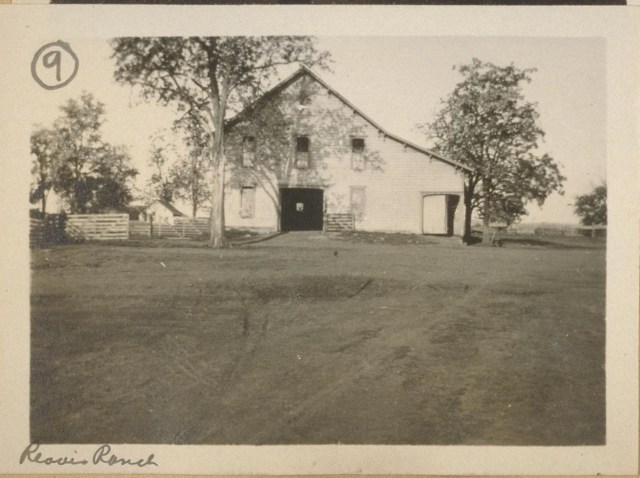
DSCF6616The handsome water tower which you see above was built by David Reavis sometime in the 1860s after he acquired the ranch. Although no longer used to store water, it is carefully maintained by Les and his crew.

Reavis grew wheat and bred horses. From the top of the tower he could watch his horses being exercised. and get a bird’s-eye view of races at the ranch’s nearby racetrack.

In his diary, John Bidwell records in December 3, 1872, that “D.M. Reavis paid me $25 towards recording Farwell patent.”

Reavis went bankrupt in 1878 and the ranch was sold. I am not sure who acquired it at that time, but sometime around 1900 it was bought by James D. Phelan, the mayor of San Francisco, who had it until his death in 1930. It was bought by partners from San Francisco — M and T — whose names I can’t remember. Their name has remained on the ranch, although it is now owned by PacTrust of Portland, Oregon.

DSCF6620

Along the Sacramento River

The 8500-acre M & T Ranch has some 6000 acres in production. More than half of the acreage in is walnuts, and it seems as if there are walnut trees as far as the eye can see. They also grow almonds, prunes, and a little rice. A large portion of the land along the Sacramento River is a riparian reserve.

If anyone knows more about the history of that beautiful water tower, please feel free to contribute a comment.


Posted in Uncategorized | 1 Comment

The Ohmura Bowl — part 2

67b5d13306ed8279bca1d6526c9fe56d

View of barracks with Castle Rock in the background, Mar. 20, 1946, Tule Lake concentration camp, California. Courtesy of the National Archives and Records Administration (Densho Encyclopedia)

Evacuation of Japanese residents in Chico began in early July of 1942. Evacuees from Butte County were sent to the camp at Tule Lake in Siskiyou County. May Ohmura, who had just completed two years of study at Mills College in Oakland, joined her parents and brother there. They lived together in a one-room “apartment” in a hastily constructed barracks.

May described the camp site as a “desert-like spot with endless dust storms, the place enclosed by barbed wire, gun towers and guards pointing machine guns at the internees.” May found a job as a nurse’s aide in the hospital and her father was given a job hauling coal. Paul enrolled in the camp high school. (McDonald 105-106) Two-thirds of the internees were American citizens, like the Ohmura family.

In February 1943 the U.S. Army sent a recruiting team to sign up Nisei (second-generation Japanese) for the draft. There was a good deal of resistance, with less than half of the military age men willing to register. The questionnaire that was devised to assess the loyalty of Japanese internees contained questions that were confusing, demeaning, and problematic for both citizens and non-citizens. The issue caused a division between the internees who wished to demonstrate their loyalty and those who protested their incarceration and loss of rights.

(For more on the Loyalty Questionnaire, see this article at the Densho Encyclopedia.)

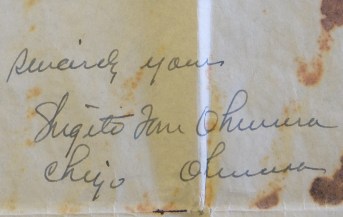
Shigeto Ohmura was vocal in stating his loyalty to the United States, drawing the anger of protestors. In a letter to the DeBeques he described the outbreak of violence against him in the camp.

DSCF6610

Letter written January 21, 1945 by Shigeto Ohmura to Robert and Mary Grace DeBeque

We don’t know how to express our appliciation [appreciation] and delight for your kindness and thoughtfulness. How wonderful you are! We feel very proud to have such a friend. We have a lot of friends in Chico but real friend are not many, even among Japanese people. It seems to be good in personally but when they get together to do something come to different.

It was in Feb. of 1943 at Tule Lake Center, W.R.A. [War Relocation Authority] required us registration to find out loyal or disloyal to united states. That time I was put in a hot water. People in the camp were very excited to discuss this registration problem and held mass meeting all over the camp. When they ask me opinion, I express my attitude as an American citizen and maintained what we should do then. Majority express my opinion. One day I received a treating [threatening] poster from these people.

Finally one night our apartment was attacked by armed group of people and our windows and door were broken by them. I did not meet these people and did not open the door. Fortunately, policemen came around as soon as hear the noise, and my family was safe. W.R.A. put a few watchmen after this happened and protected us. It was an awful thing. I din’t have any fear of them but felt so sorry for them instead. I know most of them for good many years and I have been good to them and they are good to me in personally and yet when they get together turned out disposition by the few of agitators. Well, that time I found only one real friend and he was willing to fight to death for us. I really felt wonderful of him.

May Ohmura also described the experience in a letter to Archie McDonald:

What I remember, when I returned from the evening shift at the hospital, via the ambulance, the barrack door was opened quickly and I was told to come quickly. There was a crowd surrounding the building shouting. I remember blowing a whistle hoping this would bring help. I do not recall anyone being injured. (McDonald 107)

May’s whistle was mistaken by the attackers for that of a warden, and the gang fled.
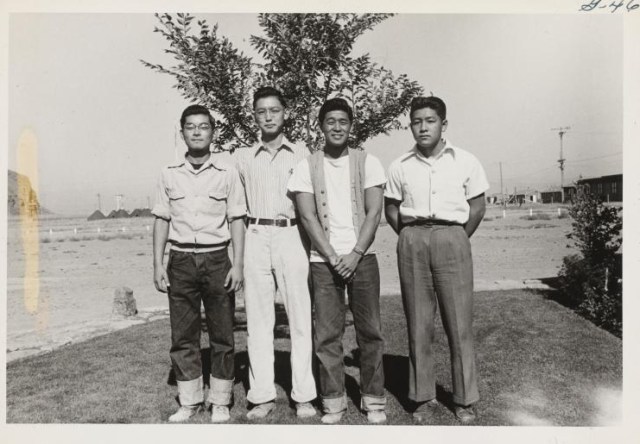
paul ohmura

Four Tri-State High School leaders (L to R) Minoru Mochizuki, Shigeo Nakanishi, Yoshimitsu Hada, Paul Ohmura. UC Berkeley, Bancroft Library.

The Ohmuras spent a year at Tule Lake, and then were transferred to the Amache camp in Colorado. Later they were released from the internment camp and relocated to Cleveland, Ohio. They never returned to California.


Next: The Ohmura Letter
Posted in Ohmura, Uncategorized | Leave a comment

The Ohmura Bowl

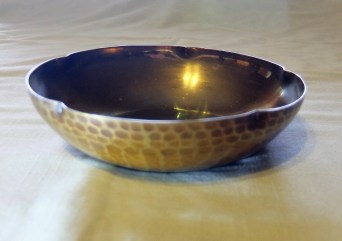
DSCF6607This bowl was a gift to my husband’s maternal grandparents, Robert and Mary Grace DeBeque, who lived in Chico during the 1940s and ’50s. I don’t know everything I would like to know about the bowl, but the letter accompanying it tells a great deal about the givers and about a significant period in Chico and American history.

The bowl was a gift from Shigeto and Satsuyo Ohmura to their friends, the DeBeques. For over twenty years Mr. Ohmura, who used Tom as his American name, was the proprietor of the Home Grown Vegetable Market, and a leader in the Japanese community in Butte County. The market was located at 171 E. 2nd Street, between Main St. and Wall St., and their produce was considered the finest available in Chico.*

DSCF6604The metal bowl is 6 ½ inches wide, and sits in a cushioned box covered on the outside with brocade fabric. The box also contains a pair of chopsticks, although I can’t imagine actually eating rice from this bowl. It seems more decorative than practical.
A label in the box indicates that it came from the Fukuya Department Store in Hiroshima. Established in 1929, the store survived the war and is still in business today. The bowl can’t have been imported during World War II, so either the Ohmura’s store also carried Japanese fancy goods, or this was one of their personal possessions. I assume they gave it to their friends the DeBeques before their involuntary departure.

Both Mr. and Mrs. Ohmura were American citizens, born in Hawaii when it was a territory of the United States. Shigeto Ohmura had gone to Japan for education and then emigrated to the United States. His wife followed a similar pattern. I am not sure what year they came to Chico, but they were living in Chico by 1922 when their first child was born. They had two children, May (b. 1922) and Paul (b. 1925), who as teenagers were popular students at Chico High School.

The attack on Pearl Harbor by Japan on December 7, 1941 shocked Americans, and fear and suspicion ran high. Suddenly every Japanese person was regarded as a possible spy or saboteur. The call to remove all Japanese, whether U.S. citizens or not, from the West Coast, was immediate. Responding to the general hysteria and calls for action from all levels of state and national government, President Roosevelt on February 19, 1942 signed Executive Order 9066, authorizing the internment of all Japanese residing in areas designated as military zones. Evacuation of Japanese residents in Butte County to the Tule Lake internment camp began in early July.

Next: The Ohmura Family at Tule Lake

*Information about the Ohmura family and the internment of Japanese residents of Butte County comes from The Japanese Experience in Butte County, California, by Archie McDonald (Association for Northern California Records and Research, 1993). The book is available from anchr.org.


Posted in Ohmura | Leave a comment

A Poem for All Seasons

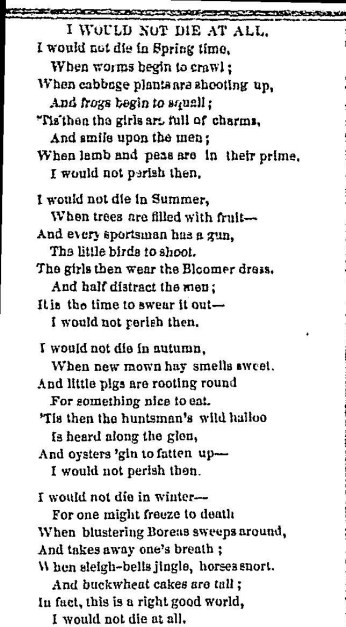
The following unattributed poem appeared in the Butte Record on November 12, 1853.

Month NOVEMBER Issue Date NOVEMBER 12 1853 page 4

I WOULD NOT DIE AT ALL

I would not die in Springtime,
When worms begin to crawl;
When cabbage plants are shooting up,
And frogs begin to squall;
‘Tis then the girls are full of charms,
And smile upon the men;
When lamb and peas are in their prime.
I would not perish then.

I would not die in Summer,
When trees are filled with fruit –
And every sportsman has a gun,
The little birds to shoot.
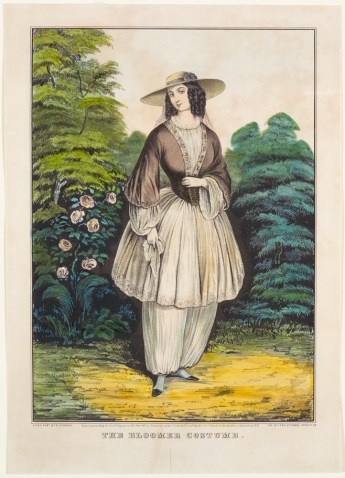
The girls then wear the Bloomer dress,
And half distract the men;
It is the time to swear it out –
I would not perish then.

I would not die in autumn,
When new-mown hay smells sweet,
And little pigs are rooting round
For something nice to eat.

the-bloomer-costume-by-nathaniel-currier

The Bloomer Costume, by Nathaniel Currier

‘Tis then the huntsman’s wild halloo
Is heard along the glen,
And oysters ‘gin to fatten up –
I would not perish then.

I would not die in winter –
For one might freeze to death
When blustering Boreas sweeps around,
And takes away one’s breath;
When sleigh-bells jingle, horses snort,
And buckwheat cakes are tall;
In fact, this is a right good world,
I would not die at all.

Posted in Uncategorized | Leave a comment

A Sunday in Oroville

gambling-in-the-mines

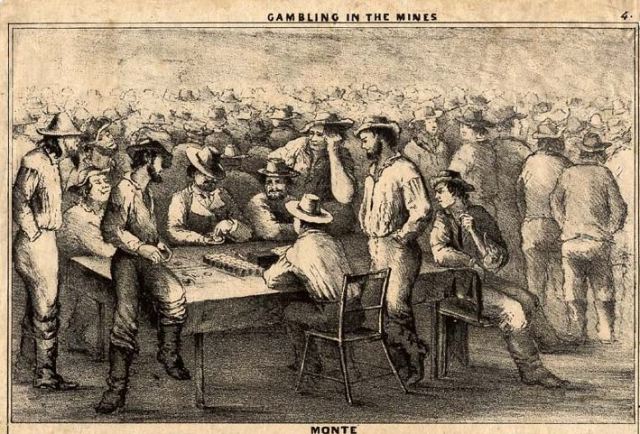
According to the editor of the Butte Record, Sundays in Oroville were wild and raucous. Other cities in the state had progressed in civilization, but not Oroville. No quiet, peaceful Sabbath in this city — the streets were crowded, the bars and theaters full, and the entertainments abundant. The spirit of ’49 still thrived, even after seven years.

month october issue date october 11 1856 page 1

Butte Record, October 11, 1856

Posted in Uncategorized | Leave a comment

Marketing Techniques — Forty-Niner style

How do you catch the reader’s eye in an old-time newspaper?

If you were a miner reading the Butte Record at Bidwell Bar in 1855, there’s one advertisement that would stand out, especially if you were hungry or thirsty. (Especially if you were thirsty.)

month june issue date june 16 1855 page 3In the Butte Record you would see advertisements for a variety of businesses.


There were drug stores and hotels:


Tobacco stores:

month june issue date june 23 1855 page 2b

month june issue date june 23 1855 page 3c  Every town had at least one livery stable, where you could rent a horse or a carriage for any occasion.


But– “Look at this!” — here is the one that would surely catch your attention. Ale, porter, and wines of all kinds, whiskey, chewing tobacco and cigars, and food of some sort — “coarse fodder” — which looks like it was mostly beans. “Oh, what Beans!”

month june issue date june 23 1855 page 3

Just one question: Where was “Mother Cooper’s side hill”?


Posted in Uncategorized | Leave a comment

From the Butte Record

Last Saturday I went to the Chico Museum to hear David Little, recently retired editor of the Chico Enterprise-Record, speak on the history of our hometown newspaper.

month april issue date april 28 1855 page 1

The Butte Record, published at Bidwell Bar, was the first newspaper in Butte County. C.W. Stiles saw the need for a local newspaper, gathered financial support, and purchased a printing press. Stiles, however, had no experience editing or printing a paper. He hired Harry De Courcey, previously of the Calaveras Chronicle, to edit the paper, and L.P. Hall to run the press.

Their tenure was short-lived. In the very first issue of the Butte Record, the following item appeared:

month november issue date november 12 1853 page 2

Butte Record, November 12, 1853

De Courcey was forced to give up the editor’s chair. His resignation notice appeared in the same issue.

month november issue date november 12 1853 page 2(1)

So it was an argument over politics that brought out the Bowie knife. Lively times in frontier journalism!

The Sacramento Daily Union reported the incident and said

Mr. Stiles has been compelled to take up the pen editorial, which he acknowledges to be foreign to his vocation. His first efforts, however, are highly creditable to his abilities.

But Stiles soon found a more lasting editor. George Crosette, who was managing a hotel in Oroville, had grown up in the printing business and took over as editor. He bought the paper from Stiles and continued as editor for many years. In 1864 the paper moved to Oroville and in 1873 Crosette moved it to Chico, where it became the Chico Record.


Posted in Uncategorized | Leave a comment

Like a Hole in the Head — part 3

Portrait

John Bidwell in 1865.


John Bidwell was proud of what he called his “self-possession.” He prided himself on keeping calm and cool during a crisis. Decades after the wreck of the steamboat Belle he recollected the incident as an example of this trait.

The following quote comes from Dictation From General John Bidwell, collected by Hubert Howe Bancroft in 1891.

I think it is presence of mind that helps people out of emergencies. When I see men in a flurry, I am generally able to keep cool. For instance: I was going up the river on a steamer; was very tired when I went on board and secured my berth and went to bed. Suddenly there was a collision* and our steamer sunk five minutes afterwards. It was crowded with men at the time, so crowded that they had to make beds on the deck. I went out to see what was the matter, returned to my stateroom, gathered my things together, and got out on the hurricane deck. Put my clothes there and commenced helping others up as fast as I could.

The other steamer came up to help us, and the men commenced jumping off while the boat was ten or fifteen feet below us, one on top of the other. The sailors were catching and throwing them aside just like pieces of wood. I did not like the looks of the thing, and waited until our steamer had almost gone down before I jumped making one easy step over. It is not bravery, it is something that is forced upon you as a necessity. I generally manage to keep perfectly cool in case of fire and such things.

*It was a boiler explosion and not a collision

The hurricane deck is the uppermost deck on a steamboat, where you could catch a breeze in the evenings.

In this version of the story, Bidwell doesn’t mention the blow he received from the piece of flying iron. This tale is all about him calmly assessing the situation, then stepping from the hurricane deck, valise in hand, to the deck of the rescuing boat.

If you are picturing a large and fancy Delta Queen-style steamboat, you will want to moderate your imagination. We don’t have a picture of the Belle, but it probably looked more like this:

steamboat

Steamboat San Joaquin, circa 1890.  Meriam Library Special Collections

or maybe this:

steamboat_on_the_sacramento_river

Steamboat Dover on the Sacramento River, 1910. Meriam Library Special Collections

rather than this:

the-great-mississippi-steamboat-race-currier-ives

The Great Mississippi Steamboat Race, by Currier and Ives

Posted in Steamboat Belle, Uncategorized | Leave a comment

Like a Hole in the Head — part 2

sdu18560308.1.2-3841-7558-953-391-476w

Sacramento Daily Union 8 March 1856

Luckily for Major Bidwell, the Sacramento Daily Union was in error.

After the explsion of the steamboat Belle, John Bidwell was taken back to Sacramento and to a doctor.  Evidently (if the newspaper notice can be trusted that far) he eventually went back to Chico. He either had a relapse, or needed further care, because by March 10  he was back in Sacramento.

sdu18560310.1.2-1984-6862-941-531-470w

Sacramento Daily Union 10 March 1856

Bidwell, as one of the oldest American residents in California, the owner of a vast rancho, and a former state senator, was one of the best known men in California. He was certainly the most prominent passenger on the Belle when the accident occurred. So his name was newsworthy.

Portrait

Republican Congressman John Bidwell of California, 1865.

He would go on to serve in Congress in 1865-66. Even though nearly ten years had past since his encounter with a piece of flying iron from the exploded boiler, the scar he received was still easy to discern on his forehead.

This photograph of John Bidwell as a newly arrived representative to Congress can be found in the National Archives.

Posted in Steamboat Belle, Uncategorized | Leave a comment

Like a Hole in the Head

Portrait

Republican Congressman John Bidwell of California, 1865.

Have you ever seen a photograph of John Bidwell that so clearly showed him with a hole in his head?

This photograph, taken at the Mathew Brady studio in Washington, D.C. in 1865, shows the injury he suffered in a steamboat accident in 1856. It’s a photo that we do not often see.

Annie, I have heard, did not care for pictures that showed her husband’s scar. In the following two photos, one from 1867 and one from 1885, the scar is visible but very faint, and I suspect the photographs have been touched up.


Bidwell sustained his injury when the boiler of the steamboat Belle exploded on the Sacramento River, as he was traveling upriver from Sacramento City to Chico Landing. The accident occured on the morning of February 5, about ten miles from the city.

Bidwell told the story of the accident to his biographer, Rockwell D. Hunt. In John Bidwell, Prince of California Pioneers, Hunt writes that Bidwell was sitting by the stove, reading the morning newspaper when:

At that instant an explosion in the engine took place. He immediately grasped the side of the berth with both hands, holding his breath to avoid the hot steam. He was virtually paralyzed, and was unable to break the cabin window for a moment; but his strength soon returned, and he stuck his head out of the window. The wound inflicted on his head by flying iron — he never knew just what hit him — was a severe fracture of the external skull about the size of a twenty-five cent piece; but his recovery was complete.Of the few passengers on the boat he said nearly all were killed, also the captain and the clerk, and the pilot was seriously injured.

The story of the explosion and loss of the Belle was widely reported in the newspapers. Here is the beginning of an article from the Sacramento Daily Union. 

sdu18560206.1.2-120-148-1903-945-951w

Sacramento Daily Union, 6 February 1856.

The article goes on to say that there were about forty passengers on the boat and at least twenty of those were dead, wounded, or missing. Survivors were picked up by a steamboat coming downriver. The fate of pets on board did not go unreported.

A canary bird belonging to Mr. Mix was in a cage placed on a table in the cabin, at the time of the explosion. Although the table was almost entirely demolished by being cleared by portions of the boiler, the bird and cage escaped uninjured, with the exception of the latter being slightly bent. The bird is now singing as sweetly as ever at the Orleans, the accident having merely disturbed its plumage.

Posted in Steamboat Belle, Uncategorized | Leave a comment