The Saga of Two-Gun Nan

LAH19100709.2.87-a2-626w

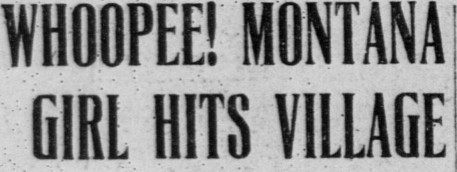
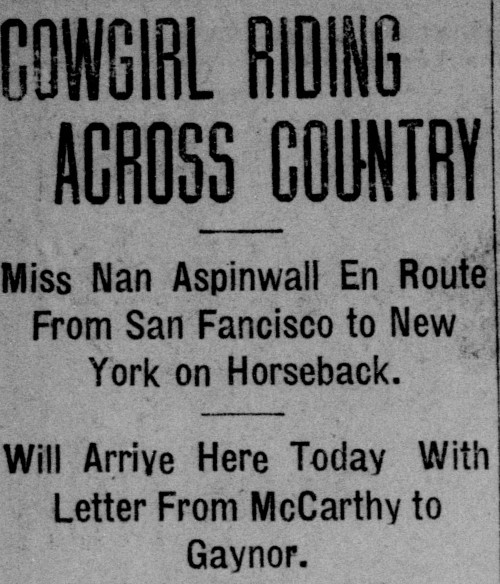
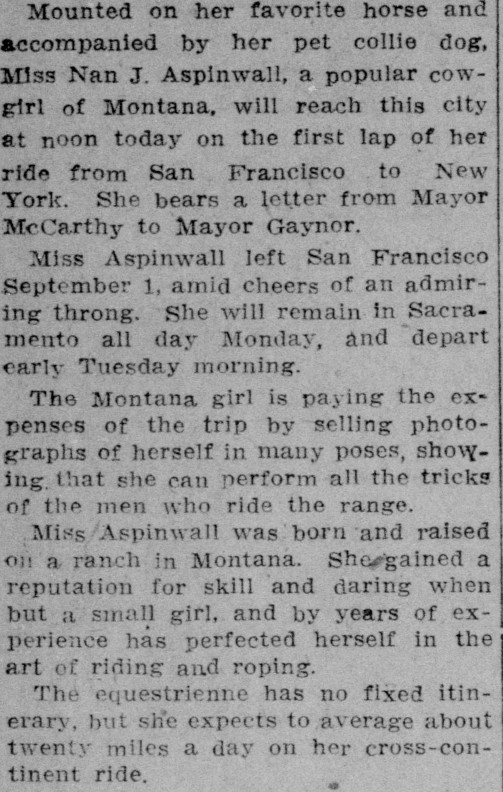
Miss Nan Aspinwall, Who Plans to Ride Across the Continent Alone, Los Angeles Herald 9 July 1910

Here is the tale of a long-forgotten publicity stunt that gave Nan Aspinwall national attention as the first woman to cross the North American continent on horseback in 1910.

Billed as “The Montana Girl” on the vaudeville circuit, Nan was a trick-riding, sharp-shooting, lariat-twirling cowgirl performer in the style of Annie Oakley.  In 1910 she and her husband Frank Gable came up with the idea to promote their show with a daring solo ride across country from sea to shining sea.

Starting in San Francisco, Nan would carry greetings from the mayor of the city by the Bay to the mayor of New York City. On the journey she gave performances to earn her way. Her husband Frank acted as her advance man, setting up shows and advertising her stunt. He traveled by train. But Nan herself did the entire journey riding on her faithful mare, Lady Ellen, accompanied only by her border collie, Ky-Ipp.

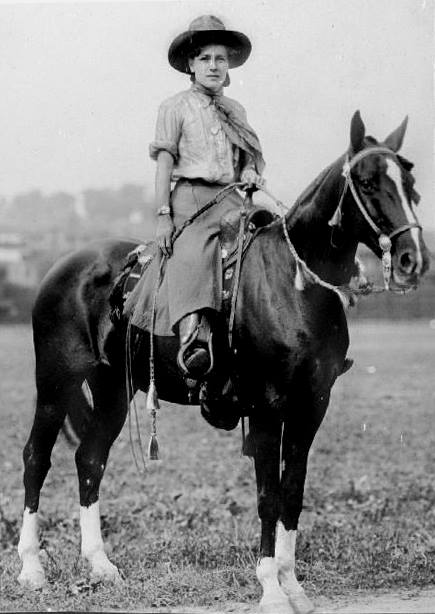
She customarily wore typical Western wear: a divided skirt, boots, a silk or flannel shirt with a bandanna around her neck, and a Stetson hat. She had long blond wavy hair and an engaging smile. She claimed to have grown up on a ranch in Montana, where her father taught her to rope and ride, She looked every bit the Girl of the Golden West.

DSCF6458 (2)Not all of her backstory was the truth, as we shall see. But her achievement as the first woman to cross the United States alone on horseback was genuine.

Stay tuned and in future installments I will tell you the true story of Nan Aspinwall.

And how did I learn about Two-Gun Nan? The poster you see above used to hang in my mother-in-law’s house. Her father (actually her step-father) was a cousin to Nan, although I do not know how closely they were related. I am really no relation at all. My daughter always liked this poster and now it hangs in her hallway. She found a book about Two-Gun Nan, a thesis written about her some twenty years ago and published by a small press that specializes in “equestrian travel classics.” Most of the information will come from this book, In Genuine Cowgirl Fashion: The Life and Ride of “Two-Gun Nan Aspinwall, by Mary Higginbotham.


Posted in Uncategorized | 1 Comment

New Book News

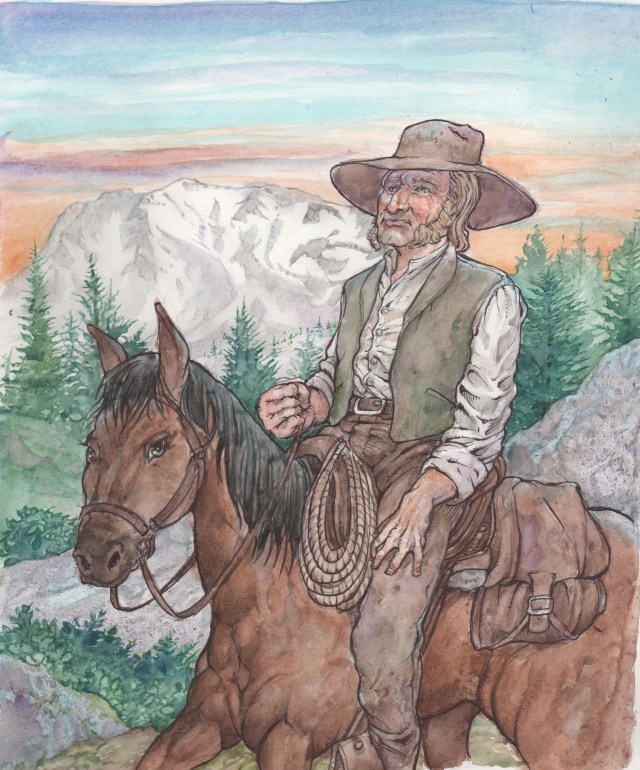
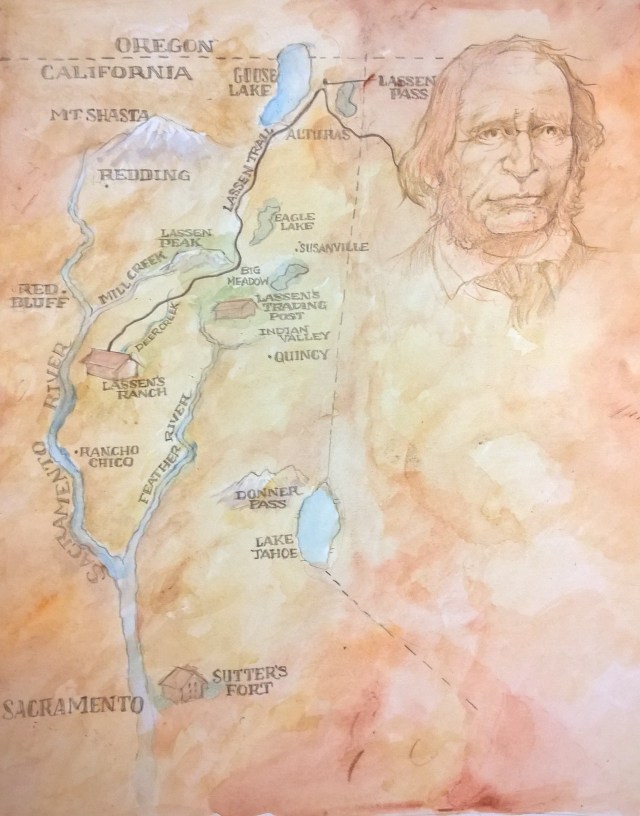
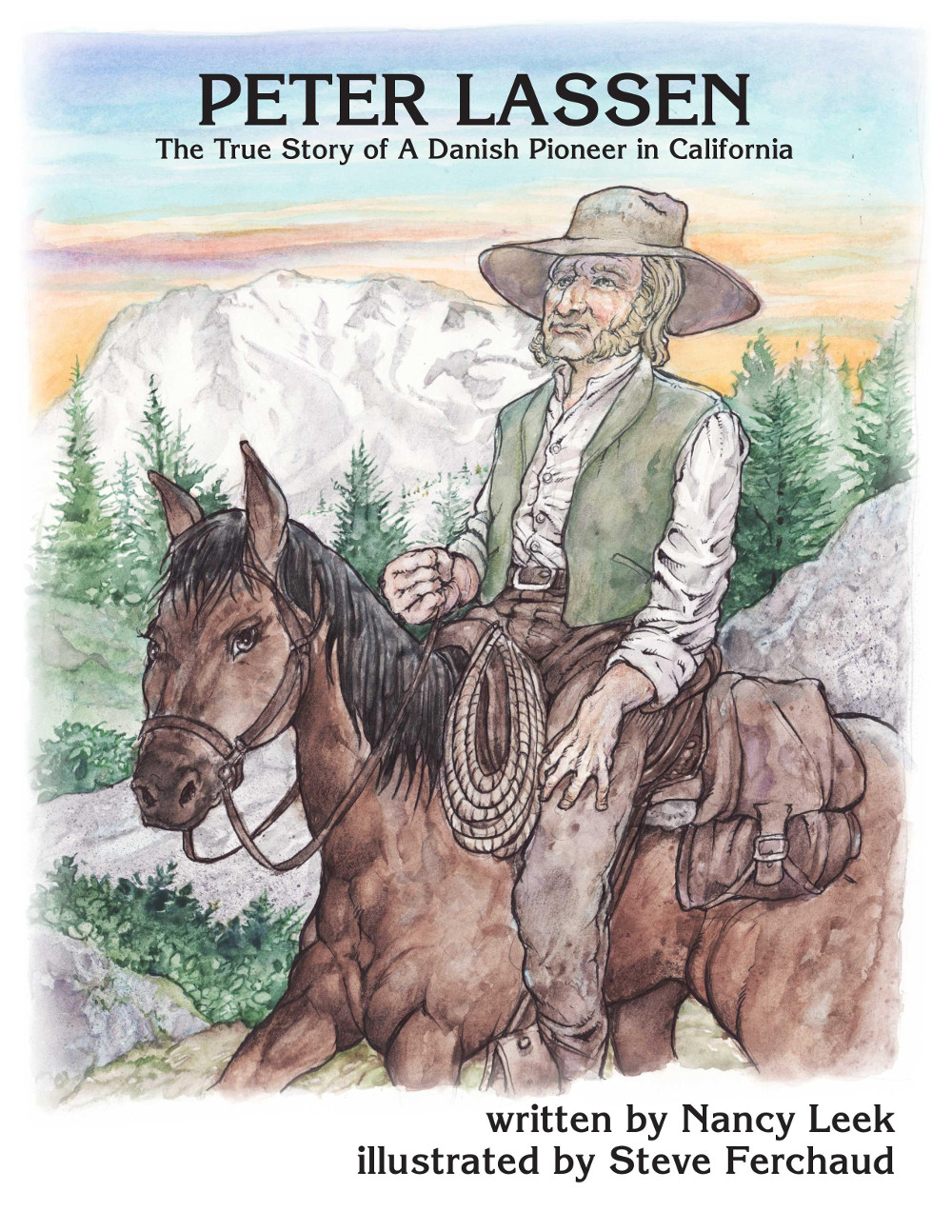
My new picture book biography of Peter Lassen is getting closer to complettion. Everything is in the hands (and computer) of my friendly neighborhood graphic designer, Carla Resnick. Pretty soon it will be off to the printer and then a big box o’ books will come to my door.

Here are the front and back cover illustrations by Steve Ferchaud, without text:

lassencovercolor

Front cover

lassen back

Back cover

Gary Kurutz, retired but very busy curator of the California State Library, gave me a quote to put on the back.

Through comprehensive research and gifted writing, historian Nancy Leek brings out the magnetic life of this intrepid Danish pioneer who crossed the country to settle and tame the rugged and remote land of northeastern California. Like Captain Sutter, he was generous and welcoming to immigrants and respected Native Americans only to be murdered in 1859 on his way to the newly discovered Nevada silver mines.

––Gary F. Kurutz, curator emeritus, California State Library and executive director, California State Library Foundation

I am very pleased to have the endorsement of an eminent scholar of California history. I’m looking forward to having that book in my hands shortly!

Posted in Peter Lassen, Uncategorized | Leave a comment

The Troubled Life of Peter Burnett

Burnett_-_circa_1860

Peter Hardemann Burnett, about 1860

How many of us can name the first governor of California?

Well, now you can. He was Peter Burnett, Oregon pioneer, Oregon’s first supreme court judge, trailblazer to California, and first governor of the Golden State. He was handsome, ambitious, and the kind of man other men gravitated to as a leader. He was also often his own worst enemy.

The Troubled Life of Peter Burnett, by R. Gregory Nokes (Oregon State University Press, 2018), is the first ever biography of this fascinating man. I heard Mr. Nokes speak to the Butte County Historical Society a couple of weeks ago, and couldn’t wait to read his book. There are heroes and villains in history, and then there are forgotten men like Peter Burnett: intelligent, attractive, complicated men, full of contradictions, who failed as often as they succeeded.

Peter Burnett came from a poor family in Tennessee, but he had rich relatives. It gave him a life-long thirst for wealth, the kind of wealth that allowed a man to own slaves to do his work for him. As a merchant in Missouri, he went deeply into debt. He studied law, helped defend the Prophet Joseph Smith in court, and served as a district attorney. But debt continued to plague him and he decided to “light out for the territory.”

He organized the first large wagon train to set out for Oregon in 1843. Possibly he took two slaves with him, the record is unclear. He was elected captain of the wagon train, but he found the duties vexatious and one week later he resigned, a portent of his future political life. In Oregon he quickly rose to prominence and served on the first legislative committee. Notoriously, he promoted legislation that would bar African-Americans, slave or free, from residing in Oregon. Known as the “lash law,” the act provided that a severe whipping would be given any black person who did not leave Oregon within a prescribed period. Burnett would take his prejudice with him to California.

Oregonians were among the first to hear of the gold discovery and Burnett quickly organized a wagon train for California. Some of the men with him settled in Butte County, where they founded Oregon City on Table Mountain, but Burnett went on to Long Bar on the Yuba River. Soon he realized that the greatest wealth could be gained in real estate and he partnered with John A. Sutter, Jr. to sell lots in Sacramento. It made him a wealthy man.

Elected to a two-year term as governor in 1849, Burnett could not even make it that long. He resigned in January 1851, after serving not much more than a year. Once again his focus had been on making California a “whites-only” state, but the legislature did not back him up. He went on to serve on the California supreme court, where he maintained his racist reputation by ruling against Archy Lee, a slave claiming freedom in a free state. Luckily for Archy, a lower court circumvented Burnett’s ruling, which was widely criticized in the newspapers.
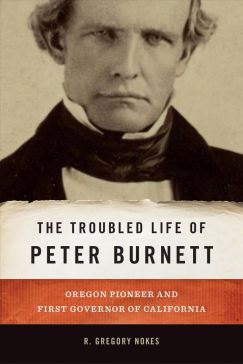
burnett bookAlthough he later wrote a lengthy book of his recollections and had a fairly successful second career in banking, Peter Burnett was soon forgotten in the political world, and is barely mentioned in California history. Greg Nokes has brought him back to life, complete with all his controversies and contradictions. His book is a window into early California politics and business. In spite of his flaws and his failures, Peter Burnett deserves to be remembered for his successes in pioneering and his place in Oregon and California history.


Posted in Peter Burnett, Uncategorized | Leave a comment

A Letter Found in a Book

People use all kinds of things for bookmarks, just ask any librarian. Today I was given the first page of a letter, written in 1900, that was used as a bookmark in antique book on learning Greek.

The library staff gave the letter to me, knowing of my interest in the Bidwells and Chico history. We don’t know who wrote the letter, although it seems to be a young woman. We don’t have the complete letter. It was written on April 5, 1900, the day after John Bidwell died, and the writer says on the second page:

Poor Mrs. Bidwell will be lost without the General, won’t she? His death must have caused quite a sensation in Chico.

So we know that news got around fast. She also mentions the Neubarth and Epperson families, both well known names in Chico. Please comment on this post if you have any information to add about the contents of this letter.

Created with GIMP


wheatland2-

Posted in Uncategorized | 2 Comments

New Book Coming!

logo

By December (if all goes well — I have my fingers crossed) I will have a new book out in the Golden State Biographies series for young readers. The new book will be about Peter Lassen, the enterprising immigrant from Denmark, who gave his name to a county, a national park, and an active volcano.

“Stunning” Steve Ferchaud has completed the illustrations, and everything is in the hands of Carla Resnick, my neighborhood graphic designer. Here are a few of Steve’s pictures to whet your appetite.

PLcolorpg7

Peter Lassen the blacksmith

PLcolorpg13

Peter and John Bidwell chasing a grizzly bear

PLcolorpg24

Peter dreams of the legendary Gold Lake, where nuggets of gold lay on the shore, ready to be picked up.

Posted in Uncategorized | Leave a comment

Who Was J.R. Poynter?

entewa-e1529787710798.jpg

The author of Entewa, the Mountain Bird was J.R. Poynter, M.D. What can we find out about Dr. Poynter?

The book was published by the Marysville Herald in 1852. Possibly it was serialized in that newspaper, but I don’t know if digital or microfilm copies of the paper exist. It isn’t in the California Digital Newspaper Collection. But searching that online newspaper collection does find a few mentions of Dr. Poynter, and it turns out that he was a busy man.

He shows up in the 1852 California census, as I. R. Pointer, in Yuba County, age 28, birthplace V (for Virginia). He was probably born in 1824. If he came to California in 1849, then he was 25 years old when he joined the Gold Rush, with a newly minted medical degree.

One can imagine that Dr. Poynter joined a company of fellow Virginians and set out for California, but whether overland or by ship we don’t know. He probably tried his hand at mining, and found out that more money could be made doctoring or raising animals or almost anything else.

Sometime in 1852 he traveled back to the states. The Marysville Daily Herald reported on 30 August 1853 that:

Our old townsman, Dr. Poynter, has also just arrived. with a drove of about 400 cattle. He started in company with Mr. Holloway who was drowned in Green River. He came by Salt Lake city, and by taking the north side of the Humboldt, avoided the crowd of emigration. Dr. P. thinks that about one-fifth of the cattle started from the States, died on the way. The bloody murrain was prevalent, in many herds, and fatal. Most of those coming with stock, left here for the purpose of stocking their ranches with good American cattle. The proportion of beef cattle is not large. Holloway and Poynter started with several young calves in their train. Six of them toddled through. and arrived fat and thrifty. Enterprising young “oxens.”

When the 49ers arrived in California there was plenty of Mexican cattle around, but many stockmen wanted to improve their herds with the American cattle they were familiar with.

Early in the 1850s he tried his hand at politics. In 1851 he took part in a political meeting  in Weaverville, Shasta County, and was appointed one of seven delegates to attend the Whig Convention in San Francisco to support the nomination of Captain William Waldo for governor. And in 1854 he ran for state senator from Sutter and Yuba counties. The Whigs were a dying party at this point though, and Poynter lost the election.

During the rest of the 1850s Dr. Poynter bred and raised stock. He won prizes for mules and cows at the California State Fair: for instance, first prize of $25 for the best California-bred Jack (mule), first premium ($15) for the best jennies and the same for the best pair of  California-bred mules. (Sacramento Daily Union, 21 September 1859)

He also kept practicing medicine, and one incident made it into the papers.

User clipping image

Sacramento Daily Union, 18 July 1855

So here is a man with an active life and a promising future. Unfortunately his life and future were cut short by his death in 1860.

User clipping image

Marysville Daily Appeal 19 April 1860

And that is all we know about Dr. J. R. Poynter. But if I ever turn up anything else about him, I’ll let you know. He was a remarkable man, and the author of the first work of fiction ever published in California.

Posted in Entewa, Uncategorized | 2 Comments

Entewa, the Mountain Bird — The Conclusion

Would it surprise you if I told you that since Entewa is an Indian and Barkley is a “paleface,” their love is doomed? Probably not. And since you are not likely to ever read the book, I will go ahead and tell you how it ends.

Entewa mourns, because she thinks that Barkley has deserted her, but Kee-wano (the good Indian) assures her that the “paleface warrior” loves her. He goes to find Barkley and bring him to her at the Battle Rock.

But, alas, when they reach the Battle Rock, Entewa has disappeared! Kee-wano and all the tribe search for her, while Barkley returns to his camp to await news, and there he is attacked and kidnapped by Kan-tee-baw! (He’s the bad Indian.)

Just as Kan-tee-baw is about to execute Barkley, Kee-wano intervenes in his behalf and speaks on his behalf before the gathered tribe.

But as the last words fell from his lips, a battle axe, wielded by the unerring hand of Kan-tee-baw, was circling ready to descend upon the head of the pale face warrior. The chief saw it, and with a quick and well directed aim, he grasped his own and drove it with full force into the merciless head of the ungrateful savage.

Close call! but Barkley is saved. He and Kee-wano join Giles and Weedow, who suspect that Entewa has been stolen by the band of robbers. They soon come to a beautiful landscape of knolls, lakes, nearby mountains, and a cliff — keep your eye on that cliff. There they find four bandits in a card game, and the one who loses has a dreadful deed to carry out. “Here,” says the his companion, “take my pistol; place it in your bosom, I see him coming now — he’s left the pretty black-eyed forester upon the cliff. She will be ours, you know, when once we get this damn’d old captain dead.”

Our heroes attack: “Down ‘ith ’em! Drot their gallinipperd, blood-suckin’, Ingen stealin’, ‘sassinnatin’, devilish hearts!” cries Giles. They kill the bandits, then Giles go after Old Cub (the damn’d old captain), who is just coming down the hill. Although he has failed to reload his rifle, Giles has a secret weapon hidden in his bosom — a huge flask, filled with alcohol — what we would call a Molotov cocktail. He lights it, scuffles with Old Cub, thrusts it in his shirt, and Old Cub is blown to smithereens.

Indian cliff

She’s not standing — I couldn’t find that one.

But what of Entewa?

“But hark! across the water comes the soft and lute-like tones of a seraphic voice, singing a dirge.” Her friends see Entewa, standing on the edge of the cliff. Though they “flew toward the cliff with aerial wings of rapidity” they are too late. “Unknowing that her friends are near” (in spite of all the commotion) and robbed by the “tyrant ruffian” of her spotless purity, she leaps into the waters of the lake.

And so ends the tragic tale of Entewa and Barkley. Accompanied by his friend Kee-wano, Barkley leaves for San Francisco, where “on the morning if the 15th December 1849” he passes through the Golden Gate on his way home. Kee-wano lingers on the wharf, keeping his vigil until the vessel passes out of sight.

DSCF6024 (2)Next time I will tell you what little I know about J.R. Poynter, the author of Entewa, the Mountain Bird.


Posted in Entewa, Uncategorized | Leave a comment

J.R. Poynter and the American Indian

J.R. Poynter, author of Entewa, the Mountain Bird, had an attitude towards Native Americans that was typical of 19th century Americans — ambivalent. It may have been based as much on his reading of popular American authors as it was on actual encounters with Indians. At least it can be said that, although he asserts all his opinions are derived from “personal observation,” these are expressed in the language of romantic primitivism. He couldn’t help but see the California Indians from a distance and through the lens of Euro-American literature.

On the one hand, he asserts that the Indians of the Sacramento Valley are an ignorant and dirty lot, but on the other hand, their brothers of the mountains are as noble and independent as the valley Indians are degraded. This degradation he attributes to their contact with Spanish civilization.

With this mongrel race which is now found in and along the valley, we have no inclination to say but little if anything in extenuation of their habits and condition. Since the first establishment of the Missions in the country, they have gradually, step by step, receded from that glorious state of primitive independence and freedom, always taking from the Spaniard in their amalgamation, all their hateful habits and vices, without inheriting a virtue, or single principle, to guide them in their wanton and licentious course . . .

So their condition is the fault of their mixing with the worst of Europe: southerners and Catholics. Poynter has no qualms about labeling them filthy, lazy, uncouth and ill-shapen. (It’s pretty hard to read.) And yet their brothers of the mountains are just the opposite.

But leave the valley — go with us into the deep defiles and unknown fastnesses the yonder mountain, to the home of the Unco-sho-sho-nees, where the whiteman, until late, has never trod and his immoral nature is unknown.  . . . Is there anything at all in these Indians resembling those of the valley? No! you will unhesitatingly answer; for they are superior in war, nobler in person, loftier in bearing, prouder in feeling, and withal possess the means and capacity to lord it over these Indians of the valley, upon whom they look down with the most sovereign contempt, and whom they are, and ever have been, time out of mind, engaged in the most deadly hostility.

Poynter then goes on to tell a garbled legend of how the Unco-sho-sho-nees, or happy Sho-sho-nees, were driven from their eastern homeland and led by a young chief to the shores of the Sacramento Valley (then a great inland sea), where they lived “amidst delightful scenes and refreshing pleasures of their new homes.”

These then are Entewa’s people, strong, courageous, and free — true exemplars of the Noble Savage.

And so you get a conversation like the following, between Giles, the young backwoodsman, and Weedow, a hardened old mountaineer. Enjoy the dialect dialogue!

“Nobler? how? w’y as to noblerty, I b’leeve an Ingen’s got more ern the pale-faces. I would’nt gin the free bo’n soul an’ ginerous heart of er Ingen, for all the good you might squeeze out’n a dozen of yer starch ear’d civilized pimps, struttin’ yer city streets ‘ith thir store clothes on, an’ ey’in er honest countryman, ‘ith a sassy grin — drot ther hypocritin picturs.”

“Pshaw! nonsense boy. When you’ve passed as many years, and learned on Ingens much as I know, you’ll change them senterments — never a nation yit could produce sich a sit of traitors, deceivers, hypocrits, thieves, murd’rers and abominators like the Ingen nation, and never will.”

“Good God, Weedow! I jist know better — ef you’d rob the white peeple of ther power, leave em the sense an’ courage they’ve got already, an’ treat ’em as the Ingens are treated, I tell yer, this yeath would knock the ‘sites’ off’en the devils own stampin’ ground; but it’s no use er talkin’ we’ve ollers differ’d and ollers will — I’ve lived too long and seed too much of Ingen life, young tho’ I am, to be mistaken ’bout this.”

There Poynter expresses the two sides of the white American view of Native Americans, and he never does find a way to reconcile them.

Posted in Uncategorized | Leave a comment

Entewa — 4

indian maid 4

Could this be Entewa?

Sorry to keep you in suspense about the fate of Entewa, the Mountain Bird and her dashing young lover, “No First Name” Barkley. I have been busy finishing up my chapter on John Bidwell and the Humboldt Road for ANCHR’s forthcoming book. Now that I have polished that off, I can get back to Entewa.

Entewa is a member of the Unco-sho-sho-nee tribe. The Shoshone I’ve heard of, but I know of no tribe called the Unco-Shoshone. I expect the author made that one up. Barkley rescues her from captivity and promises to meet her again soon.

“Will the young white brave ever think of Entewa when she is gone? Would he go to her father’s grounds?”

“Would I? replied Barkley, with a look of deep earnestness, “Yes, though walls of rock and mountains of snow, lined with enemies, lay on my way, I’d meet thee, if Entewa but wished it so.”

She gives him a gold medallion, a token of her affection, and they agree to meet.

“Yes, yes, the path is long, but Entewa will meet him, if the young white brave will come at the great burial day.”

“It is so; my life upon the word — but when?”

“On the full of yonder moon, meet me at the Battle Rock, for there Entewa will await your coming.”

But the course of true love never did run smooth. Her father, wise chief that he is, knows that no good can come of this liaison and forbids them meeting again. So, although they do meet, they part in sadness, and Entewa wonders if she will ever see her “young white brave” again.

And now in the story we meet two new characters, two mighty Indian warriors, Kee-wano and Kan-tee-baw. These two were as easy for me to mix up as Barkley and Blakely. But these two are the good guy and the bad guy of the Unco-sho-sho-nee. Kee-wano is “just in all his acts, unbiased in judgement, deliberate in council, calm in debate” and has a brotherly affection for Entewa.

Kan-tee-baw, like Kee-wano, is a famed and courageous warrior, but he is “limited in mind, mean in spirit, and selfish in feeling.” He has long wished to possess Entewa, but he has wooed her in vain, and now his jealousy is aroused by her love for the white man. He watches and follows her, as hatred grows in his heart.

Will the lovers meet again? Will Kee-wano keep Entewa’s secret? Will Kan-tee-baw dash her hopes and blast her blooming love?

Someone is bound to lose their life. Who will it be?

Stay tuned for more about Entewa, the Mountain Bird.


Posted in Entewa, Uncategorized | Leave a comment

Entewa – 3 (At last!)

As they approached Barkley, his eyes were fixed upon the lovely form of an Indian girl, clad in the russet garb of her native home, half-concealed by the graceful folds of a Mexican Sirappo,* that had been carelessly thrown about her shoulders. The lashes of her wild dark eyes, and orange cheek, were moist with tears, and as he gazed upon that face, now clouded by a tint of grief, his eye met hers, and spoke to her of hope, which she as if with supernatural aid, too plainly read.

Oh! how his heart throbbed within him, and his soul fluttered with the happiest emotions when a consciousness of the power to relieve that lovely and innocent creature, flashed before him, as she rushed and thrust herself upon her knees at his feet — ‘save me, save me,” she cried in broken Spanish.

Ah, love at first sight! Fair young Indian maiden meets handsome young woodsman.  I have an idea that the author, J.R. Poynter, had read his fair share of James Fenimore Cooper.

Here at last we meet Entewa, who has been captured, along with her companions, by Lieutenant Blakely and and a troop of armed men, “bent on revenge.”

She gave him briefly to understand that she was a stranger here — a traveller on her return from one of the Missions where she was educated and taught the [Spanish] tongue, which she now spoke, and that those who accompanied her were the attendants of her father, a venerable Sachem, on the far waters of the north.

What else would you expect? Entewa is beautiful, of good family, refined, educated, and in peril. She is, in short, everything a romantic novelist could want in a heroine.

Barkley springs forward to defend Entewa, and the endeavor sends him into the highest flights of high-flown language.

“Stay! By Heaven, you shall be protected,” said he, dropping her hand, and stepping out before the party. “For what are these people prisoners,” he continued, drawing himself erect, his gun planted by his side, while from the keen flashing of his dark grey eye, the working of his soul were plainer read than from his words.

Opposed by the captors, Barkley declares:

“By Heaven, not another foot until I’m heard, or this earth shall be drenched with the blood of some of you. You are many, but armed as I am in the cause of right, alone, I will oppose you, though my life shall pay the forfeit.”

It sounds to me like Barkley should be played in the movie by Nelson Eddy, but maybe you can think of someone more recent for the role. And what about Entewa? Any suggestions?

nelson eddy


*”Serape” (or “sarape” as it is spelled in Mexico) is a word spelled in multiple ways by Anglo writers in early California.


Posted in Entewa, Uncategorized | Leave a comment