Entewa — 2

6BPNHDE2BEY3N1H8B8IFCRMM27CQEL

Looks more like a hero than a villain

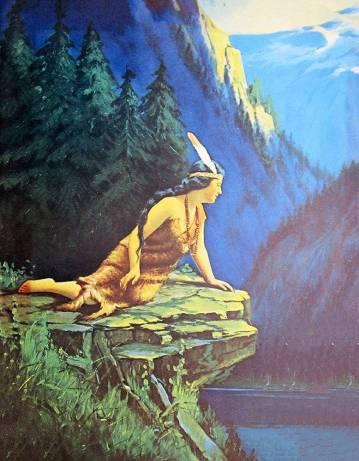
I told you about Barkley, the hero of Entewa; the Mountain Bird. Now I’ll tell you about the villain.

He is Spendower (first name unknown, like Barkley), who goes by the nickname “Old Cub,” a name acquired from his “apparent indolence and stupidity.” (Which seems a slur on bear cubs.) He always seems to have money and a jug of whiskey with him, but no sees him engaged in mining or any other lawful occupation.

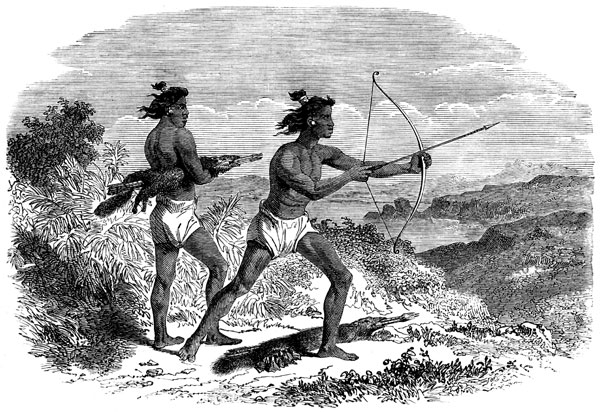
As the author tells his readers in the second chapter, “Old Cub” is the leader of a band of outlaws who rob miners and camps in the guise of Indians. There is absolutely no suspense here. You would think that the author would lead his readers on with an attack or two by the “Indians” and then let the hero uncover the deception, much to the readers’ astonishment. But no, we know from the first that this is the villain’s modus operandi. No surprises lay in store.

Barkley doubts Old Cub’s stories of Indian depredations from their very first meeting, on that “dark and stormy night,” because Barkley is sober and perceptive. But everyone else in the cabin that night believes him, and falls in with his plans for Indian extermination. And the men of the mining camp do indeed carry out an attack on an Indian village, killing innocent women and children, while Barkley is out hunting elsewhere.

While hunting, Barkley and his two companions, Mike the Irishman and Giles the young backwoodsman, come across the robber’s roost, where the bandits are getting into the whiskey stores while their leader Old Cub is away.

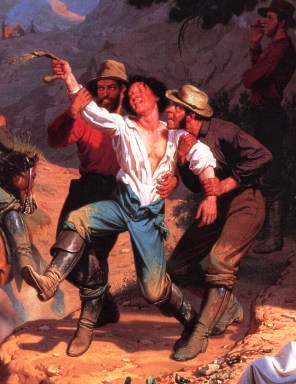
Drunk+and+Vulnerable

Detail from Charles Nahl’s Sunday Morning in the Mines

Thus commenced one of their drunken orgies. By the time the sun had reached the meridian, the repeated draughts had unbared their bosoms, shook off restraint, and showed the real demon, stalking in human shape. The pale glimmerings of the freshly fed fires, flashing in the sickening gaze of these reckless devils, who laughed and yelled, and sung their uncouth songs, with most unnatural howls, made them appear horrible, — too horrible.


Now that they know where the bandits’ hideout is, the good guys can see that they are brought to justice. Time to organize a posse and root out the evil lurking in the mountains!

But first, Barkley will have to meet Entewa at last. Stay tuned.


Posted in Entewa, Uncategorized | Leave a comment

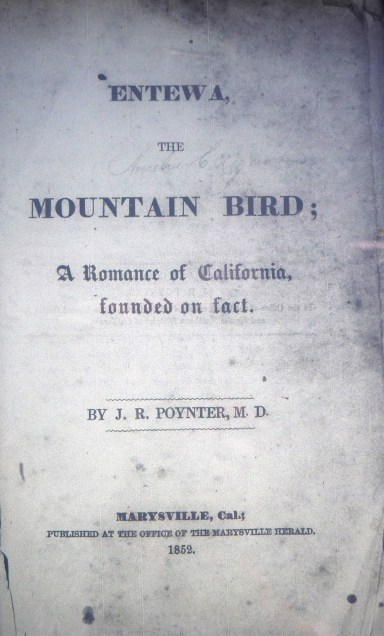
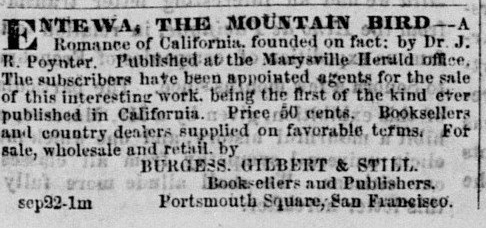
Entewa; the Mountain Bird

DSCF6024 (2)

The first fictional work ever published in California was a tale of romance and adventure in the gold-mining camps, written by a young doctor and printed in Marysville. The title is Entewa; the Mountain Bird, and the author was J. R. Poynter, M.D.

As far as I know, there is only one copy of the book extant in the world, and it belongs to the Yale Beinecke Library. (Folks in Marysville ought to be checking their attics for rare books!)

Fortunately for readers like myself who like to track down literary curiosities, the book is on microfilm in the Western American Frontier History series. Meriam Library Special Collections at CSU Chico was able to obtain it for me from another university. I would not be surprised if I were the first person to read this work in decades.

The story takes place around Coloma, the site of the first gold discovery, in the year 1849. Our hero is Barkley, “a young man of some twenty-three summers, of medium statue [sic], with light hair, and well defined features.” It’s easy to confuse Barkley with Lieutenant Blakely, who is introduced in the same paragraph, but Blakely, although he possesses “a countenance that was as free and open as his heart was just and good,” will not turn out to be as perceptive and noble-hearted as Barkley.

darkThis chapter, which begins, gratifyingly, with “It was a dark and stormy night,”* introduces several other characters, including an old mountaineer who tells the others, “Home! What, leave these diggings to go back on your old barren knobs beyant them hills? No, boys; never let sich notions trouble you as long as you kin make a ounce a day.” An ounce a day of gold flakes — all you need. Good advice from an old prospector.

Not much actual gold digging takes place in the story. There are bandits, robberies, chases, encounters with Indians, and a lot of palaver, but not much mining. Our hero is more likely to go out hunting for game than panning for gold.

For comic relief the author gives his readers a lanky backwoods boy from Missouri named Giles Jolt, and a comic Irishman who speaks in as thick a brogue as anyone could wish for.

“The bloody murtherers,” said Mike, seriously to himself, “an’ thim is what they are murtherin’ the poor craytures wid. Feth! Michael O’Gafferty, ye were the all-fir’dest fool that iver got the gold faver, to lave the home of yer fathers, an’ poor Jenny, an’ the boy in the bargain.”

But who is Entewa? Stay tuned for more about Entewa, the Mountain Bird.

*”It was a dark and stormy night” is the beginning of the opening sentence in Paul Clifford, by English novelist Edward Bulwer-Lytton. It was published in 1830, and I have no doubt that J. R. Poynter was an admiring reader of the book.

Posted in Entewa | 2 Comments

The Lost States of America

loststatesI came across this fun book titled Lost States: True Stories of Texlahoma, Transylvania, and other states that never made it, by Michael J. Trinklein (Quirk Books, 2010). This is a light-hearted and well-illustrated look at dozens of proposed states that never made it onto the map of the United States. Some were just wacky suggestions and others were serious proposals that were considered by Congress. Most are long-forgotten, but a few are still being promoted.

Many of these ideas tried to solve a geographic or economic problem: how should the Dakotas be split up, east/west or north/south, or, what to do with a territory such as Arizona/New Mexico that doesn’t have enough population (maybe call it Montezuma?)

There are some great names for states here. How about Absaroka, Deseret, Hazard, Muskogee (not in Oklahoma), Nickajack, or Yazoo?

California has generated more than its share of phantom states. Here is a little bit about each of the parts of California that might have been states in their own right (not counting recent proposals to divide California into 3, or 6, or 9 pieces)—

Nataqua: I wrote about Nataqua, the territory organized by Isaac Roop and Peter Lassen. It compassed an under-populated area of northeastern California and a swath of Nevada. Just one little problem: they drew the lines so that Susanville, the seat of government, was outside the boundaries.

jeffrsonflagJefferson: Made up of southern Oregon and northern California, this was first proposed in 1941 and is still an idea that is alive and kicking. Otherwise known as Wildfire Country at the present.

The flag shows a gold pan with a double X, represented the two regions that consider themselves “double-crossed” by their state governments.

Shasta: A small version of Jefferson comprising the northernmost counties of California (but not Tehama or Butte counties), first proposed in 1957. It all has to do with southern California stealing the north’s water.

South California: Promoted in 1859 by Andres Pico (brother of the last Mexican governor of California) as a place for the displaced Californios. He wanted to call it Colorado. Although Mr. Trinklein doesn’t mention it, there were also American Southerners who wanted to make a separate state in the south of California where slave ownership would be legal.

Sonora: That indefatigable filibuster William Walker took over Baja California and might have hung onto it, but he got greedy and tried to take the state of Sonora as well. The Mexican army ran him off. He then tried the same thing in Nicaragua and Honduras.

And last and likely least of all, Rough and Ready: The town declared its secession from the Union as “the Great Republic of Rough and Ready” on 7 April 1850, largely to avoid mining taxes, but voted to rejoin the Union less than three months later on 4 July, because they didn’t want to miss out on celebrating the independence of the United States. Trinklein says that they also seceded when Nevada County declared itself a dry county, but I don’t know if that part is true.

Posted in Uncategorized | Leave a comment

A Lady in the Northern Mines

Just a snippet from a book I was looking at yesterday. I always enjoy reading about women pioneers and the reaction they engendered when they arrived at a mining camp.

The book is The Pierce Chronicle: Personal Reminiscences of E. D. Pierce as transcribed by Lou A. Larrick. Pierce was a forty-niner who mined in California, Oregon, Washington and Idaho.  He was mining and trading at Scott’s Bar in Shasta County in 1850 or ’51 when the following occurred:

Among the new arrivals was Rev. D. H. Lowery and wife. She was the first Lady that came into camp at the northern mines. Some of the first discoverers of the mines had not seen a white lady for two years when they arrived. The miners telegraph line was hurled through the camp that a lady had arrived.

The men all quit work to come to see her, and seemed to stand and gaze with wonder and astonishment. If a locomotive with a train of cars had passed by it would not have created any more excitement, just to think for a woman to travel horse back two hundred miles in the month of Feb. in a mountainous country, through snow over a rough trail, having to camp out every night. It must have taken a persevering and determined mind and deserved to be applauded by every one.

I have no idea who Mrs. Lowery was or whether she was young or old. If she were young, then she would remind the men of a sister, wife, or sweetheart back home. If she were older, she would remind them of their dear old mother or grandmother. It didn’t matter. Just to see any woman was refreshment.

miners

Posted in Uncategorized | Leave a comment

The Untimely Death of Isadore Meyerowitz

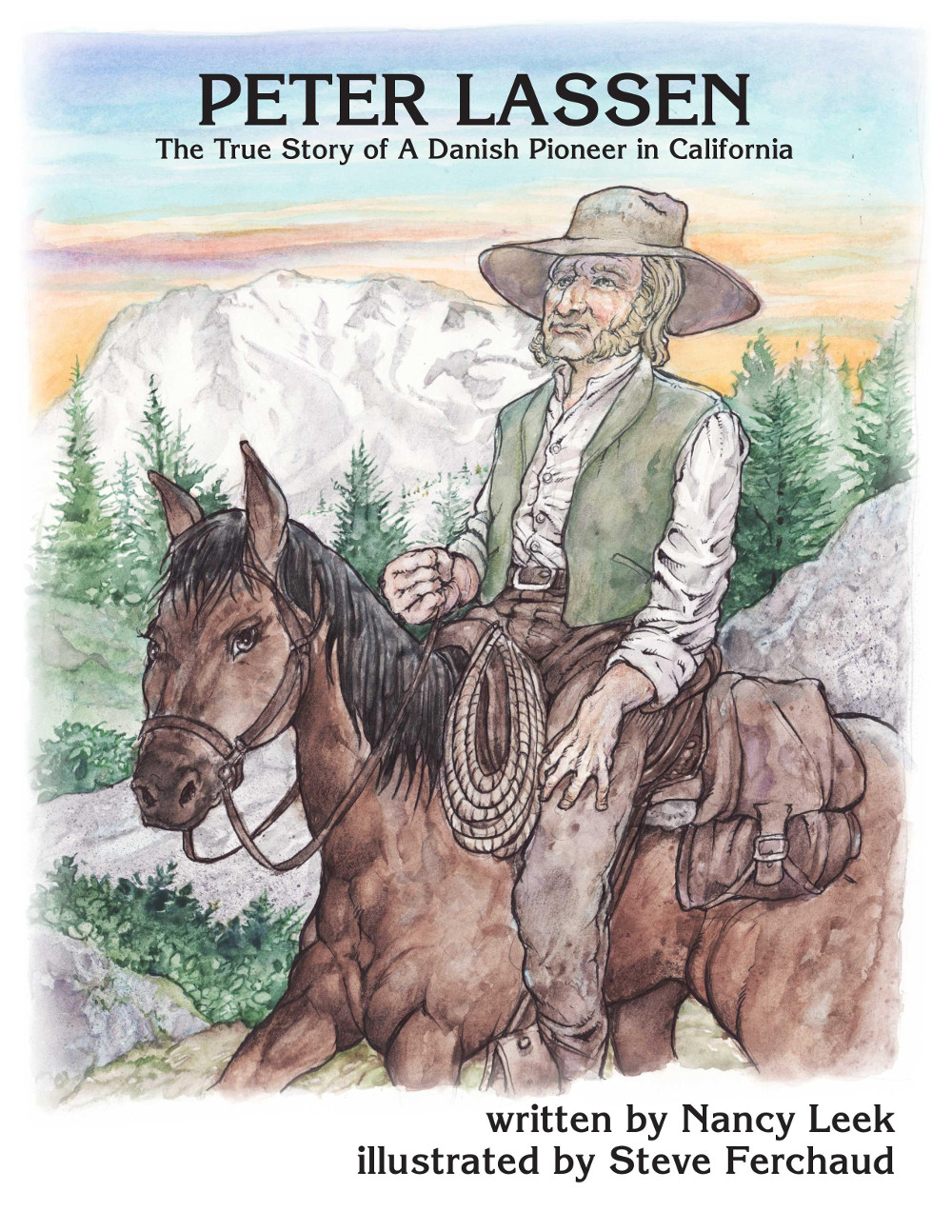
Isadore Meyerowitz and Peter Lassen moved from Indian Valley to Honey Lake Valley in the summer of 1855. It was a place they had visited as early as 1850, and they became permanent residents when they wintered over in 1855-56. They built a long low log cabin and started ranching in the valley.

Not knowing whether or not they were living within the boundaries of California due to the remote nature of the location, Lassen, Meyerowitz, and other residents of the area including Isaac Roop, decided to organize and declare their own territory. They named it Nataqua and drew up a set of territorial laws. Lassen was the first, and Isadore the second, to put their signatures on the document.

But Isadore’s term of life in Nataqua was short. In the summer of 1856 a boating accident claimed his life.

He and a companion known as Sailor Jack built a crude boat from a wagon bed. With two (or more) other men and Isadore’s Indian wife they set sail on Honey Lake. (Isadore’s wife’s name was never recorded.)

Once out in the middle of the lake, a gust of wind caught the sail and capsized the boat. At first they clung to the makeshift craft, but his wife kept slipping off, and she and Isadore both drowned. One man swam to shore and two others drifted with the boat until it reached the shore. It was a sad end to a sunny July day.

DSCF6248The bodies were never recovered. Isadore’s only memorial was a tribute written in Hutchings’ California Magazine a year later:
Isadore, for thy gentleness and kindness, many loved thee, and for thy true-hearted manliness many respected thee, and — as always when the good die — Isadore, many mourn thy departure.

(Illustration by Ben Barker on the cover of The Short-Lived Explorations of Isadore Meyerowitz, by Rosaline Levenson)

Posted in Uncategorized | Leave a comment

The California Adventures of Isadore Meyerowitz

[I was trying to fix a missing picture in this post, but I can’t find the picture, and I can’t put the post back to 2018. So I’ll just post it again so as not to lose it.]

When I visited the Lassen Historical Museum last month, I bought a little book titled The Short-Lived Explorations of Isadore Meyerowitz, by Rosaline Levenson.  Knowing that Isadore was Peter Lassen’s partner, I was interested in reading the book. Ms. Levenson did an outstanding job of tracking down every possible bit of knowledge about Isadore’s life. It’s a short book though — very little is known about the man.

Isadore was either a Russian or a Polish Jew. As Levenson points out, parts of eastern Poland alternated between Polish and Russian rule, but given the spelling of his name, he was probably from a Polish area. The date of his birth and the date of his immigration are both unknown, but it is likely that he was younger than Peter Lassen, his partner.

Isadore and Peter Lassen settled in the Indian Valley of Northern California in the 1850s. There they ran a trading post and grew vegetables to sell to miners and travelers. Isadore spent seven years as the partner of Peter Lassen and like Lassen must have been of the same restless and independent nature. Some men who met him in Indian Valley in 1854 referred to him as “an intelligent Russian.” He could speak the local Indian dialect and was married to an Indian woman.

Isadore came to California in either 1848 or 1849. He was a Mason and his name appears on the roster of California Lodge No. 13 when it first met on November 17, 1849. Lassen too was a Mason, although attached to a different lodge, and the Masonic tie would have helped to form a bond between the men.

J. Goldsborough Bruff, to whom we are indebted for so much information about Gold Rush California and Lassen in particular, wrote the following about Isadore in a diary entry on November 14, 1850:

Here occurred an instance of Israelitish fraternal regard. My estimable friend Isadore went to the wagon, in which was a friend of his, a brother Israelite, whom he had previously served. He hinted to him his present situation, when the other offered him a purse of several thousand dollars, but he took only a small sum, to purchase some necessaries to carry out in the hills.

Next time: The Untimely Death of Isadore Meyerowitz

Posted in Uncategorized | Leave a comment

Projects, I Have Projects!

My big project this summer is remodeling our kitchen, which was vintage 1974. Harvest gold everywhere! Even a range hood in harvest gold. Now it is almost done — just a few bits of trimming to put on and getting the washer and dryer back in place and then putting everything back together.

But I have writing projects too. Two.

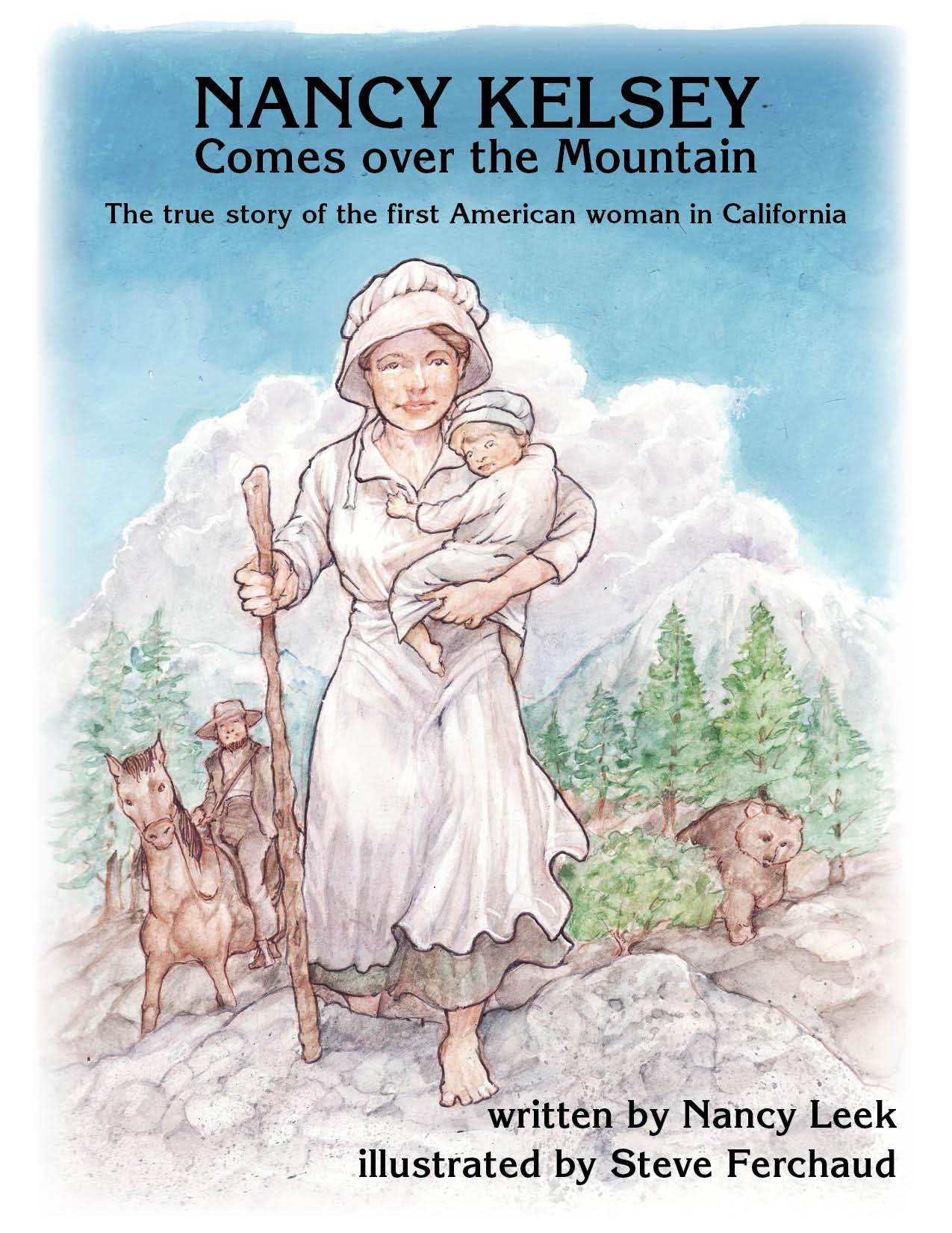
One is a picture book biography of Peter Lassen. Lassen’s name is all over northern California and several books have been written about him (mostly short ones because so much of his life is undocumented). But I have never seen a children’s book about him. So I wrote one.

Steve Ferchaud — Stunning Steve — is doing the illustrations. Right now I am going over the sketches to see if any corrections are needed. How do you like this picture for the title page?

PLBtitlepage

The first two pages will show Copenhagen harbor in 1830 and a Danish farm village. I sent these illustrations and the text to our former Danish exchange student for his critique. He and his father have been very helpful. My aim is always to have the text and pictures as accurate as humanly possible.

My other project is ANCHR‘s forthcoming publication on the Chico and Humboldt Wagon Road. It is based on some archeology work done by Greg White on a portion of the road. My contribution is a chapter on the history of the road and John Bidwell’s involvement in starting it and promoting it.

I didn’t know I would find this as interesting as I have. But once I get started on research, and start finding letters and receipts and news articles, then I can’t wait to find out more. For example — Bidwell and the wagon road company hired any good labor they could find — Indians, whites, Chinese. Here is a photo of a receipt for Chinese workers. Notice the signatures on the right.  Pretty neat!

dscf6093.jpg


Posted in Uncategorized | Leave a comment

A Lady Book Agent – 7

Only a few months after the Likins family arrived in San Francisco they experienced a violent earthquake. The earthquake had a magnitude between 6.3 and 6.7, and took place on the Hayward Fault on October 21, 1868. It was called the Great San Francisco Earthquake until the quake of 1906 came along.

Aftershocks continued for a few weeks. Amy Likins resumed her book-selling and was in Santa Clara when another strong shock hit.

DSCF6030

I now concluded to go to Santa Clara and canvass that town, before delivering my pictures in San José. Eight o’clock in the evening found me seated in the ladies’ parlor at the hotel, conversing with the landlord concerning the severe shock of earthquake we had two weeks previous.

I thought, if the Lord spared me, I would not stay another night in a brick house. I had partially undressed when the house commenced shaking. Frightened all but to death, I scarcely knew what to do; but found myself in the door-way with the candle in my hand, thinking I must not go into the street in this condition. There came a second shock. I blew out the light, threw it on the floor, and rushed into the street, not caring how I appeared. It was full of people. Some of them looked at me curiously; but I drew my shawl close about me and stood my ground, nor could I be persuaded to return to my room. The clerk brought me my shoes and baggage, and took me where he knew I could obtain lodgings, to a lady’s, a few doors away. She gladly offered me shelter, as her husband was away from home, and she was very lonely. 

There were several light shocks after I had been there. Next morning, many joked me about my appearance the evening previous, especially Mr. W., who said he never would forget how comical and frightened I looked.

What a welcome to California!


Posted in Uncategorized | 1 Comment

A Lady Book Agent – 6

DSCF6026And here she is! Or should I say, “Here I Come,” since that’s what Mrs. J. W. Likins says herself on the picture. Six years of selling books had given Amy Likins plenty of confidence.

This is the title page of her book, first published in 1874, and reprinted by the Book Club of California in 1992. The text can be accessed online at the Library of Congress (that’s what I have been using for my excerpts), but the online transcript does not include the illustrations.

To see the illustrations I had to go to the History Room of the California State Library, never a hardship for a history researcher. I had several other things to look for, but first I had to find this book.

In her memoir Mrs. Likins included the story of their trip to California by the Nicaragua route. This was an alternative to crossing the Isthmus of Panama, but actually a very similar experience. Their steamship landed at “Greytown” (San Juan de Nicaragua) and they transferred to a smaller steamer named the “Active.”

DSCF6028

The steamer was a small coaster with no cabin or accommodations whatever. There was a heavy sea, and the little steamer seemed to have all she could carry, but still battled with the waves that seemed to threaten her destruction at any moment: at every surge she seemed to crack, and sound as though she would break to pieces.

She was named the ‘Active’, and I think it a very appropriate one too, for nearly all on board soon became very active, and seemed as though they would throw up even their boots; but I will not jest about it. All the benches were occupied by ladies, lying down, groaning and moaning. The strongest man reeled, while others weaker soon became so sick that they lay on the bare floor, in all the filth and dirt—among them my husband. I was seated on some baggage, watching and tending my little girl, who was so white and limp I was afraid she would die.

The illustrations are crude, but nevertheless a delightful addition to the narrative. More to come.

Posted in Uncategorized | Leave a comment

A Lady Book Agent – 5

Mrs. Likins, the Bancroft book agent, took pride and comfort in her membership in the Rebekah order of the Independent Order of Odd Fellows and she mentions this several times in her memoir.

Independent_Order_of_Odd_Fellows

Seal of the Sovereign Grand Lodge, Independent Order of Odd Fellows

The Odd Fellows were founded in the United States of America in 1819 and quickly became one of the foremost fraternal orders. It became the first fraternity in the United States to include both men and women when it adopted the Rebekah degree in 1851, at the behest of Schuyler Colfax, later Vice-President of the United States under Abraham Lincoln. The Odd Fellows emphasized service and charity along with the usual benefits of fraternity, and by the second half of the 19th century they were the largest fraternal organization in the United State.

oddfellowsAmy Likins says that she became a Rebekah fifteen years before coming to California in 1868, which would have been only two years after the degree was created. She found her association quite useful as she went about her travels as a book agent. A man wearing the symbol of the Odd Fellows, the three link chain, was someone she could trust, someone she could call on to assist her if she were accosted by some “ruffian,” as she relates in the following story.

The next day I visited the R.R. offices, and on making my appearance before the illustrious and distinguished Govenor S.*, I was treated with a very great deal of respect, and received permission from him to visit all of the offices, after having himself patronized me, for which I tendered him my sincere thanks. I then called in every office, and among the numerous clerks; my order book will show evidence of their liberal patronage, for which I thanked them all very kindly. I here admit that Rail Road men are a class that have treated me very politely, and with but one exception .  . .

This fellow was in the employ of Mr. J., the superintendent of the road from Sacramento to Folsom. He was a baggage master, by the name of L. He came up to me, and offered to shake hands. Without being impolite, I could not very well refuse, at the same time telling him that I did not remember ever meeting him before. With a hateful grin, he said, “you cannot play that on me; didn’t I see you in San José, the week before last, working on this same book?” reaching his hand for the prospectus, which I refused to give him, saying, “you are very much mistaken, I was in that place, but had a different book.”

“I presume you take me for Mrs. B.,” who was working there on the same book. He answered, “you need not try to play such a game on me, as I know you are that Mrs. B.; probably if you don’t want to recognize me, you would recognize Mr. F., the engineer, if he would come around. Probably, you will also deny making a row between him and his wife, a few weeks ago.”

Finding it was impossible for me to convince him of his mistake, and seeing that he was a ruffian under the influence of liquor, and as I had tried hard to get away from him and his abuse, he persisted in following. At a little distance, I saw a Mr. J—, who wore an emblem of Odd Fellowship, and was pleased to find that he had taken the Rebekah degree; and immediately inquired of me what assistance I needed. I told him my name and situation as best I could, for weeping. I pointed out to him the ruffian, who stood at some little distance. Mr. J— called to him, and told him he must necessarily be mistaken, as Mrs. J. W. L. must be a lady, or otherwise she would not be in possession of certain signs and pass-words. He also told him that if he did not at once beg the lady’s pardon he would discharge him from his employ.

The ruffian did indeed beg her pardon, “with a half drunken idiotic grin on his
countenance,” and Mrs. Likins went on her way, secure in the knowledge that her Rebekah affiliation had come to her aid.

*Presumably Governor Leland Stanford, who after serving a term as state governor (1862-63), went back to being a railroad baron.

Posted in Uncategorized | 1 Comment