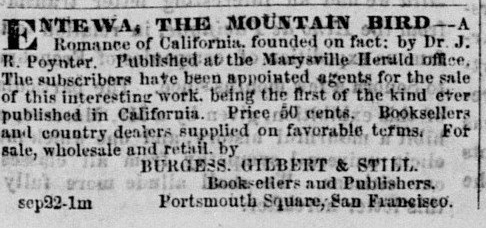
The author of Entewa, the Mountain Bird was J.R. Poynter, M.D. What can we find out about Dr. Poynter?
The book was published by the Marysville Herald in 1852. Possibly it was serialized in that newspaper, but I don’t know if digital or microfilm copies of the paper exist. It isn’t in the California Digital Newspaper Collection. But searching that online newspaper collection does find a few mentions of Dr. Poynter, and it turns out that he was a busy man.
He shows up in the 1852 California census, as I. R. Pointer, in Yuba County, age 28, birthplace V (for Virginia). He was probably born in 1824. If he came to California in 1849, then he was 25 years old when he joined the Gold Rush, with a newly minted medical degree.
One can imagine that Dr. Poynter joined a company of fellow Virginians and set out for California, but whether overland or by ship we don’t know. He probably tried his hand at mining, and found out that more money could be made doctoring or raising animals or almost anything else.
Sometime in 1852 he traveled back to the states. The Marysville Daily Herald reported on 30 August 1853 that:
Our old townsman, Dr. Poynter, has also just arrived. with a drove of about 400 cattle. He started in company with Mr. Holloway who was drowned in Green River. He came by Salt Lake city, and by taking the north side of the Humboldt, avoided the crowd of emigration. Dr. P. thinks that about one-fifth of the cattle started from the States, died on the way. The bloody murrain was prevalent, in many herds, and fatal. Most of those coming with stock, left here for the purpose of stocking their ranches with good American cattle. The proportion of beef cattle is not large. Holloway and Poynter started with several young calves in their train. Six of them toddled through. and arrived fat and thrifty. Enterprising young “oxens.”
When the 49ers arrived in California there was plenty of Mexican cattle around, but many stockmen wanted to improve their herds with the American cattle they were familiar with.
Early in the 1850s he tried his hand at politics. In 1851 he took part in a political meeting in Weaverville, Shasta County, and was appointed one of seven delegates to attend the Whig Convention in San Francisco to support the nomination of Captain William Waldo for governor. And in 1854 he ran for state senator from Sutter and Yuba counties. The Whigs were a dying party at this point though, and Poynter lost the election.
During the rest of the 1850s Dr. Poynter bred and raised stock. He won prizes for mules and cows at the California State Fair: for instance, first prize of $25 for the best California-bred Jack (mule), first premium ($15) for the best jennies and the same for the best pair of California-bred mules. (Sacramento Daily Union, 21 September 1859)
He also kept practicing medicine, and one incident made it into the papers.
Sacramento Daily Union, 18 July 1855
So here is a man with an active life and a promising future. Unfortunately his life and future were cut short by his death in 1860.
Marysville Daily Appeal 19 April 1860
And that is all we know about Dr. J. R. Poynter. But if I ever turn up anything else about him, I’ll let you know. He was a remarkable man, and the author of the first work of fiction ever published in California.
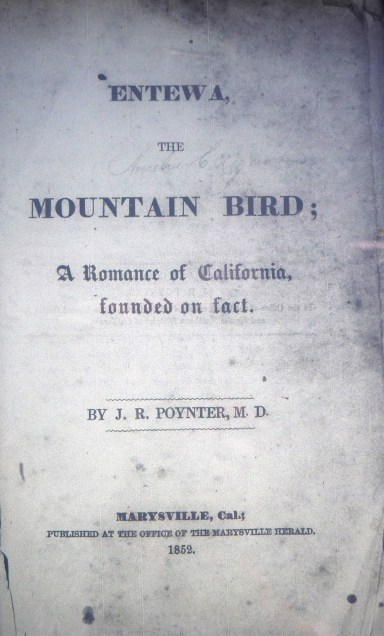 Next time I will tell you what little I know about J.R. Poynter, the author of Entewa, the Mountain Bird.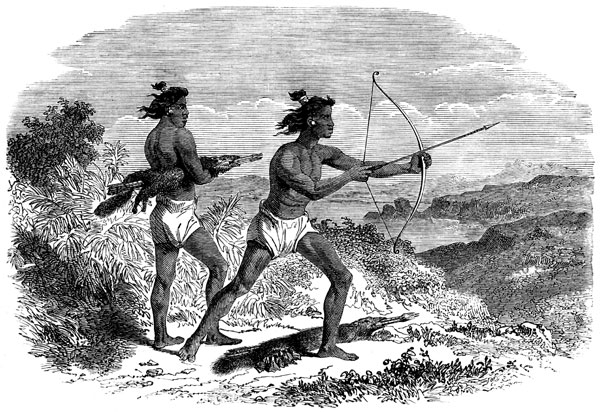


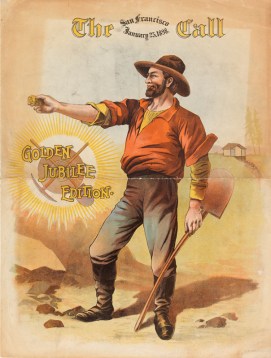
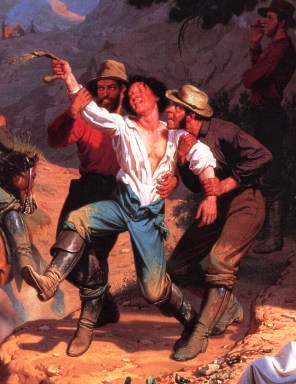

 This chapter, which begins, gratifyingly, with “It was a dark and stormy night,”* introduces several other characters, including an old mountaineer who tells the others, “Home! What, leave these diggings to go back on your old barren knobs beyant them hills? No, boys; never let sich notions trouble you as long as you kin make a ounce a day.” An ounce a day of gold flakes — all you need. Good advice from an old prospector.
 I came across this fun book titled Lost States: True Stories of Texlahoma, Transylvania, and other states that never made it, by Michael J. Trinklein (Quirk Books, 2010). This is a light-hearted and well-illustrated look at dozens of proposed states that never made it onto the map of the United States. Some were just wacky suggestions and others were serious proposals that were considered by Congress. Most are long-forgotten, but a few are still being promoted.
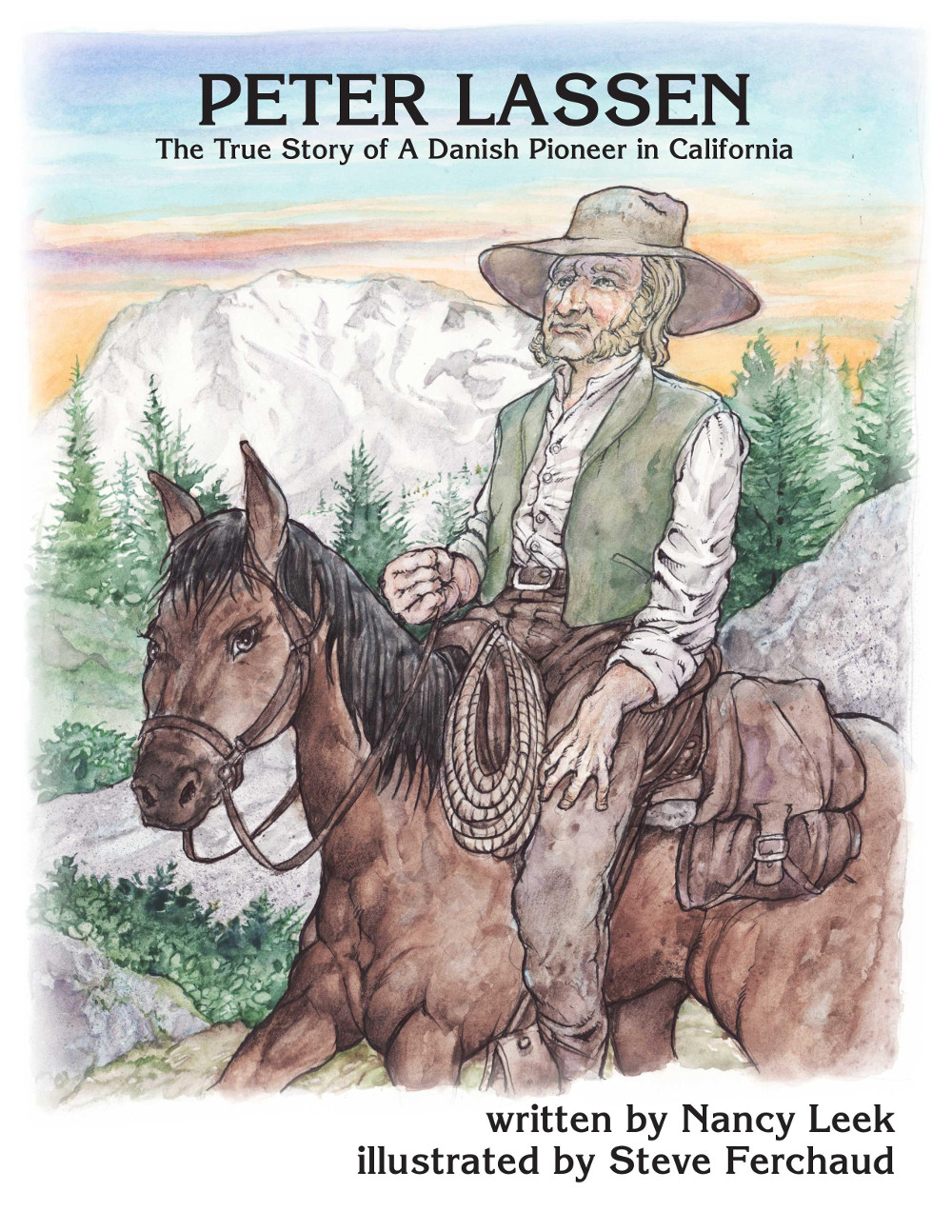
 Jefferson: Made up of southern Oregon and northern California, this was first proposed in 1941 and is still an idea that is alive and kicking. Otherwise known as Wildfire Country at the present.
 The bodies were never recovered. Isadore’s only memorial was a tribute written in Hutchings’ California Magazine a year later:
 goldfields