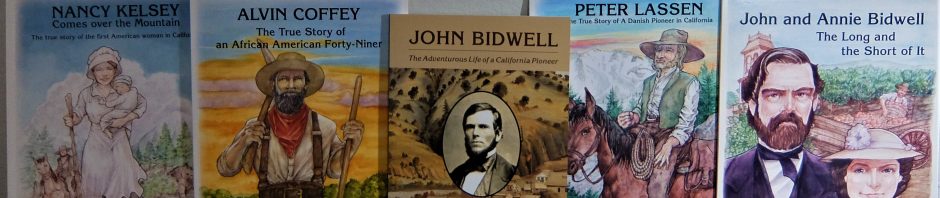
On the Trail of Peter Lassen — 3

On to Greenville!

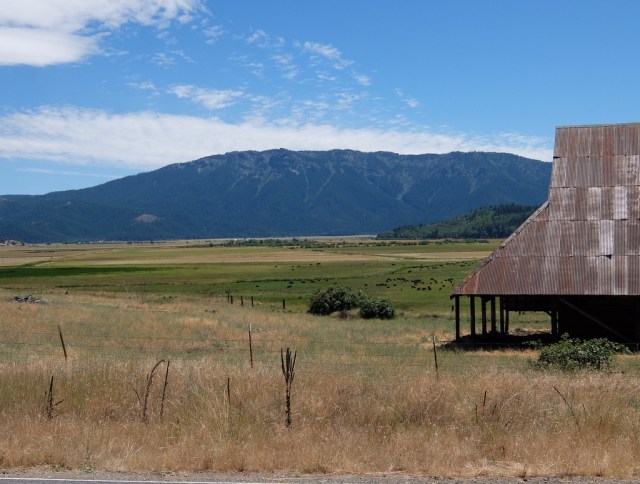
After leaving Susanville on Hwy. 36, we turned south on Hwy. 147 and drove along the east shore of Lake Almanor, then east on 89 to Greenville. In Greenville a left turn on Main St. (there’s a sign pointing the way) took us to North Valley Road, which circles the Indian Valley.

It’s a lovely place, as you can see.
DSCF5805

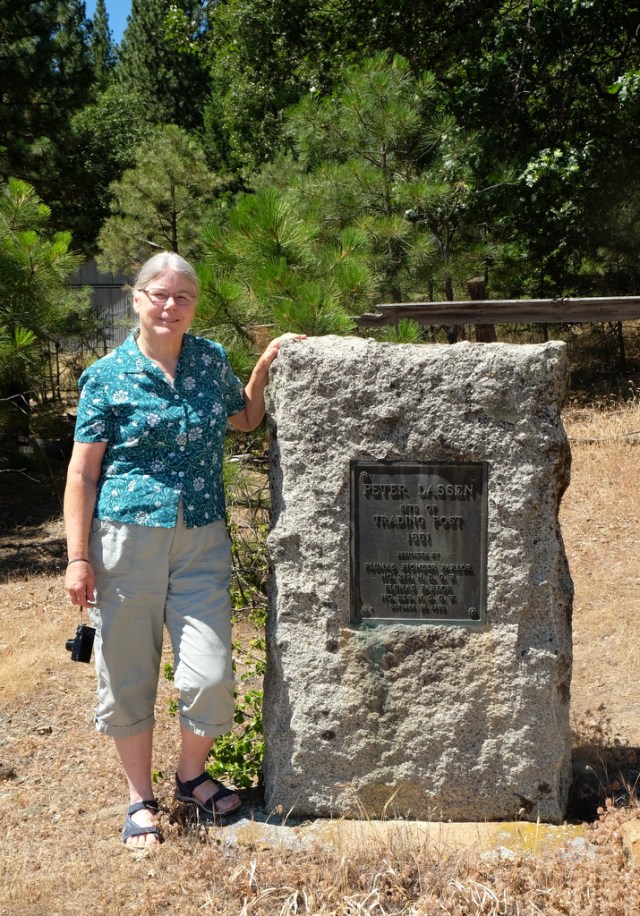
About 5 miles out of town we came to a marker beside the road. This was the location of Peter Lassen’s trading post in the Indian Valley. He grew vegetables with his partner Isadore Meyerowitz in this valley to sell to hungry miners. Everything they grew sold for 15 cents a pound. His trading post was on the ridge behind, sheltered by trees.
lassen-trip-2018 (32)


We were a little surprised to find some other people at this lonely monument. They had metal detectors and were climbing over the fence that was posted No Trespassing. Hmm, I wondered, who are these people?

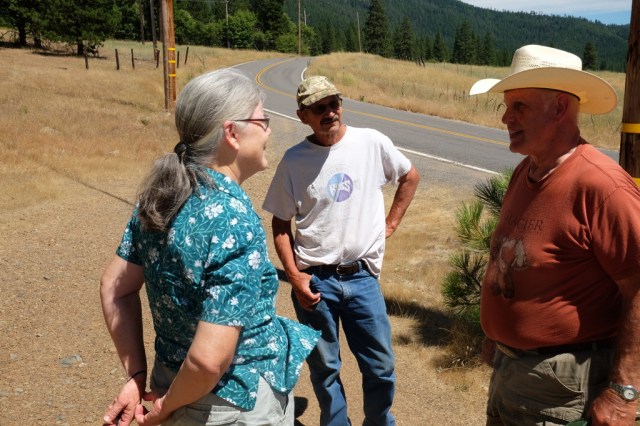
They turned out to be entirely legit. One was the land owner, a rancher named (I think) Harry Rogers. He had invited a crew of archeologists to examine the spot and see what they could find.  And who should come walking up the road but Ken Johnston, the author of Legendary Truths: Peter Lassen & His Gold Rush Trail in Fact & Fable. What better person to meet when on the trail of Peter Lassen? And while we were standing there on the roadside gravel, he spotted a square nail on the ground. I picked it up and set it on top of the monument, along with a couple other nails he had spied.
lassen-trip-2018 (41)

Talking to the rancher and Ken Johnston.

The perfect meeting on a perfect day for following the trail of Peter Lassen.
Posted in Uncategorized | 2 Comments

On the Trail of Peter Lassen — 2

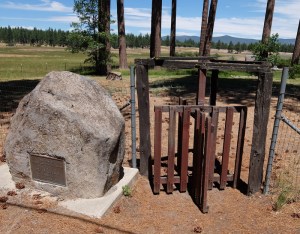
DSCF5803No visit to Susanville on the trail of Peter Lassen is complete without a visit to Lassen’s grave. He is buried in a small Masonic cemetery about 5 miles south of Susanville. The cemetery has a charming little turnstile gate next to a stone marking the site.  It’s a beautiful setting for a resting place, on the edge of the valley where sheep graze and the graves are shaded by tall Ponderosa pines.
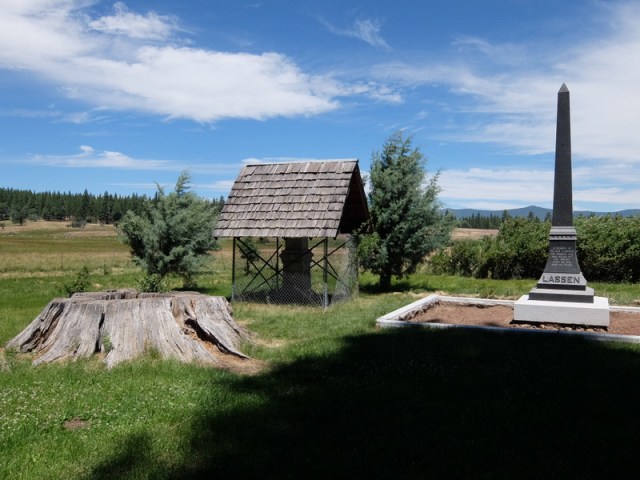
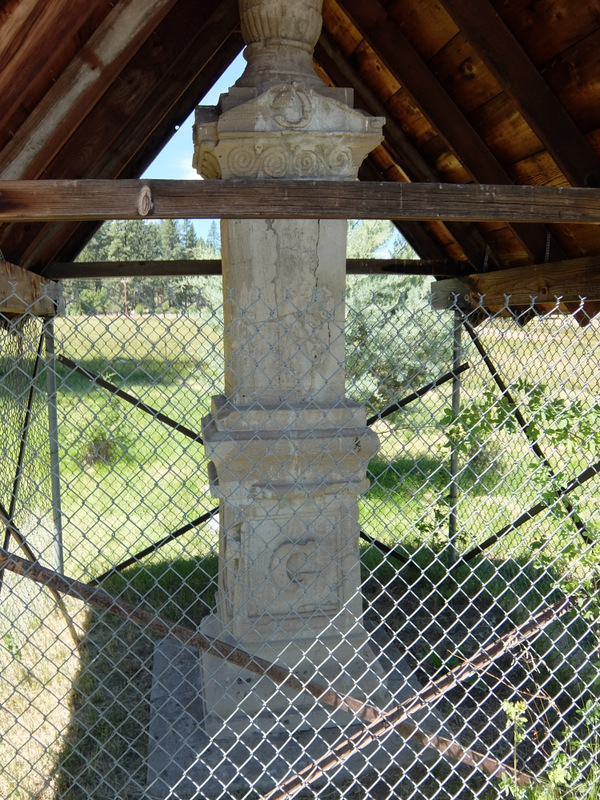
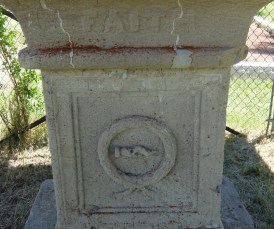
When Lassen was murdered on April 26, 1859 in the Black Rock Desert, his friends went to investigate. They buried the bodies of Lassen and his partner Ed Clapper at the murder site. But this was deemed unbefitting so notable a pioneer, and in November 1859 his remains were brought back to the Honey Lake Valley.

DSCF5797

Lassen was buried next to the mammoth Ponderosa pine that had been his shelter when he first came to the Honey Lake Valley. Over the years the tree died and was removed in 1961. Scientists studying the tree declared it to be some 600 years old, and probably the oldest and largest tree of its species in North America. The stump, nine feet in diameter, still sits next to the grave.

DSCF5799

DSCF5795The grave marker is a handsome example of 19th century mortuary art, carved with Masonic symbols, such as an all-seeing eye and clasped hands, as well as crossed gun and arrow. The monument is fenced in and roofed to preserve it from weather and the the kind of vandals who like to carve their initials on anything handy.
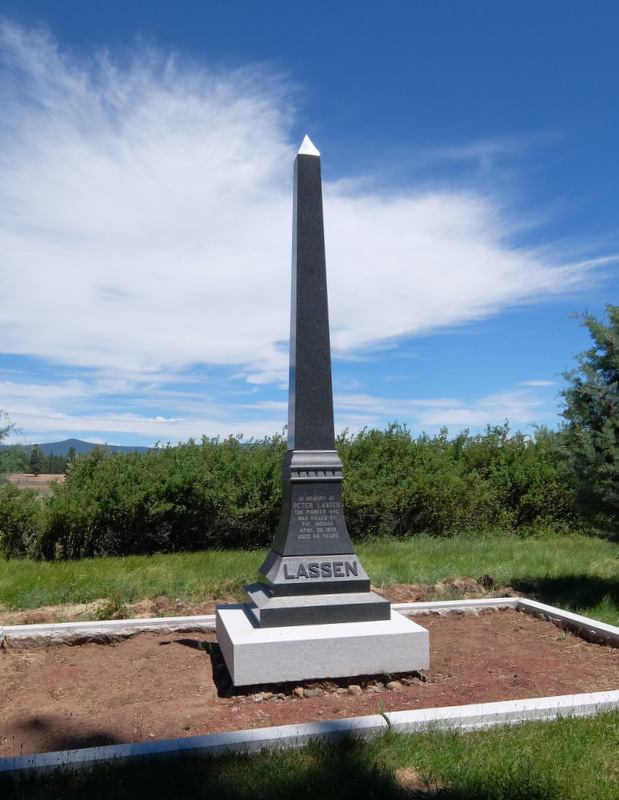
The soft rock of the grave marker has weathered over the years, and a granite monument was erected in 1917. The inscription reads: In memory of PETER LASSEN the pioneer who was killed by Indians April 26, 1859 / Aged 66 years. The age is wrong — he was 58 when he was killed, and the attribution of his death to Indians is most likely incorrect as well.

DSCF5793


Posted in Uncategorized | Leave a comment

On the Trail of Peter Lassen

I am working on a picture book biography of Peter Lassen, the old Danish pioneer whose name is all over Northern California. I have written about his mysterious death previously on this blog.

Today I went to Susanville to find out more about Lassen. It was a beautiful day for a drive up into the mountains, where it was nice and cool compared to the Sacramento Valley.

DSCF5791

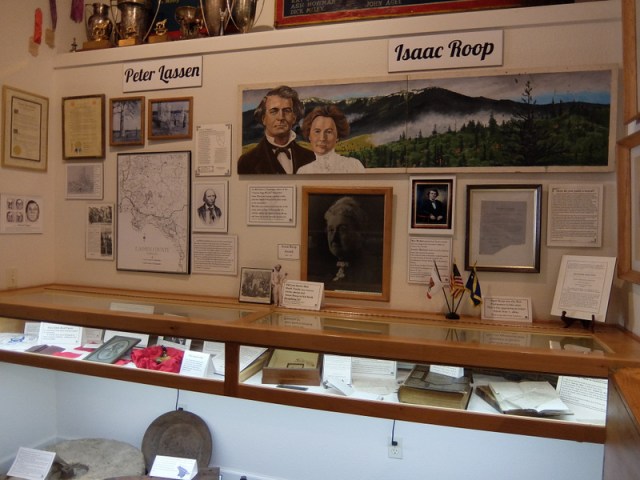
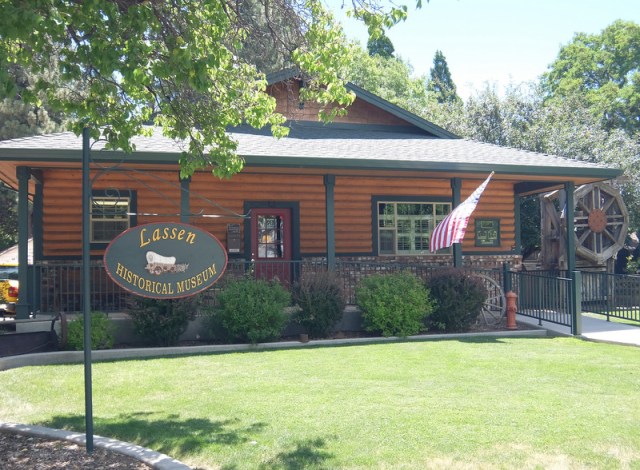
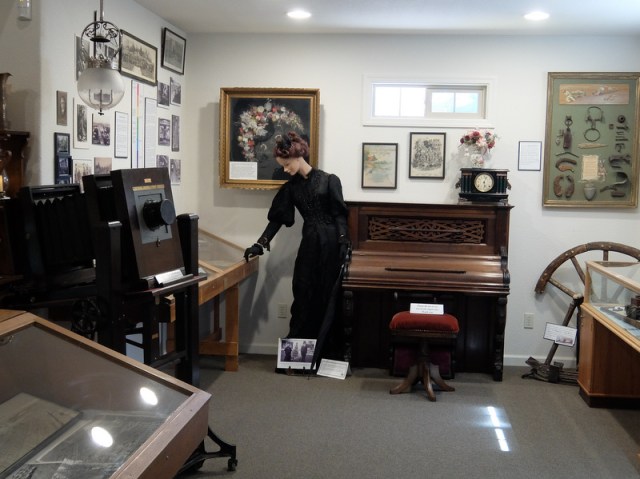
Susanville has a fine historical museum, where all the artifacts are neatly arranged and well labeled. It is open Tuesdays through Friday 10 a.m. to 2 p.m., and Saturday 10-1.

DSCF5767

There is a nice section on Peter Lassen and Isaac Roop, the founder of Susanville. The lovely young lady next to handsome Mr. Roop in the painting is his daughter Susan, for whom the town and the Susan River are named.

DSCF5766

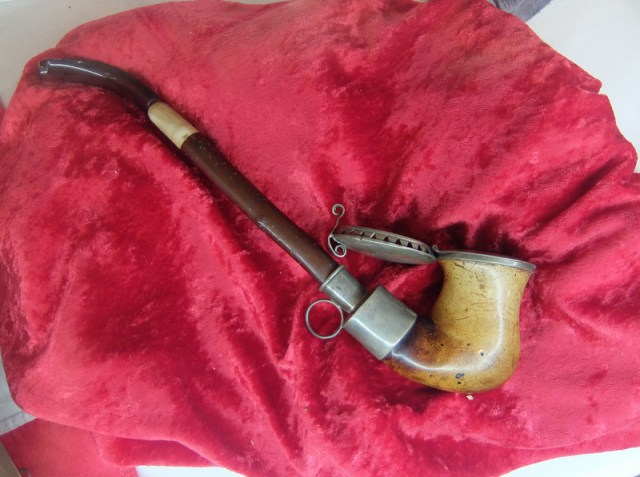
The display includes Lassen’s Danish Meerschaum pipe. It was fun to see that, a genuine item linked to Lassen. The docent at the museum was also kind enough to let me look through their files on Peter Lassen.

DSCF5751

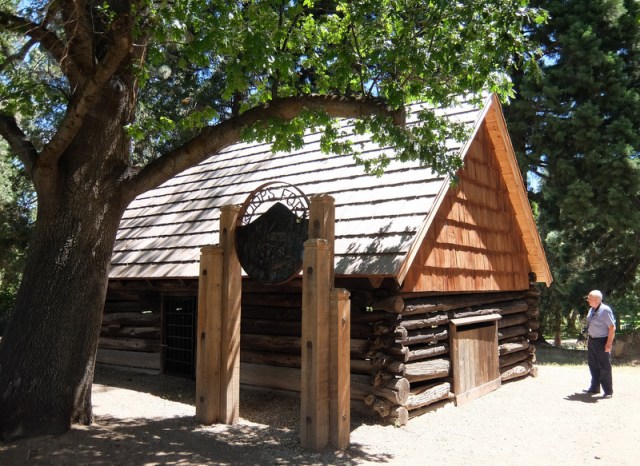
Behind the museum is Roop’s Fort, a log building that was once Isaac Roop’s trading post, but during the Sagebrush War of 1863 it became a stockade with the rather grandiose name of Fort Defiance. One of these days I will tell you more about the Sagebrush War.

DSCF5788

After a visit to Lassen’s grave (more about that next time) we had lunch at the Pioneer Cafe and visited Margie’s Book Nook next door. I never could resist a bookstore, especially one with piles of used books.

Posted in Uncategorized | Leave a comment

Pulu!

File this under “You learn something new everyday.”

Whenever I am looking for an article in an old newspaper (in the California Digital Newspaper Collection — a wonderful resource), my eye always strays to the advertisements. They are frequently entertaining and sometimes baffling.

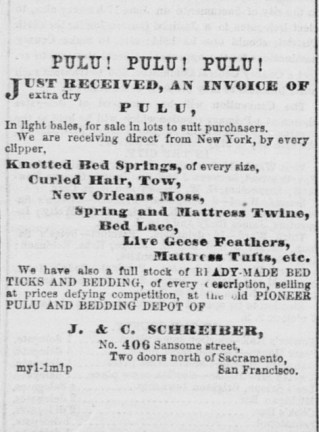
puluThis ad announcing PULU! PULU! PULU! caught my eye because I had no idea what pulu is. Clearly from the rest of the ad — which gives you a good idea what people stuffed their mattresses with — it had something to do with bedding.

Wikipedia came to my aid.

Pulu is a silky material obtained from the fibers of the hapu’u pulu (Cibotium glaucum), a tree fern which grows in Hawaii. The Hawaiians used it for padding, dressing wounds, and wrapping the dead.

The ad appeared in the Sacramento Daily Union on 21 May 1863.

Wikipedia states:

For a period in the 19th century, pulu was collected, dried, and exported to California commercially as pillow and mattress stuffing.  A stone structure in Hawai’i Volcanoes National Park known as the Old Pulu Factory was a site for drying and packing pulu. However, the discovery that pulu breaks down and crumbles into dust after only a few years led to the demise of the industry. Pulu was collected by cutting down the slow-growing ferns, an extremely unsustainable method. The industry shut down by the 1880s.

And now you know about PULU!

Posted in Uncategorized | 2 Comments

A Grand Gala Day in Chico

Month JULY Issue Date JULY 05 1888 page 3It was a full day of celebration in Chico on July 4, 1888. As reported in the Chico Enterprise, Independence Day was packed with patriotic activities.
Yesterday morning Chico, the “City of Roses.” looked gay, and her citizens smiled in the most satisfactory manner as they gazed upon the beautiful, loyal, and patriotic decorations which were displayed in the most artistic manner from nearly every store and dwelling in the city.

The day began with a parade, featuring dignitaries, the Colusa and Chico Guards, the Native Sons of the Golden West, cars and floats “beautifully trimmed” featuring young ladies representing the different states of the Union, and much more.

The firemen and exempts with their gaily decorated engines and hose carriages were quite a feature in the procession, while the old veterans of Halleck Post G.A.R. [Grand Army of the Republic], were the admired of all admirers.

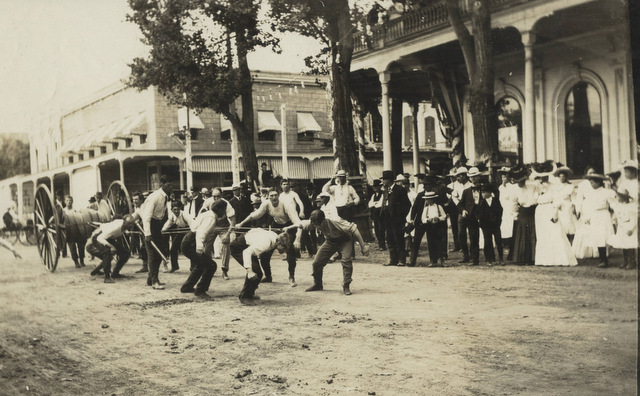
The parade was followed by a patriotic program of orations and music, and then a review of the troops.  A highlight of the afternoon was the “hose races” between the five fire engine companies, to see who could be the swiftest in unrolling their hoses and making their attachments on Broadway. Engine Co. No. 1 set a record time of 36 seconds and won a prize of $60.

Barber_hose_team

The Barber Hose Team, winning team July 4, 1905

Next on the day’s agenda was the laying of the cornerstone at the Normal School building, presided over by Grand Master Hiram N. Rucker of the Grand Lodge of Free and Accepted Masons of California. The newspaper report gave a full and lengthy list of the contents of the copper casket which was deposited in the cornerstone. I wonder what happened to the casket when the first Normal School building burned down?

This grand event was followed by the parade and performance of “horribles,” a “motley crowd of clowns, stump speakers, and brass band,” much to the amusement of all. The evening finished up with a ball, a “beautiful panorama of youth and beauty” in the Pavilion.

Posted in Uncategorized | Leave a comment

A Bit More about Entewa

Just a tiny bit more on the first work of fiction published in California.  Entewa, the Mountain Bird is mentioned briefly in Print in a Wild Land, by John Myers Myers (and no, that is not a typo — that was his name), a book about the world of Western newspapers, published in 1967.

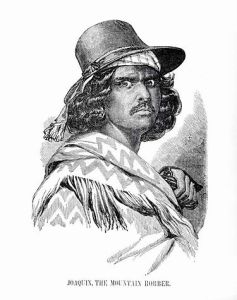
JoaquinTheMountainRobber

Another bandit, the semi-fictional Joaquin Murrieta

At the time the one and only copy of the book was owned by the estate of a famous collector of Western Americana named Thomas W. Streeter. Tied up in the estate, it was not available for viewing. All Mr. Myers Myers could say about it was that it was a paperback of 119 pages. Quoting Streeter’s catalog, he says

This is not only the first novel printed in California, but the scene is laid in the gold regions in 1849; and it is a first-class story with the villain of the piece a bandit whose crimes were ascribed to the Indians.

As they so often were.

I really do have to see if I can get access to the microfilm for this book.

Posted in Uncategorized | Leave a comment

Entewa, the Mystery Book

I have been reading an old book about the Sacramento River and California history — The Sacramento, by Julian Dana. It was part of the Rivers of America series and published in 1939.  The book has some entertaining stories, but it is dated and leaves much to be desired in the way of footnotes and bibliography.

entewa

An ad that appeared in the Sacramento Daily Union, Oct. 6, 1852

Along the way the author mentions the very first novel written in California. Entewa, The Mountain Bird: A Romance of California, Founded on Fact, written by Dr. J.R. Poynter and published in Marysville in 1852.

Well! that sounds intriguing. The first novel published in California — I’d like to see that book!

Good luck with that. It is an exceedingly rare item. It has never been digitized by Google Books. The California State Library and the Bancroft Library do not own copies, let alone my local state college library. The public library in Marysville does not have it. It does exist on microfilm, and according to WorldCat, a few universities have copies of the microfilm.  The original (and possibly the only extant copy) is in the Beinecke Library at Yale University.

As best I can tell, it is about life in the diggings and among the California Indians. Perhaps it features a handsome young forty-niner and a fair Indian maiden.

I wish I could tell you more. If I ever track it down, I will. Don’t you think someone ought to reprint it?

Posted in Uncategorized | 3 Comments

California As I Saw It

If you find accounts of life in early California fascinating, as I do, then the Library of Congress has a treasure trove for you. California as I Saw It contains first-person narratives of life in early California, from 1849 to 1900.

This collection includes more than 180 accounts by men and women who came to California in its formative years. Some of the writers are well-known figures, like Jessie Benton Fremont, John Bidwell, and Richard Henry Dana, the author of Two Years Before the Mast. Many others are remembered only because they kept a diary or later wrote a memoir, like Luzena Stanley Wilson, and numerous male Forty-Niners.

You can find Luzena’s full account here, as well as some other people I have written about, such as Edward McIlhaney and H.H. Bancroft. Here is where you can read Sim Moak’s The Last of the Mill Creeks. Check out the list of collection items, or search by contributor. Every item can be read online or downloaded.

0001Enjoy!


Posted in Uncategorized | 2 Comments

The Further Adventures of Luzena Wilson

goldrush_luzena_wilsn

Luzena in later years, a shrewd woman by the looks of her

It’s been a while since I wrote about Luzena Stanley Wilson and her memoir about life in Gold Rush California, but I have been meaning to get back to it. Her recollections are full of striking detail about everyday life, just the kind of thing I want to know about.

So here is another excerpt from her memoir (not long after they arrived in Sacramento in 1849):

Half the inhabitants kept stores; a few barrels of flour, a sack or two of yams, a keg of molasses, a barrel of salt pork, another of corned beef (like redwood in texture) some gulls’ eggs from the Farallones, a sack of onions, a few picks and shovels, and a barrel of whisky, served for a stock in trade, while a board laid across the head of a barrel answered for a counter. On many counters were scales, for coin was rare, and all debts were paid in gold dust at sixteen dollars per ounce. In the absence of scales a pinch of dust was accepted as a dollar, and you may well imagine the size of the pinch very often varied from the real standard.

Just imagine corned beef “like redwood in texture.” It would take some chewing!

Nothing sold for less than a dollar; it was the smallest fractional currency. A dollar each for onions, a dollar each for eggs, beef a dollar a pound, whisky a dollar a drink, flour fifty dollars a barrel.

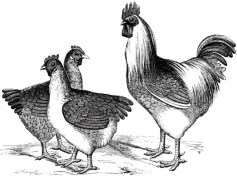
Free-Vintage-Chicken-Graphics-GraphicsFairyThis was when eggs in the States sold for 2 cents each and flour for about 10 cents a pound, with 196 pounds to a barrel. Think how valuable a flock of hens would be.

One morning an official of the town stopped at my fire, and said in his pompous way, “Madame, I want a good substantial breakfast, cooked by a woman.” I asked him what he would have, and he gave his order, “Two onions, two eggs, a beefsteak and a cup of coffee.” He ate it, thanked me, and gave me five dollars. The sum seems large now for such a meal, but then it was not much above cost, and if I had asked ten dollars he would have paid it.

Luzena saw that this was the way to earn a living, and she and her husband soon sold their oxen and bought a hotel — a small wooden building where she cooked from morning till night.

More about Luzena and her hotel to come.

Posted in Uncategorized | Leave a comment

A Wholesale and Damnable Outrage

Another tidbit from the Pioneer Collection at the California State Library — a letter from Butte County Sheriff J.Q. Wilbur to John Bidwell:

Hamilton, Butte Co. Cal.  July 4, 1851

Dear Major—

I should like to come up this morning with Fry but having some very troublesome business on hand I shall not be able to come for some days. My health is tolerable good only, and I have soon to take the field against a band of outlaws at Bidwells Bar, who have been committing a wholesale and damnable outrage upon one of my deputies, Mr. Dodge.

gunfight

Random old-time gunfight illustration

What was it? A shootout in the street? A brawl in the barroom?

I wish I could tell you what that band of outlaws was up to at Bidwell’s Bar, but I can find no other information. Newspaper accounts can be scanty for 1851.

But Deputy E. K. Dodge would go on to be elected sheriff himself in September of 1851, just two months later.

Sheriff Wilbur goes on to inquire about a lame mule. Then he takes up the subject of local politics (“This ticket will not give satisfaction to the Democratic Party, for they certainly have put forward our very weakest men“).

He closes:

I hope to see you at Ophir today.  Your friend, J.Q. Wilbur

Ophir being the old name for Oroville.

What a tantalizing letter! If we only knew more about that band of outlaws and their “wholesale and damnable outrage.”

Posted in Uncategorized | Leave a comment