Time Traveling to Chico

The article on Chico in the Pacific Rural Press, published July 3, 1886, continues with a  description of Chico’s financial and manufacturing capacity:

Bank_of_Chico

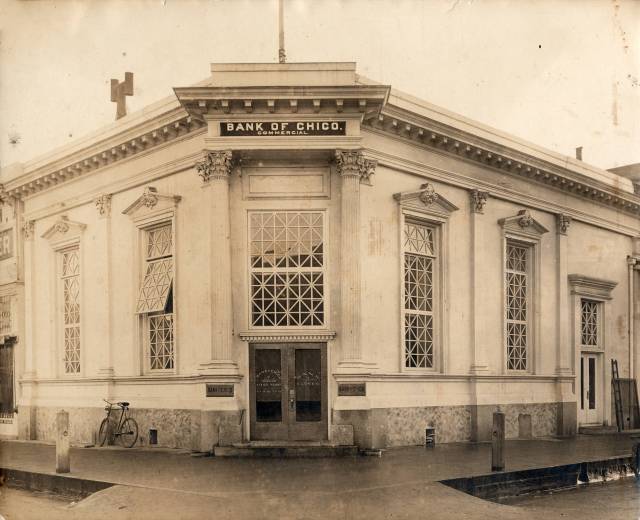
The Bank of Chico, ca. 1900. Look familiar?

Chico has two solid banks—the Bank of Butte County and the Bank of Chico. Both are located in fine brick blocks on opposite corners of Broadway and Second street. The former has a capital of $250,000, with a surplus of about $24,000. N. D. Rideout, the well-known banker of Northern California, is president, and Charles Faulkner cashier. The Bank of Chico, organized in 1872, has a paid-up capital of $100,000, and a surplus of $30,000. W. D. Heath is president, and Alex. Crew cashier. Both banks carry on a general banking business and buy and sell exchange on all the principal cities of the United States.

Among the manufactories are included planing mills, box factories, foundries, breweries, soda works, carriage and harness factories, and two large roller flour mills fitted with the latest improved machinery.

Sierra_Lumber_Company_flume_at_Chico

Employees of the Sierra Lumber Company at the yard where the flume ended. The water was discharged back into Chico Creek.

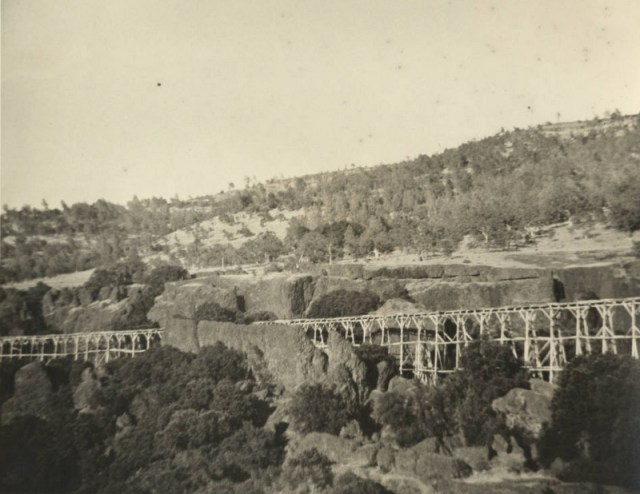
On the east side of town is situated the extensive lumber yard and planing mills of the Sierra Flume and Lumber Company, whose great V-shaped flume extends for 40 miles up into the fine timber belt of the Sierras. The company manufactures extensively sash, doors and blinds of all kinds, and gives employment to a large force of men. The immense lumber yard, embracing 15 acres, is filled with lumber and building material of every description. A side track from the railroad, running through the yard, affords excellent shipping facilities.
Sierra_Lumber_Co_Flume

The Sierra Flume running through Chico Creek Canyon

Chico has lines of stages running to Oroville, Prattville (Big Meadows), Cherokee, Deadwood, Colusa, and to Newville, Colusa county, by way of St. Johns and Orland.

I want to know where Deadwood was, or is. Mining camp or lumber camp? Is it a ghost town today? I have never heard of Deadwood in Butte County.

All photos are used courtesy of Special Collections, Meriam Library. California State University, Chico.  The library has many more historical photos, including many flume pictures, in the Northeastern California Historical Photograph Collection.
Posted in Chico, Uncategorized | 2 Comments

Visiting the Garden City

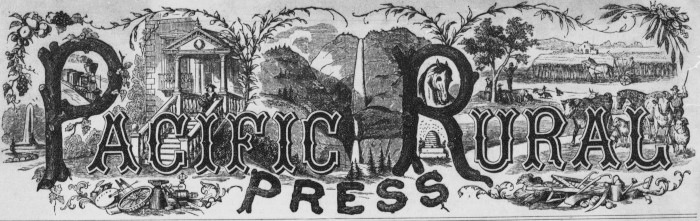
I’ve been browsing online issues of the Pacific Rural Press. Look at their masthead — isn’t that a delight? They don’t make them like that anymore.

pacific rural press-001

Note the locomotive in the loop of the P and the horse’s head in the R, with a beehive below. Is that Yosemite Falls in the center? I like the house (or is it a school?) on the left and the wheat field on the right, not to mention all  the implements (a little tricky to make out) along the bottom.

The Pacific Rural Press was published from 1871 to 1922 by Dewey & Co. of San Francisco. Here is what they had to say about visiting Chico in 1886:

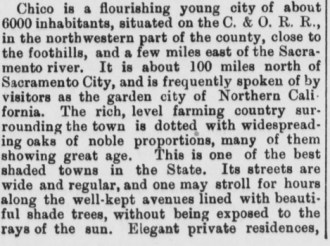
PRP chico1Chico is a flourishing young city of about 6000 inhabitants, situated on the C. & O. R. R., in the northwestern part of the county, close to the foothills, and a few miles east of the Sacramento river. It is about 100 miles north of Sacramento City, and is frequently spoken of by visitors as the garden city of Northern California. The rich, level farming country surrounding the town is dotted with wide-spreading oaks of noble proportions, many of them showing great age. This is one of the best shaded towns in the State. Its streets are wide and regular, and one may stroll for hours along the well-kept avenues lined with beautiful shade trees, without being exposed to the rays of the sun.
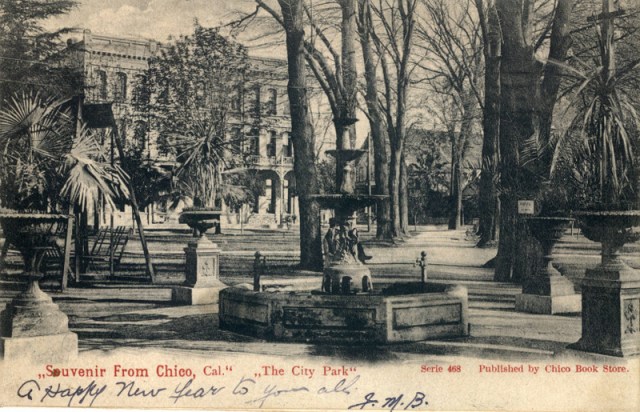
Elegant private residences, set in the midst of tastefully-arranged lawns and gardens, and pretty little vine-covered cottages, are to be seen on all sides, while an attractive feature of the place is a handsome little park, occupying a square in the center of the town. Chico creek, a clear, cool stream from which the town takes its name, flows through the place; and Recreation Park, Bidwell’s Park, and other fine groves in the suburbs, contribute to the beauty of the surroundings. The town has well-equipped gas works and water works, and an effort is being made to place electric lights on some of the main streets.

The press is well represented by several live weekly and daily newspapers. Chico is noted for the large number and variety of its well-filled stores and the many different business establishments. The High School building, a fine brick structure, the different private schools, and the several large churches, show that educational and religious matters are not neglected. The new opera house, the commodious public halls, the many hotels and restaurants, and the elegant equipages seen on the streets, give the place quite a metropolitan appearance.

Doesn’t that sound pleasant? The garden city of Northern California! Oh for a time machine so that we could visit Chico as it was!

Chico_City_Plaza(1)

Chico City Plaza, ca. 1905


Posted in Chico, Uncategorized | 3 Comments

A Blog for History Buffs

If you like history (and you must since you are reading this blog), The History Blog is a great place to get your daily history fix.

“Livius Drusus,” the editor of the blog, faithfully posts a history news item every day of the year, a schedule very few bloggers can boast of, myself included. Every day it is something different: the discovery of an Anglo-Saxon coin hoard, or the excavation of a centurion’s villa under a Metro station, or the restoration of a Renaissance painting. Here are two good recent ones:

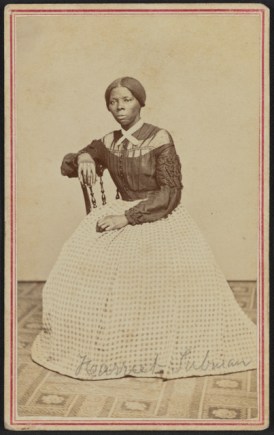
Harriet-Tubman

Signed portrait of Harriet Tubman, c. 1868

Did you know that there is a photograph of Harriet Tubman as a young woman? It was discovered in an album last year, and the Library of Congress quickly digitized the entire album so that everyone could take a look. I had never seen a photo of her that wasn’t taken in old age. The History Blog reported on it when it was first discovered and the album went up for auction, and again this month went the digitization became available.

Harriet Tubman was in her mid-forties when this portrait was taken, so she is not really a young woman, but it is so much earlier than the other portraits we have seen, that it seems young.

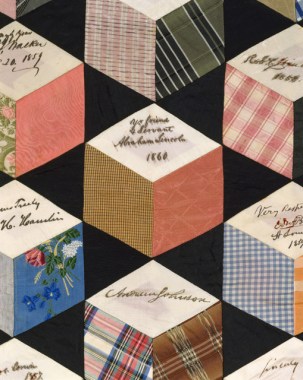
Are you the kind of person who likes to quilt? (I quilt occasionally.) Would you spend more than 20 years on one quilt? (I don’t have that kind of stamina.) Adeline Harris spent eleven years collecting signatures from famous people of her day, and even longer sewing the blocks that incorporate the signatures. Her quilt is a who’s who of 19th century America, with the autographs of presidents, generals, authors, clergymen, scientists, actors, and many more — 360 signatures in all.

http://www.metmuseum.org/art/collection/search/15391

Detail from quilt, with the autograph of Abraham Lincoln in center

She meticulously sewed the signature scraps to two other pieces of silk, to make what is called a “tumbling block” pattern. The assembled blocks give the optical illusion of stacked cubes. It is a tour de force of quilting. The quilt was kept in pristine condition by her family for 140 years, and now belongs to the Metropolitan Museum of Art.

These are just two entries at The History Blog that fascinated me, but really, the blog is a treat every day. Check it out!


Posted in Uncategorized | Leave a comment

A Tour of Rancho Chico, Part 2

Dow devoted not one, but two chapters of A Tour in America to General Bidwell’s Rancho Chico. His next chapter is about “A Fruit Orchard of 1000 Acres.”

The 1000 acres of orchard and vineyard are not all in one block, but grouped around a number of the homesteads in different parts of the property. One homestead has its apple and pear orchard, another its almond orchard, and so on, a system which enables the main work of fruit-gathering to Be conducted at the various centres in turn.

He says that irrigation is available but generally not used in the orchards, which surprised me. Maybe my fruit trees could get along with less water than I give them. I worry that they will dry up and blow away over the long hot valley summer. Back in the day, irrigation was mainly used for the nursery and the vegetable garden.

Dow tallies 12,000 peach trees, 5000 plums, 3000 apples, 3000 apricots, 2000 pears and 1600 cherries, and also give their yields for 1881 (980,000 lbs. of peaches!) What did Bidwell do with all this fruit?

The only large towns in the state available as markets are San Francisco (with less than 300,000 inhabitants) and Sacramento (with 26,000) while, as these cities have extensive areas of fruit gardens in their immediate vicinity, much of the supply from Chico must be sent to the more distant centres of population. A quantity of green fruit is sent by rail to cities in the eastern states, reaching as far as Chicago, New York, and New Orleans, thousands of miles from Chico, while the canning establishment puts the surplus in a condition to be transported to any part of the world.

It’s no wonder General Bidwell wanted to build the Humboldt Road to the mines of Nevada and Idaho. He needed markets for his surplus produce.

Dow also tells us the cost of labor: “The cheapest labour in the country costs 4s. 2d. per day, this amount being paid to Chinese, and to women and girls in canning factories, while white men receive from 6s. to 8s. 6d. a day.”

And how much was an Australian shilling worth in 1883? According to my trusty web pal, Measuring Worth, one shilling was worth $5.60 Australian dollars today, which is $4.40 American. So a white male laborer was making about $4 a day on Rancho Chico.

But wait! There’s more. Measuring Worth always has a caveat, as follows:

This may not be the best answer. The best measure of the relative value over time depends on if you are interested in comparing the cost or value of a Commodity, Income or Wealth, or a Project. If you want to compare the value of a £0 1s 0d Commodity in 1883 there are three choices. In 2016 the relative:
real price of that commodity is $5.60
labour value of that commodity is $41.64 (using average weekly earnings)
income value of that commodity is $41.66

And much more, which I would need a degree in Economics to understand.

Peach_harvesting_on_Rancho_Chico

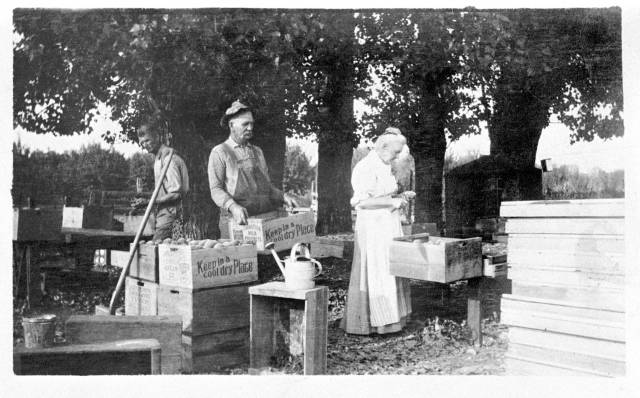
Peach packing in the orchard. Note the age of the workers. If it weren’t for Social Security, that would be me.

The fresh fruit which is sent to market is gathered and placed in small boxes in the orchard, the fruit being graded or assorted to some extent upon the spot. A light waggon gathers up the boxes and takes them to the fruit-house, where they are evenly filled and closed up ready for transportation to the railway station, about half a mile distant. Fruit intended for such distant markets is packed in a special way. Each pear or plum is wrapped in a piece of paper before being placed in the box ; a Chinaman, at a dollar a day, being very expert at this kind of work.

So it could be that 4 shillings a day was more like $1 US, which is in line with average wages in the U.S. in 1880, according to another website.

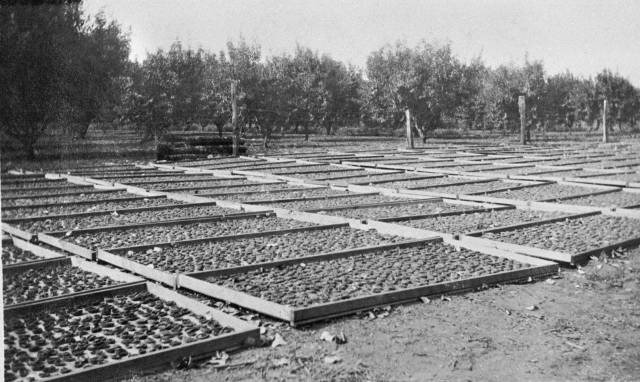
Much of the fruit was dried, and a lot of the apple crop was turned into vinegar. Dow explains the process. Anyone wishing to set up a similar operation today could get quite a bit of information from reading Dow’s Tour in America. Dow has this to say about grapes, wine, and raisins:

General Bidwell formerly made wine, but now raisin-making varieties of grapes are being substituted, and no wine is produced. It is believed by many that raisin-growing is more profitable than wine-making, but this consideration has not been the General’s object in changing his procedure. He came to the conclusion that the making of wine contributed to intemperance, and therefore devoted his vineyard to the production of raisins.

Prune_drying_Rancho_Chico

Prunes drying. Fruit was partially dried in the sun, and finished in an artificial drier.

Posted in Uncategorized | 3 Comments

A Tour of Rancho Chico in 1883

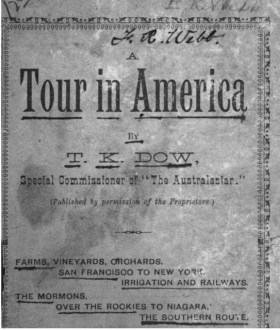
Fullscreen capture 352018 81423 PMIn 1883 Thomas Kirkland Dow, Australian journalist, set out to visit the United States and report on agricultural practices to the readers of his magazine, The Australasian. His book, A Tour in America, was published in Melbourne in 1884.
After arriving in San Francisco, Dow proceeded to the Sacramento Valley to observe best practices at three outstanding locations. The three ranches he visited were Dr. Hugh Glenn’s enormous wheat farm in what was then Colusa County (now Glenn County), former Governor Leland Stanford’s vineyard at Vina, and General John Bidwell’s Rancho Chico.

Mr. Dow was decidedly impressed with Bidwell’s ranch, writing, “The estate of General J. Bidwell has the reputation of being the most interesting and the best-conducted farm in California.”

He commends General Bidwell for being one of those “landowners who do not sacrifice everything to the immediate making of money.” for Bidwell, “while seeking to work his estate at a profit, values some things in the world more highly than money.”

Not only have the natural beauties of the country been preserved, but the gold derived from its productiveness have been expended upon developing and increasing the pleasing appearance of the estate. The property of 25,000 acres is like a group of delightful parks, and one drives for hours in every direction along charming avenues, past farm-houses, orchards, vineyards, grain-fields, and pastures, among browsing cattle and sheep, and seeing busy fruit-gatherers as well as quickly-moving harvesting machinery, without ever losing the sense of rural beauty.

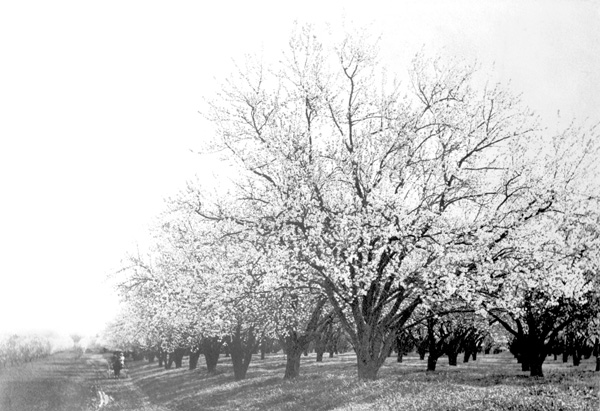
sc10658Almond Orchard, Bidwell Ranch
ca 1895

Almond orchard on Rancho Chico

Dow was overwhelmed with the beauty and variety he found on Rancho Chico, and describes the “winding carriage-ways,” the fields of grain, the vineyards, orchards, animal-raising operations, the nursery, the flour mill, fruit drying operation, the canning factory, and more. He was especially impressed with “the experimental plots, where there are some forty different kinds of cereals grown under various conditions of agriculture.”

He was well taken care of during his short stay. General and Mrs. Bidwell fed him on “ice-crowned heaps of strawberries and cherries” at breakfast and took him on “delightful driving excursions along endless miles of avenues formed of planted trees or cut out of the natural forest.”

General Bidwell ran his ranch like a well-organized corporation:

There are managers in charge of the different departments, and overseers under the managers ; and the General has been able to organize matters so as to relieve himself of much personal supervision. There are five gentlemen in charge of sections, who constitute a kind of board of management, with the general as president. Thus there are the head bookkeeper, the miller, the manager of the vineyards and orchards, the manager of the agricultural branch, and the manager of the stock. These gentlemen meet in General Bidwell’s office every Monday morning, and oftener if needful, and discuss whatever business there is to be dealt with, and whatever is agreed upon is carried out by each individual.

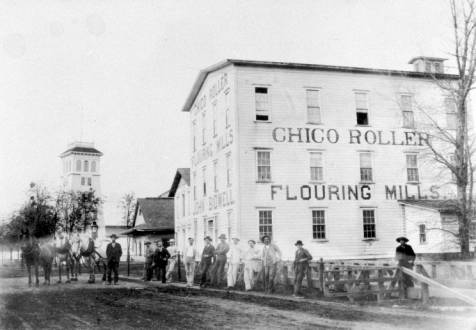
Chico_Roller_Flouring_Mills(2)

The flour mill, with water tower in background

Dow gives detailed description of operations on the ranch, with statistics on the number of barrels of flour ground per day, the quantity of sheep, hogs, and cattle, and the depth (20 to 70 feet) at which water can be obtained.

If you want a farmer’s-eye view of functions on Rancho Chico when it was running at full capacity, Dow’s book is a good place to start. The entire book can be downloaded from Google Books.

Posted in Rancho Chico | Leave a comment

Settling a Lawsuit with a Horse Race

John Bidwell was not a gambling man. In Gold Rush California, where men would bet on just about anything, and where horse-racing was popular entertainment, Bidwell generally stayed away. But one time he found himself the participant in a horse race that would decide the outcome of a lawsuit.

In the Fall of 1852, a former Rancho Chico employee by the name of James Dinning sued Bidwell for back wages in the amount of twelve dollars. Bidwell refused to pay him, although his reason is unclear, and who really had the legitimate claim in unknown at this date.

Attorney George Adams Smith took Dinning’s case before Chico’s Justice of the Peace, Thomas Wright Shelton, who held court in his house, which also served as a public gathering place. Bidwell was represented by Charles Lott. Squire Wright (as he was known) assembled a jury of twelve men, but as the lawyers consulted, someone in the crowd suggested that the matter be settled with a horse race.

The notion caught the fancy of Squire Wright, who was fond of a horse race himself. He announced:

“Gentlemen, the parties propose to settle the case with a hoss race. I think that his is the best way to settle it myself. Therefore, the court will adjourn until the hoss race is over.”

horse race-e

Attorney Smith loaned his client his own swift horse “Rabbit Catcher.” Bidwell gave his black saddle horse to his employee Frank Davis to ride for him in the race. It was stipulated that in case Bidwell lost he would pay the $12 but would not pay costs.

The race was on – Bidwell’s black saddle horse against “Rabbit Catcher.” You can imagine the excitement! Suddenly, something startled Bidwell’s horse and he dashed off the track and into the chaparral.  No sooner had the race begun than it was over.

Judge Wright ruled that John Bidwell had lost the case by default of his horse and had to pay Dinning his $12. But Dinning was responsible for the court costs, which amounted to $18.

Bidwell was disgusted with the whole proceedings and never again engaged in a horse race.

wright houseSquire Wright’s house still stands, the oldest wood frame building in the Sacramento Valley. Chico Heritage Association has devoted time, money, and a great deal of effort to preserving the house, which you can read about on their webpage.

The story of this horse race has been told many times. George C. Mansfield, in his History of Butte County, tells it, but he gets a few of the facts wrong. Rockwell Hunt heard the story “straight from the horse’s mouth,” so to speak, and relates it in John Bidwell: Prince of Pioneers. But Bidwell didn’t explain to him why he had the disagreement with Dinning in the first place. The best account comes from Michele Shover, in her essay The Doctor, the Lawyer, and the Political Chief, where she relies not only on the Bidwell/Hunt version, but also contemporary letters between Smith and Bidwell.

Posted in Uncategorized | Leave a comment

Romantic Cities of California

817I just came across this book today: Romantic Cities of California, by Hildegarde Hawthorne, with illustrations by E. H. Suydam, published in 1939 by D. Appleton-Century Co.  It is a tour of the towns and cities of California, all up and down the state from San Diego to Weaverville. I wouldn’t have thought of all these towns as romantic (I’m looking at you, Bakersfield), but I guess you can’t sell a travel book by calling it Romantic and Not-So-Romantic Cities of California.

Of course I was curious what the author had to say about the town where I live — Chico. What did Chico look like to a visitor in 1939?

Most of the chapter is taken up with her telling about how John Bidwell came to California, and what he did after he got here, as published in The Century Magazine back in 1889. That’s a good story, but doesn’t tell you much about Chico. Finally she gets to the town:

We ought to get back to Chico, which today is the county-seat (it isn’t and wasn’t) and chief city of Butte, however, and where the big stone house with its wide verandahs and galleries and its square tower still remains the Bidwell family mansion. It was erected in the middle part of the sixties, near the creek that still runs shining through  the grounds . . .

She mentions Bidwell Park “the vast city recreation center,” the Hooker Oak, and the United States Governmental Experimental Garden. Her paragraphs on the city of Chico say:

The Chico of today is a solidly built, prosperous, lovely city with plenty of room and a consuming pride in its rose gardens, which are numerous and in which roses of every possible variety flourish and bloom almost the whole year through, certainly in every month of the year. It is primarily built and planted to be a city in which it is good to live.

Its lumbering interests, that range from the making of matches up through anything you might want for building a house or a boat or any other wooden structure, are the chief of its industries, but it, like other towns and cities scattered up and down the valleys of these rivers which were once only interesting because of the gold you got out of them, is also an agricultural center.

Not is education left out of the sum. Chico State College is a handsome collection of dignified brick buildings that make a very handsome and stately group centered by a really glorious tower. Its high school is a beauty. (Alas, that high school building is gone.) And you feel that it is a city beloved by those who live in it, who cherish its appearance, who enjoy its broad esplanade, the wide, tree-planted principal street, its cleanliness and homeliness, in the old sense of the word. Chico is proud of the old pioneer who was its father, and General John Bidwell could be proud of it today.

She doesn’t give statistics, but for your information, Chico in 1940 had a population of 9,287. That’s only a little bigger than Orland today. It must have been a charming place. Today Chico is ten times larger than it was when Hildegarde Hawthorne visited it.

DSCF4969

Main Street, Chico, as drawn by E. H. Suydam. Note the fire station, City Hall, the Senator Theater, and the Park Hotel.

(By the way, when  I typed “Weaverville” in the first paragraph, WordPress didn’t recognize the word. Its suggestion? “Versailles.” A bit of difference there, even if it shares a few letters.)

Posted in Uncategorized | Leave a comment

Book of the Week!

NKfrontcoverYippee!

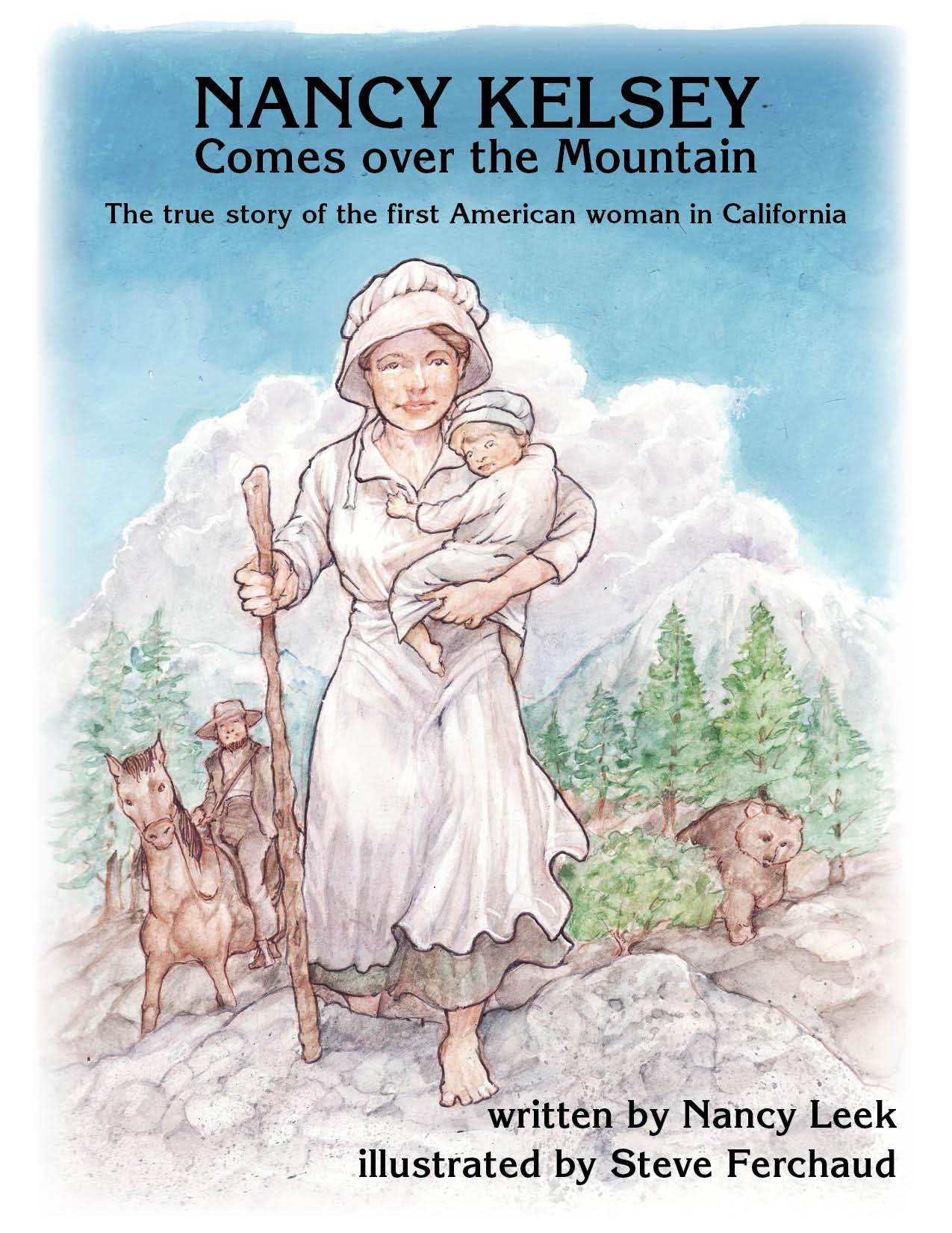
The California State Library choose my book Nancy Kelsey Comes Over the Mountain as their book of the week!

This absolutely makes my day. Here’s what they said in their Facebook post:

Book of the Week: Looking for a good way to kick off Women’s History Month? Check out Nancy Kelsey Comes Over the Mountain by Nancy Leek and Steve Ferchaud. This charmingly illustrated account of Nancy Kelsey’s journey to California and the challenges she faced on the way, not only brings her history to life but introduces young readers to primary sources. If you are looking for a story that will inspire your daughters, this is the book for you! #BOTW#BookOfTheWeek

So— go and “like” the California State Library. They are a great institution, and a place I love to visit and do research in. Click on the My Books tab above to order books.

Posted in Uncategorized | Leave a comment

The Young Mountaineer

Some time ago I wrote about Dr. James O’Brien after seeing his amputation kit at the Society of California Pioneers in San Francisco. That was in 2014, but I recently received a comment on that entry, from the doctor’s great-great-great-granddaughter.

She said that the doctor, his wife Eliza, and their two little girls came to California in 1849, and that they “had a son born during the journey through the Sierra Nevada Mountains. They named him Pius Sierra Nevada O’Brien.” What a fine name! I thought.

Was 1363037

Self-portrait of J. Goldsborough Bruff

Now I have just turned up another reference to Dr. O’Brien and his family. I am looking through the journal of J. Goldsborough Bruff, who is famous for his account of his overland trek, his winter in the Sierras, and his drawings of life on the trail. (See Gold Rush: The Journals, Drawings, and Other Papers of J. Goldsborough Bruff (New York: Columbia University Press, 1949). The book is expensive to buy, but free to borrow from the library.)

J. Goldsborough Bruff came to California by way of the Lassen Trail, which should have landed him at Lassen’s Rancho on the Sacramento River in the fall of 1849. But he had a falling-out with his his trail mates, who abandoned him in the mountains. He suffered through a winter in the mountains and nearly died. He wasn’t rescued until April 1850.

During that 1849 fall season, he aided many other stragglers on the trail, including the O’Brien family (“clever folks” he calls them). He first met them on the Lassen Trail in September. On November 4th, he encountered them again, at the camp of the Fairchild family.

At their camp I found Mrs. O’Brien, with 2 beautiful little curly-headed girls, and a mountaineer, 3 weeks old only! I remained till night, and then walked with Mrs. O’B. back 200 yds. to her wagon & campfire. I carried young Nevada under my poncho, to protect the little fellow from the snow, the mother held on to the folds, to assist her in walking over the wet & slippery trail; and the poor little girls, hand & hand, followed, slipping & tottering, and crying with cold & wet. Quite a snow storm.

The young man Dr. O’B. had employed as a teamster, was asleep in the wet, under the wagon; and the fire was nearly out. I saw Mrs. ensconced, with her beautiful children, handed in the young mountaineer, made the young man turn out, get limbs and stocks and build up the fire, and bade them good-night.

The O’Brien family made it safe and sound to Sacramento, where little one-year-old Pius Sierra Nevada O’Brien appears on the census record, taken November 4, 1850.

record-image_S3HT-DC3S-X8M

James O’Brien, M.D., and family. “Do” after each name stands for “ditto”.

Posted in James O'Brien, Uncategorized | Leave a comment

One of Those Strange Individuals

John Bidwell told many fascinating stories about his life and experiences. Here is one about his friend and trail companion, James John, and an encounter with a grizzly bear in California.

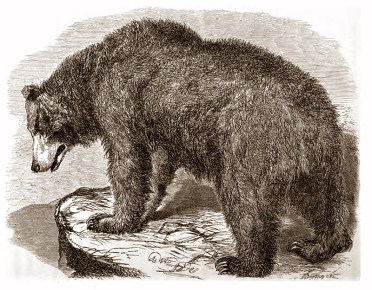
grizzly

“The Grizzly”
From The Trapper’s Guide by Sewell Newhouse

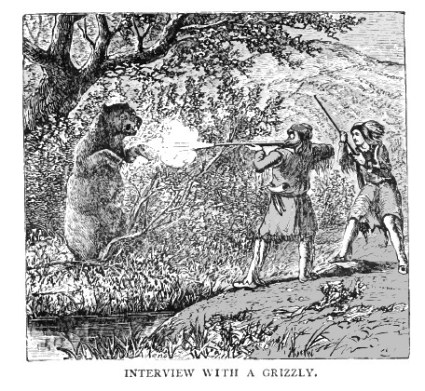
The grizzly bear was an hourly sight. In the vicinity of streams it was not uncommon to see thirty or forty in a day. . . In this connection let me relate an incident. Becoming tired of beef, James John, one of the first overland party, declared he would have some bear meat. An old Rocky Mountain hunter named Bill Burrows offered to go with him to get his bear meat. It was only a walk of one, two or three miles to find bear, so they started and soon came in sight of one, a monster in size, feeding in the tall grass not far from the river timber, on the west side of the Sacramento River, opposite to where Sacramento now stands.

A man who knows anything about the grizzly is cautious. Old hunters always keep to the leeward of a bear, and so take advantage and take a dead shot, but raw hunters, till experience has taught them caution, are often careless, and so Jimmy John went to within fifty yards of the bear and fired, the old mountaineer screaming at him, “You fool! don’t go there! Come back! ”

But Jimmy, as we used to call him, was one of those strange individuals you may see once in a life-time, who never seem to know what fear is. When the grizzly heard the shot, he broke into one of the dense thickets of grape-vine and willows along the river bank. Jimmy followed right along after the bear into the thicket, and was gone about fifteen minutes, when he came out greatly disappointed, because he had not succeeded in killing his game. He said he had bad luck because he got within six feet of the bear and fancied he was wounded, and when the animal opened his mouth, he wanted to make sure work of it by thrusting his muzzle into it, but the bear suddenly took to his heels and scampered off still deeper into the thicket.

grizzleyI used this story in the (almost) one-man show about John Bidwell that I wrote last year. Nick Anderson portrays Major Bidwell in 1858, and I play the fictitious lady reporter, Mrs. Leticia Norris, who has journeyed to Rancho Chico to interview him.  Bidwell liked to regale his listeners with stories about grizzly bears; this is not the only one.

By the way, if you need a program for your group, Nick and I are happy to come and present our Conversation with Major John Bidwell, 1858. It takes about a half hour, and we believe it is highly entertaining and informative.


Posted in James John, Uncategorized | Leave a comment