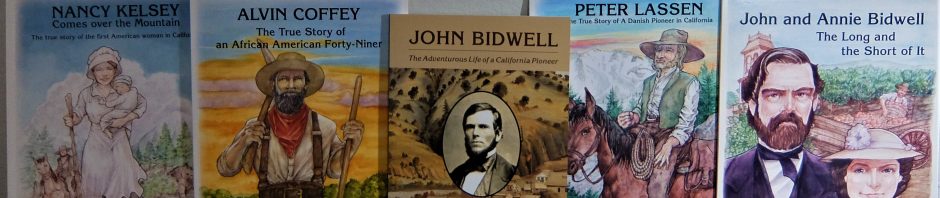
I’ve been going through letters in the John Bidwell Papers in the California State Library. Bidwell was the kind of man who held on to all his correspondence, and kept it well organized. Most of the letters deal with mundane matters, but as such they are a glimpse into everyday life in Northern California.
Here is a letter from a man seeking some runaway horses:
Monroe’s Ranch Colusi Co. California July 20th, 1851
Dear Sir,
Some days since I bought of Capt. Sutter twenty mares, and in crossing these on the Sacramento River, about one mile below this place, three of the mares escaped from us. These mares may fall in with your wild bands – if so please keep them until I see you which will be most probably, with the next four weeks.
The following is a description of the mares, as near as I can recollect.
One cream colored “Gil. flirt” mare, rather old.
One dun, or brown, mare, with a black list down the back.
One light bay mare, with a ball face. All of these mares are branded with Capt. Sutter’s iron, and vented, the vent being placed upside down.
Your attention to this Sir, will confer an especial favor for which I shall be pleased to make a remuneration.
Very truly yours etc.
John T. Hughes
Here are a few things to can learn about this letter:
Monroe’s Ranch belonged to Uriah P. Monroe, who helped to organize Colusi County and conveniently placed the county seat on his ranch, at a town he named Monroeville. When it was organized in 1850, the county had 115 non-native residents. It encompassed present-day Colusa and Glenn Counties, and part of Tehama County.
Monroeville was located where Stony Creek joins the Sacramento River, about five miles south of Hamilton City. The town has disappeared, but there is a Monroeville Cemetery, where William B. Ide is buried. You can learn more about Monroeville here.
The horses: Wild horses roamed all over California in those days. There were probably quite a few on Rancho Chico.
I don’t know what a “Gil Flirt” mare looks like, but there was a mare named Gil Flirt in 1816 who shows up on breeding charts. I don’t know what a “black list” is, or a “ball face” either, unless he meant to write “bald face.”
To “vent” a brand is to cancel it. According to an article by Delbert Trew (and “It’s All Trew”), “A brand may be canceled or abandoned by branding a bar across the original brand. This is called venting or barring out a brand.”
I like how politely Mr. Hughes asks Bidwell to “confer an especial favor.” Courtesy counts!
Who was the writer? John T. Hughes shows up as a miner, living in a cabin with three other men, in Mariposa County in the 1850 census. In 1851 he was living in Colusi County, where on May 3rd he was elected county judge to replace J. S. Holland (who had died). By September 1851 another election had to be held, because he had left the county. (This information from The History of Colusa and Glenn Counties.) Where he went from there, or what happened to the mares, I don’t know.
And yet the letter is still filed away in the library, and we can read it today.


 In January 1892, the Trustees invited John Bidwell and another old-timer, Charles Stevens, to inspect the work.
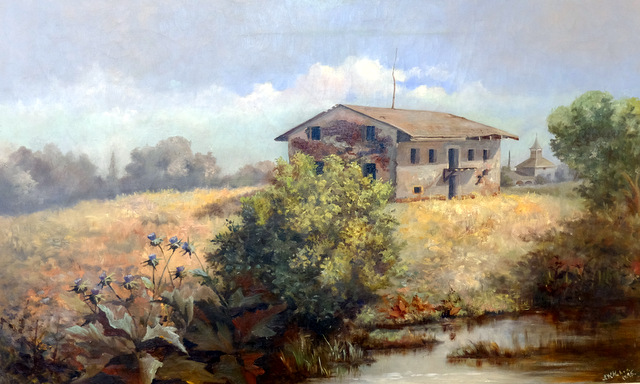
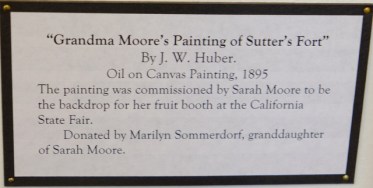 I am a bit confused by the date — 1895 — for the painting, since restoration of the fort by the Native Sons of the Golden West began in 1891. The painting must have actually been done some time before the restoration began.
 Here’s one — another picture of Sutter’s Fort in decline. It’s a pencil drawing by W. Tyrrell done in 1855. Only a few years after the gold rush and the walls are crumbling and the floors are sagging. It wouldn’t be long before the adobe bricks melted back into the earth.
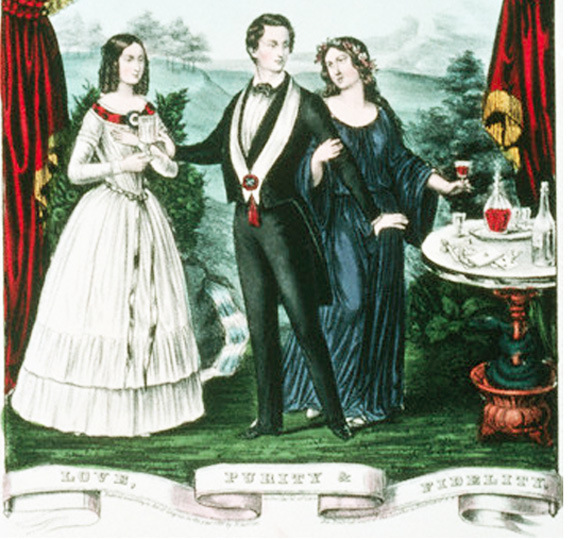
 Miss Pellett delivered a lecture at the Court House in Bidwell, on Tuesday evening last. The attendance was unusually large, and all expressed themselves well pleased. This was her first visit in Butte County. She lectured in Thursday Evening, at Spanish Ranch, on Friday at Quincy, and this evening will lecture at Elizabethtown. From thence, on Sunday evening at Nelson Point, and the balance of the week at different places in Sierra County, arriving at Forbestown, on Sunday November 11. She will again lecture at Bidwell on Monday Evening, Nov. 12, and at Ophir on the evening of the 13th.
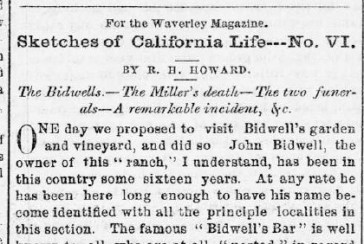 The article Nelson Blake saw is titled Sketches of California Life — No. VI, by R. H. Howard. It begins:

 Last Monday (Jan. 22) Nick Anderson and I presented our historical program to SIRs, Bidwell Branch 110, at the invitation of past “Big Sir” Keith Johnson. (SIRs is an organization for retired men who like to get together for a monthly luncheon and various interest groups.)
 Our conversation lasts about a half hour, and during that time we discuss adventures on the California Trail, grizzly bears, Captain Sutter, Fort Ross, exploring the Sacramento Valley, the Mexican War, politics, and more grizzly bears. (They keep coming up.) I based the script on Bidwell’s own recollections, and most of his words are taken verbatim from his writings and speeches.


 goldfields