Sarah Pellet’s Philanthropic Scheme

According to the Butte Record for December 23, 1854, Sarah Pellet had a brilliant plan for promoting temperance among the California miners.

Issue Date DECEMBER 23 1854 page 2 pellet

Five thousand young ladies! Miss Pellet certainly did not think small.

The same item was also reported in the Daily Alta California on December 19, 1854, under the headline A Desirable Enterprise. Both newspapers picked up the item from The Miner’s Advocate of Coloma. Was that editor joking, or was Sarah really offering to import young ladies as brides for Sons of Temperance?

The editor of the Daily Alta California commended the plan, but doubted the lady’s ability to carry it out:

If Miss Pellet can carry it out effectually, she will deserve the thanks of the whole bachelor community of the State. There are thousands upon thousands of girls, respectable, well-educated and honest, working from daylight till dark among the deafening machinery of cotton mills, and earning but small wages, who, we should suppose, would gladly come to California if safe conduct and reception, and particularly husbands, were guaranteed them on their arrival, and who are well calculated for helpmates for our farmers, our miners and mechanics, and citizens generally. This is really a very desirable operation of Miss Pellet’s, but, begging the lady’s pardon, we scarcely believe that she possesses the practical ability to carry it into effect.

She didn’t. But anyone out there is welcome to use this story as the basis for a novel about manly miners and New England’s fairest.

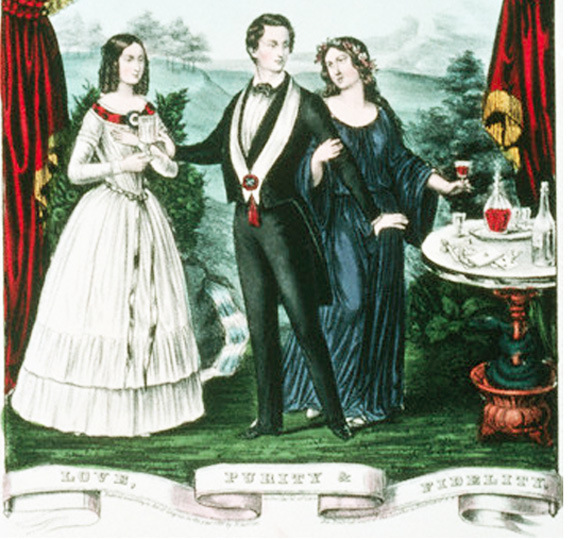
sons temperance n currier

A Sons of Temperance poster from 1851

Posted in Sarah Pellet, Uncategorized | 2 Comments

Sarah Pellet in the Mining Camps

Sarah Pellet came to Bidwell Bar to lecture in the Fall of 1855. The Butte Record of November 3rd noted her plans for a tour of mining camps:

SP Issue Date NOVEMBER 03 1855 page 2Miss Pellett delivered a lecture at the Court House in Bidwell, on Tuesday evening last. The attendance was unusually large, and all expressed themselves well pleased. This was her first visit in Butte County. She lectured in Thursday Evening, at Spanish Ranch, on Friday at Quincy, and this evening will lecture at Elizabethtown. From thence, on Sunday evening at Nelson Point, and the balance of the week at different places in Sierra County, arriving at Forbestown, on Sunday November 11. She will again lecture at Bidwell on Monday Evening, Nov. 12, and at Ophir on the evening of the 13th.
Elizabethtown has disappeared under the debris from hydraulic mining, and Bidwell Bar is drowned under Lake Oroville, but Quincy is still there where she would have found it, and Ophir has changed its name to Oroville.

This is an ambitious schedule. Most of her traveling would have been on muleback, and while the distances are not all that long, the terrain was rough and mountainous. It would have been slow-going. She would have spent her days riding a mule (maybe she wore her brown linen bloomers), her evenings lecturing, and her nights on a cot in a tent or a shack.

Dame Shirley described conditions at Bidwell Bar just three years earlier:

As there was nothing to sleep in but a tent, and nothing to sleep on but the ground, and the air was black with fleas hopping about in every direction, we concluded to ride forward to Berry Creek House, a ranch ten miles farther on our way, where we proposed to pass the night.

Bidwell Bar does not sound very inviting, and they got lost on their way to Berry Creek House, and spent the night on the trail.

But Miss Pellet braved the dangers of the trail and the discomforts of the mining camps. Men were glad to see her, no matter what she proposed as her topic. The sight of a woman, even one lecturing on temperance, abolition, and political reform, was a welcome one. I wish she had written an account of her experiences in California.


Posted in Sarah Pellet, Uncategorized | Leave a comment

A Sketch of California Life in the Waverley Magazine, 1856

After reading the article on Chico in the Waverley Magazine, Nelson Blake wrote “I don’t understand it and await an explanation from you.” I don’t know if he ever got his explanation from John Bidwell, since Bidwell’s letters to Blake were lost long ago.

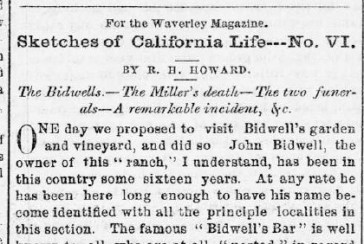
Fullscreen capture 1252018 100728 AMThe article Nelson Blake saw is titled Sketches of California Life — No. VI, by R. H. Howard. It begins:

One day we proposed to visit Bidwell’s garden and vineyard and did so. John Bidwell, the owner of this “ranch,” I understand, has been in this country some sixteen years. At any rate he has been here long enough to have his name become identified with all the principle localities in this section. The famous “Bidwell’s Bar” is well know to all who are “posted” in regard to the geography of this state.

The author, R. H. Howard, does not propose “to give the particulars in an agricultural point of view” (I wish he had!) but only to relate one or two incidents that have “rested upon my mind with no little weight.” These consist of: meeting Bidwell’s brother from Vermont (the author’s home state), the death and funeral of the miller, and the death of an ox. Pretty slim pickings.

The brother in question, although the author of the piece does not name him, was Daniel Bidwell, who came to Chico with his family around 1855. Daniel had a wife, three (I think) sons, and a sixteen-year-old daughter, Mary, who caught the eye of the reporter. She was “as fine a specimen of womanhood as one of as much pride as myself could ask to represent that branch of indigenous products of his home state.” (You can see how wordy this fellow is.)

“I was also much interested, during this visit, in a young man, there laboring at the time under a severe attack of the delirium tremens.” The unnamed young man, “Bidwell’s miller and a native of New York,” dies and is buried, accompanied by much more verbiage about the “mournful occasion” and “this strife and struggle and sacrifice for gain,” — but no details.

But, says Nelson Blake in his letter, “you told me that he died from wounds received in an Indian skirmish.” What Indian skirmish? Who is he referring to? It can’t be Amos Frye, who did indeed die in that way, because Frye died in 1852, while Blake was still residing at Rancho Chico. I don’t know of such an incident in 1855 or ’56, although there was an Indian attempt on Bidwell’s life in early 1856. Evidently I am going to have to do more research.

The death of the miller calls forth from the author sad reflections on the mutability of life, and ‘yet another lesson” — “That to steer clear of the treacherous quicksands that everywhere begirt us, especially in this country, you must shun every species of intemperance as you would the veritable precursor of ruin and death.” I have the notion that the Waverley was enlisted in the cause of Temperance.

The last incident from this visit that “rested upon [the author’s] mind with no little weight,” is the death of an ox.

I was down, the other day, to where the Little Butte creek sinks on the prairie. The Little Butte on one side, and a succession of sloughs on the other, gradually curving, come at length together forming a peninsula covered with oak timber.

There he spies an ox that had apparently just died. As he studies the scene, another ox approaches to investigate and then sends up a anguished howl in mourning. Soon all the cattle “join their full sonorous voices in the chorus, by lowing and bellowing and screaming — chanting a requiem full of power and pathos to their departed companion and friend.” Another meditative paragraph follows, ending with the thought, “And where will my journey end?”

Early_Chico

Rancho Chico in the 1850s, with Bidwell’s Store, adobe house and hotel, and flour mill.

I wish, before his journey’s end, he had given his readers a fuller picture of life at Rancho Chico.


Posted in Nelson Blake, Uncategorized | 1 Comment

Adventures in Research

Last month I went to the California State Library to look at the Sutter’s Fort Pioneer Collection, which contains a file of John Bidwell material. In it was one letter from E. Nelson Blake, a Massachusetts man who had worked for Bidwell in 1851-52 and then returned east. I had seen (so I thought) all of the letters between Blake and Bidwell (they were lifelong friends), but here was one last lone letter.

Nelson Blake was always asking for news of Rancho Chico, and this letter of April 8th 1856, is no exception. (“I would give almost anything to hear a full report of “Chico” news,” he says.) One paragraph stood out to me. Blake writes

I saw last week in a paper printed in Boston called the “Waverley Magazine” a sketch written by a correspondent of a visit to Bidwell’s. I was pleased to read it but was surprised to learn from that, that you had a brother there with you from Vermont with his family. When you spoke of your brother being with you, I thought you meant Thomas. I was also surprised to read there that your miller died of Delirium Tremens when you told me that he died from wounds received in an Indian skirmish. I don’t understand it and await an explanation from you.

Blake was, as you can see, very fond of underlining his words.

I had never heard of this Waverley Magazine and its article on a visit to Bidwell’s ranch. Accounts of Rancho Chico in the 1850s are scarce, and I figured it would be well worth tracking this item down.

It wasn’t just sitting there online (except for a single later issue). It hadn’t been digitized by Google Books. It wasn’t the sort of thing you would find in just any library, even a large research library.

But I did find that the American Antiquarian Society (in where else? Massachusetts) had copies of the magazine. A phone call to their Reference Desk put me in touch with Kim Toney, reference librarian. She did some magic, and a few minutes later a pdf of the April 1856 issue of Waverley Magazine plopped into my In Box.  Hooray!

Fullscreen capture 1252018 101444 AM

So . . . Who was this brother mentioned? Who was the miller, and what did he die of? What other revelations about Rancho Chico are set forth in the article?

Stay tuned for the next episode of Adventures in Research!


Posted in Nelson Blake | Leave a comment

Major Bidwell and the Lady Reporter

DSC_0007AJELast Monday (Jan. 22) Nick Anderson and I presented our historical program to SIRs, Bidwell Branch 110, at the invitation of past “Big Sir” Keith Johnson. (SIRs is an organization for retired men who like to get together for a monthly luncheon and various interest groups.)

I originally worked up this program for the Chico Museum, where we presented it last year. It was much improved this time around, mainly because of all the rehearsal time put in, especially by Nick, who carries much the greater part of the dialogue.

The setting is as follows:

I am a fictitious lady reporter from San Francisco, interviewing prominent Californians in 1858. My nom de plume is Mrs. Leticia Norris. I have traveled to Rancho Chico to talk with Major John Bidwell, famous pioneer, well-known ranch owner, and veteran of the war for California independence.

DSC_0006AJEOur conversation lasts about a half hour, and during that time we discuss adventures on the California Trail, grizzly bears, Captain Sutter, Fort Ross, exploring the Sacramento Valley, the Mexican War, politics, and more grizzly bears. (They keep coming up.) I based the script on Bidwell’s own recollections, and most of his words are taken verbatim from his writings and speeches.

If you know of a group that would enjoy seeing and hearing John Bidwell live and on stage, just get in touch with me in the comments. Nick and I would be delighted to bring our program to you.

DSC_0001AJE

Nick, Nancy, and Keith

Posted in Uncategorized | 1 Comment

Sarah Pellet in California

In Gold Rush California, Miss Sarah Pellet was an item of interest, receiving considerable attention from the newspapers. The first notice of her arrival, in the Sacramento Daily Union of September 20, 1854, stated:

Miss Sarah Pellet, a graduate of Oberlin Seminary, active in her endeavors to promote the philanthropical movements of the day, is among the list of new-comers. We learn from the New York Tribune that she is on a visit to her two brothers, settled in California, and that she will avail herself of any opportunity to address the people of the Golden State upon Temperance, Anti-Slavery, or Woman’s Rights.

She began in San Francisco, and was not exactly a sensation. The Daily Alta California reported:

Miss Pellet’s Lecture on Political Reform. — The announcement that a lecture on  “Political Reform: the means of securing it,” would be delivered at Musical Hall last evening, by Miss Sarah Pellet, drew together not a very large, but a very intellectual audience, who appeared to have gone partly from curiosity and partly from an evident disposition to encourage the lecturer. About eight o’clock, Miss Pellet was introduced to the audience by A. Williams, Esq. She placed herself behind a pulpit looking arrangement which was placed on the stage, and which only permitted her head to be exhibited to the audience. She is a woman apparently about thirty years of age, small and neat-looking, and wearing spectacles.

We suppose that when a woman enters upon the arena of politics, and becomes a public lecturer, she expects to subject herself to the same criticism that would be called out by a lecture from one of the opposite sex. Throwing entirely aside the question of the propriety of women becoming public lecturers, we must say that Miss Pellet does not seem to possess any of the qualifications for an interesting lecturer. Her address was written, and, in reading it, she appeared to find great difficulty, until her constant repetitions and haltings became painful to the audience. Her voice is not pleasant, and her manner of delivery anything but agreeable.

The reporter concluded that her lecture was “very dull and very prosy,” and Miss Pellet would be better off pursuing her reforms by means of the pen, rather than on the lecture circuit.

Sarah Pellet persisted however. She lectured throughout the gold mining regions, from Sonora to Weaverville, and on up into Oregon. A correspondent in Placer County was kinder than the City reporter:

    Our citizens had the pleasure of listening to a temperance lecture last evening, in the new Town Hall, delivered by Miss Sarah Pellet. The audience was quite large and paid the most respectful attention to the fair lecturer. Miss Pellet is a tolerably fair speaker, her articulation very distinct, her points and illustrations quite apropos, and by her pleasing but modest style will doubtless effect much good for the cause of temperance reform in her peregrinations through the mines of California. It is a subject of the highest importance to the mass of our population. A lady lecturer can at any time attract a large crowd and make a more durable impression than a man, and I do hope that Miss Pellet will not cease in her work of temperance reform.

MDH18560805.2.8.2-a1-447wpelletShe left the state at the end of January 1856 and went by steamer to Nicaragua, where she observed with admiration the campaign of William Walker to seize control of that country. She was not done with California, however. She would return in 1857 to continue her endeavors to reform the morals and habits of the ’49ers.

In the meantime, her name had become synonymous with temperance reform in California, and was used to promote temperance beverages, as you can see in this advertisement from 1856.

I am not exactly sure what Cream of Nectar is, but I am sure that it is delicious. It may be the same as Cream Nectar, which (so Internet tells me) is a pink Southern concoction of almond and vanilla flavorings that is still popular in New Orleans for snow-cones.


Posted in Uncategorized | 2 Comments

Sarah Pellet, Lady Reformer

I haven’t been able to find a picture of Sarah Pellet. I wish I had one to show you, because I wonder what she looked like. Newspaper reports sometimes refer to her as “fair” (as in “the fair lecturer”), but that was a convention.

The Daily Alta California said she was “small and neat-looking, and wearing spectacles” and another editor called her “angular.” She was 30 years old when she first came to California. Her passport application of 1858 gives a description that includes height of 5 feet 2 and 3/4 inches, a dark complexion, black hair and eyes, a Grecian nose and a mouth “rather large.”

lucy_stone

Lucy Stone

Sarah Pellet was born in North Brookfield, Massachusetts in 1824. A neighbor of Lucy Stone, she became friends with that women’s rights activist, and like her attended Oberlin College, graduating in 1851. Following her graduation, she returned to Massachusetts and became active in the cause of women’s rights. Later she went on to gain a medical degree. She was certainly an intelligent and determined woman.

Inspired by Lucy Stone’s lecturing tour of the “western states” (what we would call “midwestern”, i.e. Ohio, Indiana and Illinois) in 1853, Sarah decided to go even further west, to California, in 1854-55. A letter to Sarah from Susan B. Anthony in August 1854 encouraged her to take up lecturing to spread the word of women’s rights.

Dear Sarah

I had long been asking my self where is Sarah Pellet & what is she busy about, for busy she must be
What say you Sarah— here is a chance for you, (under the auspices of our State Committee) to make yourself thoroughly at home in the Lecture room—  If you ever intend to make Lecturing your business, you surely need just such a discipline—one cannot have a reputation as speaker, until they have won it, & simply giving a few Lectures to small audiences in large places will not win a name to one’s self—
 
bloomercostume-7

Susan B. Anthony was asking Sarah to campaign around the Northeast, but Sarah decided to go further afield. In the fall of 1854 she boarded a steamship for California, and drew a considerable amount of humorous comment, dressed as she was in “brown linen bloomers.”

Bloomers were practical, especially for a woman who would have to ride a mule across the Isthmus of Panama, but they were considered outlandish and dirisible. Did she continue to wear the bloomers while touring and lecturing throughout California? I wonder.  

Next: Sarah Pellet in California  

Posted in Uncategorized | 3 Comments

Duel in Downieville, and the Woman Who Caused It

But not for the reason you might think.

Miss Sarah Pellet came to California in the autumn of 1854 to lecture on temperance, women’s rights, and political reform. A female lecturer was a rarity anywhere, but especially in California, and Miss Pellet attracted crowds wherever she went.

Some years later, Calvin B. McDonald, who had been the editor of the Sierra Citizen in Downieville when Miss Pellet came to town, told the story of her visit and the subsequent duel. Her lectures to the men of Downieville had an effect that must have gratified the lady reformer. Wrote Mr. McDonald:

Sonsof-TemperanceThrough her exertions a large and flourishing division of the Sons of Temperance was there established, and all the respectable young men temporarily stopped drinking and became enthusiastic advocates of total abstinence. A temperance Fourth of July celebration was projected, and we nominated our friend, Miss Pellet, to make the oration, and notwithstanding a strong prejudice against women orators, succeeded in procuring her the coveted invitation.

Unfortunately, an up-and-coming young politician named Robert Tevis had planned on making the oration. He was given the job of reading the Declaration of Independence instead. His lengthy remarks following the reading drew the ire of the crowd, who set about firing anvils and making a racket to drown him out. Mr. McDonald continues the story:

The event made a great deal of talk, and brought the ambitious young man into very unpleasant notoriety instead of fame. The Democratic Party had procured the use of two columns of the local paper, and had appointed as editor the Hon. Charles E. Lippincott, State Senator from Yuba County. Lippincott had a keen appreciation of the ludicrous, and as Tevis was a Know-Nothing, he took occasion to roast the unfortunate young man in the Democratic corner of the paper, and it created a great deal of fun in the town. The next day Mr. Tevis came to me–I had no jurisdiction in the Democratic side of the paper–and demanded the publication of a card which pronounced the author of Lippincott’s article “a liar and a slanderer.” He was white with rage, and trembling, and would not be reasoned with. Knowing the nature of his antagonist and his deadly skill with arms, I tried to dissuade Tevis from the rash and dangerous publication, and dwelt on the inevitable consequence. But he would hear nothing; he wanted to fight, he said, and would fight, in the street or otherwise.

A location for the duel outside of town was selected and the weapons agreed on — double-barreled shotguns at forty yards. When the time came, the sheriff arrived to intervene (for dueling was actually illegal in California), so the duel was moved over the county line into Yuba County.

Charles Lippincott was an expert marksman. According to McDonald, “He declared he did not wish to kill his adversary, to whom he had never spoken in person, did not want to fight if it could be avoided, but the nature of the public insult and the customs of the time compelled him to send the challenge.” Once an insulting “card” was published in a newspaper, a duel was bound to follow.

The combatants took their places, forty yards apart; the ground was a little sloping, and the highest situation fell to the lot of Tevis. As his second walked away he turned toward Tevis and laid his finger on his own breast, as an indication where to aim, and Lippincott observed the gesture and fixed his eyes on the same place. The word was given; both guns cracked at the same instant. Tevis sank down, shot directly through the heart, and a lock of hair fell from near Lippincott’s ear. The fallen man had not made the necessary allowance for descending ground, and his murderous lead had passed directly over his adversary’s left shoulder, grazing his face.

Lippincott left for Nevada, but later returned to Downieville for a time, but after completion of his term in the State Senate, he went back to his home state of Illinois.

And what of Miss Sarah Pellet?

Miss Pellet, regarding herself as the innocent cause of the duel, stood courageously by her friend [Lippincott], visited him in his exile, exerted all her personal influence to reconcile public opinion to the survivor, and behaved altogether like a brave, true-hearted woman, as she was and still is, in her fancied mission of reform. . . .

Her temperance division at Downieville has melted away; some of her cold-water converts are dead; [and] others have been separated from their families by the foul fiend whom she almost drove from the place.

More on Sarah Pellet and her career in California next time.

Posted in Sarah Pellet | Leave a comment

Bear Story

Issue Date DECEMBER 23 1854 page 1

While searching old newspapers online looking for something else (isn’t that always the way), I came across this entertaining story in the Butte Record of December 23, 1854.

Bear Story

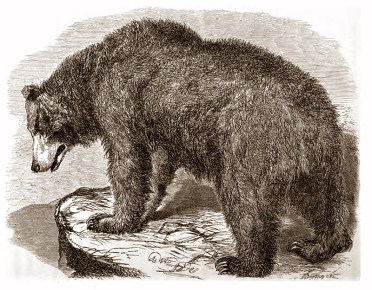
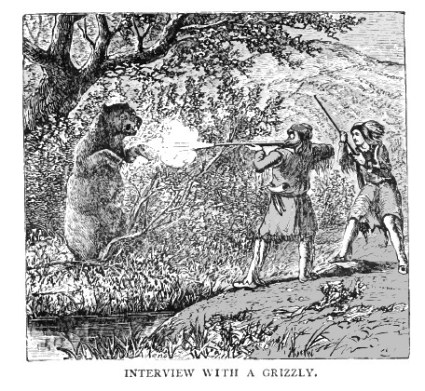
The little town of Hamilton, a few evenings since, was visited by a Bruin of the grizzly species. The first intimation the peaceful inhabitants had of his presence, was given by their lowing and frightened herds, coming tearing into town as fast as their trembling limbs could carry them.  The inhabitants were soon aroused, and discovered his bearship in the rear of the flying cattle. Judge W., from the upper country, happened to be in Hamilton, and the inhabitants arming themselves, and letting loose their dogs, followed the warlike Judge to the bushy field. They soon succeeded in corraling his bearship in the top of a fallen tree, which was soon surrounded by dogs, and armed and silent but excited citizens.

A hideous noise issuing from the tree top, warned all to be on their guard, and convinced the Judge, to whom the sound was perfectly familiar, that they had a regular grizzly to deal with. The utmost caution was now used. One person who was perched upon a high log, soon discovered a pair of fierce burning eyes, in the wreck of the tree top, at which he levelled his death-dealing rifle as well as the shades of evening would permit. His aim was sure, and the huge monster’s eyes were closed forever. The dogs then rushed in and grappling with their ferocious foe, drew forth a – Billy Goat!

Kee-ris-topher Columbus, Judge,” exclaimed a voice in the nasal accent of New England; “ can’t you tell the snort of a grizzly from the bleat of a mounting goat?”

“For God’s sake, boys,” exclaimed the agonized Judge, “let’s bury him and swear it was a grizzly! It will never do to let this yarn reach Neal’s Ranch! What’ll you drink?”

Issue Date DECEMBER 23 1854 page 2 bear story2I don’t know whether this is a true story, or just a tall tale to fill a page. There were certainly still grizzly bears in Butte County in 1854, so it could have happened.

Why not?

Posted in Uncategorized | Leave a comment

More Shameless Book Promotion


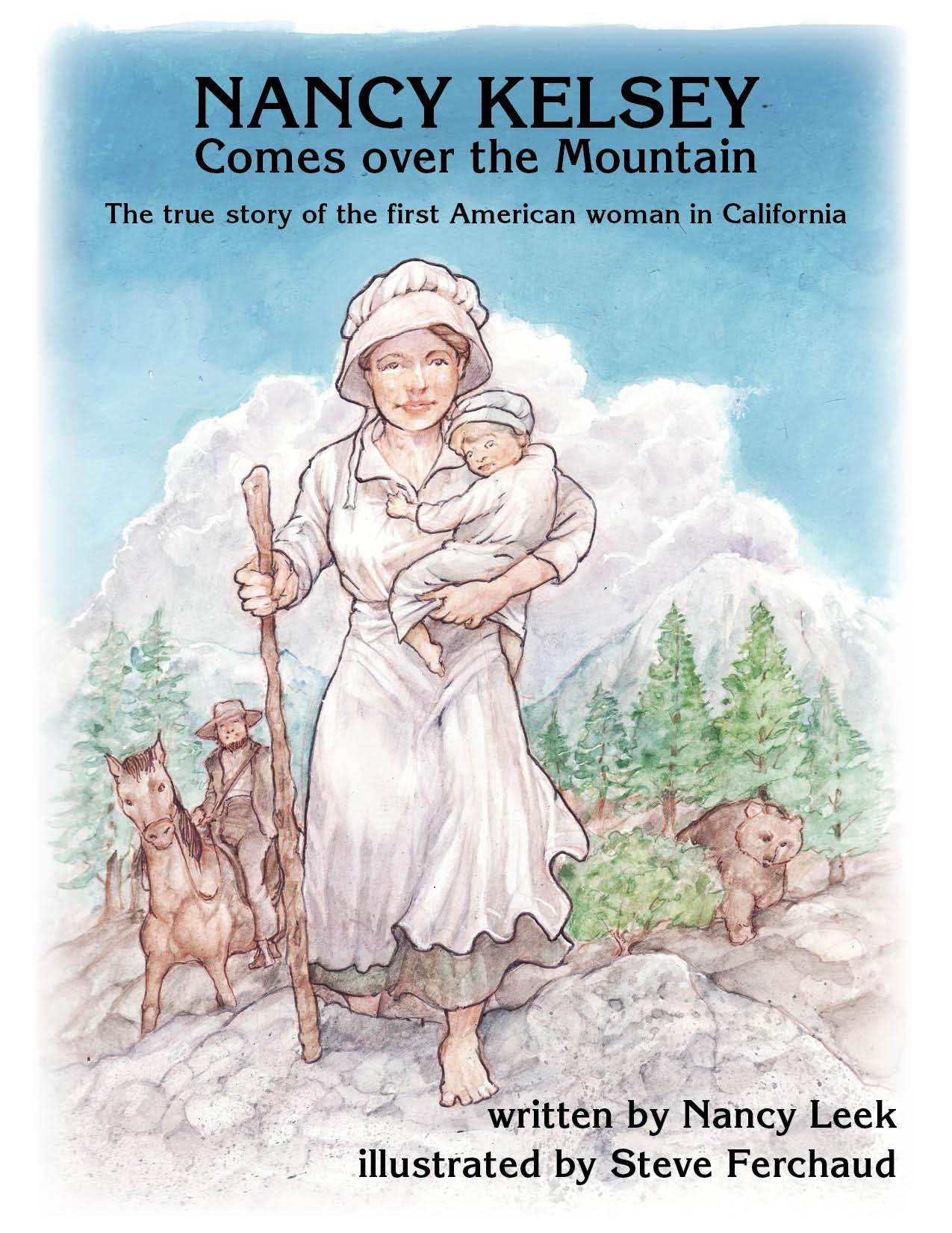
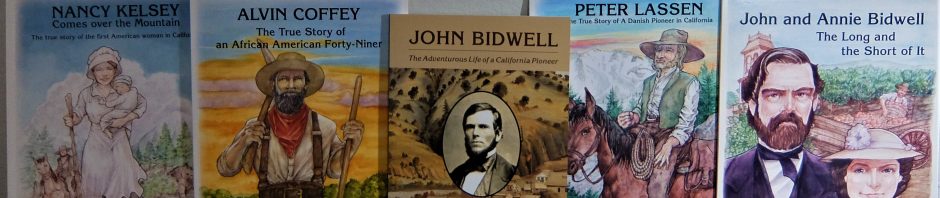
My picture book biographies, Nancy Kelsey Comes over the Mountain and John and Annie Bidwell: The Long and the Short of It, are both available on Amazon. But I need to some reviews! If you have bought or read the books (available at a library near you, I hope) then you could post a review.

DSCF4730

I have started sending out postcards to schools, museums, and libraries advertising my latest book. If they go to Amazon to look at the book, I think it would encourage them to buy it if it had some good reviews. I hope you think so too, and can help me out.

Gary Kurutz, who is curator emeritus of the  California State Library and executive director, California State Library Foundation (and a very nice person) said of the Nancy Kelsey book:

“Nancy Leek is a master story-teller and has brought to life the heroic 1841 overland trek of Nancy Kelsey. Her book proves that women could handle just about any obstacle thrown their way.”

You can order the book here at Goldfields Books or you can order from Amazon or you can buy it locally, but whichever you do, I hope you will post a review.

DSCF4720


Posted in Uncategorized | Leave a comment