This Date in California History

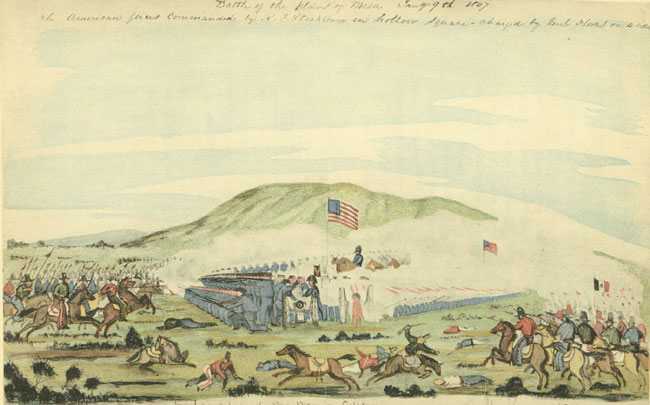
Today, January 9th, is the date of the final battle of the California Campaign of the Mexican-American War. The Battle of La Mesa occurred one day after the Battle of Rio San Gabriel and brought an end to hostilities between American forces and the Californios.

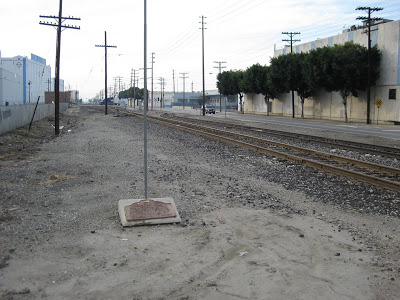
The site of the battle was on a plain between the Los Angeles River and the San Gabriel River. The city of Vernon, just south of downtown Los Angeles, now occupies the site.

The two sides looked to be evenly matched: 300 Mexican Californians under Jose Maria Flores faced 300 American troops under Commodore Robert Stockton and General Stephen Watts Kearny. But the Americans were armed with rifles, while the Californios were armed only with lances.

LaMesa battle

Battle of La Mesa

Marching toward Los Angeles, the American troops encountered the Californios on horseback, who extended their line to surround the Americans. The cavalry charged the American troops, but were cut down by relentless rifle fire and forced to retreat. Losses during this and the precious day’s battle consisted of three dead on each side and several wounded.

The conquest of California was settled with the signing of the Treaty of Cahuenga by Lieutenant-Colonel John C. Frémont and Californio General Andrés Pico four days later, on January 13, 1847.

LaMesa2

Plaque marking the battle in Vernon California — California Historical Landmark #167

Posted in Uncategorized | Leave a comment

Entrepreneurs of the Gold Rush

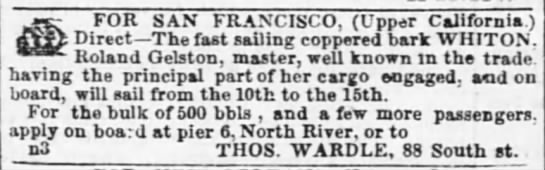
What would a canny ship owner do as soon as he heard about gold in California in 1848? He would load up a ship with goods and passengers, and set sail for the Pacific.

whiton

Among the many fascinating items to be found among the Bidwell Papers at the California State Library are a series of receipts from a shopping trip John Bidwell took to Sacramento in 1849 where he purchased goods to supply a trading post at Bidwell Bar. Over a two day period he visited at least ten merchants, buying whatever they had.

One of the stores he visited was not in a building or a tent, but on a ship. According to Mark A. Eifler in Gold Rush Capitalists (University of New Mexico Press, 2002), Roland Gelston, captain of the bark Whiton, was the first to bring a shipload of merchandise from the East Coast directly to Sacramento. He left New York in November of 1848 and sailed around Cape Horn with cargo and passengers. Arriving in May 1849, he “immediately threw open his ship’s hold to sell merchandise to expectant miners.”


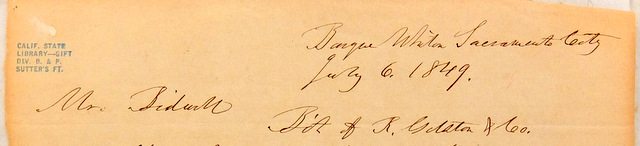
He was still selling when John Bidwell bought from him on July 6, 1849.

DSCF4531

Among the items he bought were two kegs of molasses, shelled almonds, dried apples, two tin kettles, and a shot pouch (also useful for gold dust). The handwriting is not very clear, and I can’t read some of the other things he bought. But he spent $229.45 with R. Gelston & Co.

Posted in Uncategorized | Leave a comment

Happy New Year!

happy-new-year-clipart-15Best wishes for a happy and prosperous New Year from Goldfields Books. I hope 2018 is filled with wonderful discoveries and joyful events for you and yours.
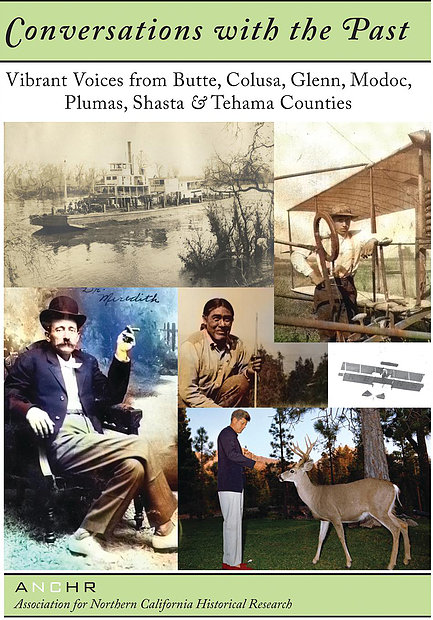
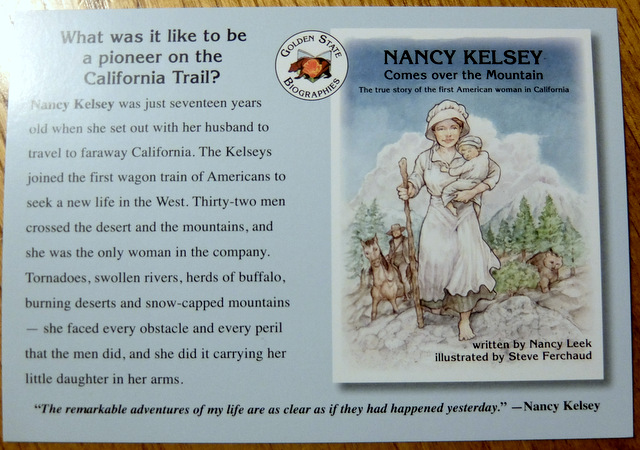
This past year I worked on two publishing projects: my own book on Nancy Kelsey and ANCHR’s compilation of Northern California oral histories.

Conversationswith the PastIf you have not yet seen ANCHR’s new book you need to check it out — Conversations with the Past: Vibrant Voices from Butte, Colusa, Glenn, Modoc, Plumas, Shasta & Tehama Counties. This book truly has something for every history buff’s interest.
In the 1970s, members of the Association of Northern California Records and Research (ANCHR’s predecessor) spent several years collecting and transcribing oral histories. These histories have languished in storage files for decades. We rediscovered them this year and decided these voices and their stories needed to be heard.

These personal accounts provide a priceless window to a past long gone. But they also show that people did back then what we do now — live their lives.

These memories range from personal accounts about the Bidwells, family cattle drives, early days in Paradise and Chico, hitching canoe rides on riverboat barges, Chico’s first teenage aviator, the discovery of Ishi in Oroville, western Colusa County Indian life and John Bidwell’s explorations, herding geese (it’s not what you might think it is), pioneer life in Orland and Newville including feuding Civil War veterans, memories of Modoc County, the town of Prattville and Big Meadows before Lake Almanor flooded the areas, railroad torpedoes, and President Kennedy’s visit to Lassen Volcanic National Park in 1963.

 NKfrontcoverThe book costs $16.95 and is available at The Bookstore on Main St. in Chico, ABC Books, Discount Books in Oroville, My Girlfriend’s Closet in Paradise, and various museums and historical societies in Northern California. You can also order online at anchr.org.
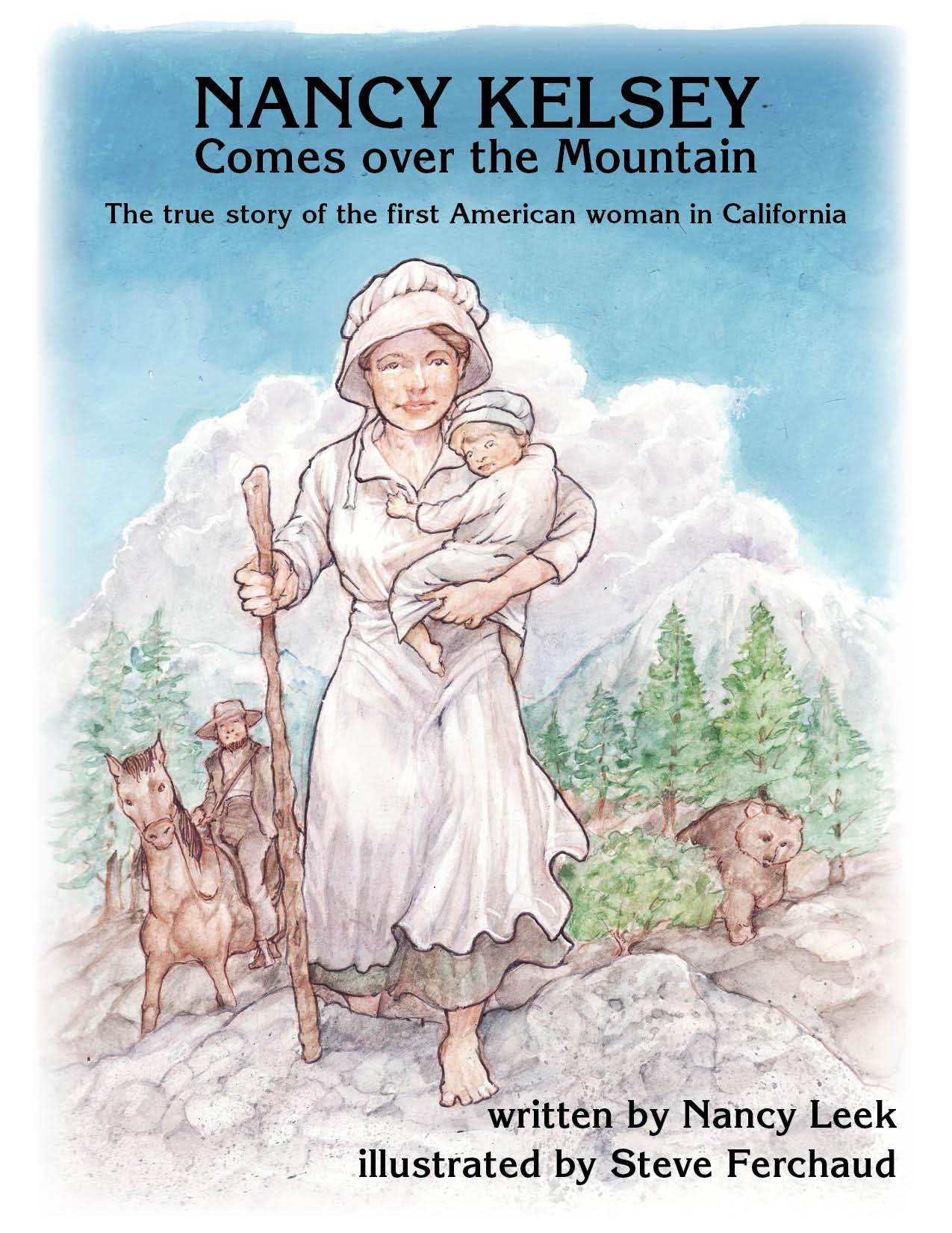
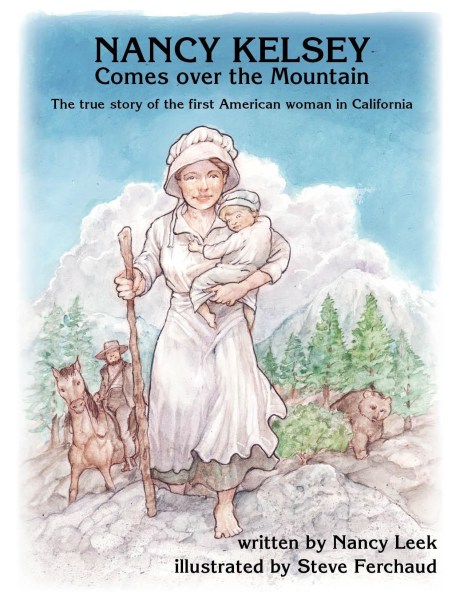
Nancy Kelsey Comes over the Mountain is also available from the ANCHR website, and from me right here, and from Amazon.com. The book was a joy to research and to write. If you would like to hear Steve Ferchaud and me talk about our work on this book, you can hear us on a Nancy’s Bookshelf podcast.
And . . . if you would like to hear either the ANCHR team of editors, or me, talk about our books, please contact me at goldfieldsbooksca@gmail.com. We are available to speak to groups throughout the North State.
DSCF4389

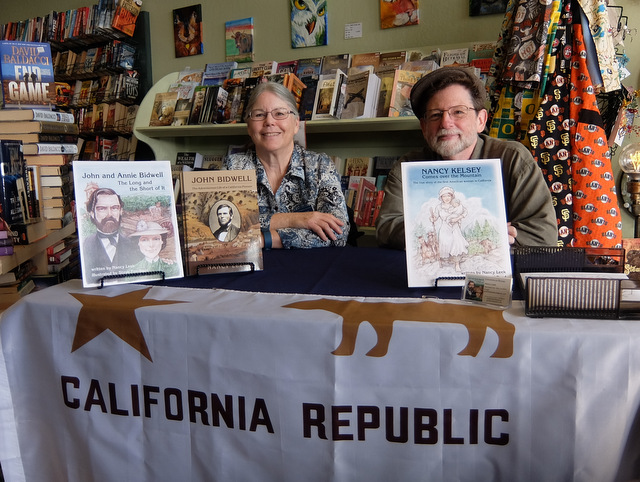
Steve and I peddling our books at ABC Books on Mangrove in Chico.


Posted in Uncategorized | 1 Comment

Bidwell’s Winepress

I spent the day at the History Room of the California State Library in Sacramento, looking at papers in the Sutter’s Fort Pioneer Collection. Among other things, this collection contains two boxes of papers pulled from the Bidwell Papers, consisting primarily of business letters, contracts and receipts. It’s full of interesting items that I had never seen before.

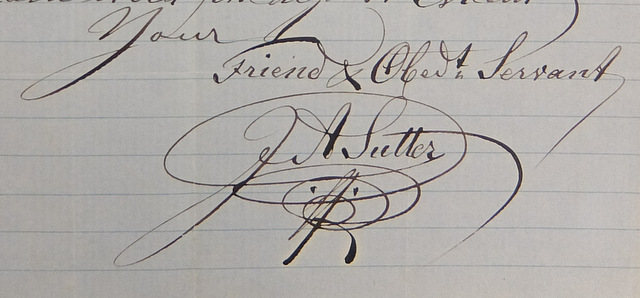
Here is one little tidbit, a letter from John Sutter to Bidwell, concerning a screw for his winepress.

            My Dear Sir,

The screw for your winepress will be ready at the Marysville foundry at the same time when mine, the price of them they could not tell me when I ordered them, but will know it on Wednesday when I will be there and will write you a few lines.

The carpenter will be ready with my work in a few days and then he will go up to your establishment, he understand likewise to make the wine.

I remain with the highest Esteem

Your Friend and Obedt. Servant  J. A. Sutter

DSCF4391

The date is missing from the top of the letter, so I don’t know when it was written. According to the History Of Yuba And Sutter Counties, the first foundry in Marysville was established in 1852, so it can’t be any earlier than that. It was probably written sometime in the mid-1850s.

Just a glimpse of John Bidwell before he met Annie!


Posted in Uncategorized | Leave a comment

Rancho Rio de los Molinos

This Week in California History (an ever-useful site, maintained by Jim Silverman) tells me that December 20th, 1844, is the date on which

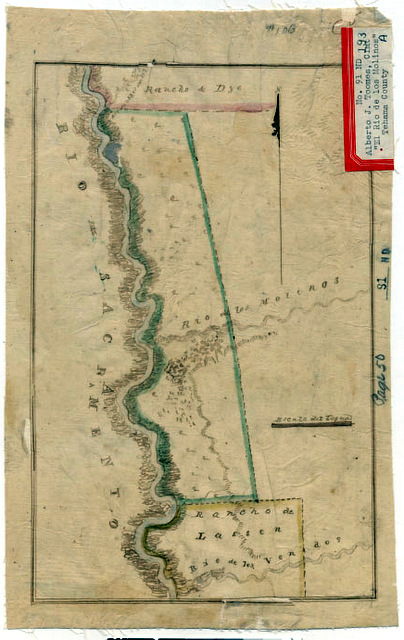
Rancho Rio de los Molinos, a 22,172-acre Mexican land grant in present day Tehama County was deeded. It extended along the east side of the Sacramento River from Dye Creek to Toomes Creek, including present day Los Molinos.

So here is a little more about Rancho Rio de los Molinos:

Albert G. Toomes, a native of Missouri, came into California with the Rowland-Workman party by way of the southern route. They arrived in California on November 10, 1841, just a few days after the Bidwell-Bartleson Party arrived at Marsh’s Ranch near Mt. Diablo.

Toomes worked in Monterey as a carpenter with Robert H. Thomes, who had come with the Bidwell group. Together they built a house for Manuel Jimeno Casarin, secretary of state and sometimes acting governor under Governors Alvarado and Micheltorena, This turned out to be to their advantage, for as Toomes said:

“The house we built at Monterey for Governor Jimeno in 1845 was one of the best jobs we ever did in our lives, for the old gentleman not only paid us well, but got us our farms without any of the trouble others had.”

RanchoMolinos

Diseño for Rancho Rio de los Molinos

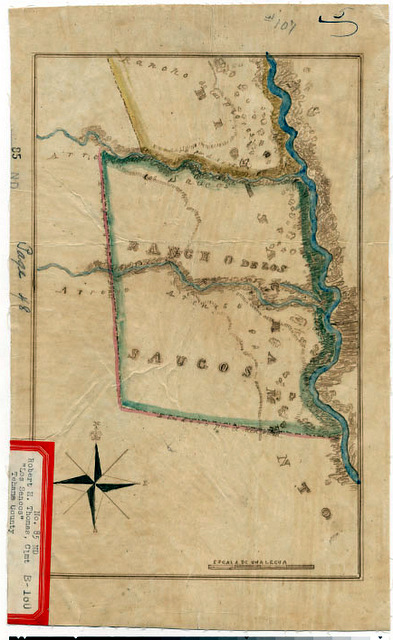
On December 20th, 1844, five square leagues (22,177 acres) were granted to Albert G. Toomes by Manuel Micheltorena, between Dye Creek and Toomes Creek with Mill Creek in about the center, on the east side of the Sacramento River. Robert H. Thomes received a matching land grant, Rancho Saucos, on the west side of the river.

John Bidwell had named Mill Creek (in Spanish, Rio de los Molinos) because it looked like a good stream for a mill. He also drew the diseño for the rancho.

You can see on the diseño that Job Dye’s ranch (Rancho de Dye) is to the north, and Peter Lassen’s ranch is to the south.


RanchoSaucos

Diseño for Rancho Saucos

Posted in Albert G. Toomes, Robert Thomes, Uncategorized | 4 Comments

Bidwellville, Anyone?

chico sealNot long ago a friend of mine asked me why John Bidwell did not name the town he founded after himself. He could name it anything he wanted. Why Chico? Why not Bidwellville, or Bidwellton, or Bidwell City?

It used to be pretty common to name a town after its founder, or someone the founder wanted to honor. Gridley is named for founder George W. Gridley. Redding is named for railroad man Benjamin Redding (or maybe pioneer Pierson B. Reading, who owned the rancho Redding was built on). Weed is named for founder Abner Weed, and not for  tumbleweeds or any other plant. Susanville is named after Susan Roop, the daughter of founder Isaac Roop (before that it was Rooptown) and Marysville is named after Mary Murphy Covillaud, a survivor of the Donner Party and wife of Charles Covillaud, who bought Theodor Cordua’s ranch. Cordua called the community he founded New Mecklenburg.

1848_sutterville-sacramento_cityJohn Bidwell had been employed by John Sutter to survey the prospective town of Sutterville, just south of Sacramento. Even though it was laid out on higher ground than Sacramento (which was prone to flooding), it never took off, and Bidwell’s lots in the town were worthless. Maybe that was not a good omen.

Bidwell was never much for naming things after himself. As a state senator, he had a hand in naming the counties. He named Sutter County after John Sutter, whose Hock Farm was located there. Perhaps he could have named Butte County after himself, but he didn’t.

In 1849 Bidwell bought Rancho del Arroyo Chico. I don’t know who named it that, but Chico Creek (Arroyo Chico — Small Creek) seems to have had that name when he got here. He sometimes referred to his place as Rio Chico, or Chico Farm. It must have seemed natural then to name the town Chico.

What we called Bidwell Park was named by the city. He and Annie never called it that — they called the area Vallombrosa. There is Bidwell Junior High School in Chico, and two Bidwell Elementary Schools, one in Red Bluff and one in Sacramento. But no town of Bidwell.

Birds_eye_view_of_Chico_and_Chico_Vecino_Butte_County_CaliforniaThere is a Bidwell Avenue in Chico, which runs along Big Chico Creek west of Nord Ave. Two other streets that were named after John Bidwell have disappeared. I wrote about one of them here. John Gallardo recently informed me that another Bidwell Street shows up on an 1888 bird’s-eye map of Chico. I think it was what is now 12th Street. It is right at the bottom of this map. You can get a closer look at the map at the Chico State Historical Map Collection.


Posted in Uncategorized | 1 Comment

A Visit to Stansbury House

The last field trip for my OLLI Historic Homes group last Thursday was to my favorite Victorian home, Stansbury House in Chico. I love Bidwell Mansion too, but it’s too grand for me to actually imagine living there. But I can imagine living in Stansbury House.

IMG_20171207_154359493_HDRThe house stands at the corner of Fifth and Salem Streets near downtown Chico. Built by Dr. Oscar Stansbury in 1883, it now belongs to the city of Chico. It is cared for by the Stansbury Home Preservation Association and is open for public tours Saturdays and Sundays from 1 to 4 p.m. We were given a special tour by John Gallardo, who knows the house inside and out, having lived there as caretaker (oops — resident curator) for twenty years.

Dr. Stansbury was born in Mississippi in 1852 and received his medical degree in 1873. In 1875, at the request of his cousin, he came to Chico, California to take over his cousin’s medical practice. After two years he returned to Maryland to marry his fiancée, Libbie Manlove, and then brought her back to Chico. A few years later he inherited the money that allowed him to build an elegant home for his growing family. The Stansburys had three children, Middleton, Angeline, and Ellen.

IMG_20171207_145649658

Bedroom ceiling decoration

Miss Angeline Stansbury never married. Her mother died in 1923, followed by her father in 1926. An art teacher at Chico High School for forty years, she continued to live in the home until her death on Christmas Day, 1974. She diligently preserved the pristine quality of her home and its furnishings, resulting in a model of Victorian life in Chico.

The house was designed by Sacramento architect, A.A. Cook, and is a classic example of Italianate Victorian—a style patterned after the sturdy square manor houses of the Italian countryside. Dr. Stansbury bought the quarter block on which the home was built for $1,000 and the 10-room house was constructed for just under $8,000.

The exterior of the house is a fine example of the elaborate style of decoration favored in the Victorian era. It incorporates beautifully molded and arched windows accented with carved rosettes at their peak, angled bay windows flanked by colonettes; entrance porches with slender fluted columns; carved balustrades and decorated pediments, all topped by bracketed cornices. Centered on the roof is a low decorative wrought iron fence.

IMG_20171207_154221404_HDR

Wainscoting and wallpaper and stained glass window (which does not show up well in this photo)


The walls and ceilings of the home reward careful examination. Every surface is covered in wallpaper, imitation leather wainscoting, or ornamental plaster-work, all of it original. At every house we visited, I asked if the wallpaper was original, and it never was. It had either deteriorated to the point where it had to go, or it had been replaced during an earlier remodeling.  It is highly unusual to see wallpaper that is over 100 years old.

Much of the paper has either darkened or faded though. Luckily, leftover pieces and rolls of wallpaper were found in the basement, so that our docent, John, was able to show us what the paper looked like when new.


IMG_20171207_144205630Another highlight of the house is Dr. Stansbury’s medical office. He had an office downtown, but he also maintained a small office in his home, with a separate entrance. It contains his books and instruments, his examining chair (leather with silk fringe!), his roll-top desk, and his skeleton, a real one.

In 1976, the historic house was acquired by the City of Chico through donation by the Stansbury family heirs combined with partial purchase. It is presently open to the public under the auspices of The Stansbury Home Preservation Association, Inc., a community-wide non-profit organization.

Some information adapted from Stansbury Home Preservation Association website, http://www.stansburyhome.org/.


Posted in Uncategorized | Leave a comment

The Rush Is On!

polkOn December 5, 1848, President James K. Polk ignited the California Gold Rush in his State of the Union address to Congress.

Gold was discovered by James Marshall at Sutter’s Mill in January 1848, but John Sutter did the best he could to keep the news to himself, at least until his harvest of winter wheat was in. It wasn’t until May that Sam Brannan spread the news to San Francisco, and then it would take up to six months for the word to get to the East Coast states.

The news began to circulate in the fall of 1848. Still, many people believed that the claim of gold was a hoax. It took President Polk’s speech to convince Easterners that the rumors were true. President Polk devoted a sizable section of his speech to the situation in California and its great potential to enrich the nation and project the power of the United States into the Pacific.

It was known that mines of the precious metals existed to a considerable extent in California at the time of its acquisition. Recent discoveries render it probable that these mines are more extensive and valuable than was anticipated. The accounts of the abundance of gold in that territory are of such an extraordinary character as would scarcely command belief were they not corroborated by the authentic reports of officers in the public service who have visited the mineral district and derived the facts which they detail from personal observation.

The military governor of California, Richard B. Mason, visited the mines in July 1848 and found 4,000 men already at work digging out gold. Every day more men went to the goldfields; sailors left their ships and soldiers deserted their post.

Polk called for a branch of the U.S. Mint to be built in California, as well as post offices and custom houses. The United States Treasury was losing revenue if these things were not in place.

That we may the more speedily and fully avail ourselves of the undeveloped wealth of these mines, it is deemed of vast importance that a branch of the Mint of the United States be authorized to be established at your present session in California.


So, 169 years ago today, the word was out and the rush was on. Men throughout the United States made their plans and set out for the California goldfields.

gold-rush

Posted in Gold, Uncategorized | Leave a comment

Shameless Book Promotion

NKfrontcoverThere are lots of opportunities this holiday season to promote my new book, Nancy Kelsey Comes over the Mountain. Dan Barnett reviewed it in the Chico Enterprise-Record yesterday, Sunday December 3rd.  Here is what he says:

This captivating book keeps alive for a new generation the life of an extraordinary woman.

Thanks, Dan!

This coming Wednesday I’ll be recording with Nancy Wiegman at North State Public Radio (KCHO FM 91.7) for an upcoming episode of Nancy’s Bookshelf. I can’t tell you when the interview will be broadcast — it might be next week, or next month, or somewhere else down the line. But it is always a pleasure to talk to Nancy. She asks the best questions, and you can always tell that she has read the book.

Nancy’s Bookshelf is on every Friday at 10 a.m. If you miss it on the radio (as I mostly do) you can listen to the podcast online anytime. Always fascinating.

And then there are the book-signings! Friday evening I will be with Steve Ferchaud, the illustrator of the book, at the BMA annual member event, “Christmas with the Bidwells.” The next day, Saturday Dec. 9, Steve and I will be at ABC Books, selling and signing books with other members of North State Writers. ABC Books is at 950 Mangrove Ave, in the shopping center across the street from the Chico Cemetery. If you know where La Comida is (and who doesn’t?) then you can find ABC Books, a great little used book store that is now also featuring new books from local authors. Come and visit with us from 11 to 2.

conversationsAnd then that same Saturday, Dec. 9, I will be with other ANCHR writers at the Butte County Historical Society‘s Open House in Oroville from 3 to 6 p.m.. We will be talking about ANCHR’s new book, Conversations with the Past. If you like local history, North State history, then you will love this book, which is full of accounts by real people who lived history in northern California. The narratives are based on the oral histories that ANCHR collected back in the 1970s. I worked on two of the chapters, Frieda Petersen Knotts and Ruby English.  I’ll have my new book with me as well.

If you are looking for a copy of my new book, you can find it at Bidwell Mansion, Made in Chico, and ABC Books (and I encourage you to shop local!), and on Amazon.com and right here at Goldfields Books.  I’m working on getting it into other outlets too. If you live in Chico and want to buy directly from me, just email me at goldfieldsbooksca@gmail.com. I will deliver a signed copy to you!

I am also available to talk to groups and do class presentations. I love to talk about California history to groups of all ages.

Posted in Uncategorized | Leave a comment

A Visit to Bidwell Mansion

My OLLI group has been visiting Historic Homes in Northern California, and today we visited Bidwell Mansion State Historic Park. OUr tour guide was Noel Lopez. Most of the group had visited it before, but some not for twenty or thirty years. And that’s just too long! I know most of my readers are familiar with the Bidwells and their beautiful home, but I’ll go ahead and give you a little tour anyway.

sc10890Bidwell Mansion ca 1870

Bidwell Mansion about 1870

Bidwell Mansion State Historic Park is a three-story, 26-room Victorian House and Museum that stands as a memorial to John and Annie Bidwell. John Bidwell came to California as a leader of the emigrant group that blazed the California Trail in 1841. He was known throughout California and across the nation as a pioneer, farmer, soldier, statesman, politician and philanthropist.  Annie Ellicott Kennedy Bidwell, the daughter of a socially prominent, high ranking Washington official, was deeply religious, and active in the suffrage and prohibition movements.

19ChicoAdobe

Bidwell’s adobe

John Bidwell began the building of his mansion in 1865, just as he was leaving to serve in the U.S. House of Representatives. In the previous fifteen years he had lived in a log cabin (which burned down in 1852), a two-story adobe building (which also served as a hotel and tavern), and a brick Federal-style house. There are, unfortunately, no photographs of the latter building.

Bidwell had political ambitions and hopes for a career in state politics. He had sought the nomination for California governor before, and he would do it again. He needed a house that was fit for a governor, one in which he could entertain in style.

In Washington John Bidwell met and courted Annie Kennedy, After his term in office was finished, he returned to California and continue to correspond with Annie until he persuaded her to marry him. The Bidwell’s were married April 16, 1868 in Washington, D.C. with President Andrew Johnson and General U. S. Grant among the guests. Upon arrival in Chico, the Bidwells used the Mansion extensively for entertainment of friends and visitors to Chico.

When completed in 1868, Bidwell Mansion featured the most modern plumbing, gas lighting and water systems. Each of the bedrooms hadscf2352s a sink with running water, and the three bathrooms on the second floor (one in the servants’ rooms) have bathtubs and flushing toilets, an innovation in the 1860s. From the tower John Bidwell could survey his pastures, fields, and orchards. He could even see the Sacramento River, seven miles away, and Chico Landing, where the steamboats docked.

Designed by San Francisco architect H. W. Cleaveland , the overall style of the three-story brick structure is that of an Italian villa, with high ceilings and large windows. The outside and inside walls are two thicknesses of brick with an air space in between for insulation. The building’s exterior is finished with a pink-tinted plaster.

Upon her death in 1918, Annie Bidwell bequeathed the mansion to the Presbyterian Church. They intended to use it as a seminary, but it was too expensive to maintain. The church donated it to Chico Normal School, now California State University Chico. It served as a dormitory for women students and later housed the Art and Home Economics departments. In 1964 the California State Park System acquired the mansion and it became Bidwell Mansion State Historic Park. The Bidwell Mansion Association was founded to aid in the restoration of the mansion. Bidwell Mansion is a California Historical Landmark and is listed on the National Register of Historic Places.

Posted in Uncategorized | Leave a comment