Settling a Lawsuit with a Horse Race

John Bidwell was not a gambling man. In Gold Rush California, where men would bet on just about anything, and where horse-racing was popular entertainment, Bidwell generally stayed away. But one time he found himself the participant in a horse race that would decide the outcome of a lawsuit.

In the Fall of 1852, a former Rancho Chico employee by the name of James Dinning sued Bidwell for back wages in the amount of twelve dollars. Bidwell refused to pay him, although his reason is unclear, and who really had the legitimate claim in unknown at this date.

Attorney George Adams Smith took Dinning’s case before Chico’s Justice of the Peace, Thomas Wright Shelton, who held court in his house, which also served as a public gathering place. Bidwell was represented by Charles Lott. Squire Wright (as he was known) assembled a jury of twelve men, but as the lawyers consulted, someone in the crowd suggested that the matter be settled with a horse race.

The notion caught the fancy of Squire Wright, who was fond of a horse race himself. He announced:

“Gentlemen, the parties propose to settle the case with a hoss race. I think that his is the best way to settle it myself. Therefore, the court will adjourn until the hoss race is over.”

horse race-e

Attorney Smith loaned his client his own swift horse “Rabbit Catcher.” Bidwell gave his black saddle horse to his employee Frank Davis to ride for him in the race. It was stipulated that in case Bidwell lost he would pay the $12 but would not pay costs.

The race was on – Bidwell’s black saddle horse against “Rabbit Catcher.” You can imagine the excitement! Suddenly, something startled Bidwell’s horse and he dashed off the track and into the chaparral.  No sooner had the race begun than it was over.

Judge Wright ruled that John Bidwell had lost the case by default of his horse and had to pay Dinning his $12. But Dinning was responsible for the court costs, which amounted to $18.

Bidwell was disgusted with the whole proceedings and never again engaged in a horse race.

wright houseSquire Wright’s house still stands, the oldest wood frame building in the Sacramento Valley. Chico Heritage Association has devoted time, money, and a great deal of effort to preserving the house, which you can read about on their webpage.

The story of this horse race has been told many times. George C. Mansfield, in his History of Butte County, tells it, but he gets a few of the facts wrong. Rockwell Hunt heard the story “straight from the horse’s mouth,” so to speak, and relates it in John Bidwell: Prince of Pioneers. But Bidwell didn’t explain to him why he had the disagreement with Dinning in the first place. The best account comes from Michele Shover, in her essay The Doctor, the Lawyer, and the Political Chief, where she relies not only on the Bidwell/Hunt version, but also contemporary letters between Smith and Bidwell.

Posted in Uncategorized | Leave a comment

Romantic Cities of California

817I just came across this book today: Romantic Cities of California, by Hildegarde Hawthorne, with illustrations by E. H. Suydam, published in 1939 by D. Appleton-Century Co.  It is a tour of the towns and cities of California, all up and down the state from San Diego to Weaverville. I wouldn’t have thought of all these towns as romantic (I’m looking at you, Bakersfield), but I guess you can’t sell a travel book by calling it Romantic and Not-So-Romantic Cities of California.

Of course I was curious what the author had to say about the town where I live — Chico. What did Chico look like to a visitor in 1939?

Most of the chapter is taken up with her telling about how John Bidwell came to California, and what he did after he got here, as published in The Century Magazine back in 1889. That’s a good story, but doesn’t tell you much about Chico. Finally she gets to the town:

We ought to get back to Chico, which today is the county-seat (it isn’t and wasn’t) and chief city of Butte, however, and where the big stone house with its wide verandahs and galleries and its square tower still remains the Bidwell family mansion. It was erected in the middle part of the sixties, near the creek that still runs shining through  the grounds . . .

She mentions Bidwell Park “the vast city recreation center,” the Hooker Oak, and the United States Governmental Experimental Garden. Her paragraphs on the city of Chico say:

The Chico of today is a solidly built, prosperous, lovely city with plenty of room and a consuming pride in its rose gardens, which are numerous and in which roses of every possible variety flourish and bloom almost the whole year through, certainly in every month of the year. It is primarily built and planted to be a city in which it is good to live.

Its lumbering interests, that range from the making of matches up through anything you might want for building a house or a boat or any other wooden structure, are the chief of its industries, but it, like other towns and cities scattered up and down the valleys of these rivers which were once only interesting because of the gold you got out of them, is also an agricultural center.

Not is education left out of the sum. Chico State College is a handsome collection of dignified brick buildings that make a very handsome and stately group centered by a really glorious tower. Its high school is a beauty. (Alas, that high school building is gone.) And you feel that it is a city beloved by those who live in it, who cherish its appearance, who enjoy its broad esplanade, the wide, tree-planted principal street, its cleanliness and homeliness, in the old sense of the word. Chico is proud of the old pioneer who was its father, and General John Bidwell could be proud of it today.

She doesn’t give statistics, but for your information, Chico in 1940 had a population of 9,287. That’s only a little bigger than Orland today. It must have been a charming place. Today Chico is ten times larger than it was when Hildegarde Hawthorne visited it.

DSCF4969

Main Street, Chico, as drawn by E. H. Suydam. Note the fire station, City Hall, the Senator Theater, and the Park Hotel.

(By the way, when  I typed “Weaverville” in the first paragraph, WordPress didn’t recognize the word. Its suggestion? “Versailles.” A bit of difference there, even if it shares a few letters.)

Posted in Uncategorized | Leave a comment

Book of the Week!

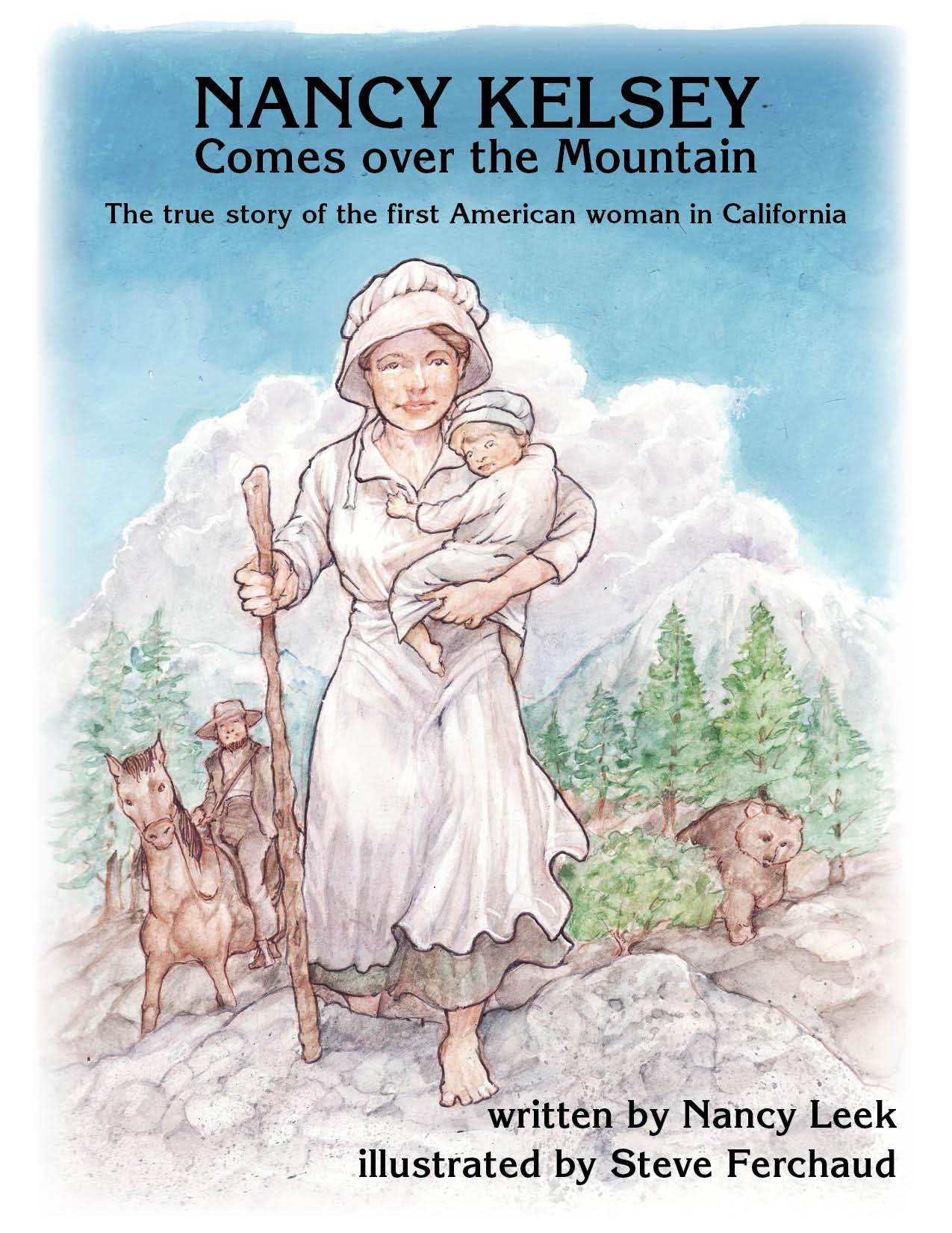
NKfrontcoverYippee!

The California State Library choose my book Nancy Kelsey Comes Over the Mountain as their book of the week!

This absolutely makes my day. Here’s what they said in their Facebook post:

Book of the Week: Looking for a good way to kick off Women’s History Month? Check out Nancy Kelsey Comes Over the Mountain by Nancy Leek and Steve Ferchaud. This charmingly illustrated account of Nancy Kelsey’s journey to California and the challenges she faced on the way, not only brings her history to life but introduces young readers to primary sources. If you are looking for a story that will inspire your daughters, this is the book for you! #BOTW#BookOfTheWeek

So— go and “like” the California State Library. They are a great institution, and a place I love to visit and do research in. Click on the My Books tab above to order books.

Posted in Uncategorized | Leave a comment

The Young Mountaineer

Some time ago I wrote about Dr. James O’Brien after seeing his amputation kit at the Society of California Pioneers in San Francisco. That was in 2014, but I recently received a comment on that entry, from the doctor’s great-great-great-granddaughter.

She said that the doctor, his wife Eliza, and their two little girls came to California in 1849, and that they “had a son born during the journey through the Sierra Nevada Mountains. They named him Pius Sierra Nevada O’Brien.” What a fine name! I thought.

Was 1363037

Self-portrait of J. Goldsborough Bruff

Now I have just turned up another reference to Dr. O’Brien and his family. I am looking through the journal of J. Goldsborough Bruff, who is famous for his account of his overland trek, his winter in the Sierras, and his drawings of life on the trail. (See Gold Rush: The Journals, Drawings, and Other Papers of J. Goldsborough Bruff (New York: Columbia University Press, 1949). The book is expensive to buy, but free to borrow from the library.)

J. Goldsborough Bruff came to California by way of the Lassen Trail, which should have landed him at Lassen’s Rancho on the Sacramento River in the fall of 1849. But he had a falling-out with his his trail mates, who abandoned him in the mountains. He suffered through a winter in the mountains and nearly died. He wasn’t rescued until April 1850.

During that 1849 fall season, he aided many other stragglers on the trail, including the O’Brien family (“clever folks” he calls them). He first met them on the Lassen Trail in September. On November 4th, he encountered them again, at the camp of the Fairchild family.

At their camp I found Mrs. O’Brien, with 2 beautiful little curly-headed girls, and a mountaineer, 3 weeks old only! I remained till night, and then walked with Mrs. O’B. back 200 yds. to her wagon & campfire. I carried young Nevada under my poncho, to protect the little fellow from the snow, the mother held on to the folds, to assist her in walking over the wet & slippery trail; and the poor little girls, hand & hand, followed, slipping & tottering, and crying with cold & wet. Quite a snow storm.

The young man Dr. O’B. had employed as a teamster, was asleep in the wet, under the wagon; and the fire was nearly out. I saw Mrs. ensconced, with her beautiful children, handed in the young mountaineer, made the young man turn out, get limbs and stocks and build up the fire, and bade them good-night.

The O’Brien family made it safe and sound to Sacramento, where little one-year-old Pius Sierra Nevada O’Brien appears on the census record, taken November 4, 1850.

record-image_S3HT-DC3S-X8M

James O’Brien, M.D., and family. “Do” after each name stands for “ditto”.

Posted in James O'Brien, Uncategorized | Leave a comment

One of Those Strange Individuals

John Bidwell told many fascinating stories about his life and experiences. Here is one about his friend and trail companion, James John, and an encounter with a grizzly bear in California.

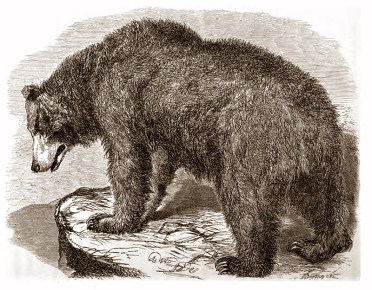
grizzly

“The Grizzly”
From The Trapper’s Guide by Sewell Newhouse

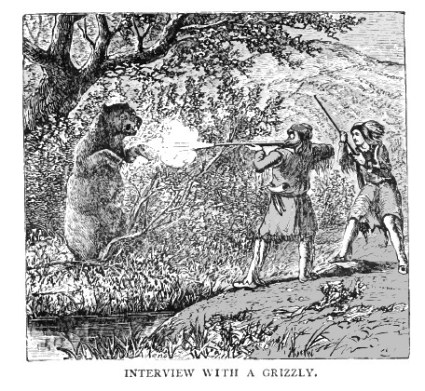
The grizzly bear was an hourly sight. In the vicinity of streams it was not uncommon to see thirty or forty in a day. . . In this connection let me relate an incident. Becoming tired of beef, James John, one of the first overland party, declared he would have some bear meat. An old Rocky Mountain hunter named Bill Burrows offered to go with him to get his bear meat. It was only a walk of one, two or three miles to find bear, so they started and soon came in sight of one, a monster in size, feeding in the tall grass not far from the river timber, on the west side of the Sacramento River, opposite to where Sacramento now stands.

A man who knows anything about the grizzly is cautious. Old hunters always keep to the leeward of a bear, and so take advantage and take a dead shot, but raw hunters, till experience has taught them caution, are often careless, and so Jimmy John went to within fifty yards of the bear and fired, the old mountaineer screaming at him, “You fool! don’t go there! Come back! ”

But Jimmy, as we used to call him, was one of those strange individuals you may see once in a life-time, who never seem to know what fear is. When the grizzly heard the shot, he broke into one of the dense thickets of grape-vine and willows along the river bank. Jimmy followed right along after the bear into the thicket, and was gone about fifteen minutes, when he came out greatly disappointed, because he had not succeeded in killing his game. He said he had bad luck because he got within six feet of the bear and fancied he was wounded, and when the animal opened his mouth, he wanted to make sure work of it by thrusting his muzzle into it, but the bear suddenly took to his heels and scampered off still deeper into the thicket.

grizzleyI used this story in the (almost) one-man show about John Bidwell that I wrote last year. Nick Anderson portrays Major Bidwell in 1858, and I play the fictitious lady reporter, Mrs. Leticia Norris, who has journeyed to Rancho Chico to interview him.  Bidwell liked to regale his listeners with stories about grizzly bears; this is not the only one.

By the way, if you need a program for your group, Nick and I are happy to come and present our Conversation with Major John Bidwell, 1858. It takes about a half hour, and we believe it is highly entertaining and informative.


Posted in James John, Uncategorized | Leave a comment

Runaway Horses in 1851

I’ve been going through letters in the John Bidwell Papers in the California State Library. Bidwell was the kind of man who held on to all his correspondence, and kept it well organized. Most of the letters deal with mundane matters, but as such they are a glimpse into everyday life in Northern California.

Here is a letter from a man seeking some runaway horses:

                                                Monroe’s Ranch Colusi Co. California  July 20th, 1851

Dear Sir,

Some days since I bought of Capt. Sutter twenty mares, and in crossing these on the Sacramento River, about one mile below this place, three of the mares escaped from us. These mares may fall in with your wild bands – if so please keep them until I see you which will be most probably, with the next four weeks.

The following is a description of the mares, as near as I can recollect.

One cream colored “Gil. flirt” mare, rather old.

One dun, or brown, mare, with a black list down the back.

One light bay mare, with a ball face. All of these mares are branded with Capt. Sutter’s iron, and vented, the vent being placed upside down.

Your attention to this Sir, will confer an especial favor for which I shall be pleased to make a remuneration.

Very truly yours etc.

John T. Hughes

Here are a few things to can learn about this letter:

Monroe’s Ranch belonged to Uriah P. Monroe, who helped to organize Colusi County and conveniently placed the county seat on his ranch, at a town he named Monroeville. When it was organized in 1850, the county had 115 non-native residents. It encompassed present-day Colusa and Glenn Counties, and part of Tehama County.

Monroeville was located where Stony Creek joins the Sacramento River, about five miles south of Hamilton City. The town has disappeared, but there is a Monroeville Cemetery, where William B. Ide is buried. You can learn more about Monroeville here.

The horses: Wild horses roamed all over California in those days. There were probably quite a few on Rancho Chico.

I don’t know what a “Gil Flirt” mare looks like, but there was a mare named Gil Flirt in 1816 who shows up on breeding charts. I don’t know what a “black list” is, or a “ball face” either, unless he meant to write “bald face.”

To “vent” a brand is to cancel it. According to an article by Delbert Trew (and “It’s All Trew”), “A brand may be canceled or abandoned by branding a bar across the original brand. This is called venting or barring out a brand.”

I like how politely Mr. Hughes asks Bidwell to “confer an especial favor.” Courtesy counts!

Who was the writer? John T. Hughes shows up as a miner, living in a cabin with three other men, in Mariposa County in the 1850 census. In 1851 he was living in Colusi County, where on May 3rd he was elected county judge to replace J. S. Holland (who had died). By September 1851 another election had to be held, because he had left the county. (This information from The History of Colusa and Glenn Counties.) Where he went from there, or what happened to the mares, I don’t know.

And yet the letter is still filed away in the library, and we can read it today.

Posted in Uncategorized | Leave a comment

More about Sutter and the Mormons

ThomasLarkin

Thomas O. Larkin

At the same time that Captain Sutter was bragging to General Vallejo (in Spanish), about his wheat fields and his new saw mill and flour mill, he was also writing to Thomas O. Larkin (in slightly awkward English) on the same subjects.

Larkin was an American merchant in Monterey who had lived in California since 1832, and served as the first (and only) American consul in Alta California. He was the man Sutter wrote when he needed supplies that could only be procured from ships calling at Monterey.

On October 29, 1847 Sutter wrote to Larkin, thanking him for sending a saw for his saw mill, and asking Larkin to send “bolting clothes.”

sieve01

Sieve covered with bolting cloth, from Flour Bolting, by Theodore R. Hazen

Nothing is wanting now to this enterprise, as the bolting clothes, and for those I take the liberty to apply to you for them, as the protector of such undertakings, and beg you to do this great favor to procure them for me, and I would be forever under the greatest obligation to you, and pay you for them immediately in lumber, flour, or money.

This bolting cloth is for his new flour mill. It was used to sift larger particles out of wheat flour, and it wasn’t something Sutter could have made on site. Hence his obsequious request to Larkin.

In a letter to John Bidwell a week later, Larkin said: “Say to Captain Sutter I rejoice in his prospects and I do not know of a yard of bolting cloth for sale in California.”

Sutter continues:

My tanyard is now once carried on well. I have about 1500 hides to tan. I have two tannery and 3 shoemakers (Mormons) all the hands on my mills are Mormons, and the best people which ever I has had employed. If I would have had Mormons 4 or 5 years past I would have a fortune, but so long I am here I has had only a few good men, the balance was a bad kind of man.

There are those Mormons again. If only he had had workers this intelligent and diligent a few years ago. How prosperous he would be! But things are looking up. Success and riches are sure to come now that everything is going so well.

The only other thing he needs is a clerk.

I am in want of a good Clerk who have to be, a good correspondent and a good bookkeeper (brought up on the desk). I would be very much obliged to you if you could recommend me a good one.

John Bidwell had been his clerk, but now Bidwell has gone off to farm for himself at Butte Creek. Sutter needs a new clerk and bookkeeper. A good clerk was hard to find, and even harder to keep.

Posted in John Sutter, Mormon Battalion, Uncategorized | Leave a comment

The Best of Days for John A. Sutter

John_Augustus_Sutter_c1850

John A. Sutter in 1850, the earliest photograph.

1847 was a good year for Captain John Sutter. Things were going well and prosperity lay all around. Here is a letter written from John A. Sutter to Mariano Guadalupe Vallejo on October 31, 1847. (The original letter, in the Bancroft Library, is in Spanish.) He relates that the wheat crop is good, cattle trading is fine, the building of a saw mill and a flour mill are going well, he has hired skilled workmen, and by the end of the year he expects to have finished up the year’s work successfully.

Immigrants are coming into California from the United States, but not so many as to be a problem. (According to George R. Stewart in The California Trail, there were less than half as many immigrants in 1847 as there were in 1846. Maybe less than 100 arrived overland to Sutter’s Fort.) He writes:

                                                                                               New Helvetia, 1847 – October 31

Senor Don Mariano Guadalupe Vallejo at Sonoma

My dear Sir and Friend:

I regret very much that I cannot come to visit you in Sonoma – for I have had an inflammation in my eye for the last two weeks.

I have received 150 head of cattle, cows, bulls and calves. Do me the favor to tell me the price of this cattle. Mr. Reading, who has 60 or 68 head will come to see you in a short time. I will send you the bricks when I finish delivering the wheat that I have to deliver. I still have much wheat outside. The saw mill was made in a few weeks, and with the large flour mill we are getting ahead with the work, and by the end of the month of December we shall finish up everything.

The Mormons are the best workers I have, without them the mills could not be made. In a short time I will send you some ramrods to try, for I have workmen who know the trade well. If you need strong shoes for your vaqueros I can send them to you, for I have good shoemakers – all Mormons.

As a Mormon myself (though not of pioneer stock) I am glad to hear these fellow Saints commended for their talents and industry. The letter continues:

Have you jerked meat for sale? How many vine stocks can you sell me in the months of January and February?

The sick are recovering everywhere on the Sacramento. It seems that in many other parts of the country there was much sickness, in Monterey, San Francisco, Napa, etc.

I received a letter from a gentleman in Switzerland. He wishes to come with a company of colonists or emigrants, when I send him a reply favorable to the country. I am certainly going to write him to come, for all of those people are industrious.

Excuse my bad Spanish.

I am, with the highest consideration,

Your very attentive and obedient servant,

DSCF4391

P.S. Do me the favor to give food to Olimpio and his brother, the messengers.

Olimpio was an Eastern Miwok Indian and the head of Sutter’s vaqueros. He often acted as a courier and in 1848 became keeper of the keys at Sutter’s Fort.

October 31, 1847 — everything is about to change for Sutter. In three months gold will be discovered at his new saw mill, his workers will leave for the goldfields, and he will soon be overrun with exhausted forty-niners and land-hungry squatters. Nothing would ever be this good again.

Posted in John Sutter | Leave a comment

Sutter’s Fort Restored

suttersfort1879

The central building in 1879, surrounded by an empty field

“In its broken, withered and dilapidated condition it offers sublime evidence of the devastation of time.”

So wrote the Sacramento Daily Union on September 2, 1891. But by 1890, nostalgia for “the days of old, the days of gold, the days of ’49” had roused the citizens of Sacramento to restore Sutter’s Fort to its former glory. The newspaper reported  that restoration work had begun and was being “carried on in good earnest.”

The foundation was strengthened with brick and cement, and new adobe bricks were made in the time-honored fashion.

A force of men are busily engaged in making adobe bricks on the ground. This work, to the uninitiated, is peculiarly interesting, for, in order to duplicate the original strength, it necessitates using the same kind of earth, and the same line of operation that was adopted by the original builders. The earth is mixed with water and tramped into proper consistency by the bare feet of the workmen. It is then molded into proper shape and placed on the ground to dry. After being turned several times it soon becomes hard enough for use.

The original fort must have been even larger than it appears today, because the newspaper reported that

Owing to the fact that the south corner of the outer walls extended to where the center of L street now is, the Restoration Trustees have decided to abandon the work of restoring that portion. It is, however, the intention to restore the two bastions, one at the west and the other at the east angles of the building, and show the profile of the outer trails jutting from the bastions, and gradually breaking down to the ground. Limited space in the two blocks will not permit the restoration of the entire outer walls, but by the foregoing plan the exact outline of same can be shown.

As it is, L Street has to curve slightly around the grounds of Sutter’s Fort State Historic Park.

at the old fort newsIn January 1892, the Trustees invited John Bidwell and another old-timer, Charles Stevens, to inspect the work.

The old-timers were delighted with the appearance of the structure, and both united in saying that it looked quite natural. General Bidwell, however, thought the walls used to be whiter than the new coating of adobe renders them. “They used to get a white potter’s clay somewhere up in what is now Amador County,” he said, ” and with that the Indians whitewashed the walls, bastions and the buildings, and I tell you it was quite a feature. As one approached the fort from a distance, the aspect of the old fort, with its snow-white walls, was inviting, I can assure you. The sight gladdened the heart of many a weary traveler.

It must have gleamed as white in the old days as it does today.

suttersfort

Sutter’s Fort in 1847. Library of Congress


Posted in Sutter's Fort | Leave a comment

Sutter’s Fort As It Was

jan30-sac (118)

This painting hangs in the California History Room at the State Library in Sacramento. It shows Sutter’s Fort, what was left of it, as it looked before its restoration in the 1890s. The fort had deteriorated quickly after the gold rush, and well before 1890 all that was left was the dilapidated central two-story adobe building where John A. Sutter and John Bidwell had their offices.

jan30-sac (120)I am a bit confused by the date — 1895 — for the painting, since restoration of the fort by the Native Sons of the Golden West began in 1891. The painting must have actually been done some time before the restoration began.

I am tickled to know, however, that “Grandma Moore” (Sarah Moore) had the picture painted to memorialize the old fort, and to advertise her fruit booth at the State Fair. What a nice idea! And imagine having that as a view from the orchard on your ranch.

The artist, J.W. Huber, was Jennie Willis Huber, who taught art at an academy in Sacramento before her marriage to a man named Amos Brothers.

The painting was donated to the State Library by Grandma Moore’s great-granddaughter, Marilyn Moore Sommerdorf in 2009. You can read more about the painting in the California State Library Foundation Bulletin, no. 94. More images of Sutter’s Fort can be found at Calisphere, a wonderful source of California pictures.

sutters fort old Here’s one — another picture of Sutter’s Fort in decline. It’s a pencil drawing by W. Tyrrell done in 1855. Only a few years after the gold rush and the walls are crumbling and the floors are sagging. It wouldn’t be long before the adobe bricks melted back into the earth.

Posted in Sutter's Fort | Leave a comment