A Visit to the Mary Aaron Museum

This fall I am (for the first time) a peer leader for an OLLI class. (OLLI is basically retirees teaching other retirees anything they are interested in.) We are touring historic houses in northern California. Sounds like a fun idea, right?

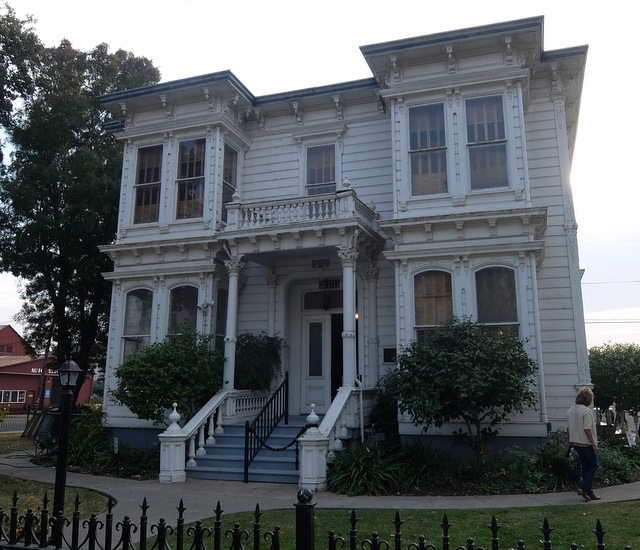
Our first class was today and we drove to Marysville to visit the Mary Aaron Museum in the Warren P. Miller House, which is on the National Register of Historic Places. It is one of the earliest structures still standing in Marysville, and a striking example of Gothic Revival architecture.

During the California Gold Rush, Marysville was one of the largest cities in the state with a booming economy, fueled by gold from the northern mines. Warren P. Miller arrived in Marysville from New York in 1850, and made his living designing buildings for the prosperous citizens of Marysville. This house is the one he built for his own family in 1855.

DSCF3991.JPG

The Warren P. Miller House

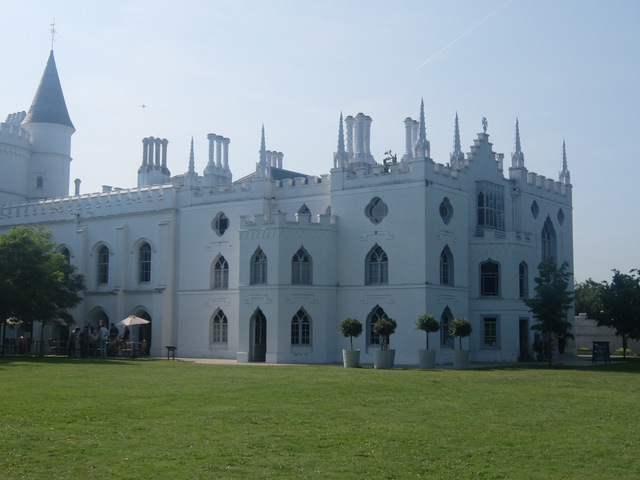
Our guide told us that Mr. Miller modeled the design for his house on Strawberry Hill, the home outside London of eccentric 18th century author Horace Walpole. Looking at the exterior of the house, it’s not hard to see it as a mini-Strawberry Hill. Check out that roof line.

DSCF0934

Strawberry Hill House, a Gothic Revival extravaganza

Warren Miller was not only an architect and builder, but also an inventor. At the California State Fair held in Marysville in 1858 he displayed a self-regulating windmill, the first practical working model of a tractor/crawler to be built in the United States, and an excavator/grader to be pulled by the tractor. Later he would patent an improved gun turret and replaceable teeth for industrial saw blades. The latter invention brought him a fortune and in 1869 he moved his family to New York, where he died in 1888.

DSCF3996

The staircase is impressively curved and dangerously steep

The Aaron family bought Miller’s Marysville house in the 1870s. It remained in the family until 1955, when the only son of Mary Bobo Aaron donated it to the City of Marysville to be maintained as a museum in honor of his mother. In 1998 the house was added to the National Register of Historic Places.

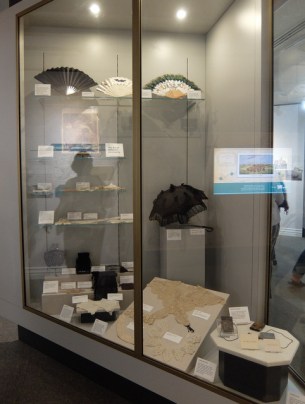
The house/museum has Victorian furniture and knickknacks, period artifacts and documents, a nice selection of dresses from the 19th century, and a never-touched wedding cake from 1875 in a wooden box (!).


DSCF3994

A lovely old-fashioned parlor

It’s worth a visit, so put it on your list of North State places to see.

Posted in Uncategorized | Leave a comment

Feuding in the Kitchen

If you have attended an event at Bidwell Mansion in the last few years, you may have been lucky enough to see some dramatic vignettes performed inside the Mansion.

These short dramas are all based on actual historical accounts — letters, diaries, interviews. I have written most of them, and even performed in them, usually as Florence the cook, who had an ongoing feud with a young woman named Ruby English, Annie Bidwell’s maid in the last years of Annie’s life.

2016 JOHN BIDWELL BIRTHDAY 066

Florence faces off with Ruby (played by Adrienne Glatz)

Our little drama is based on the “Recollections of Ruby English as Mrs. Annie E. K. Bidwell’s Maid, 1914-1918,” an oral history interview done in 1964, five years before Mrs. English’s death. I was introduced to this story a few years ago by Susie Zimmer, who knew that it contained some good stories that we could use for our vignettes at Bidwell Mansion.

Soon you will be able to read Ruby English’s account yourself, because it will be published this fall in a compilation of oral histories by the Association for Northern California Historical Research.* These interviews are fascinating accounts of bygone days by people from all walks of life. The upcoming publication will have six or seven accounts on a variety of topics. There is bound to be one that will catch your fancy!

In preparing this oral history for publication, I realized an important aspect that goes entirely unmentioned in the account itself.

Ruby Daily English was African-American. It never comes up in the interview, simply because it was obvious. At the time the interview was done, she was well-known in the community; now 53 years later, few people know who she was. Susie and I certainly didn’t. It was only by looking at census records for more information on her that I figured out her race.

I wish I had a photograph of her, but I can’t find one. I did find a photo of her brother Cliff Devinger, who was also popular and well-known in Chico. More about him some other time.

Knowing that Ruby was black casts a new light on her troubles with the cook. Florence didn’t want to serve her cream with her coffee, or give her a piece of the special cakes she baked. She resented the fact that Ruby and her husband were now occupying the upstairs servants’ rooms that had once been hers. She finally left Bidwell Mansion rather than come to terms with the maid, whom she considered an upstart and a usurper.

I hope you will want to read ANCHR’s anthology of oral histories when it becomes available later this year. If you are interested in the African-American experience in Chico, look for another publication by ANCHR: Michele Shover’s Blacks in Chico, 1860-1935: Climbing the Slippery Slope.

*ANCHR is a non-profit organization which was originally founded to rescue and provide access to historical records in Butte County. Its purpose currently is to promote the publication of historical accounts pertaining to northern California. ANCHR assists authors, edits publications, and makes them available to the community.


Posted in ANCHR | 2 Comments

“I do not want to “fail” in this job”

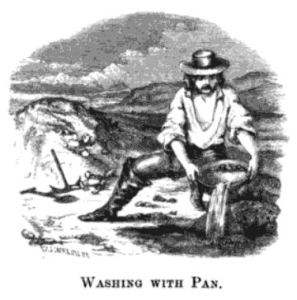
gold-miner-washing-with-panThis is John Bidwell’s last letter to George McKinstry for the year 1848. He is still at the ranch of Charles Roether, which was on the Feather River at Honcut Creek, where he has been buying cattle to drive to the mountains. He has also been checking over the stores sent up the river from Sacramento — he can’t find the pepper, the raisins, or the drawers (underwear) and shirts.
Charles Roether’s  Sat 4th Nov. 1848

Dear Mac,

Yours of yesterday was rec’d. I am at a loss to know where the drawers & shirts could have gone, which you say are missing. I have not time this morning to overhaul all of the boxes & bales to see whether or not they are here. I have opened all the boxes & have seen nothing of the pepper, nor the half box of raisins. I rec’d from McDougal the number of packages & boxes mention by you on the memorandum.

Before I received your note yesterday by Rolfe I had concluded the arrangement for beef and I send Rolfe, that we may not discharge the Indians, or at least to have them return on Tuesday, Rolfe will have to be here on Sunday evening; Monday night we sleep on the plains & Tuesday I come with cattle. I went up on Yuba and saw Covillo. I shall bring 40 or 50 head at [?] dollars per head you will not of course disclose this to any one till I see you. (If inquiries from the other side, say (M.T.)

The cattle for beef is important because that was one way they paid their Indian workers. No beef and the Indians would leave Bidwell Bar and go home. So the sooner they can get the beef to the mountains the better.

I will have to look at the letter again (I have only a typescript with me at the moment) to see if I can figure out how much he paid for the catte. He was hoping for something under $40 a head. He must have got a good price or he would not have cautioned McKinstry to not disclose the price. I assume that “say (M.T.)” means say nothing.

Bringing this number will not in any manner interfere with other plans. I hope you will have everything as ready as possible, grind the knives on the grind stone of Old John, etc. etc. etc.

I think Hensian [?] had better put another hide in the water to mend any places where the coyotes may eat the hide of the corral, and fasten on to all of those sticks where the Indians lashed the stocks with hide, I do not want to “fail” in this job.

Yours, J. Bidwell

It’s going to be butchering time when Bidwell gets there with the cattle, hence the notes about sharpening the knives, and mending the corral with hides.

P.S. I forgot to say in my letter the other day that Reading had passed two days ago down to Fort and getting along very well, Peter Lassen has got in with all his party & wagons, also the Columbia party & wagons, some on Feather River already – this news from Swift.

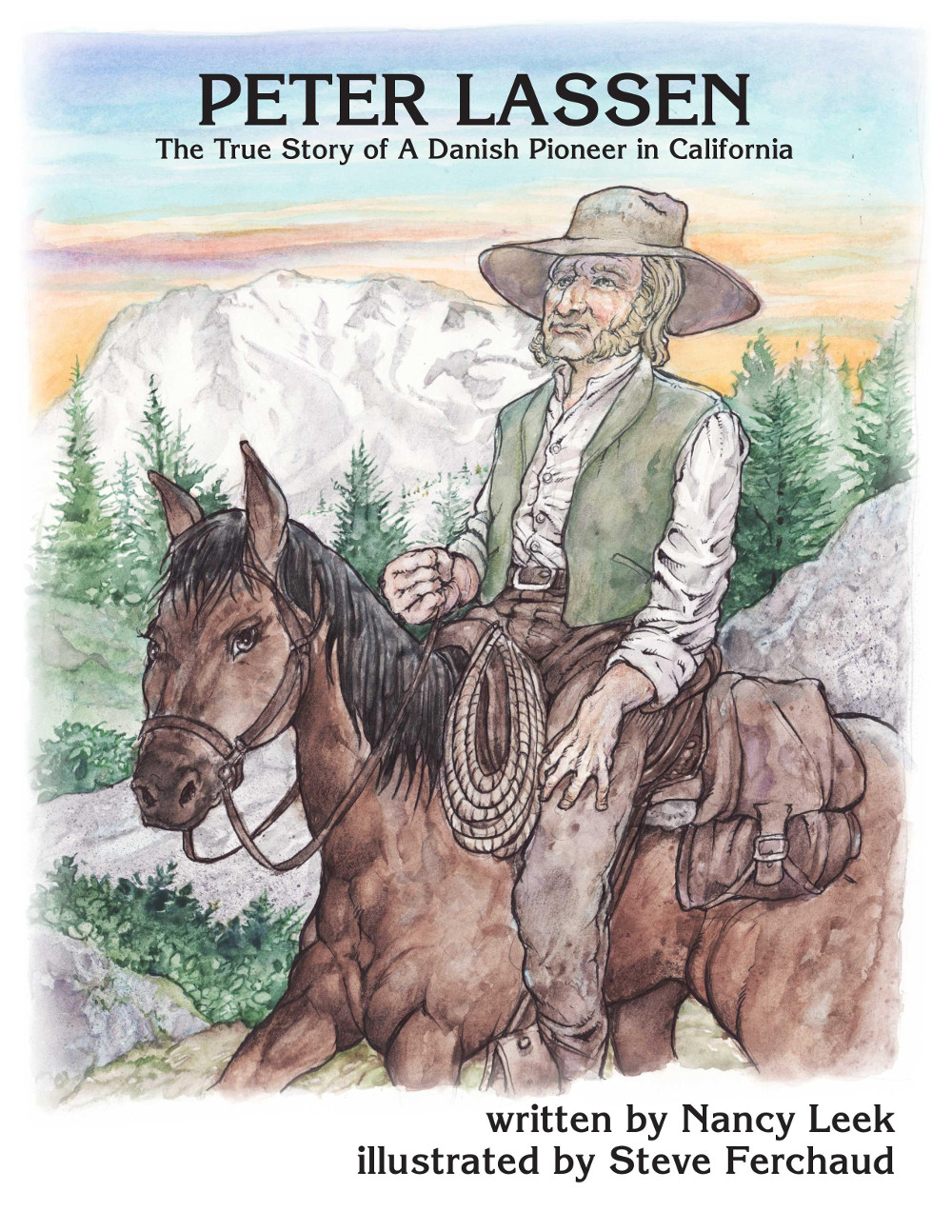
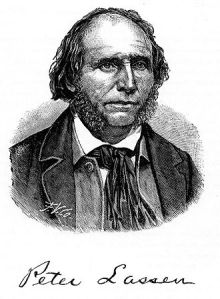
Here we have some names well-known to students of northern Califoria history. Pierson 330px-Peter_Lassen-portraitB. Reading, a good friend of Bidwell’s, owned Rancho Buena Ventura at the present site of Redding. He mined extensively in Shasta County.  Peter Lassen had a ranch in Tehama County where Vina is today. In his effort to promote his ranch, he had returned to Missouri in 1847 where he recruited a party of settlers and brought them to his ranch by way of the Lassen Trail. He only learned of the gold discovery of January 1848 when he found his ranch virtually deserted.
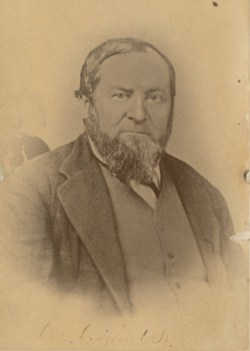
Granville Swift was another California pioneer who was a Bear Flagger and a prosperous cattle rancher in Colusi County (later split up into Clusa, Glenn and Tehama counties) before he made a fortune at gold mining. The remains of his adobe home can be seen in Orland.

All three of these men deserve blog posts of their own, and someday they will get them.


Posted in Uncategorized | Leave a comment

1848 Shipping List — Part 2

Here is the rest of Bidwell’s letter to McKinstry on November 1, 1848. It is chiefly concerned with that most important trade item — cattle. Demand was going up, and so were prices.

I learn here that Cordua has raised the price of Cattle to from 40 to 50 dollars on Feather River and that Yates has a letter from Covillo to this effect which he showed here yesterday. I shall go down to Cordua’s today – I think Rolfe had better come down tomorrow, & bring all the pack animals, with him. By him I want to hear from you, with your opinion how much you are willing to give for cattle – I mean to highest price; I will get them, of course, as low as I can, but I will not close a bargain to give over $30 before I hear from you. I met old Goda the Frenchman, here this morning, & exchanged a pick with him, & and then sold the other dull Pick to another Frenchman for $8. I let Goda have the bolt of Stripe drilling which you will see on Norris’ Bill at $32. I borrowed $10 & paid him which just squared his bill. I have charged all the things on this bill in my memo here. Send by Rolfe $10 & repay this sum.

I think it is doubtful if we get any cattle this week – but I shall use all possible means to get up this week. I wish Baptish and his Vaquero would get their horses from the other side & hold themselves in readiness to help drive the cattle in the corral – say on Saturday – I may possibly be in camp before I come with the cattle.

It may be that I can make a King “Jumping” bargain with Yates about the cattle which will come somewhere near the mark etc.

Yours etc.  J. Bidwell

John Yates was an English sailor who came to California in 1842. For a time he worked for Sutter as the master of his launch, and in 1845 he, along with William Dickey, was located on Rancho del Arroyo Chico. Later he owned Yates Ranch, a few miles south of Oroville. He must have been a restless man, for in 1851 he left California for Hawaii. Bidwell referred to him as a “tough old sailor.”

covillaud

Charles Covillaud in later years

“Covillo” was Charles Covillaud, a Frenchman who was in partnership with Theodor Cordua. Cordua was struggling to keep his ranch going as all his vaqueros and other employees headed for the goldfields. Covillaud had a trading post where he sold beef and other goods to miners and Indians. In 1848 he married Mary Murphy, a survivor of the Donner Party, and named the town that grew up on Cordua’s ranch Marysville, after her.

I don’t know who “Goda the Frenchman” was. Wish I did.

I also can’t identify “Baptish,” unless he is Jean-Baptiste Trudeau, who was often called Baptiste.  He was a surviving member of the Donner Party of 1846. Bancroft lists him as Jean Baptiste (without the Trudeau), and says he was one of the earliest miners, but also notes that “there are several of this name not to be identified.”

And what is a “King “Jumping” bargain””? I have no idea.

I always welcome your comments, especially if you can solve any of these mysteries!


Posted in Uncategorized | Leave a comment

A Shipping List from 1848

Here is Bidwell, in November 1848, with a list of items that he is shipping to George McKinstry for sale at their trading post at Bidwell Bar. At least that’s where I think all this stuff is going. I’m not sure where McKinstry was, but Bidwell is writing from Roether’s Ranch on the Feather River at Honcut Creek.

I have never heard of “Rolfe” before, but he is probably Tallman H. Rolfe, who came to California in 1847. After working with Bidwell, he established his own store in Yuba City in 1849. According to The History of Yuba And Sutter Counties:

The first store in Yuba City was opened in August, 1849, by Tallman H. Rolfe and Henry Cheever. Two advertisements by these enterprising men appeared in the Sacramento Placer Times on August 25, 1849. They read as follows: “Rolfe & Cheever, wholesale and retail dealers, Yuba City, corner of Water and B Streets.”  “Notice to Miners. Rolfe & Cheever, having established a store at Yuba City, will keep constantly on hand a large and general assortment of dry goods, groceries, provisions, etc., which will be sold low for cash or gold dust.”

Here is Bidwell’s list of goods shipped, with explanatory notes in brackets [ ].

                                               Charles Roether’s 1st Nov. 1848

Dear Sir

I send by Rolfe

4 Ps Blue Drill  [pieces of fabric — drill is a heavy-weight, durable cotton twill]

6 Copper Pans  [for panning gold or for cooking? Gold pans were usually iron]

6 Doz. Cot. Hdkfs  [cotton handkerchiefs, plenty of them. They would be the size of bandanas]   pepperboxjpg

1 Pepper Box [probably a pepper grinder, not the kind of revolver called a pepperbox]

1 Tin Funnel

3 Blk Hdld Butcher Knives  [black handled]

9 Barlow Knives  [common pocket knife of the day — Tom Sawyer had one]

barlwo knife

Antique Barlow knife

2 Hats (for me and Rolfe)

2 Ps Col’d Manta  [manta was a cotton cloth made in Mexico, “col’d” is “colored”, i.e., dyed rather than natural]

6 Ps Blue Prints

1 Ps Stripe Drilling  [more fabric]

1 Gimblet & 1 Looking glass

Gimlet1

A Gimblet, for boring holes

1 Paper      [don’t know what kind of paper]

Needles & 1 Paper Buttons  [a paper card of buttons]

1 Pad Lock

1 Lb. Epsom Salts

1 Drawing knife       [a woodworking tool]

drawknife

a drawing knife, or draw knife


6 Ps Calico (which I got at McKee’s) [this was plain, not printed, cotton cloth]

9 Picks

4 Prs Shoes (Nos 6 among them)  [better not be picky about the size]

1 Coffee Mill

11 Butcher Knives

87 lbs Sugar

40 lbs  Flour

Of Hosier’s things  [I don’t know who Hosier was, perhaps a carpenter]

1 Handsaw      Pants & Coat

1 Jointer   [a kind of carpenter’s plane]

jointer_plane

a jointer plane

2 Shirts,          etc.

1 Pr Boots       2 Pipes, Tobacco

1 Ps Shaving Soap etc.

½ Quire Paper & 2 Spoons

The pepper was not in the large Box, as marked on your memorandum, and I did not search farther. The Epsom Salts are those which I bought from McK. Yours I did not find in the big box.

Epsom salts (magnesium sulphate) is still used today, primarily for soaking sore and tired feet. In the 19th century it was a common remedy, used as a laxative or purgative. It might not be the first choice for that today.

I had fun looking up some of these items and finding out what a gimblet and a jointer were.

Posted in Uncategorized | Leave a comment

Happy Admission Day!

Today is California Admission Day, the day that California was admitted to the Union as the 31st state. So do something fun to commemorate this day in history, like the San Franciscans did when they got the news on October 18, 1850. Jubilation erupted throughout San Francisco as the citizens celebrated with bonfires, marching bands, booming cannons, and all-night balls. It’s a day to celebrate!

fuzzyflag

Headline of the Daily Alta California, Oct. 16, 1850.

Posted in Uncategorized | Leave a comment

“If this is true . . . it is outrageous.”

Here is the second half of Bidwell’s September 30, 1848 letter to George McKinstry. He is outraged by a rumor that he has killed two Indians, a charge that he stoutly denies. It would certainly have been out of character for Bidwell. The story may have been motivated by Bidwell’s success in mining and in recruiting Indians to work for him.

He is particularly incensed that this report is being spread by Michael Nye, one of his companions on the overland journey in 1841.

I have been told by a great many persons that there is a report all through the country, that I have killed most barbarously two Indians who were at work for me – and that it come from Nye, and was told and repeated by him without any reserve all down this river the day he left our camp when I was absent – You recollect the time, he was here.

One Indian was said to be cruelly beaten by my vaquero and that he fell and dashed his brains out against a rock. – the other, it was said, I have stabbed with my knife in the act of stealing meat, and thrown him in the river. You will hear if this is believed below, from whom it came; if from Nye or anyone else. If any one has heard Nye say so, I wish you would be particular and receive it from him who heard it told direct by Nye. For if this is true that Nye has said so it is outrageous.

It must be on account of the sway which we hold over the Indians in these regions, which prevents his success on this river. However the Indians came constantly to work here from the plains but almost invariably complain of Nye’s Alcalde interfering with them. The Toto Indians came this morning with complains that Pumul (Nye’s Alcalde) was at their rancheria and had taken all their things from them. I sent one of the men to find out certain before I do farther.

DSCF0593   Tuesday after you left the other current machine was in operation, and all three have been going ever since except one day. I am extremely anxious to see you in camp, but do not expect you until next Saturday. I hope you will make all haste your presence is much wanted in camp – people are going above us in all directions etc. etc.

Yours truly,  J. Bidwell

rancho willy

Diseno of Rancho Willy, drawn by John Bidwell. Courtesy of the Bancroft Library.

Michael C. Nye was probably born in 1811, making him just a few years older than John Bidwell. He came to California with the Bidwell-Bartleson Party and was granted a rancho for his service in the Micheltorena War in 1844. His Rancho de Willy was on the Sacramento River, between Rancho del Arroyo Chico on the south and Lassen’s Rancho on the north.

He may not have done much to develop the ranch, since he spent most of his time in Marysville. Nye later moved to Oregon, where he died in 1906, the last surviving member of the Bidwell-Bartleson Party.

Posted in Michael Nye, Uncategorized | Leave a comment

“A great many people have crowded upon this stream”

gold-miner-washing-with-panAnother letter from Bidwell to George McKinstry in 1848. I hope you find these letters as interesting as I do. I think the insights into the early days of gold-mining in California are fascinating.

Camp 30th Sept. 1848

Dear Mac,

Two weeks and a little more have elapsed since you left, and our work has gone on with usual regularity. I was back in camp early Sunday morning after I left you on Friday at Charles’s, — the 5 new Indians had run away on Friday night – and I have not been able since to prevail upon them to return. The Paegnes, however have submitted since I paid them a visit and made them some presents, and I have 11 of them at work also some of the Yunos. Last week we had 20; this 33 hands. A great many people have crowded upon this stream since you left. About 300 people have arrived from Oregon inpressly [sic] for Gold digging.

Charles’s was the ranch of Charles Roether, a German immigrant who came overland to California in 1845. According to Bancroft’s Pioneer Register, “his name often appears in the New Helvetia Diary ’45-’47; [he] settled at ‘Charley’s rancho’ in Butte Co, moving in ’58 to Feather River in Yuba, where he died in ’68, leaving a widow and 3 children.” Mansfield’s History of Butte County locates the ranch on the Huber Grant, on Honcut Creek.

I don’t recognize the names “Paegnes” and “Yunos” for California Indian tribes. If anyone can enlighten me, please do. It’s interesting to see how Bidwell deals with the Indians, paying them visits and giving them presents, in an effort to get them to “submit” to working for him.

            I have heard of the arrival of several companies from the States – and have seen some of the people among whom was Mr. Farwell, formerly in this country. He returned, perfectly “broke down” as regards funds, and desired to join us, but I did not employ him in any way, although I would like to assist him if any one. In case nothing has transpired since you left to prevent starting a trading post at some point on your return, and you have not made other engagements, I think Mr. Farwell would answer the purpose. You will probably see him at Mr. Cordua’s.

We have been apprehensive that people might call on us to work on our bar, but up to date have not been interfered with. Burch has said since he left us that we had bluffed him off abruptly when he asked permission to work here and that he was not going to give it up, but find a partner and come any how; but he is all talk – this was told me by one to whom B. was telling it, but did not want B. to know he told me.

“Our bar” is probably Bidwell Bar, as it became known. It was a productive site for gold.

Edward A. Farwell, a sailor from Boston, came to California in 1842, and after becoming a Mexican citizen in 1843, got the “Rancho de Farwell” grant on the south side of Chico Creek. In 1845 he returned to the States to seek medical help for his “weak eyes.” He returned, as Bidwell reports here, in 1848. He still owned the Farwell grant, but he was land rich and cash poor. Nothing had been done to develop the ranch.

Rather than take a job at the Bidwell & McKinstry trading post, he ran Sutter’s launch on the Sacramento River for a few months. He died in San Francisco in January 1849, leaving his estate to be administered by John Bidwell.

“Mr. Cordua’s” was the ranch of Theodor Cordua, another German immigrant.

Burch is probably Charles H. Burch, who shows up in Bancroft’s Pioneer Register. He came in 1846 and was at Sutter’s Fort (everyone was at Sutter’s Fort) 1846-47. Nothing more known about him.

This is just the beginning of this letter. Next time we’ll get to the juicy part, in which Bidwell defends himself against accusations of brutality towards the Indians.

Posted in Edward Farwell, George McKinstry, Theodore Cordua | 2 Comments

“The most laborious business I know of”

Charlie_S_Miner_Photo_-_Library_of_Congress

This letter is in the McKinstry collection, but I don’t know who wrote it. Possibly it is by the Mr. McCall mentioned in Bidwell’s letter of 24 June 1848. It gives another view of Bidwell and Dickey mining on the Feather River. It’s a long letter, and I won’t quote all of it. This is just the opening sentences. It looks like the letter-writer is writing from Sutter’s Fort.

New Helvetia  July 1st ‘48

Dear Sir,

Your two favors of 22d & 27th June I found on my desk last night on my arrival from the mountains after an absence of eight days. I was in hopes that I should have found you here on my return, I have brought down a letter from Mr. Bidwell which I send annexed which will explain to you the situation of the business on the mountains. It was my second visit to the camp I find it entirely different from what I expected it to be. The country is so rough that it is impossible to employ hands, in fact it is actually necessary to work in person which is the most laborious business I know of.

Mr. Dickey and Bidwell have been very industrious but not very successful as you will see from his statement. Mr. Dickey positively refuses to be engaged in the business with partners while on the mountains. I explored the Yuba river and the South fork of Feather river but can find no suitable place for working machines and the Indians do nothing working among the rock. Could a suitable place be found Mr Bidwell and myself could probably bring two hundred Indians in the field but now we find that 6 or 8 hands are more than we can employ profitably.

I have no doubt could I be kept supplied with a stock of goods say to the amount of 8 or 10,000 dollars I could make much more than I could by gold digging but as at present it appears that it is not convenient for you to furnish the goods and I therefore have concluded to go to digging say for some two months. I am more strongly convinced that a large and profitable business could be done at this point and I flatter myself that I could compete with anyone now engaged. The work of mining is too severe for my constitution and I do not think I can stand it long. The weather on the mountains is much warmer than in the valley there are already a number of severe cases of bilious fever on the Feather river, one I brought down, others to low to remove.

Hard labor, hot weather — it’s no wonder that this writer and many others aspired to be merchants rather than miners.

And what was bilious fever, you ask? It was a common diagnosis in the 19th century for any fever that was accompanied by symptoms of nausea, vomiting, and diarrhea. “Bilious” meant the condition was thought to arise from disorders of bile in the liver. It could have been any number of diseases; very commonly it was malaria.


Posted in Uncategorized | Leave a comment

“We did tolerably well washing the sands”

Another 1848 letter from John Bidwell to George McKinstry.

Feather River below first camp

Saturday 24th June 1848

Dear Mc,

Mr. McCall arrived yesterday morning and brought two letters from you dated the 20th inst. We spent the remainder of the day in search of a place to construct a washing machine, but did not succeed in finding one. McCall and Dickey go again today to look at another place.


Washing machine? Bidwell means this: cradle

A machine for washing gold out of sand, by rocking it in a “cradle.” His first one must have been a rather crude version.


Not this: washingmachine

            Last week we did tolerably well washing the sands along the river – we made something not far from $1000 – This week we have done but little – The first camp above where we were when you came to us, was good – the first day of our arrival there we took out not less than 300 dolls. – but the place soon became exhausted it being small, and we have not been able to find as good a one since – In fact if Mr. McCall had not arrived I should have sent an express to you yesterday. We are not making over $50 per day with all our Indians – and if we do not find a good place in one or two days at most, I want to go down either to Yuba or the American Fork. So I think that the boat had better not be sent up until we determine, or if it is already on the way when you receive this, have it detained at Hock.

According to the website Measuring Worth, $1000 dollars in 1848 would have a purchasing power of $31,000 today. Not bad for a week’s work. Even that $50 a day was equivalent to $1550. The forty-niners, however, would soon find out that prices were high in California and a thousand dollars in gold wasn’t as much as it sounded like it was.

I am expecting this letter will find you of the road up, but thought you might dispatch the boat ahead with direction to pass on up from Hock. I have written a few lines to Mr. Cameron, requesting him to detain the boat until you receive my letter. I shall expect you to either come or send an answer to this, stating your opinion of going below etc. I am entirely out of coffee; I would like a few more shirts having sold nearly all of these which I brought up. I see plainly that we cannot keep goods in camp to supply miners unless we can find a place where we can establish ourselves permanently for some time or are better provided with means of transportation. I cannot leave camp or I would meet you at Hock. If I were certain that you would be there I should come down any how. If you come you can find camp by asking any of the Indians along the river mentioning my name.

Yours etc.  J. Bidwell

Maybe Bidwell hadn’t settled at Bidwell Bar yet; he seems to be moving around quite a bit. A permanent place of business and reliable transportation are concerns.

Duncan E. Cameron was employed at Sutter’s Hock Farm, but other than that I know nothing about him.

All the men who were already established on ranches in the valley used Indian labor when they went seeking gold. They usually brought along natives that they had already established a working relationship with. They saw their role as one of supervising and organizing, rather than the harder labor of digging and panning.

Bidwell had a reputation for treating his Indian workers fairly, but many others did not. There is no doubt, of course, that from our perspective, the Indians were being exploited as labor by all the white settlers. But Bidwell used persuasion and payment instead of coercion. Indians were paid in food, blankets, shirts, and desirable items like sugar, knives, and beads.

Posted in George McKinstry, Uncategorized | 1 Comment