A Visit to the Bayliss Library

DSCF3578

The Bayliss Library, in Glenn County, celebrates its centennial this year, and yesterday the community marked one hundred years of library service to this rural area with everything you could want in a community celebration: speeches, music, food, activities for the kids, and the chance to see a lovely old-fashioned library.

DSCF3579The Bayliss Library is a Carnegie library, built in 1917 with money donated by steel magnate and philanthropist Andrew Carnegie. Carnegie financed 1689 libraries in the United States, and many more overseas. 142 were built in California, and 36 of those still operate as public libraries, including the Bayliss Library. The Biggs Branch of the Butte County Library is also a Carnegie Library. Other Carnegie libraries in the region have been put to other uses: the library in Orland became a community center, the one in Oroville houses the Butte County Law Library, and the one in Chico is now the Chico Museum.
The Bayliss Library is unusual because it is a rural library, in an unincorporated community, surrounded by agricultural land. All other Carnegie libraries that I am aware of were established in incorporated towns and cities, where the municipal government was responsible for the continuing staffing and maintenance of the library. Bayliss Library is now operated as a branch of the Willows Library, and is open one day a week, on Tuesdays.

DSCF3587

Andrew Carnegie watches over the library, which has fine wood trim and bookcases throughout.


Posted in Uncategorized | Leave a comment

My New Project

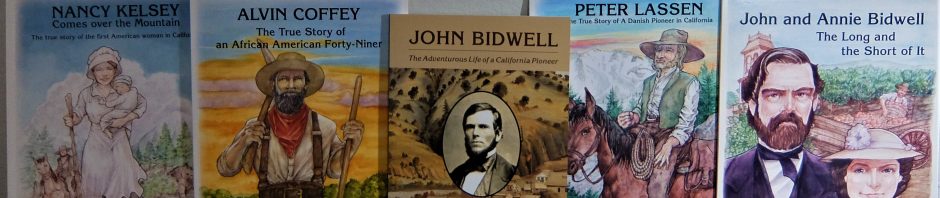
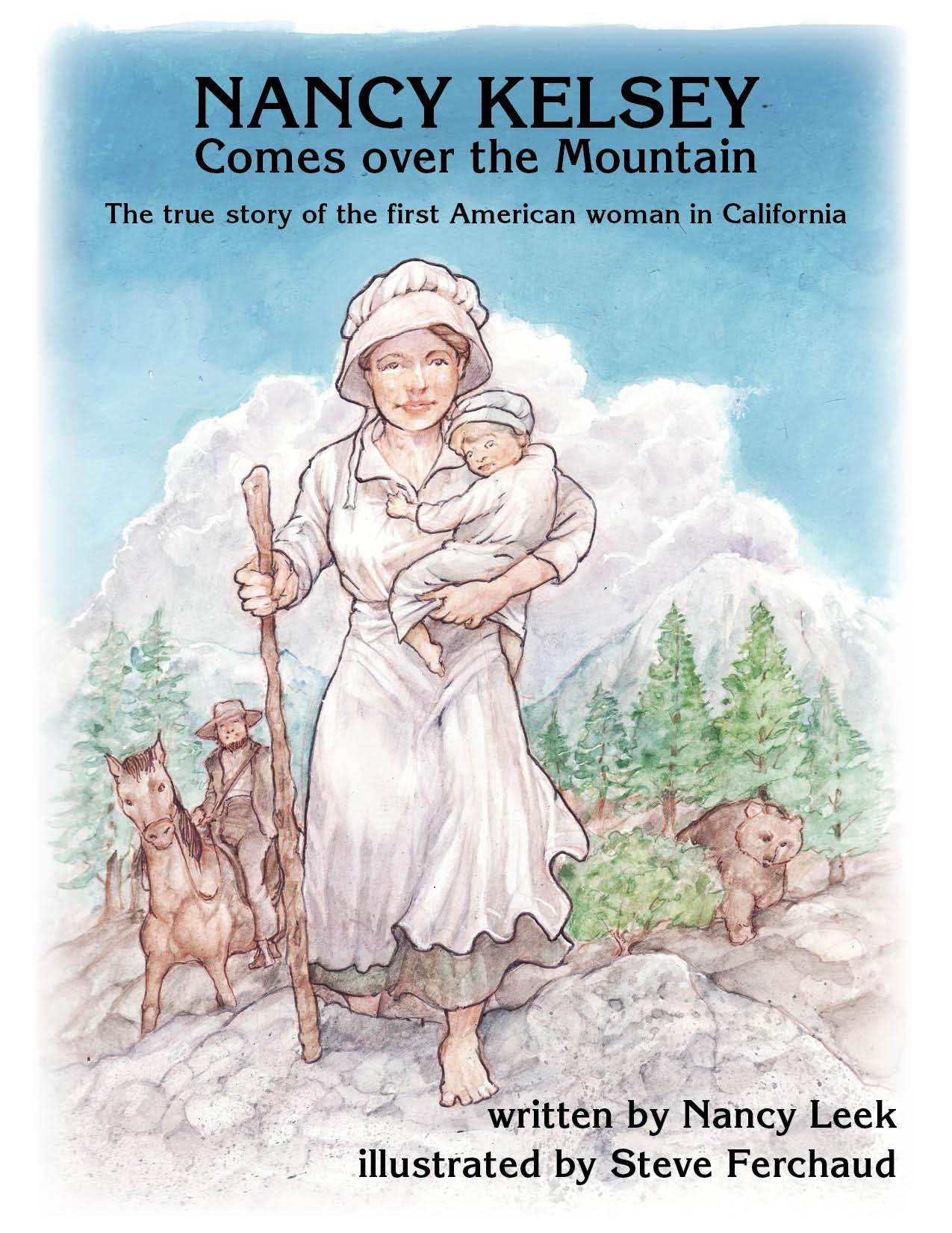
I am working on a picture book biography of Nancy Kelsey, the first American woman to come over the Sierra Nevada into California. Nancy was seventeen years old when she set out across the plains with her husband Ben and their one-year-old daughter Martha Ann. When the company split at Soda Springs, she was the only woman to travel into the unknown desert toward California (the few other women went to Oregon, the safer option).

When friends told her she should stay behind and wait for Ben to check out California first she said,

Where my husband goes, I can go. I can better endure the hardships of the journey than the anxieties for an absent husband.  

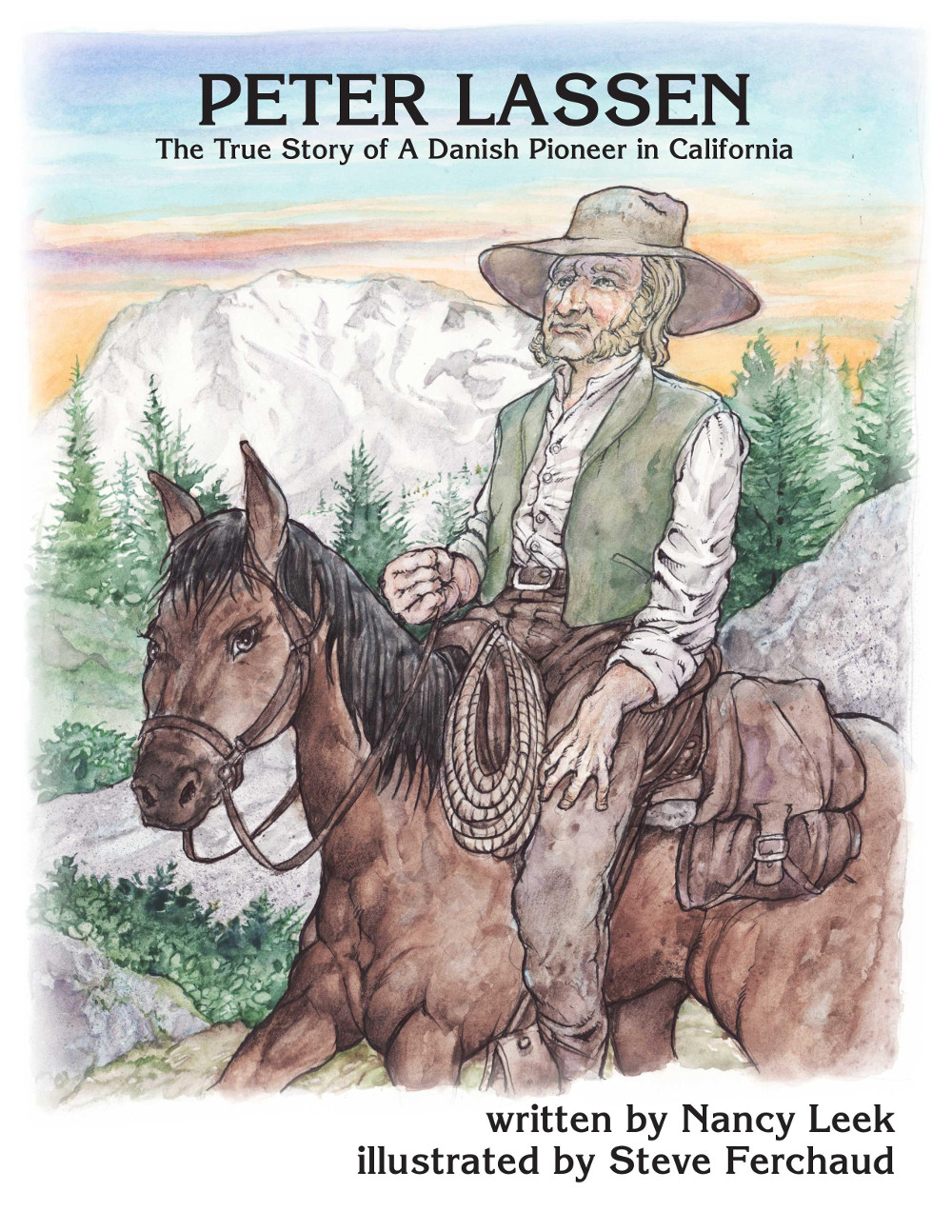
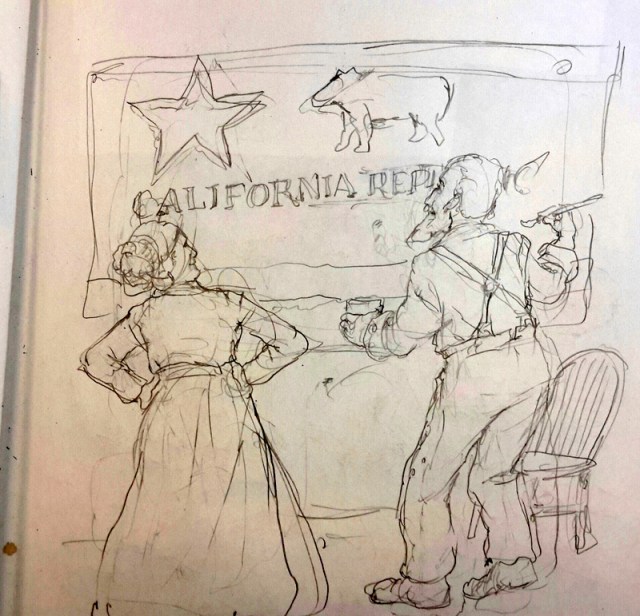
Steve Ferchaud, who illustrated my John & Annie picture book, is working on the illustrations, and his sketches look great.

20170622_160157-1

Nancy Kelsey admires her handiwork on the Bear Flag

20170622_160142-1

A mule tumbles over a cliff in the Sierra Nevada mountains

I feel sorry for that poor mule who fell to his death in a rocky canyon. Although if he had not fallen, he probably would have been eaten. Members of the Bidwell-Bartleson Party had to eat their oxen first, and when those were gone and they couldn’t find game, they had to eat their mules to survive.

I’ll keep you posted as the book progresses. If all goes well it will be out this fall, another story of early California from Goldfields Books.

Posted in Nancy Kelsey, Uncategorized | 2 Comments

Another Final Word on Talbot H. Green

Embarcadero-Working-148

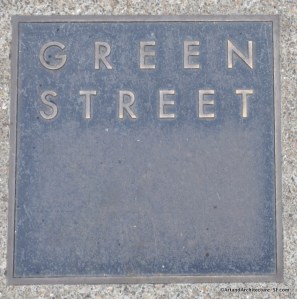
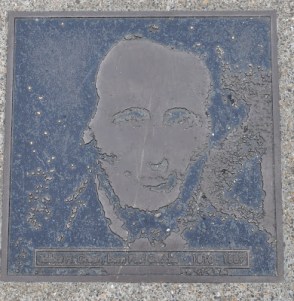
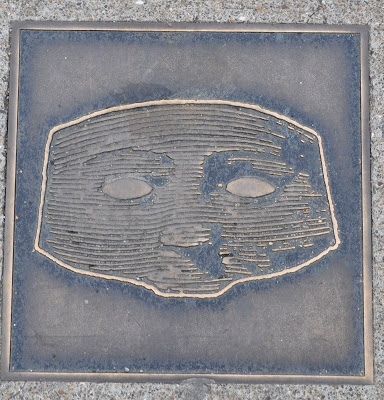
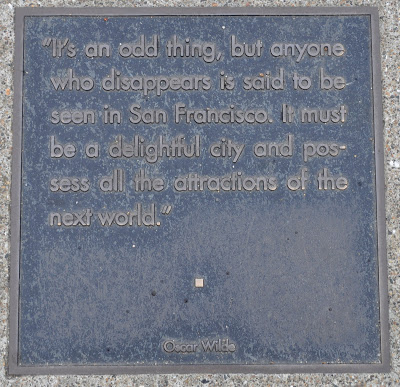
Where Green Street in San Francisco meets the Embarcadero, there are plaques embedded in the pavement telling the history behind the street name. Similar plaques adorn Fremont, Francisco, Brannan, Townsend, and other streets of the City.

All cities should do this so we can learn some history as we hurry along the street.


Embarcadero Working-149

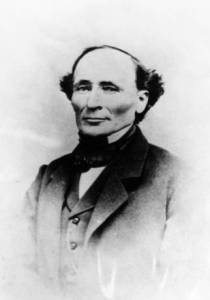
One plaque is a portrait of Talbot H, Green, but it is almost certainly Samuel J. Hensley. The image is very much worn down by the countless shoes that have passed over it.

Embarcadero Working-150

Another plaque has a description of Green’s career in California. It isn’t entirely accurate, but it comes close.

There is an image of a mask (very appropriate!) The mask reminds me of something drawn by Edward Gorey.

Embarcadero Working-151

And, last but by no means least, there is a quote from Oscar Wilde. This is the perfect quote to match the story of Talbot Green.

Embarcadero Working-152

I am indebted to the website Public Art and Architecture from Around the World for these images.  Someday I’ll go look at them myself. They are just across the street from the new location of the Exploratorium at Pier 15.

Posted in Talbot H. Green | Leave a comment

A Final Word on Talbot H. Green (with Picture!)

I couldn’t find a picture of Talbot H. Green online or in any books, and I assumed that while in California he avoided having his likeness taken. But I thought that there just might be a picture of his grave online, under his real name of Paul Geddes. And I got lucky!

PaulGeddes

Paul Geddes, from the Rob Leicester Wagner Collection

On findagrave.com there is a picture of the Geddes family tomb at the Lewisburg, PA cemetery, plus there is a picture of the man himself. I contacted Rob Wagner, who posted the picture, and he tells me that Paul Geddes was his three-times great uncle, and that his (Rob’s) grandmother, kept a family photo album in which this picture appears. It is definitely Paul Geddes, aka Talbot H. Green. The photograph was probably taken sometime around 1860 in Pennsylvania.

Looking at this photo, you can see why “Cheyenne” Dawson described him as “gentlemanly, kindly, genial, generous,” and “a favorite with all.”

There is some confusion about the group daguerreotype of Thomas O. Larkin and his business associates. The man at the back left is sometimes identified as Talbot H. Green, and they are similar looking. But the Bancroft Library identifies him as Samuel J. Hensley, and that accords better with other pictures of Hensley. SCPfounding members

The findagrave.com site also has a photo

HenriettaGeddes

Henrietta Geddes, from the Rob Leicester Wagner Collection.

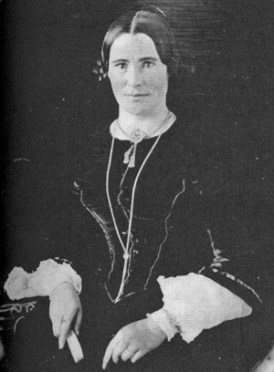
of Mrs. Geddes, courtesy of Rob Wagner.  Here is Geddes’ long-suffering first wife, Henrietta Fredericks Geddes.

I am very grateful to Rob Wagner for making these pictures available online. I agree with him that “genealogists, researchers and just the plain curious should have free access to photos, documents, newspaper obituaries and ephemera.”

One last photograph. Talbot H. Green was a founding member of the Society of California Pioneers and its first treasurer. The Society is still in existence in San Francisco and has a wonderful little research library.

I was there a few months ago, looking for material on John Bidwell and Dr. John Townsend. In leafing through their membership book I found the entry for Talbot H. Green. Near the bottom is the note “ex-member,” with an explanation. I find it poignant that he was struck off the books like that, for in spite of his mistakes, he was indeed a California pioneer.

DSCF2487

Posted in Talbot H. Green | 5 Comments

The Sensational Saga of Talbot H. Green — Part 6

For four years, from 1851 to 1855, Talbot Green languished in Tennessee, writing plaintive letters to Thomas O. Larkin and watching the return mail. He maintained that his former partners and friends, W.D.M. Howard and Joseph P. Thompson, owed him a considerable sum of money. Moreover, the U. S. government still owed him money for goods he supplied the army in 1847. His pleas did not go unheeded, but it must have been easy to ignore a man who was in the powerless position that Green found himself.

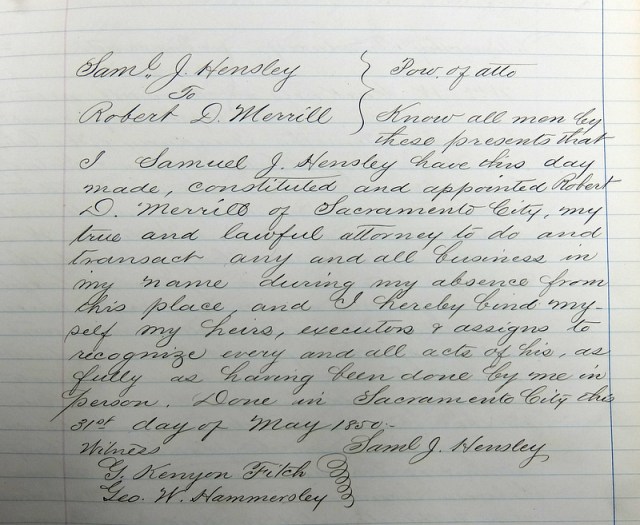
The claim on the government necessitated a power of attorney from Green, and Larkin gave the task to his stepbrother Ebenezer Childs to execute. By this means Green’s whereabouts were revealed. This put him in a tizzy, but eventually it all worked out. He was able to meet with Sam Brannan and W.D.M. Howard to settle his affairs satisfactorily. After some dickering and discounting, he wrote to Larkin that the balance due him, which Howard promised to pay, was $67,118. He stopped by Lewisburg, Pennsylvania and gave his wife Henrietta $500.

He returned to San Francisco in the summer of 1855. It was not, however, the happy reunion with old friends that he had hoped for. William Francis White, in A Picture of Pioneer Times in California, reported that he looked “broken down and wretched.”

He appeared to shun every one, and every one shunned him. I met him once after his return. We had been intimate friends. The meeting was embarrassing and awkward. I did not know how to address him. With me Talbot H. Green was no longer in existence, and as to the poor, weak creature, Paul Geddes, I did not care for his acquaintance; so, without addressing him once by name, we parted.

Green/Geddes left San Francisco and traveled up the Sacramento Valley. He visited old acquaintances in Northern California: Pierson B. Reading, Albert G. Toomes, and Robert H. Thomes. The names will be familiar to residents of Shasta and Tehama Counties.

He left California in September 1856 and returned at last to his hometown in Pennsylvania. He wrote to Larkin:

I found everything about the house as I left it, nothing changed. It seems now as if I had not been absent a week, everything is so familiar. The hardest task was to have to become acquainted with my own children. One is 19 years old; the other 17. [Two children had died while he was absent.] My daughter is a very bright and smart girl and has improved her time at school very well; the boy is very quiet and, I think, rather dull, but I hope he will improve.

106018643_1401155380

Geddes family tomb, from Findagrave.com

He didn’t stay in Pennsylvania. He moved with his wife and children to Texas, where he engaged in land speculation for a few years. By 1880 he was back at home in Pennsylvania, living on friendly terms with his neighbors, although he would never talk of his time in California. He died on July 2, 1889.

His name lives on in San Francisco: Talbot H. Green is the man that Green Street is named after. Notice it the next time you drive northward on Van Ness Ave (Hwy. 101), and think of the man who could have inspired the song, “What Was Your Name in the States?”


Bibliographical Note: The information for this series of posts came primarily from:

Hussey, John Adam. “New Light upon Talbot H. Green.” California Historical Society Quarterly, March 1939, pp. 32-63.

A Picture of Pioneer Times in California , by William Francis White, can be found on Google Books, and makes for entertaining reading.


Posted in Talbot H. Green | Leave a comment

Lassen Volcano — 102 Years Ago Today

This is really neat footage of the eruption of the volcano in our backyard. Lassen Peak erupted on May 22, 1915 and the event was caught on film by Justin J. Hammer of Red Bluff. The film comes from the Shasta Historical Society.

According to the Lassen Volcanic National Park website:

On May 22, 1915, an explosive eruption at Lassen Peak, the southernmost active volcano in the Cascade Range, devastated nearby areas and rained volcanic ash as far away as 200 miles to the east. This explosion was the most powerful in a 1914-17 series of eruptions that were the last to occur in the Cascades before the 1980 eruption of Mt. St. Helens. Lassen Peak is the largest of a group of more than 30 volcanic domes erupted over the past 300,000 years in Lassen Volcanic National Park.

cover4

For more information, including eyewitness accounts, read The Lassen Peak Eruptions & Their Lingering Legacy, by Alan Willendrup, published by The Association for Northern California Historical Research.

Posted in Uncategorized | Leave a comment

The Sensational Saga of Talbot H. Green (and Sarah Montgomery) — Part 5

Sarah Armstrong Montgomery was eighteen years old when she came to California. She married Allen Montgomery, a gunsmith, in Missouri in 1843. In 1844 they set out with the Stephens-Murphy Party for California. This was the first group of pioneers to bring (with great difficulty) wagons over the Sierra Nevada.

Allen Montgomery went to work for John Sutter and the young couple settled in a cabin near Sutter’s Fort. When the Bear Flaggers began their insurrection in the summer of 1846, Allen joined the California Battalion. So far, it was a typical life for young California pioneers before the gold rush.

In 1847 Allen Montgomery set sail for Hawaii, reason unknown. Allen was never heard from again. There was no sign of him when news of the gold discovery brought men from around the world to California. Sarah assumed she was a widow.

Talbot Green moved to San Francisco in January 1849 and soon made the acquaintance of Mrs. Montgomery. Since she had no official notice of her husband’s death, she was still legally married to Montgomery, but that detail did not stand in the way of their marriage. Green and Sarah Montgomery were quietly married at the home of his old comrade, Grove C. Cook, in San Jose on October 25, 1849.

His situation was, as we know, even sketchier than hers. But nobody knew about his past crimes or his wife in Pennsylvania. He continued to live comfortably in San Francisco with his new wife for a year before the rumors began to circulate. A son was born to them on July 3, 1851, but by then Talbot Green had been gone for two and a half months.

He later told Thomas O. Larkin that his resolve in going to San Francisco was to earn enough money to pay back the bank and redeem himself in the eyes of his family, (although he made no attempt to communicate with them in ten years).

I hoped to make a fortune for them & pay the bank and perhaps would have succeeded had not the fondness for company & drink drowned all my secret resolves and finally smothered conscience entirely. I found & seen that I was fast going to destruction and would soon be lost had I not something to cling to present.

I then by some fatality, although against my reason & judgement, began really and truly to love the woman I married. I studied her character well and was convinced that she had a much stronger mind than my own. I then thought if I married her I might be saved & in a few years pay up & provide for all, which was my full intention, and if I had not been recognized I should have done so before this.

This is a convoluted pack of excuses and self-justification, but he did really seem to love Sarah. In his letters to Larkin his concern for her welfare is second only to his concern for his own. Before leaving San Francisco he had arranged for her to be given $450 a month. He repeatedly asks after her and maintains “I loved that woman and still love her.”

But Sarah was moving on. Larkin wrote to Green in January 1854, enclosing Sarah’s application for a divorce. Green wrote back:

I loved that woman and I still love her, but as she has taken that course I know her so well that she will not stop; but I wish you to go to her and tell her from me never to marry again until I see her. Even if she persists in getting the divorce, as much as I love her & thought she loved me, I cannot blame her as I have done so wrong to her.

If he thought that she might wait until he returned and could work his charm on her, he was wrong. Sarah knew her own mind, and she had her pick of men in San Francisco. In July 1854, she married Joseph S. Wallis, and up-and-coming young lawyer who would later serve as a judge and a State senator. He adopted her son by Green, whose name became Talbot H. Wallis. Sarah was 29 years old as she started on her third marriage, the one that would last. Green wrote plaintively from Tennessee,

It is my sincere prayer that she may be happy in her choice, but I fear for her unless her husband is of a mild and conciliating disposition. . . I wish you to see her and tell her I have heard of her marriage and hope she will be happy, and tell her to take care of our boy, and if I ever come into possession of my own I will do what is right and just toward him.

wallishome

The Wallis home at Mayfield (now part of Palo Alto)

The couple moved to Mayfield, in Santa Clara County, where they had a large estate. They became the parents of four children, in addition to Sarah’s son by Green. Sarah was active in the social and economic life of her community. She and her husband were strong supporters of women’s rights. Her husband Joseph Wallis died in 1898, and Sarah lived until 1905. She had lived a long, busy, and quintessentially Californian life.


Posted in Sarah Montgomery Green Wallis, Talbot H. Green | Leave a comment

The Sensational Saga of Talbot H. Green — Part 4

Talbot H. Green had two valuable assets that he brought to California in 1841. One was his lump of “lead.” Whatever it was, however much it was worth, and however he managed to turn it into spendable currency, it helped to set him up in business.

His other asset was his experience as a storekeeper. He had no trouble finding work with Thomas O. Larkin, the foremost American merchant in Monterey. Men who knew how to handle merchandise, how to buy and sell and negotiate, who knew how to keep accounts and keep up friendly business relationships were in very short supply in Alta California. The only handicap that Green discovered in himself was that he couldn’t speak Spanish.

That was a drawback that was remedied over time, as Green learned the language and customs of California. Larkin soon grew to trust and rely on his new clerk. He sent him on business trips to Los Angeles and Mazatlan. By January 1846, when Green had been in California four years, he was able to contract with Larkin to run his mercantile business for a period of three years for one-third of the profits.

Green’s popularity increased along with his experience. Walter Colton, the alcalde at Monterey, said that Green “enjoys a wide reputation for business habits and sterling integrity of character.” No one had anything detrimental to say about him.

Green was a busy man in the 1840s. As Larkin’s agent, he sold goods to Capt. John C. Fremont and the rest of the U.S. military and naval forces. He voyaged to Mazatlan for supplies from Mexico, he sold goods and bought lots in San Francisco, and when the gold discovery took off, he visited the gold mines. He could see opportunities everywhere, and he moved his base of operations from Monterey to San Francisco.

In January 1849 he joined the prominent trading firm of Mellus, Howard, & Co. Now he had truly arrived. The Mellus brothers soon sold their interest and it became the firm of Howard & Green, buying, selling, trading, and providing office space in San Francisco. He was also active in political life, serving on the San Francisco city council.

In August 1850 the following advertisement appeared in the Daily Alta California.

DAC18500831.2.11.1-a1-503w

It was the beginning of the Society of California Pioneers. Six men, including Talbot Green, Sam Brannan, and W.D.M. Howard, met to form a social club for emigrants who had arrived in California before the rush. The three-year requirement barred any forty-niners, and made it a very exclusive club indeed, although eventually they settled on January 1, 1850 as the cut-off arrival date for membership. Five men from the Bidwell-Bartleson Party of 1841 were among the first members: Green, John Bidwell, Grove Cook, Josiah Belden and Francis Henry Huber. Talbot Green was the society’s first treasurer.

Green was not only active in business, civic, and social life of San Francisco, but in the fall of 1849 he became a married man. A twice-married man, but nobody knew about his wife in Pennsylvania.

Stay tuned for the tale of Talbot Green and the redoubtable widow, Mrs. Montgomery.

Posted in Society of California Pioneers, Talbot H. Green | 3 Comments

The Sensational Saga of Talbot H. Green — Part 3

Paul Geddes left Pennsylvania and made his way to New Orleans, probably by ship from New York City. From New Orleans, he took a steamboat up the Mississippi. He was getting as far away from the scene of his crime as he could. On board the boat he met an Englishman, Talbot Henry Green, and when the man died, he appropriated his name.

He continued from St. Louis up the Missouri River until he reached Westport, that jumping off place for the western plains. An emigration party was forming to journey to California. He couldn’t get any farther away from the States than California; he signed up. It was May, 1841.
He made a good impression on the other men. Nicholas “Cheyenne” Dawson recalled him as “a young man of evident culture and very pleasing address.” When the company gathered to organize and elect officers, Green was elected president. This was not a position with much responsibility. The Company had a captain, John Bartleson, and a trail guide, Thomas Fitzpatrick, who was the true leader, at least until the California-bound company parted from the larger group. But Green’s election was testimony to his instant likability. Many years later, “Cheyenne” Dawson wrote:

Among my overland comrades of ’41, the most to my liking and with whom I became most friendly was Talbot H. Green. Gentlemanly, kindly, genial, generous, he was a favorite with all. Before starting the trip he had provided himself with a case of medicines, and from his attention to the sick, he soon won the title of doctor. After we reached California, Green and I were separated, but I took great interest in him, and although I wondered somewhat at his and Grove Cook’s sudden affluence, no suspicion entered my mind, and for some years Green was, to me, just about the all-around best man I had ever known.

Dawson noticed that Green’s “most important possession seemed to be a quantity of lead that he was taking with him.” In the Utah desert the company had to abandon their wagons, but Green clung to his packet of lead. By the time they reached the Sierra Nevada the two men were sharing one mule, taking turns riding “Monte.”

It was in the Sierras that the lead-covered lump became too heavy for Green to carry. Dawson recalled that, “Green, whose pack of lead which he clung to most solicitously, had been growing heavier for his weakened animal, took Grove Cook with him, and going off into some gulch secreted or cached it.” After they reached the rancho of John Marsh, Green and Cook hired an Indian guide and went back for the “lead.”

We can only assume that the lump of “lead” was gold coin, covered over with a coating of lead. Perhaps the coin was in a leather bag and the bag was wrapped in lead sheets. Whatever its exact nature, it was Talbot H. Green’s grubstake in California. When Dawson met Green again after a year in California, he found that Green was thriving.

HPF-20-T.-O.-Larkin-Portrait-1

Thomas O. Larkin

I found T. H. Green in Monterey, clerking for T. O. Larkin. It was from his recommendation that I was now at Dye’s. Green was finely dressed, and apparently very prosperous. Soon after my arrival, he set up a store of his own out at a ranch near the redwoods. “Where did he get the money?” I queried of Larkin. “Oh, Green has plenty of money,” was the answer.

Dawson may have had his curiosity about Green’s special package, but he couldn’t guess how he had come by it.

Posted in Talbot H. Green | Leave a comment

The Sensational Saga of Talbot H. Green — Part 2

No extant portrait of Talbot H. Green exists. In a day when forty-niners right and left were having their likenesses made, he avoided the camera. He is absent from a group photograph of Thomas O. Larkin and his business associates. Those who knew him described him as a short, square-built man, with plain but kindly features. He was well-known and well-liked.

hensleylarkinetal

Talbot H. Green, conspicuous by his absence. His business associates, left to right and top to bottom: Samuel J. Hensley, Samuel Brannan, Jacob Leese, Thomas O. Larkin, W.D.M. Howard.

White’s account of a woman recognizing Paul Geddes in the Admission Day parade was only one version of the unmasking of Talbot H. Green. Others said that it was a lawyer from Philadelphia who recognized him, or a woman at a ball. However it happened, Green steadily denied the accusation. At the same time, he withdrew his name from the mayoral race. His friends loyally stood beside him, but the rumors grew and spread. Green, once so prosperous and popular, was under suspicion.

His denials did nothing to allay the rumors, so Green offered to return to the East to clear his name. The day before his departure in April 1851 on the steamship Panama his friends gathered at a tavern and toasted his success. As reported in the Alta California, his old business partner and mentor, Thomas O. Larkin, climbed upon a table, lifted a glass, and proclaimed, “The health and prosperity of our friend and fellow citizen, Talbot H. Green; may the best among us be as worthy as we believe him to be.” In response Green thanked them for their faith in him and promised to return quickly with proof of his good reputation.

Still, the doubt lingered in his friends’ minds that perhaps Green really was Geddes. Their doubt only grew when he failed to return or to write. Two years went by before Larkin finally received a letter from Green that confirmed all their doubts.

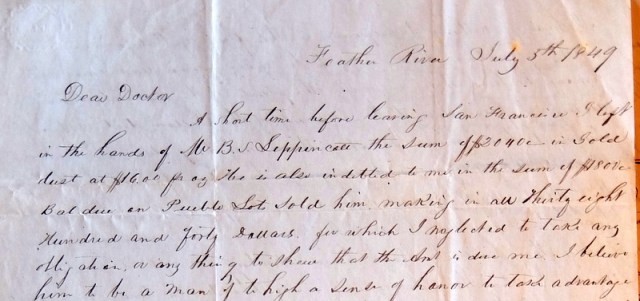
Green had not returned to Pennsylvania as he had promised; he was somewhere in Tennessee, hiding out. He never would have written at all, except that he had lost $3200, (so he said) stolen out of his trunk, and he was now penniless. He asked Larkin to obtain his share of investments in San Francisco and send him a draft for the money as soon as possible. He was destitute and he wrote of “the bitter tears I have shed since I left you.” But he didn’t explain his misdeeds, not yet.

Talbot H. Green told his story to Larkin in one of his later letters. He said he was born Paul Geddes in Lewisburg, Pennsylvania in 1810. In 1832 he married Henrietta Frederick, and they had had four children. By 1840 he was a store owner and a trusted man of business. (The spelling in the following quotation is his own.)

In the Spring of 1840 I went on to Philadelphia to buy goods. I made my purchase and had a large quantity of wheat consigned to a house in Philadepha. When I was about to return home I went & drew 3,000$ on acct. and had it about my person and intended to start home next morn’g but was induced to go out with some acquaintances and drank to much and my money was taken from me, but on the same afternoon the cashir of the Farmers & Mechanics Bank of Philadelpa sent for me and asked me to carry money to the Northumberland bank. I told them I would do so. They got a carpet bag and put up 105,000$ in it in my presence and sent a porter with me to the Hotel. I put it in my trunk and went out.

On my return I found that I had been robbed of my money. I was under the excitement of liquor—no excuse—and was in fact not at myself. I opened the carpet bag and took out nearly 8,000$ and done the parcel up again. I then went to bed. In the morning I ten thought of what I had done—the first bad act I had ever done in money matters but it was done. I then took the carpet bag to a merchant & told him what it containd and wished him to keep it until the next day. Next day I went and paid a good many of my debts with the money and sent 3,000$ to my partner to pay notes we owed in bank and that night I left Philadelpia with 375$ determined that my people should never here of me again. I went west and fell in with the emigration for Californa. I joined it with 11$ and a gold watch which I gave for my passage out.

That was his story. Was it true? No doubt he spinned it to put himself in the best light possible. But $105,000 in 1840 dollars! In a carpetbag! The laxity is astonishing.

And as we shall see in the next episode, he had more with him on his journey west than $11.


Posted in Uncategorized | Leave a comment