The Sensational Saga of Talbot H. Green

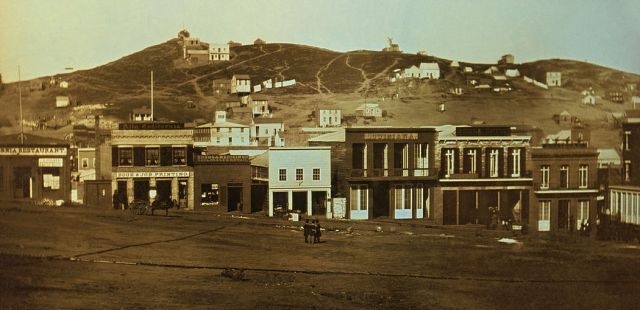
SanFrancisco1851a

San Francisco in 1851, showing a commercial district near Portsmouth Square. Image from the Library of Congress.

San Francisco in 1851 was a booming, bustling place. Fortunes were made and lost daily. Men who had come to California with hardly a penny in their pockets rose to prominence, while others who had struck it rich in the mines and spent freely sank into poverty.

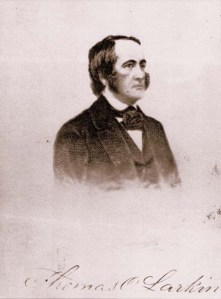
Talbot H. Green had seen nothing but success ever since he came to California in 1841. He had begun by clerking for Thomas O. Larkin in Monterey and gone on to become his trusted business partner. Moving to San Francisco, he cashed in on the gold rush demand for all kinds of goods. By 1849 he was a partner in the foremost mercantile firm of Mellus, Howard & Company. He was a founding member of the Society of California Pioneers and a member of San Francisco’s first city council. In 1849, he married the widow Sarah Montgomery. In 1850, he decided to run for mayor of the city. It would be the pinnacle of his successful 10-year career in California.

Then the scandal broke.

When San Francisco celebrated its admission to the Union in October 1850, Green took a prominent place in the parade. According to W. F. White, a friend of Green’s and the author of A Picture of Pioneer Times in California:

As the procession was breaking up and dispersing on the Plaza, a lady walked forward to Green, and in an excited, astonished way, reached out her hand, saying, “Oh! Mr. Geddes, can it be possible that you are here in California?” Green, in apparent surprise, took her hand and said with perfect coolness: “You must be mistaken, madam, in the person. My name is Green—Talbot H. Green.”

The lady drew back, abashed, but said: “Why, certainly I am not mistaken. I cannot be mistaken. I knew you all my life. I know your wife, your sister, and your children.” A gentleman who stood by said that Green turned pale, and that a tremor shook his frame, but with a forced smile he again denied his identity with Geddes.

But he was Geddes, Paul Geddes, of Lewisburg, Pennsylvania. And Paul Geddes was a store owner who had absconded with the bank’s money and disappeared, leaving behind a wife and four children.

What was his story? How had he come to California? How did he deal with his sudden unmasking?

Stay tuned for more in the Sensational Saga of Talbot H. Green.


Posted in Talbot H. Green | Leave a comment

Sunday Morning in the Mines

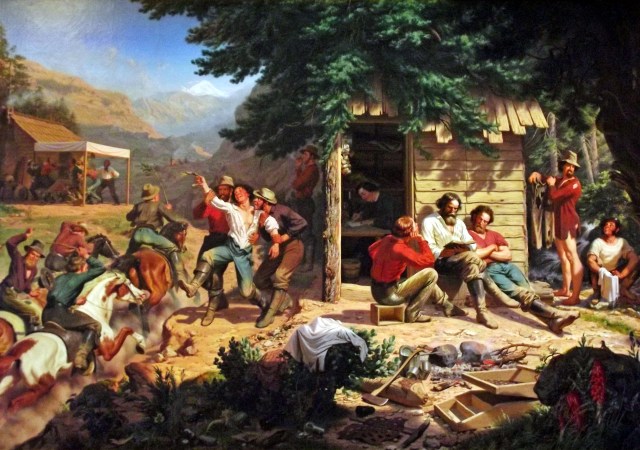
This being a Sunday morning, I’d like to share one of my favorite paintings with you: Sunday Morning in the Mines, by Charles Christian Nahl. It was painted in 1872, but harks back to the “Days of ’49.” The painting is in the Crocker Art Museum in Sacramento. The museum has a number of paintings by Nahl and other California artists.

Nahl_1872,_Sunday_Morning_in_the_Mines

Sunday Morning in the Mines, by Charles Christian Nahl, from Wikimedia Commons

This painting is a moral allegory — laid out before the viewer are the good and evil choices made by men who are far away from civilization. The two worlds are strictly set apart by the pine tree that bisects the painting. Even the foreground is divided between dark and light. On the left in the foreground among the dark plants are discarded bottles and other trash. On the right, the sun shines and the workman’s tools are set aside for the day.

On the left side of the painting are scenes of riotous living: a wild horse race, a drunken young man being set upon by thieves, an idle smoker, and in the background, a brawl at a gambler’s cabin. The young man’s face is flushed, his out-flung arm clutches his poke, from which the gold dust spills. All is confusion and contention. Even the little scene at the cabin is divided in two — on the left, in shadow, two men are at each other’s throats and the man on the far left fires a pistol, while on the right the three men in the light are trying to break up the fight.

The scene on the right shows peaceable acts of the Sabbath.  The men rest from their labors in the goldfields. The central figure reads from the Bible to his two attentive companions, while inside the cabin a man is writing a letter. The two men on the far right are cheerfully doing their laundry, because cleanliness is next to godliness.

Charles Christian Nahl came to California from Germany in 1851, and for a while sought his fortune in gold-mining.  But he had trained as an artist in Europe and he soon found a better fortune in illustrating and painting, with a studio first in Sacramento and then in San Francisco. He became the most popular artist of 19th century California. The bear on the California flag is based on his painting of a grizzly bear.

If you would like to see some closeups of Sunday Morning in the Mines, go to this website.


Posted in Uncategorized | 2 Comments

A Piece of California History

Who doesn’t like to see and hold in their hands a genuine piece of California history?

Cane and cover

The cane and its sheath

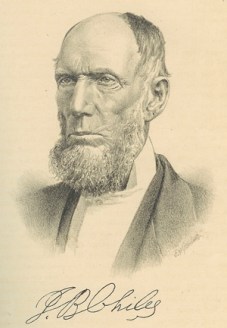
Today I was lucky enough to see and admire the gold-headed walking stick that belonged to Joseph B. Chiles, one of the earliest American pioneers in California.

chiles2I made this connection through this blog, because some time ago I wrote a post called “Whatever Happened to Joseph B. Chiles?” and if you read it, you will know what happened to that member of the Bidwell-Bartleson Party after he arrived in 1841. He participated in the Mexican War and had a long and successful career as a rancher, farmer, and mill-owner.

Recently I was contacted by Sandy Shepard, a friend of a long-time Chico teacher named Peggy Chiles, the great-granddaughter of Joe B. She is trying to determine who gave this cane to Chiles. It may have been Governor J. Neely Johnson around 1856, but so far we don’t know for sure.

The cane is an admirable piece of craftsmanship and in excellent condition. These sticks for gentlemen were very popular in the 19th century, and a man who had lived and prospered in California would, of course, want a such an accessory.  I am very grateful to Sandy and her friend Harold for letting me show you these photographs.

As you can see from the photos, a beveled piece of gold-veined quartz is embedded in the gold head of the cane. It is inscribed with the name of “J.B. Chiles.” It looks like a presentation piece, but there is no date on it, and no name of the giver.

Do you know anything about Joseph B. Chiles that might contribute to the provenance of this item? If so, please let us know!

By the way, today was a librarian and history buff’s dream for me. Not only did I enjoy meeting with Sandy and Harold and seeing the cane, but after that I got to have lunch with the head researcher at Jeopardy!, my favorite TV show. We talked trivia and research and Chico history and Alex Trebek. So much fun!

Posted in Joseph B. Chiles | 3 Comments

Eureka!

No, I haven’t struck gold. But I found something I’ve been looking for — an old episode of Death Valley Days.

A year ago or so I found out that John Bidwell featured in the episode The Lady With the Blue Silk Umbrella, broadcast on television on January 9, 1953. I looked for it, but at that time very few episodes were available for viewing. Now there is a pile of them on YouTube.

Stories on Death Valley Days were taken from true events, and this one is based in fact. Sort of. It’s full of errors, the worst being that Bidwell in 1850 was not a fifty-year-old general in the U.S. Army.  He was much closer to the (fictional) young and handsome Lt. Hastings. However, the outline of the story is factual, and it’s fun to travel back in time — to 1953 — and see what was on TV.

So enjoy!

Posted in Uncategorized | Leave a comment

The Mysterious Death of Peter Lassen — Part 3

Whodunit?

Lemericus Wyatt was quick to blame the Paiute Indians. The natives always made  convenient and believable scapegoats. A man named Fred Kingsbury, whose father had been Peter Lassen’s partner, later pointed out that:

When Indians kill they want something for it. They take anything and everything in sight. Nothing was disturbed, not even the food in camp, or Peter’s pocketbook, containing his money. It wasn’t an Indian job.

Left behind were two sacks of flour, plenty of dried meat, and a keg of whiskey. Why pass that up?

Young Chief Winnemucca denied involvement, and was quoted as complaining “that he was accused of killing Pete Lassen, who had been one of the best men he had ever known and with whom he had slept in the same blanket.” His cousin Sarah Winnemucca said that the Indian agent, Major Dodge, also did not think the Paiutes had killed Lassen. Dodge suspected Mormons.

The Mormons, it seems, were second only to Indians when it came to convenient scapegoats. There was no indication that Mormons had anything to do with it.

Captain Weatherlow suggested Pit River Indians. Weatherlow was in the other group that left two days before Lassen’s party to go prospecting in the Black Rock Hills. The settlers had had clashes with the Pit Rivers, and possibly they took revenge on Lassen. Again, there is no proof, and nothing was taken from the campsite. But Weatherlow didn’t want to think it could be a white man.

Three years later two two other men, James Bailey and William Cook, were attacked by Indians in the same region of Nevada. The camp was looted. Captain Weatherlow was in the group of ten men who set out in pursuit of the attackers. They found a camp of nine Indians (tribe not indicated) and killed them. By one of the corpses they found the gun Peter Lassen was carrying when he met his death. It was the only thing taken from Lassen’s campsite.

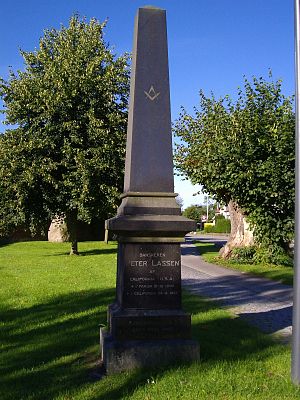
300px-Peter_Lassen_mindesten

Memorial to Peter Lassen in his home town of Farum, Denmark.

How did the gun get there?

Ken Johnston, in his book Legendary Truths, has some suggestions:

Did the Indians kill Lassen and take his rifle? (But why didn’t they take anything else?)

Did the Indians take the rifle from Bailey and Cook? (If so, how did those two get it?)

Did Weatherlow plant the rifle on the dead Indian? (But how could he have arranged that?)

Or was Lassen not the target at all? Perhaps someone was after Clapper, and Lassen just happened to be in the way.

I can’t tell you the answer. The Death of Peter Lassen remains a mystery, never solved. If someone (not me!) wants to write a series of historical mysteries set in 19th century northern California, here’s one you can start with.

By the way, I used the name Lemericus Wyatt because that is a version that shows up in newspaper reports. But the only name that comes close in census records is Lemarcus Wiatt. I imagine that’s the same man. In the 1852 California census he was a 49-year-old Kentuckian living in Sonoma. In 1870 he is married, a carpenter, and living in Petaluma. But in between he must have gone to the Honey Lake Valley, met up with Peter Lassen, and then . . .  the mystery.

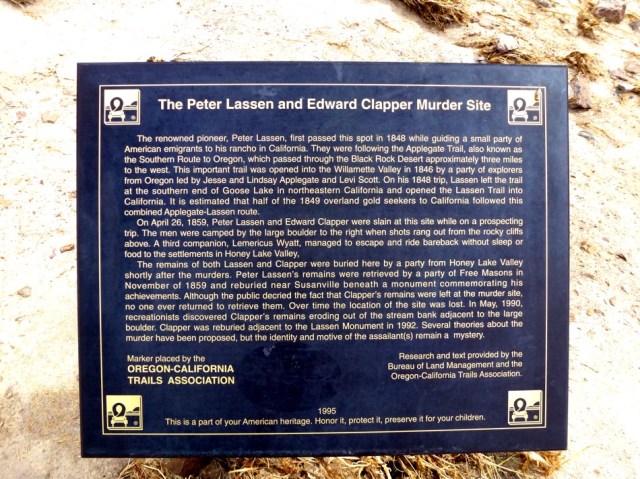
plaque

Trail marker installed at the site of the murders by the Oregon-California Trail Association.

Posted in Peter Lassen, Uncategorized | 5 Comments

The Mysterious Death of Peter Lassen — Part 2

Peter Lassen (or Larsen, since his father’s name was Lars) was born near Copenhagen in 1800.  He became a blacksmith. In 1830 he applied to the king for permission to immigrate, probably because the depressed European economy made it hard to find sufficient work. Or maybe he was just restless.

He arrived in Boston, and later moved to St. Louis, Missouri. In 1839 he joined an emigrant party to Oregon. From Oregon he took ship down the coast and got off at Bodega Bay and traveled overland to Sutter’s settlement, where he easily found work as a blacksmith.

So by the time of his death in 1859 he had been in California nearly 20 years and was well-known and respected. For now I’ll skip over his subsequent peripatetic career in California. By the late 1850s he had lost his Rancho Bosquejo (at Vina) and had relocated to Honey Lake Valley near Susanville. (See my Ever Been to Nataqua? post for more information.)

In the winter of 1858 Lassen and friends heard about a silver strike in the Black Rock Desert of Nevada, which at that time was part of the Utah Territory. It was a region that Lassen was familiar with from the days when he guided emigrants along the Lassen Cutoff of the California Trail. Peter Lassen, Edward Clapper, and Lamericus Wyatt* set out to do some prospecting on April 19, 1859. The plan was to rendezvous with another group of prospectors at Black Rock Springs. When Lassen’s group got there, they didn’t meet the other group, so they set up camp to wait.

canyont

This photo, from the Black Rock Explorers Society website, shows the canyon where the deaths took place.

Just at daylight on April 26th gunshots rang out and Wyatt and Lassen sprang to their feet. Going to rouse Clapper, Wyatt found him already dead, shot through the temple. According to Wyatt, who was the only survivor, Lassen said he would stand lookout while Wyatt gathered up their things and got the horses. A moment later, Lassen was shot and fell, gasping, “They have killed me.”**

Taking nothing but his rifle, Wyatt sprang onto his horse and rode without food or rest for 48 hours (so he claimed) until he arrived back at Susanville and reported the deaths. Twenty men immediately set out for the camp to recover any horses and property, and to assess the situation.

Wyatt blamed the ambush on Paiute Indians. He claimed that a Paiute had come to the camp the evening before, asking for ammunition for his muzzle-loading rifle. Over the objections of Wyatt and Clapper, Peter Lassen gave the man bullets and powder, remarking that he had always been friendly with the Paiutes, they knew old Uncle Pete, and no harm would come of it.

If that really happened, then it made it easy for Wyatt to pin the blame on Indians, and by extension, Peter Lassen himself, who had so foolishly supplied the Indian with the ammo to kill him the next day. But other people questioned this scenario. If Indians did the deed, why did they not loot the camp, as they typically did? When the posse arrived, nothing had been taken from the camp.

bigrock

Site of the camp, again from the Black Rock Explorers Society website. Note the historical marker on the left.

So if not Paiute Indians, then who? Let’s explore that in the next episode.

*Wyatt’s first name also shows up as Americus, LaMarcus, and similar variations.

** As reported in the Downieville Mountain Messenger, and quoted in History of Lassen County. See Ken Johnston, Legendary Truths: Peter Lassen and His Gold Rush Trail in Fact and Fable, p. 287, which is the source of most of my information.

Posted in Peter Lassen, Uncategorized | Leave a comment

The Mysterious Death of Peter Lassen

330px-Peter_Lassen-portraitOn April 26, 1859 — 158 years ago — Peter Lassen was murdered at Black Rock Canyon in what is now Nevada. He had gone prospecting for silver with two men, Edward Clapper and Lamericus Wyatt. Clapper also lost his life in the ambush that occurred early on the morning of April 26. Wyatt escaped and quickly fled back to Honey Valley, where he reported the deaths. He stated that Lassen and Clapper had been murdered by Paiute Indians.

But had they? It was easy enough to pin the blame on Indians, and for many years that story stood. It is even stated on Lassen’s grave marker. But many historians have doubted Wyatt’s story.

If Wyatt was the murderer, what was his motive? Or was there some third party? lassengrave-001Disgruntled immigrants, led astray by Peter Lassen, have been suggested.

Stayed tuned and I’ll tell you more about the life and death of Peter Lassen, the California pioneer from distant Denmark, who met an untimely death in the desert.

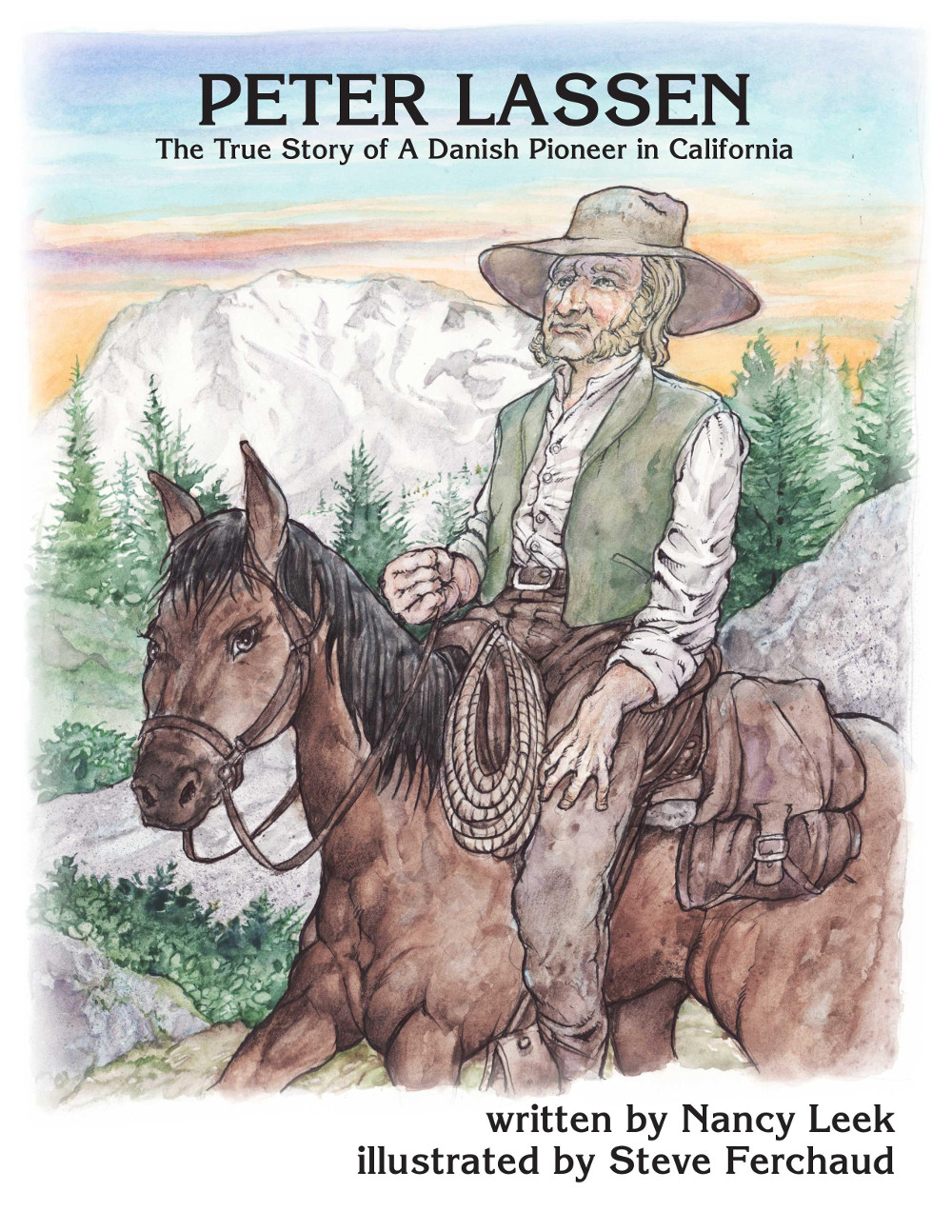
And if you want a fun and accurate book about Peter Lassen, check out my book Peter Lassen: The True Story of a Danish Pioneer in California. It’s available from my website, from local bookstores and gift shops, and on Amazon.


Posted in Peter Lassen, Uncategorized | 8 Comments

The Liberty Bell Comes to Chico

I read an article in the April 2017 issue of Smithsonian about the 1915 national tour of the Liberty Bell to promote war bonds (“Saved by the Bell” by Stephen Fried). Even though the U.S. had not yet entered World War I, the trip was organized “as President Wilson, former President Theodore Roosevelt and other leaders felt the need to whip the nation into a patriotic frenzy to prepare for the war to end all wars.”

On its 4-month long rail journey the bell stopped in 275 American cities and towns, but according to the map that accompanies the article, only 12 of those towns were in California. Among them were Red Bluff, Chico, Marysville, and Sacramento. The bell spent four months at the Panama-Pacific International Exhibition at San Francisco.

Everyone flocked to see it when it came to town. As Theodore Roosevelt said, ” Can any puerile, peace-talking molly-coddle stand before this emblem of Liberty without a blush of shame?”

The Bell came to Chico on Friday, July 16, 1915.  The Chico Record headline the next day proclaimed: 5000 of Patriotic Citizens of Chico View Liberty Bell. That number included folks from Oroville, Gridley, Biggs, Durham, and “fifty school children of Hamilton City.” Banks and stores closed for business so all could view the bell.

Liberty_Bell_visits_Chico

The Liberty Bell in Chico. Photo courtesy Special Collections, Meriam Library, CSU Chico.

The special train carrying the bell and its escort of Philadelphia officials arrived at 1:05, an hour and ten minutes late, and remained in Chico fifteen minutes. During the stop members of the party on the train tossed souvenirs, a basket of peaches and apricots was presented the visitors by the Chico Development Committee and patriotic airs were played by the Park band.

Even Mother Nature herself got into the act:

As if in an exuberant, patriotic mood, Mount Lassen gave vent to its American spirit and fired a salute of steam and smoke as the Liberty Bell train passed down the valley toward Chico.

What a sight that must have been!

Posted in Uncategorized | Leave a comment

Gold, Grizzlies, and Mexican Land Grants

DSCF0461

Take a trip back in time to hear John Bidwell recount his adventures in California. You’ll hear about gold mining, grizzly bears, and how he acquired a Mexican land grant. The year is 1858, and John Bidwell is 39 years old. He holds the rank of major in the California Battalion. He has been in California since 1841, and has been living on Rancho Chico for nearly ten years.

Nick Anderson, who portrays John Bidwell at events at Bidwell Mansion, and myself — Nancy Leek — as a lady reporter from San Francisco, will enact an interview with the proprietor of Rancho Chico.

Everything you will hear is either a direct quote from Bidwell or an abridgement of his words. All the incidents really happened to him – no need to make anything up. The only fictional element is the lady reporter. Bidwell was interviewed several times during his life, but not as early as 1858, and not by a lady (as far as I know).

It will be lots of fun! Come to the Chico Museum next Saturday, April 22, at 10 a.m. to hear John Bidwell himself tell his story.

Posted in Uncategorized | Leave a comment

Costume Time

Here’s the dress I spent a good part of two months working on—

(actually half the time was on the underpinnings of the dress)

DSCF0469

We look serious because this is the 19th century, when no one smiled for photos 🙂

Nick Anderson is portraying John Bidwell, and I am a fictional lady reporter from San Francisco. I have given myself the name “Mrs. Letitia Norris.” I will be interviewing Major Bidwell on April 22 at 10 a.m. at the Chico Museum.

I made Nick’s shirt and vest too, so that he would always be ready to play John Bidwell for the Bidwell Mansion Association.

DSCF0484


Posted in Uncategorized | 3 Comments