Nicholas Dawson — Hunting Otter on the Santa Barbaras

Nicholas “Cheyenne” Dawson spent about a year at Santa Cruz keeping store and supervising the shipping of redwood lumber for Job Dye. The business wasn’t making money, so Dye closed the store. He decided to try otter hunting instead and offered Dawson a job as a otter hunter.

DSCF2704Dawson was no seaman, but he was game. Dye built three 15-foot boats, and manned them with three men each. Dawson was the hunter in the bow of one of the boats. They sailed down the coast from Monterey to Santa Barbara and began hunting around the offshore islands. Their procedure was to surround a raft of otters and begin shooting them, and then collecting as many as they could. (I assume dead otters float.)

Otter hunting is a very exciting business, and somewhat dangerous, as you are apt to think when you hear a bullet whistle past you, it having glanced from a wave as it came from a hunter’s gun opposite, who had shot at an otter on a line between you and him. But these risks will be run for an otter skin, worth thirty dollars. and especially when there is rivalry among the hunters.

Thirty dollars in 1842 would be about $500 today, which certainly would make otter hunting a lucrative business. When Dawson later took ship for Mazatlan, Mexico from San Pedro, he paid for his passage with a single otter skin.

At Santa Barbara we found an old otter hunter, A. B. Thompson, who proposed to go into partnership with us on the halves–he to furnish a vessel officered and manned, and to provision us; we to furnish boats guns and ammunition and do the hunting.

This partnership had the advantage that the hunters would not continually be needing to seek shelter to camp. With a vessel to back them up they could work quicker.

We first visited San Nicholas Island, and, hunting around it, killed several otter. Here we searched on shore for a lone woman whom we knew to be on the island, but failed to find her, although we found her tracks.

Anyone who has read Island of the Blue Dolphins, by Scott O’Dell, will recognize this reference. O’Dell used the story of the “Lone Woman” of San Nicholas as the basis for a novel for young readers. Island of the Blue Dolphins was published in 1960 and won the Newbery Medal in 1961. In the book O’Dell calls the girl Karana. I don’t think anyone knows her true Indian name. At the Santa Barbara Mission, where she was taken in 1853, she was known as Juana Maria. She lived alone on San Nicholas Island for 18 years and was not rescued (if that’s what it was) until 10 years after Dawson looked for her.

Dawson and his partners continued the hunt until the otter gave out, and then they went back to Santa Barbara and settled accounts.

I found myself with forty dollars in money and five or six otter skins, a broken arm, and my feet so badly bruised that I could scarcely walk on crutches. [This was the result of a fall off a cliff.]

About this time he decided he had seen enough of California, but “the difficulty now was how to get away.” Leaving California could be just as tricky as getting there, it seems, but eventually he was able to board a ship heading to Mazatlan, and take the overland route across Mexico. He wasn’t sure whether or not it was time to give up his wandering and head for the States, so he let his horse make the decision.

I saw the City of the Aztecs, and as I rode slowly out of it, my mind was still wavering. If I went on with my travels, I would strike out for Acapulco; if I gave them up, my route would be to Vera Cruz. I let my horse decide it. He took the road to Vera Cruz, and I have never regretted it.

But California would call to him again in ’49.
 

Posted in Nicholas "Cheyenne" Dawson, Uncategorized | Leave a comment

Breaking News (1848)

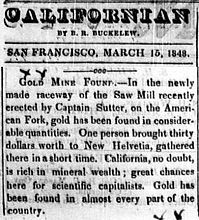
On this day in 1848 The Californian newspaper of San Francisco broke the news of gold discovery.

CalifornianNewspaperGoldFoundMarch15-1848


Gold Mine Found. –In the newly made raceway of the Saw Mill recently erected by Captain Sutter, on the American Fork, gold has been found in considerable quantities. One person brought thirty dollars worth to New Helvetia, gathered there in a short time. California, no doubt, is rich in mineral wealth; great chance here for scientific capitalists. Gold has been found in almost every part of the country.


It’s true that gold had been found elsewhere in California — a gold mine in the San Fernando Hills had been producing gold for several years — but in such small quantities that no one thought it was worthwhile to pursue it.

But this news of gold in the American River touched off the California Gold Rush, a massive movement of men (and a few women) from all over the world. California would never be the same again.


Posted in Uncategorized | Leave a comment

Nicholas “Cheyenne” Dawson in California, part 8

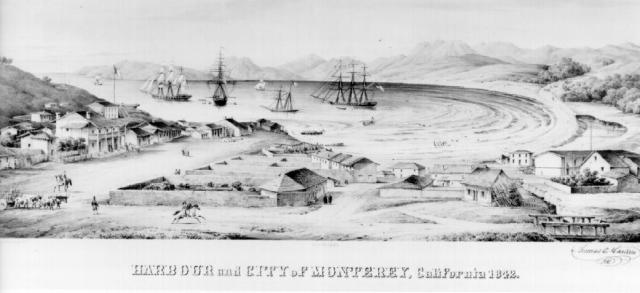
monterey

If you were an American coming to California in the 1840s, where did you go to find a job? If you were a hunter or trapper or cowboy, like many of the men in that first emigrant train, you went to Sutter. If that wasn’t what you wanted, but were willing to try your hand at just about anything else, you went to villages like San Jose or Monterey (they could hardly be called cities), and looked for someone to hire you to do, well, what?

In Dawson’s case, first he helped build a distillery. Then he cut shingles. Next he got an offer to clerk at a store. That must have sounded easier than wood-cutting.

I helped Bowen start his distillery, and then he, not needing me longer, proposed to furnish me tools and provisions and I to make shingles on the halves. I accepted the proposition and went to work. Selecting a medium-sized tree, I felled it and worked it up; then another—making altogether forty thousand shingles.

The trees were too think for a cross-cut saw to reach through, and I would have to cut in part way with an ax. I was bothered to keep a partner, as most of the redwood sawyers preferred drinking at the still-house to working, and I did most of the work by myself.

(These sawyers were “mostly runaway sailors, and were generally of a low class.”)

While I was working away at my shingles I received a letter by hand from a man by the name of Job F. Dye, in Monterey, requesting me to come there and keep store for him. I was undecided . . .  Would he take me when he saw me? I was nearly naked; what clothes I had were soiled and ragged, as I could hire no washing or mending done, and had tried myself but made a failure.

He decided to give it a try; he was tired of the lonely life of making shingles on his own. He went to Monterey, met Mr. Dye, “a plain, honorable Kentuckian.” Dye had a store at Santa Cruz, and he needed a man with some education to run it for him.

I soon struck a trade with him at twenty dollars per month, cash. When the bargain was closed, Mr. Dye told me to select any ready-made clothing in the stock that I needed, and charge it to myself. This I did immediately, and then I felt a new man. And when I went to supper and had bread, tea, and vegetables, and, best of all, a neat, lively lady at the head of the table, I felt more so. My diet for about a year had been meat alone, except two or three times when I had eaten a few tortillas.

Civilization at last!

Dawson stayed at this job for about a year, and much of his time was taken up with overseeing men who cut and hauled lumber for sale. His greatest trouble, he said, “was to keep from selling to slow-paying customers, and to collect from them when sold to; for very little honor was to be found in either natives or foreigners.”

(Just a note: In these recollections of early California, natives means the Mexican Californians, not Indians, and foreigners means Americans and Europeans.)


Posted in Uncategorized | Leave a comment

A Miner Forty-Niner and his Blue Jeans

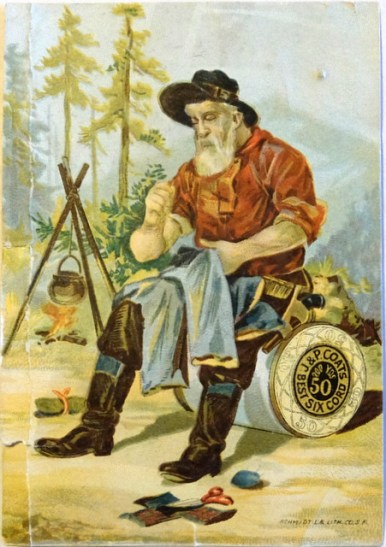
DSCF2760Randy Taylor will recognize this advertisement for Coats’ thread. I bought it yesterday at the Chico Bottle Show. I don’t collect bottles, but I think they are interesting and pretty, so I stopped by the show.

What I do like, and will buy occasionally, are vintage greeting and advertising cards, and Randy has some of those too.

Isn’t this a great image? J & P Coats (later Coats & Clark), used many images that highlighted the strength of their thread: hauling boats, stringing a bow, muzzling a dog. They also liked cute pictures of babies, puppies and kittens (and who doesn’t?)

Here we see the typical Forty-Niner, red flannel shirt, leather boots, pistol and all, in camp patching his blue jeans with J&P Coats Best Six Cord thread.

I am going to put this in a little frame and hang over my sewing machine. It’s the perfect image for a seamstress and a writer of northern California history.

Posted in Uncategorized | 3 Comments

“Cheyenne” Dawson in California, part 7

At that time Sutter was on the Sacramento, and wanted colonists; but I, with ten or twelve others who were in a hurry to get into employment, decided to try the Spanish settlements south of us, and after a day or two’s stay at Marsh’s, set off. Marsh told us that we might meet with difficulties on account of having no passports from our government, and advised us to leave our guns behind. This all did but me.

Marsh told them of the hospitality of the Mexican rancheros, and gave them a letter of introduction to the next ranch. They found that by showing up at any ranch and signaling that they were hungry they could get a meal of beef. There was very little else to eat. When they came near San Jose they were apprehended by a squad of soldiers who escorted them to the “calaboose, or jail.” They were rescued by an American named Tom Bowen, who persuaded the alcalde to liberate them and who looked after them until they could get passports from M. G. Vallejo, the military commander. Dawson describes San Jose as a sleepy little town of about 150 residents, with meandering streets and houses with next to no furniture.

Dawson was offered a job by Bowen to work at a distillery he was setting up to make rum from “Sandwich Island molasses.” They first went to Mission San Jose to get his passport. The distance was only twelve miles, but Monte, Dawson’s horse, was so weak that it took all day to get there.

Poor old Monte, worn out from his trek from Missouri, and starving from the lack of grass in drought-ridden California, kept laying down on the trail until at last Dawson dismounted, took the saddle on his shoulders, and led Monte by the bridle. They came to the house of Alexander Forbes, the English Consul, who provided Monte with a pile of wheat straw to eat, and offered to send him along with some of his horses up in the hills where there was grass. Leaving Monte in his care, Dawson went on to the distillery.

At the distillery I found, in the way of provisions, a sack containing beans and wheat, and a cake of tallow; and finding plenty of deer close by, I fared very well. The distillery was located in a grove of redwoods, west of San Jose.

It didn’t take much to fare very well in old California.

California was not what Nicholas Dawson expected, but he found his experience fascinating. In his narrative he describes the ranchos, the cattle and horses, and how everyone rode everywhere “perhaps only to cross a street.” He explains how the hide and tallow trade worked. He enjoys a fandango (“the  only dancing I ever did in my life”) and describes deer and geese grazing among the cattle, and grizzly bears crossing the roads.  He observes a bull and bear fight:

The issue of this fight was very doubtful, depending altogether on which put in the first blow. If Bruin got the bull’s nose with his paw, he won; if the bull got his horns in Bruin’s carcass first, he won.

It was a strange new world for the young man from the States.


Posted in Nicholas "Cheyenne" Dawson, Uncategorized | Leave a comment

The Adventures of “Cheyenne” Dawson, Part 6

The Bidwell-Bartleson party of American emigrants arrived at the ranch of John Marsh on November 4, 1841. Now they at last knew for sure that they were in California. But it was not exactly what they had expected. Here is “Cheyenne” Dawson’s reaction:

We had expected to find civilization – with big fields, fine houses, churches, schools, etc. Instead, we found houses resembling unburnt brick kilns, with no floors, no chimneys, and with the openings for doors and windows closed by shutters instead of glass. There were no fields or fencing in sight – only a strong lot made of logs, called a corral. Cattle and horses were grazing everywhere; but we soon found that there was nothing to eat but poor beef. The season before had been exceptionally dry*, and no crops had been made except at the missions, where they irrigated; and , as many of the mission were on a rapid decline, but little had been raised at them.

*Which goes to show that there is nothing new about drought in California.

John_Marsh,_Pioneer,_1852

John Marsh in 1852

Marsh was very kind and asked us what we craved most. We told him something fat. He had a fat hog. This he killed for us, and divided it among the messes. [The men had organized themselves into groups that ate together]. He also had a small quantity of seed wheat that he was saving to plant. A part of this he had made into tortillas for us.

A generous host indeed!

He told us that if we wished we could sleep in the house. This novel experience some of us tried, but we were much disturbed by fleas, and sick-stomached men crawling over us to get out. They had eaten too much pork.

Ah! Life in old California and the romance of the ranchos! Such were the realities of life in Alta California in 1841.

CalAdobe

John Marsh’s rancho would not have looked this good.


Posted in Nicholas "Cheyenne" Dawson, Uncategorized | Leave a comment

What is the Oldest Building in Chico?

stjosephmarysville

St. Joseph’s, Marysville From the Church website

A little background about why this question came up:

I was in Marysville on Monday with my OLLI class. We were touring churches in the area that have pipe organs. St. Joseph’s Catholic Church, on the corner of C St. and Oak, is a beautiful building with a fine pipe organ. As you can see from the photo, the building was built in 1855. You can read the history of the church here. I don’t know if it is the oldest building in Marysville, but it may well be.

That got me to thinking — what is the oldest building in Chico? Marysville is older than Chico, and I was pretty sure there was nothing older than 1860, when Chico was founded.

So I did what any sensible person does nowadays, I posted the question on Facebook, on the “You Know You’re From Chico . . .” page. And I got my answer. From Randy Taylor, that expert on all things Chico. He said:

Bidwell’s Store (Tres Hombres) was built in 1861 but only one wall, the north wall, is original. The Sommer Gage house was built in the 1860’s and is the oldest home in the city limits. The Wright Patrick house next to the cemetery on the Midway was built in 1852 and is probably the oldest north of Sacramento. The oldest original complete building would be the Masonic building (Colliers) which was constructed in 1871.

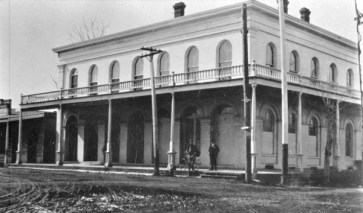
bidwellstoreBidwell’s Store was a two-story building on the corner of 1st St. and Broadway, built in 1861. The second story is gone now. It was right across the street from Bidwell’s nursery, and across the creek from Bidwell Mansion, a short walk for General Bidwell. It has housed a variety of businesses over the years, and currently it is Tres Hombres restaurant.
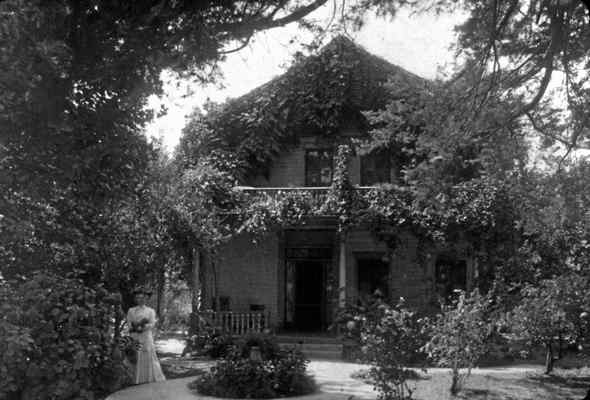
The Allen-Sommer-Gage house is at 410 Normal Ave. (which at the time the house was built, was called Sycamore Ave.) It is listed on the National Register of Historic Places. It was completed in 1862, making it the oldest dwelling in Chico. And it is more complete than Bidwell’s Store. Helen Sommer was born in the house in 1888 and was living in it when she died in 1980.

sommergagehouse

One of these days I’ll write about the Wright-Patrick House, the oldest house north of Sacramento. (Not the same as the house at Patrick Ranch.)

Bidwell Mansion, by the way, was completed in 1868. At which point Bidwell tore down the two-story adobe house/office/hotel/tavern that he built in 1852.


Posted in Chico, Uncategorized | 3 Comments

“Cheyenne” Dawson, Part 5

At Soda Springs the company of emigrants split in two. The more cautious of them took the advice of their trail guide and remained on the Oregon Trail, but 32 men, plus Mrs. Kelsey and her baby, stuck to their original aim of heading for California.

One of the reasons that they felt confident in doing so, in spite of the warnings of Fitzpatrick and the unexplored nature of the Great Basin, was that they had a map. How were they to know that it was wrong? How should they know that the mapmaker had filled in the empty sections with hearsay and fabrications?

Tanner J

A misleading map of North America by Henry S. Tanner, 1822. The smaller of the two lakes is labeled Salt Lake, with the Buenaventura River flowing right to the Pacific..

According to Dawson:

We knew nothing positive about the route, except that it went west. True, we had some old maps picturing a river called Buenaventura, or St. Mary’s river, which, flowing out of Great Salt Lake and pursing a westerly course emptied into the Pacific; and from this map we thought all we should have to do was to find our river and follow it. However, we had been told by trappers that there was no river flowing from the lake, but that there was a river (which they called Ogden’s) that had its source west of the lake and flowed west, and that it might take us to California.

The trappers were right about Ogden’s river (also called Mary’s and later, Humboldt), but even they did not know about the Sierra Nevada. The company found the river, and faithfully followed it, expecting it to lead them to the shores of the Pacific. Alas—

The river seemed to be dwindling instead of receiving big tributaries to swell its flood and guide us into the plains of California and on to the Pacific, where our suffering and troubles would end, and where we could eat, eat, eat – and something that had some fat in it. But the route was getting more nearly impassable; and alas! What meant those big mountains ahead with no opening through them?


Posted in Nicholas "Cheyenne" Dawson, Uncategorized | Leave a comment

“Cheyenne” Dawson, Part 4

“Cheyenne” Dawson’s account of his journey to California was written down many years after the event, but he had a clear and lively recollection of the expedition. Here he is, telling how the company fared after they abandoned their wagons near the Great Salt Lake and packed all their possessions on their animals.

There was one thing we had no trouble to pack – our provisions. Though we had been eating very sparingly for several weeks, our last provisions had been consumed just before we reached Salt Lake, and since, we had been subsisting on what game we could kill, and when no game was to be had, an ox out of our train.

Now some of us were inwardly rejoicing over leaving the wagons behind, for it meant more beef – poor beef, but a long way better than nothing to eat. On the eighteen or twenty lean oxen that had drawn our wagons, we subsisted until we entered the Sierra Nevada, for there was not more game to be had. When the oxen were gone, we lived on horse and mule meat, and acorns.

Since the oxen were no longer needed to draw the wagons, they became dinner “on the hoof,” a traveling supply of meat. Those who had horses or mules rode, and the others walked, driving the oxen. Dawson had a mule named Monte; Bidwell was on foot. Every few days they killed one of the oxen for dinner. It was all they had.

Posted in Nicholas "Cheyenne" Dawson | Leave a comment

“Cheyenne” Gets His Nickname (Nicholas Dawson Part 3)

There were two men in the Bidwell-Bartleson Party named Dawson: Nicholas and V.W. Almost nothing is known about V.W., including what the initials stood for, but he went by the nickname “Bear.” The two men were not related. It was not long into the journey when Nick Dawson earned his own nickname.

While we were in the Platte valleys a little incident occurred that gave me a nickname for the rest of the journey: we were now in the country of hostile Indians, and Fitzpatrick had warned us not to stray beyond sight of the wagon train. But one day, curious to see the country that lay beyond the range of hills, I had ventured farther than usual, and coming upon a herd of antelope I, in my eagerness to get a shot at them, had followed them still farther. I was off my mule . . . trying to creep near enough for a shot at them, when I was startled by an Indian whoop.

I sprang upon my mule, but he perversely wheeled and ran toward the sound, I pulling desperately at the reins. Finally I got his head in the direction I wanted to go, but no amount of urging could get that mule to hurry, and in an instant I was surrounded by Indians. One galloped by me, thrust a spear along my back, and motioned for me to dismount. I did so. They seized my gun and knife, stripped me of my outer clothing, and taking my mule, left me. I hurried after our train, and overtaking it, told my story.

The alarm spread along the line, and all was confusion. Fitzpatrick galloped back, calling out the horsemen as he came, and was off with them to find the Indians, and if necessary, give them battle. I was very angry now, and intent on vengeance, so hastily borrowing a horse and gun, I hurried after the party. I came on at full speed and was aiming at the first Indian within range, when I was stopped by some forcible language from Fitzpatrick, and perceived that Fitzpatrick and the Indians were engaged in a friendly powwow. It had proved to be a band of Cheyennes, friendly but thievish.

They camped near us that night, and Fitzpatrick attempted to get back my property. He and I and the Indians sat around in a circle, and for every article to be returned, gifts of blankets, clothes, etc. had to be thrown down, a peace pipe smoked by all, and much haranguing done. Fitzpatrick’s patience gave out before all was got back, and declaring that I ought to be satisfied to have got off with my life, he refused to intercede further. I chafed under my enforced friendliness, and after that, to distinguish me from another Dawson in the company known as Bear Dawson, I was called Cheyenne Dawson.

Nearly everyone who wrote a memoir of the journey mentions this incident. John Bidwell, Josiah Belden, Nancy Kelsey, and James John all relate it. Bidwell had this to say:

A young man (Dawson) was out hunting, when suddenly a band of Cheyenne Indians about 40 in number came upon him; they were pleased to strip him of his mule, gun, and pistol, and let him go. He had no sooner reached the camp and related the news than the whole band came in sight. We hastened to form a corral with our wagons, but it was done in haste. To show you how it affected the green ones, I will give the answer I received from a stout, young man (and he perhaps was but one of 30 in the same situation), when I asked him how many Indians there were. He answered with a trembling voice, half scared out of his wits, there are lots, gaubs, fields and swarms of them!!! I do really believe he thought there were some thousands. Lo! there were but 40, perfectly friendly, delivered up every article taken, but the pistol.

Bidwell was proud of his “self-possession” and you wouldn’t catch him admitting to being frightened.

cheyenne-george_catlin

Portrait of Cheyenne chief Wolf-on-the-Hill by George Catlin, 1832

Josiah Belden left the best description of the Cheyennes:

We found them to be a war party of the Cheyenne tribe, about 50 or 60 warriors, fine looking, and they said they were looking for the Pawnees. They were fully armed with bows and arrows and tomahawks, and some few guns. They were the finest looking body of men I ever saw for Indians, quite a formidable looking party.


Posted in Uncategorized | Leave a comment