The Man Who Founded New Mecklenburg, part 3

You can get an idea of how productive an operation Theodore Cordua was running in 1848 from this letter excerpt, written by John Bidwell to his partner George McKinstry that April:

Cordua at the head of his fleet has set out with the following articles only intended for the San Francisco market: viz; Candles, Hides, Flour, Manteca, Butter, Cheese, Hams, Pork, Beef, Smoked Beef, Corn, Bearskins, Bear oil, Indian Baskets, Bows & Arrows, Dressed Deerskins, Buckskin Pants, Moccasins, Eggs, Beaver, Otter, Panther, Raccoon, & Coyote skins, Castor etc. etc. etc. Isn’t he an old Coon?

By calling him an “old Coon” Bidwell meant he was a crafty operator. His fleet at that time consisted of sailboats and canoes; his schooner hadn’t been completed.

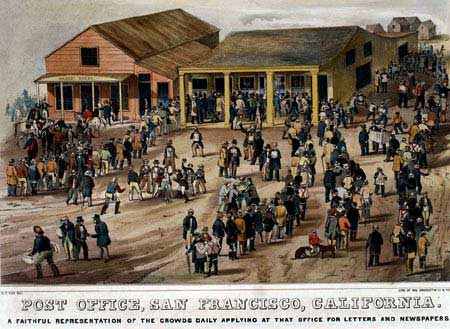
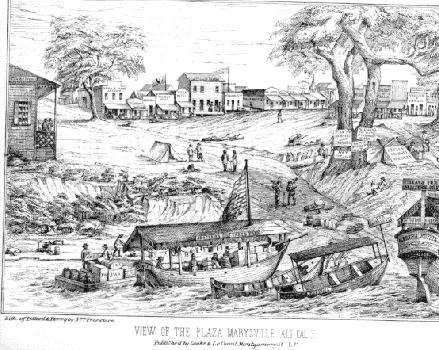
marysvilleplaza

A view of the Plaza at Marysville, in 1850

Theodore Cordua had his fingers in any number of pies, and he didn’t limit his business activities to his ranch at New Mecklenburg (Marysville). He owned lots in Napa, Sonoma, Benicia, San Francisco, and Suttersville. He took a ten-year lease on a ten-thousand acre ranch at Corte Madera on the bay. He stocked it with chickens and milk cows, sheep and hogs, and planted vegetables, all with an eye to selling fresh provisions to the whaling ships that entered San Francisco Bay.

In February 1848 he entered into a contract with the U.S. Army to supply hay for horses. Another good business deal, he thought, which would give him the cash he needed to complete his sea-going schooner. His plan was to send men to the Napa Valley to cut wild oats, press them, bale them, and ship them to Sacramento for the cavalry.

By this time he had heard about the gold discovery at Coloma, but it didn’t worry him — not at first. For years there had been an operating gold mine in the San Fernando hills, and everyone knew how little it produced. How could a small amount of gold in the river affect his agricultural empire?

But when he went to cut the hay at Napa, he couldn’t get enough workers to do the job. The men he had hired to do the job were heading for the goldfields instead. His Indian workers were loyal, but there just weren’t enough of them to completely fulfill the contract. Cordua delivered 140 of the 190 tons he had contracted for. Most of that shipment ended up rotting in the winter rains when Lieutenant Folsom could not find ships to freight it. Everyone had gone gold-seeking.

On his return to New Mecklenburg he found that his majordomo was drunk, his white employees had deserted, the grain was unharvested, and even the floorboards of his house had been pulled up to build a machine for washing gold. And that was only the beginning of the downward spiral.

Next: Leaving California

P.S. Nearly the all the information in these posts (other than Bidwell’s letter), comes from The Memoirs of Theodor Cordua, the Pioneer of New Mecklenburg in the Sacramento Valley, edited and translated by Erwin G. Gudde (December 1933), which is available online at www.corduan.com/images/Ted_Cordua_Memoirs.pdf .

Posted in Theodore Cordua | Leave a comment

The Man Who Founded New Mecklenburg, Part 2

By 1847 everything at Theodore Cordua’s settlement of New Mecklenburg was prospering. He had thousands of head of cattle and hogs. Like the Mexican rancheros, he slaughtered his cattle for the hides and tallow, and sent them down the river for export to Boston. Much of the meat went to waste. In 1847 he decided to increase his profit by salting, curing and smoking the meat.

Cordua oversaw a vastly productive establishment. He and his workers grew wheat, barley, and peas. They raised chickens by the thousands, made butter and cheese, and salted salmon. They even made caviar from sturgeon eggs. His hunters brought in the pelts of otters and beavers. Deerskins were made into trousers, shirts and shoes.

He was beginning to wonder what to do with all this bounty. The local market for his products was small, and San Francisco (before the Gold Rush) could not absorb it all. Where could he send it?

schooner3In 1847 he made a contract with three English carpenters to build a sea-going schooner at New Mecklenburg. He planned to sail the schooner to Mazatlán, perhaps even Hawaii, and sell his produce. As the business grew, he planned add more ships to carry more goods. Prosperity beckoned.

He had plenty of timber available, and a blacksmith to fashion the needed ironwork. Still, there were items he would need to purchase to complete the ship:  ropes, sails, anchor, and chains. In order to raise the money to buy these items, he entered into a contract to supply hay to the U.S. cavalry. With the Mexican War just concluded, troops stationed in California needed supplies. It seemed like a deal he could count on.

And yet it all went wrong when gold was discovered.

Next: Cordua in the Gold Rush

Posted in Theodore Cordua | Leave a comment

The Man Who Founded New Mecklenburg

John Sutter had his New Helvetia (New Switzerland), and another German-speaking immigrant founded New Mecklenburg, better known today as Marysville. Although not as well-known as Sutter, Theodore Cordua had much in common with his more famous compatriot.

cordua

A young Theodore Cordua

Like Sutter, Cordua was an enterprising German-speaking immigrant to California who arrived before the Gold Rush. He had large land holdings in the Sacramento Valley, where he raised cattle and wheat, employing American immigrants and native Indians, and like Sutter, he lost it all after the Gold Rush and left California nearly as poor as when he came.

Cordua was born near Mecklenburg in northern Germany in 1796. As a youth he wasn’t interested in schoolroom learning. He wanted to see the world, and he thought that the life of a merchant might give him the chance to travel. After a few dreary years as a grocery clerk, he set out, first to the Dutch East Indies, and then to Central America, where he became wealthy in trade. In spite of this initial prosperity, by 1841 he had lost it all.

He traveled to the Hawaiian Islands, and there he heard of John Sutter’s good fortune in California. (Sutter had spent about half a year in Hawaii in 1839, cultivating friendly relations with the American and European community there). Cordua decided to follow Sutter’s example. He arrived in Monterey in May 1842 and after looking all around Alta California, was induced by another German, Carl Flugge, to visit Sutter at New Helvetia. Cordua had heard enough about Sutter’s business practices to be cautious (Sutter had a habit of not paying his debts) but finally arrived at a deal in which he sold Sutter $8000 worth of much-needed supplies from Hawaii in exchange for cattle, horses, and a lengthy lease on all of Sutter’s land grant north of the Yuba River.

Having acquired five leagues of land from Sutter, he requested a land grant from the Mexican government of another ten leagues on the northern border of Sutter’s grant. Although this ranch never seems to have been confirmed by the Mexican government, he considered himself the owner of Rancho Honcut. Cordua called his establishment New Mecklenburg.

rancho-honcut

Diseno for Rancho Honcut, labeled Cordua’s Ranch

It was tough going at first. The land was rich but had never been plowed and was as hard as adobe bricks. The Indians worked willingly — Cordua seems to have treated them better than Sutter did — but they were unskilled in European farming practices. It was a lonely life as well. Until 1844 Cordua was the only white settler in the Upper Sacramento Valley. In spite of these difficulties, Cordua gradually built up his ranch until by 1848 he had so much livestock, grain, and produce that he had to search for a new outlet for his products.

Next time: Cordua builds a ship

Posted in Theodore Cordua | 2 Comments

Need a Speaker for Your Group?

happy-new-year-clipart-15Happy New Year to all the history buffs out there. I hope 2017 is filled with wonderful discoveries and joyful events.

Are you a member of a group or club that needs a speaker? I love to speak to groups—it’s a lot of fun to talk about John Bidwell and his world. It’s a treat to interact with folks who love history. So if you know anyone looking for a speaker, send me a note at goldfieldsbooksca@gmail.com. (Note the “s” in the middle of the address, actually, two of them — it’s easy to miss them.)

bidwell2013 002I love to talk to elementary students, too, so if you know a teacher, pass this on. 3rd and 4th grade students visit Bidwell Mansion — a talk and slideshow about John and Annie Bidwell before they visit is a great way to get ready. Sometimes I even bring John along with me! (As portrayed by Nick Anderson.)

I have several ideas and projects in the works, and I’ll keep you posted about those as they progress. In the meantime, make 2017 a wonderful year!

Posted in Uncategorized | Leave a comment

Christmas in California, 1841

merry-christmas-vintage-textJohn Bidwell knew he was in California when he arrived at John Marsh’s rancho on November 4, 1841. Like most Americans who came to California in the 1840s, he went to John Sutter to find work.

By Christmas Day, Bidwell had been at Sutter’s settlement for about a month. Sutter had enthusiastically hired Bidwell and planned to send him off to the coast to oversee his recent acquisition of Fort Ross. Here is Bidwell describing Sutter’s “Fort” as he first saw it:

The settlement, if it could then be so designated, was in an embryo state. No crops had been raised; grain had been sown, but owing to an unprecedentedly dry season, it had failed to mature.

There was no such thing as bread, so we had to eat beef, and occasionally game, such as elk, deer, antelope, wild geese, and ducks. Our Christmas dinner that year was entirely of ducks. (Colusa County, p. 37)

Just ducks for Christmas dinner! But they wouldn’t go hungry, for there was no shortage of ducks and geese along the river that winter.

So safe at last in California, John Bidwell enjoyed a merry Christmas with John Sutter, his trail mates Jimmy John and Mike Nye, and Sutter’s motley household of Mexicans, Kanakas, and Indians.

I hope you have a very merry holiday season too, whether it’s ducks for dinner, or turkey, ham, or roast beef. Or even vegetarian (which wasn’t an option for Bidwell). Thanks for reading my blog. I’ll be back next year with more Northern California adventures.

Posted in Uncategorized | Leave a comment

The Other Slavery

otherslaveryIn his book The Other Slavery, historian Andrés Reséndez reveals a missing piece of American history — the enslavement of Native Americans. From the first days of Columbus in the Caribbean down to the 20th century, Indians were pressed into slavery.

Only it wasn’t called slavery. It was called indenture, or debt peonage, or not given any name at all. Indian slavery was different from African slavery. The slaves were not transported across the ocean. They were captured and sold by rival Indian tribes, hunted down by white kidnappers, or taken up on charges of vagrancy. Unlike Africans, who all came to North America originally in bondage, Native slavery varied depending on location and tribe.

It was different in other ways too. African slavers sought primarily young men, but with Indian slavery, women and children were more desirable. Women had useful skills — weaving, food preparation, child care. Women and children were more docile and easily managed. In the West particularly, household servants were often Native Americans, often children who had grown up working for their owners.

Indian slavery was not legal, but it persisted anyway. The Spanish crown prohibited Native slavery in 1592, but it continued. Mexico outlawed all forms of bondage and gave the Indians citizenship, but peonage continued. The 13th Amendment prohibited slavery and involuntary servitude in the United States, and this certainly should have applied to Indians as much as African-Americans, but Native bondage was ignored. They weren’t called slaves, so how could they be set free?

Reséndez looks at slavery’s beginnings in the Caribbean, the encomienda system in Mexico, and the spread of slavery throughout the American Southwest. When the Mormons arrived in Utah, they came upon a thriving slave trade already in place, and in their efforts to rescue and convert natives, they found themselves entangled in buying and keeping Indian children. In New Mexico the removal of the Navajo to a reservation was an opportunity for slave traders to capture and sell into bondage countless women and children. And in California, even before the Gold Rush, the Indians were coerced into labor by the rancheros, both Mexican and American

Reséndez explores how Native American slavery has been overlooked. He sees in it a major cause of the decline of the Indian populations that can be added to the well-known causes of disease, massacre, and removal. For anyone interested in Native American history or the history of the American West, this is an important book.


Posted in Uncategorized | Leave a comment

The Rush Is On

On December 8 and 9, 1848 (168 years ago), news of the gold discovery in California was first reported in the New York Daily Tribune. The first report was a letter written on August 17th from Monterey by Col. Richard B. Mason who surveyed the gold regions with Lieut. William Tecumseh Sherman. You may read the entire story here:

image_681x648_from_9391247_to_26322859He relates how James Marshall found the gold in the tail race of the mill he was building for Sutter:

He then went to the fort, told Captain Sutter of his discovery, and they agreed to keep it secret until a certain grist-mill of Sutter’s was finished. It, however, got out and spread like magic. Remarkable success attended the labours of the first explorers, and, in a few weeks, hundreds of men were drawn thither. At the time of my visit, but little more than three months after its first discovery, it was estimated that upwards of four thousand people were employed.

He goes on to describe how gold fever overtook all the inhabitants of California:

The discovery of these vast deposits of gold has entirely changed the character of Upper California. Its people, before engaged in cultivating their small patches of ground, and guarding their herds of cattle and horses, have all gone to the mines, or are on their way thither. Labourers of every trade have left their work-benches, and tradesmen their shops; sailors desert their ships as fast as they arrive on the coast; and several vessels have gone to sea with hardly enough hands to spread a sail. Two or three are now at anchor in San Francisco, with no crew on board. Many desertions, too, have taken place from the garrisons within the influence of these mines; twenty-six soldiers have deserted from the post of Sonoma, twenty-four from that of San Francisco, and twenty-four from Monterey.

This was followed the next day by two letters from Thomas O. Larkin to the Secretary of State. Larkin had been the American consul in Monterey when California had been part of Mexico. His letters were actually written earlier than Mason’s; they are dated June 1 and June 28.

image_681x383_from_4287540_to_70612100

Sir: I have to report to the State Department one of the most astonishing excitements and state of affairs now existing in this country, that, perhaps, has ever been brought to the notice of the Government. On the American fork of the Sacramento and Feather River, another branch of the same, and the adjoining lands, there has been within the present year discovered a placer, a vast tract of land containing gold, in small particles.

Larkin makes a point of noting that “this placer, or gold region, is situated on public land.” That meant it was free for the taking. Imagine the excitement!

And so every man started figuring out how to make the journey, and worrying that all the gold would be picked up before he could get there. The Rush was on!

Posted in Uncategorized | Leave a comment

The Road to Cherokee

cover-for-nancyThe Association for Northern California Historical Research has just launched its new book: The Road to Cherokee, by Mary Ray King. This work of fiction is a first for ANCHR, a historical romance set in Butte County, focusing on two families that come to California in 1850 and seek their fortunes in the rich gold mines of the hills and the rich farmland in the valley.

The author, Mary Ray King, penned her novel in the 1940’s but passed away before seeing it in print. Her granddaughter, Jean Whiles, brought it to the attention of ANCHR. King’s story has been expanded with historical photos, maps, and introductions about the author and about the historical background. This is a rich book!

The Road To Cherokee: A California Epic ($24.95 in paperback) is available at The Bookstore and Bidwell Mansion (Chico), My Girlfriend’s Closet (Paradise), Discount Books (Oroville), the Butte County Historical Society (Oroville), and the Gridley Museum. Or you can contact ANCHR direct for your copy (530-636-0778 or ANCHR.Books@gmail.com)

Dan Barnett, writing in the Chico Enterprise-Record says “Get it now!”

Posted in Uncategorized | Leave a comment

100 Years Ago

File this under “They Don’t Write Newspapers Like They Used To”—

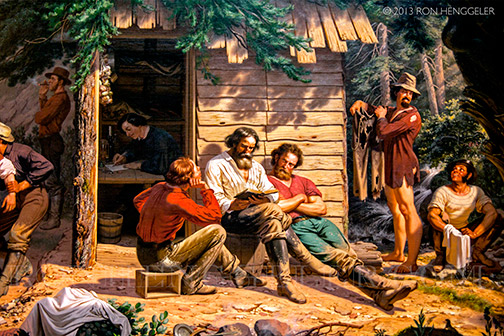
two-cal-miners

Random photo of two Californians

100 years ago:

WYANDOTTE HAS ELIGIBLE BACHELORS FOR RICH CHICO WIDOWS — BUT NOT ENOUGH

(Originally published in the Oroville Mercury and republished in the Chico Daily Enterprise Nov. 28)

There are some 85 wealthy widows in Chico, according to the sworn statement of the Enterprise, who are waiting for some handsome man to propose to them.

By a coincidence there are 30 handsome and husky bachelors in Wyandotte. The Enterprise has publicly stated it is ready to sacrifice the interests of Chico by marrying off any of these widows. The Mercury has a list of Wyandotte bachelors. Let the Enterprise send in a list of widows and the county clerk and Judge J.V. Parks will get busy.

“Exhibit A” is a fine, tall, 6-footer, who has a good disposition, is kind to animals and owns a ranch. He would not object to a widow, especially a wealthy one, providing she is a good cook. Short, stout blonde preferred.

“Exhibit B” short, plump and dark. Also owns a ranch. Plays the oboe but would discontinue his musical exercises if his future wife objects to music. Would like as a life partner a tall, dark, slim, widow.

“Exhibit C” tall, handsome and — but why throw all our cards on the board?

In fact, to give those Chico widows a chance we will even go so far as to print a list of some of the Wyandotte bachelors, kindly furnished us by Fred Cornehl, a public spirited citizen of Wyandotte.

— Chico Daily Enterprise, Nov. 28, 1916

I like “Exhibit A” but I am not a short blonde. I am a pretty good cook though.

Thanks to Sally Mau of the Chico Enterprise-Record, who writes this weekly feature.

Posted in Uncategorized | Leave a comment

Thanksgiving Day at Bidwell Mansion

From Annie Bidwell’s Diary:

Fri., Nov. 28 [1890]

Perfect day. Rev. Mr Murrish & wife, Rev & Mrs Reames, Rev & Mrs Green dined with us at one O’Clock today. Came at noon, left about 4 P.M. Had excellent dinner closing with ice-cream, plum-pudding, coffee, shelled Eng walnuts, & almonds: raisins, Japanese Persimmons, pears, apples, grapes, etc. Guests seemed happy & we enjoyed having them to “Thanksgiving Dinner” – if on Friday.

Thurs., November 26. [1903]

Thanksgiving Day. Places: Church, ll A.M. Union Services at Presbyterian Church. To dinner – Sister, brother Tom, Willie, Cora, Guy, Eva, Joseph, Dr. Gatchell & Cousin Ella Gatchell. Col. Royce, his mother & wife. Rev. & Mrs. White & babe.

Good dinner. Plum pudding, ice-cream with water ice layer in blocks – 3 blocks of it. Fruits -Jap. persimmons, pears, muscat & other grapes. Apples, oranges (Reuben’s grove),pomegranates, almonds, pecan-nuts, Eng. Walnuts, hazel nuts -all from Ranch Chico – our first new olives.

Young People’s Union Social at our house this evg. 300 said to be present. Much music, joy, etc.  Weather: Faultless!

Sounds yummy!

Posted in Uncategorized | Leave a comment