More from Dr. Townsend

Another letter from Dr. John Townsend to his wife:

dscf2538

Peyeys Ranch  August 16th 1848

Dearest

I embrace the opportunity of writing by Mr. Norris. Yesterday Moses arrived at our camp, He is in partnership with Larkin and Green. He has two machines I think he will come to work on the Ubo day after tomorrow. I and Buchanan intend going up the Ubo to look for richer digings. The box you sent by Foster has not yet arrived but it is on the road.

I do not know what to think of buying a house. I fear it will put us too much in debt. We had better rent. If I continue in the mines I intend to have you with me.

Try and get along as well as you can. I may come home when you least expect me.

I enjoy good health but am very thin in flesh. I hope your health will continue pretty good. Write to me every opportunity. The Gold mines, spell mines. Direct to me at the Falls of Ubo.

Your dearest  J. Townsend

Moses Schallenberger was Mrs. Townsend’s younger brother. In 1844, when the Murphy-Townsend-Stevens party came to California, he was 18 years old. When the party abandoned some of their wagons at Donner Lake, he stayed behind to guard them over the winter. He survived by trapping and eating foxes.

Larkin and Green were Thomas O. Larkin and Talbot H. Green, merchant partners at Monterey. Larkin served as consul for the U.S. government.

I am sure I am misreading the name of that ranch, but I don’t know what it is, even though I think I’ve seen it mentioned in other letters somewhere. Any suggestions?

Posted in Uncategorized | Leave a comment

Dr. Townsend in California

Dr. John Townsend came to California in 1844 with the Murphy-Townsend-Stevens wagon train, the first to bring wagons all the way over the Sierras. He was the first qualified physician in California and the first non-Mexican alcalde of San Francisco.

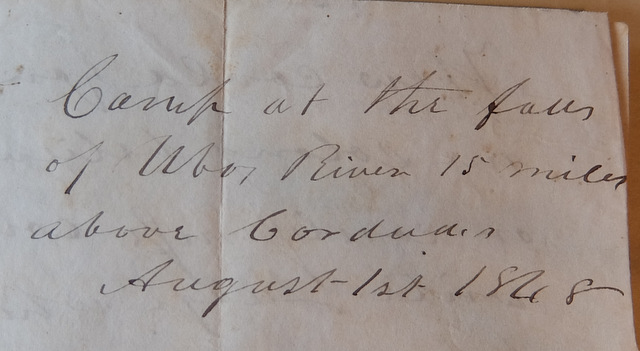
When gold was discovered he went to the goldfields in search of wealth. Here is a letter written to his wife from his camp “at the falls of Ubo River.” (No one was sure how to spell the name of the river — later they settled on spelling it Yuba.)

dscf2534

Dearest I received your letter by Farnham today, and by Brannan yesterday. I regret exceedingly that I have had neither ink nor paper to write. I wrote you by Stetson one month ago or more, and he certainly did not take it to you. I also wrote by Mr. Davis and Foster ten days ago which you will certainly receive. Buchanan and I are working still on our claim at the falls of Ubo, We have no hands and are working very hard ourselves. Some days we make fifty dollars a piece, and other days twenty-five dollars. We have now seventeen hundred dollars between us, and we hope in a few days to have one thousand a piece.

How could you who have known me so long believe that indifference or carelessness could induce me not to write. Judge when I tell you that I have not only three days since received my Trunk. I could get no account of it. I was out of shirts and all my clothes were worn out, and I never expected to hear of the trunk in the world as many trunks were lost. But I had no paper to write to any one about it. I could neither buy paper or shirts. Dr. Fourgeaud has been very sick of fever a[t] Johnsons I have be[en] called to see him twice as his wife did not expect him to live. I suppose she did not expect to want favours of me when she treated you as she did about Eliza.

I do not expect to return under one month as I shall probably quit for the winter. A great many have returned to San Francisco and I hope you will be able to buy some wood. Try and manage as well as you can I want to bring home all the gold that I possibly can.

Mr. O’Farrel is waiting for this and will speed it on its way but is not going to San Francisco. I will write when I can and do be satisfied with that I think you are doing well to walk in the morning for your health. Take good care of yourself dearest as all my gain would only be my curse if ill should come of you.

Yours as ever, J. Townsend

Mrs. Townsend was pregnant at the time with their first child, which explains his concern for her health.

I think these letters from the gold rush are so interesting. They tell us whether or not the miners had hired Indian workers, how much money they were making, and how much trouble it was to get supplies.  He mentions places: Johnson’s Ranch (Wheatland) and Cordua’s Ranch (Marysville).

This letter is held by The Society of California Pioneers at the Presidio. There are more Townsend papers in the San Jose Public Library.

Posted in Uncategorized | 2 Comments

Dickey’s Ranch Becomes Bidwell’s Ranch

John Bidwell was not the only American (or other foreigner) in California seeking land. William Dickey and Edward Farwell were after grants, as were several other men. In October 1844 Bidwell and Sutter went to Monterey to discuss the matter with the governor. Bidwell had already extensively explored northern California on both sides of the Sacramento River. He especially liked the land along Chico Creek.

Governor Pio Pico asked Bidwell what piece of land he would like to have.

At the time I saw the land where I now am, I was looking after some horses which had been stolen by a company on its way to Oregon, but my former companion, Mr. Dickey, had been up there, and wanted a grant of the land. In those days we never interfered with one another. I was asked by the Governor if there was a tract of land I like better than in Colusa; I told him there was, but that Mr. Dickey had confided to me his application for it, and of course I would not take it, so I got a title for him. Later I bought him out. (Dictation, 1891)

Bidwell took the Colusa grant, but he never developed it and later sold it. He settled instead on a corner of the Farwell grant and bided his time. When gold was discovered Bidwell and Dickey mined together on the Feather River. Having mined for two seasons, Dickey decided in 1849 he would take his earnings and return to the States.

Dickey, however, didn’t sell Rancho del Arroyo Chico to Bidwell; he sold it to Bidwell’s sometime partner, George McKinstry, who took possession in May 1849. McKinstry turned right around and sold half of the rancho to Bidwell on July 6, 1849 for $1785. Why Dickey didn’t sell directly to Bidwell, who very much wanted that land is not known.

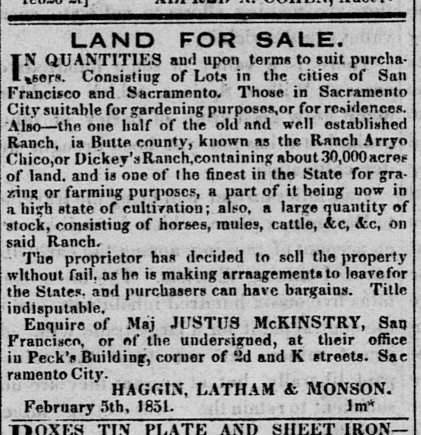
George McKinstry conveyed the other half of the rancho to his brother Justus in December 1850. But Justus must not have had any interest in farming, because he promptly advertised the land for sale, along with lots he owned in San Francisco and Sacramento.

For $9000 (the price had gone up a lot) Bidwell acquired the other half of the land he had long coveted. Rancho Chico was his.

st18510227-2-11-3-a1-421w

Posted in Rancho Chico, Uncategorized, William Dickey | Leave a comment

Dickey’s Ranch

st18510227-2-11-3-a1-421w

You might look at this advertisement from the February 6, 1851 Sacramento Transcript and wonder who was Justus McKinstry and why was he selling half of Rancho Chico, because didn’t that already belong to John Bidwell? Here is the story behind the ad—

William Dickey was an Irishman who came to California a couple of years before John Bidwell. I’m not sure of the year, but he was in California in 1840 during the Graham Affair. He worked for John Sutter (didn’t they all) and it was Sutter who suggested that Dickey and Edward Farwell go exploring up the Sacramento Valley, beyond the limits of Sutter’s own vast land grant.

They came to a beautiful stream and named it Chico Creek. The spot had everything to recommend it, and they decided to ask for five leagues each on either side of the stream. They tossed a coin to decide who would get which tract, and Dickey won the north side, while Farwell got the south side.

They returned to Sutter’s Fort where they told their comrade John Bidwell about their wonderful find and their desire to take possession of that spot. Not long after Bidwell himself traveled up the valley to Chico Creek and admired its beauties. Later that year (1843) Dickey and Farwell petitioned the Governor for the land, which was granted to them in November 1844.

So Rancho del Arroyo Chico became commonly known as Dickey’s Ranch. And California was so new that a 6 or 7 year old ranch could be called “old and well-established.”

Tomorrow: The Rest of the Story


Posted in Uncategorized, William Dickey | 1 Comment

In Camp and Cabin

John Steele came to California in 1850 as a young man of eighteen. He spent three years as a gold miner in California before returning to his home in Wisconsin, where he studied for the ministry and became a preacher in the Methodist Episcopal Church. He kept a journal  during his time in the gold fields and in later life he published his memoir, In Camp and Cabin, based on those journal entries. The experiences he relates are typical of many a gold seeker, with all the adventure, tedium, peril, humor, and everyday detail one might expect.

Here is his description of getting mail at the post office in Sacramento:
postoffice

The Post Office in San Francisco, 1849. Crowds were worse in Sacramento.

Our first visit was to the post office. I am quite sure that at this  time there  was not a post office in the mines. Letters for miners were addressed to Sacramento, and of course the mail  arriving here was immense, and when we reached the office the crowd was too great for us to approach the delivery during the day.
The next morning we were there an hour before the time of opening, but the crowd seemed just as great as ever, so we retired again . . .
Saturday, March 29. . . . However, we resolved to make one more effort to get our mail.
The condition of this post office is altogether unique. It opens at eight in  the morning and closes at eight in the evening. There is a delivery window for nearly every letter  of the alphabet, and at each  there is a row of people, often reaching more than around the block. When so many come in person for their mail it is simply overwhelming, and when it come time to close the office, the lines break up, each to take his chance another day. But as hope deferred makes the heart sick, so, many who came a great distance and waited long, are compelled to turn away still enduring their anxious suspense.
Monday, march 31.  This morning about one o’clock we arrived at the post office and found a large number in waiting. The line facing the S window already extended halfway around the block.bidwell-ltr-sutters-mill
Taking my place in the line, I waited until the office opened, and as the line in front melted away, moved forward. Of course each one of our little company sought the delivery according to name. This put us in different lines, and as we approached the window men came and tried to buy a place in the line, offering twenty-five and fifty dollars, and I was told even a hundred dollars had been  paid for a place near the delivery. The one who sold his place stepped from the line and went to the extreme read, or else waited until the office closed and night had shortened the line, and again found a place. Many who were near the delivery when the office closed, remained, holding their place until it opened in the morning.
At last I reached the delivery, and the busy clerk, after looking over a vast pile of mail matter, handed out what belonged to me. Gladly I got out of the way, and hurrying to our room, scanned the familiar writing, and with a strange tremor read the first letters I had received from home and friends since leaving them more than  a year before.
sundayin-the-mines

A detail from Charles Nahl, Sunday in the Mines. The miner inside the cabin is writing a letter.

Posted in John Steele, Uncategorized | Leave a comment

The Lakeside Classics

dscf2625For Christmas my daughter gave me a book in the Lakeside Classics series. These books are a bibliophile’s and librarian’s dream, and being a librarian and a bit of a bibliophile, I fell in love with the first one I saw, which was Revolutionary Days by Princess Julia Cantacuzene née Grant (but hers is another story).

For over one hundred years R.R. Donnelly and Sons of Chicago, a publishing firm that has grown to be a communications giant, has printed a book at Christmas time as a gift to their employees and clients. The books in the Lakeside Classics series are mostly first-person narratives of American history, often from works that are out of print and not easily obtainable.

Each book is an example of fine printing — cloth bound, gold embossed, with a sewn binding. The small size, about 5″ by 8″, feels pleasant in the hand. Everything about the book is good quality — the paper, the typography, the illustrations. These books are a sheer pleasure to read.

dscf2626-001And which book did my daughter give me? A Bidwell book, of course. In 1928 the Lakeside Press published Echoes of the Past in California, by John Bidwell, together with another California classic, In Camp and Cabin, by Rev. John Steele. In future posts I will tell you something about John Steele and his adventures in California.

Several of the Lakeside Classic books deal with California history, including the one other volume that I own, From Mexican Days to the Gold Rush: Memoirs of James Wilson Marshall and Edward Gould Buffum Who Grew Up with California (1993).  Just reading some of the titles in the series is enough to make a history lover drool: Six Years with the Texas Rangers by James B. Gillett, Across the Plains in Forty-nine by Reuben Cole Shaw, War-Path and Bivouac by John F. Finerty, A Frontier Doctor by Henry F. Hoyt, and Hell among the Yearlings by Edmund Randolph.

Seek them out in libraries and used bookstores, and enjoy reading!dscf2628

Posted in Uncategorized | Leave a comment

A Visit to the Society of California Pioneers

The Society of California Pioneers is a small organization with a big history and an impressive research library. Yours truly likes nothing better than an afternoon spent in a research library, so last Thursday I visited Pioneer Hall in San Francisco.pioneer-hall-at-the-presidio-624x735

The Society of California Pioneers has moved house several times since they were founded in 1850 and are now located in one of the brick barracks at the Presidio, just down the street from the Walt Disney Family Museum. You could go to the Presidio for nothing more than a picnic and the views of the Bay and the Golden Gate Bridge, and have a thoroughly enjoyable time, but there is much more to do and see.

The SCP has a small museum with changing exhibits — you can check their schedule here. They also have a library with one room of books and a couple more of archives and manuscripts. The library is open by appointment only.

dscf2486

The Library reading room and stacks

The SCP was founded in 1850 by a six men who had come to California before the Gold Rush. The original aims of the Society were “to cultivate social bonds, to collect and preserve information related to California history, and to perpetuate the memory of early pioneers.” Membership was limited to men who arrived in California before 1850. The Society is now open to both men and women who are descendants of pioneers.

dscf2492The Society was diligent in preserving the memory of those early pioneers. They collected autobiographies and recollections of early days, and those records are available online. John Bidwell’s address to the Society was one of the best sources for my book.

They maintained obituary records, in which they memorialized their most prominent members with lengthy tributes, and a mortuary record, which recorded the death of each member. They also have letters, deeds, and other manuscript material on many members.

dscf2499I was looking for anything on John Bidwell, John Marsh, or Dr. John Townsend. Although there was not a large amount on any of these men, I found several choice tidbits. In the case of Dr. Townsend, not only was he a member, having arrived in 1844 with the Stephens-Townsend-Murphy Party, but his son John, who was born in San Francisco in 1848, also qualified to be a member. He must have been the youngest one among the senior pioneers.

dscf2568-001

The President of the Society gets to wear this fantastic medal at their annual dinner. It was donated by the philanthropist James Lick, who was an early member.


Posted in Society of California Pioneers | 2 Comments

Folklore Friday from ANCHR

Every Friday the Association for Northern California Historical Research — ANCHR — posts an audio clip on Facebook from Dr. Hector Lee on northern California folklore and history. This one is about William B. Ide, participant in the Bear Flag Revolt and first president of the Republic of California.

If you enjoy this clip, and can’t wait for more, subscribe to the ANCHR Facebook page and get another Folklore Friday post every Friday.

hector-leeHector Lee (1908-1992) was a professor of folklore who began his career at Chico State University and then transferred to Sonoma State. He was a nationally known authority on the folklore of the American West and his collections of tales appeared not only in books, but on radio and television as well. The clips presented on the ANCHR Facebook page come from the files of CSUChico Meriam Library Special Collections, who have given permission to share them.

Posted in Uncategorized | Leave a comment

The Man Who Founded New Mecklenburg — Leaving California

The year 1847 ended with the greatest expectations and it seemed that the following year would crown my success. Around my dwelling, whose doors were never locked, the former wilderness had changed into gardens and large fields of various kinds of grain. The antelope and deer had been replaced by large herds of cattle and horses which grazed unhampered and unguarded. Even the wild Indians appeared to be not unimpressionable by culture and civilization. With my Indians I always lived in peaceful and harmonious relations. What they lost by my cattle as to acorns, grass seeds, etc., I replaced with wheat, corn, melons, etc., which I planted and shared with them.
Almost in all directions I now had neighbors, so that the social relations were considerably improved. In addition, I enjoyed the greatest freedom which any human being could enjoy and was frequently in a position to give the deciding vote in a judgment over life and death. Then gold was found in my district and my great hopes came to naught.

So wrote Theodore Cordua in his memoir of life in California. His hard work and energy had paid off. He had a large successful ranch, far-reaching business interests, good neighbors, and above all, freedom to act as he pleased.

He wrote to friends in Germany, recommending that they come to California and share in the bounty. But his invitations went unheeded, although he was ready and willing to help any German immigrants with land, cattle, and implements. He later lamented:

Had I had only a few honest Mecklenburgers in my employ or in my district for neighbors! How we could have been the happiest and richest people, not by digging for gold but by the possession of land, by agriculture, and cattle raising!

The dreams of founding a German colony in the Sacramento Valley, and the reality of his prosperous agricultural empire, all came crashing down with the Gold Rush. His employees ran off to the goldfields, but he felt constrained to stay at New Mecklenburg and guard his holdings. Goldseekers flocked to his ranch, ate his food, burnt his fuel, destroyed his land.

covillaud

Charles Covillaud

He decided what he needed was a partner, someone to help him hold down the land and supply cattle to the mining camps. He went into partnership with Charles Covillaud, a Frenchman whom he had formerly employed as a cooper. Covillaud had a trading post where he sold goods to miners and Indians, which would provide a market for Cordua’s beef.

In 1848 Charles Covillaud married Mary Murphy, a survivor of the Donner Party, and named the town that grew up on Cordua’s ranch Marysville, after her. She was 17 when she married Covillaud, and it was her second marriage (but that is a tale for another time.)

Looking to get out from under the burden of his failing ranch, Theodore Cordua sold the other half to Michael Nye (who had come to California with John Bidwell) and William Foster. Taking the profit, he became once again a merchant and bought goods to sell in the goldfields. He also had high expectations for his lots in Suttersville. Less subject to flooding than Sacramento City, Suttersville was poised to prosper as a gateway to the gold regions, but it never took off, and his investment was worthless.1848_sutterville-sacramento_city

Everything went wrong for Cordua. Gold deposited in a bank was stolen, his trading post on the Yuba River burnt to the ground, fires in San Francisco destroyed other buildings, mules and horses disappeared, expenses were high and debts went unpaid. He took to drink, wandered from place to place looking for opportunity, and despaired of ever again finding wealth in California.

He finally gave up on California in May 1852 and took ship for Honolulu. He lived in Hawaii for several years, and then returned to Germany in 1856. There he dreamed of starting anew in some foreign land, perhaps at Vancouver Island. But before he could journey again he died in Germany in October, 1857. He was 61 years old.


Posted in Uncategorized | Leave a comment

The Great Flood of 1850

On January 8, 1850 it commenced raining in the Sacramento Valley. The rain continued for ten days, and this after an already wet winter, with rains that began in October 1849.Sac-River-III-Photo.jpg

Sacramento City, built on the riverside where the American and Sacramento Rivers joined, was inundated, with water extending a mile inland from the embarcadero. The streets were filled with water, tents and buildings were swept away, and thousands of dollars of merchandise were lost.

sacfloodHere are a few quotations from an eyewitness report which appeared in the Daily Alta California, 16 January 1850:

Long before noon hundreds of boats were crossing every street, far and near, and bearing to the several vessels that lay at the river’s bank, women and children, the sick and the feeble; and as they arrived, the owners of the vessels were ready to offer them prompt aid and every comfort in their power; and when they were safely landed upon the decks, the shout of joy went up to heaven in loud cheers from those who landed them, for their safety, and these shouts were echoed back by the hundreds of voices that were in the surrounding boats, and within hearing of the response. During the entire day and until night, this work of humanity and mercy went on.

As an evidence of the power of the current, the new and valuable brick building, corner of J and 3d street, built at great cost by the Messrs. Merritt, having walls nearly or quite 18 inches in thickness, was undermined, and fell with a heavy crash, carrying with it the next store, Messrs. Massett & Brewsters, with which it fell into the flood a mass of ruin. The large iron store on K street, was lifted from its position, carried into the street, and then overthrown, and various others shared the same fate.

The City Hotel, where so many of our friends have enjoyed the excellent fare that was always provided by the proprietors, was so completely submerged as to compel the boarders to enter by boats, at the second story, the first being completely under water.

The full article can be read at the California Digital Newspaper Collection web page.

For the 49ers, this was their first winter in California. They had no idea whether this was normal or not. By 1862, when the floods were even more extensive than those of 1850, they knew that flooding at least once a decade was going to be the norm.

Posted in Uncategorized | Leave a comment