On the Trail — October 15-16, 1841

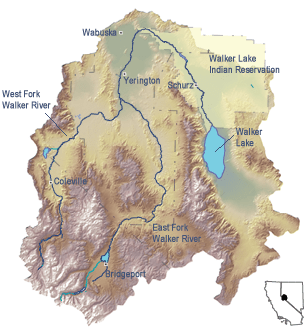
Friday, 15th. Advanced upstream about 12 miles and arrived at the base of very high mountains. The creek had become a small spring branch, and took its rise at no great distance in the mountains. But we saw plainly it was impossible to progress further without scaling the mts., and our Indian guides said they knew no further.

walker-015

Along the Walker River

Saturday, 16th.  This morning 4 or 5 men started to ascend several of the high peaks to ascertain if it was possible to pass the mountains. Just as they were going to start Capt. B. came up. He was in rather a hungry condition, and had been traveling several days without provision, excepting a few nuts which they had purchased from the Indians . . .

Bidwell later recalled that Bartleson and his men had also obtained fresh fish from the Indians—fish which gave them all dysentery, and made them so weak they could hardly stand. No wonder they were eager to reunite with the rest of the party.

We were glad to see them although they had deserted us. We ran out to meet them and shook hands, and put our frying-pans on and gave them the best supper we could. Captain Bartleson, who when we started from Missouri was a portly man, was reduced to half his former girth. He said, “Boys! If I ever get back to Missouri, I will never leave that country. I would gladly eat out of the troughs with my dogs.” He seemed to be heartily sick of his late experience, but that did not prevent him from leaving us twice after that. (Echoes of the Past)

On the evening of the 16th the group discussed their situation and took a vote. Should they go back to the lake and take a different route they had seen there or should they attempt to climb the mountains? He doesn’t say which lake he is talking about, but I think he means the Great Salt Lake. Maybe they could retrace their steps and by going northwest head for Oregon after all.

“Nearly all were unanimous against turning back.” Turning back would have been suicide. They didn’t have the provisions for it, and they knew it.

Posted in Uncategorized | Leave a comment

The Know-Nothings in California

The Know-Nothing Party got its start in New York in the 1840s. The movement spread to other states and in 1845 nativist groups united as the Native American Party. (Nothing to do with what we now call Native Americans, of course.) In 1855 they renamed themselves simply the American Party, but throughout this time they were popularly known as the Know-Nothing Party, and that name even appeared on ballots.

The Know-Nothings gained strength from the demise of the Whigs and concern over immigration. Their platform called for severe restrictions on immigration, a 21-year wait for naturalization, barring foreign-born citizens from public office, and the employment of only Protestants as teachers in public schools. Their main concern was the growing number of Catholic Irish and German immigrants, who, they maintained, could never be true Americans, since they were under the control of priests and the Pope. This animosity was coupled to dissatisfaction with the career politicians of the Whig and Democrat parties who had not controlled immigration and had not solved the problems of slavery and sectionalism.

In California the concern was not as much about Irish and German immigration, as the influx of Chinese and South American immigrants. But at the bottom was the same fear of the “other” and the desire to keep California (and America) for Americans. Like their Eastern brethren, Californian voters were unhappy with incumbent politicians. Two-term governor John Bigler, who was running for a third term on the Democratic ticket, was seen as responsible for the growing state indebtedness. It was time for new blood.

jneelyjohnson

J. Neely Johnson

The Know-Nothing Party put up as their candidate Assemblyman J. Neely Johnson. He won and was described as “the most startled man in the state” when told of his election. (Where that quote comes from I do not know, but every source online quotes it.) At thirty years old, he was the youngest man to ever be elected as governor of California.

The Know-Nothings did well in the 1855 election. Several senators and assemblymen were elected on their ticket, as well as the mayor of San Francisco.

Unfortunately, it was the wrong year for John Bidwell to decide to run again for the state senate as a Democrat. According to Gillis and Magliari:

Campaigning to recapture his old senate seat, Bidwell carried Butte County with just sixteen votes to spare against his Know-Nothing opponent, John B. McGee. Bidwell’s narrow margin in Butte was eclipsed, however, by McGee’s majority in neighboring Plumas County, which comprised the second half of the Fourteenth Senate District. (John Bidwell & California, by Michael J. Gillis & Michael F. Magliari, p. 186.)

Although the Know-Nothings faded quickly after that, Bidwell never again tried to run for the state senate. Instead, he left the Democratic Party (when it fell apart in 1860) for the new Republican Party, and in 1864 was elected to the United State Congress.


Posted in Uncategorized | 1 Comment

On the Trail — Oct. 9-11

October 9th found the emigrants following the trail of Captain Bartleson, who had abandoned the company and rode on ahead. They trudged through sand hills and came to a swamp, the water of which was “very nauseous.” They had reached Humboldt Sink, and here they camped for a day.

Monday, 11th. Left the lake this morning going into the mountains on a S.W. course. Today we left the trail of Capt. B. and having traveled 19 miles, arrived on a stream which flowed rapidly, and afforded more water than Mary’s river. We thought now, without doubt, that we were safe on the waters of the St. Joaquin (pronounced St. Wawkeen) according to Marsh’s letter. Here grew willows, balm Gilead, and a few cottonwoods.

Of course, they were nowhere near the San Joaquin River yet, but John Marsh’s letter had told them to be on the lookout for it, so they were hopeful that they were nearing California.

walker-river

The river that they mistook for the San Joaquin was the Walker River, which flows eastward out of the Sierras. It made for a good route up into the mountains. Future travelers on the California Trail would not travel this far south, but in following water Bidwell & Co. had missed the few miles of dry country that would have taken them to the Truckee River.

Posted in Uncategorized | Leave a comment

On the Trail – October 7, 1841

Now we have been found fault with long enough, and we are going to California. If you can keep up with us, all right; if you cannot, you may go to hell!

Captain John Bartleson’s words still rang in John Bidwell’s mind when he wrote about the incident 48 years later.   (Although Bidwell, mindful of the audience for Echoes of the Past, put in a dash — for the word “hell.” I am assuming that’s what Bartleson said.)

Bartleson and his eight companions took off on their mules, with most of the meat from a freshly-slaughtered ox.  They had not said a word about abandoning their companions before this. Figuring that he and his men had enough meat to get them to the mountains, they left the others in the dust—the other men mostly on foot, Nancy Kelsey and her little daughter on a horse, and the slow-traveling oxen.

Who was John Bartleson? Nothing much is known about him before he joined up with the Western Emigration Society in 1841. After making the trip to California, he returned to Missouri in 1842. He died there on October 7, 1848, aged 61 years.

At 55 years of age when the wagon train set out for California, he was considerably older than the rest of the men in the company. Most of the men were, like John Bidwell, in their early 20’s or 30’s. Bartleson insisted on being chosen as the captain of the company, saying that if he was not, he and the men with him would not go. Since the party wanted all the men and guns they could muster, they allowed Bartleson to take charge.

At the outset, this probably didn’t make a lot of difference. Thomas Fitzpatrick, the trail guide hired by Father DeSmet, was the real leader of the combined companies. It was only after the two groups split up that Bartleson’s defects became apparent. Headstrong and over-bearing, Bartleson made a poor leader. If it were not for the fact that they still needed all hands, the rest of the company would probably be glad to see the back of John Bartleson.

Posted in Uncategorized | Leave a comment

On the Trail — October 5-6, 1841

humboldtriver

The Humboldt Valley, as drawn by Daniel A. Jenks in 1849

Tuesday, 5th.  Today was very warm, and the oxen were not able to keep up with the horses. Traveled about 30 miles and stopped on the river about dark – grass plenty, willows – this going so fast was the fault of Capt. B., nothing kept him from going as fast as his mules could possibly travel. But his dependence was on the oxen for beef – for it was now all we had to live upon.

Wednesday, 6th. Company was out of meat and remained till the oxen came up; several Indians came to camp, one of whom we hired to pilot us on.

On horses and mules, and half of them on foot, the Bidwell-Bartleson Party was making its way across Nevada along Mary’s River (the Humboldt River).  They were getting close to the Humboldt Sink, and by continuing to follow the Humboldt, they bypassed Truckee Meadows.

On the 5th it was Bidwell’s turn to drive the oxen, as he recounts many years later in Echoes of the Past. As Bartleson and his companions drove forward on their animals, Bidwell lagged behind with the slow cattle.

That night, far behind the others, he found a patch of grass, unpacked the oxen, and laid down to sleep without supper and without blankets. The next morning he packed the oxen again and started out to find the others.

Not having had supper or breakfast, and having to travel nine miles before I overtook the party, perhaps I was not in the best humor. [Who would be?] They were waiting, and for the very good reason that they could have nothing to eat until I came up with the oxen and one could be killed. I felt badly treated, and let the captain know it plainly; but much to my surprise he made no reply, and none of his men said a word. (Echoes of the Past p. 127)

Imagine having to walk 2 or 3 hours through the rocky wilderness on no breakfast, looking for your flyaway companions. Imagine the others, sitting in camp, no breakfast, waiting for food to show up in the form of an emaciated ox that they would have to slaughter and roast before they could eat. It amazes me that this group did not have more arguments and divisions than it did, and furthermore, that they would all make it to California alive.

Just why Bartleson did not argue with Bidwell we shall see next time. He had a plan.

Posted in Uncategorized | Leave a comment

Political Turmoil in the 1850s

There were rapid changes in the American political scene during the 1850s.  The Whig Party, led by Henry Clay, was fading. The Democratic Party, the party of Andrew Jackson, was in control. But not for much longer. Sectionalism, slavery, and immigration were splitting the Democrats apart. The Republican Party would soon replace the Whigs as the opponents of the Democrats. And a third party would come along to briefly throw the others into confusion.

This was the Native American Party, better known as the Know-Nothings. They arose as a reaction against the immigration of impoverished Germans and Irish and the subsequent alarming rise in crime and welfare costs. They were strongly anti-Catholic, believing that Catholics were under the control of a foreign power, the Pope.

The party began among anti-Catholic secret societies opposed to Democratic policies. The “Know-Nothing” nickname came about because they were instructed to answer “I know nothing” if asked about these secretive organizations.

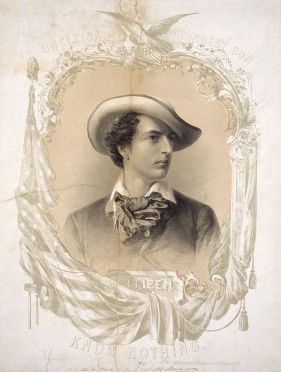
679px-citizen_know_nothing

Citizen Know-Nothing

The members of the party saw themselves as honest, patriotic, fair-dealing opponents of foreign influence and corruption in politics. Their symbol was Citizen Know-Nothing, an idealized American farmer, handsome, young, and white.

John Bidwell’s friend, Nelson Blake, writing from Boston in 1854, typified the concerns and prejudices of the Know-Nothing Party.

I will fix you up a package of “Bosting” papers as specimens of some of the ‘Isms that are rooted and growing here, prominent among which is “Know Nothingism.” A portion of their creed, as far as can be ascertained that is, I go in for. No man that looks upon the Pope as Christ’s Vice-Regent and infallible is fit to be one of a people who make their own laws and choose their own rulers, for where all are at the “beck and nod” of one man, all are of one mind, and he (the Pope) is Absolute Monarch over them, and if the people go through the formality of electing Officers, you may be certain they are of the right stamp and such as “He” approves of, men after his own heart. Blake to Bidwell, 25 July, 1854

I learn from the papers that there is a shaking among the politicians in Cal. even as elsewhere, but out there from a different cause. Your watch-word is Reform! Ours is Nativism and they are both good. When such a man or Scholar as Orestes A. Brownson cannot write an article to be published until it is submitted to the inspection of Bishop Fitzpatrick or Patrick Somebody! because forsooth he is within the pale of the “Holy Church”? and he though a good Catholic, is still a Yankee born one and must not be trusted too far. When a Religion whose Leader demands that of his followers, comes to meddle in petty States and National politics, or Governments, ‘tis time to say “Hold!” Blake to Bidwell, 17 Sept. 1854

Unfortunately, we do not have Bidwell’s replies to Blake’s letters during the 1850s, so it is difficult to know how Bidwell reacted to these statements, although he did not join the Know-Nothings. We do know that the Know-Nothings were, for one election cycle, a powerful force in California politics.

Next time: The Know-Nothings in California


Posted in Uncategorized | 1 Comment

The Mighty San Buenaventura River

Our ignorance of the route was complete. We knew that California lay west, and that was the extent of our knowledge. Some of the maps consulted, supposed of course to be correct, showed a lake in the vicinity of where Salt Lake now is; it was represented as a long lake, three or four hundred miles in extent, narrow and with two outlets, both running into the Pacific Ocean, either apparently larger than the Mississippi River.  (Echoes of the Past, p. 111)

Tanner J

A portion of an 1822 map of North America by Henry S. Tanner

The map shown above (which can be examined in its entirety at the University of Tulsa website) is very close to Bidwell’s description. But a close examination of the map shows how little anyone knew about the topography of western America.

The Bidwell-Bartleson Party did not have any maps with them, but John Bidwell had seen a map very much like this one in Missouri in the winter of 1840-41. Look at those rivers! Two large rivers leaving giant Lake Timpanogos and flowing unimpeded to the Pacific Ocean. Another river, the San Buenaventura, flowing from Salt Lake. No wonder some folks told them to take tools for building boats.

The legend of these non-existent rivers had a fairly long life in American cartography. Explorers and settlers wanted a river that would link the Rockies to the West Coast, and make trade and transportation possible. They fastened on reports of much smaller rivers in Utah, like Green River, to create these waterways to the Pacific.

You can see from the map that the distance from the Rockies to the Pacific is underestimated, and the Sierra Nevada range is not shown at all. The distance north to south, from the Columbia River to San Francisco Bay (labeled Port Sir Francis Drake) is also much less than it actually is. And even though a number of the Spanish missions are indicated on the map, the coastline of California is all wrong.

With what feelings of dismay and alarm did Bidwell and his companions face the Nevada desert and the looming Sierras? By this point they knew the maps were wrong, and they were alone. Entirely dependent on their own resourcefulness, they traveled onward, with no way of knowing how far they had yet to go.

Posted in Uncategorized | 1 Comment

On the Trail — Oct. 1-2, 1841

We are back on the trail with the Bidwell-Bartleson Party. They spent the last week of September traveling along a stream that they hoped would turn into Mary’s River (the Humboldt). It had been six weeks since the original party had split in two, with half the members going on to Oregon, rather than risk the unknown in the Great Basin. Six weeks of sand, sun, salt plains, and the endless search for grass and water. Bidwell wrote:

October 1st. The stream had already attained the size of which we supposed Mary’s river to be, and yet its course was due N.W. Distance 20 miles.

Saturday, 2nd.  Having traveled about 5 miles, we all beheld with delight the course of the river change to S. W.  Here was excellent grass–it was 3 or 4 feet high, and stood thick like a meadow, it was a kind of bluegrass. The whole valley seemed to be swarming with Indians, but they were very timid.  Their sable heads were seen in groups of 15 or 20, just above the tops of the grass to catch a view of us passing by.

The Humboldt River takes a turn southward where it meets present day Highway 789, about 25 miles east of Winnemucca, Nevada. Then it meanders westward until just north of Winnemucca, where it takes a definite turn to the southwest. Seeing the river turn in the expected direction was a great relief to Bidwell & Co. They were pretty sure that they were on the right track, their animals had sufficient feed, and they had access to water.

They were tired though. In Echoes of the Past Bidwell writes:

From the time we left our wagons many had to walk, and more and more as we advanced. Going down the Humboldt at least half were on foot [including Bidwell]. Provisions had given out, . . . we saw no game except antelope, and they were scarce and hard to kill; and walking was very fatiguing.

So they pressed on, wondering “How much farther to California?”

Posted in Uncategorized | Leave a comment

Hail Columbia!

Although John Bidwell was a steadfast Democrat in the 1850s, he did not always vote the party ticket. In the 1851 contest for governor, he supported the Whig candidate, his friend Pierson B. Reading (who founded the town of Redding), rather than the Democratic candidate, John Bigler.

It was a close race. Reading lost by only a thousand votes, in spite of the predominance of the Democratic Party. Like Bidwell, Reading was an old, long-time resident of California, well-educated and well-spoken. Perhaps Bigler was seen as an unpolished upstart, but with the Democratic machine behind him, he could hardly fail.

bigler_painting

Governor John Bigler

Bigler was re-elected in 1853 and ran for a third term in 1855. (Terms in office were only two years until 1862.) Bidwell never approved of him and Bigler did not appreciate the lack of support from Bidwell, who was influential in the capital.

I did not vote for Bigler when he was nominated the second time because I did not like his first administration. When he became a third time a candidate for renomination I was out against him; that is, I spoke with firmness against him.

I met him once on the streets of Sacramento, and he gave me “Hail Columbia” because I had blamed him for some of his acts; but I stood my ground. And I cannot say that Bigler was a very bitter enemy of mine, but he was a politician of the worst kind. He belonged to that class that thought anything they could do to win would be right.

“Hail Columbia!” There’s a bit of 19th century slang for you. It’s a euphemism for “Hell”. A gentleman would not have said “he gave me hell” in the kind of formal speech that this was (he was addressing the Society of California Pioneers). Besides, Bidwell was always quite mild in his language; his usual exclamation was “My, my!”

But “Hail Columbia!” I think we should bring that one back.

Posted in politics, Uncategorized | Leave a comment

Bidwell the Democrat

John Bidwell told his biographer Rockwell Hunt that during his early years in California he was an “incorrigible Democrat.” As a young man from Missouri, he naturally allied himself with the party of Andrew Jackson.  The Democrats were the party for the small farmer and the working man. Their opposition in the first half of the 19th century were the Whigs, the party of entrepreneurs and large land owners.

Later in his life he would become disaffected by the Democrats and change his allegiance, but during the 1850s he voted Democrat and helped to organize the Democratic Party  in California. In 1860 he was a delegate to the Democratic National Convention, where he supported Stephen Douglas for president, against the rest of the delegates, who were Southern sympathizers and supported Breckinridge.

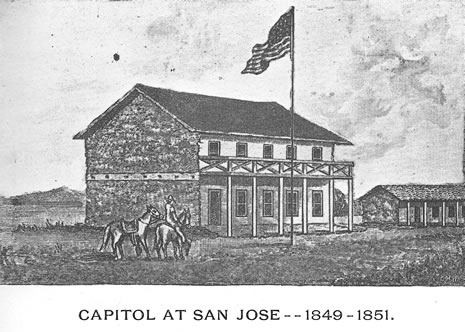
The Democrats dominated California politics during the 1850’s. In the first statewide election on November 13, 1849 (although in reality California was not yet a state) John Bidwell was elected to the state senate, representing the Sacramento district. In December he went to San Jose and together with the rest of the new legislature began the process of building a state government.

san-jose-state-cap1850-5a

He later wrote:

We had to frame a code of laws, and our constitution was almost a literal copy of the constitution of New York. A few members who had been able to get copies of the statues of N.Y. introduced nearly all the bills, and they were almost literal transcriptions of the N.Y. laws.  . . . I was head of the committee on corporations, also on the committee of county boundaries. I was chosen for this because I had more knowledge of the counties than perhaps any one else there.

I wrote the first charter of the City of San Francisco, for which the newspapers gave me great credit, but I didn’t deserve the credit, because I had copied it almost entirely from the charter of St. Louis. There was nothing very remarkable in getting up the code of laws.

And so began Bidwell’s political career in California. There was one earlier event – in August 1849 he was elected to the state constitutional convention.  But he never got the word of his election until it was too late. He hadn’t campaigned for the position, and in the summertime he was up in the hills, mining for gold. By the time he found out that he had been selected by voters to help write the constitution, it was too late to go to Monterey and take part.

Posted in politics | 1 Comment