On the Trail — October 25-26, 1841

Monday, 25th. Went about 6 miles and found it impossible to proceed. Went back about 2 miles and encamped — dug holes in the ground to deposit such things as we could dispense with. Did not do it, discovering the Indians were watching us, among them was the old, rascally pilot.

Tuesday, 26th. Went S. about 3 miles and camped in a deep ravine. It was urged by some that we should kill our horses and mules — dry what meat we could carry and start on foot to find the way out of the mountains.

Bidwell & Co. were making very slow progress, and it must have felt like no progress at all. They feared they might wander about in the canyons for weeks until the snows caught them and they perished.

While Bidwell was off on his his detour to the grove of sequoias, the rest of the company had hired an old Indian to pilot them out of the mountains. They were sure that he had led them “into the worst place he could find” and then absconded. They suspected the Indians of wanting their horses for food, and they did not trust them.

Before Bidwell caught up with his companions late on the 24th, they abandoned five of their horses and mules that could no longer travel. On his way back to join the group, Bidwell came upon the Indians cutting the beasts up for meat while they still stood on their feet.

Now they had to consider whether it was time to kill the rest of the animals and travel on foot as lightly as possible.  They decided, for the time being, to keep their animals alive. If nothing else, they were dinner on the hoof, and at a last resort could be eaten.

Game was amazingly scarce in the Sierra Nevada. They shot a wildcat and a few crows, but never any deer. They ate acorns, but the bitter tannin in the untreated acorns made them sick. Years later Bidwell could still vividly recall how he longed for good food, especially bread.

I was always so fond of bread that I could not imagine how any one could live without it. How the people in the Rocky Mountains [the trappers] had been able to live on meat alone was to me a mystery.

When our flour began to give out, the idea of doing without bread was painful to me, and by great economy my mess managed to eke out their flour a short time longer than the others. It was bad enough to have poor beef, but when brought to it we longed for fat beef and thought with it we might possibly live without bread. But when poor mule meat stared us in the face, we said if we could only have beef, no matter how poor, we could live. (1877 Dictation)

Posted in Uncategorized | Leave a comment

On the Trail — October 23, 1841

Friday, 23rd. Having no more meat than would last us 3 days [they had just killed their last ox], it was necessary to use all possible exertions to kill game, which was exceedingly scarce. For this purpose I started alone, very early in the morning, to keep some distance before the Company . . .  I went about 4 miles –met the Indian who came to us last night — obtained a little provision made of acorns — got an Indian boy to pilot me to his house. [How did they communicate with the Indians?] He took me down the most rugged path in all nature — arrived on the banks of a river at least 3/4 of a mile perpendicular from where I started with him — found no more provision, continued down the river . . .

The mountains, which walled in the stream, were so steep that it was with great difficulty I scaled them — having in one place come within an inch of falling from a craggy cliff down a precipice nearly a fourth of a mile perpendicular. 4 long hours I labored before I reached the summit — proceeded directly to intercept the trail of the Company. Mts. covered with the largest and tallest pines, firs, &c., thick copses of hazel &c. — travelled till dark over hills, dales, crags, rocks, &c., found no trail — lay down and slept.

You would think that Bidwell would take someone else with him, but he doesn’t seem to have heard of the buddy system. His idea was to range around looking for game to shoot, then rejoin the Company further down the trail. Needless to say, he never found any game, and the others weren’t doing much better. In Echoes of the Past he says:

When we killed our last ox [on the 22nd] we shot and ate crows or anything we could kill, and one man shot a wildcat. We could eat anything.

Although he found no game, he did make a fascinating discovery.

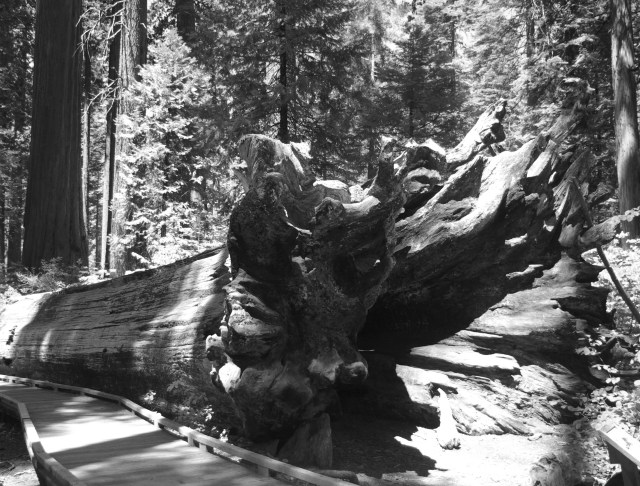
Just at dark I came to an enormous fallen tree and tried to go around the top, but the place was too brushy, so I went around the butt, which seemed to me to be about twenty or twenty-five feet above my head. This I suppose to have been one of the fallen trees in the Calaveras Grove of Sequoia gigantea or mammoth trees, as I have since been there, and to my own satisfaction identified the lay of the land and the tree. Hence I concluded that I must have been the first white man who ever saw the Sequoia gigantea, of which I told Fremont when he came to California in 1844. (Echoes of the Past)

You can read more about John Bidwell and what is today Calaveras Big Trees State Park here.

fathertree

The Father of the Forest, as it appears today.

Posted in Uncategorized | Leave a comment

On the Trail — October 21, 1841

Wednesday, 21st. Our route today was much better than expected, though in any other place than the mountains it would be considered horrible. Capt. B. with his 7 or 8 overtook us, but we heard nothing of J. John. Distance about 10 miles, could see no prospect of a termination to the mts., mts., mountains!

Surrounded by mountains, and unable to proceed down the steep and rocky canyon, the party traveled along the ridge between the Middle and North Forks of the Stanislaus River.  The landscape was “recently burned over” by forest fires. This desolate terrain offered no game and almost no grass for the horses, the mules, and their one remaining ox.

burnt_pine_forest

In his 1877 Dictation, Bidwell describes how Bartleson’s group, who had tried to get down the canyon, spent all day retracing their steps, although the distance was no more than half a mile.

At one place it took all of the men either pushing or pulling to help each mule back up again, and for the whole distance the loads had to be carried on the backs of the men.

Tough going indeed!

Posted in Uncategorized | Leave a comment

On the Trail — October 20, 1841

Wednesday, 20th. Men went in different directions to see if there was any possibility of extracting ourselves from this place without going back. They returned and reported that it was utterly impossible to go down the creek. One young man was so confident that he could pass along the creek with his horse that he started alone, in spite of many persuasions to the contrary.

Capt. B. also being tired of waiting for the explorers to return, started down the stream, which so jaded his animals that he was obliged to wait all day to rest them before he was able to retrace his steps. In the meantime the rest of the Company, suffering for want of water, were obliged to travel. We proceeded directly N. up the mountains, about 4 miles, found a little grass and water — here we killed one of the 2 oxen.

Lost in the mountains — no way of knowing where they were or how to get out — only two oxen left for food. Not a good situation.

Among the “men who went in different directions” were John Bidwell and James John — cautious John and impulsive Jimmy. In his 1877 Dictation, and in Echoes of the Past, Bidwell tells the story of their attempt to find a way out of the canyon. The men all agreed that if any of them found a way which was passable, they were  to fire a gun to alert the others.

When Jimmy and I got down about three-quarters of a mile I came to the conclusion that it was impossible to get through, and said to him, ‘Jimmy, we might as well go back; we can’t go here.’ “’Yes, we can,’ said he; and insisting that we could, he pulled out a pistol and fired. It was an old dragoon pistol, and reverberated like a cannon.

I hurried back to tell the company not to come down, but before I reached them, the captain and his party had started. I explained and warned them that they could not get down; but they went on as far as they could go, and then were obliged to stay all day and night to rest the animals. The men had to pick grass here and there where it grew among the rocks for their horses and mules. To get water, they went down to the stream and carried the water back up in cups and kettles, and even their boots, and then poured the water down the animals’ throats.

Meanwhile, Jimmy John continued down the stream on his own. He waited for the others to catch up with him, but they never managed to reconnect.

J. John was never more seen by any of us till we found him afterwards in California. His experience after he left us was of the severest character. He was repeatedly chased by Indians and was without anything to eat until he was nearly starved yet managed to get through to Sutter’s Fort and told S. of our being on the route. (1877 Dictation)

Posted in Uncategorized | Leave a comment

On the Trail — October 18-19, 1841

Fortunately for the Bidwell-Bartleson Party, the winter storms had not yet come to the Sierra Nevada mountains. (The Donner-Reed Party was not so lucky.) Even so, it was a struggle.

Monday, 18th. Having ascended a about half a mile, a frightful prospect opened before us–naked mountains whose summits still retained the snows perhaps of a thousand years, for it had withstood the heat of a long dry summer, and ceased to melt for the season. The winds roared–but in the deep dark gulfs which yawned on every side, profound solitude seemed to reign. We would along among the peaks in such a manner as to avoid most of the mountains which we had expected to climb–struck a small stream descending toward the W., on which we encamped, having come 15 miles.

The “small stream” that they camped by was Clark’s Fork, which flows into the Middle Fork of the Stanislaus River. They didn’t know how far they had to go yet, but at lest they were headed downstream.

920x920

Somewhere in the Sierras

Michael J. Gillis traced this journey in his article for the Overland Journal entitled “The 1841 Trans-Sierra Route of the Bidwell-Bartleson Party.” On the 18th he says that the group was climbing up Golden Canyon, and crested the Sierra Nevada at an elevation of 9,425 feet.

Tuesday, 19th. Descending along the stream,we found several oak scrubs which confirmed us in the hope that we were on the waters of the Pacific. But the route became exceedingly difficult–the stream had swelled to a river–could not approach it–could only hear it roaring among the rocks. Having come about 12 miles a horrid precipice bid us stop — we obeyed and encamped.

Those who went to explore the route had not time to come to any conclusion where we could pass. We had descended rapidly all day; the mts. were still mantled with forests of towering pines. The roaring winds and the hollow murmuring of the dashing waters conveyed int he darkness of the night the most solemn and impressive ideas of solitude.

To a person fond of the retiring life, this, thought I, would be a perfect terrestrial Paradise, but it was not so to us, when we knew that winter was at hand, and the Capt. Walker (the mountaineer) had been lost in these very mountains 22 days before he could extricate himself.

It was tough going. Joseph Walker had guided Bonneville’s party through the Sierras in 1833 and was with Fremont on his exploring trips during the 1840’s. Fremont named the Walker River and Walker Lake after him. Bidwell had probably read about him in Washington Irving’s popular account of the Bonneville expedition. Spending 22 days wandering around the Sierra Nevada as winter came on was certainly not anything that he wanted to do. The sooner they got out the better.

Posted in Uncategorized | Leave a comment

October 18th — California Admission Day

Wait a minute I hear you say, isn’t September 9th California Admission Day?

Yes it is. California officially became part of the Union on September 9th, 1850, when President Millard Fillmore signed the admission bill. The population of California had increased rapidly after the discovery of gold, and Americans in California were eager to become a state. After heated debate in the U.S. Congress arising out of the slavery issue, California was admitted to the Union as a free, non-slavery state by the Compromise of 1850.

But in California on September 9th, 1850 no one knew that California had just been declared a State of the Union. With no telegraph or any other means of swift communication, they had no way to get the news. In fact, they would not know it until October 18th, when the steamship Oregon sailed into San Francisco Bay. On board ship was John Bidwell, carrying the document that made California a state.

admission_-grand_celebration

The city of San Francisco erupted in celebration. Cannons boomed and militias marched. Bands, bonfires, and balls kept the celebration going all night long.

admission-day-statueSan Francisco has a monument to Admission Day. It is located at the intersection of Market Street and Montgomery Street. Commissioned by Mayor James D. Phelan, it was unveiled on September 5, 1897.

It depicts a miner with an American flag in his hand, a pick over his shoulder, and a revolver by his side. The monument is crowned by an angel, and features a fountain in the shape of a bear head on the side.  I think that’s a squid under the basin.

admission-day-bear

Posted in Admission Day | Leave a comment

On the Trail — October 15-16, 1841

Friday, 15th. Advanced upstream about 12 miles and arrived at the base of very high mountains. The creek had become a small spring branch, and took its rise at no great distance in the mountains. But we saw plainly it was impossible to progress further without scaling the mts., and our Indian guides said they knew no further.

walker-015

Along the Walker River

Saturday, 16th.  This morning 4 or 5 men started to ascend several of the high peaks to ascertain if it was possible to pass the mountains. Just as they were going to start Capt. B. came up. He was in rather a hungry condition, and had been traveling several days without provision, excepting a few nuts which they had purchased from the Indians . . .

Bidwell later recalled that Bartleson and his men had also obtained fresh fish from the Indians—fish which gave them all dysentery, and made them so weak they could hardly stand. No wonder they were eager to reunite with the rest of the party.

We were glad to see them although they had deserted us. We ran out to meet them and shook hands, and put our frying-pans on and gave them the best supper we could. Captain Bartleson, who when we started from Missouri was a portly man, was reduced to half his former girth. He said, “Boys! If I ever get back to Missouri, I will never leave that country. I would gladly eat out of the troughs with my dogs.” He seemed to be heartily sick of his late experience, but that did not prevent him from leaving us twice after that. (Echoes of the Past)

On the evening of the 16th the group discussed their situation and took a vote. Should they go back to the lake and take a different route they had seen there or should they attempt to climb the mountains? He doesn’t say which lake he is talking about, but I think he means the Great Salt Lake. Maybe they could retrace their steps and by going northwest head for Oregon after all.

“Nearly all were unanimous against turning back.” Turning back would have been suicide. They didn’t have the provisions for it, and they knew it.

Posted in Uncategorized | Leave a comment

The Know-Nothings in California

The Know-Nothing Party got its start in New York in the 1840s. The movement spread to other states and in 1845 nativist groups united as the Native American Party. (Nothing to do with what we now call Native Americans, of course.) In 1855 they renamed themselves simply the American Party, but throughout this time they were popularly known as the Know-Nothing Party, and that name even appeared on ballots.

The Know-Nothings gained strength from the demise of the Whigs and concern over immigration. Their platform called for severe restrictions on immigration, a 21-year wait for naturalization, barring foreign-born citizens from public office, and the employment of only Protestants as teachers in public schools. Their main concern was the growing number of Catholic Irish and German immigrants, who, they maintained, could never be true Americans, since they were under the control of priests and the Pope. This animosity was coupled to dissatisfaction with the career politicians of the Whig and Democrat parties who had not controlled immigration and had not solved the problems of slavery and sectionalism.

In California the concern was not as much about Irish and German immigration, as the influx of Chinese and South American immigrants. But at the bottom was the same fear of the “other” and the desire to keep California (and America) for Americans. Like their Eastern brethren, Californian voters were unhappy with incumbent politicians. Two-term governor John Bigler, who was running for a third term on the Democratic ticket, was seen as responsible for the growing state indebtedness. It was time for new blood.

jneelyjohnson

J. Neely Johnson

The Know-Nothing Party put up as their candidate Assemblyman J. Neely Johnson. He won and was described as “the most startled man in the state” when told of his election. (Where that quote comes from I do not know, but every source online quotes it.) At thirty years old, he was the youngest man to ever be elected as governor of California.

The Know-Nothings did well in the 1855 election. Several senators and assemblymen were elected on their ticket, as well as the mayor of San Francisco.

Unfortunately, it was the wrong year for John Bidwell to decide to run again for the state senate as a Democrat. According to Gillis and Magliari:

Campaigning to recapture his old senate seat, Bidwell carried Butte County with just sixteen votes to spare against his Know-Nothing opponent, John B. McGee. Bidwell’s narrow margin in Butte was eclipsed, however, by McGee’s majority in neighboring Plumas County, which comprised the second half of the Fourteenth Senate District. (John Bidwell & California, by Michael J. Gillis & Michael F. Magliari, p. 186.)

Although the Know-Nothings faded quickly after that, Bidwell never again tried to run for the state senate. Instead, he left the Democratic Party (when it fell apart in 1860) for the new Republican Party, and in 1864 was elected to the United State Congress.


Posted in Uncategorized | 1 Comment

On the Trail — Oct. 9-11

October 9th found the emigrants following the trail of Captain Bartleson, who had abandoned the company and rode on ahead. They trudged through sand hills and came to a swamp, the water of which was “very nauseous.” They had reached Humboldt Sink, and here they camped for a day.

Monday, 11th. Left the lake this morning going into the mountains on a S.W. course. Today we left the trail of Capt. B. and having traveled 19 miles, arrived on a stream which flowed rapidly, and afforded more water than Mary’s river. We thought now, without doubt, that we were safe on the waters of the St. Joaquin (pronounced St. Wawkeen) according to Marsh’s letter. Here grew willows, balm Gilead, and a few cottonwoods.

Of course, they were nowhere near the San Joaquin River yet, but John Marsh’s letter had told them to be on the lookout for it, so they were hopeful that they were nearing California.

walker-river

The river that they mistook for the San Joaquin was the Walker River, which flows eastward out of the Sierras. It made for a good route up into the mountains. Future travelers on the California Trail would not travel this far south, but in following water Bidwell & Co. had missed the few miles of dry country that would have taken them to the Truckee River.

Posted in Uncategorized | Leave a comment

On the Trail – October 7, 1841

Now we have been found fault with long enough, and we are going to California. If you can keep up with us, all right; if you cannot, you may go to hell!

Captain John Bartleson’s words still rang in John Bidwell’s mind when he wrote about the incident 48 years later.   (Although Bidwell, mindful of the audience for Echoes of the Past, put in a dash — for the word “hell.” I am assuming that’s what Bartleson said.)

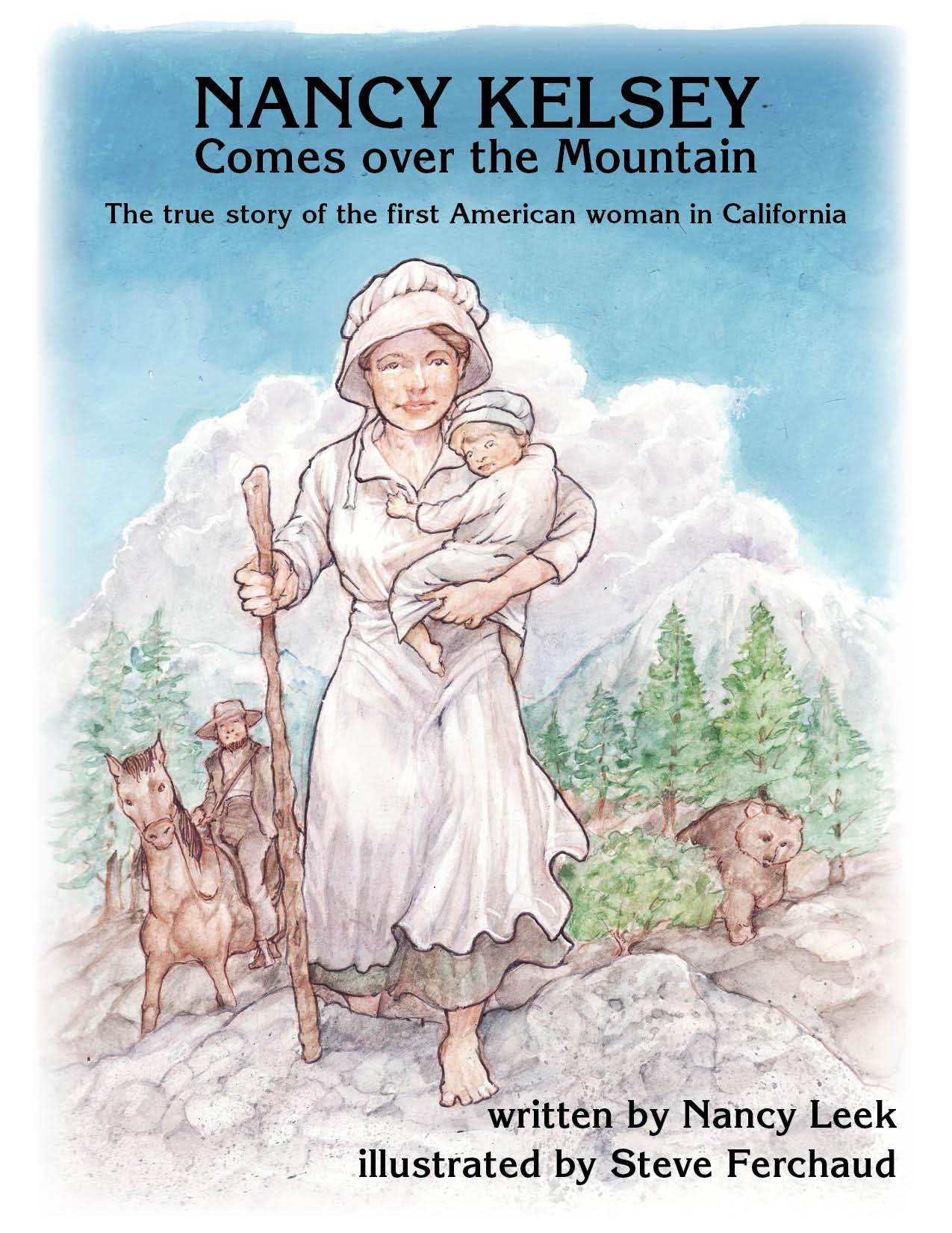
Bartleson and his eight companions took off on their mules, with most of the meat from a freshly-slaughtered ox.  They had not said a word about abandoning their companions before this. Figuring that he and his men had enough meat to get them to the mountains, they left the others in the dust—the other men mostly on foot, Nancy Kelsey and her little daughter on a horse, and the slow-traveling oxen.

Who was John Bartleson? Nothing much is known about him before he joined up with the Western Emigration Society in 1841. After making the trip to California, he returned to Missouri in 1842. He died there on October 7, 1848, aged 61 years.

At 55 years of age when the wagon train set out for California, he was considerably older than the rest of the men in the company. Most of the men were, like John Bidwell, in their early 20’s or 30’s. Bartleson insisted on being chosen as the captain of the company, saying that if he was not, he and the men with him would not go. Since the party wanted all the men and guns they could muster, they allowed Bartleson to take charge.

At the outset, this probably didn’t make a lot of difference. Thomas Fitzpatrick, the trail guide hired by Father DeSmet, was the real leader of the combined companies. It was only after the two groups split up that Bartleson’s defects became apparent. Headstrong and over-bearing, Bartleson made a poor leader. If it were not for the fact that they still needed all hands, the rest of the company would probably be glad to see the back of John Bartleson.

Posted in Uncategorized | Leave a comment