On the Trail — September 21, 1841

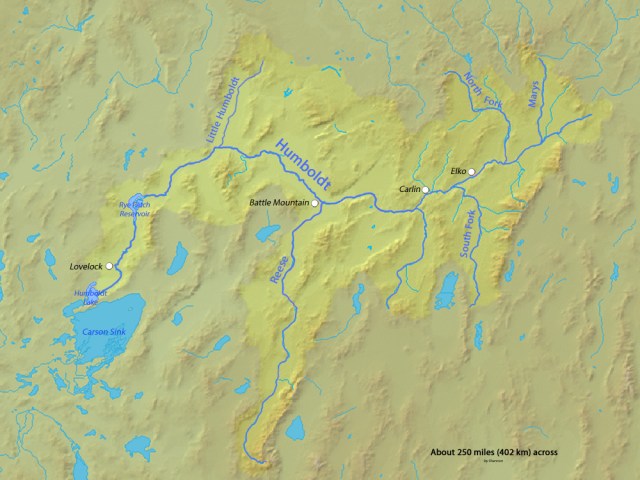
Once Bidwell had rejoined his companions, they rested up for a day. Then on the 20th they traveled through some rough terrain — the Ruby Mountains — still looking for Mary’s River, as the Humboldt was then known. Two of the men went out hunting and returned with meat.

Tuesday, 21st.  Hunters returned; many antelope were seen and 2 or 3 killed. About 10 o’clock a.m. as we were coasting along the mountain in a W. direction, we came to some hot springs, which were to me a great curiosity. Within the circumference of a mile there were perhaps 20 springs, the most of which were extremely beautiful, the water being so transparent we could see the smallest thing 20 or 30 feet deep. The rocks which walled the springs, and the beautifully white sediment lodged among them, reflected the sun’s rays in such a manner as to exhibit the most splendid combination of colors, blue, green, red, etc. I ever witnessed.

The water in most of them was boiling hot. There was one, however, more beautiful than the rest; it really appeared more like a work of art than nature. It was about 4 feet in diameter, round as a circle, and deeper than we could see–the cavity looked like a well cut in a solid rock, its walls being smooth and perpendicular. Just as I was viewing this curiosity, some hunters came up with some meat. We all partook, putting it into the hot spring, where it cooked perfectly done in 10 minutes—this is no fish story!

ruby-valley-hot-springs

Ruby Valley Hot Springs

George R. Stewart, in The California Trail, writes: “One sure point is marked by the hot springs which they passed on September 21 and which Bidwell described in some detail. These beautiful springs still bubble out near the base of the Ruby Mountains, just as they did when Bidwell saw them.”

They must have been at the Ruby Valley Hot Springs, which can still be visited, but which are in a very remote area. This Travel Nevada site has information and pictures, and is also the source of the photo of one of the springs.

Posted in Uncategorized | Leave a comment

On the Trail — September 18, 1841

The night of September 17th, Bidwell’s two oxen, carrying packs, got lost.ox-team

Saturday, 18th. Morning found us on the east side of a mountain not far from its base but there were no signs of water; the lost oxen not having come up, I, in company with another young man, went in search of them while the company went on, promising to stop as soon as they found water. I went back about 10 miles, but found nothing of their trail–the sun was in a melting mood–the young man became discouraged and in spite of all my entreaties returned to the company.

The young man who went with John Bidwell to search for the oxen was “Cheyenne” Dawson. Under the hot summer sun he gave up, saying that there were plenty of cattle in California. Which was true, but Bidwell had to go on — without his oxen he had nothing.

Water in the company was in very short supply. Before they left on their search they were each given about a half cup (4 oz.) of water. This was all they had until the next day.

About an hour after [Dawson departed] I found the trail of the oxen which bore directly north. After pursuing it some distance, I discovered fresh moccasin tracks upon the trail, and there began to be high grass, which made me mistrust the Indians had got the oxen. But my horse was good and my rifle ready. . . . But what made me most anxious to find the oxen was the prospect of our wanting them for beef. We had already killed 4 oxen and there were but 13 remaining, including the lost ones, and the Co. was now killing an ox every two or three days.

After 10 miles of following their tracks, Bidwell found the oxen where they had stopped to lay down in the grass. He got them up and moving, hastening to rejoin the company. They had promised to stop and wait for him when they found water.

I traveled all night,and at early dawn came to where there was plenty of water and where the company had taken their dinner the day before, but they had failed to stop for me according to promise.

Bidwell was decidedly miffed at this. He figured that he had been abandoned by his companions. He searched in ever widening circles until he saw three men who were coming to find him.

It was a great relief. I felt indignant that the party had not stopped for me – not the less so when I learned that Captain Bartleson had said, when they started back to find me, that they “would be in better business to go ahead and look for a road.” He had not forgotten certain comments of mine of his qualities as a student of Indian character.

Obviously there was no love lost between those two. Bidwell, who considered himself a good judge of character and a man of “self-possession,” looked on Bartleson as a hot-headed ignoramus. Bartleson would do nothing in the future to change that assessment.

Posted in Uncategorized | Leave a comment

A Memorable Encounter on the Trail

Thursday, 16th. All hands were busy making pack saddles and getting ready to pack. While thus engaged an Indian, well advanced in years, came out of the mountains to our camp. He told us by signs that the Great Spirit had spoken to him to go down upon the plains in the morning, and on the E. side of the mts. he would find some strange people, who would give him a great many things. Accordingly he had come. We gave him all such things as we had intended to throw away; whenever he received anything which he thought useful to him, he paused and looking steadfastly at the sun, addressed him in a loud voice, marking out his course in the sky, as he advanced in his invocation, which took him  about 2 minutes to perform. As he received quite a number of articles, it took him a considerable part of the day to repeat his blessings. No Persian, in appearance, could be more sincere.

Nearly every man who left an account of the trip remarked upon this Indian. Dawson notes: “We signed to our aged host that the wagons and everything abandoned were his, all his, and left him circumscribing the heavens — the happiest, richest, most religious man I ever saw.”

Jimmy John said,”One old Indian in particular appeared to be very thankful for every thing he received if any one gave him a present. He would hold it up between him and the sun and say over it a long preamble.”

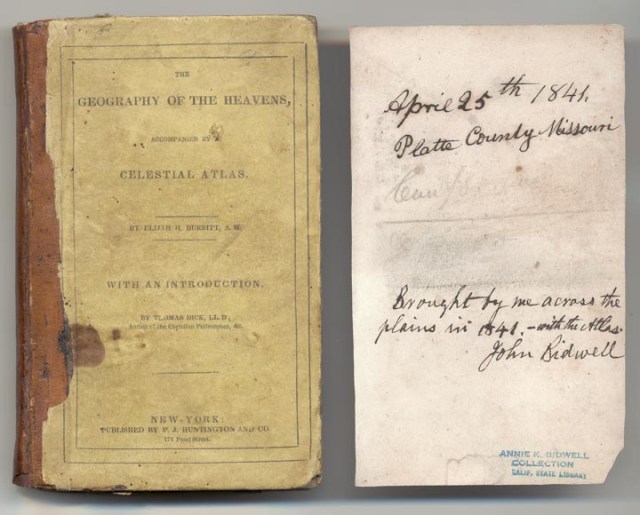
The Company divested itself of extra clothing, cooking equipment, tools, empty containers — anything non-essential. One thing that John Bidwell did not leave behind however were his two books. He had an astronomy manual titled The Geography of the Heavens and a large celestial atlas that went with it. He carried these all the way to California and kept them all his life. astronomybook


Posted in Uncategorized | Leave a comment

On the Trail — September 15-16, 1841

Wednesday, 15th. Started very early, day was exceedingly warm, passed through a gap in a ridge of mountains, came to a high dry plain, traveled some distance into it, saw the form of a high mountain through the smoky atmosphere — reached it, having come about 15 miles — found plenty of water — our animals were nearly given out. We were obliged to go so much further to get along with the wagons. We concluded to leave them and pack as many things as we could.

Thursday, 16th. All hands were busy making pack saddles and getting ready to pack.

John Bidwell tells more about the company’s packing adventures in The First Emigrant Train to California.

Packing is an art, and something that only an experience mountaineer can do well so as to save his animal and keep his pack from falling off. We were unaccustomed to it, and the difficulties we had at first were simply indescribable.

The trouble began the very first day. But we started — most of us on foot, for nearly all the animals, including several of the oxen, had to carry packs. It was but a few minutes before the packs began to turn; horses became scared, mules kicked, oxen jumped and bellowed, and articles were scattered in all directions.

ox-with-pack

This is the only picture of an ox with pack that I could find, by “Country Mama” on a photography forum 

It was a scene both comic and desperate. Oxen are not used to carrying packs — I imagine that trying to get some kind of pack onto the back of an ox is not an easy thing. But Bidwell had no choice — his two oxen were all he had to carry his belongings, other than his own back. They were also his dinner on the hoof.

Note all the strapping in this picture, and imagine trying to arrange that without the handy straps and buckles.

Posted in Uncategorized | Leave a comment

What the Heck Was Halo Chamuck?

C18481007.2.9.1-a1-552w.jpg

This advertisement appeared in the Californian on September 23, 1848:

IMMIGRANTS. Immigrants wishing winter quarters for their families, can be accommodated with several small houses at HALO CHAMUCK, situated on the N. W. bank of the Sacramento river, near its junction with the San Joaquin, and about midway between San Francisco and the gold placero, at a point affording as good a market as any in California. Any amount of land can be had for cultivation. The subscriber will furnish a lot of hogs, American milch cows, wheat and farming utensils. For further information, apply to Major P. B. Reading or John Bidwell, Esq., gold placero, or to the subscriber at this place.

The item appeared several times in the Californian, signed with the name of the editor, J. D. Hoppe. He also published letters, signed A FRIEND TO ENTERPRIZE and probably written by himself, extolling the virtues of the new settlement on the Sacramento.

So where was this wonder-place that he was promoting, and what did Reading and Bidwell have to do with it?

The future community of Halo Chamuck was located on John Bidwell’s first rancho.

dscf1724

A section of Bidwell’s Mapa del Valle del Sacramento, created for the Land Commission. Rancho de Bidwell (Ulpinos) is colored yellow.

In October 1844 John Bidwell was granted title to Rancho Los Ulpinos by Governor Micheltorena. The grant lay along the northwest banks of the Sacramento River, where the river enters the delta and joins with the San Joaquin River. In January 1846 Bidwell attempted to develop the land and attract immigrants. With the help of Indians he built an adobe house where Cache Slough enters the river. In the fall he managed to attract some immigrants to settle there. The winter of 1846-47 was a harsh one however, and the immigrants suffered from lack of food. According to Rio Vista — History and Development, by Mrs. Duncan S. Robinson:

But the rigors of a severe winter, with lack of adequate food supplies, resulted in the disbanding of both the white and Indian settlers. During the long, hard winter, the hungry and discouraged Indians frequently used the expression “Hale-che-muck”, which meant “nothing to eat”, hence the origin of the name of the Bidwell settlement: Hale-che-muck! !

So Halo Chamuck = “Nothing to eat!” Seems a strange thing to name a town that you want to attract settlers to, but there it is in the newspaper. Did the promoters think that no one would ask what the name meant?

In spite of the harsh winter of 1846-47 driving off the first settlers, Hoppe continued to promote Halo Chamuck (or Halo Chamo, as he sometimes spelled it). In August 28, 1847 he printed a lengthy letter, praising the location:

Amongst the many enterprizes of the day, the laying out of a city on the Sacramento River near its mouth, the proprietors of which are John Bidwell, Esq., Maj. Redding, and Captain J. D. Hoppe, in my opinion is of the greatest importance . . . The said city is to be called Halo Chamo, and is beautifully situated  . . .  the water deep and the anchorage good . . . especially well adapted for agriculture and grazing . . . many different kinds of timber . . . etc. etc.

Starving winters were not Halo Chamuck’s only drawback. John Bidwell never settled there himself for any length of time. He claimed that the mosquitoes from the nearby tule marshes were so bad that he fell sick from sheer loss of blood. He preferred Butte County’s more salubrious climate.

In 1854 Bidwell’s title to Rancho Los Ulpinos was confirmed by the Board of Land Commissioners. By then he was firmly established at Rancho Chico and he began selling off portions of Rancho Ulpinos. One of the buyers was Col. N. H. Davis, who established a town site not far from the failed town of Halo Chamuck and named it Brazos del Rio, meaning Arms of the River, since it was located where three channels of the Sacramento River come together.

The town was promoted as a way station for steamboats plying the route between Sacramento City and San Francisco. The river teemed with salmon, and a successful salmon fishery was established. All went swimmingly (as it were) until the rains of 1862. The town washed away in the floods.

When the town was reestablished on higher ground, it was renamed Rio Vista, and there it is to this day, where state highway 12 crosses the mighty Sacramento.

For more on the history of Rio Vista, check out this article on the Solano History website. Click on the map below to go to an 1877 map of Solano County, where you can see Rancho Los Ulpinos and Rio Vista on the lower right.

solano-map

Posted in Uncategorized | Leave a comment

On the Trail — September 9-12, 1841

Thursday, 9th. The part of the Company that remained yesterday went on and overtook the 2 wagons. Capt. Bartleson & Hopper returned, bring intelligence that they had found the head of Mary’s river — distance about 5 days’ travel. Distance traveled today about 12 miles S.W. direction. The Indians stole a horse — day cool.

It would be much more than 5 days before they got to Mary’s river (the Humboldt River). They traveled for two days, then the Kelseys abandoned their two wagons.

Sunday, 12th. Mr. Kelsey left his wagons and took his family and goods on pack horses, his oxen not being able to keep up.

covered-wagons-1Two more days of travel and the other members would do the same. It was just too slow and difficult for the weary oxen to drag the wagons through the sand. Moreover, it was pointless since they no longer had any food to eat in them. Nicholas Dawson recalled:

Though we had been eating very sparingly for several weeks, our last provisions had been consumed just before we reached Salt Lake, and since, we had been subsisting on what game we could kill, and when no game was to be had, an ox out of our train.

They traveled onward, “between salt plains on the E. and high mts. on the W” across what is now Nevada, probably wondering why they hadn’t reached Mary’s River yet. Sometimes they found a spring, sometimes the land was “destitute of water.” The entire expedition was teetering on the edge of disaster.


Posted in Uncategorized | Leave a comment

Bidwell Book Reprint!

bidwellbookMy first book, John Bidwell: The Adventurous Life of a California Pioneer, has been reprinted. The initial print run was 1000 copies. All are gone, except for those that wait to be sold on store shelves.

The book is published by the Association for Northern California Historical Research. When we were first talking about publishing, I asked Heather Lyon, of Lyon Books, how many copies she thought we should print. She said one thousand, and told me that we could sell that many in four or five years.

Well, it’s been six years, but not a bad prediction, and I appreciate the support Heather gave me on this project. Likewise I appreciate all my readers and all of you who have taken an interest.

There are no changes to this second printing, except that now there is a price on the back cover. Previously there was no price indicated. The price is $19.95, the same as it has been all along.


Posted in Uncategorized | Leave a comment

On the Trail — September 5-8

The Company was a little north and west of the Great Salt Lake, and near to Pilot Peak, as they made their way slowly across a region inhabited by only a few Shoshone Indians.

2014-06-29_05_37_10_View_of_Pilot_Peak_from_Leppy_Pass_Road_in_northwestern_Tooele_County,_Utah

View of Pilot Peak from Leppy Pass Road in northwestern Tooele County, Utah

Sunday, 5th Grass having become scarce, we concluded to move on a little every day to meet Capt. B & H [Captain Bartleson and Charles Hopper]. Traveled about 6 miles and encamped by a beautiful cedar grove.

The next two days they continued ahead 7 miles each day, traveling slowly, waiting for their scouts to return with news of Mary’s River.

Wednesday, 8th. Exceedingly cold; ice in our water buckets. Part of the Company remained on account of the cold — 2 wagons with owners being contrary, went on.

In James John’s diary he notes that “six waggons stayed in camp and two went on and expected to meet the next day.” So at this point, for 33 people, they have eight wagons. The men were organized into messes of five or six men, and this would give them more than one wagon per mess. Benjamin Kelsey, traveling with his wife and baby daughter, had two wagons. But there was not much left in those wagons.

Posted in Uncategorized | Leave a comment

On the Trail — August 28-29, 1841

From John Bidwell’s journal:

Saturday, 28th. Company remained here. A Shoshonee Indian came to our camp; from him we learned that there were more Indians not far off who had horses. Several men and myself went in search of them. Having gone about 5 miles, up hills and down hills covered with thick groves of cedar (red), we unexpectedly came to an Indian, who was in the act of taking care of some meat — venison — which he had just killed; about half of which we readily purchased for 12 cartridges of powder & ball. With him as a pilot we went in pursuit of other Indians; he led us far up in the mountains by a difficult path, where we found two or three families, hid as it were from all the world, by the roughness of nature. The only provision which they seemed to have was a few elderberries and a few seeds; under a temporary covert of bushes, I observed the aged Patriarch, whose head looked as though it had been whitened by the frosts of at least 90 winters. The scars on his arms and legs were almost countless — a higher forehead I never saw upon a man’s head. But here in the solitude of the mountains and with the  utmost contentment,  he was willing to spend the last days of his life among the hoary rocks and craggy cliffs, where perhaps he, in his youthful gayety, used to sport along crystal streams which run purling from the mountains.  Not succeeding in finding horses, we returned to camp.

The Shoshone Indians inhabited present-day northern Utah and southern Idaho, living in small bands of a few hundred at most. Bidwell, as usual, is curious about the Indians, but not disparaging about their way of life.

Sunday 29th. Capt. Bartleson with C. Hopper started to explore the route to the head of Mary’s river, expecting to be absent 8 or 9 days — the Company to await here his return.

All that the Bidwell-Bartleson Party knew about this region was that they had to find Mary’s River (as it was then called). The Humboldt River was the only way to cross what is now the state of Nevada. If the whole group were to go wandering around looking for it, the exploration might be fatal, so they sent off two men on a scouting trip, and the rest stayed where they had water and grass for their animals. For the next several days Bidwell’s journal is terse:

(30th) Nothing of importance occurred — (31st) No success in hunting — (1st) An ox killed for beef — (2nd) Idle in camp.

They were running low on provisions. Bidwell doesn’t say whether they had anything left in the way of flour or beans or coffee, but if they were not completely out, they were getting close. They had not been able to get anything from Fort Hall. Meat was scarce, and they began slaughtering oxen for beef.

Tough times ahead.

Posted in Uncategorized | Leave a comment

This Desolate Region — August 26-27, 1841


Thursday, 26th. Traveled all day over dry barren plains, producing nothing but sage, or rather, as it ought to be called, wormwood, and which I believe will grow without water or soil. Two men were sent ahead to search for water, but returned a little while before dark, unsuccessful.

Our course intersected an Indian trail, which we followed directly north towards the mountains, knowing that in these dry countries the Indian trails always lead to the nearest water. Having traveled till about 10 o’clock p.m. made a halt, and waited until morning. Distance about 30 miles.

sagebrush

This was one of those days when they traveled all day in the hot sun, hoping to find fresh water, and saw nothing but sand, salt, and sagebrush. Another day like that might have killed them all. They were wise to follow the Indian trail.

Friday, 27th. Daylight discovered to us a spot of green grass on the declivity of the mountain towards which we were advancing. 5 miles took us to this place, where we found, to our great joy, an excellent spring of water and an abundance of grass. Here we determined to continue ’till the route was explorer to the head of Mary’s river and run no more risks of perishing for want of water in this desolate region.

Reminds me of this song:

Posted in Uncategorized | Leave a comment