On the Trail with John Bidwell: June 21, 1841

june2014 436

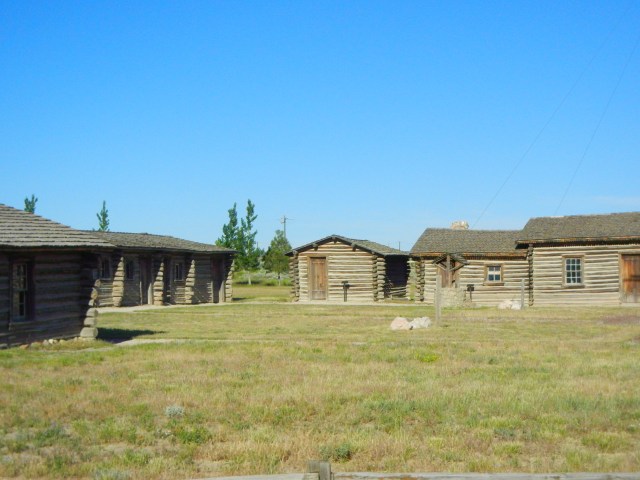
Fort Laramie National Historic Site today.

Monday, 21st: We had an uncommonly good road today — an abundance of cottonwood timber — traveled late, having taken a stride of 27 miles.

Tuesday, 22nd:  Eight miles this morning took us to Fort Larimie, which is on Larimie’s fork of Platte about 800 miles from the frontiers of Missouri. It is owned by the American Fur Company. There is another fort within a mile and a half of this place, belonging to an individual by the name of Lupton.

The Black Hills were now in view; a very noted peak, called the Black Hill mountain, was seen like a dark cloud in the western horizon. The country along the Platte river is far from being fertile and is uncommonly destitute if timber.

Fort Laramie made a welcome stopping point. It was originally a private fur trading post founded by William Sublette and called Fort William. In 1841 it had just been purchased by the American Fur Company and renamed Fort John, although everyone seems to have called it Fort Laramie, after the river on which it was situated.

The river was named for Jacques La Ramee (1784-1820), a fur trapper who visited the area in the first two decades of the 19th century. Everyone seemed to have a different spelling for the name: Bidwell spelled it Larimie, Jimmy John spelled it Laramy, and Father De Smet, being a French speaker, got it right and spelled it La Ramee. There was another fort nearby, Fort Lupton, and they camped in between the two forts. They stayed to rest on Wednesday, and sold poor Mr. Shotwell’s possessions at an auction.
Posted in Fort Laramie, Uncategorized | Leave a comment

On the Trail with John Bidwell: June 19, 1841

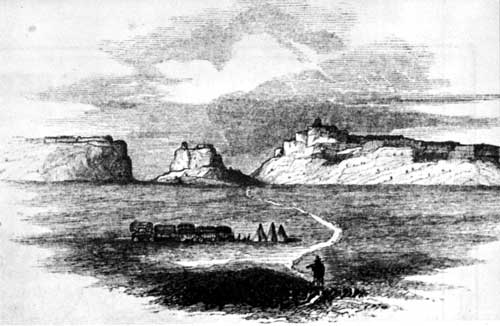
We gradually receded from the river in order to pass through a gap in a range of high hills called Scott’s Bluffs. As we advanced towards these hills, the scenery of the surrounding country became beautifully grand and picturesque–they were worn in such a manner by the storms of unnumbered seasons that they really counterfeited the lofty spires, towering edifices, spacious domes, and in fine all the beautiful mansions of cities. We encamped among these envious objects having come about 20 miles.

After the flat monotony of the prairies, Scotts Bluff provided a welcome change of scenery for travelers on the Oregon Trail. Many travelers remarked on the fantastic forms taken by the steep-sided hills in this area of western Nebraska. More information about the history and geology of Scotts Bluff can be found at the website for Scotts Bluff National Monument and the Oregon-California Trails Association. 

Here is what Scotts Bluff looks like today. Much the same, except that the Bidwell-Bartleson Party had to negotiate deep ravines, like the ones in the foreground, rather than the smooth road you see on the left.

june2014 333

Scotts Bluff National Monument

june2014 369

Looks like John Bidwell left his wagon behind.

Posted in Uncategorized | Leave a comment

June 17, 1841

From John Bidwell’s Journal:

Thursday 17th. Continued to coast along up the river — encamped on its banks nearly opposite to a huge isolated bluff bearing some resemblance to an immense castle in  ruins. Its distance from us no one supposed more than 1 1/2 miles, and yet it was at least 7. This deception was owing to the pure atmosphere through which it was viewed, and the want of objects, by which only, accurate ideas of distance can be acquired without measure.

The “huge isolated bluff” was probably what other pioneers called Courthouse Rock and the smaller Jail Rock. In the otherwise flat terrain of western Nebraska these features can be seen for miles around.

JailhouseandCourthouseRock-352971f3

Jail Rock and Courthouse Rock, Nebraska


Posted in Uncategorized | Leave a comment

June 13, 1841 – A Death on the Prairie

Sunday, 13th. A mournful accident occurred in the camp this morning–a young man by the name of Shotwell while in the act of taking a gun out of the wagon, drew it with the muzzle towards him in such a manner that it went off and shot him near the heart. He lived about an hour and died in the full possession of his senses.

This was the only death during the entire dangerous trip. George Shotwell was “buried in the most decent manner our circumstances would admit of, after which a funeral sermon was preached by Mr. Williams.”

James John vividly describes the same incident:

I was out of camp seeking oxen from the river. I heard the report of a gun and heard a Scream. I went to the camp and saw a man bleeding on the ground. He was taking his gun out of the wagon with the muzzle towards him and it discharged and shot him thru the left side. He lived about an hour and died. We buried him the the sand about a mile from the Camp.

It was a lesson in gun safety: never grab a gun, loaded or unloaded, by the muzzle. Poor George Shotwell! A letter was sent to his family later by a returning traveler, and at Fort Laramie “the things of Mr. Shotwell were sold at auction.”


Posted in Uncategorized | 1 Comment

June 10 & 11, 1841

Thursday, 10th.  This morning the most of the oxen were again at large, owing to the neglect of the owners to the great danger of losing them by the Indians and by their mingling with buffalo, or  by straying so far that it would be impossible to track them on account of the innumerable tracks of the buffalo. Making therefore a rather late start, we continued to ascend the river on the N side. We traveled about 14 miles and encamped on the river. Buffalo were seen in countless thousands on the opposite side of the river; from the time we began our journey this morning till we ceased to travel at night, the whole south side of the stream was completely clouded by these huge animals, grazing in the valley and on the hills, ruminating upon the margin of the river, or crowding down its banks for water.

bisonherd

Through the remissness of the sentinels, the guard last night was nearly vacant; and as this was considered dangerous ground on account of the warlike Pawnees, Chiennes etc., a court martial was called to force those to their duty on guard, who were so negligent and remiss.

This is an interesting example of how the emigrants organized and disciplined themselves. At the outset of their expedition, being Americans, they elected a president and a recording secretary, and also a captain. So it was both a democratic association  and a semi-military organization.

When a problem arose, they consulted together in a trial, or court martial, of the offenders. Bidwell doesn’t indicate any punishment given. I imagine the men who were found guilty were given extra guard duties for a time.

Friday 11th. The oxen had wandered about 1/2 mile from the camp this morning, when a man was sent to bring them in; he soon came running back in great haste, crying “the Indians are driving the oxen off!!” In less than half an hour the oxen were at camp and not an Indian seen–all this is easily accounted for when we consider how timidity and fear will make every bush, or stone, or stump an Indian, and 40 Indians, thousands. Vast herds of buffalo continued to be seen on the opposite side of the river. Distance today about 20 miles.

Posted in Uncategorized | Leave a comment

June 8, 1841

From John Bidwell’s Journal:

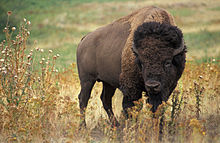
220px-American_bison_k5680-1Tuesday, 8th. There were 8 or 10 buffalo killed today; but not one-tenth of the meat was used; the rest was left to waste upon the prairie. In the afternoon we passed the confluence of the N. & S. forks of the Platte river & encamped, having come about 18 miles; many hundreds of buffaloes were seen at this place.
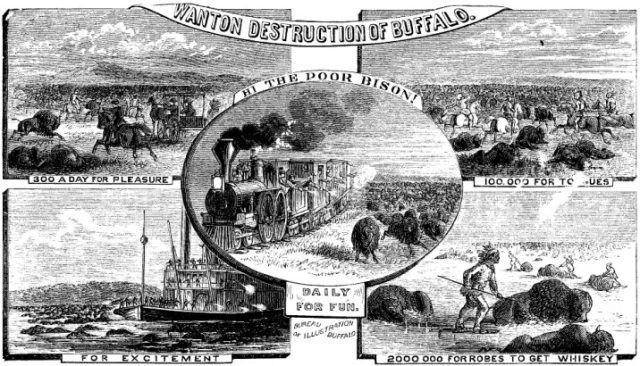
The scenery of the country on the Platte is rather dull and monotonous, but there are some objects which must ever attract the attention of the observant traveler; I mean the immense quantity of buffalo bones, which are everywhere strewed with great profusion, so that the valley, throughout its whole length and breadth, is nothing but one complete slaughter yard, where the noble animals used to graze, ruminate and multiply in uncounted thousands–but they are fast diminishing. If they continue to decrease in the same ratio that they have for the past 15 or 20 years, they will ere long become totally extinct. It has been but a few years since they left the frontiers of Missouri, and are now fast retreating towards the Rocky Mountains.

The Indians are anxious to preserve them, and it is said of them that they never kill as long as they have any meat remaining, but behold with indignation the shameful and outrageous prodigality of the whites, who slaughter thousands merely for their robes and leave the meat, which is far more delicious than that of tame cattle, to waste or be eaten by wolves and vultures.

buffalowantonlrg

When you think that the massive slaughter of the American bison had only just begun, and that the great Gold Rush migration, and the building of the railroad, was yet to come, you realize how prescient John Bidwell was when he foretold the extermination of the buffalo. Those mighty herds would be brought to the edge of extinction before the slaughter ended and the rescue began.

Posted in Uncategorized | Leave a comment

June 5, 1841

Saturday, 5th. Started early to get clear of our red visitors. Descried a large herd of buffalo on the opposite side of the river–saw several boats descending the river, laden with fur, robes, etc. They belonged to the American Fur Company–one of our Company, E. Stone, returned with them.

The latter part of the day was very inclement, high winds, dark clouds rushed in wild confusion around and above us. Soon with amazement we saw a lofty waterspout, towering like a huge column to support the arch of the sky; and while we were moving with all haste, lest it should pass over us and dash our wagons to pieces, it moved off with the swiftness of the wind and was soon lost among the clouds. Rain & hail succeeded, the largest hailstones I ever saw. Several were found, an hour after the sun came out bright & warm, larger than a turkey egg.

Another one of the emigrants, James John, described this same storm:

There came up a storm in the afternoon. The wind blew very hard and on the opposite side of the river a tremendous hurricane. We saw trees flying on the air and water blown our of the river a high apparently as the clouds. After the storm abated we traveled about one mile and found hail stones as big as goose eggs.

Tornadoes, hailstorms, and wild weather are nothing new to the Great Plains, but this was the first time these Americans had seen weather quite so spectacular.tornado-1999

Posted in Uncategorized | Leave a comment

June 4, 1841

Friday, 4th. Half past six this morning saw us on the march. The valley of the [Platte] river was here about 4 miles wide. Antelope were seen in abundance. A young man (Dawson) was out hunting, when suddenly a band of Cheyenne Indians about 40 in number came upon him; they were pleased to strip him of his mule, gun, and pistol, and let him go. He had no sooner reached the camp and related the news than the whole band came in sight. We hastened to form a corral with our wagons, but it was done in haste. To show you how it affected the green ones, I will give the answer I received from a stout, young man (and he perhaps was but one of 30 in the same situation), when I asked him how many Indians there were. He answered with a trembling voice, half scared out of his wits, there are lots, gaubs, fields and swarms of them!!! I do really believe he thought there were some thousands. Lo! there were but 40, perfectly friendly, delivered up every article taken, but the pistol.

Nicholas Dawson was ever after this incident known in the company as “Cheyenne,” to distinguish him from the other Dawson in the company, V. W. Dawson, called “Bear.” He left his own account of the incident. The guide, Thomas Fitzpatrick, had warned them not to stray beyond sight of the wagon train, but in following an antelope herd Dawson had wandered out of sight. Suddenly he was accosted by the band of Cheyenne, who forced him to dismount and, in his words, “seized my gun and knife, stripped me of my outer clothing, and taking my mule, left me.”

Dawson ran back to the wagon train, told his story, and Fitzpatrick and a few men on horseback set out to find the Indians.

I was very angry now, and intent on vengeance, so hastily borrowing a horse and gun, I hurried after the party. I came on at full speed and was aiming at the first Indian within range, when I was stopped by some forcible language from Fitzpatrick, and perceived that Fitzpatrick and the Indians were engaged in a friendly powwow. It had proved to be a band of Cheyennes, friendly but thievish. They camped near us that night, and Fitzpatrick attempted to get back my property. He and I and the Indians sat around in a circle, and for every article to be returned, gifts of blankets, clothes, etc. had to be thrown down, a peace pipe smoked by all, and much haranguing done. Fitzpatrick’s patience gave out before all was got back, and declaring that I ought to be satisfied to have got off with my life, he refused to intercede further.

Seems to me that it was a good thing all around that the Bidwell-Bartleson Party had joined up with the missionaries and their guide, Fitzpatrick. Otherwise they would have all been dead on the prairie within a month from their misadventures.

Posted in Nicholas "Cheyenne" Dawson, Uncategorized | Leave a comment

June 1, 1841

From John Bidwell’s Journal:

June. Tuesday, 1st. This morning we hastened to leave our miserable encampment and proceeded directly north, we reached Big Platte river about 12 o’clock. The heat was uncommonly oppressive.  I here discovered the ground was in many places hoary with Glauber Salts, or at least I was unable to distinguish them by taste. This afternoon we had a soaking shower, which was succeeded by a heavy hailstorm.

Glauber Salts are sodium sulfate, an inorganic chemical which today is used in the manufacture of detergents and in paper pulping. In Bidwell’s day it was used as a laxative.

About the hailstorm, the Rev. Williams wrote: “At 2 o’clock commenced a most tremendous bad storm, with wind, which blew down most of the tents, accompanied with rain and lightning and thunder almost all night. I slept but little, the ground being all covered with water. That night dreadful oaths were heard all over the camp ground. O the wickedness of the wicked!” Poor Rev. Williams found it very trying to travel “in the midst of an ignorant and hard-hearted people.”

Bidwell continues his journal entry:

Wonderful! This evening a new family was created! Isaac Kelsey was married to Miss Williams, daughter of R. Williams. The marriage ceremony was performed by the Rev. Pr. Williams, so we now have five families, if we include a widow and child.

Miss Winifred Williams was the daughter of Richard Williams and his wife, whose name is not recorded. Isaac Kelsey, who was also known as Zedidiah, was one of the four Kelsey brothers on the trip. He and Samuel went to Oregon, and Benjamin and Andrew went to California. Isaac was born in 1818, making him one year older than John Bidwell, and 22 or 23 years old when he married on the trail. Very little else is known about the young couple and their further adventures.

Posted in Uncategorized | Leave a comment

May 31, 1841

From John Bidwell’s Journal:

Monday, 31st. This morning about 10 o’clock we met six wagons with 18 men, with fur and robes on their way from Ft. Larimie [sic] to St. Louis. Ft. Larimie is situated on Larimie’s fork near its junction with the N. fork of Platte, and is about 800 miles from Independence. [So their guide, Thomas Fitzpatrick, must have told Bidwell.] The wagons were drawn by oxen and mules–the former looked as though they received a thousand lashes every day of their existence! The rusty mountaineers looked as though they never had seen razor, water, soap, or brush. It was very warm, and we travelled till dark before we were able to reach water, and then it was not fit to drink, and then we could not procure any wood, grass scarce.

This illustration by Frederic Remington shows two mountaineers as Bidwell saw them, without “razor, water, soap, or brush.”

The company had left the Kansas River and traveled up the Little Blue, and at this date were situated just beyond the source of the Little Blue and not yet at the Platte River, which they would follow until they reached Ft. Laramie.

The “rusty mountaineers” that Bidwell’s group met were working for one of the fur-trading companies that flourished in the western territories during the first half of the 19th century. St. Louis was the marketplace and supply point for the fur traders and mountain men, and from that point the buffalo robes and beaver pelts were shipped to the East Coast and Europe.

Posted in Uncategorized | Leave a comment