Nancy’s Bookshelf

Nancywiegman

Nancy Wiegman

This bookshelf is not my bookshelf. This Nancy is Nancy Wiegman, interviewer extraordinaire.

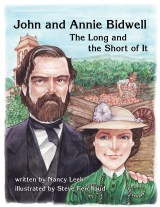
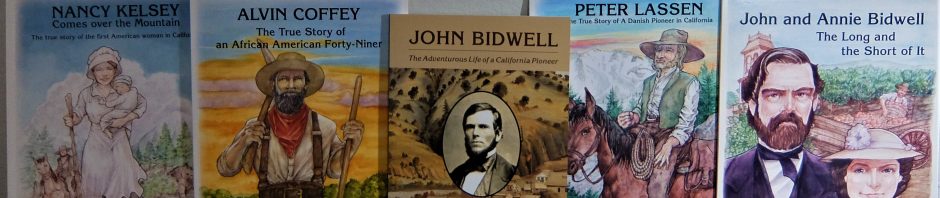
Back in November Nancy interviewed Steve Ferchaud and myself about our new picture book biography of John and Annie Bidwell, and also a bit about The Miner Poet: Poems of Pres Longley. Then when she went from a half-hour to an hour format, she brought me back in along with my daughter, Jean Leek Ping. Jean writes a blog — Howling Frog Books–about the the great variety books that she reads.

So here is a link to the podcast of the interview at mynspr.org. And here is a link to the books.

Posted in Uncategorized | Leave a comment

And They’re Off!

On May 19th the Bidwell-Bartleson Party started for California. John Bidwell, as secretary of the group, kept a journal. Later, while at Bodega Bay, he tidied up his journal entries and sent them back to a friend in Missouri, who had them printed as a guidebook. This is the source of the quotes in this and future entries.

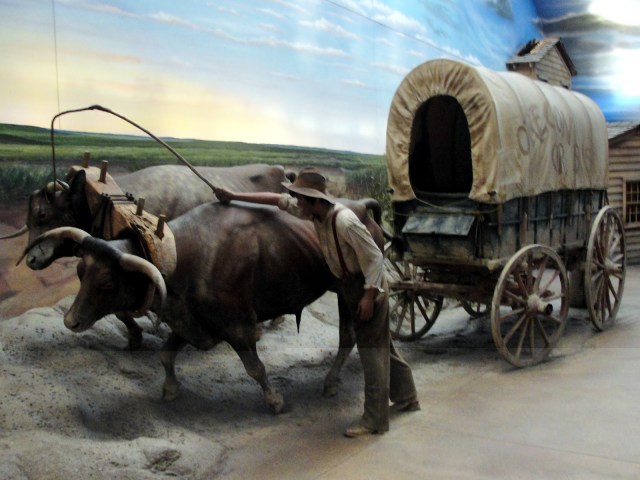
Wednesday, 19th. This morning the wagons started off in single file; first the 4 carts and 1 small wagon of the missionaries, next 8 wagons drawn by mules and horses, and lastly, 5 wagons drawn by 17 yoke of oxen. It was the calculation of the company to move on slowly till the wagon of Chiles overtook us.

Our course was west, leaving the Kanzas no great distance to our left, we traveled in the valley of the river which was prairie excepting near the margin of the stream. The day was very warm and we stopped about noon, having traveled about 12 miles. (Bidwell-Bartleson Party, ed. by Doyce B. Nunis, p. 28-29)

The missionaries were led by Father Pierre Jean De Smet, a Belgian Jesuit who spent many years working among the American Indians. In 1841 he was on his way, with two other priests and three lay brothers, to minister to the Flathead Indians. He established St. Mary’s Mission on the Bitterroot River near Missoula, Montana. Bidwell described him as follows:

He was genial, of fine presence, and one of the saintliest men I have ever known, and I cannot wonder that the Indians were made to believe him divinely protected. He was a man of great kindness and great affability under all circumstances; nothing seemed to disturb his temper.(Echoes of the Past, p. 114)

More information on Father De Smet can be found in this article from Historic St. Mary’s Mission and Museum.

Posted in Uncategorized | Leave a comment

The Journey Begins

From A Journey to California, 1841, by John Bidwell:

May, Tuesday 18th 1841. Having waited at this place (2 miles W. of Kanzas river) 2 days, and all the Company being arrived, except those heretofore mentioned, the Company was convened for the purpose of electing a Captain and adopting rules of government of the Company; when T. H. Green was chosen President–and J. Bidwell, Secretary.

After the rules were read and adopted, J. Bartleson was elected Captain; it will be understood that Fitzpatrick was Capt. of the Missionary Company and pilot of the whole. Orders were given for the company to start in the morning, and the meeting was broken up.  (Bidwell-Bartleson Party, edited by Doyce B. Nunis, p. 28)

The Bidwell-Bartleson Party (as it is usually known today) was the first group of emigrants from the United States to make a planned overland journey to California. They left Missouri with the aim of reaching California. Half the group was persuaded to take the Oregon Trail to Oregon instead (which was the safer option), but Bidwell’s group, consisting of 32 men, one woman and her baby, maintained their determination to achieve their goal.

Bidwell and his friends traveled part of the way with Father Pierre Jean de Smet’s missionary party. They were lucky to have made this connection, because Father de Smet had hired a guide, Thomas Fitzpatrick, a man with many years experience in the Far West.

Posted in Uncategorized | 2 Comments

A Chico History Weekend

This has been a weekend full of Chico history events.

John Bidwell 1850

John Bidwell in 1850

Saturday morning I gave a talk at the Chico Museum on “Early Days at Rancho Chico,” all about John Bidwell’s activities during the 1850s. I crammed as much history as I could into 60 minutes, because there was so much to talk about. It was well attended — about 60 people came.

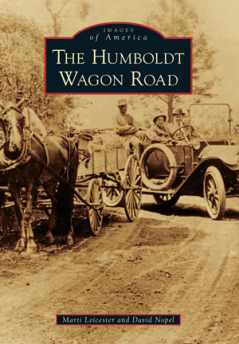
In the afternoon I took the tour, led by Dave Nopel, on “Rocks and Ruts.” We met at the Junction, where Broadway, Main, Park, 8th and 9th Streets all meet, and where the Humboldt Road begins. From there we followed the road through town, taking a jog around the freeway, and on up into the hills to see wagon ruts and rock walls. Along the way Dave, who “knows all there is to be knowed” about the Humboldt Wagon Road, told us about its humboldt roadorigin and significance. He should know — he literally wrote the book about it, along with Marti Leicester.

 

It was a beautiful day to be looking at the foothills. At several places along the old Humboldt Road the ruts can be seen, worn into the soft lava cap by the iron rims of the wagon wheels. This was a route traversed by freight wagons, lumber wagons, and stagecoaches. The road never paid off for John Bidwell the way he hoped — the railroad took the shipping business that he was planning to send by this road to the mines in Nevada and Idaho. But it became a significant route for the lumber trade and for valley residents seeking relief from the hot summers in the mountains.

DSCF0694

Wagon ruts can still be seen next to the paved Humboldt road in some places.

Butte County residents are familiar with the rock walls that can be seen along roads and in fields around Chico. These were built to fence in cattle, clear rocks out of fields, and keep cowboys busy during slow times. They are fine examples of the art of rock wall building and a part of our history. They will stand firm unless disturbed. Unfortunately, the rocks are steadily disappearing.

Folks, leave the rocks where they are! They are being stolen. A group called Respect the Walls is working to preserve this heritage by documenting and seeking protection for the walls. They have a website and a Facebook page. Please help them by not taking any more rocks.

DSCF0697

A rock wall along the Humboldt Road, about half the height it should be.

Then today (Sunday) I took a tour of downtown Chico with Randy Taylor, sponsored by the Chico Heritage Association. Another great tour, focusing on the buildings — the ones that have changed, the ones that have stayed the same, and the ones that are gone — along Main Street and Broadway.

If you like historical tours it’s not too late. There is one of the South Campus neighborhood with John Gallardo on Saturday,May 28th at 1 p.m. Find out about the Language Houses and other residences next to the Chico State campus.

Posted in Uncategorized | Leave a comment

Wagons West

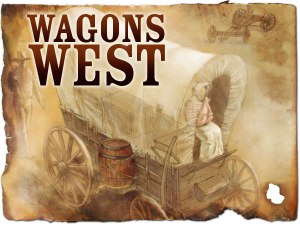
westwagons600450bThe Chico Enterprise-Record today published a full-page color feature marking the 175th anniversary of the “first organized wagon train that left Missouri for California.” I can’t find it on the E-R webpage, but you can find it at the Orange County Register site.

John Bidwell, one of the leaders of the Bidwell-Bartleson Party, helped blaze the California Trail, the overland route that would bring hundreds of thousands of migrants to the Golden State. The migration that started with one small group in 1841, would become a flood in 1849 and the early 1850s.

Although the feature states that the Bidwell-Bartleson Party left Independence, Missouri on May 9th, 1841, they did not actually get going quite that soon. John Bidwell showed up at the rendezvous at Sapling Grove, a campground near Westport (now part of Kansas City) on May 9th.  When he arrived he found only one other wagon there. Other emigrants trickled in over the next several days. On May 18th they formally organized their party, electing a president, secretary, and captain, and on May 19th they started out on the trail.

I will be posting more about the adventures of John Bidwell on the California Trail in the coming days, so stay tuned.

Posted in Bidwell-Bartleson Party, Uncategorized | 4 Comments

Ghost Town

Columbia_Flippen_Webdam-1280x642

I love reading old books about California history, tales of “The days of old, the days of old, the days of ’49.” And here is just such a book.20160510_095015-1

Ghost Town, by G. Ezra Dane, is a collection of incidents, mostly true, from  the history of Columbia. Today Columbia, “the Gem of the Southern Mines,” is a State Historic Park, with many visitors. But when Dane published these stories in 1941, it really was a “Ghost Town.”

Dane begins his tale with this caveat:

Warning to unwary readers: Here is where we tell you what not to expect from this book. Do not expect historical accuracy — this is not a history. There is some history in it; there are even whole pages of what we know to be plain, honest truth. A great deal more of it may be true; we shouldn’t be surprised if it was. Some of it we know to be absolutely false, and that is the best part of all. In another sense it is all true. It’s “genuwine.” What there is of invention in it is the natural product of three generations of story-telling in a country where that art has flourished.

Although the entire book is related as if by a single “Old-Timer” it is actually made up of stories from a number of storytellers, all of whom are given credit at the end of the book. The chapters have headings such as this one:

Wherein we learn why Life in the Diggins produced such remarkable characters; are introduced to several of them, including Nervi the Hieroglyphographer; the comparatively learned Mr.Matt Brady; George Foster, the Jovial Host & Joker; and J.B. Harmon, the Water-Walker; and are told of the Cook that was Too Good for Columbia,, or, the Black Cat in Rabbit’s Clothing.

How can you resist wanting to read more about them? and many more, including Pitch-Pine Billy and his Golden Frog, the Valiant Washer-Lady, the Battle of Hardscrabble Gulch, the Loves of Diamond Bill, and Women, Plain & Fancy. This is pure entertainment, and “mostly true.”

20160510_095101

I have another reason, besides its sheer entertainment value, for recommending this long out-of-print book. I checked it out of the Butte County Library. It is labeled copy 3, and is the only copy left in the system. Since it was rebound at some time, it doesn’t look like much. It’s the sort of book that could be carelessly discarded, but not if it has a history of frequent checkouts.

So read it and enjoy!

Posted in Columbia, Uncategorized | 2 Comments

Join Me at the Chico Museum

bidwelldayz

What was happening at Rancho Chico in the early 1850s? Who was here and what were they doing?

Find out when I interview Major John Bidwell at the Chico Museum on Saturday, May 14th. Enjoy the program at 10 a.m. and then stay to enjoy “Chico through Time,” an outstanding display all about Chico history. Your $5 admission gets you the program and museum entry.

John Bidwell is portrayed by Nick Anderson. I always enjoy working with Nick. Last month we went to Orland and talked to some 4th grade classes. This month we face a tougher audience — people who actually know something about Chico history!


Posted in Uncategorized | 1 Comment

May Garden Journal continued

DSCN3982

1853          Rio Chico

May 6:   Planted Watermelons and Cantaloupes
May 11:  Hoed Sweet Corn
Planted Lima Beans
Irishmen dug Ditch
Heavy Shower this evening
Sowed a few Marrowfat Peas
Rained all night

May 12: Rained hard this forenoon

Sund[ay] 15: Arrived Barber from the Meadows with wagon

Barber is Alexander H. Barber, Bidwell’s ranch manager at the time. He supervised various activities around the ranch, and often went on business trips to Marysville and Sacramento. Marrowfat peas are the traditional starchy green peas.

I don’t know who the Irishmen were who were digging the ditch. Bidwell had a great number of men working for him, and the roster changed all the time as the men came and went.


Posted in Gardening, Uncategorized | Leave a comment

More on The Esplanade

In 1979 Helen Sommer Gage was interviewed in an oral history project about her memories of early Chico. The interview is called Chico Changes: The Bidwells, the Park, First Street, the Esplanade, 1888 to 1979, and the interviewer was Insu Justesen. The typescript of the interview is available at Special Collections, Meriam Library, CSU Chico.

Helen Sommer Gage was born in 1888, and had grown up knowing the General and Mrs. Bidwell. As a young woman she was a friend and companion to Mrs. Bidwell, and often stayed overnight at the Mansion. Here is what she had to say about the development of The Esplanade:

IJ: How do you feel about the remaking of the Esplanade? I know that they took out a lot of trees and remade it.

HG: They didn’t remake it exactly. After General made his first visit to Washington as a member of the House, that was his first view of a real beautiful city. He was just enchanted with the tree-lined streets and the beautiful homes set back in lovely gardens. He made up his mind: if he ever had a town it would have broad streets lined with trees. And that was one reason why Chico’s streets are broader than the towns that were laid out at that time.

locust-tree3

He planted locust trees from one end of town to the other. They were very beautiful, and they were very fragrant, but of course they did scatter blossoms and all that sort of thing. It had been his project to make the Esplanade a beautiful, tree-lined street. I remember after they cut them all down, it was horrible, just a blazing mass in the summertime. And I remember Mrs. Bidwell having one of those little carriage parasols that turned sideways. Whenever her carriage was driven out when they came out of the Mansion gate she would never look towards the Esplanade. And she’d say a little prayer to herself, like that. . . . But she felt so terribly to see that beautiful tree-lined street that in the springtime was just filled with these beautiful, white blossoms. She just couldn’t look at it. And a lot of people felt that way too.

IJ: I know that this century, when those trees did finally grow, I heard that when you drove along Esplanade you were completely enclosed by the tree branches meeting overhead.

HG: You mean the old trees that were there. Yes, they were big trees. I think it’s beautiful now. I think they probably have a better type of street tree. That was all they had in those days.

esplanade postcard

Meriam Library, Special Collections

Posted in Esplanade, Uncategorized | Leave a comment

May Garden Journal

DSCN3981-001

May
Mon 2:  Transplanted Cabage
Sowed Onion Seed
rain storm     slight Shower

Tues 3:  Made Beds    drived home Mr. Bidwell
Sowed Onion Seed
Sowed Buck Wheat
Weed peas.  passed  Stage passed up

The note “drived home Mr. Bidwell” is an indication that not only is this journal not written in Bidwell’s hand, but that he wasn’t even present when some of it was written. Bidwell was frequently gone from Rancho Chico — at Marysville, Sacramento, or San Francisco — engaged in business or politics.

Posted in Gardening, Uncategorized | Leave a comment