Happy 100th, Beverly Cleary

Are you a Beverly Cleary fan? I am, and in honor of the author’s 100th birthday, I wrote a guest post on my daughter’s blog, Howling Frog Books.

Does Beverly Cleary qualify as northern California history? Of course! In the first place, anything 100 years old is history.

As for California, it’s true, she was born and raised in Oregon and her most famous stories are set on Klickitat Street in Portland. But she graduated from the University of California at Berkeley (me too!) where she met her husband (me too!)  After a stint as a children’s librarian (me too!) in Yakima, Washington, she and her husband moved to Carmel, California, where she started writing books and kept on writing for the next 49 years. (not me)

Today she lives in a retirement home in Carmel (which is northern California, if you live in San Diego) and is enjoying carrot cake for her birthday.

So read about her here, and all over the Web. And read one of her many, many books. If you don’t want to read a children’s book (why not?) then read her wonderful memoirs: A Girl from Yamhill and My Own Two Feet. Guaranteed enjoyment.

Posted in Uncategorized | Leave a comment

More from Bidwell’s Garden Journal

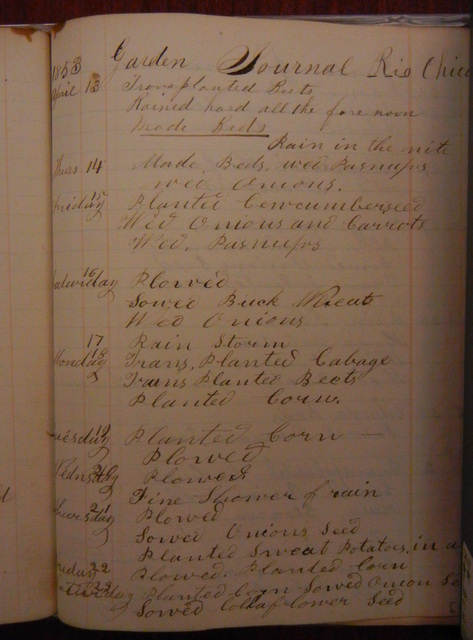
DSCN3979

1853     Garden Journal           Rio Chico

April 13:  Transplanted Beets
Rained hard all the forenoon
Made Beds
Rain in the nite

Thurs 14:  Made Beds, weed Parsnips
Weed Onions
Friday 15:  Planted Cewcumber seed
Weed Onions and Carrots
Weed Parsnips
Saturday 16:  Plowed
Sowed Buck Wheat
Weed Onions

17:  Rain Storm
Monday 18:  Transplanted Cabage
Transplanted Beets
Planted Corn
Tuesday 19:  Planted Corn
Plowed

Wednesday 20:  Plowed
Fine shower of rain
Thursday 21:  Plowed
Sowed Onions seed
Planted Sweet Potatoes

Friday 22:  Plowed, Planted Corn
Saturday 23:  Planted Corn, Sowed Onion seed
Sowed Collaflower seed

A nice look at what was growing in the vegetable garden at Rancho Chico in 1853: beets, cabbage, cauliflower, onions, cucumbers, corn, and sweet potatoes. That’s a good variety of veggies. It rained frequently too, more often than I have noticed it raining in April here nowadays.

Posted in Gardening | Leave a comment

Scurvy at Bidwell’s Bar

bidwellsbar1.jpg

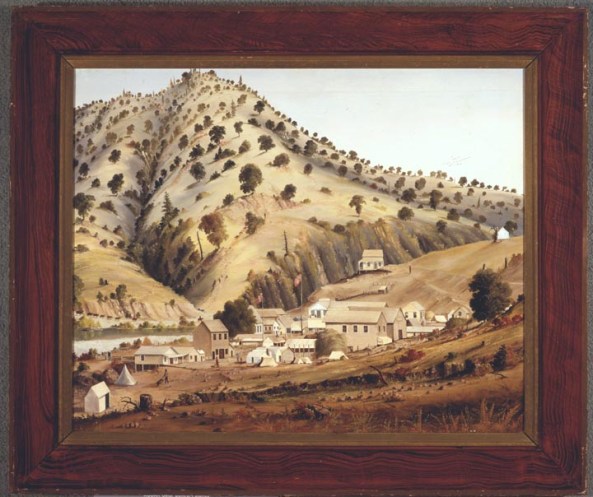
Painting of Bidwell’s Bar around 1854, painting attributed to Henry Rust Mighels. California State Library.

After Edward McIlhany got back to camp at Bidwell’s Bar at the end of that rainy November in 1849, he came down with a case of scurvy.


The doctor said it was caused from eating so much salt bacon on the Plains and getting wet that brought the disease out on me.

A diet consisting primarily of salt bacon, along with beans and biscuit, certainly would conduce to a case of scurvy. Doctors didn’t know that scurvy was caused by a deficiency of vitamin C, but they did know that a diet lacking in fruits and vegetables could bring it on.

McIlhany spent the winter months lying weakly in his tent. His companions “were making money all the time” digging gold, and they shared with Ed just as if he were working. The doctor, who charged an ounce of gold ($16) per visit, advised him to eat provisions such as “stewed dried apples, pickles, and acids” but the boys had run out of those commodities.

One pretty morning I felt better, got a stick, and I walked down the bank of the river not far from where all the stores were, and went to a stand kept by an old woman. I asked her if she had any dried apples to sell. She said no. She put her dried apples into pies to sell. I asked her the price of her pies and she told me two dollars. I stood there and ate the apples out and threw the crust away.

I then walked down to another store and looked up on the shelves and saw some bottles of pickles. They looked good so I selected a small bottle of cucumbers. They handed me the bottle. I examined it, asked them the price, they said $8.00. It was a half pint [one cup]. The pie and the half pint of pickles cost me $10.00. I returned to camp and when the boys came in from work I told them of my experience in going down to the store. They were delighted to see me out and were amused at my experience of buying fruit and pickles.

Ed McIlhany does not say any more about the scurvy or his recovery, but if he and his friends were smart, they would have gone looking for miner’s lettuce to add to their diet in the spring. It is an early and delicious green, something like spinach in texture. It certainly must have been a welcome addition to the miners’ limited diet.


Posted in Edward McIlhany, Uncategorized | Leave a comment

Butte County’s Rock Walls

ROCKS-2-jpgA post on the Facebook page “You Know You’re from Chico When . . .” alerted me to a news story on KRCR Channel 7 about the old rock walls you see along Humboldt and Cohasset Roads. Dennis Van Dyke and Debbie Meline are working to protect and preserve the walls and are asking people not to remove rocks from them. They have a Facebook page dedicated to the walls called “Respect the Walls.”  

A lot of people are curious about those walls: Who built them? Why? What are they for?

I turned to the Butte County Historical Society’s quarterly journal Diggin’s to see if it had anything. According to the online index, there have been two articles about the walls, one in the Winter 1858 issue, and one in the Winter 1974 issue. I don’t have the 1958 issue on hand, but here is the text of the brief article that appeared in 1974. It seems to have originally appeared in the Chico Enterprise-Record on July 21, 1971.

ROCK WALLS

Manuel Picanco, aged Chico resident, was one of the three Portuguese craftsmen who handled the construction of the endless miles of rock walls one the Cohasset, Humboldt, and Neal Roads nearly 60 years ago. That is the story told by Charles McClard, 134 W. Third Ave., who at one time worked on construction of the walls. They were erected by owners of two great cattle and hog ranches east of town to keep stock within the bounds of the property.

McClard said that ranch hands, during their idle months between harvest, pried the large rocks out of the ground and called them to the wall site. However, McClard said, three Portuguese craftsmen, one of whom was Picanco, handled the actual placing of the rocks. The walls were constructed with such exactness, that after over half a century no major rebuilding of the unique walls has been necessary. Constructed over a span of six years, the walls are four feet thick at the base and two and one-half across the top.

If the walls were constructed 60 years before this article appeared in 1971, then they were built in the early years of the 20th century, and are now over 100 years old. We should indeed protect them and respect them.


Posted in rock walls, Uncategorized | 2 Comments

Further Adventures of Edward McIlhany

Continuing the story of Edward McIlhany in the goldfields of Northern California:

We left the Major’s and in a few days reached Shasta, not too far from what was called the great Shasta Peak. The place was quite small and the mines were not very rich, so we did not remain long, as outlook for making money was poor. . . . We decided to return and camped at the Major’s ranch, where we told him that we were not satisfied at Shasta and had determined to go to his rich bar that he discovered.

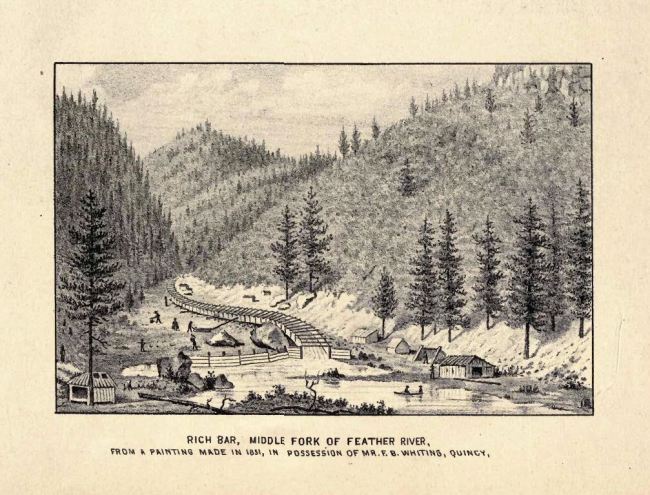
We finally struck the Feather River seventeen miles below the bar. We forded the river where afterwards very rich mines were discovered, now called Oroville. Going up the east bank of the river we finally reached the bar and made camp on the hillside, about 200 yards from the river. There were quite a number camped there, mining, mostly using rockers and washing the gold dust out with pans. The diggings were very rich and there were new pockets and discoveries of gold up and down the river for several miles. We located our mining claims and finding the mines were rich, decided to locate for the winter. By that time it was getting late in the fall.

They set up camp and were soon taking out about $150 a day in gold. Things were looking good. But prices were high at Bidwell’s Bar and the group decided to send McIlhany down to Marysville to stock up on supplies for the winter. In Marysville they filled their wagon with all the mules could pull and started back to Bidwell’s Bar.

Only fifteen miles from their camp it began to rain, and it rained every day for a solid month while they waited, sopping wet, in their tent. When at last the skies cleared they hitched up the mules and after “a few days of very hard and tiresome work” (to go only fifteen miles) they reached camp, where their friends were still taking out $150 in gold a day.

Next time: Scurvy!

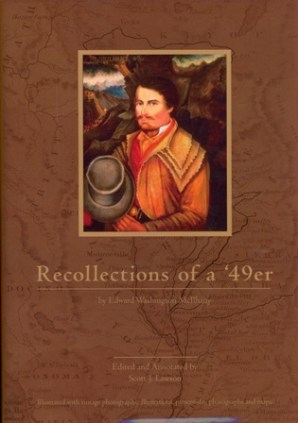
mcilhany book

(I am indebted to Scott Lawson for his fine editing of Edward W. McIlhany’s story. Recollections of a ’49er: a quaint and thrilling narrative of a trip across the Plains and life in the California gold fields during the stirring days following the discovery of gold in the Far West, edited and annotated by Scott Lawson (2006) is available at the Plumas County Museum, or at your public library.)


Posted in Edward McIlhany, Uncategorized | Leave a comment

Meeting Major Bidwell

mcilhany

Edward W. McIlhany, portrait by Thomas Moore, painted in Onion Valley 1850. Now in the Oakland Museum.

In the spring of 1849 a company of young men, eager to reach the goldfields, set out from Virginia. Almost 80 years later, one of those men, Edward Washington McIlhany, set down his Recollections of a ’49er. His book was first published in 1908, and republished in 2006 in a beautiful new edition edited by Scott Lawson. director of the Plumas County Museum.

In the fall of 1849, as Ed McIlhany and friends made their way up the valley en route to the Shasta mines, they stopped for several days at Rancho Chico. Here is his account of that stay:

We started on up the river and finally reached Major Bidwell’s Ranch, one of the finest ranches in California. We found him a very intelligent, hospitable, and a fine looking man. We remained at his ranch several days also, gaining a great deal of information. Bidwell gave us an account of his mining first in ’48 at a mining camp called Bidwell’s Bar, named after him, as he discovered the camp. It was on the Feather River that emptied into the Sacramento River.

He told us that he thought we would be disappointed in the mines, but as we had started we would not be satisfied until we got there, not being very far from his place. He advised us that if we were not satisfied there to go to Bidwell’s Bar, as it was very rich and was not worked out. Mr. Bidwell owned thousands of acres of land gotten from a Mexican grant. He had an Indian village not far from his residence built of adobe houses, trees set out in the village and ditches through the village to carry pure water from the mountains. Forty Indian men in this village worked for him in his mine by which he made a great deal of money.

John Bidwell had achieved the rank of major in the California Battalion during the Mexican War. In 1847 he settled on Little Butte Creek on a portion the Farwell Grant, and in July 1849 he bought a half-interest in Rancho Chico from his business partner George McKinstrey.

Bidwell promptly built a cabin on the north side of Chico Creek right where the Oregon Road forded the creek. This became a landmark for travelers to the Shasta mines and beyond, where they could camp out, get a meal, feed and water their stock, and learn something of California from an “old-timer” like John Bidwell.

More about McIlhany and Bidwell next time.

Posted in Edward McIlhany | 1 Comment

“Miners Would Go Miles to See It”

In 1853, John Bidwell couldn’t buy packets of seeds off a rack in store and he couldn’t order them from a seed catalog. So how did he get the seeds for his vegetable garden?

In 1851 and ’52 Bidwell had a young Bostonian named Nelson Blake working for him. Before he left home to try his luck in the goldfields, Blake had worked for his uncle raising vegetables for the Boston market, so he was well-acquainted with farming.

Nelson Blake wrote back East for seeds and they arrived in February 1852. Many years later he told his biographer:

The planting of these fresh, high grade seeds produced such a garden in the summer of 1852 that miners would go miles to see it.

And in a letter from Blake to Bidwell in 1884 he recalled:

The Summer following [the winter of 1851-52] was the one that we had the fine garden, when we raised the peach trees, and the immense crops of all kinds of vegetables.

The seeds would have come from open-pollinated varieties, what we would consider

seed packet

A vintage seed packet –much later than the seeds Bidwell planted in 1852 — but a cute picture.

“heritage” varieties today.

Even after he returned to Boston, Blake continued taking an interest in farming at Rancho Chico, and he sent more seeds for the vegetable garden. In a letter dated July 17, 1853 he writes:

Enclosed in this I will send you some Rhubarb seed, of the kind called Imperial, Royal Superbiferous Giant. It is very large without exaggeration, the stalks of the plant that this seed came from were some of them two inches in width and as large very other way, proportionally. I think Rhubarb must be a splendid thing for you there, where there are no Apples raised, for it is an excellent material for Pies, Puddings and Sauces.

Don’t you wish you could get seeds to grow “Imperial, Royal Superbiferous Giant Rhubarb” today? Sounds fantastic. I can find no trace of it however.

In another letter dated April 11, 1954 Blake says:

If I can I will put in some Water-melon seeds before I close this up. They are a long, striped melon, they grew with us very large I sold one man in F.H. M’k’t twenty last Summer. He said they were the handsomest lot he ever saw together.

So that’s how vegetable gardening got started on Rancho Chico.

Posted in Gardening, Uncategorized | Leave a comment

Bidwell’s Garden Journal 1853

DSCN3978

It’s April 1st, time to start planting your vegetable garden, just like Bidwell did back in the day.  In 1853 Bidwell recorded a Garden Journal in the back of his store ledger. Here’s what was happening day by day in the garden at Rancho Chico in April 1853:

Fri 1:  Sowed Beets
Sat 2:  ditto  ditto
Mon 4:  Planted Irish Potatoes
Tues 5:  Hoed Peas and Grapevines
Wed 6:  Made Beds (vegetable beds, that is)
Thurs 7:  Transplanted Lettuce
Fri 8:  Made Beds
Sat. 9:  Hoed out Seed Onions
Mon 11:  Planted Watermelons
Planted Corn
Tues 12:  Transplanted Cabbages
Plowed and made 2 Beds
Sowed Cabbage & Cauliflower Seed
Wind from the South

Keep in mind that Bidwell was not doing all this work himself. He had a number of men and women working for him: Americans, Mexicans, and Indians. In addition to these vegetables, he was growing grains and livestock. I wish we had more of his journals from the 1850s!

Posted in Uncategorized | Leave a comment

Sewing Project Done

I have a new respect for the seamstresses and tailors of yore. What a lot of work went into a shirt or a waistcoat! And a full three-piece suit — let’s not even go there.

The patterns I used contained complete instructions for sewing the garments by hand, for the true and authentic 19th century experience. I am not that dedicated and did most of the work on my trusty Bernina sewing machine. Even so, there was a fair amount of hand-stitching to be done, especially on the shirt. And 19th century men’s shirts were voluminous — longer and fuller than men’s shirts today.

And yet in 1850 a man could buy a shirt for less than a dollar. Unless he was mining in California. In 1849 at Bidwell’s Bar and other mining camps a shirt sold for $8. Men were astonished at the prices.

On Thursday I am doing a school presentation, and I am taking “John Bidwell” with me to talk to the kids. Here is a picture of Nick Anderson in his new Bidwell outfit. All he needs is DSCF0466a cravat, and his costume will be complete.


Posted in Uncategorized | 1 Comment

Blogging or Sewing?

I feel like I ought to be writing more blog posts. I have some topics I’d like to research and write about. But instead I have been sewing.

bidwell2013 002I have a friend named Nick Anderson who portrays John Bidwell at events put on by the Bidwell Mansion Association. He and I are going to take our show on the road next week and visit a couple of 4th grade classes at Fairview School in Orland during the school’s Community Read-In. I’ve gone and talked about John Bidwell before, but I never actually brought him with me. I think it will be great fun!


DSCF0461At Mansion events Nick wears a fabulous 19th Century frock coat. But I didn’t want to ask to borrow that from State Parks. So I decided to make a vest, using this pattern from Past Patterns. And here it is — I finished it last night. Let’s just hope it fits.

Next I want to make a shirt. Here’s the pattern for that. And now I am going to get off the computer and go cut out some fabric.

Posted in Uncategorized | Leave a comment